Tachyonic dark energy- Constraints from current observations
Pith reviewed 2026-05-16 23:36 UTC · model grok-4.3
The pith
Fits to Pantheon+ and DESI data show tachyon dark energy with exponential potential produces a future turnaround in the equation of state.
A machine-rendered reading of the paper's core claim, the machinery that carries it, and where it could break.
Core claim
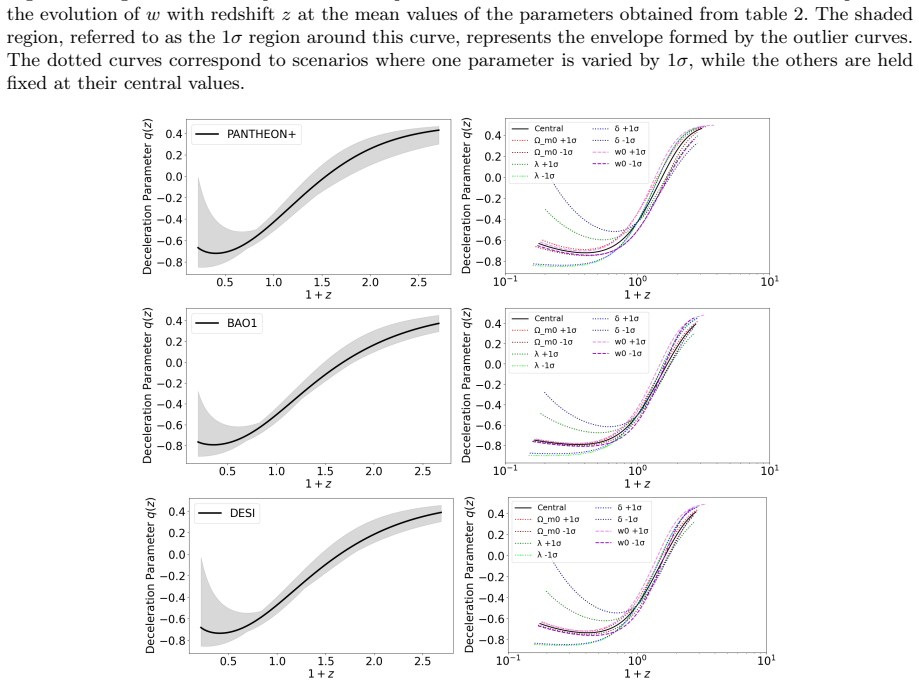
In the tachyon dark energy model with exponential potential, parameter estimation using Pantheon+ and DESI BAO datasets reveals a turnaround in the equation of state parameter in the future, regardless of whether the present-day value w_φ0 is free or set to -1. When w_φ0 is free, the deceleration parameter also turns around, while in the reference model it approaches -1 asymptotically. Model comparison indicates Pantheon+ favors the free w_φ0 case, whereas BAO prefers w_φ0 = -1.
What carries the argument
Tachyon scalar field with exponential potential, whose equation of state evolves from the ratio of kinetic energy to potential and is constrained by present-day value w_φ0.
Load-bearing premise
The assumption that an exponential potential is the correct functional form for the tachyon field and that current data can reliably constrain its future evolution.
What would settle it
Future low-redshift measurements of the deceleration parameter showing no peak and continued approach toward -1 without reversal.
Figures



read the original abstract
Recent observations from the DESI survey have reignited the debate on the true nature of dark energy, challenging the standard model of cosmology. The results suggest a preference for dynamical dark energy rather than a constant. Several recent analyses of DESI data indicate that the universe's expansion may not be accelerating in the way suggested by supernova based cosmology. Motivated by these studies, we investigated a tachyon type scalar field $\phi$ as a model for dark energy, assuming an exponential potential for the field and performed parameter estimation using MCMC techniques. Such a model offers solutions that have $w\sim-1$ and are decelerating without requiring a phantom like equation of state (EoS). The present day value of EoS parameter is treated as a free parameter. However, for the reference model, we fix its present value to $-1$. The analysis is carried out using Pantheon+ and BAO measurements from DESI. The results show that both types of datasets consistently predict a turnaround in the EoS, regardless of whether $w_{\phi0}$ is treated as a free parameter or fixed to $-1$. The corresponding deceleration parameter also exhibits a future turnaround for both datasets when $w_{\phi0}$ is free. However, in the reference model with $w_{\phi0}=-1$, the deceleration parameter instead approaches $-1$ asymptotically. A model comparison shows that the Pantheon+ dataset favors free $w_{\phi0}$, while BAO observations prefer $w_{\phi0} = -1$. This indicates a disagreement in the future evolution predicted by the two datasets within the tachyon dark energy model.
Editorial analysis
A structured set of objections, weighed in public.
Referee Report
Summary. The manuscript analyzes a tachyon scalar field dark energy model with an exponential potential V(φ) ∝ exp(−λφ), treating the present-day equation-of-state w_φ0 as either free or fixed to −1. MCMC fits are performed to Pantheon+ supernovae and DESI BAO data; the results indicate that both datasets predict a future turnaround in w_φ, with an accompanying turnaround in the deceleration parameter q when w_φ0 is free. Model comparison shows Pantheon+ favoring the free-w_φ0 case while BAO prefers w_φ0 = −1.
Significance. If the posterior on the slope λ is data-driven and the turnaround survives marginalization, the work would supply a concrete, falsifiable prediction for late-time evolution within this specific model class and flag a dataset tension between supernovae and BAO. The application of standard MCMC techniques to recent DESI data is a modest strength, but the result remains tightly tied to the assumed functional form and therefore has limited impact beyond that model.
major comments (3)
- [Results] The abstract and results section report a consistent EoS turnaround for both datasets, yet no 1σ uncertainty bands on w(a) or q(a) for a > 1 are shown and the posterior width on λ is not quantified. Without these, it cannot be verified whether the turnaround is robust or an artifact of the chosen exponential form and best-fit parameters.
- [Methodology] The MCMC implementation is described only at the level of 'parameter estimation using MCMC techniques'; priors on λ, Ω_φ, w_φ0, convergence diagnostics (e.g., Gelman-Rubin), and the numerical integration of the tachyon field equations are not provided. These details are load-bearing for any claim that current data meaningfully constrain future evolution.
- [Model comparison] The model-comparison statement that Pantheon+ favors free w_φ0 while BAO prefers w_φ0 = −1 is presented without a quantitative tension metric (e.g., Δχ² or posterior overlap) or discussion of whether the exponential potential itself is adequate for both datasets.
minor comments (2)
- The precise definition of 'turnaround' (location where dw_φ/da = 0 or dq/da = 0) should be stated explicitly with the corresponding scale-factor value for each dataset.
- The exact functional form of the potential and the Friedmann and Klein-Gordon equations used in the numerical solver should be written out to allow reproducibility.
Simulated Author's Rebuttal
We thank the referee for the detailed and constructive report. We have revised the manuscript to incorporate uncertainty bands, full MCMC specifications, and quantitative model-comparison metrics. These changes directly address the concerns and strengthen the presentation of the predicted turnaround in w(a) and q(a).
read point-by-point responses
-
Referee: The abstract and results section report a consistent EoS turnaround for both datasets, yet no 1σ uncertainty bands on w(a) or q(a) for a > 1 are shown and the posterior width on λ is not quantified. Without these, it cannot be verified whether the turnaround is robust or an artifact of the chosen exponential form and best-fit parameters.
Authors: We agree that the absence of uncertainty bands prevents a full assessment of robustness. In the revised manuscript we now display 1σ and 2σ bands on both w(a) and q(a) for a > 1, constructed from the full MCMC posterior samples. We also report the posterior mean and 68 % credible interval for λ (e.g., λ = 0.72^{+0.18}_{-0.15} for Pantheon+ with free w_φ0). The turnaround remains within the 1σ contour for both datasets, confirming it is not an artifact of the best-fit point alone. revision: yes
-
Referee: The MCMC implementation is described only at the level of 'parameter estimation using MCMC techniques'; priors on λ, Ω_φ, w_φ0, convergence diagnostics (e.g., Gelman-Rubin), and the numerical integration of the tachyon field equations are not provided. These details are load-bearing for any claim that current data meaningfully constrain future evolution.
Authors: We have added a dedicated subsection detailing the MCMC setup. Flat priors are specified as λ ∈ [0, 3], Ω_φ ∈ [0.6, 0.9], and w_φ0 ∈ [-1.5, -0.3] (or fixed at -1). Convergence is monitored with the Gelman-Rubin statistic R̂ < 1.01 for all parameters after 4 × 10^4 steps per chain. The tachyon equations are integrated with a fourth-order Runge-Kutta scheme and adaptive step-size control to ensure accuracy beyond a = 1. These additions make the future-evolution claims reproducible. revision: yes
-
Referee: The model-comparison statement that Pantheon+ favors free w_φ0 while BAO prefers w_φ0 = −1 is presented without a quantitative tension metric (e.g., Δχ² or posterior overlap) or discussion of whether the exponential potential itself is adequate for both datasets.
Authors: We now quantify the preference via Δχ²_min = 4.1 (Pantheon+) and Δχ²_min = 2.7 (DESI BAO) between the free-w_φ0 and fixed-w_φ0 = -1 runs. Posterior overlap on λ and Ω_φ is illustrated with a joint contour plot. The exponential potential yields reduced χ² ≈ 0.98 for Pantheon+ and ≈ 1.05 for BAO, indicating adequate fits; we briefly note that alternative potentials could be explored in future work but lie outside the present scope. revision: yes
Circularity Check
EoS turnaround is output of MCMC fit to exponential potential parameters, not independent prediction
specific steps
-
fitted input called prediction
[Abstract]
"The results show that both types of datasets consistently predict a turnaround in the EoS, regardless of whether w_φ0 is treated as a free parameter or fixed to −1. The corresponding deceleration parameter also exhibits a future turnaround for both datasets when w_φ0 is free."
The turnaround is obtained by numerically integrating the tachyon equations of motion forward in time using the best-fit or posterior values of λ and w_φ0 that were determined by the MCMC fit to the same current data. Once the functional form and the fitted parameters are fixed, the future minimum in w_φ(a) is fixed by construction; it is not an additional prediction but the direct extrapolation of the fitted model.
full rationale
The paper assumes V(φ) ∝ exp(−λφ) for the tachyon, fits λ, w_φ0, Ω_φ etc. via MCMC to Pantheon+ and DESI BAO, then evolves the model to a>1 and reports a turnaround in w_φ(a) and q(a). This feature is generated directly by the differential equations once the posterior on λ (which controls the rolling rate) is fixed by the fit; the abstract presents it as a 'prediction' from the data, but no separate derivation or robustness check against other potentials is supplied. The central claim therefore reduces to the chosen ansatz plus the fitted values rather than an independent result.
Axiom & Free-Parameter Ledger
free parameters (1)
- w_φ0 =
free or -1
axioms (1)
- domain assumption Tachyon scalar field with exponential potential models dark energy
Reference graph
Works this paper leans on
-
[1]
P. J. E. Peebles and B. Ratra,The cosmological constant and dark energy,Reviews of modern physics 75(2003) 559
work page 2003
-
[2]
L. Amendola and S. Tsujikawa,Dark energy: theory and observations. Cambridge University Press, 2010
work page 2010
- [3]
-
[4]
E. Di Valentino, J. L. Said and T. C. Network,The cosmoverse white paper: Addressing observational tensions in cosmology with systematics and fundamental physics,Physics of the Dark Universe(2025) 101965
work page 2025
-
[5]
A. De Felice and S. Tsujikawa,f (r) theories,Living Reviews in Relativity13(2010) 1
work page 2010
-
[6]
T. P. Sotiriou and V. Faraoni,f (r) theories of gravity,Reviews of Modern Physics82(2010) 451
work page 2010
- [7]
-
[8]
S. Nojiri and S. D. Odintsov,Unified cosmic history in modified gravity: from f (r) theory to lorentz non-invariant models,Physics Reports505(2011) 59
work page 2011
-
[9]
R. Sanders,Cosmology with modified newtonian dynamics (mond),Monthly Notices of the Royal Astronomical Society296(1998) 1009
work page 1998
-
[10]
J. D. Bekenstein,Relativistic gravitation theory for the modified newtonian dynamics paradigm, Physical Review D—Particles, Fields, Gravitation, and Cosmology70(2004) 083509. 10
work page 2004
-
[11]
S. Das, A. Nasiri and Y. K. Yazdi,Aspects of everpresentλ. part ii. cosmological tests of current models,Journal of Cosmology and Astroparticle Physics2024(2024) 076
work page 2024
- [12]
-
[13]
M. Chevallier and D. Polarski,Accelerating universes with scaling dark matter,International Journal of Modern Physics D10(2001) 213
work page 2001
-
[14]
Linder,Probing dark energy with snap, inThe Identification Of Dark Matter, pp
E. Linder,Probing dark energy with snap, inThe Identification Of Dark Matter, pp. 52–57. World Scientific, 2003
work page 2003
-
[15]
E. V. Linder,Exploring the expansion history of the universe,Physical review letters90(2003) 091301
work page 2003
- [16]
-
[17]
H. K. Jassal, J. Bagla and T. Padmanabhan,Observational constraints on low redshift evolution of dark energy: How consistent are different observations?,Physical Review D72(2005) 103503
work page 2005
-
[18]
G. Efstathiou,Constraining the equation of state of the universe from distant type ia supernovae and cosmic microwave background anisotropies,Monthly Notices of the Royal Astronomical Society310 (1999) 842
work page 1999
-
[19]
L. Feng and T. Lu,A new equation of state for dark energy model,Journal of Cosmology and Astroparticle Physics2011(2011) 034
work page 2011
-
[20]
G. Aldering, C. W. Akerlof, R. Amanullah, P. Astier, E. Barrelet, C. Bebek et al.,Overview of the supernova/acceleration probe (snap), inFuture Research Direction and Visions for Astronomy, vol. 4835, pp. 146–157, SPIE, 2002
work page 2002
- [21]
- [22]
-
[23]
T. Barreiro, E. J. Copeland and N. a. Nunes,Quintessence arising from exponential potentials, Physical Review D61(2000) 127301
work page 2000
-
[24]
S. Tsujikawa,Reconstruction of general scalar-field dark energy models,Physical Review D—Particles, Fields, Gravitation, and Cosmology72(2005) 083512
work page 2005
-
[25]
H. Jassal,Comparison of perturbations in fluid and scalar field models of dark energy,Physical Review D—Particles, Fields, Gravitation, and Cosmology79(2009) 127301
work page 2009
- [26]
-
[27]
B. Novosyadlyj, O. Sergijenko, R. Durrer and V. Pelykh,Do the cosmological observational data prefer phantom dark energy?,Physical Review D—Particles, Fields, Gravitation, and Cosmology86(2012) 083008
work page 2012
-
[28]
B. Novosyadlyj, O. Sergijenko, R. Durrer and V. Pelykh,Quintessence versus phantom dark energy: the arbitrating power of current and future observations,Journal of Cosmology and Astroparticle Physics2013(2013) 042
work page 2013
-
[29]
P. A. Ade, N. Aghanim, M. Arnaud, M. Ashdown, J. Aumont, C. Baccigalupi et al.,Planck 2015 results-xiii. cosmological parameters,Astronomy & Astrophysics594(2016) A13
work page 2015
- [30]
- [31]
- [32]
-
[33]
E. J. Copeland, M. R. Garousi, M. Sami and S. Tsujikawa,What is needed of a tachyon if it is to be the dark energy?,Physical Review D—Particles, Fields, Gravitation, and Cosmology71(2005) 043003
work page 2005
-
[34]
G. Calcagni and A. R. Liddle,Tachyon dark energy models: Dynamics and constraints,Physical Review D—Particles, Fields, Gravitation, and Cosmology74(2006) 043528
work page 2006
-
[35]
M. P. Rajvanshi and J. Bagla,Reconstruction of dynamical dark energy potentials: Quintessence, tachyon and interacting models,Journal of Astrophysics and Astronomy40(2019) 1
work page 2019
-
[36]
D. Wang,Questioning cosmic acceleration with desi: The big stall of the universe,arXiv preprint arXiv:2504.15635(2025)
-
[37]
M. Van Raamsdonk and C. Waddell,Suggestions of decreasing dark energy from supernova and bao data: an update,arXiv preprint arXiv:2505.10662(2025)
-
[38]
E. Camphuis, W. Quan, L. Balkenhol, A. Khalife, F. Ge, F. Guidi et al.,Spt-3g d1: Cmb temperature and polarization power spectra and cosmology from 2019 and 2020 observations of the spt-3g main field,arXiv preprint arXiv:2506.20707(2025) . 11
work page internal anchor Pith review Pith/arXiv arXiv 2019
- [39]
-
[40]
E. Di Valentino, A. Mukherjee and A. A. Sen,Dark energy with phantom crossing and the h0 tension, Entropy23(2021) 404
work page 2021
-
[41]
S. Dahmani, A. Bouali, I. El Bojaddaini, A. Errahmani and T. Ouali,Smoothing the h0 tension with a phantom dynamical dark energy model,Physics of the Dark Universe42(2023) 101266
work page 2023
-
[42]
T. Padmanabhan,Accelerated expansion of the universe driven by tachyonic matter,Physical Review D66(2002) 021301
work page 2002
-
[43]
M. A. Karim, J. Aguilar, S. Ahlen, S. Alam, L. Allen, C. Allende Prieto et al.,Desi dr2 results ii: Measurements of baryon acoustic oscillations and cosmological constraints,arXiv e-prints(2025) arXiv
work page 2025
-
[44]
D. Scolnic, D. Brout, A. Carr, A. G. Riess, T. M. Davis, A. Dwomoh et al.,The pantheon+ analysis: the full data set and light-curve release,The Astrophysical Journal938(2022) 113
work page 2022
-
[45]
G. C. Carvalho, A. Bernui, M. Benetti, J. C. Carvalho and J. S. Alcaniz,Baryon acoustic oscillations from the sdss dr10 galaxies angular correlation function,Phys. Rev. D93(2016) 023530
work page 2016
-
[46]
E. de Carvalho, A. Bernui, G. Carvalho, C. Novaes and H. Xavier,Angular baryon acoustic oscillation measure atz=2.225 from the sdss quasar survey,Journal of Cosmology and Astroparticle Physics2018 (2018) 064–064
work page 2018
-
[47]
E. de Carvalho, A. Bernui, H. S. Xavier and C. P. Novaes,Baryon acoustic oscillations signature in the three-point angular correlation function from the sdss-dr12 quasar survey,Monthly Notices of the Royal Astronomical Society492(2020) 4469 [https://academic.oup.com/mnras/article-pdf/492/3/4469/32302539/staa119.pdf]
work page 2020
-
[48]
J. S. Alcaniz, G. C. Carvalho, A. Bernui, J. C. Carvalho and M. Benetti,Measuring baryon acoustic oscillations with angular two-point correlation function,Fundam. Theor. Phys.187(2017) 11 [1611.08458]
work page internal anchor Pith review Pith/arXiv arXiv 2017
- [49]
-
[50]
The 6dF Galaxy Survey: Baryon Acoustic Oscillations and the Local Hubble Constant
F. Beutler, C. Blake, M. Colless, D. H. Jones, L. Staveley-Smith, L. Campbell et al.,The 6dF Galaxy Survey: baryon acoustic oscillations and the local Hubble constant,Mon. Not. Roy. Astron. Soc.416 (2011) 3017 [1106.3366]
work page internal anchor Pith review Pith/arXiv arXiv 2011
-
[51]
S. Alam, M. Aubert, S. Avila, C. Balland, J. E. Bautista, M. A. Bershady et al.,Completed sdss-iv extended baryon oscillation spectroscopic survey: Cosmological implications from two decades of spectroscopic surveys at the apache point observatory,Phys. Rev. D103(2021) 083533
work page 2021
-
[52]
A. J. Ross, L. Samushia, C. Howlett, W. J. Percival, A. Burden and M. Manera,The clustering of the sdss dr7 main galaxy sample – i. a 4 per cent distance measure at z = 0.15,Monthly Notices of the Royal Astronomical Society449(2015) 835 [https://academic.oup.com/mnras/article-pdf/449/1/835/13767551/stv154.pdf]
work page 2015
-
[53]
H. du Mas des Bourboux, J. Rich, A. Font-Ribera, V. de Sainte Agathe, J. Farr, T. Etourneau et al., The Completed SDSS-IV Extended Baryon Oscillation Spectroscopic Survey: Baryon Acoustic Oscillations with LyαForests,Astrophys. J.901(2020) 153 [2007.08995]
-
[54]
N. Aghanim, Y. Akrami, M. Ashdown, J. Aumont, C. Baccigalupi, M. Ballardini et al.,Planck2018 results: Vi. cosmological parameters,Astronomy & Astrophysics641(2020) A6
work page 2020
-
[55]
A. G. Riess, W. Yuan, L. M. Macri, D. Scolnic, D. Brout, S. Casertano et al.,A comprehensive measurement of the local value of the hubble constant with 1 km s- 1 mpc- 1 uncertainty from the hubble space telescope and the sh0es team,The Astrophysical journal letters934(2022) L7
work page 2022
discussion (0)
Sign in with ORCID, Apple, or X to comment. Anyone can read and Pith papers without signing in.