Metric-driven numerical methods
Pith reviewed 2026-05-16 22:49 UTC · model grok-4.3
The pith
Choosing a Sobolev metric for Riemannian gradients in multiscale PDE solvers induces approximation spaces that recover Localized Orthogonal Decomposition.
A machine-rendered reading of the paper's core claim, the machinery that carries it, and where it could break.
Core claim
Representing the gradient of a functional or eigenvalue problem in a chosen Sobolev metric within a Riemannian optimization loop produces both a specific iterative scheme and an associated finite-element space whose approximation quality is enhanced precisely in regimes where standard spaces fail; when the metric is chosen to localize the correction, the resulting space coincides with the Localized Orthogonal Decomposition space.
What carries the argument
Sobolev metric used to define the Riemannian gradient, which simultaneously steers the iteration and generates the trial space for the next correction step.
If this is right
- The metric choice directly controls both convergence rate and the quality of the discrete space without separate homogenization analysis.
- Localized Orthogonal Decomposition spaces arise as the natural outcome of a particular metric selection rather than from an independent construction.
- The same Riemannian-gradient procedure extends without change to nonlinear eigenvalue problems such as the spin-orbit-coupled Gross-Pitaevskii equation.
- Convergence acceleration and space enrichment are obtained from a single mechanism rather than from two separate algorithmic layers.
Where Pith is reading between the lines
- Metric selection could be made adaptive by monitoring local residual features during the iteration, potentially removing the need for a priori knowledge of the oscillation scale.
- The perspective may unify other variational multiscale methods that currently appear unrelated because they start from different variational principles.
- If the metric can be chosen from solution-dependent quantities, the approach might extend to time-dependent or fully nonlinear problems where the optimal metric evolves.
Load-bearing premise
An arbitrary or heuristically selected Sobolev metric will automatically produce approximation spaces with improved accuracy in low-regularity or multiscale settings.
What would settle it
A concrete multiscale test problem (for example the standard LOD benchmark with a highly oscillatory coefficient) where the space induced by a simple diagonal Sobolev metric shows no better L2 or H1 error decay than plain linear finite elements.
Figures


read the original abstract
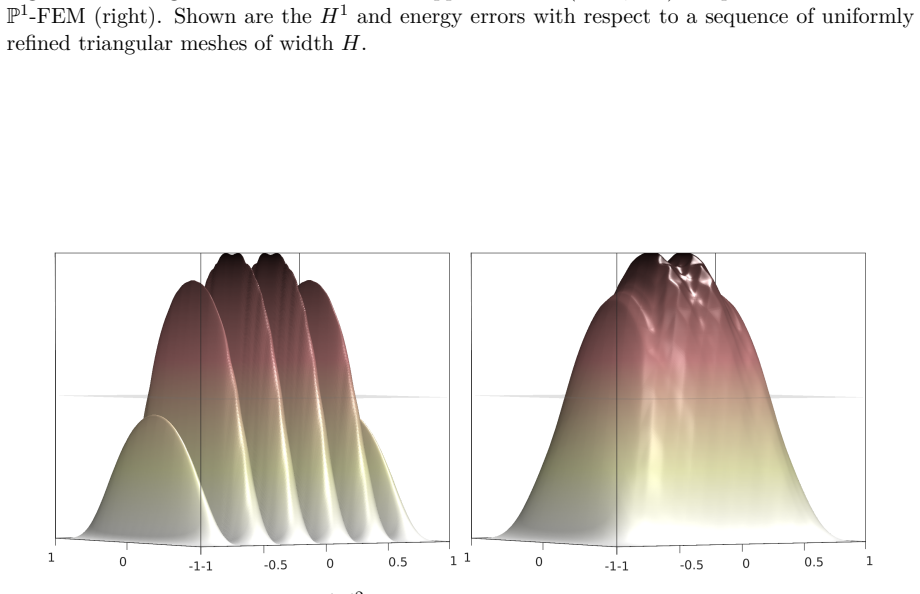
In this paper, we explore the concept of metric-driven numerical methods as a powerful tool for solving various types of multiscale partial differential equations. Our focus is on computing constrained minimizers of functionals - or, equivalently, by considering the associated Euler-Lagrange equations - the solution of a class of eigenvalue problems that may involve nonlinearities in the eigenfunctions. We introduce metric-driven methods for such problems via Riemannian gradient techniques, leveraging the idea that gradients can be represented in different metrics (so-called Sobolev gradients) to accelerate convergence. We show that the choice of metric not only leads to specific metric-driven iterative schemes, but also induces approximation spaces with enhanced properties, particularly in low-regularity regimes or when the solution exhibits heterogeneous multiscale features. In fact, we recover a well-known class of multiscale spaces based on the Localized Orthogonal Decomposition (LOD), now derived from a new perspective. Alongside a discussion of the metric-driven approach for a model problem, we also demonstrate its application to simulating the ground states of spin-orbit-coupled Bose-Einstein condensates.
Editorial analysis
A structured set of objections, weighed in public.
Referee Report
Summary. The paper introduces metric-driven numerical methods for multiscale PDEs and nonlinear eigenvalue problems, using Riemannian gradient flows in Sobolev metrics to compute constrained minimizers. It claims that suitable metric choices induce finite-dimensional approximation spaces that recover the Localized Orthogonal Decomposition (LOD) spaces from a new perspective, and demonstrates the framework on a model problem plus ground-state computations for spin-orbit-coupled Bose-Einstein condensates.
Significance. If the metric-induced spaces are shown to coincide exactly with standard LOD without hidden assumptions, the work would provide a unifying variational perspective linking iterative gradient methods to multiscale finite-element constructions, potentially simplifying the design of approximation spaces in low-regularity regimes. The BEC application illustrates practical utility, but the overall significance hinges on whether the recovery is rigorous and accompanied by error analysis or numerical validation.
major comments (2)
- [metric-driven iteration and LOD recovery section] The central LOD-recovery claim (stated in the abstract and developed in the metric-driven iteration section) requires an explicit proof that the minimizers under the chosen Sobolev metric satisfy the same localized orthogonality and corrector equations as classical LOD; without this equivalence, the enhanced approximation properties in multiscale regimes are not automatically inherited and need separate a-priori estimates.
- [model problem and numerical results] The abstract and model-problem discussion provide no derivation steps, error bounds, or numerical verification that the metric-induced spaces achieve the same convergence rates as LOD; the weakest link is the step from an arbitrary Sobolev metric to the specific LOD properties, which appears heuristic rather than rigorous.
minor comments (2)
- [introduction and preliminaries] Notation for the Riemannian gradient and the specific Sobolev metric should be introduced with an explicit formula (e.g., inner-product definition) early in the paper to avoid ambiguity when comparing to standard LOD.
- [Bose-Einstein condensate application] The BEC application section would benefit from a brief comparison table of iteration counts or energy errors against standard LOD or other multiscale methods to quantify the claimed acceleration.
Simulated Author's Rebuttal
We thank the referee for the careful reading and constructive suggestions. We address the two major comments point by point below and will revise the manuscript to incorporate explicit proofs, derivations, and supporting analysis.
read point-by-point responses
-
Referee: The central LOD-recovery claim (stated in the abstract and developed in the metric-driven iteration section) requires an explicit proof that the minimizers under the chosen Sobolev metric satisfy the same localized orthogonality and corrector equations as classical LOD; without this equivalence, the enhanced approximation properties in multiscale regimes are not automatically inherited and need separate a-priori estimates.
Authors: We agree that an explicit equivalence proof is necessary to make the recovery rigorous. In the revised manuscript we will insert a new theorem in the metric-driven iteration section that directly shows the constrained minimizers under the chosen Sobolev metric satisfy the identical localized orthogonality conditions and corrector equations as classical LOD. With this equivalence established, the approximation properties follow from the existing LOD theory; we will also add a short paragraph referencing the relevant a-priori estimates. revision: yes
-
Referee: The abstract and model-problem discussion provide no derivation steps, error bounds, or numerical verification that the metric-induced spaces achieve the same convergence rates as LOD; the weakest link is the step from an arbitrary Sobolev metric to the specific LOD properties, which appears heuristic rather than rigorous.
Authors: We acknowledge that the current exposition of the model problem is too concise. We will expand the section with step-by-step derivations that start from the general Sobolev metric and arrive at the LOD corrector equations, include explicit a-priori error bounds that recover the standard LOD convergence rates, and add numerical experiments on the model problem that confirm these rates. These additions will replace the current heuristic presentation with a fully rigorous argument. revision: yes
Circularity Check
Metric-driven derivation of LOD spaces is self-contained with no circular reduction
full rationale
The paper derives multiscale approximation spaces from the choice of a Sobolev metric via Riemannian gradient flow on constrained minimization problems. This construction is presented as inducing the LOD spaces as a consequence rather than by presupposing them; the abstract frames the recovery explicitly as a new perspective obtained from the metric, without reducing the target spaces to a fitted parameter or a prior self-citation that is itself unverified. No equation or step in the described chain equates the output spaces to the input metric by construction, and the approach remains externally falsifiable through standard a-priori error analysis for the resulting spaces. The derivation therefore stands independently of any self-citation load.
Axiom & Free-Parameter Ledger
axioms (2)
- domain assumption Gradients of the energy functional can be represented in different Sobolev metrics to produce equivalent but numerically distinct descent directions.
- domain assumption The choice of metric induces approximation spaces with enhanced properties for multiscale or low-regularity solutions.
Lean theorems connected to this paper
-
IndisputableMonolith/Foundation/AlphaCoordinateFixation.leanJ_uniquely_calibrated_via_higher_derivative echoes?
echoesECHOES: this paper passage has the same mathematical shape or conceptual pattern as the Recognition theorem, but is not a direct formal dependency.
the choice of metric... induces approximation spaces with enhanced properties... (Aru,rv) + (Vu,v) defines the X-metric
What do these tags mean?
- matches
- The paper's claim is directly supported by a theorem in the formal canon.
- supports
- The theorem supports part of the paper's argument, but the paper may add assumptions or extra steps.
- extends
- The paper goes beyond the formal theorem; the theorem is a base layer rather than the whole result.
- uses
- The paper appears to rely on the theorem as machinery.
- contradicts
- The paper's claim conflicts with a theorem or certificate in the canon.
- unclear
- Pith found a possible connection, but the passage is too broad, indirect, or ambiguous to say the theorem truly supports the claim.
Reference graph
Works this paper leans on
-
[1]
A. Abdulle, W. E, B. Engquist, and E. Vanden-Eijnden. The heterogeneous multiscale method. Acta Numer. , 21:1–87, 2012
work page 2012
- [2]
-
[3]
R. Altmann, P. Henning, and D. Peterseim. Numerical homogenization beyond scale sep- aration. Acta Numer. , 30:1–86, 2021
work page 2021
-
[4]
R. Altmann, M. Hermann, D. Peterseim, and T. Stykel. Riemannian optimization methods for ground states of multicomponent Bose–Einstein condensates. IMA Journal of Numerical Analysis, page draf046, 06 2025
work page 2025
-
[5]
R. Altmann, D. Peterseim, and T. Stykel. Energy-adaptive Riemannian optimization on the Stiefel manifold. ESAIM Math. Model. Numer. Anal. , 56(5):1629–1653, 2022. 28 10−1.8 10−1.6 10−1.4 10−1.2 10−1 10−0.810−5 10−4 10−3 10−2 10−1 100 101 H diam(Ω) (log) H 1(Ω) error energy error H 7! cH 3 H 7! cH 6 10−1.8 10−1.6 10−1.4 10−1.2 10−1 10−0.810−5 10−4 10−3 10−...
work page 2022
-
[6]
R. Altmann, D. Peterseim, and T. Stykel. Riemannian Newton methods for energy mini- mization problems of Kohn-Sham type. J. Sci. Comput. , 101(1):Paper No. 6, 25, 2024
work page 2024
-
[7]
I. Babuska and R. Lipton. Optimal local approximation spaces for generalized finite element methods with application to multiscale problems. Multiscale Model. Simul. , 9(1):373–406, 2011
work page 2011
-
[8]
I. Babuška, R. Lipton, P. Sinz, and M. Stuebner. Multiscale-spectral GFEM and optimal oversampling. Comput. Methods Appl. Mech. Engrg. , 364:112960, 28, 2020
work page 2020
- [9]
- [10]
-
[11]
S. N. Bose. Plancks Gesetz und Lichtquantenhypothese. Zeitschrift für Physik , 26(1):178– 181, 1924
work page 1924
- [12]
-
[13]
C. Carstensen. Quasi-interpolation and a posteriori error analysis in finite element methods. M2AN Math. Model. Numer. Anal. , 33(6):1187–1202, 1999
work page 1999
-
[14]
Z. Chen, J. Lu, Y. Lu, and X. Zhang. On the convergence of Sobolev gradient flow for the Gross-Pitaevskii eigenvalue problem. SIAM J. Numer. Anal. , 62(2):667–691, 2024
work page 2024
- [15]
-
[16]
I. Danaila and P. Kazemi. A new Sobolev gradient method for direct minimization of the Gross-Pitaevskii energy with rotation. SIAM J. Sci. Comput. , 32(5):2447–2467, 2010
work page 2010
-
[17]
I. Danaila and B. Protas. Computation of ground states of the Gross-Pitaevskii functional via Riemannian optimization. SIAM J. Sci. Comput. , 39(6):B1102–B1129, 2017
work page 2017
- [18]
-
[19]
W. E and B. Engquist. The heterogeneous multiscale methods. Commun. Math. Sci. , 1(1):87–132, 2003
work page 2003
-
[20]
Y. Efendiev, J. Galvis, and T. Y. Hou. Generalized multiscale finite element methods (GMsFEM). J. Comput. Phys. , 251:116–135, 2013
work page 2013
-
[21]
Y. Efendiev and T. Y. Hou. Multiscale finite element methods , volume 4 of Surveys and Tutorials in the Applied Mathematical Sciences . Springer, New York, 2009. Theory and applications
work page 2009
- [22]
- [23]
-
[24]
Z. Feng, Q. Tang, and C. Wang. On the discrete normalized gradient flow for computing ground states of rotating Bose–Einstein condensates: energy dissipation and global conver- gence. IMA J. Numer. Anal. , page draf100, 11 2025
work page 2025
-
[25]
M. Hauck and D. Peterseim. Super-localization of elliptic multiscale problems. Math. Comp., 92(341):981–1003, 2023
work page 2023
-
[26]
P. Henning. The dependency of spectral gaps on the convergence of the inverse iteration for a nonlinear eigenvector problem. Mathematical Models and Methods in Applied Sciences , 33(07):1517–1544, 2023
work page 2023
-
[27]
P. Henning and E. Jarlebring. The Gross-Pitaevskii equation and eigenvector nonlinearities: numerical methods and algorithms. SIAM Rev. , 67(2):256–317, 2025
work page 2025
-
[28]
P. Henning, A. Målqvist, and D. Peterseim. A localized orthogonal decomposition method for semi-linear elliptic problems. ESAIM Math. Model. Numer. Anal. (M2AN) , 48(5):1331– 1349, 2014
work page 2014
-
[29]
P. Henning, A. Målqvist, and D. Peterseim. Two-level discretization techniques for ground state computations of Bose-Einstein condensates. SIAM J. Numer. Anal. , 52(4):1525–1550, 2014
work page 2014
-
[30]
P. Henning and A. Persson. On optimal convergence rates for discrete minimizers of the Gross-Pitaevskii energy in localized orthogonal decomposition spaces. Multiscale Model. Simul., 21(3):993–1011, 2023
work page 2023
-
[31]
P. Henning and D. Peterseim. Oversampling for the Multiscale Finite Element Method. SIAM Multiscale Model. Simul. , 11(4):1149–1175, 2013
work page 2013
-
[32]
P. Henning and D. Peterseim. Sobolev gradient flow for the Gross-Pitaevskii eigen- value problem: global convergence and computational efficiency. SIAM J. Numer. Anal. , 58(3):1744–1772, 2020
work page 2020
-
[33]
P. Henning and J. Wärnegå rd. Superconvergence of time invariants for the Gross-Pitaevskii equation. Math. Comp. , 91(334):509–555, 2022
work page 2022
-
[34]
P. Henning and M. Yadav. Convergence of a Riemannian gradient method for the Gross– Pitaevskii energy functional in a rotating frame. ESAIM Math. Model. Numer. Anal. , 59
-
[35]
P. Henning and M. Yadav. On discrete ground states of rotating Bose-Einstein condensates. Math. Comp. , 94(351):1–32, 2025
work page 2025
-
[36]
T. Y. Hou and X.-H. Wu. A multiscale finite element method for elliptic problems in composite materials and porous media. J. Comput. Phys. , 134(1):169–189, 1997
work page 1997
-
[37]
T. J. R. Hughes, G. R. Feijóo, L. Mazzei, and J.-B. Quincy. The variational multiscale method—a paradigm for computational mechanics. Comput. Methods Appl. Mech. Engrg. , 166(1-2):3–24, 1998
work page 1998
-
[38]
T. J. R. Hughes and G. Sangalli. Variational multiscale analysis: the fine-scale Green’s function, projection, optimization, localization, and stabilized methods. SIAM J. Numer. Anal., 45(2):539–557, 2007. 31
work page 2007
-
[39]
P. Kazemi and M. Eckart. Minimizing the Gross-Pitaevskii energy functional with the Sobolev gradient – analytical and numerical results. Int. J. Comput. Methods , 7(3):453– 475, 2010
work page 2010
-
[40]
M. G. Larson and A. Målqvist. Adaptive variational multiscale methods based on a poste- riori error estimation: energy norm estimates for elliptic problems. Comput. Methods Appl. Mech. Engrg., 196(21-24):2313–2324, 2007
work page 2007
-
[41]
J.-R. Li, J. Lee, W. Huang, S. Burchesky, B. Shteynas, F. c. Top, A. O. Jamison, and W. Ketterle. A stripe phase with supersolid properties in spin–orbit-coupled bose–einstein condensates. Nature, 543(7643):91–94, 2017
work page 2017
- [42]
-
[43]
C. Ma, R. Scheichl, and T. Dodwell. Novel design and analysis of generalized finite ele- ment methods based on locally optimal spectral approximations. SIAM J. Numer. Anal. , 60(1):244–273, 2022
work page 2022
-
[44]
A. Målqvist and D. Peterseim. Localization of elliptic multiscale problems. Math. Comp. , 83(290):2583–2603, 2014
work page 2014
-
[45]
A. Målqvist and D. Peterseim. Computation of eigenvalues by numerical upscaling. Numer. Math., 130(2):337–361, 2015
work page 2015
-
[46]
A. Målqvist and D. Peterseim. Numerical homogenization by localized orthogonal decom- position, volume 5 of SIAM Spotlights . Society for Industrial and Applied Mathematics (SIAM), Philadelphia, PA, [2021] ©2021
work page 2021
-
[47]
J. W. Neuberger. Sobolev gradients and differential equations , volume 1670 of Lecture Notes in Mathematics . Springer-Verlag, Berlin, 1997
work page 1997
-
[48]
H. Owhadi. Multigrid with rough coefficients and multiresolution operator decomposition from hierarchical information games. SIAM Rev. , 59(1):99–149, 2017
work page 2017
-
[49]
H. Owhadi and C. Scovel. Operator-adapted wavelets, fast solvers, and numerical homoge- nization, volume 35 of Cambridge Monographs on Applied and Computational Mathematics . Cambridge University Press, Cambridge, 2019. From a game theoretic approach to numer- ical approximation and algorithm design
work page 2019
-
[50]
H. Owhadi and L. Zhang. Metric-based upscaling. Comm. Pure Appl. Math. , 60(5):675–723, 2007
work page 2007
-
[51]
D. Peterseim, J. Wärnegå rd, and C. Zimmer. Super-localised wave function approximation of Bose-Einstein condensates. J. Comput. Phys. , 510:Paper No. 113097, 23, 2024
work page 2024
-
[52]
L. Pitaevskii and S. Stringari. Bose-Einstein condensation , volume 116 of International Series of Monographs on Physics . The Clarendon Press, Oxford University Press, Oxford, 2003
work page 2003
-
[53]
S. Shrestha, J. Dekker, M. Gerritsma, S. Hulshoff, and I. Akkerman. Construction and application of an algebraic dual basis and the fine-scale Greens’ function for computing projections and reconstructing unresolved scales. Comput. Methods Appl. Mech. Engrg. , 422:Paper No. 116833, 24, 2024. 32
work page 2024
-
[54]
Y. Wu, C. Liu, and Y. Cai. Normalized flows based on Sobolev gradients for computing ground states of spinor Bose-Einstein condensates. J. Comput. Phys. , 538:Paper No. 114153, 2025
work page 2025
-
[55]
X. Zhang and H. Wang. Second-order Sobolev gradient flows for computing ground state of ultracold Fermi gases. J. Comput. Appl. Math. , 451:Paper No. 116096, 15, 2024
work page 2024
-
[56]
Z. Zhang. Exponential convergence of Sobolev gradient descent for a class of nonlinear eigenproblems. Commun. Math. Sci. , 20(2):377–403, 2022. 33
work page 2022
discussion (0)
Sign in with ORCID, Apple, or X to comment. Anyone can read and Pith papers without signing in.