REVIEW 4 major objections 5 minor 61 references
FEADME: Fast Elliptical Accretion Disk Modeling Engine
T0 review · 4 major / 5 minor · reviewed 2026-08-03 · deepseek-v4-flash
Pith's one-line read Modeling 237 AGN and five tidal disruption events with a uniform relativistic elliptical-disk fit, this paper finds that TDE disks are significantly more circular than AGN disks (median eccentricity 0.17 versus 0.64), while otherwise overla
desk verdict A useful tool paper whose main astrophysical claim is undermined by epoch-level pseudo-replication and an untested degeneracy with the broad Gaussian component. read the letter →
The pith
A machine-rendered reading of the paper's core claim, the machinery that carries it, and where it could break.
The reading
What carries the argument
The load-bearing object is the relativistic elliptical accretion-disk line-profile model: geometrically thin, optically thick Keplerian elliptical orbits around a black hole, with a power-law radial emissivity and local Gaussian broadening. Its seven parameters generate the double-peaked H-alpha profile through a Doppler-boosted integral over the disk, including light-bending corrections. The paper implements this model as a differentiable forward model and fits it with Hamiltonian Monte Carlo, comparing three model families (disk + broad Gaussian + narrow lines; disk only; broad Gaussian only) by approximate leave-one-out cross-validation. The fitted disk eccentricity, co-fit with the broad
What would settle it
Synthetic injection: generate mock double-peaked profiles with known disk eccentricity, fit them with the full model (disk + free broad Gaussian), and compare recovered versus input eccentricity as a function of broad Gaussian width. If broader Gaussians systematically lower recovered eccentricity, the TDE-versus-AGN gap is plausibly degenerate; if recovered eccentricity is robust to broad-Gaussian width, the population difference is physical.
Extended reading notes
Core claim
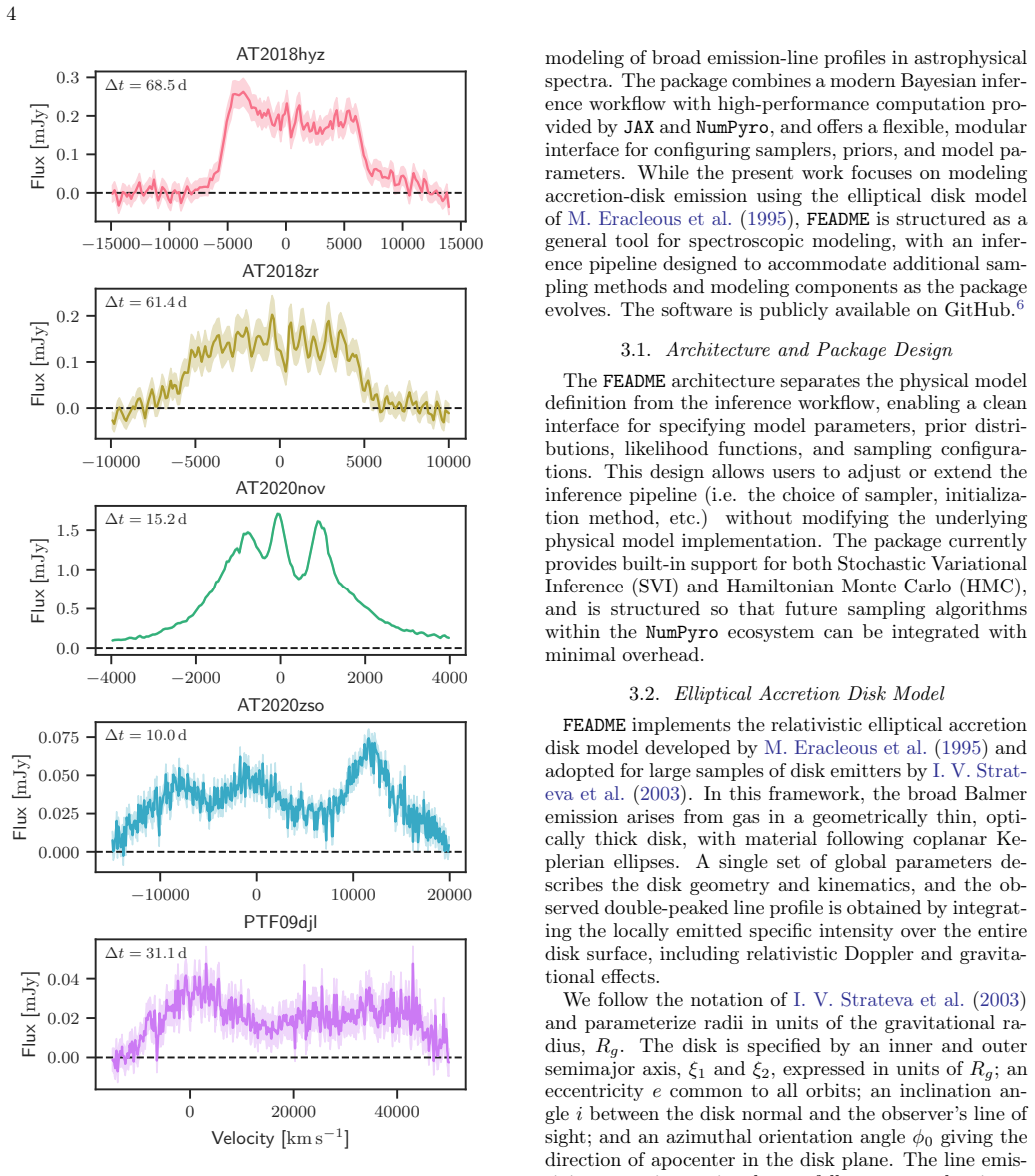
The central discovery is that the eccentricity of the line-emitting disk separates the two populations. Using the same seven-parameter relativistic thin-disk model (inner and outer radius, eccentricity, inclination, apocenter angle, emissivity index, local broadening) fit with Bayesian inference and model selection, the paper finds that TDE disks have median e = 0.17 versus an AGN median of e = 0.64, with a Mann–Whitney p-value of 2.3e-8. For inclination, emissivity slope, local broadening, and outer radius, the TDE and AGN distributions are statistically indistinguishable (p > 0.1 for five of seven parameters); inner radius is smaller in TDEs but within the AGN range. The non-disk broad Gau
Load-bearing premise
The fitted disk eccentricity is a physical orbital property rather than a trade-off with the co-fit broad Gaussian component; the paper does not test this degeneracy, so the reported roundness of TDE disks could be an artifact of model flexibility.
Editorial extensions
If this is right
- If TDE disks truly are rounder, then the emergence of broad Balmer emission marks a state in which stellar debris has already circularized; low eccentricity can serve as a spectroscopic clock for disk formation in future TDEs.
- The near-universal coexistence of disk and extra broad component implies that disk emission is rarely isolated; single-component models of broad lines will systematically misattribute flux.
- The overlap in other parameters means that TDEs can be used as laboratories for AGN disk physics with time-resolved spectroscopy, since the same model applies to both.
- The broader non-disk component in TDEs implies that the high-velocity gas in TDEs is dynamically younger and more energetic than the virialized broad-line region of AGN, a difference that should show up in multi-line comparisons.
- Population-scale, reproducible disk modeling becomes feasible, allowing future surveys to fit hundreds of sources with the same code and physical assumptions.
Reading between the lines
- The eccentricity difference may partly reflect a model degeneracy: the extra broad Gaussian, which is significantly wider in TDEs, could absorb asymmetric line wings that a narrower Gaussian would leave for the disk's eccentricity to explain. A direct test would be to fit AGN with TDE-like broad Gaussian widths and see whether inferred eccentricities drop toward 0.2.
- Because the TDE sample was preselected for double-peaked morphology and is tiny (five events), the overlap with AGN may be a selection effect; including TDEs without double-peaked profiles would test whether the round-disk conclusion extends to all TDE disks.
- If the thin-disk approximation is violated for super-Eddington TDEs, the fitted 'eccentricity' may be a proxy for the asymmetry of a thickened disk or wind; then the correct physical statement would be that TDE line-forming regions are more symmetric, not more circular—a distinction testable with radiative-transfer models of thick disks and winds.
- The time-resolved fits show early epochs with elevated eccentricity in at least two events, so an explicit testable prediction is that eccentricity decreases monotonically with time in individual TDEs as circularization proceeds; the current sample is too sparse to confirm this.
Editorial analysis
A structured set of objections, weighed in public.
Referee Report
Summary. The paper presents FEADME, a GPU-accelerated JAX/NumPyro implementation of the Eracleous et al. (1995) relativistic elliptical disk model for broad Balmer-line profiles. The authors fit three model families (disk + narrow lines + broad Gaussian, disk + narrow lines only, and broad Gaussian + narrow lines only) to 237 AGN double-peaked emitters from Ward et al. (2024) and to five TDEs, select a preferred model per spectrum with LOO/WAIC, and compare posterior parameter distributions. The main astrophysical claim is that TDE disks are significantly less eccentric (median e = 0.17) than AGN disks (median e = 0.64; p = 2.3e-8), while other disk parameters overlap; a secondary claim is that the non-disk broad Gaussian component is broader in TDEs.
Significance. If the eccentricity difference is robust, it is an interesting and timely constraint on debris circularization and it supports a unified picture of line-forming disks in persistent AGN and transient TDEs. The paper also contributes an open-source, reproducible modeling framework and applies a consistent Bayesian pipeline to a large sample, which are genuine strengths. However, the headline result rests on two currently untested statistical assumptions: no degeneracy between disk eccentricity and the broad Gaussian component, and independence of repeated TDE epochs. The manuscript also contains internal inconsistencies in sample sizes and model-selection terminology. The central claim is therefore not yet established; targeted revisions could make it publishable.
major comments (4)
- [§6.1, Table 2, Fig. 7] The conclusion that TDE disks are rounder is potentially confounded by the simultaneously broader non-disk Gaussian component. TDEs require a broad Gaussian with median FWHM ≈ 1.1e4 km/s versus ≈ 6.7e3 km/s for AGN (p = 4e-5). The paper never tests whether a broad Gaussian can absorb the line asymmetries that would otherwise drive e upward. Please report posterior correlations between e and Gaussian FWHM, include a circular-disk + broad-Gaussian model in the TDE model comparison, or run simulations with known e to show that the fitted e is not biased low by the extra component.
- [§6.1, Table 2] The Mann–Whitney test compares 27 (or 29) TDE epochs drawn from only five events against the AGN source distribution. Repeated epochs of the same transient trace the same disk and viewing geometry and are serially correlated; pooling them as independent samples inflates the effective sample size by roughly a factor of five. The p = 2.3e-8 therefore does not establish that 'TDE disks are rounder' as a population statement. The authors should report an event-level comparison (e.g., one summary e per TDE, or a hierarchical model) and recompute the significance.
- [Abstract, §4, §5.2, Table 1] Sample-size and model-selection statements are internally inconsistent. The abstract says 237 AGN and 165 AGN after filtering, 27 usable TDE epochs, and WAIC; §4 says 29 usable TDE epochs and uses LOO; §5.2 clustering sums to 199 AGN (167 + 32) rather than 237; and the abstract's 'five phenomenological Gaussian-mixture morphology bins' does not match the four HDBSCAN clusters described in the text. Please reconcile all numbers, define the posterior-quality filtering, and use one model-selection terminology throughout.
- [§6.1, §7] The statement that 'with the exception of eccentricity, TDE disks are not strongly distinguishable from AGN disks' is contradicted by the paper's own tests: the broad Gaussian FWHM differs at p = 4.18e-5 and the inner radius at p = 2.1e-3. These are reported in §6.1 as significant differences. Please either qualify the conclusion to include these parameters or explicitly explain why these differences are not considered 'strong' in the context of the paper's claims.
minor comments (5)
- [§2.2] Typo: 'ASSASN-14li' should be 'ASASSN-14li'.
- [§6.2] Typo: 'standard think-disk solutions' should read 'standard thin-disk solutions'; also 'Eddington ratio of ∼0.6at peak' is missing a space.
- [§4] The model-family label 'No-BLR Model' is confusing because the 'BLR' component in the Full Model is a broad Gaussian, not the full broad-line region; consider renaming to 'No-Broad-Gaussian'.
- [§5.2] The clustering analysis reports four clusters, but Table 1 and Figure 5 do not list a fifth cluster; the abstract's 'five ... morphology bins' appears to be a residual from an earlier draft and should be corrected.
- [Abstract] The abstract uses 'widely applicable information criterion (WAIC)' while the text uses approximate leave-one-out (LOO) cross-validation. Choose one and use it consistently.
Circularity Check
No significant circularity: the central result is an empirical posterior comparison, not a derivation from fitted inputs.
full rationale
The paper does not claim to derive TDE eccentricity from first principles. All disk parameters (e, i, ξ1, ξ2, q, σ, φ0) are free parameters in the adopted Eracleous et al. (1995) elliptical disk model, fitted independently to each spectrum. The headline result—TDE median e = 0.17 versus AGN median e = 0.64, p = 2.3e-8—is a Mann-Whitney comparison of posterior medians, so there is no fitted-input-called-prediction reduction: the 'prediction' is the posterior itself, not an independent quantity derived from it. The model is adopted from an external, standard reference (Eracleous et al. 1995; Strateva et al. 2003), not from a self-citation chain, and FEADME is an implementation rather than a derivation. The only self-citations (e.g., N. Earl et al. 2025 for AT2020nov's prior outer radius and eccentricity) are contextual; Table 2 reports the paper's own refits, so the central eccentricity comparison does not depend on those cited values. The acknowledged thin-disk limitation in §6.2 is a caveat about interpretation, not a circular step. Statistical concerns such as epoch-level pseudo-replication and possible degeneracy between e and the broad Gaussian are correctness and robustness risks, not circularity by construction.
Assumptions & free parameters
free parameters (8)
- e (disk eccentricity) =
AGN median 0.64; TDE median 0.17
- i (inclination) =
AGN median 61 deg; TDE median 64 deg
- xi1 (inner semimajor axis) =
AGN median 2225 Rg
- xi2 (outer semimajor axis) =
AGN median 11882 Rg
- q (emissivity index) =
AGN median 1.69
- sigma (local Gaussian broadening) =
AGN median 819 km/s; TDE median 649 km/s
- phi0 (apocenter angle) =
AGN median 220 deg
- Broad Gaussian FWHM =
TDE median ~1.1e4 km/s; AGN median ~6.7e3 km/s
assumptions (7)
- domain assumption The Eracleous et al. (1995) weak-field relativistic elliptical disk model (Eqs. 2-6) accurately describes the shape of the broad Balmer-line profile.
- domain assumption Line-emitting gas is geometrically thin, optically thick, coplanar, and follows Keplerian ellipses with a single common eccentricity e.
- domain assumption Emissivity follows xi^{-q} and local broadening is Gaussian with a single sigma.
- domain assumption Normalized profile shape (amplitude factored out) is sufficient, so unknown black-hole masses and distances do not affect the fit.
- ad hoc to paper The broad Gaussian component captures non-disk emission and does not strongly degenerate with disk eccentricity.
- domain assumption Leave-one-out cross-validation (ArviZ) reliably selects the correct model family for each spectrum.
- domain assumption The five selected TDEs are representative of disk-like TDEs, and multi-epoch stacking weights epochs within an event equally.
Cite this review
Pith. "Pith review of FEADME: Fast Elliptical Accretion Disk Modeling Engine." pith.science (2026). https://pith.science/paper/E4LEVKP7
@misc{pith2026251210228,
  author       = {Pith},
  title        = {Pith review of: FEADME: Fast Elliptical Accretion Disk Modeling Engine},
  year         = {2026},
  howpublished = {\url{https://pith.science/paper/E4LEVKP7}},
  note         = {Machine review of arXiv:2512.10228}
}
abstract
We present FEADME (Fast Elliptical Accretion Disk Modeling Engine), a GPU-accelerated Python framework for modeling broad Balmer-line emission using a relativistic elliptical accretion-disk formalism. Leveraging JAX and NumPyro for differentiable forward modeling and efficient Bayesian inference, FEADME enables large-sample, reproducible analyses of disk-dominated emission-line profiles. We apply the framework to 237 double-peaked emitters (DPEs) from the literature and to five tidal disruption events (TDEs) with disk-like H$\alpha$ emission, fitting three physically motivated model families per spectrum and selecting the preferred model using the widely applicable information criterion (WAIC). After posterior-quality filtering, the disk-bearing active galactic nuclei (AGN) analysis sample contains 165 sources and the TDE sample contains 27 usable epochs. We find that AGN occupy a broad, continuous distribution of disk geometries and kinematics that is usefully summarized by five phenomenological Gaussian-mixture morphology bins. The TDE disk parameters overlap substantially with the AGN population in radial scale, local broadening, and emissivity slope, but TDEs are systematically less eccentric and show broader non-disk Gaussian components. The majority of both AGN and TDEs favor models that include both a disk and an additional broad-line component, suggesting that disk emission commonly coexists with more isotropic or wind-driven gas. These results indicate that once a line-emitting disk forms, its spectroscopic appearance is governed by similar physical processes in both persistent AGN and transient TDE accretion flows, and they demonstrate the utility of FEADME for population-level studies of disk structure in galactic nuclei.
Figures


Figures from the paper (4 more)


Reference graph
Works this paper leans on
-
[1]
Bellm, E. C., Kulkarni, S. R., Graham, M. J., et al. 2019, PASP, 131, 018002, doi: 10.1088/1538-3873/aaecbe
-
[2]
Bingham, E., Chen, J. P., Jankowiak, M., et al. 2018, arXiv e-prints, arXiv:1810.09538, doi: 10.48550/arXiv.1810.09538
-
[4]
2020, MNRAS, 495, 1374, doi: 10.1093/mnras/staa1246
Bonnerot, C., & Lu, W. 2020, MNRAS, 495, 1374, doi: 10.1093/mnras/staa1246
-
[5]
Campello, R. J. G. B., Moulavi, D., & Sander, J. 2013, in Advances in Knowledge Discovery and Data Mining, ed. J. Pei, V. S. Tseng, L. Cao, H. Motoda, & G. Xu (Berlin, Heidelberg: Springer Berlin Heidelberg), 160–172
2013
-
[6]
Cao, R., Liu, F. K., Zhou, Z. Q., Komossa, S., & Ho, L. C. 2018, MNRAS, 480, 2929, doi: 10.1093/mnras/sty1997
-
[7]
2023, MNRAS, 526, 3273, doi: 10.1093/mnras/stad2597
Cappellari, M. 2023, MNRAS, 526, 3273, doi: 10.1093/mnras/stad2597
-
[8]
Chajet, L. S., & Hall, P. B. 2013, MNRAS, 429, 3214, doi: 10.1093/mnras/sts580
-
[9]
Charalampopoulos, P., Leloudas, G., Malesani, D. B., et al. 2022, A&A, 659, A34, doi: 10.1051/0004-6361/202142122 19
Show all 61 references
-
[10]
P., & Filippenko, A
Chen, K., Halpern, J. P., & Filippenko, A. V. 1989, ApJ, 339, 742, doi: 10.1086/167332
1989 doi
-
[11]
Miller, M. C. 2018, ApJL, 859, L20, doi: 10.3847/2041-8213/aab429
2018 doi
-
[12]
M., Riddle, R., et al
Dekany, R., Smith, R. M., Riddle, R., et al. 2020, PASP, 132, 038001, doi: 10.1088/1538-3873/ab4ca2
2020 doi
-
[13]
D., Ramirez-Ruiz, E., et al
Earl, N., French, K. D., Ramirez-Ruiz, E., et al. 2025, ApJ, 983, 28, doi: 10.3847/1538-4357/adb974
2025 doi
-
[14]
1998, Advances in Space Research, 21, 33, doi: 10.1016/S0273-1177(97)00612-1
Eracleous, M. 1998, Advances in Space Research, 21, 33, doi: 10.1016/S0273-1177(97)00612-1
1998 doi
-
[15]
Eracleous, M., & Halpern, J. P. 2003, ApJ, 599, 886, doi: 10.1086/379540
2003 doi
-
[16]
1995, ApJ, 438, 610, doi: 10.1086/175104
Storchi-Bergmann, T. 1995, ApJ, 438, 610, doi: 10.1086/175104
1995 doi
-
[17]
Flohic, H. M. L. G., Eracleous, M., & Bogdanović, T. 2012, ApJ, 753, 133, doi: 10.1088/0004-637X/753/2/133
2012 doi
-
[18]
P., & Eracleous, M
Gezari, S., Halpern, J. P., & Eracleous, M. 2007, ApJS, 169, 167, doi: 10.1086/511032
2007 doi
-
[19]
2019, A&A, 630, A94, doi: 10.1051/0004-6361/201833810
Giustini, M., & Proga, D. 2019, A&A, 630, A94, doi: 10.1051/0004-6361/201833810
2019 doi
-
[20]
J., Kulkarni, S
Graham, M. J., Kulkarni, S. R., Bellm, E. C., et al. 2019, PASP, 131, 078001, doi: 10.1088/1538-3873/ab006c GRAVITY Collaboration, Amorim, A., Bourdarot, G., et al. 2024, A&A, 684, A167, doi: 10.1051/0004-6361/202348167
2019 doi
-
[21]
C., Rudnick, G., Rix, H.-W., et al
Ho, L. C., Rudnick, G., Rix, H.-W., et al. 2000, ApJ, 541, 120, doi: 10.1086/309440
2000 doi
- [22]
-
[23]
Holoien, T. W. S., Huber, M. E., Shappee, B. J., et al. 2019, ApJ, 880, 120, doi: 10.3847/1538-4357/ab2ae1
2019 doi
-
[24]
Hopkins, B., & Skellam, J. G. 1954, Annals of Botany, 18, 213, doi: 10.1093/oxfordjournals.aob.a083391
1954 doi
-
[25]
W., & Jiang, Y.-f
Huang, X., Davis, S. W., & Jiang, Y.-f. 2024, ApJ, 974, 165, doi: 10.3847/1538-4357/ad6c39
2024 doi
-
[26]
J., Ramirez-Ruiz, E., et al
Hung, T., Foley, R. J., Ramirez-Ruiz, E., et al. 2020, The Astrophysical Journal, 903, 31, doi: 10.3847/1538-4357/abb606
2020 doi
-
[27]
2012, A&A, 548, A37, doi: 10.1051/0004-6361/201118174
Kollatschny, W., Reichstein, A., & Zetzl, M. 2012, A&A, 548, A37, doi: 10.1051/0004-6361/201118174
2012 doi
-
[28]
2013, A&A, 549, A100, doi: 10.1051/0004-6361/201219411
Kollatschny, W., & Zetzl, M. 2013, A&A, 549, A100, doi: 10.1051/0004-6361/201219411
2013 doi
-
[29]
Krolik, J., Piran, T., Svirski, G., & Cheng, R. M. 2016, ApJ, 827, 127, doi: 10.3847/0004-637X/827/2/127
2016 doi
-
[30]
T., Eracleous, M., & Storchi-Bergmann, T
Lewis, K. T., Eracleous, M., & Storchi-Bergmann, T. 2010, ApJS, 187, 416, doi: 10.1088/0067-0049/187/2/416
2010 doi
-
[31]
K., Zhou, Z
Liu, F. K., Zhou, Z. Q., Cao, R., Ho, L. C., & Komossa, S. 2017, MNRAS, 472, L99, doi: 10.1093/mnrasl/slx147
2017 doi
- [32]
-
[33]
C., Dai, L., & Avara, M
McKinney, J. C., Dai, L., & Avara, M. J. 2015, MNRAS, 454, L6, doi: 10.1093/mnrasl/slv115
2015 doi
-
[34]
D., & Stone, N
Metzger, B. D., & Stone, N. C. 2016, MNRAS, 461, 948, doi: 10.1093/mnras/stw1394
2016 doi
-
[35]
1996, Nature, 382, 789, doi: 10.1038/382789a0
Murray, N., & Chiang, J. 1996, Nature, 382, 789, doi: 10.1038/382789a0
1996 doi
-
[36]
M., & Sánchez, F
Negus, J., Comerford, J. M., & Sánchez, F. M. 2024, ApJ, 971, 92, doi: 10.3847/1538-4357/ad4c68
2024 doi
-
[37]
2011, ApJ, 736, 2, doi: 10.1088/0004-637X/736/1/2
Ohsuga, K., & Mineshige, S. 2011, ApJ, 736, 2, doi: 10.1088/0004-637X/736/1/2
2011 doi
-
[38]
I., Blackman, E
Pariev, V. I., Blackman, E. G., & Boldyrev, S. A. 2003, A&A, 407, 403, doi: 10.1051/0004-6361:20030868
2003 doi
-
[39]
J., Knigge, C., Matthews, J
Parkinson, E. J., Knigge, C., Matthews, J. H., et al. 2022, MNRAS, 510, 5426, doi: 10.1093/mnras/stac027
2022 doi
- [40]
-
[41]
2015, ApJ, 806, 164, doi: 10.1088/0004-637X/806/2/164 Popović, L
Shiokawa, H. 2015, ApJ, 806, 164, doi: 10.1088/0004-637X/806/2/164 Popović, L. Č., Mediavilla, E., Bon, E., & Ilić, D. 2004, A&A, 423, 909, doi: 10.1051/0004-6361:20034431
2015 doi
-
[42]
M., & Kallman, T
Proga, D., Stone, J. M., & Kallman, T. R. 2000, ApJ, 543, 686, doi: 10.1086/317154
2000 doi
-
[43]
Rees, M. J. 1988, Nature, 333, 523, doi: 10.1038/333523a0
1988 doi
-
[44]
2012, ApJ, 748, 145, doi: 10.1088/0004-637X/748/2/145
Winge, C., & Eracleous, M. 2012, ApJ, 748, 145, doi: 10.1088/0004-637X/748/2/145
2012 doi
-
[45]
S., & Eracleous, M
Nemmen, R. S., & Eracleous, M. 2017, MNRAS, 472, 2170, doi: 10.1093/mnras/stx2107
2017 doi
-
[46]
I., & Sunyaev, R
Shakura, N. I., & Sunyaev, R. A. 1973, A&A, 24, 337
1973
-
[47]
2009, New Astronomy Reviews, 53, 191, doi: https://doi.org/10.1016/j.newar.2009.08.004
Shapovalova, A., Popović, L., Bochkarev, N., et al. 2009, New Astronomy Reviews, 53, 191, doi: https://doi.org/10.1016/j.newar.2009.08.004
2009 doi
-
[48]
Noble, S. C. 2015, ApJ, 804, 85, doi: 10.1088/0004-637X/804/2/85
2015 doi
-
[49]
2020, MNRAS, 498, 4119, doi: 10.1093/mnras/staa2065 Sądowski, A., Tejeda, E., Gafton, E., Rosswog, S., &
Short, P., Nicholl, M., Lawrence, A., et al. 2020, MNRAS, 498, 4119, doi: 10.1093/mnras/staa2065 Sądowski, A., Tejeda, E., Gafton, E., Rosswog, S., &
2020 doi
-
[50]
2016, MNRAS, 458, 4250, doi: 10.1093/mnras/stw589
Abarca, D. 2016, MNRAS, 458, 4250, doi: 10.1093/mnras/stw589
2016 doi
-
[51]
Steinberg, E., & Stone, N. C. 2024, Nature, 625, 463, doi: 10.1038/s41586-023-06875-y 20
2024 doi
-
[52]
1997, ApJ, 489, 87, doi: 10.1086/304783
Storchi-Bergmann, T., Eracleous, M., Teresa Ruiz, M., et al. 1997, ApJ, 489, 87, doi: 10.1086/304783
1997 doi
-
[53]
2003a, in Astronomical Society of the Pacific Conference Series, Vol
Storchi-Bergmann, T., Nemmen da Silva, R., & Eracleous, M. 2003a, in Astronomical Society of the Pacific Conference Series, Vol. 297, Star Formation Through Time, ed. E. Perez, R. M. Gonzalez Delgado, & G. Tenorio-Tagle, 431, doi: 10.48550/arXiv.astro-ph/0211477
-
[54]
S., Peterson, B
Storchi-Bergmann, T., Schimoia, J. S., Peterson, B. M., et al. 2017, ApJ, 835, 236, doi: 10.3847/1538-4357/835/2/236
2017 doi
-
[55]
2003b, ApJ, 598, 956, doi: 10.1086/378938
Storchi-Bergmann, T., Nemmen da Silva, R., Eracleous, M., et al. 2003b, ApJ, 598, 956, doi: 10.1086/378938
-
[56]
V., Strauss, M
Strateva, I. V., Strauss, M. A., Hao, L., et al. 2003, AJ, 126, 1720, doi: 10.1086/378367
2003 doi
-
[57]
E., & Quataert, E
Strubbe, L. E., & Quataert, E. 2009, MNRAS, 400, 2070, doi: 10.1111/j.1365-2966.2009.15599.x
2009
-
[58]
E., & Quataert, E
Strubbe, L. E., & Quataert, E. 2011, MNRAS, 415, 168, doi: 10.1111/j.1365-2966.2011.18686.x
2011
-
[59]
2024, ApJ, 961, 172, doi: 10.3847/1538-4357/ad147d
Ward, C., Gezari, S., Nugent, P., et al. 2024, ApJ, 961, 172, doi: 10.3847/1538-4357/ad147d
2024 doi
-
[60]
2022, A&A, 666, A6, doi: 10.1051/0004-6361/202142616
Wevers, T., Nicholl, M., Guolo, M., et al. 2022, A&A, 666, A6, doi: 10.1051/0004-6361/202142616
2022 doi
-
[61]
Y., Webster, R
Yong, S. Y., Webster, R. L., King, A. L., et al. 2017, PASA, 34, e042, doi: 10.1017/pasa.2017.37
2017 doi
-
[62]
2025, ApJ, 993, 244, doi: 10.3847/1538-4357/ae0581
Zhang, M., Zhang, W., Deng, H., Guo, H., & Sun, J. 2025, ApJ, 993, 244, doi: 10.3847/1538-4357/ae0581
2025 doi
Reviewed August 3, 2026 · model on record in the stance chip above.
Discussion (0). Sign in to comment.