REVIEW 5 major objections 4 minor 19 references
Second order reduced model via incremental projection for Navier Stokes
T0 review · 5 major / 4 minor · reviewed 2026-08-03 · deepseek-v4-flash
Pith's one-line read A POD-based reduced-order incremental projection scheme for the Stokes equations is stable, and its velocity and pressure errors are bounded—up to an explicit exponential factor—by the POD projection error whenever the reduced velocity and
desk verdict A plausible but sloppy ROM paper: the BDF2-incremental-projection extension is real, but the numerical validation and the printed reduced system do not hold up. read the letter →
The pith
A machine-rendered reading of the paper's core claim, the machinery that carries it, and where it could break.
The reading
What carries the argument
The central object is the saturation property (Definition 3.1): a pair of finite-dimensional subspaces (Y,Z) of a Hilbert space is saturated when ||y||+||z|| ≤ C||y+z|| for all y,z, equivalently |(y,z)| ≤ α||y||||z|| with α<1—an angle condition. The paper uses this with Y=Ur and Z=span{∇ψ_i} to control pressure–velocity cross terms. Around this, the method builds on an incremental (Goda-type) BDF2 projection scheme for the Stokes equations, H1-inner-product POD bases for both velocity and pressure, and a three-term recursion inequality plus Gronwall's lemma to handle the time-stepping.
What would settle it
Compute α = sup_{y∈Ur, z∈∇Qr} |(y,z)_X| / (||y||_X ||z||_X) for the H1-based POD spaces built from the paper's snapshot ensembles; if for typical snapshot sets one finds α ≥ 3/8, the theorem's hypothesis is violated and the stated error bound is not guaranteed. Additionally, with α in hand, one can compare the measured ROM errors against the right-hand side of (3.26) at fixed ν and τ to test the bound directly.
Extended reading notes
Core claim
Theorem 3.2: if the saturation constant α of the reduced velocity space Ur and the pressure-gradient space span{∇ψ_1,...,∇ψ_r} is strictly less than 3/8, then the difference between the reduced-order solution and the full finite-element solution satisfies a bound where the summed velocity and pressure errors are at most C(α) e^{((7τ+4α)/2)T} times the sum of the omitted velocity and pressure POD eigenvalues, each weighted by norms of the corresponding POD modes. This makes the POD truncation error the sole driver of the ROM error, up to a stability factor.
Load-bearing premise
The load-bearing premise is that the reduced velocity space and the pressure-gradient space satisfy the saturation property with constant α < 3/8, and that the time step is below a threshold depending on α—conditions neither proven for POD bases nor checked in the numerical experiments, which instead use L2-based POD.
Editorial extensions
If this is right
- The ROM error can be reduced predictably by adding POD modes; the estimate gives the per-mode contribution as weighted eigenvalues, so mode selection is a matter of truncating small eigenvalues.
- No inf-sup/LBB condition is required in the reduced pair; pressure is obtained explicitly through a pressure-stiffness update, preserving the decoupling that makes projection methods efficient.
- The scheme is second-order in time; the numerical tables show convergence rates near 1.99 for velocity and 1.98 for pressure.
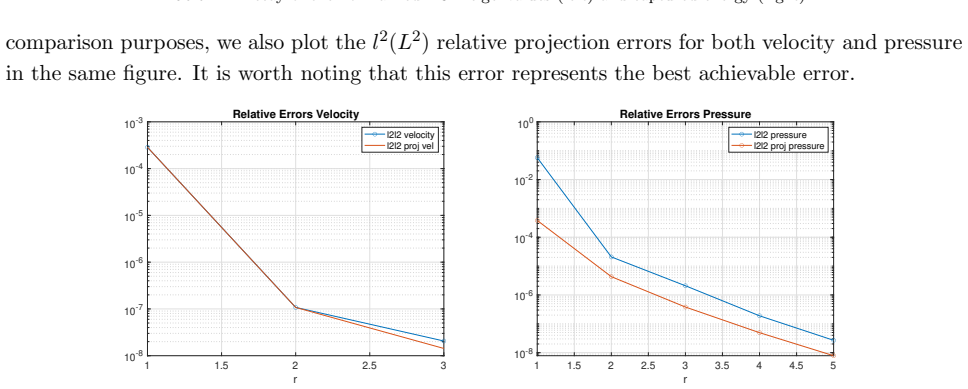
- Very few modes suffice on smooth problems: two velocity modes give relative errors around 10^-7, and about four pressure modes reach the same level.
- The method extends to parametric settings: in the lid-driven cavity test, the ROM tracks the projection error when interpolating in Reynolds number and even when extrapolating in time.
Reading between the lines
- The saturation constant α is computable from the POD bases; a practical implementation should measure it, because if α ≥ 3/8 the proven bound does not apply and the error may not follow the POD truncation.
- The numerical experiments generate POD modes with the L2 inner product, while the theory assumes H1 (gradient) inner products; verifying the theory numerically would require repeating the tests with H1-based POD and checking α.
- The exponential factor e^{((7τ+4α)/2)T} implies the error bound is only useful over moderate time horizons; for long-time integration the bound becomes very pessimistic, suggesting the need for time-domain decomposition or a sharper analysis.
- The rigorous error analysis is for the linear Stokes problem; the lid-driven cavity test adds a nonlinear convection term via extrapolation, so a full Navier–Stokes error estimate remains open, as the authors themselves indicate.
Editorial analysis
A structured set of objections, weighed in public.
Referee Report
Summary. The paper proposes a POD-based reduced-order model for the unsteady Stokes equations built on a BDF2 incremental projection scheme. It presents semi-discrete and fully discrete formulations, a stability estimate (Theorem 3.1), and an a priori error estimate (Theorem 3.2) in which the ROM error is bounded by POD truncation eigenvalues up to a factor depending on a saturation constant alpha < 3/8. Numerical experiments with a manufactured solution and a lid-driven cavity are reported. The main claim is that the reduced velocity and pressure are accurate with few modes and that the scheme preserves second-order accuracy in time.
Significance. If the main theorem were fully established, the paper would be a useful contribution: it combines a popular pressure-correction time-splitting scheme with POD, and the claimed bound by POD truncation error is an attractive and practically relevant statement. The paper also attempts a complete stability analysis. However, the numerical validation is invalid because the manufactured solution is not divergence-free, the printed reduced algebraic system is inconsistent with the Galerkin weak form, the experiments use L2-POD while the theory uses H1-POD, and the central error estimate rests on an unverified saturation hypothesis and contains gaps in the Gronwall argument. As it stands, the central claims are not supported.
major comments (5)
- [Section 4.1, Eq. (4.1)] The manufactured solution is not divergence-free. Both components are printed as u=v=cos(t) pi sin^2(pi x) sin(2 pi y), whose divergence is 2 pi^2 cos(t) sin(pi x)(cos(pi x) sin(2 pi y)+sin(pi x) cos(2 pi y)), not identically zero. It therefore violates (2.1b) and is not a solution of the Stokes problem. Consequently the convergence rates in Table 1 and the ROM errors in Figures 2-3 do not measure errors against a valid exact solution. A divergence-free manufactured solution is required to validate the scheme or the theory.
- [Section 3.2, Eqs. (3.4a)-(3.5b)] The reduced algebraic system is inconsistent with the stated weak form. The pressure term in (3.4a) is -1/3 (p, div v_r). With P_ij=(psi_i, div phi_j), this contributes -1/3 P^T b, not +1/3 P b as printed in (3.5a). Similarly, (div u^{n+1}, psi_i) with the stated definition of P gives P a^{n+1}, so (3.5b) should not contain P^T. As printed, the system does not represent the Galerkin equations (3.4). Any implementation following (3.5) solves a different ROM, so the numerical results do not validate the printed scheme.
- [Sections 3.1 and 4.1.1/4.2.1] The theory and experiments use different POD inner products. Section 3.1 constructs POD bases with X=H^1-seminorm and Y=H^1-seminorm, with orthonormality (nabla phi_i, nabla phi_j)=delta_ij; but Sections 4.1.1 and 4.2.1 explicitly state that 'POD modes are generated in L2-norm for velocity and pressure'. The POD projection error estimates and the saturation property in Theorem 3.2 are formulated for the H1-POD spaces, so the experiments do not test the spaces appearing in the theory. The paper must either adapt the analysis to L2-POD or run the numerical tests with H1-POD.
- [Definition 3.1, Lemma 3.1, Theorem 3.2] The saturation property is assumed, not verified, for the specific reduced spaces U_r and span{nabla psi_1,...,nabla psi_r}. Definition 3.1 requires Y cap Z = {0} and (3.23), and Theorem 3.2 assumes the saturation constant satisfies alpha < 3/8. The paper proves no such property for POD bases and gives no computational estimate of alpha. This is load-bearing: the absorption step leading to (3.46) requires positivity of 1-17 tau/4-alpha, and the Gronwall coefficient depends on alpha. Without a proof, a verifiable criterion, or an estimate of alpha for the actual POD spaces, the advertised error bound is conditional on an unestablished geometric hypothesis.
- [Theorem 3.2 proof, Eqs. (3.41), (3.51), (3.52)] Two central steps in the proof are not justified. First, the estimate (3.41) for A6 is not a consequence of Lemma 3.1: A6 is an L2 pairing between an element of U_r and an element of span{nabla Q_r}, whereas Lemma 3.1 controls the X-inner product. If X=H^1, the controlled inner product is (nabla . , nabla .); if X=L^2, the POD construction is different. No inverse or norm-equivalence inequality is stated. Second, the discrete Gronwall step to (3.52) is inconsistent with (3.51): the coefficient on the energy-type sum is (7 tau + 4 alpha)/4, so discrete Gronwall gives a factor (1+(7 tau+4 alpha)/4)^{N_t} ~ exp((alpha+7 tau/4)T/tau), not exp((7 tau+4 alpha)T/2). The exponent in (3.52) has the wrong scaling in T and tau, which affects the validity of the stated error bound.
minor comments (4)
- [Section 4.2] The lid-driven cavity test solves the nonlinear Navier-Stokes equations with the extrapolated convection term ((2 u^n - u^{n-1}) . grad) u^{n+1}, while the stability and error analyses in Section 3 are for the linear Stokes problem. These results should be labeled as heuristic and outside the scope of Theorem 3.2.
- [Section 3.1] The summation indices in the POD basis formulas run from k=0 to N_t+1, but the snapshots are defined for indices 1 to N_t+1; u^0 is not defined. The index range should be corrected.
- [Section 4.1.1] The statement that 81 snapshots are collected from storing every fourth FOM simulation in [0.21,1] appears inconsistent with tau=1e-2; the number of stored snapshots and the time interval should be reconciled.
- [Abstract and Conclusion] The abstract claims numerical validation of second-order convergence in time, but Table 1 tests the full-order scheme, not the ROM; the ROM experiments show errors versus mode number rather than time-step convergence. The text should distinguish these.
Circularity Check
No significant circularity: the central error-transfer theorem is conditional and self-contained; the main issues are an unverified saturation hypothesis and a self-citation that is not itself the argument.
full rationale
Theorem 3.2 is a conditional error-transfer result: it starts from the full-order scheme (2.6), the POD reduced scheme (3.4), and the POD projection errors (eigenvalue tails), and proves an energy inequality whose right-hand side is the projection error. Nothing is fitted from ROM output and then called a prediction; the constants C(α) are not calibrated against the reported errors. The saturation property (Definition 3.1, Eq. (3.23)) is assumed, not proved, for Y=U_r and Z=span{∇ψ1,...,∇ψr}, and the condition α<3/8 is used to keep coefficients positive (e.g., the absorbing step leading to (3.46) and the condition τ<4(1−8α/3)/17). This is an unverified hypothesis rather than a circular derivation; the theorem is honestly worded as an 'if' statement. Lemma 3.1 is cited to the authors' prior work [17], but it is a general equivalence between saturation and an angle bound, and its assumptions do not include the target error estimate, so it is real, if self-referential, evidence. The numerical section generates POD modes in the L2 norm (Sections 4.1.1 and 4.2.1) while the theory uses H1-seminorm inner products (Section 3.1), so the experiments do not test the saturation hypothesis; this is a validation gap, not circularity. Overall, no step reduces by construction to its own input, so the circularity score is low.
Assumptions & free parameters
assumptions (5)
- domain assumption The reduced spaces U_r and Q_r satisfy the saturation property with constant α < 3/8 (Definition 3.1, Eq. 3.23).
- domain assumption The full-order BDF2 incremental projection scheme (2.6) is stable and second-order accurate in time (O(δt^2 + h^{l+1})), as established in [12].
- standard math POD projection error equals the sum of neglected eigenvalues: (1/(N_t+1))∑∥ũ^i - Π_v ũ^i∥^2_X = ∑_{j>N_u} λ_j, and analogously for pressure (Section 3.1).
- standard math Lemma 3.1 (saturation property equivalent to angle bound, |(y,z)_X| ≤ α∥y∥_X∥z∥_X) holds as stated in [17, Lemma 5.3].
- domain assumption Initial pressure data p^0_h and p^{-1}_h exist and are available for the BDF2 recurrence (2.6) at n=1.
Cite this review
Pith. "Pith review of Second order reduced model via incremental projection for Navier Stokes." pith.science (2026). https://pith.science/paper/NKE36C4M
@misc{pith2026251210473,
  author       = {Pith},
  title        = {Pith review of: Second order reduced model via incremental projection for Navier Stokes},
  year         = {2026},
  howpublished = {\url{https://pith.science/paper/NKE36C4M}},
  note         = {Machine review of arXiv:2512.10473}
}
read the original abstract
The numerical simulation of incompressible flows is challenging due to the tight coupling of velocity and pressure. Projection methods offer an effective solution by decoupling these variables, making them suitable for large-scale computations. This work focuses on reduced-order modeling using incremental projection schemes for the Stokes equations. We present both semi-discrete and fully discrete formulations, employing BDF2 in time and finite elements in space. A proper orthogonal decomposition (POD) approach is adopted to construct a reduced-order model for the Stokes problem. The method enables explicit computation of reduced velocity and pressure while preserving accuracy. We provide a detailed stability analysis and derive error estimates, showing second-order convergence in time. Numerical experiments are conducted to validate the theoretical results and demonstrate computational efficiency.
Figures


Figures from the paper (4 more)


Reference graph
Works this paper leans on
-
[1]
Aza ¨ ıez, T
M. Aza ¨ ıez, T. Chac´ on Rebollo, C. N´ u˜ nez Fern´ andez, and S. Rubino. A pod-based reduced order method applied to goda time-splitting scheme. Journal of Scientific Computing , 104(1):9, 2025
2025
-
[2]
Fran¸ cois E. Cellier. Continuous system modeling . New York etc.: Springer-Verlag, 1991
1991
-
[3]
A.J. Chorin. Numerical solution of the navier–stokes eq uations. Math. Comput , 22(4):745–762, 1968
1968
-
[4]
Bosco Garc ´ ıa-Archilla, V. John, and Julia Novo. Error analysis of BDF schemes for the evolutionary incompressible Navier–Stokes equations. Preprint, arXiv:2506.16917 [ma th.NA] (2025), 2025
arXiv 2025
-
[5]
Se cond order error bounds for POD-ROM methods based on first order divided differences
Bosco Garc ´ ıa-Archilla, Volker John, and Julia Novo. Se cond order error bounds for POD-ROM methods based on first order divided differences. Appl. Math. Lett. , 146:7, 2023. Id/No 108836
2023
-
[6]
Glowinski
R. Glowinski. Finite element methods for incompressible viscous flow . Elsevier Science B.V., Amsterdam, 2003
2003
-
[7]
A multistep technique with implicit diffe rence schemes for calculating two- or three-dimensional cavity flows
Katuhiko Goda. A multistep technique with implicit diffe rence schemes for calculating two- or three-dimensional cavity flows. J. Comput. Phys. , 30:76–95, 1979
1979
-
[8]
Error analysis of a frac tional time-stepping technique for incompressible flows with variable density
J-L Guermond and Abner J Salgado. Error analysis of a frac tional time-stepping technique for incompressible flows with variable density. SIAM Journal on Numerical Analysis , 49(3):917–944, 2011
2011
Show all 19 references
-
[9]
An overvie w of projection methods for incompressible flows
Jean-Luc Guermond, Peter Minev, and Jie Shen. An overvie w of projection methods for incompressible flows. Computer methods in applied mechanics and engineering , 195(44-47):6011–6045, 2006
2006
-
[10]
E fficient and scalable discretization of the Navier-Stokes equations with LPS modeling
Ryadh Haferssas, Pierre Jolivet, and Samuele Rubino. E fficient and scalable discretization of the Navier-Stokes equations with LPS modeling. Comput. Methods Appl. Mech. Eng. , 333:371–394, 2018
2018
-
[11]
Heywood and Rolf Rannacher
John G. Heywood and Rolf Rannacher. Finite-element app roximation of the nonstationary Navier-Stokes problem. IV: Error analysis for second-order time discretization. SIAM J. Numer. Anal. , 27(2):353–384, 1990
1990
-
[12]
A convergence result for the approx imation of the navier-stokes equations by an incremental projection method
Guermond Jean-Luc. A convergence result for the approx imation of the navier-stokes equations by an incremental projection method. C. R. Acad. Sci. Paris, S´ erie I , 325(12):1329–1332, 1997
1997
-
[13]
Kunisch and S
K. Kunisch and S. Volkwein. Galerkin proper orthogonal decomposition methods for parabolic problems. Numer. math., 90(1):117–148, 2001
2001
-
[14]
An efficient Chorin-Temam p rojection proper orthogonal decomposition based reduced-order model for nonstationary Stokes equations
Xi Li, Yan Luo, and Minfu Feng. An efficient Chorin-Temam p rojection proper orthogonal decomposition based reduced-order model for nonstationary Stokes equations. J. Sci. Comput. , 93(3):26, 2022. Id/No 64
2022
-
[15]
An efficient chorin-temam p rojection proper orthogonal decomposition based reduced-order model for nonstationary stokes equations
Xi Li, Yan Luo, and Minfu Feng. An efficient chorin-temam p rojection proper orthogonal decomposition based reduced-order model for nonstationary stokes equations. Journal of Scientific Computing , 93(3):64, 2022
2022
-
[16]
An efficient time-splitting approximat ion of the Navier-Stokes equations with LPS modeling
Samuele Rubino. An efficient time-splitting approximat ion of the Navier-Stokes equations with LPS modeling. Appl. Math. Comput. , 348:318–337, 2019
2019
-
[17]
Numerical analysis of a projection-ba sed stabilized POD-ROM for incompressible flows
Samuele Rubino. Numerical analysis of a projection-ba sed stabilized POD-ROM for incompressible flows. SIAM J. Numer. Anal. , 58(4):2019–2058, 2020
2019
-
[18]
R. Temam. Sur l’approximation de la solution des ´ equat ions de navier–stokes par la m´ ethode des pas fractionnaires ii. MArch. Ration. Mech. Anal. , 33(4):377–385, 1969
1969
-
[19]
N.N. Yanenko. The Method of Fractional Steps. The Solution of Problems of M athematical Physics in Several Variables. Springer-Verlag, New York, 1971
1971
Reviewed August 3, 2026 · model on record in the stance chip above.
Discussion (0). Continue with ORCID to comment.