Dynamic sparse graphs with overlapping communities
Pith reviewed 2026-05-16 22:48 UTC · model grok-4.3
The pith
A Bayesian nonparametric model built from coupled completely random measures and a latent Markov process captures dynamic overlapping communities in sparse temporal networks.
A machine-rendered reading of the paper's core claim, the machinery that carries it, and where it could break.
Core claim
The model is constructed from vectors of completely random measures coupled through a latent Markov process governing the evolution of node affiliations. This provides a flexible and interpretable Bayesian nonparametric approach to dynamic communities that generalizes existing overlapping block models to the sparse and scale-free regimes, with asymptotic results on sparsity and degree heterogeneity over time.
What carries the argument
Vectors of completely random measures coupled through a latent Markov process on node affiliations, which generates the time-evolving sparse graph with overlapping communities.
If this is right
- The model yields an approximate inference procedure to recover time-varying community trajectories.
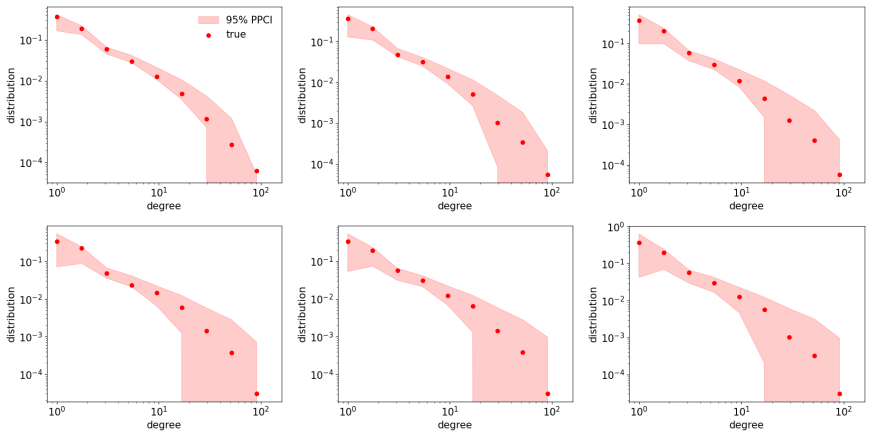
- Asymptotic characterizations show how sparsity and degree heterogeneity behave over time.
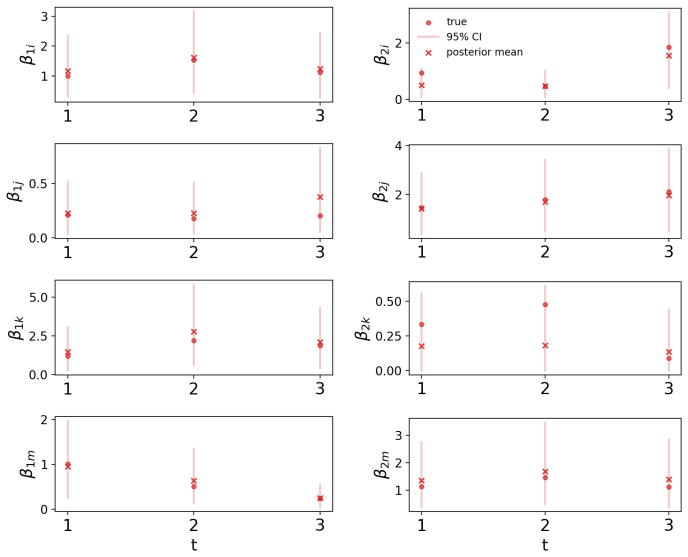
- Applications recover evolving community structure accurately in synthetic and real-world networks.
- The construction generalizes static overlapping block models to dynamic sparse settings.
Where Pith is reading between the lines
- This framework could support forecasting future network structures by projecting the Markov process forward.
- Similar coupling mechanisms might apply to modeling dynamic interactions in other fields like epidemiology or financial networks.
- Relaxing the Markov assumption in extensions could allow for more complex non-Markovian community evolutions.
- Integrating node covariates into the random measures could enhance the model's ability to explain affiliation changes.
Load-bearing premise
That vectors of completely random measures coupled by a latent Markov process can flexibly represent sparsity, power-law degrees, and dynamic overlapping communities in real temporal networks.
What would settle it
A large-scale simulation where networks generated under the model do not exhibit the predicted asymptotic sparsity and power-law degree distributions over time, or where inference fails to recover known community trajectories in controlled synthetic data.
Figures






read the original abstract
Dynamic community detection concerns inferring how community memberships evolve over time, including the emergence, persistence, merging, and dissolution of groups in temporal networks. We propose a Bayesian nonparametric model for time-evolving sparse networks, which captures power-law degree distributions and dynamically overlapping communities. The model is constructed from vectors of completely random measures coupled through a latent Markov process governing the evolution of node affiliations. This construction provides a flexible and interpretable approach to model dynamic communities, naturally generalizing existing overlapping block models to the sparse and scale-free regimes. We establish asymptotic results characterizing sparsity and degree heterogeneity over time, and develop an approximate inference procedure for recovering time-varying community trajectories. Applications to synthetic and real-world dynamic networks show that the model accurately uncovers evolving community structure and yields interpretable temporal patterns.
Editorial analysis
A structured set of objections, weighed in public.
Referee Report
Summary. The manuscript proposes a Bayesian nonparametric model for time-evolving sparse networks that captures power-law degree distributions and dynamically overlapping communities. The construction uses vectors of completely random measures coupled through a latent Markov process on node affiliations, generalizing existing overlapping block models to sparse and scale-free regimes. Asymptotic results characterizing sparsity and degree heterogeneity over time are established, an approximate inference procedure for recovering time-varying community trajectories is developed, and the model is applied to synthetic and real-world dynamic networks.
Significance. If the central claims hold, the work provides a flexible nonparametric framework for dynamic community detection in sparse temporal networks, extending overlapping block models with interpretable evolution of affiliations and explicit asymptotic characterizations of sparsity and heterogeneity. The Markov coupling on CRMs is a natural extension of exchangeable sparse graph constructions and could enable reproducible inference in applications where community persistence, merging, and dissolution must be tracked.
major comments (2)
- [§4] §4 (asymptotics): The claimed characterizations of sparsity and degree heterogeneity over time are load-bearing for the generalization to scale-free regimes, but the manuscript provides no explicit derivation or error bounds linking the latent Markov process parameters to the resulting power-law exponents; the reduction from the coupled CRM construction to the stated asymptotics must be shown in detail rather than asserted.
- [§5] §5 (inference): The approximate inference procedure for time-varying community trajectories is central to the empirical claims, yet no analysis of approximation error, convergence diagnostics, or sensitivity to the Markov transition kernel is supplied; this leaves open whether the recovered trajectories are reliable for the dynamic overlapping structure asserted in the abstract.
minor comments (2)
- [§2] Notation for the vector of CRMs and the Markov process on affiliations should be introduced with a single consolidated table or diagram to avoid repeated re-definition across sections.
- [§6] The real-world data applications would benefit from explicit reporting of network sizes, time spans, and baseline comparisons (e.g., dynamic SBM or Hawkes-process alternatives) in a summary table.
Simulated Author's Rebuttal
We thank the referee for the constructive feedback and positive overall assessment of our manuscript. We address each major comment in detail below and indicate the revisions we will make.
read point-by-point responses
-
Referee: [§4] §4 (asymptotics): The claimed characterizations of sparsity and degree heterogeneity over time are load-bearing for the generalization to scale-free regimes, but the manuscript provides no explicit derivation or error bounds linking the latent Markov process parameters to the resulting power-law exponents; the reduction from the coupled CRM construction to the stated asymptotics must be shown in detail rather than asserted.
Authors: We agree that a fully explicit derivation is necessary to support the asymptotic claims. The current manuscript states the asymptotic characterizations but does not provide the complete reduction from the coupled CRM construction and Markov transition kernel to the power-law exponents and sparsity rates. In the revised version we will expand §4 with a detailed derivation, including explicit error bounds that relate the Markov process parameters to the time-dependent degree heterogeneity and sparsity exponents. revision: yes
-
Referee: [§5] §5 (inference): The approximate inference procedure for time-varying community trajectories is central to the empirical claims, yet no analysis of approximation error, convergence diagnostics, or sensitivity to the Markov transition kernel is supplied; this leaves open whether the recovered trajectories are reliable for the dynamic overlapping structure asserted in the abstract.
Authors: We acknowledge that the manuscript currently validates the inference procedure primarily through empirical results on synthetic and real data without a formal analysis of approximation quality. In the revision we will add a dedicated subsection in §5 that quantifies the variational approximation error, reports convergence diagnostics for the inference algorithm, and includes a sensitivity analysis with respect to the Markov transition kernel parameters. These additions will directly address the reliability of the recovered time-varying community trajectories. revision: yes
Circularity Check
No significant circularity
full rationale
The paper defines a new generative model via vectors of completely random measures coupled by a latent Markov process on node affiliations. This construction is presented as an independent nonparametric extension of existing overlapping block models to sparse, scale-free, dynamic regimes. Asymptotic characterizations of sparsity and degree heterogeneity are asserted to follow from the model definition, and an approximate inference procedure is developed separately. No equation or result in the abstract or summary reduces by construction to a fitted input, self-citation chain, or renamed known pattern; the central claim is the model itself rather than a tautological prediction.
Axiom & Free-Parameter Ledger
axioms (2)
- domain assumption Node affiliations can be represented via vectors of completely random measures.
- domain assumption A latent Markov process governs the temporal evolution of node affiliations.
Lean theorems connected to this paper
-
IndisputableMonolith/Cost/FunctionalEquation.leanwashburn_uniqueness_aczel unclear?
unclearRelation between the paper passage and the cited Recognition theorem.
vectors of completely random measures coupled through a latent Markov process governing the evolution of node affiliations
-
IndisputableMonolith/Foundation/RealityFromDistinction.leanreality_from_one_distinction unclear?
unclearRelation between the paper passage and the cited Recognition theorem.
asymptotic results characterizing sparsity and degree heterogeneity over time (Prop. 2-3)
What do these tags mean?
- matches
- The paper's claim is directly supported by a theorem in the formal canon.
- supports
- The theorem supports part of the paper's argument, but the paper may add assumptions or extra steps.
- extends
- The paper goes beyond the formal theorem; the theorem is a base layer rather than the whole result.
- uses
- The paper appears to rely on the theorem as machinery.
- contradicts
- The paper's claim conflicts with a theorem or certificate in the canon.
- unclear
- Pith found a possible connection, but the passage is too broad, indirect, or ambiguous to say the theorem truly supports the claim.
Reference graph
Works this paper leans on
-
[1]
Airoldi, E. M., Blei, D., Fienberg, S. E. & Xing, E. (2008), ‘Mixed membership stochastic blockmodels’, The Journal of Machine Learning Research 9, 1981–2014. Ball, B., Karrer, B. & Newman, M. E. J. (2011), ‘Efficient and principled method for detecting communities in networks’, Physical Review E 84, 036103. Borgs, C., Chayes, J., Cohn, H. & Holden, N. (20...
work page 2008
-
[2]
(2010), ‘Community detection in graphs’, Physics Reports 486(3-5), 75–174
Fortunato, S. (2010), ‘Community detection in graphs’, Physics Reports 486(3-5), 75–174. 31 Fu, W., Song, L. & Xing, E. P. (2009), Dynamic mixed membership blockmodel for evolv- ing networks, in ‘Proceedings of the 26th Annual International Conference on Machine Learning’, pp. 329–336. Gopalan, P., Hofman, J. M. & Blei, D. M. (2015), Scalable Recommendati...
work page 2010
-
[3]
32 Ishiguro, K., Iwata, T., Ueda, N. & Tenenbaum, J. B. (2010), Dynamic infinite relational model for time-varying relational data analysis, in ‘NIPS’, pp. 919–927. Kallenberg, O. (1990), ‘Exchangeable random measures in the plane’, Journal of Theoretical Probability 3(1), 81–136. Kang, X., Ganguly, A. & Kolaczyk, E. D. (2022), ‘Dynamic networks with mult...
work page 2010
-
[4]
Composable Effects for Flexible and Accelerated Probabilistic Programming in NumPyro
Li, J., Cheung, W. K., Liu, J. & Li, C. (2009), On discovering community trends in social networks, in ‘2009 IEEE/WIC/ACM International Joint Conference on Web Intelligence and Intelligent Agent Technology’, Vol. 1, IEEE, pp. 230–237. Lovász, L. (2013), Large Networks and Graph Limits , Vol. 60 of Colloquium Publications , American Mathematical Society, P...
work page internal anchor Pith review Pith/arXiv arXiv 2009
-
[5]
follow from Remark 5 in Caron et al. (2023) upon noting that 1 − 𝑒−2 ∑𝑝 𝑘=1 𝑤(𝑡) 𝑘𝑖 𝑤(𝑡) 𝑘𝑗 = 1 − 𝑒−2𝑤0𝑖 𝑤0𝑗 ∑𝑝 𝑘=1 𝛽(𝑡) 𝑘𝑖 𝛽(𝑡) 𝑘𝑗 = 1 − 𝑒𝜂(𝑤0𝑖 ,𝑤0𝑗 )𝜔(𝛽(𝑡) 𝑖 ,𝛽(𝑡) 𝑗 ) where 𝜔(𝛽(𝑡) 𝑖 , 𝛽(𝑡) 𝑗 ) ∶= ∑ 𝑝 𝑘=1 𝛽(𝑡) 𝑘𝑖 𝛽(𝑡) 𝑘𝑗 and 𝜂(𝑤0𝑖, 𝑤0𝑗) ∶= 2𝑤0𝑖𝑤0𝑗. To map back to the notation of Caron et al. (2023) we note that 𝑤0𝑖 can be obtained as 𝑤0𝑖 = ̄ 𝜌0 −1(𝜗𝑖), ...
work page 2023
discussion (0)
Sign in with ORCID, Apple, or X to comment. Anyone can read and Pith papers without signing in.