Transfer Learning-Based Surrogate Modeling for Nonlinear Time-History Response Analysis of High-Fidelity Structural Models
Pith reviewed 2026-05-16 22:20 UTC · model grok-4.3
The pith
Transfer learning from low-fidelity simulations builds accurate high-fidelity structural response surrogates from only 20 samples.
A machine-rendered reading of the paper's core claim, the machinery that carries it, and where it could break.
Core claim
A surrogate model pretrained on low-fidelity response data can be transferred to predict high-fidelity nonlinear time-history responses of a 20-story steel moment frame with only 20 high-fidelity training samples, yielding predictions that remain consistent with a site-specific time-based hazard.
What carries the argument
Transfer learning that uses a low-fidelity surrogate as the pretrained base and adapts it to limited high-fidelity data.
If this is right
- High-fidelity surrogate models for detailed structures become practical without collecting hundreds of expensive simulations.
- Performance-based earthquake engineering can incorporate richer structural detail at far lower computational cost.
- Predictions stay consistent with hazard curves, supporting direct use in seismic risk calculations.
- The same low-to-high fidelity transfer step can be repeated for new ground-motion sets without retraining from scratch.
Where Pith is reading between the lines
- The approach may extend to other multi-fidelity problems in engineering where a coarse model already captures the main physics.
- If the transfer holds across different structural types, it could support rapid assessment of building inventories during regional hazard studies.
- Combining the surrogate with incremental high-fidelity updates could allow ongoing refinement as new data become available.
Load-bearing premise
The low-fidelity and high-fidelity models must share enough structural response characteristics that the transferred knowledge generalizes accurately from only 20 high-fidelity samples.
What would settle it
Compare the surrogate predictions against full high-fidelity nonlinear time-history results on a fresh set of ground motions not used in the 20-sample training set; systematic mismatch in peak displacements or other response quantities would show the transfer failed.
Figures






read the original abstract
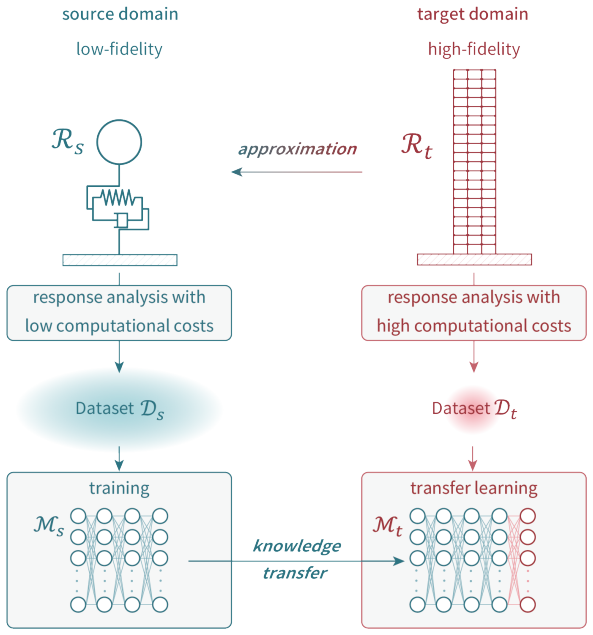
In a performance based earthquake engineering (PBEE) framework, nonlinear time-history response analysis (NLTHA) for numerous ground motions are required to assess the seismic risk of buildings or civil engineering structures. However, such numerical simulations are computationally expensive, limiting the real-world practical application of the framework. To address this issue, previous studies have used machine learning to predict the structural responses to ground motions with low computational costs. These studies typically conduct NLTHAs for a few hundreds ground motions and use the results to train and validate surrogate models. However, most of the previous studies focused on computationally-inexpensive response analysis models such as single degree of freedom. Surrogate models of high-fidelity response analysis are required to enrich the quantity and diversity of information used for damage assessment in PBEE. Notably, the computational cost of creating training and validation datasets increases if the fidelity of response analysis model becomes higher. Therefore, methods that enable surrogate modeling of high-fidelity response analysis without a large number of training samples are needed. This study proposes a framework that uses transfer learning to construct the surrogate model of a high-fidelity response analysis model. This framework uses a surrogate model of low-fidelity response analysis as the pretrained model and transfers its knowledge to construct surrogate models for high-fidelity response analysis with substantially reduced computational cost. As a case study, surrogate models that predict responses of a 20-story steel moment frame were constructed with only 20 samples as the training dataset. The responses to the ground motions predicted by constructed surrogate model were consistent with a site-specific time-based hazard.
Editorial analysis
A structured set of objections, weighed in public.
Referee Report
Summary. The manuscript proposes a transfer learning framework to build surrogate models for high-fidelity nonlinear time-history analysis (NLTHA) of structures. A low-fidelity surrogate is pretrained on cheaper simulations and its knowledge is transferred to construct a high-fidelity surrogate for a 20-story steel moment frame using only 20 high-fidelity training samples; the resulting predictions are stated to be consistent with a site-specific time-based hazard curve.
Significance. If the central claim holds with rigorous validation, the method would meaningfully lower the data-generation cost for high-fidelity structural surrogates in performance-based earthquake engineering, allowing more complex models to be used in risk assessment without hundreds of expensive NLTHA runs.
major comments (2)
- [Abstract] Abstract: the claim that responses 'were consistent with a site-specific time-based hazard' is unsupported by any quantitative error metrics (RMSE, MAE, R², or exceedance probability errors), validation splits, baseline comparisons (transfer vs. scratch training on the same 20 samples), or uncertainty quantification. Without these, the effectiveness of the transfer and the computational-cost reduction cannot be assessed.
- [Case study] Case study description: no information is given on the definition of the low-fidelity model (e.g., element types, damping, or nonlinearity idealization), the transfer-learning architecture (frozen layers, learning-rate schedule, or regularization), or any diagnostic for negative transfer. With only 20 high-fidelity samples, any mismatch in modal properties or nonlinearity patterns between fidelities risks underfitting or degraded performance, yet no such check is reported.
minor comments (1)
- [Abstract] Abstract: the phrase 'substantially reduced computational cost' is not quantified (e.g., wall-clock time or number of NLTHA runs saved relative to a non-transfer baseline).
Simulated Author's Rebuttal
We thank the referee for the constructive feedback on our manuscript. We agree that the abstract claim requires quantitative backing and that the case study section needs expanded technical details on the models and transfer setup. The revised manuscript incorporates these elements to allow proper assessment of the transfer learning approach and its computational benefits.
read point-by-point responses
-
Referee: [Abstract] Abstract: the claim that responses 'were consistent with a site-specific time-based hazard' is unsupported by any quantitative error metrics (RMSE, MAE, R², or exceedance probability errors), validation splits, baseline comparisons (transfer vs. scratch training on the same 20 samples), or uncertainty quantification. Without these, the effectiveness of the transfer and the computational-cost reduction cannot be assessed.
Authors: We acknowledge that the original abstract statement lacked supporting quantitative evidence. In the revision we have added RMSE, MAE, R², and exceedance-probability error metrics computed on a held-out validation set of 10 ground motions, explicit description of the 70/30 train/validation split, direct baseline comparisons of transfer learning versus training from scratch on the identical 20 high-fidelity samples, and uncertainty bands obtained from an ensemble of fine-tuned models. These additions demonstrate both the accuracy of the transferred surrogate and the reduction in required high-fidelity runs. revision: yes
-
Referee: [Case study] Case study description: no information is given on the definition of the low-fidelity model (e.g., element types, damping, or nonlinearity idealization), the transfer-learning architecture (frozen layers, learning-rate schedule, or regularization), or any diagnostic for negative transfer. With only 20 high-fidelity samples, any mismatch in modal properties or nonlinearity patterns between fidelities risks underfitting or degraded performance, yet no such check is reported.
Authors: We have expanded the case-study section to specify the low-fidelity model (2-D frame elements with concentrated plastic hinges, Rayleigh damping calibrated to 5 % critical at the first two modes, and bilinear moment-rotation idealization). The transfer architecture is now detailed: a 4-layer feed-forward network with the first two layers frozen, a cosine-annealing learning-rate schedule starting at 1e-3, and L2 regularization of 1e-4. We also report modal-frequency comparisons (error < 3 %) and pushover-curve similarity metrics between fidelities, together with a negative-transfer diagnostic that shows no performance degradation relative to the scratch-trained baseline. revision: yes
Circularity Check
No circularity: independent pretraining and transfer from low- to high-fidelity surrogates
full rationale
The paper's core framework pretrains a surrogate on low-fidelity NLTHA data (independent of the target high-fidelity model) then adapts it via transfer learning to a 20-story frame using only 20 high-fidelity samples. No equations, fitted parameters, or self-citations are shown that reduce the reported predictions or hazard consistency to the inputs by construction. The derivation chain consists of standard transfer-learning steps whose validity rests on empirical similarity between fidelity levels rather than definitional equivalence or self-referential fitting. This is the normal non-circular case for applied ML papers in structural engineering.
Axiom & Free-Parameter Ledger
free parameters (1)
- Transfer learning hyperparameters
axioms (1)
- domain assumption Low-fidelity and high-fidelity models share transferable response features to ground motions
Lean theorems connected to this paper
-
IndisputableMonolith/Cost/FunctionalEquation.leanwashburn_uniqueness_aczel unclear?
unclearRelation between the paper passage and the cited Recognition theorem.
This study proposes a framework that uses transfer learning to construct the surrogate model of a high-fidelity response analysis model. This framework uses a surrogate model of low-fidelity response analysis as the pretrained model...
-
IndisputableMonolith/Foundation/RealityFromDistinction.leanreality_from_one_distinction unclear?
unclearRelation between the paper passage and the cited Recognition theorem.
surrogate models that predict acceleration and inter-story drift ratio at each floor of a 20-story steel moment frame were constructed with only 20 samples
What do these tags mean?
- matches
- The paper's claim is directly supported by a theorem in the formal canon.
- supports
- The theorem supports part of the paper's argument, but the paper may add assumptions or extra steps.
- extends
- The paper goes beyond the formal theorem; the theorem is a base layer rather than the whole result.
- uses
- The paper appears to rely on the theorem as machinery.
- contradicts
- The paper's claim conflicts with a theorem or certificate in the canon.
- unclear
- Pith found a possible connection, but the passage is too broad, indirect, or ambiguous to say the theorem truly supports the claim.
Reference graph
Works this paper leans on
-
[1]
FEMA. Seismic performance assessment of buildings, volume 1 – methodology second edition, fema p-58-1, 09 2018
work page 2018
-
[2]
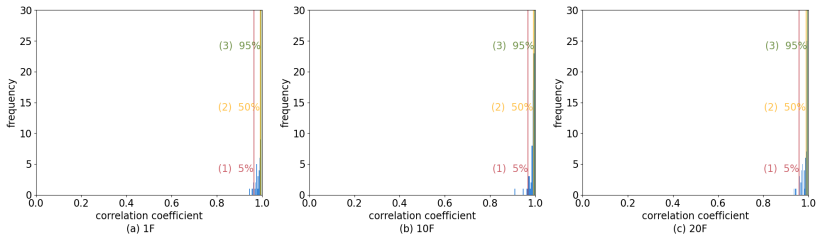
Selim G¨ unay and Khalid M. Mosalam. Peer performance-based earthquake engineering methodology, revisited. Journal of Earthquake Engineering, 17(6):829–858, 2013. 14 Figure 15: Distribution of correlation coefficients between response analyses results and predic- tion byM t,IDR Figure 16: Comparison of response analysis results and prediction byM t,IDR
work page 2013
-
[3]
Jack P. Moehle and Gregory G. Deierlein. A framework methodology for performance-based earthquake engineering. 2004
work page 2004
-
[4]
C. Allin Cornell. Engineering seismic risk analysis. Bulletin of the Seismological Society of America, 58(5):1583–1606, 10 1968
work page 1968
-
[5]
Jong-Wha Bai, Paolo Gardoni, and Mary Beth D. Hueste. Story-specific demand models and seismic fragility estimates for multi-story buildings. Structural Safety, 33(1):96–107, 2011
work page 2011
-
[6]
Ed´ en Boj´ orquez and Jorge Ruiz-Garc´ ıa. Residual drift demands in moment-resisting steel frames subjected to narrow-band earthquake ground motions. Earthquake Engineering & Structural Dynamics, 42(11):1583–1598, 2013
work page 2013
-
[7]
Farahnaz Soleimani and Xi Liu. Artificial neural network application in predicting prob- abilistic seismic demands of bridge components. Earthquake Engineering & Structural Dynamics, 51(3):612–629, 2022
work page 2022
-
[8]
Navarro, Sanjay Govindjee, and Gregory G
Kuanshi Zhong, Javier G. Navarro, Sanjay Govindjee, and Gregory G. Deierlein. Sur- rogate modeling of structural seismic response using probabilistic learning on manifolds. Earthquake Engineering & Structural Dynamics, 52(8):2407–2428, 2023
work page 2023
-
[9]
Mitropoulou and Manolis Papadrakakis
Chara Ch. Mitropoulou and Manolis Papadrakakis. Developing fragility curves based on neural network ida predictions. Engineering Structures, 33(12):3409–3421, 2011. 15 (a) Distribution of the average of correla- tion coefficients ofM t,accel (b) Distribution of the average of correla- tion coefficients ofM t,IDR Figure 17: Distributions of average of corr...
work page 2011
-
[10]
Jack W. Baker. Conditional mean spectrum: Tool for ground-motion selection. Journal of Structural Engineering, 137(3):322–331, 2011
work page 2011
-
[11]
Reza D. D. Esfahani, Fabrice Cotton, Matthias Ohrnberger, and Frank Scherbaum. Tfc- gan: Nonstationary ground-motion simulation in the time–frequency domain using condi- tional generative adversarial network (cgan) and phase retrieval methods. Bulletin of the Seismological Society of America, 113(1):453–467, 12 2022
work page 2022
-
[12]
Florez, Michaelangelo Caporale, Pakpoom Buabthong, Zachary E
Manuel A. Florez, Michaelangelo Caporale, Pakpoom Buabthong, Zachary E. Ross, Dom- niki Asimaki, and Men-Andrin Meier. Data-driven synthesis of broadband earthquake ground motions using artificial intelligence.Bulletin of the Seismological Society of America, 112(4):1979–1996, 04 2022
work page 1979
-
[13]
Junki Yamaguchi, Yusuke Tomozawa, and Toshihide Saka. Site-specific ground-motion waveform generation using a conditional generative adversarial network and generalized inversion technique. Bulletin of the Seismological Society of America, 114(4):2118–2137, 04 2024
work page 2024
-
[14]
Ross, and Kamyar Azizzadenesheli
Yaozhong Shi, Grigorios Lavrentiadis, Domniki Asimaki, Zachary E. Ross, and Kamyar Azizzadenesheli. Broadband ground-motion synthesis via generative adversarial neural op- erators: Development and validation. Bulletin of the Seismological Society of America, 114(4):2151–2171, 03 2024
work page 2024
-
[15]
Yuma Matsumoto, Taro Yaoyama, Sangwon Lee, Takenori Hida, and Tatsuya Itoi. Fun- damental study on probabilistic generative modeling of earthquake ground motion time histories using generative adversarial networks. Japan Architectural Review, 6(1):e12392,
-
[16]
e12392 JAR-2023-0055.R2
work page 2023
-
[17]
Yuma Matsumoto, Taro Yaoyama, Sangwon Lee, Takenori Hida, and Tatsuya Itoi. Gener- ative adversarial networks-based ground-motion model for crustal earthquakes in japan considering detailed site conditions. Bulletin of the Seismological Society of America, 114(6):2886–2911, 09 2024
work page 2024
-
[18]
Waveform- based probabilistic seismic hazard analysis using ground-motion generative models, 2025
Yuma Matsumoto, Taro Yaoyama, Sangwon Lee, Asako Iwaki, and Tatsuya Itoi. Waveform- based probabilistic seismic hazard analysis using ground-motion generative models, 2025
work page 2025
-
[19]
Deep long short-term memory networks for nonlinear structural seismic response prediction
Ruiyang Zhang, Zhao Chen, Su Chen, Jingwei Zheng, Oral B¨ uy¨ uk¨ ozt¨ urk, and Hao Sun. Deep long short-term memory networks for nonlinear structural seismic response prediction. Computers & Structures, 220:55–68, 2019. 16 (a) The distribution of peak floor acceleration at each floor (b) The distribution of inter-story drift ratio at each floor Figure 18...
work page 2019
-
[20]
Multi-end physics-informed deep learning for seismic response estimation
Peng Ni, Limin Sun, Jipeng Yang, and Yixian Li. Multi-end physics-informed deep learning for seismic response estimation. Sensors, 22(10), 2022
work page 2022
-
[21]
Lstm, wavenet, and 2d cnn for nonlinear time history prediction of seismic responses
Chunxiao Ning, Yazhou Xie, and Lijun Sun. Lstm, wavenet, and 2d cnn for nonlinear time history prediction of seismic responses. Engineering Structures, 286:116083, 2023
work page 2023
-
[22]
Taisei Saida and Mayuko Nishio. Exsrnet: Explainable deep learning model for seismic re- sponse prediction with frequency attention mechanism.Engineering Structures, 343:120953, 2025
work page 2025
-
[23]
Physics-guided convolutional neural network (phycnn) for data-driven seismic response modeling
Ruiyang Zhang, Yang Liu, and Hao Sun. Physics-guided convolutional neural network (phycnn) for data-driven seismic response modeling. Engineering Structures, 215:110704, 2020
work page 2020
-
[24]
A comprehensive survey on transfer learning
Fuzhen Zhuang, Zhiyuan Qi, Keyu Duan, Dongbo Xi, Yongchun Zhu, Hengshu Zhu, Hui Xiong, and Qing He. A comprehensive survey on transfer learning. Proceedings of the IEEE, 109(1):43–76, 2021
work page 2021
-
[25]
Dyadic transfer learning for cross- domain image classification
Hua Wang, Feiping Nie, Heng Huang, and Chris Ding. Dyadic transfer learning for cross- domain image classification. pages 551–556, 2011
work page 2011
-
[26]
N Yoshida. Dyneq: a computer program for dynamic analysis of level ground based on equivalent linear method, 1996
work page 1996
-
[27]
Seismic Response Analysis and Design of Buildings Considering Dynamic Soil-Structure Interaction
Architectural Institute of Japan. Seismic Response Analysis and Design of Buildings Considering Dynamic Soil-Structure Interaction. Maruzen, 2006. (in Japanese)
work page 2006
-
[28]
The farthest point strategy for progressive image sampling
Yuval Eldar, Michael Lindenbaum, Moshe Porat, and Yehoshua Zeevi. The farthest point strategy for progressive image sampling. IEEE Transactions on Image Processing, 6:1305– 15, 02 1997. 17 Figure 19: The comparison of peak floor acceleration to the 10000 ground motions selected randomly from the hazard calculated by response analysis and predicted byM t 1...
work page 1997
-
[29]
Optuna: A next-generation hyperparameter optimization framework
Takuya Akiba, Shotaro Sano, Toshihiko Yanase, Takeru Ohta, and Masanori Koyama. Optuna: A next-generation hyperparameter optimization framework. In Proceedings of the 25th ACM SIGKDD International Conference on Knowledge Discovery and Data Mining, 2019
work page 2019
-
[30]
Minjie Zhu, Frank McKenna, and Michael H. Scott. Openseespy: Python library for the opensees finite element framework. SoftwareX, 7:6–11, 2018
work page 2018
-
[31]
Evaluation of the FEMA P-695 Methodology for Quantification of Building Seismic Performance Factors
Charles Kircher, Gregory Deierlein, John Hooper, Helmut Krawinkler, Steve Mahin, Benson Shing, and John Wallace. Evaluation of the FEMA P-695 Methodology for Quantification of Building Seismic Performance Factors. Grant Contract Reports (NISTGCR), National Institute of Standards and Technology, Gaithersburg, MD, 2010-11-15 2010
work page 2010
-
[32]
Hysteretic models that incorpo- rate strength and stiffness deterioration
Luis Ibarra, Ricardo Medina, and Helmut Krawinkler. Hysteretic models that incorpo- rate strength and stiffness deterioration. Earthquake Engineering & Structural Dynamics, 34:1489 – 1511, 10 2005
work page 2005
-
[33]
Dimitrios G. Lignos and Helmut Krawinkler. Deterioration modeling of steel components in support of collapse prediction of steel moment frames under earthquake loading. Journal of Structural Engineering, 137(11):1291–1302, 2011
work page 2011
-
[34]
Modeling and acceptance criteria for seismic design and analysis of tall buildings, 2010
Pacific Earthquake Engineering Research Center. Modeling and acceptance criteria for seismic design and analysis of tall buildings, 2010. PEER Report 2010-111. 20
work page 2010
discussion (0)
Sign in with ORCID, Apple, or X to comment. Anyone can read and Pith papers without signing in.