SNIC: Synthesized Noisy Images using Calibration
Pith reviewed 2026-05-16 21:05 UTC · model grok-4.3
The pith
A dark-frame calibration pipeline for heteroscedastic noise models generates synthesized RAW images that reduce the PSNR gap to real noise by 54-64 percent compared to manufacturer profiles.
A machine-rendered reading of the paper's core claim, the machinery that carries it, and where it could break.
Core claim
By incorporating dark frames into a rigorous calibration and tuning pipeline for heteroscedastic noise models across various sensors, the synthesized noisy RAW images achieve a 54-64% reduction in the PSNR gap to real-world noise when evaluated with a state-of-the-art denoiser, compared to images synthesized using manufacturer-provided noise profiles that do not account for smartphone ISP noise suppression.
What carries the argument
The calibration and tuning pipeline that uses dark frames to capture signal-independent noise components in heteroscedastic noise models for different sensors including DSLR, point-and-shoot, and smartphone.
Load-bearing premise
The dark-frame-based calibration accurately captures the effective noise distribution after smartphone ISP processing and the PSNR improvements generalize beyond the tested denoiser and scenes.
What would settle it
Measuring the PSNR of a different state-of-the-art denoiser on the synthesized images versus real noisy images and finding the gap reduction falls below 50 percent would challenge the claim.
Figures




read the original abstract
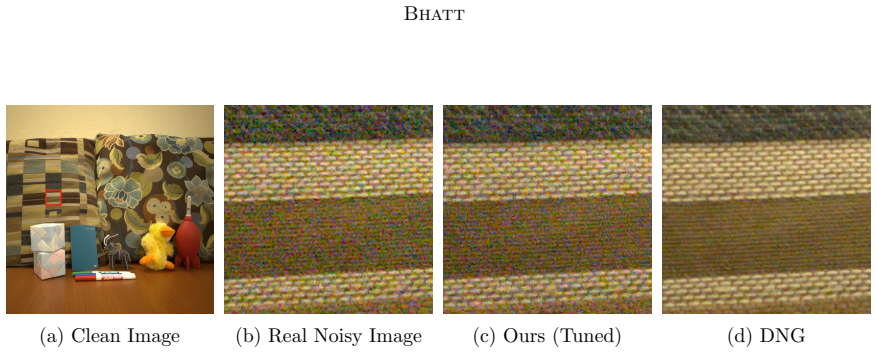
Training advanced denoising models requires large datasets of high-fidelity, physically accurate images. While heteroscedastic noise models can simulate realistic noise, methodologies for their calibration remain under-explored, and large-scale calibrated datasets are scarce. We present a rigorous calibration and tuning pipeline for building high-quality heteroscedastic noise models across a range of sensors, incorporating dark frames to capture signal-independent noise. When evaluated with a state-of-the-art denoiser, our synthesized noisy RAW images reduce the Peak Signal to Noise Ratio (PSNR) gap to real-world noise by 54-64% compared to synthesized RAW images created using manufacturer-provided noise profiles, which fail to account for smart-phone ISP processing that suppresses noise in RAW files during calibration. Leveraging our pipeline, we introduce the Synthesized Noisy Images using Calibration (SNIC) dataset: over 6600 images across 30 scenes and four sensors (DSLR, point-and-shoot, and smartphone), with open-source calibration code and noise models. To our knowledge, SNIC is the only publicly available dataset with calibrated synthesized noise providing paired RAW and TIFF data, offering a new resource for researchers developing noise reduction models.
Editorial analysis
A structured set of objections, weighed in public.
Referee Report
Summary. The paper presents a calibration pipeline for heteroscedastic noise models that uses dark frames to capture signal-independent noise components suppressed by smartphone ISPs. It introduces the SNIC dataset of over 6600 synthesized noisy RAW images across 30 scenes and four sensors, with paired TIFF data and open-source calibration code. The central claim is that SNIC-synthesized images reduce the PSNR gap to real noisy images by 54-64% relative to manufacturer-provided profiles when training a state-of-the-art denoiser.
Significance. If the calibration pipeline is accurate and the reported improvement generalizes, the work supplies a reproducible resource for generating training data for denoising models, particularly for sensors where ISP processing alters effective noise. The open release of the dataset, paired RAW/TIFF pairs, and calibration code is a concrete strength that supports reproducibility.
major comments (2)
- [Experimental Results] The 54-64% PSNR gap reduction (abstract and experimental results) is evaluated exclusively with one state-of-the-art denoiser. No ablations across denoiser families (CNN vs. transformer vs. classical), no per-scene variance, and no statistical tests are reported to confirm the gain is driven by the calibration rather than denoiser-specific sensitivity. This is load-bearing for the headline claim that the synthesized images produce generally superior training data.
- [Experimental Results] The evaluation protocol, baseline details, and error analysis are insufficiently specified, preventing verification of whether post-hoc choices or limited testing affect the 54-64% figure (as reflected in the low soundness rating).
minor comments (1)
- [Abstract] The abstract refers to 'a state-of-the-art denoiser' without naming the model or architecture; this detail should be stated explicitly for reproducibility.
Simulated Author's Rebuttal
We thank the referee for the constructive feedback on our manuscript. We address the major comments point-by-point below, agreeing where additional details are warranted and providing justification for our experimental choices. We will incorporate clarifications and supplementary analyses in the revised version to improve verifiability.
read point-by-point responses
-
Referee: [Experimental Results] The 54-64% PSNR gap reduction (abstract and experimental results) is evaluated exclusively with one state-of-the-art denoiser. No ablations across denoiser families (CNN vs. transformer vs. classical), no per-scene variance, and no statistical tests are reported to confirm the gain is driven by the calibration rather than denoiser-specific sensitivity. This is load-bearing for the headline claim that the synthesized images produce generally superior training data.
Authors: We selected a representative state-of-the-art denoiser to evaluate the practical utility of the SNIC calibration pipeline, as our core claim concerns the improvement in training data quality for such models relative to manufacturer profiles. The headline result is framed specifically around this evaluation rather than universality across all possible denoisers. To address the concern about consistency, we will add per-scene PSNR variance reporting and statistical significance tests (e.g., paired t-tests across scenes) in the revised manuscript. Comprehensive ablations across CNN, transformer, and classical families fall outside the primary scope of demonstrating the calibration method and releasing the dataset; we maintain that the reported gains support the value of SNIC as training data without requiring exhaustive cross-architecture validation. revision: partial
-
Referee: [Experimental Results] The evaluation protocol, baseline details, and error analysis are insufficiently specified, preventing verification of whether post-hoc choices or limited testing affect the 54-64% figure (as reflected in the low soundness rating).
Authors: We agree that the current manuscript would benefit from expanded specification of the evaluation protocol. In the revision, we will include detailed descriptions of the denoiser architecture and training hyperparameters, exact baseline implementation steps, the precise method for computing the PSNR gap to real noise, and any error or variance analysis performed. These additions will enable full reproduction and verification of the 54-64% figure. revision: yes
Circularity Check
No circularity: empirical PSNR gap reduction measured against real data
full rationale
The paper's central result is an empirical comparison: SNIC-synthesized noisy RAW images, produced via a dark-frame calibration pipeline, are fed to one denoiser and yield a 54-64% smaller PSNR gap to real noisy images than manufacturer-profile syntheses. This metric is computed directly from held-out real captures and is not algebraically or statistically forced by the calibration parameters. No equations define the reported improvement in terms of the fitted noise model; no self-citation supplies a uniqueness theorem or ansatz; the calibration itself uses independent dark-frame measurements rather than the target PSNR quantity. The derivation chain therefore remains self-contained and externally falsifiable.
Axiom & Free-Parameter Ledger
free parameters (1)
- heteroscedastic noise parameters
axioms (1)
- domain assumption Heteroscedastic noise model is appropriate for RAW sensor data
Reference graph
Works this paper leans on
- [1]
-
[2]
[ 2 ] A. Abdelrahman and B. M. A. A. B. M. S., ``Noise flow: Noise modeling with conditional normalizing flows,'' in Proceedings of the IEEE/CVF international conference on computer vision (ICCV), 2019, pp. 3165--3173
work page 2019
-
[3]
[ 3 ] Adobe Systems Incorporated, Digital negative (DNG) specification. Adobe, 2023. Available: https://helpx.adobe.com/photoshop/digital-negative.html
work page 2023
-
[4]
[ 4 ] G. E. Healey and R. Kondepudy, ``Radiometric CCD camera calibration and noise estimation,'' IEEE Transactions on Pattern Analysis and Machine Intelligence, vol. 16, no. 3, pp. 267--276, 1994, doi: 10.1109/34.273734 https://doi.org/10.1109/34.273734
-
[5]
[ 5 ] C. Chen, Q. Chen, J. Xu, and V. Koltun, ``Learning to see in the dark,'' in Proceedings of the IEEE/CVF conference on computer vision and pattern recognition (CVPR), 2018, pp. 3291--3300
work page 2018
-
[6]
[ 6 ] A. Abdelhamed, S. Lin, and M. S. Brown, ``A high-quality denoising dataset for smartphone cameras,'' in Proceedings of the IEEE/CVF conference on computer vision and pattern recognition (CVPR), 2018, pp. 1692--1700
work page 2018
-
[7]
One family, six distributions -- A flexible model for insurance claim severity
[ 7 ] J. Anaya and A. Ortiz, ``RENOIR: A dataset for real low-light image noise reduction,'' arXiv preprint arXiv:1805.10854, 2018
work page internal anchor Pith review Pith/arXiv arXiv 2018
-
[8]
[ 8 ] T. Plötz and S. Roth, ``Benchmarking denoising algorithms with real photographs,'' Proceedings of the IEEE Conference on Computer Vision and Pattern Recognition (CVPR), pp. 1586--1595, 2017
work page 2017
-
[9]
[ 9 ] K. Wei, Y. Fu, J. Yang, Z. Ying, Y. Gao, and H. Huang, ``A physics-based noise formation model for extreme low-light raw denoising,'' in Proceedings of the IEEE/CVF conference on computer vision and pattern recognition (CVPR), 2020, pp. 10011--10020
work page 2020
-
[10]
[ 10 ] B. Flepp, Y. Mei, Z. Xia, Z. Xia, Z. Xia, et al. , ``Real-world mobile image denoising dataset with efficient baselines,'' in Proceedings of the IEEE/CVF conference on computer vision and pattern recognition (CVPR), 2024, pp. 19635--19645. Available: https://openaccess.thecvf.com/content/CVPR2024/papers/Flepp_Real-World_Mobile_Image_Denoising_Datas...
work page 2024
-
[11]
[ 11 ] J. Xu, H. Li, Z. Liang, and D. Zhang, ``Real-world noisy image denoising: A new benchmark,'' arXiv preprint arXiv:1804.02603, 2018, Available: https://arxiv.org/abs/1804.02603
work page internal anchor Pith review Pith/arXiv arXiv 2018
-
[12]
[ 12 ] L. Chen, X. Chu, X. Zhang, and J. Sun, ``Simple baselines for image restoration,'' in Computer vision -- ECCV 2022: 17th european conference, tel aviv, israel, october 23--27, 2022, proceedings, part VII, 2022, pp. 17--33. doi: 10.1007/978-3-031-20071-7\_2 https://doi.org/10.1007/978-3-031-20071-7_2
-
[13]
The Unreasonable Effectiveness of Deep Features as a Perceptual Metric
[ 13 ] R. Zhang, P. Isola, A. A. Efros, E. Shechtman, and O. Wang, ``The unreasonable effectiveness of deep features as a perceptual metric,'' in Proceedings of the IEEE conference on computer vision and pattern recognition (CVPR), 2018. doi: 10.48550/arXiv.1801.03924 https://doi.org/10.48550/arXiv.1801.03924
work page internal anchor Pith review Pith/arXiv arXiv doi:10.48550/arxiv.1801.03924 2018
-
[14]
[ 14 ] Z. Wang, A. C. Bovik, H. R. Sheikh, and E. P. Simoncelli, ``Image quality assessment: From error visibility to structural similarity,'' IEEE Transactions on Image Processing, vol. 13, no. 4, pp. 600--612, 2004, doi: 10.1109/TIP.2003.819861 https://doi.org/10.1109/TIP.2003.819861. CSLReferences Appendix appendix Following are additional plots of LPI...
discussion (0)
Sign in with ORCID, Apple, or X to comment. Anyone can read and Pith papers without signing in.