BeppoSAX-WFC catalog of fast X-ray transients
Pith reviewed 2026-05-16 21:04 UTC · model grok-4.3
The pith
BeppoSAX data yields a catalog of 149 fast X-ray transients split by a clear bimodal distribution into gamma-ray bursts and stellar flares.
A machine-rendered reading of the paper's core claim, the machinery that carries it, and where it could break.
Core claim
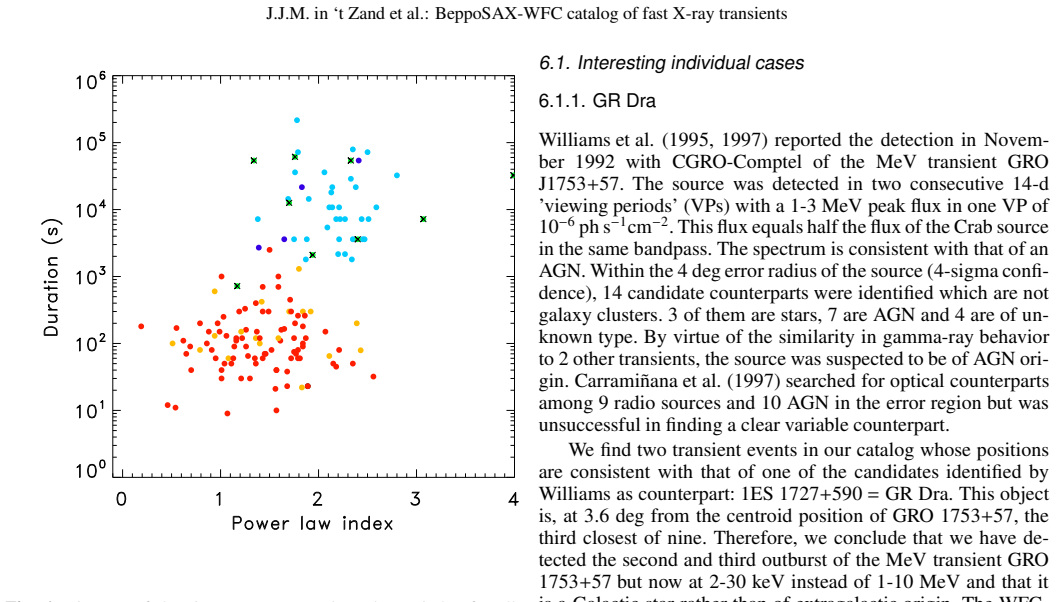
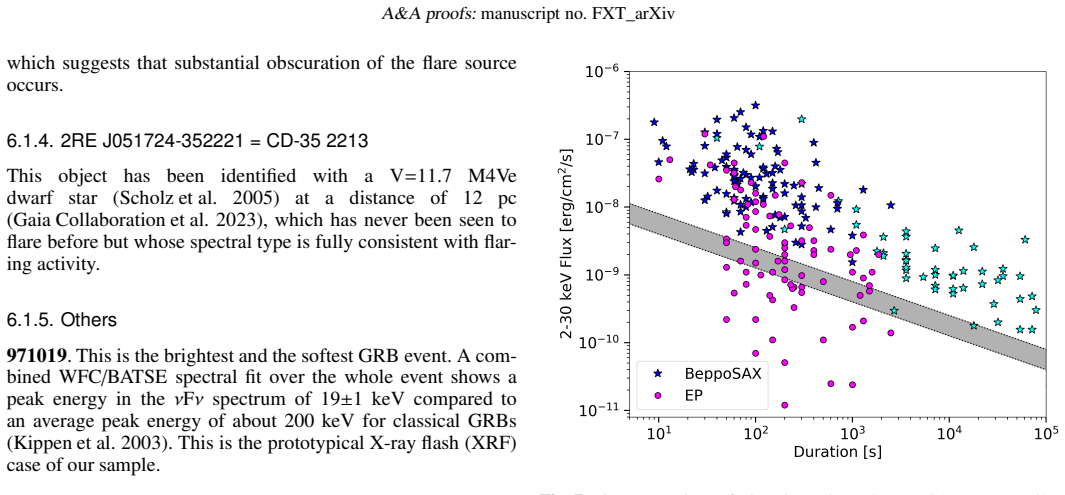
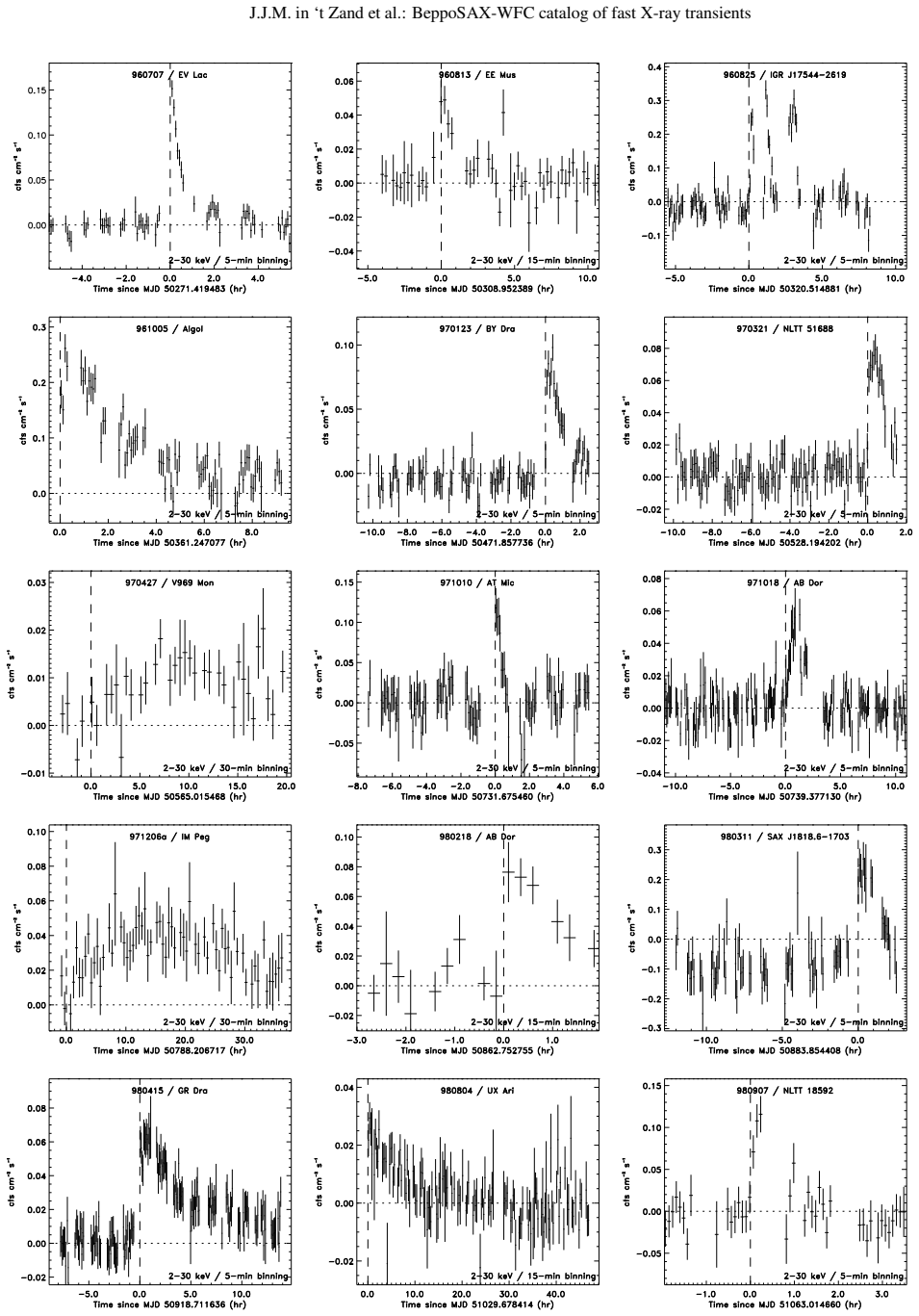
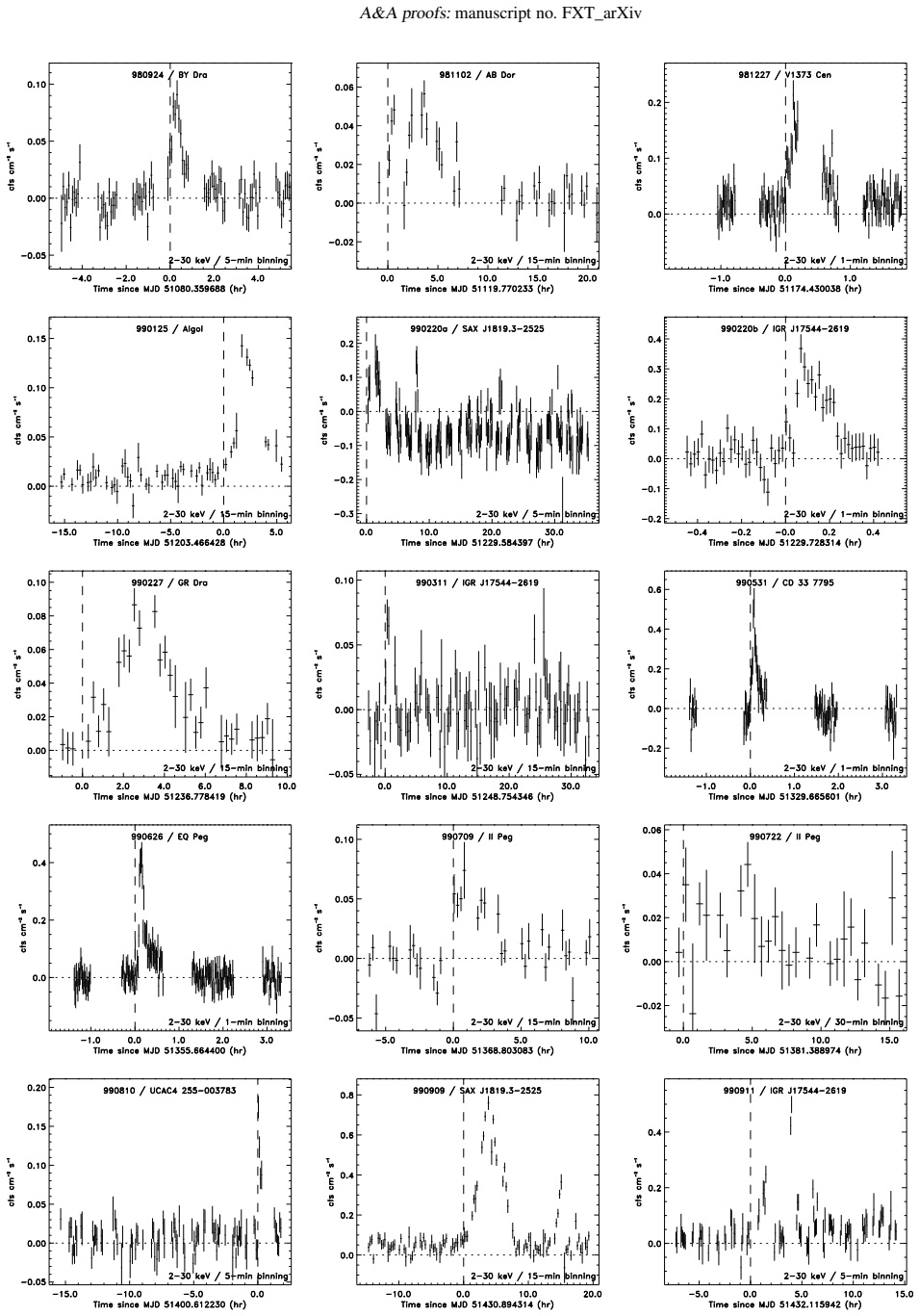
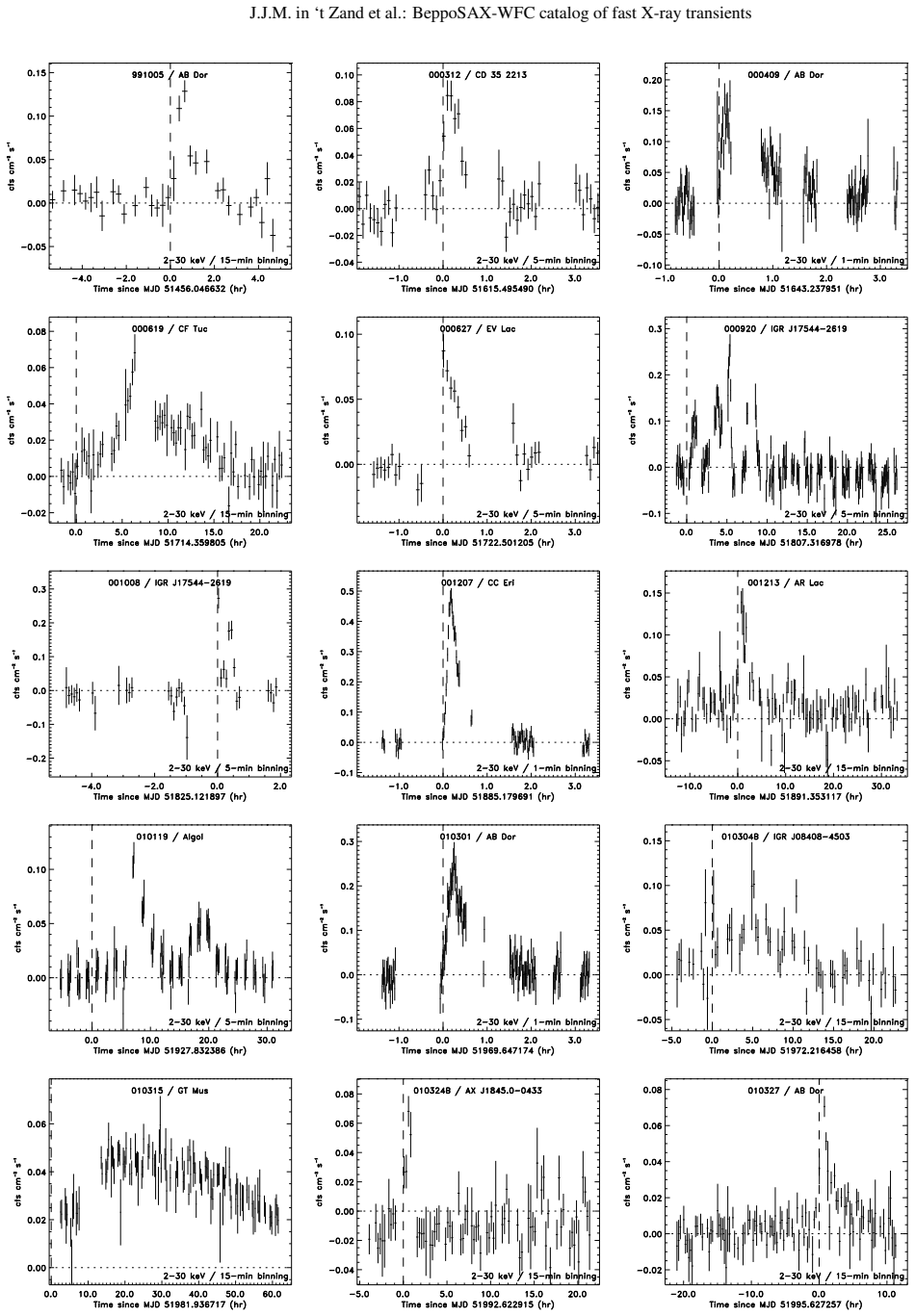
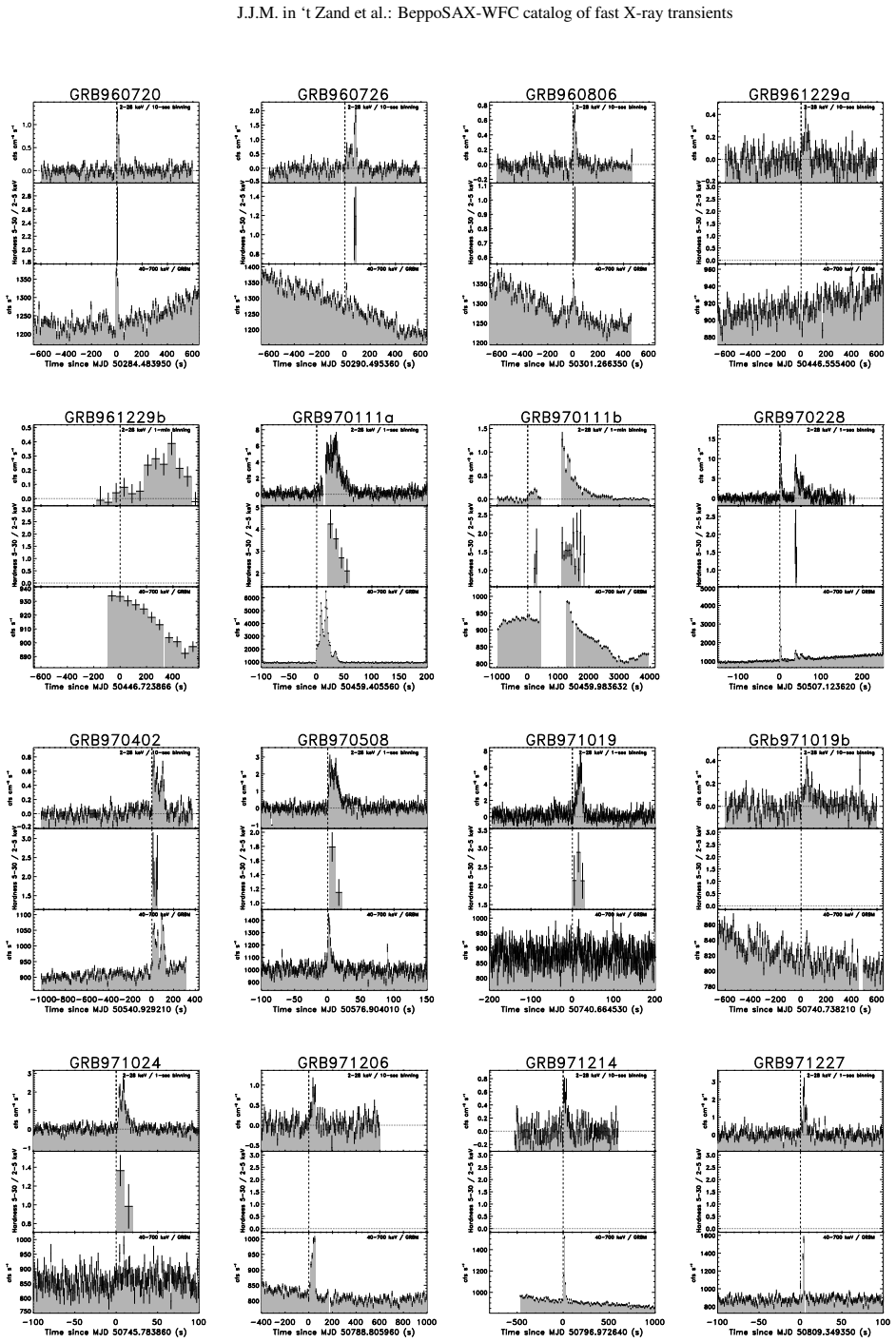
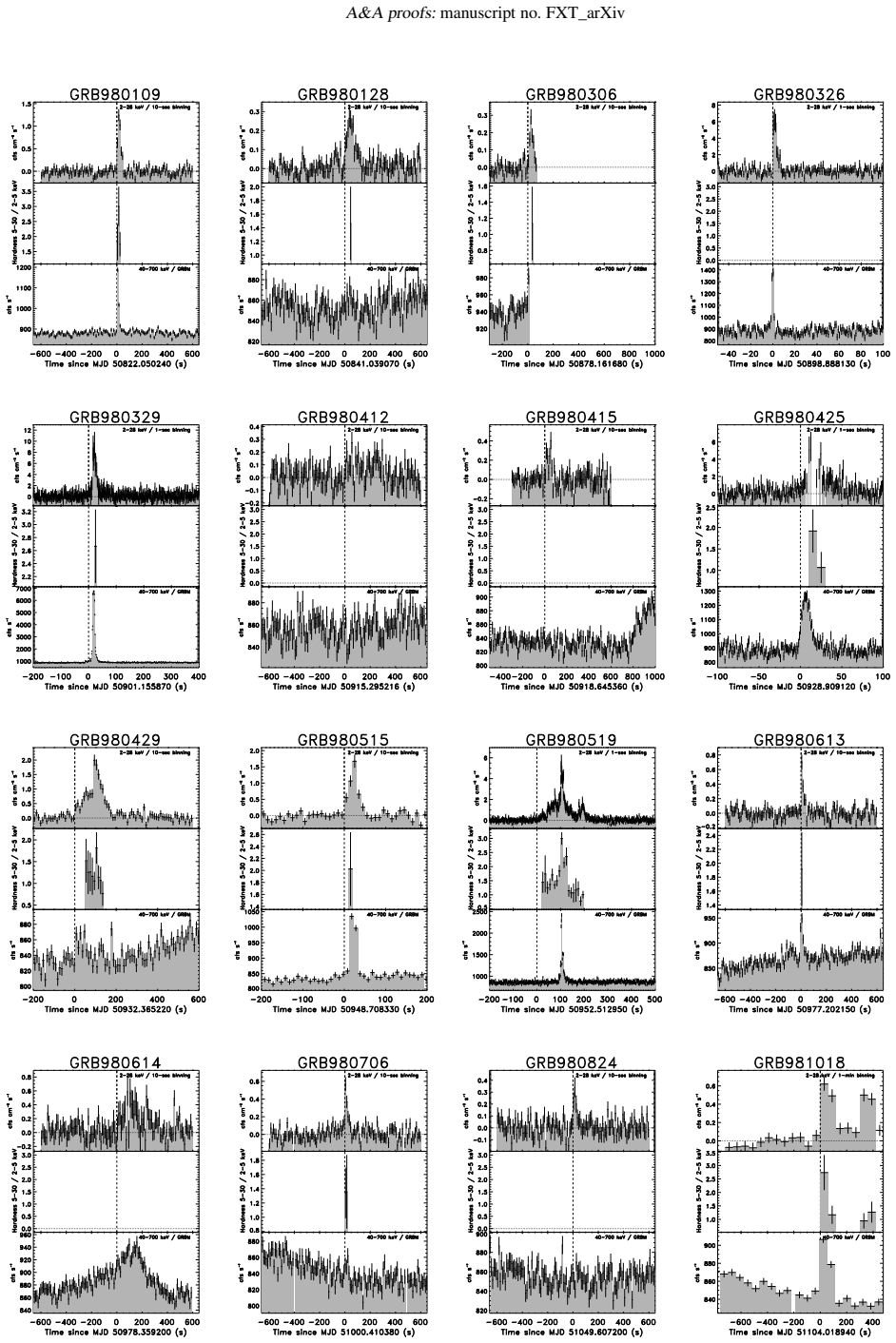
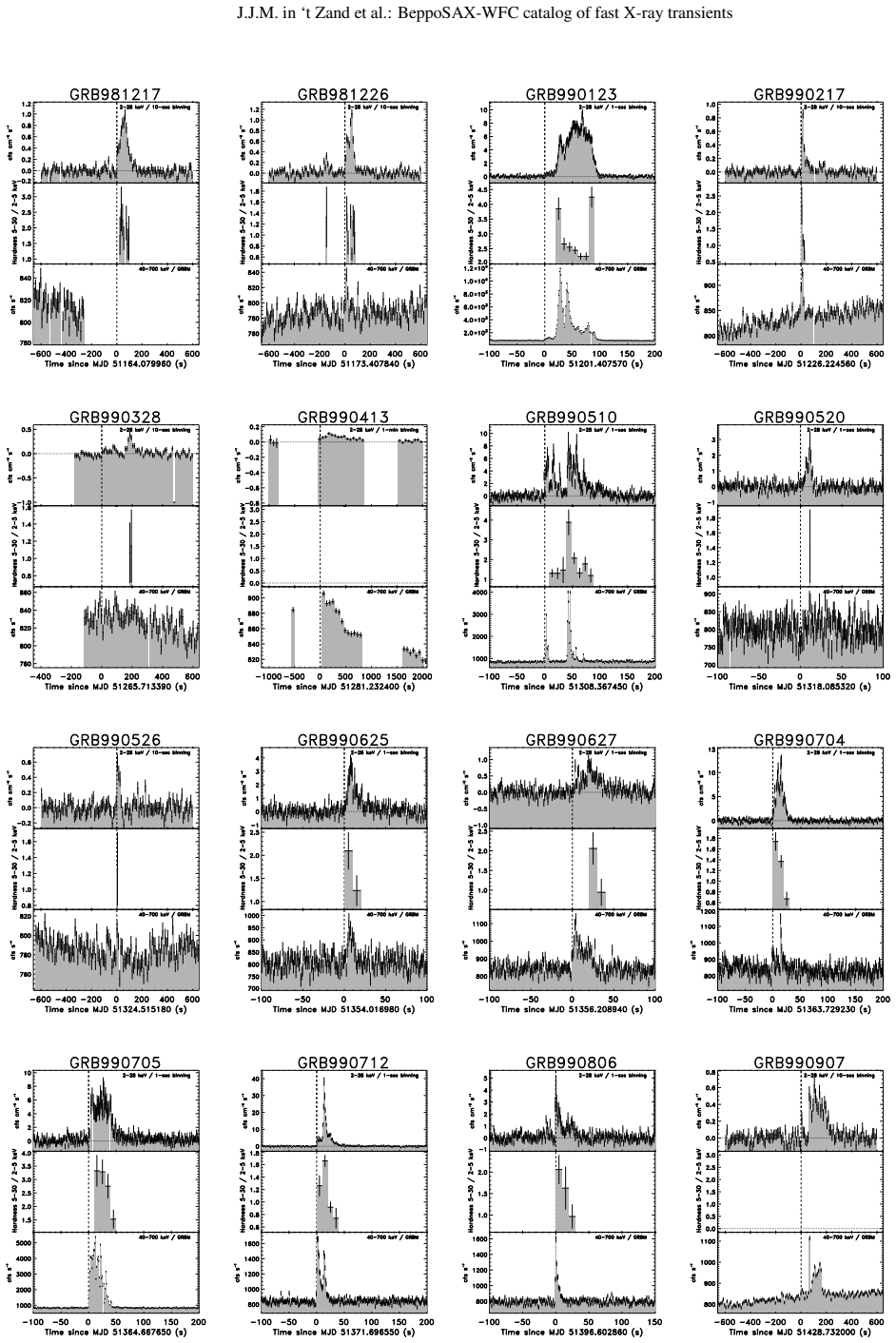
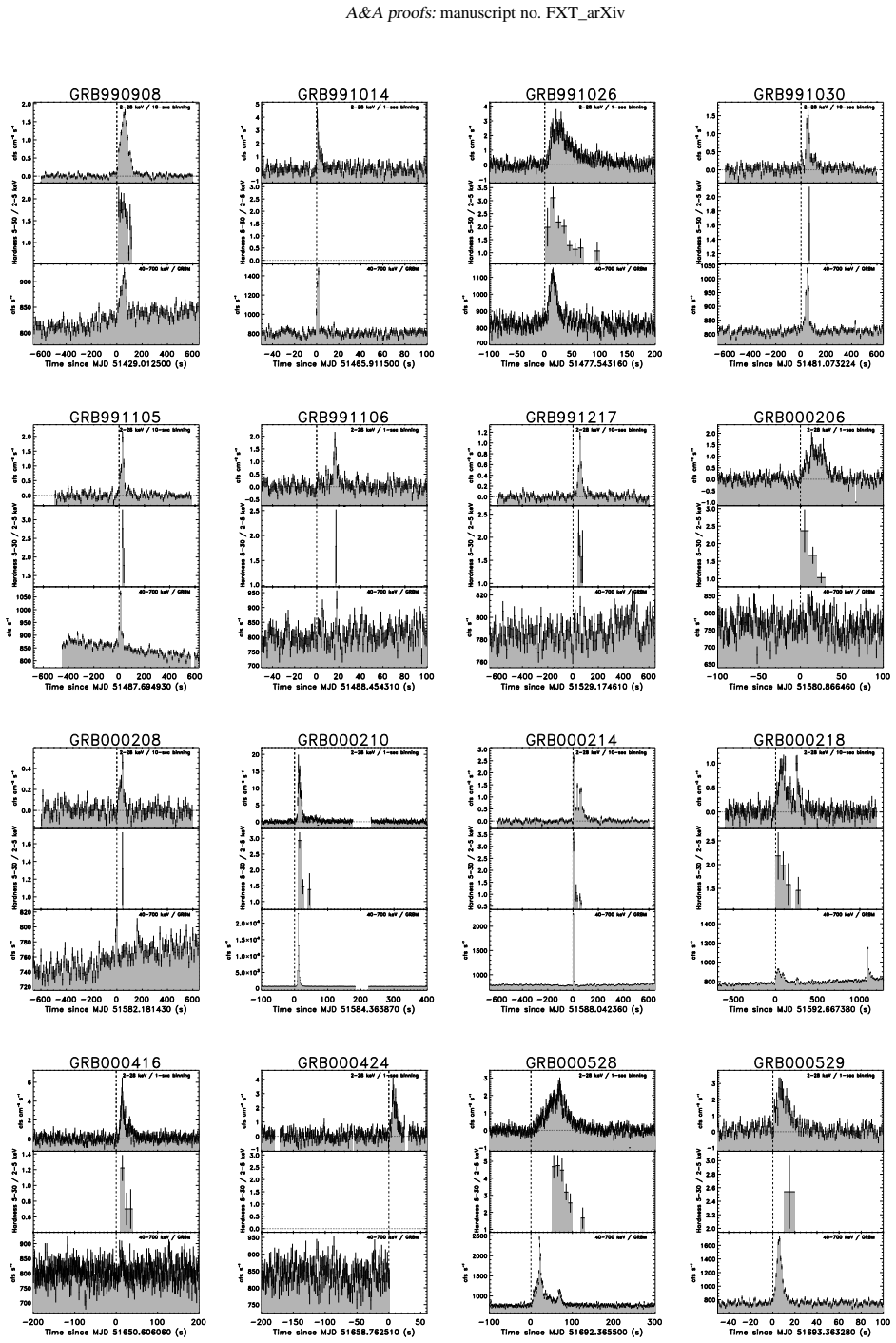
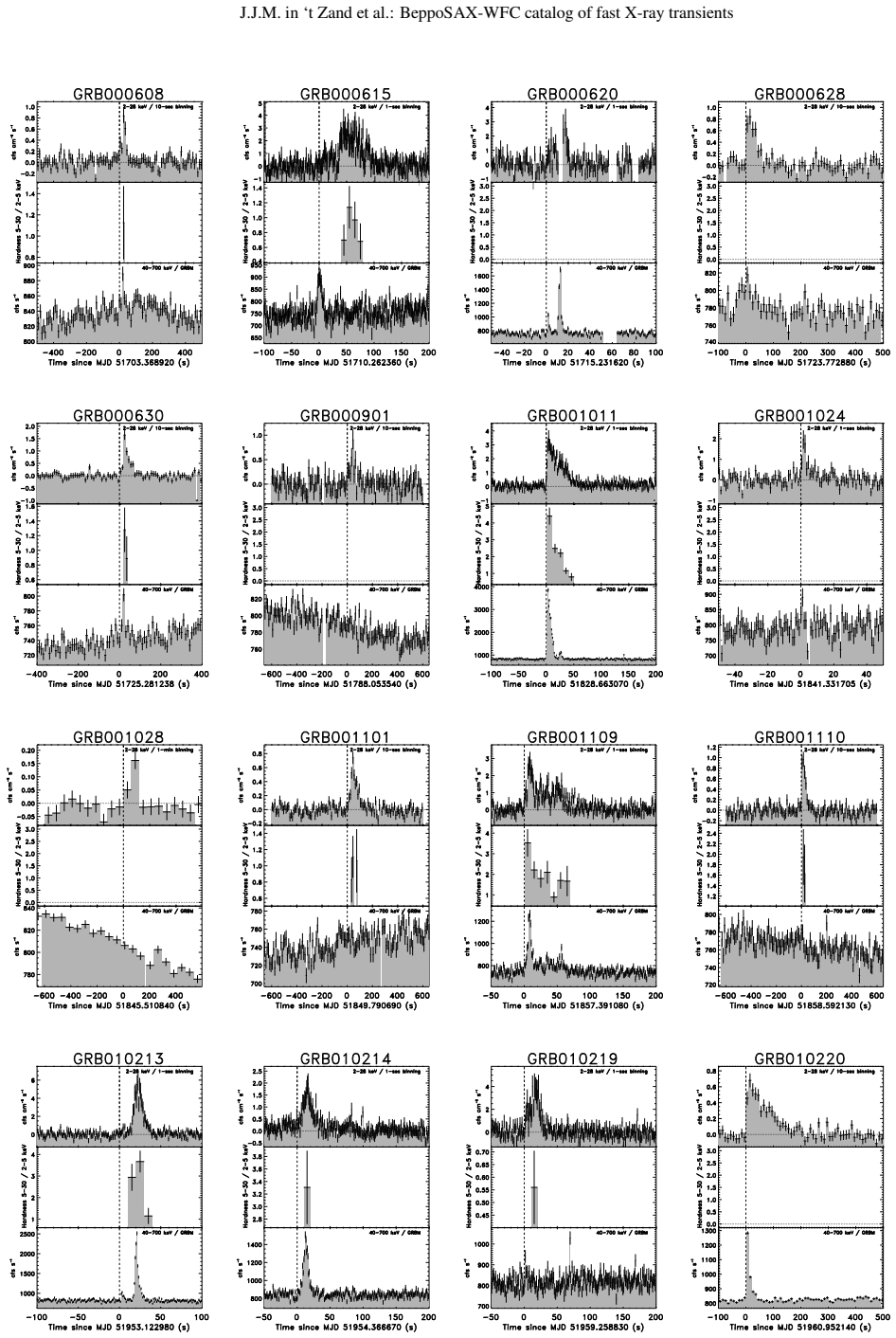
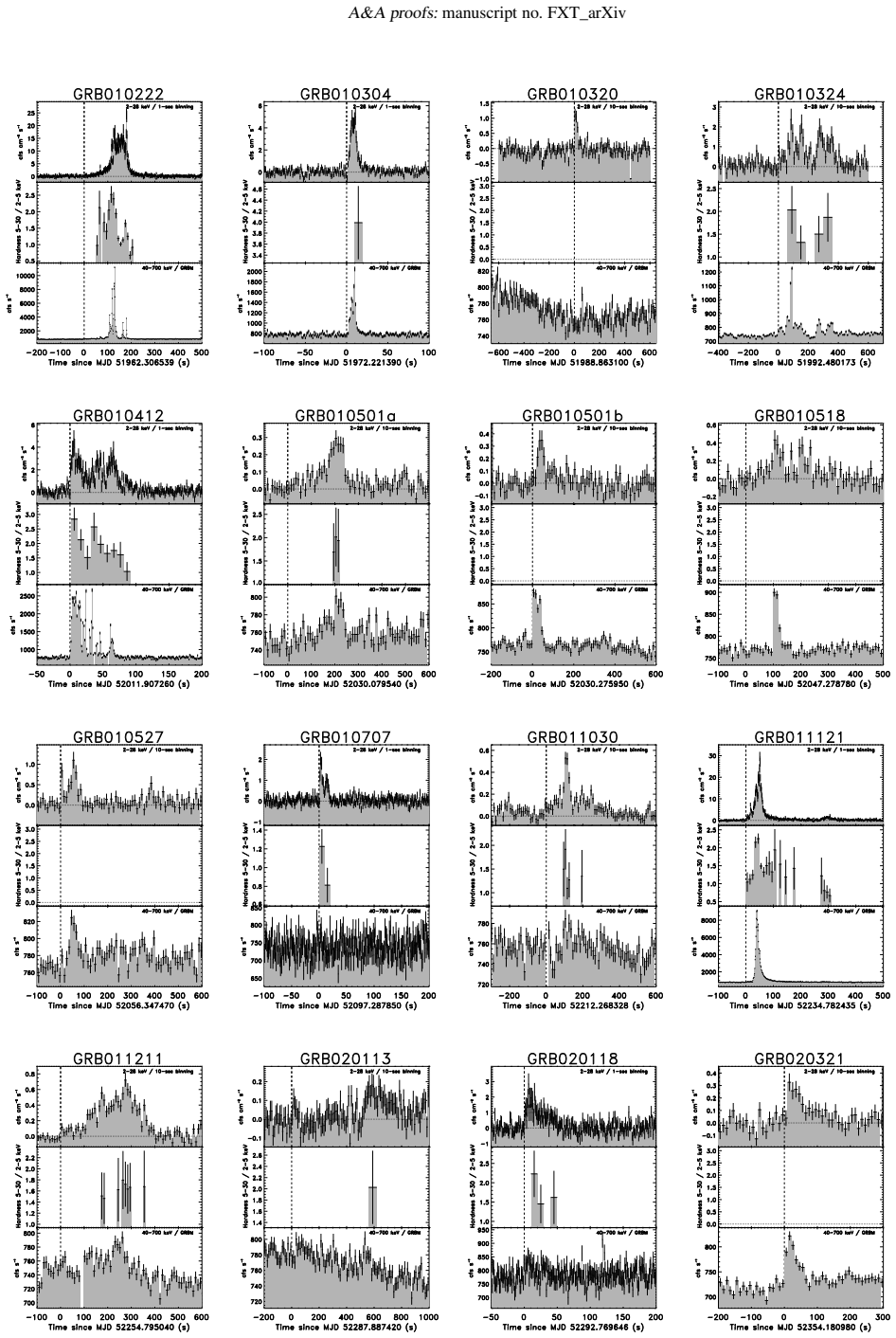
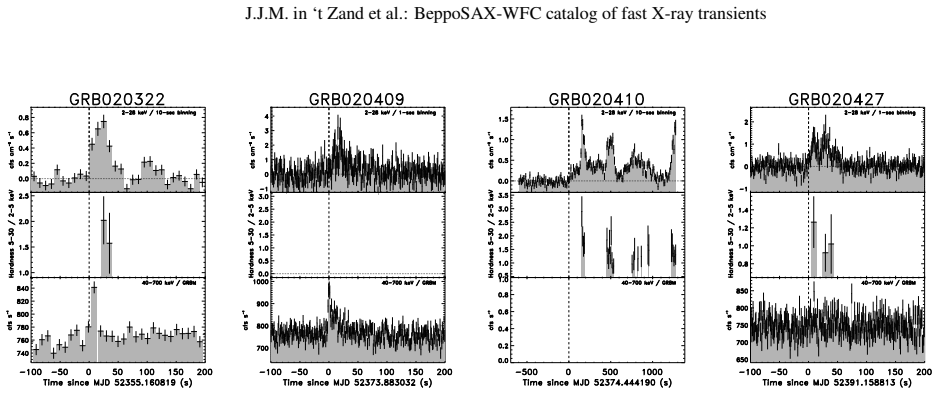
The BeppoSAX-WFC catalog contains 149 fast X-ray transients, 63 new to the literature. The duration and spectral hardness distribution of the full set is bimodal, separating events shorter than about 1 ksec with relatively hard spectra, identified as GRBs and XRFs, from longer events with relatively soft spectra, identified as flares from nearby late-type stars and X-ray binaries. The catalog includes 38 flares from 22 nearby stars (three of which had not been seen flaring before), eleven flares from known high-mass X-ray binaries, and 100 GRBs (24 previously unpublished), of which 37 percent are classified as XRFs on the basis of their large X-ray to gamma-ray flux ratios.
What carries the argument
The bimodal distribution of fast X-ray transients in duration and spectral hardness, used to classify short-hard events as GRBs and XRFs and long-soft events as stellar and binary flares.
If this is right
- The 63 newly reported events provide targets for follow-up observations to confirm their nature and measure distances.
- The re-identification of GRO J1753+57 with the flaring star GR Dra removes it from the list of candidate active galactic nuclei.
- The 37 percent fraction of X-ray-detected GRBs classified as XRFs quantifies the relative occurrence of soft-spectrum bursts in the BeppoSAX era.
- Consistency with the Einstein Probe sample after sensitivity correction implies that the two populations of FXTs are stable across different instruments and epochs.
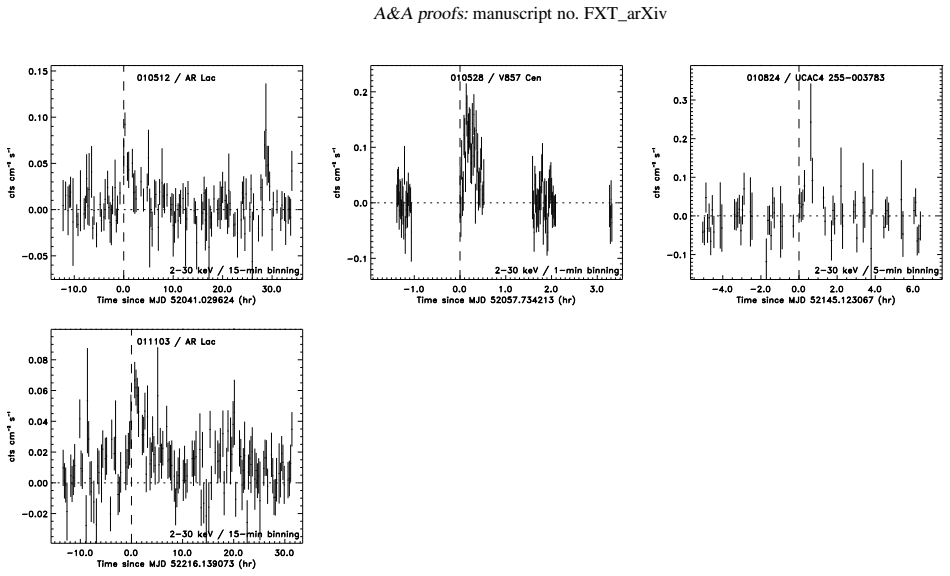
- The three newly identified flaring stars (NLTT 51688, GR Dra, UCAC4 255-003783) expand the known sample of X-ray-active late-type stars.
Where Pith is reading between the lines
- The catalog supplies a ready-made reference sample for estimating the all-sky rate of each FXT class once selection effects are modeled.
- Surveys with similar wide-field sensitivity can adopt the same duration-hardness cut to pre-classify new transients before optical or radio follow-up.
- Repeated monitoring of the three newly flaring stars could test whether their X-ray activity correlates with optical variability on longer timescales.
- Archival searches in other wide-field X-ray data sets could apply the same bimodal criteria to enlarge the total known population.
Load-bearing premise
The 149 events are correctly classified into the two groups and matched to known sources using only duration, spectral hardness, and positional coincidence, without detailed false-positive rates.
What would settle it
A substantial population of events with durations near 1 ksec or intermediate hardness ratios that cannot be cleanly assigned to either the GRB/XRF or stellar-flare groups, or repeated failures to confirm positional coincidences with the claimed stars and binaries.
Figures
read the original abstract
We performed a search for fast X-ray transients (FXTs), with durations longer than one second and less than one day, through data of the Wide Field Camera (WFC) instrument onboard the BeppoSAX X-ray observatory collected between June 1996 and April 2002. (..) We focused our search on gamma-ray bursts (GRBs), X-ray flashes (XRFs), X-ray flares from high-mass X-ray binaries and stellar flares, while Type-I and II X-ray bursts from Galactic neutron stars were excluded. 149 such fast transient events were detected. 63 of these are new to the literature. 38 flares are identified with 22 nearby stars. Three stars have never been seen flaring before in X-rays or optical (NLTT 51688, GR Dra and UCAC4 255-003783). We find that the MeV transient GRO J1753+57 is most likely the same object as GR Dra rather than an AGN as previously thought. Eleven flares were detected from known high-mass X-ray binaries with irregular wind accretion (four of which are of the subclass of supergiant fast X-ray transients). 100 GRBs were identified of which 24 have not been published before. We classify 37% of the X-ray detected GRBs as XRFs with relatively large X-ray to gamma-ray flux ratio, gamma-rays being measured with the BeppoSAX Gamma Ray Burst Monitor. The duration/spectral hardness distribution of all FXTs is bimodal, separating the group roughly in transients shorter and longer than 1 ksec and with relatively hard and soft spectra, respectively. We identify the 'short' FXTs as GRBs and XRFs and the `long' FXTs as flares from nearby late-type stars and X-ray binaries. The BeppoSAX-WFC FXT sample is found to be consistent with the one observed by Einstein Probe, when the sensitivity of the two instruments is taken into account.
Editorial analysis
A structured set of objections, weighed in public.
Referee Report
Summary. The manuscript reports a search for fast X-ray transients (FXTs) with durations 1 s to 1 day in BeppoSAX-WFC data (1996–2002). The authors detect 149 events (63 new to the literature), excluding Type I/II bursts. They classify 100 as GRBs (24 unpublished, 37% of which are XRFs), 38 as flares from 22 nearby stars (including 3 new identifications), and 11 from known HMXBs (4 supergiant fast X-ray transients). The duration/spectral hardness distribution is reported as bimodal, separating short-hard events (identified as GRBs/XRFs) from long-soft events (stellar flares and X-ray binaries), with the sample stated to be consistent with Einstein Probe observations after sensitivity correction.
Significance. If the sample construction and classifications hold, the work supplies a substantial archival catalog of FXTs that bridges pre-Swift and modern wide-field monitors, quantifies the relative populations of GRB-like versus flare-like transients, and supplies concrete source identifications (including three previously undetected stellar flares). The reported bimodality and cross-mission consistency would be useful reference points for population studies once the detection pipeline is fully documented.
major comments (3)
- [search methodology and event selection] The detection pipeline description provides no quantitative detection threshold, background model, or false-positive rate for the 149 events. Without these, the headline counts and the claimed bimodality at ~1 ks cannot be assessed for contamination by background fluctuations, particularly in the long-duration sample.
- [source identification and classification] The 38 stellar-flare identifications rest on positional coincidence with 22 stars inside WFC error circles, yet no Poisson probability for random alignments or chance-coincidence rate is supplied. This directly affects the reliability of the long-FXT count and the separation from the GRB population.
- [GRB and XRF classification] The statement that 37% of the X-ray-detected GRBs are XRFs is based on X-ray-to-gamma-ray flux ratios measured with the GRBM, but no completeness correction, selection bias discussion, or comparison to the full GRB sample is given, weakening the XRF fraction claim.
minor comments (3)
- [individual source notes] The abstract states that GRO J1753+57 is most likely the same object as GR Dra; the supporting positional and temporal evidence should be shown explicitly in a dedicated subsection or table.
- [statistical analysis of the FXT population] The duration/hardness bimodality is described qualitatively; a quantitative test (e.g., mixture-model likelihood ratio or dip statistic) with the actual data points would strengthen the claim.
- [tables and figures] Table or figure captions should list the exact number of events in each subclass and the adopted duration/hardness cuts so that the bimodality separation is reproducible from the published material.
Simulated Author's Rebuttal
We thank the referee for the constructive and detailed comments, which have helped us strengthen the manuscript. We have revised the text to address the concerns on detection methodology, identification statistics, and classification biases by adding quantitative details and clarifications. Our point-by-point responses follow.
read point-by-point responses
-
Referee: The detection pipeline description provides no quantitative detection threshold, background model, or false-positive rate for the 149 events. Without these, the headline counts and the claimed bimodality at ~1 ks cannot be assessed for contamination by background fluctuations, particularly in the long-duration sample.
Authors: We agree that the original manuscript provided insufficient quantitative detail on the detection pipeline. In the revised version we have expanded the methods section to specify: a detection threshold of 5 sigma above the local background, a background model constructed from a running average of the WFC count rate with known sources masked, and a false-positive rate estimated via Monte Carlo simulations of background-only light curves. These simulations indicate an expected contamination below 5 percent in the long-duration sample. The added material confirms that the reported bimodality near 1 ks is not produced by background fluctuations. revision: yes
-
Referee: The 38 stellar-flare identifications rest on positional coincidence with 22 stars inside WFC error circles, yet no Poisson probability for random alignments or chance-coincidence rate is supplied. This directly affects the reliability of the long-FXT count and the separation from the GRB population.
Authors: We have now computed the chance-coincidence probabilities using Poisson statistics, adopting the typical WFC error-circle radius of approximately 3 arcmin and local stellar densities from the Tycho-2 and 2MASS catalogs. The expected number of random alignments across the 38 events is 0.8, implying that the large majority of associations are physical. This calculation and the resulting probabilities have been added to Section 3.2, reinforcing the reliability of the stellar-flare sample and the separation from the GRB population. revision: yes
-
Referee: The statement that 37% of the X-ray-detected GRBs are XRFs is based on X-ray-to-gamma-ray flux ratios measured with the GRBM, but no completeness correction, selection bias discussion, or comparison to the full GRB sample is given, weakening the XRF fraction claim.
Authors: We acknowledge that the original text omitted an explicit discussion of selection biases and completeness. The revised manuscript now includes a dedicated paragraph noting that the WFC X-ray trigger preferentially selects events with higher X-ray to gamma-ray ratios, naturally producing a higher XRF fraction than gamma-ray-selected samples. While a full end-to-end completeness correction lies beyond the scope of this archival study, we compare the observed 37 percent fraction to published values from other X-ray-selected GRB samples (typically 30-40 percent) and find consistency. This addition provides the requested context. revision: partial
Circularity Check
No circularity: empirical catalog from direct data search
full rationale
The paper reports an empirical search through archived BeppoSAX-WFC observations, yielding 149 detected FXTs (63 new), with classifications based on observed duration, spectral hardness, and positional coincidence with known sources. No equations, model fits, predictions, or derivations appear; the bimodality claim and source identifications are direct observational summaries without self-referential loops, fitted inputs renamed as predictions, or load-bearing self-citations. The analysis is self-contained, with external consistency checks (e.g., Einstein Probe) that do not reduce to the paper's own inputs.
Axiom & Free-Parameter Ledger
free parameters (1)
- Duration thresholds (1s to 1 day)
axioms (1)
- domain assumption Events with durations between 1 second and 1 day that are not Type I or II X-ray bursts qualify as fast X-ray transients of interest.
Forward citations
Cited by 1 Pith paper
-
Probing a new subclass of llGRB-SN transients: Insights from EP250304a and its associated supernova
EP250304a/SN 2025fhm is presented as a member of an emerging subclass of shocked cocoon-dominated low-luminosity GRB-SNe based on spectral, photometric, and light-curve modeling comparisons to prior events.
Reference graph
Works this paper leans on
-
[1]
Amati, L., Cinti, M. N., Feroci, M., et al. 1997, in Society of Photo-Optical In- strumentation Engineers (SPIE) Conference Series, V ol. 31 14, EUV , X-Ray, and Gamma-Ray Instrumentation for Astronomy VIII, ed. O. H. Siegmund & M. A. Gummin, 176–185 Amati, L., Frontera, F., in’t Zand, J. J. M., et al. 2004, A&A, 426, 415 Amati, L., Frontera, F., Vietri, ...
-
[2]
Palermo, 54 van den Oord, G. H. J. & Mewe, R. 1989, A&A, 213, 245 van Paradijs, J., Groot, P . J., Galama, T., et al. 1997, Natur e, 386, 686 V etere, L., Soffitta, P ., Massaro, E., Giommi, P ., & Costa, E. 2007, A&A, 473, 347 V oges, W., Aschenbach, B., Boller, T., et al. 1999, A&A, 349, 389 Williams, O. R., Bennett, K., Much, R., et al. 1997, in Americ a...
work page 1989
-
[4]
ID Ref† r OP/ MJD(UTC)-start Timescale R.A
continued. ID Ref† r OP/ MJD(UTC)-start Timescale R.A. Dec. Err. Dev. BA TSE WFC/GRBM Softness Type Identification / remarks WFC Duration rise τ (′) (′) ID peak flux ratio unit (s) (s) (min) 971019a 8 2705/2 50740.664410 30(2) 0.394±0.057 217.6194 +74.3645 2.56 untr 6.09 / 55 111 GRB GRB971019a / XRF 971019b u 2706/1 50740.738210 200(10) 0.844±0.211 88.9121...
-
[5]
ID Ref† r OP/ MJD(UTC)-start Timescale R.A
continued. ID Ref† r OP/ MJD(UTC)-start Timescale R.A. Dec. Err. Dev. BA TSE WFC/GRBM Softness Type Identification / remarks WFC Duration rise τ (′) (′) ID peak flux ratio unit (s) (s) (min) 981217 9 6002/2 51164.079960 150(10) 1.5 0.493±0.057 294.6259 +80.5517 1.95 0.98 / n.a. GRB? GRB981217 981226 20 + 6055/1 51173.407840 260(5) 1 0.416±0.037 352.4125 -23...
-
[6]
ID Ref† r OP/ MJD(UTC)-start Timescale R.A
continued. ID Ref† r OP/ MJD(UTC)-start Timescale R.A. Dec. Err. Dev. BA TSE WFC/GRBM Softness Type Identification / remarks WFC Duration rise τ (′) (′) ID peak flux ratio unit (s) (s) (min) 990810 u 7362/2 51400.612230 1 h 1 16.4±3.8 56.6564 -39.1073 2.17 0.37 0.174 T Tauri? SAX J0346.6-3906=UCAC4 255-003783? / This is a 16 mag 3700K star (see also 010824)...
-
[7]
ID Ref† r OP/ MJD(UTC)-start Timescale R.A
continued. ID Ref† r OP/ MJD(UTC)-start Timescale R.A. Dec. Err. Dev. BA TSE WFC/GRBM Softness Type Identification / remarks WFC Duration rise τ (′) (′) ID peak flux ratio unit (s) (s) (min) 000920 23 9832/2 51807.316978 9h 268.6704 -26.3206 1.87 3.42 0.263 SFXT IGR J17544-2619 flare 4 001008 23 9934/2 51825.121897 35min 268.6704 -26.3206 2.72 0.48 0.272 SFX...
-
[8]
ID Ref† r OP/ MJD(UTC)-start Timescale R.A
continued. ID Ref† r OP/ MJD(UTC)-start Timescale R.A. Dec. Err. Dev. BA TSE WFC/GRBM Softness Type Identification / remarks WFC Duration rise τ (′) (′) ID peak flux ratio unit (s) (s) (min) 011121 9 + 12252/1 52234.782435 400(30) 0.8 0.939±0.076 173.6086 -76.0259 1.45 0.26 29.64 / 7695 3.9 GRB GRB011121 / 2nd brightest IN WFC / peak flux of first peak 011211...
-
[9]
Distances were extracted from Simbad, redshift o r via GAIA parallaxes. ID OP / MJD-start Time Photon 2-30 keV fluence χ2 r Distance 2-30 keV energy Identification WFC span (s) index (10 −6 erg cm −2) (pc /z) (ergs) 960707 616 /1 50271.419483 5400 2.33(7) 3.0(2) 2.07 5.05 1.6E34 EV Lac 1 960720 675 /1 50284.483892 30 1.89(20) 0.33(5) 0.94 GRB960720 960726 6...
-
[10]
continued. ID OP / MJD-start Time Photon 2-30 keV fluence χ2 r Distance 2-30 keV energy Identification WFC span (s) index (10 −6 erg cm −2) (pc /z) (ergs) 990625 7072 /2 51354.016980 20 1.68(17) 0.60(8) 0.98 GRB990625 990626 7088 /2 51355.664400 2400 1.87(10) 5.4(4) 0.93 6.18 2.5E34 EQ Peg 990627 7096 /2 51356.208940 40 1.14(12) 0.43(4) 0.78 GRB990627 99070...
-
[11]
continued. ID OP / MJD-start Time Photon 2-30 keV fluence χ2 r Distance 2-30 keV energy Identification WFC span (s) index (10 −6 erg cm −2) (pc /z) (ergs) 010501B 11203 /1 52030.276181 40 0.19(25) 0.52(14) 0.63 GRB010501B 010512 11268 /1 52041.029624 3600 2.16(27) 1.8(4) 1.37 42.51 5.3E35 AR Lac 2 010518 11292 /2 52047.278780 300 1.25(23) 0.93(20) 1.22 GRB0...
discussion (0)
Sign in with ORCID, Apple, or X to comment. Anyone can read and Pith papers without signing in.