Local h-, p-, and k-Refinement Strategies for the Isogeometric Shifted Boundary Method Using THB-Splines
Pith reviewed 2026-05-16 20:47 UTC · model grok-4.3
The pith
Targeted local degree elevation in THB-splines mitigates the convergence reduction for Neumann boundaries in the Shifted Boundary Method.
A machine-rendered reading of the paper's core claim, the machinery that carries it, and where it could break.
Core claim
The central claim is that local p- and k-refinement schemes for THB-splines, paired with an enhanced shift operator that incorporates mixed partial derivatives, change convergence behavior in SBM-based trimmed IGA formulations and that targeted degree elevation can mitigate the order reduction that standard SBM exhibits for Neumann boundary conditions, while stability is maintained across benchmark trimmed problems.
What carries the argument
The enhanced mixed-derivative shift operator applied within the Shifted Boundary Method to locally refined THB-splines.
Load-bearing premise
The local p- and k-refinement schemes together with the mixed-derivative shift operator preserve stability and optimal convergence rates across trimmed configurations without introducing new ill-conditioning.
What would settle it
A numerical test on a trimmed domain with Neumann boundary conditions in which p-refinement and the mixed-derivative operator still produce the same one-order drop in convergence rate as unmodified SBM.
Figures




read the original abstract
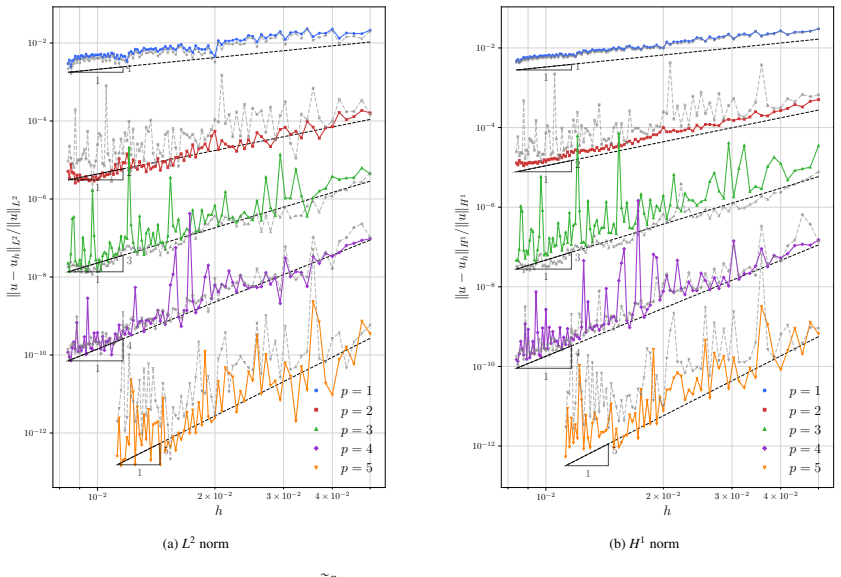
The concept of trimming, embedding, or immersing geometries into a computational background mesh has gained considerable attention in recent years, particularly in isogeometric analysis (IGA). In this approach, the physical domain is represented independently from the computational mesh, allowing the latter to be generated more easily compared with body-fitted meshes. While this facilitates the treatment of complex geometries, it also introduces challenges, such as ill-conditioning of the stiffness matrix caused by small cut elements and difficulties in accurately enforcing boundary conditions. A recently proposed technique to address these issues is the Shifted Boundary Method (SBM), which represents the computational domain solely through uncut elements and enforces boundary conditions via a Taylor expansion from a surrogate boundary to the true boundary. Previous studies have shown that, for Neumann boundary conditions, the flux evaluation requires additional derivatives in the Taylor expansion, effectively reducing the order of convergence by one. In this work, we investigate for the first time the performance of SBM combined with Truncated Hierarchical B-splines (THB-splines) under various local refinement strategies. In particular, we propose local p- and k-refinement schemes for THB-splines and compare them with local h-refinement and the unmodified SBM. Furthermore, we propose an enhanced shift operator that incorporates mixed partial derivatives, in contrast to the standard operator. The study assesses accuracy, stability, and computational efficiency for benchmark problems on trimmed domains. The results highlight how different refinement strategies affect convergence behavior in trimmed IGA formulations using SBM and demonstrate that targeted degree elevation can mitigate the Neumann boundary limitations of the standard method.
Editorial analysis
A structured set of objections, weighed in public.
Referee Report
Summary. The paper claims to investigate local h-, p-, and k-refinement strategies for the Isogeometric Shifted Boundary Method (SBM) using THB-splines on trimmed domains. It proposes an enhanced shift operator incorporating mixed partial derivatives to overcome the order reduction in Neumann boundary conditions associated with the standard SBM. Through numerical benchmarks on trimmed domains, it demonstrates the impact of different refinement strategies on convergence behavior and shows that targeted degree elevation can mitigate the Neumann limitations.
Significance. If the results hold, this work advances the field by providing practical refinement strategies for immersed IGA methods, improving accuracy and efficiency for complex geometries. The enhanced operator and THB-spline refinements could lead to more stable and optimal convergent methods for problems involving Neumann conditions, building on prior SBM and THB literature.
major comments (2)
- [Enhanced shift operator description] The central claim that the mixed-derivative shift operator preserves consistency and stability when paired with local THB-spline refinements lacks supporting a-priori error estimates. The Taylor expansion accuracy under variable knot multiplicities and hierarchical truncation is not analyzed, placing the full burden on numerical benchmarks which may be configuration-specific.
- [Numerical benchmarks] The abstract asserts that benchmark results support the mitigation of Neumann order reduction via targeted p-refinement, but no quantitative error tables, convergence rates, or stability metrics are provided in the available text. This undermines the ability to assess the strength of the claims regarding generality across trimmed configurations.
minor comments (2)
- [Abstract] The abstract could more clearly specify the benchmark problems used and the observed convergence orders to strengthen the summary of results.
- [Refinement strategies] Clarify the distinction between p- and k-refinement in the context of THB-splines, as the notation may be non-standard for some readers.
Simulated Author's Rebuttal
We thank the referee for the constructive comments and the opportunity to clarify and strengthen our manuscript. We address each major point below and indicate the planned revisions.
read point-by-point responses
-
Referee: The central claim that the mixed-derivative shift operator preserves consistency and stability when paired with local THB-spline refinements lacks supporting a-priori error estimates. The Taylor expansion accuracy under variable knot multiplicities and hierarchical truncation is not analyzed, placing the full burden on numerical benchmarks which may be configuration-specific.
Authors: We acknowledge that a full a-priori error analysis for the enhanced shift operator under THB-spline hierarchies would provide stronger theoretical backing. The manuscript focuses on numerical investigation of local refinement strategies; the mixed-derivative operator is derived directly from the Taylor expansion to restore consistency for Neumann data. We will add a dedicated subsection deriving the consistency of the operator, explicitly addressing the effect of knot multiplicity changes and truncation on the expansion remainder, and include additional numerical tests on configurations with varying hierarchical levels to support generality. A complete a-priori proof is beyond the present scope. revision: partial
-
Referee: The abstract asserts that benchmark results support the mitigation of Neumann order reduction via targeted p-refinement, but no quantitative error tables, convergence rates, or stability metrics are provided in the available text. This undermines the ability to assess the strength of the claims regarding generality across trimmed configurations.
Authors: The full manuscript contains detailed numerical results, including L2 and H1 error tables, observed convergence rates, and condition-number metrics for several trimmed geometries. We will revise the text to ensure these quantitative data are explicitly referenced from the abstract onward, add a summary table of convergence rates across all refinement strategies, and include two additional trimmed-domain examples to further illustrate generality. revision: yes
Circularity Check
No significant circularity in the derivation or claims.
full rationale
The paper proposes local h-, p-, and k-refinement strategies for THB-splines in the context of the Shifted Boundary Method and introduces an enhanced shift operator incorporating mixed partial derivatives. These are evaluated via numerical benchmarks on trimmed domains, with convergence behavior compared to the unmodified SBM. No equations, parameters, or central claims reduce by construction to fitted inputs, self-definitions, or load-bearing self-citations; the work builds on prior SBM and THB literature as external foundations while presenting independent numerical assessments of accuracy, stability, and efficiency.
Axiom & Free-Parameter Ledger
Reference graph
Works this paper leans on
-
[1]
Bayesian Segmentation of Atrium Wall Using Globally-Optimal Graph Cuts on 3D Meshes
L. Piegl, W. Tiller, The NURBS Book, Monographs in Visual Communication, Springer Berlin Heidelberg, 1997. doi:10.1007/978-3-642- 59223-2
-
[2]
Bathe, Finite Element Procedures, Prentice Hall, Pearson Education Inc., 2014
K.-J. Bathe, Finite Element Procedures, Prentice Hall, Pearson Education Inc., 2014
work page 2014
-
[3]
T. J. Hughes, J. A. Cottrell, Y . Bazilevs, Isogeometric analysis: Cad, finite elements, nurbs, exact geometry and mesh refinement, Computer methods in applied mechanics and engineering 194 (39-41) (2005) 4135–4195
work page 2005
-
[4]
J. A. Cottrell, T. J. Hughes, Y . Bazilevs, Isogeometric analysis: toward integration of CAD and FEA, John Wiley & Sons, 2009
work page 2009
-
[5]
J. A. Cottrell, A. Reali, Y . Bazilevs, T. J. Hughes, Isogeometric Analysis of structural vibrations, Computer methods in applied mechanics and engineering 195 (41-43) (2006) 5257–5296
work page 2006
-
[6]
A. Apostolatos, R. Schmidt, R. W ¨uchner, K.-U. Bletzinger, A Nitsche-type formulation and comparison of the most common domain de- composition methods in isogeometric analysis, International Journal for Numerical Methods in Engineering 97 (7) (2014-02-17) 473–504. doi:10.1002/nme.4568
-
[7]
A. Bauer, M. Breitenberger, B. Philipp, R. W ¨uchner, K.-U. Bletzinger, Nonlinear isogeometric spatial Bernoulli beam, Computer Methods in Applied Mechanics and Engineering 303 (2016-05) 101–127. doi:10.1016/j.cma.2015.12.027
-
[8]
A. M. Bauer, R. W ¨uchner, K.-U. Bletzinger, Innovative CAD-integrated isogeometric simulation of sliding edge cables in lightweight structures, Journal of the International Association for Shell and Spatial Structures 59 (4) (2018-12-01) 251–258. doi:10.20898/j.iass.2018.198.039
-
[9]
A. Bauer, R. W ¨uchner, K.-U. Bletzinger, Weak coupling of nonlinear isogeometric spatial Bernoulli beams, Computer Methods in Applied Mechanics and Engineering 361 (2020) 112747. doi:10.1016/j.cma.2019.112747
-
[10]
L. Leidinger, M. Breitenberger, A. Bauer, S. Hartmann, R. W ¨uchner, K.-U. Bletzinger, F. Duddeck, L. Song, Explicit dynamic isogeometric B-Rep analysis of penalty-coupled trimmed NURBS shells, Computer Methods in Applied Mechanics and Engineering 351 (2019-07) 891–
work page 2019
-
[11]
doi:10.1016/j.cma.2019.04.016
-
[12]
M. Meßmer, T. Teschemacher, L. F. Leidinger, R. W ¨uchner, K.-U. Bletzinger, Efficient CAD-integrated isogeometric analysis of trimmed solids, Computer Methods in Applied Mechanics and Engineering 400 (2022-10) 115584. doi:10.1016/j.cma.2022.115584
-
[13]
L. Chen, W. Zhao, C. Liu, H. Chen, S. Marburg, Isogeometric fast multipole boundary element method based on Burton-Miller formulation for 3d acoustic problems, Archives of Acoustics 44 (3) (2019) 475–492. doi:10.24425/aoa.2019.129263
-
[14]
L. Chen, S. Marburg, W. Zhao, C. Liu, H. Chen, Implementation of isogeometric fast multipole boundary element methods for 2d half-space acoustic scattering problems with absorbing boundary condition, Journal of Theoretical and Computational Acoustics 27 (2018) 1850024. doi:10.1142/S259172851850024X
-
[15]
C. Ding, K. K. Tamma, H. Lian, Y . Ding, T. J. Dodwell, S. P. Bordas, Uncertainty quantification of spatially uncorrelated loads with a reduced-order stochastic isogeometric method, Computational Mechanics 67 (5) (2021) 1255–1271
work page 2021
-
[16]
N. A. Manque, J. Liedmann, F.-J. Barthold, M. A. Valdebenito, M. G. Faes, Interval isogeometric analysis for coping with geometric uncer- tainty, Computer Methods in Applied Mechanics and Engineering 437 (2025) 117773
work page 2025
-
[17]
M. E. Matzen, Isogeometrische Modellierung und Diskretisierung von Kontaktproblemen, Ph.D. thesis, Universit ¨at Stuttgart (2015). URLhttps://elib.uni-stuttgart.de/handle/11682/659
work page 2015
-
[18]
L. De Lorenzis, P. Wriggers, T. J. Hughes, Isogeometric contact: a review, GAMM-Mitteilungen 37 (1) (2014) 85–123. doi:10.1002/gamm.201410005
-
[19]
Y . Bazilevs, M.-C. Hsu, M. Scott, Isogeometric fluid–structure interaction Analysis with emphasis on non-matching discretiza- tions, and with application to wind turbines, Computer Methods in Applied Mechanics and Engineering 249-252 (2012) 28–41. doi:10.1016/j.cma.2012.03.028
-
[20]
Y . Bazilevs, V . M. Calo, Y . Zhang, T. J. R. Hughes, Isogeometric fluid–structure interaction Analysis with applications to arterial, Computa- tional Mechanics (2006). doi:10.1007/s00466-006-0084-3
-
[21]
M.-C. Hsu, I. Akkerman, Y . Bazilevs, High-performance computing of wind turbine aerodynamics using isogeometric Analysis, Computers & Fluids 49 (1) (2011) 93–100. doi:10.1016/j.compfluid.2011.05.002
-
[22]
Y . Bazilevs, V . Calo, J. Cottrell, T. Hughes, A. Reali, G. Scovazzi, Variational multiscale residual-based turbulence modeling for large eddy simulation of incompressible flows, Computer Methods in Applied Mechanics and Engineering 197 (1) (2007) 173–201. doi:10.1016/j.cma.2007.07.016
-
[23]
X. Qian, O. Sigmund, Isogeometric shape optimization of photonic crystals via coons patches, Computer Methods in Applied Mechanics and Engineering 200 (25) (2011) 2237–2255. doi:10.1016/j.cma.2011.03.007
-
[24]
P. Kang, S.-K. Youn, Isogeometric shape optimization of trimmed shell structures, Structural and Multidisciplinary Optimization (2016). doi:10.1007/s00158-015-1361-6
-
[25]
J. Kiendl, K.-U. Bletzinger, J. Linhard, R. W ¨uchner, Isogeometric shell analysis with Kirchhoff–Love elements, Computer Methods in Applied Mechanics and Engineering 198 (49) (2009-11) 3902–3914. doi:10.1016/j.cma.2009.08.013
-
[26]
J. Kiendl, Y . Bazilevs, M.-C. Hsu, R. W ¨uchner, K.-U. Bletzinger, The bending strip method for isogeometric analysis of Kirchhoff–Love shell structures comprised of multiple patches, Computer Methods in Applied Mechanics and Engineering 199 (37) (2010-08) 2403–2416. doi:10.1016/j.cma.2010.03.029
-
[27]
J. Kiendl, R. Schmidt, R. W ¨uchner, K.-U. Bletzinger, Isogeometric shape optimization of shells using semi-analytical sensitivity analysis and sensitivity weighting, Computer Methods in Applied Mechanics and Engineering 274 (2014-06) 148–167. doi:10.1016/j.cma.2014.02.001
- [28]
-
[29]
S. Goswami, C. Anitescu, T. Rabczuk, Adaptive fourth-order phase field analysis for brittle fracture, Computer Methods in Applied Mechanics and Engineering 361 (2020) 112808. doi:https://doi.org/10.1016/j.cma.2019.112808. URLhttps://www.sciencedirect.com/science/article/pii/S0045782519307005
-
[30]
L. Rorris, A. Nagy, S. Hartmann, I. Chalkidis, A. Vafeidis, The ansa/ls-dyna approach for iga simulations, in: 12th European LS-DYNA 28 Conference, BETA CAE Systems International AG, Livermore Software Technology Corporation, DYNAmore GmbH, BETA CAE Systems SA, Koblenz, Germany, 2019
work page 2019
-
[31]
L. Rorris, I. Chalkidis, The latest developments of the ansa preprocessor for iga applications of ls-dyna, in: 16th International LS-DYNA® Users Conference Isogeometric Analysis, BETA CAE Systems International AG and BETA CAE Systems SA, Switzerland and Greece, 2020, pp. 1–XX
work page 2020
-
[32]
M. Breitenberger, A. Apostolatos, B. Philipp, R. W ¨uchner, K.-U. Bletzinger, Analysis in computer aided design: Nonlinear iso- geometric B-Rep analysis of shell structures, Computer Methods in Applied Mechanics and Engineering 284 (2015-02) 401–457. doi:10.1016/j.cma.2014.09.033
-
[33]
T. Teschemacher, A. M. Bauer, T. Oberbichler, M. Breitenberger, R. Rossi, R. W ¨uchner, K.-U. Bletzinger, Realization of CAD-integrated shell simulation based on isogeometric B-Rep analysis, Advanced Modeling and Simulation in Engineering Sciences 5 (1) (2018-12) 19. doi:10.1186/s40323-018-0109-4
-
[34]
T. Teschemacher, A. M. Bauer, R. Aristio, M. Meßmer, R. W ¨uchner, K.-U. Bletzinger, Concepts of data collection for the cad-integrated isogeometric analysis, Engineering with Computers 38 (6) (2022) 5675–5693
work page 2022
-
[35]
J. Parvizian, A. D ¨uster, E. Rank, Finite cell method: h-and p-extension for embedded domain problems in solid mechanics, Computational Mechanics 41 (1) (2007) 121–133
work page 2007
-
[36]
E. Rank, M. Ruess, S. Kollmannsberger, D. Schillinger, A. D ¨uster, Geometric modeling, isogeometric analysis and the finite cell method, Computer Methods in Applied Mechanics and Engineering 249-252 (2012) 104–115
work page 2012
-
[37]
Leidinger, Explicit isogeometric B-Rep analysis for nonlinear dynamic crash simulations, Ph.D
L. Leidinger, Explicit isogeometric B-Rep analysis for nonlinear dynamic crash simulations, Ph.D. thesis, Technische Universit ¨at M¨unchen (2020). URLhttps://mediatum.ub.tum.de/1542623
-
[38]
F. de Prenter, C. V . Verhoosel, E. H. van Brummelen, M. G. Larson, S. Badia, Stability and conditioning of immersed finite element methods: Analysis and remedies, Archives of Computational Methods in Engineering 30 (6) (2023) 3617–3656. doi:10.1007/s11831-023-09913-0. URLhttps://doi.org/10.1007/s11831-023-09913-0
-
[39]
A. Main, G. Scovazzi, The shifted boundary method for embedded domain computations. part i: Poisson and stokes problems, Journal of Computational Physics 372 (2018) 972–995
work page 2018
-
[40]
N. M. Atallah, C. Canuto, G. Scovazzi, The shifted boundary method for solid mechanics, International Journal for Numerical Methods in Engineering 122 (20) (2021) 5935–5970
work page 2021
-
[41]
K. Li, A. Gorgi, R. Rossi, G. Scovazzi, The shifted boundary method for contact problems, Computer Methods in Applied Mechanics and Engineering 440 (2025) 117940
work page 2025
-
[42]
N. Antonelli, R. Aristio, A. Gorgi, R. Zorrilla, R. Rossi, G. Scovazzi, R. W ¨uchner, The shifted boundary method in isogeometric analysis, Computer Methods in Applied Mechanics and Engineering 430 (2024) 117228
work page 2024
-
[43]
N. Antonelli, A. Gorgi, R. Zorrilla, R. Rossi, Isogeometric analysis for non-newtonian viscoplastic fluids: challenges for non-smooth solu- tions, Computer Methods in Applied Mechanics and Engineering 447 (2025) 118386
work page 2025
- [44]
-
[45]
T. J. R. Hughes, Y . Bazilevs, Isogeometric analysis: toward integration of CAD and FEA, Wiley, 2009
work page 2009
-
[46]
C. Giannelli, B. J ¨uttler, H. Speleers, THB-splines: The truncated basis for hierarchical splines, Computer Aided Geometric Design 29 (7) (2012-10) 485–498. doi:10.1016/j.cagd.2012.03.025
-
[47]
C. Giannelli, B. J ¨uttler, H. Speleers, Strongly stable bases for adaptively refined multilevel spline spaces, Advances in Computational Math- ematics 40 (2) (2014-04) 459–490. doi:10.1007/s10444-013-9315-2
-
[48]
A. Buffa, G. Gantner, C. Giannelli, D. Praetorius, R. V ´azquez, Mathematical foundations of adaptive isogeometric Analysis, Archives of Computational Methods in Engineering (Nov 2022). doi:10.1007/s11831-022-09752-5
-
[49]
E. M. Garau, R. V ´azquez, Algorithms for the implementation of adaptive isogeometric methods using hierarchical B-splines, Applied Nu- merical Mathematics 123 (2018) 58–87. doi:10.1016/j.apnum.2017.08.006
-
[50]
D. Schillinger, The p- and b-spline versions of the geometrically nonlinear finite cell method and hierarchical refinement strategies for adaptive isogeometric and embedded domain analysis, Ph.D. thesis, Technische Universit¨at M¨unchen (2012). URLhttps://mediatum.ub.tum.de/1093297
-
[51]
J. A. Cottrell, T. J. Hughes, A. Reali, Studies of refinement and continuity in isogeometric structural analysis, Computer methods in applied mechanics and engineering 196 (41) (2007) 4160–4183
work page 2007
-
[52]
E. Burman, A penalty-free nonsymmetric nitsche-type method for the weak imposition of boundary conditions, SIAM Journal on Numerical Analysis 50 (4) (2012) 1959–1981
work page 2012
-
[53]
Q. Hu, F. Chouly, P. Hu, G. Cheng, S. P. Bordas, Skew-symmetric nitsche’s formulation in isogeometric analysis: Dirichlet and symmetry conditions, patch coupling and frictionless contact, Computer Methods in Applied Mechanics and Engineering 341 (2018) 188–220
work page 2018
-
[54]
C. Giannelli, B. J ¨uttler, S. K. Kleiss, A. Mantzaflaris, B. Simeon, J. ˇSpeh, THB-splines: An effective mathematical technology for adaptive refinement in geometric design and isogeometric analysis, Computer Methods in Applied Mechanics and Engineering 299 (2016) 337–365. doi:10.1016/j.cma.2015.11.002
-
[55]
J. Gu, T. Yu, L. Van Lich, T.-T. Nguyen, T. Q. Bui, Adaptive multi-patch isogeometric analysis based on locally refined B-splines, Computer Methods in Applied Mechanics and Engineering 339 (2018-09) 704–738. doi:10.1016/j.cma.2018.04.013
-
[56]
F. Patrizi, C. Manni, F. Pelosi, H. Speleers, Adaptive refinement with locally linearly independent LR B-splines: Theory and applications, Computer Methods in Applied Mechanics and Engineering 369 (2020-09) 113230. doi:10.1016/j.cma.2020.113230
-
[57]
M. Kumar, T. Kvamsdal, K. A. Johannessen, Simple a posteriori error estimators in adaptive isogeometric Analysis, Computers & Mathe- matics with Applications 70 (7) (2015-10) 1555–1582. doi:10.1016/j.camwa.2015.05.031. 29
discussion (0)
Sign in with ORCID, Apple, or X to comment. Anyone can read and Pith papers without signing in.