REVIEW 3 major objections 5 minor 111 references
Non-perturbative effects of short-range spatial correlations at the two-particle level
T0 review · 3 major / 5 minor · reviewed 2026-08-03 · deepseek-v4-flash
Pith's one-line read Short-range spin fluctuations shift the breakdown of perturbation theory to lower interaction strengths in the two-dimensional Hubbard model.
desk verdict Solid formal extension of the vertex-divergence program to CDMFT, with a credible but not yet cluster-size-converged picture of how short-range AF fluctuations lower the first divergence line. read the letter →
The pith
A machine-rendered reading of the paper's core claim, the machinery that carries it, and where it could break.
The reading
What carries the argument
The central object is the two-particle irreducible charge vertex Γ_ch of the cluster impurity, extracted from the cluster generalized susceptibility via the inverse Bethe-Salpeter equation. The authors derive explicit real-space BSE expressions for the charge, spin, and particle-particle channels within CDMFT, together with Ward identities that benchmark the calculation. The divergence of Γ_ch corresponds to a vanishing eigenvalue of the generalized charge susceptibility of the impurity, and the lattice response is built from the same vertex through a cluster-local BSE with a Fourier periodization. A strong-coupling approximation of the lattice bubble difference t²_eff,q is used to turn the
What would settle it
Compute the first vertex-divergence line with a larger cluster (e.g., 4x4 or 8x8 CDMFT) at the same temperatures and interaction range, or with an alternative periodization scheme that enforces momentum conservation in the bubble. If the divergence line shifts back toward the DMFT line, or if the eigenvalue zero-crossing no longer precedes the Mott transition, the central claim would be a finite-cluster artifact.
Extended reading notes
Core claim
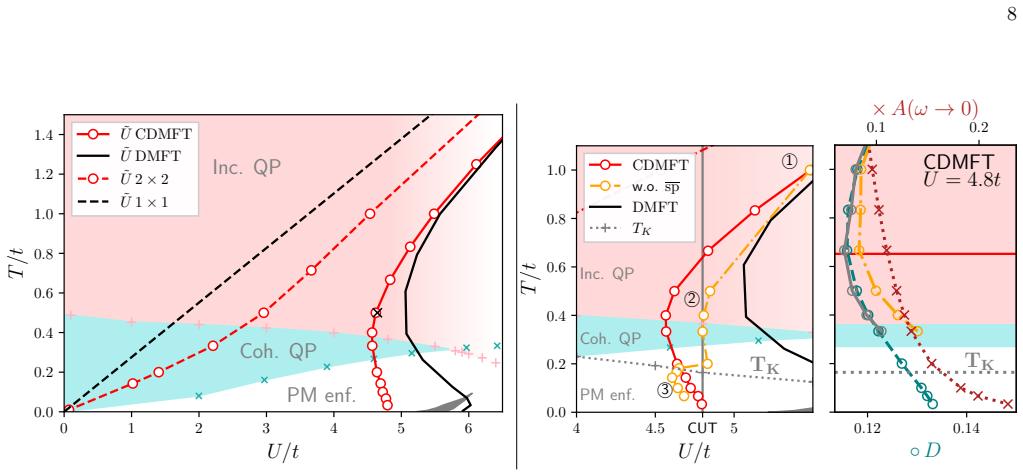
The central claim is that the first divergence of the two-particle irreducible charge vertex Γ_ch in CDMFT sits systematically below the DMFT divergence line at intermediate and low temperatures, and that this downward shift is caused by short-range transverse spin fluctuations. The authors show that removing the non-local spin-transverse diagrams from the vertex moves the divergence line back toward higher U, flattening its distinctive 'belly' shape. They also find that the eigenvalue of the generalized charge susceptibility that drives the vertex divergence must cross zero and become negative before the Mott transition can occur at larger U; this same eigenvalue then controls the divergenc
Load-bearing premise
The mapping of cluster two-particle quantities onto the lattice assumes that all sites inside the cluster are equivalent, even though the cluster Green's function is not translationally invariant; if this periodization distorts the lattice response, the downward shift of the divergence line could be an artifact of the 2x2 cluster rather than a real physical effect.
Editorial extensions
If this is right
- If the divergence line is genuinely lower in CDMFT, then perturbation-theory-based methods become unreliable at weaker interactions in two dimensions than previously expected, and the regime of 'strong correlations' is broader than the local picture suggests.
- The identification of the eigenvalue sign change as a necessary prerequisite for the Mott transition implies that any successful non-perturbative theory of the 2D Hubbard model must reproduce this zero-crossing before the transition, not merely the transition itself.
- The anti-symmetric frequency structure of the critical eigenvector explains why the uniform charge response stays finite at the half-filled Mott transition even though the generalized susceptibility diverges, resolving a long-standing puzzle.
- The strong-coupling threshold derived from t²_eff,q provides a practical way to predict the location of the Mott transition from cluster impurity data alone, without full lattice diagonalization.
- Because the same mechanism drives phase-separation instabilities at finite doping, the result constrains the shape of the coexistence region in cluster DMFT phase diagrams.
Reading between the lines
- If short-range spin fluctuations lower the vertex-divergence line, then in the thermodynamic limit the first divergence line may begin at U=T=0 with an exponential onset, as the authors speculate; this could be tested with larger clusters or diagrammatic Monte Carlo in the paramagnetic phase.
- The finding strengthens the analogy between vertex divergences and local-moment formation: in 2D, the relevant 'local' moment is spatially extended across nearest neighbors, so cluster size should systematically control the divergence scale—a prediction one could verify by comparing 2x2 and 4x4 clusters at fixed temperature.
- The same eigenvalue crossing that precedes the Mott transition may also enhance electron-phonon coupling in 2D, as the authors hint; a concrete test would be to compute the phonon self-energy using the CDMFT charge vertex and look for a divergent tendency near the vertex-divergence line.
- The periodization ambiguity suggests that a translation-invariant alternative (e.g., a DCA-like BSE with enforced momentum conservation) should produce a different divergence line; comparing the two periodizations would isolate the true non-local effect from the cluster-geometry artifact.
Signed reviews
Editorial analysis
A structured set of objections, weighed in public.
Referee Report
Summary. The paper develops a two-particle Bethe-Salpeter formalism for cellular dynamical mean-field theory (CDMFT) on a real-space 2×2 cluster, including Ward identities in all channels and a detailed particle-particle BSE derivation. It computes the first divergence line of the two-particle irreducible charge vertex for the 2D Hubbard model at half-filling and finds that, relative to DMFT, the divergence occurs at systematically lower interactions, which it attributes to short-range antiferromagnetic spin fluctuations (analyzed via a single-boson-exchange decomposition). The paper then studies the Mott transition region at the two-particle level, showing that a single eigenvalue of the generalized charge susceptibility diverges at the transition, and argues that a sign change of the corresponding cluster-impurity eigenvalue—the same event as the vertex divergence—is a necessary prerequisite for the Mott transition and phase-separation instabilities. The work also connects the strong-coupling approximation of the lattice bubble to an effective hopping amplitude t2_eff,q.
Significance. If the central numerical claims hold, the paper is a significant contribution: it provides a consistent and carefully benchmarked two-particle CDMFT framework, with Ward identities and applied-field checks, and it extends the DMFT vertex-divergence program to include short-range spatial correlations. The formal BSE/Ward-identity sections are carefully derived and the small-cluster results are benchmarked against DiagMC and larger-cluster data, which increases credibility. The paper also makes a falsifiable prediction: in CDMFT, the charge-vertex divergence line is shifted to lower U than in DMFT, and the same eigenvalue sign change precedes the Mott transition. The machine-checkable derivations and reproducible benchmarks are notable strengths. However, the numerical support for the 'systematic' shift and the 'essential prerequisite' claim rests entirely on a single 2×2 cluster, and this is load-bearing for the central assertions.
major comments (3)
- [Fig. 5 and §III.A] The central claim that the vertex divergence line occurs 'systematically' at lower interactions in CDMFT than DMFT is supported only for a single cluster size (Nc=2×2). The paper's own Fig. 4 shows that the 2×2 cluster has a substantially higher Néel temperature than 8×8 CDMFT, so the short-range AF fluctuations invoked to explain the lowering may be quantitatively overestimated by the perfect-nesting geometry of the 2×2 plaquette. Without a cluster-size scaling test (e.g., 4×4 CDMFT at selected temperatures, or at least a systematic discussion of the 8×8 benchmark data), the assertion that this is a robust property of short-range correlations rather than a finite-size artifact is not established. The authors do discuss the isolated-cluster comparison, but that is a different limit and does not control the imprint of the embedding bath on the 2×2 geometry.
- [§IV.B, Eqs. (44)–(48)] The derivation of the necessary condition for the MIT relies on projecting onto the leading lattice eigenvector V∞ at Uc2. Equation (47) sums over impurity eigenvalues Ei with projections P∞(Xi). The plot in Fig. 7 shows that one eigenvalue E1 dominates at Uc2, but the subsequent tracking of X1U as a function of U (green line) must be protected against eigenvalue crossing or level repulsion. The authors state that they follow the eigenvector with 'largest overlap' with X1^Uc2, but the numerical value of that overlap is not given. If the overlap is not close to 1, the 'necessary prerequisite' conclusion could be weakened. Please provide the overlap values or a more quantitative tracking criterion. In addition, the inversion leading to Eq. (48), where (t2_q)^{-1} is placed on the left-hand side, should be justified more carefully; the strong-coupling approximation t2_eff,q is introduced in
- [§II.B, Eq. (14) and §III.A] The paper notes after Eq. (14) that the reciprocal-lattice mapping 'implicitly assumes an equivalence of each atom, which is strictly speaking an approximation.' The reader's report raised the concern that this periodization could bias the lattice response. In this paper, the central vertex-divergence line (Fig. 5) is computed directly from the impurity cluster before periodization, and the eigenvalue necessary condition in §IV.B also uses the impurity cluster and the superlattice equation without the reciprocal-lattice mapping. Thus the periodization caveat is less load-bearing for the main claims than it could appear. However, the paper should state this explicitly, since the abstract and §IV.A refer to 'two-particle CDMFT' without clarifying that the key divergence line is a cluster (not periodized) quantity. The periodization mainly affects which specific eigenvalue is identified in
minor comments (5)
- [§II.C, Fig. 4] The Ward identity check is shown for only one orbital combination and one parameter point. It would be helpful to state that the Ward identity was verified for all orbital combinations and for the parameter range used in the phase diagram, especially in the strong-coupling regime near the MIT.
- [§III.B, Eq. (34)] The notation 'w.o. sp' in Fig. 5 is defined in the text, but the orange dashed line's exact construction (subtraction of all non-local spin-transverse SBE diagrams) could be re-stated more clearly in the caption. The same applies to the yellow dot-dashed line in the left panel of Fig. 5.
- [§IV.B, Eq. (43)] The strong-coupling approximation t2_eff,q is written as a 16×16 matrix in App. B2. The main text should mention that the approximation is diagonal in Matsubara frequency and that it is valid when the self-energy is large compared to the hopping, as stated in the text, but the limits of this validity for the intermediate-coupling regime T=1/15t, U≈5.9t should be discussed.
- [Fig. 6] The labels in Fig. 6c) and d) are small and difficult to read. Consider enlarging the eigenvector plots or providing a separate panel for the leading eigenvector structure.
- [General, typos] There are a few typos and small errors: in App. A 'estaimated' should be 'estimated' and 'plance' should be 'plane'; in Fig. 9 caption 'T=0/15t' should presumably be 'T=1/15t'; in the references, some entries are incomplete (e.g., Ref. [29] has missing page numbers).
Circularity Check
No significant circularity: the CDMFT vertex-divergence and eigenvalue-prerequisite results are derived from the BSE formalism and benchmarked against external methods.
full rationale
The paper's central numerical claim—that the first charge-vertex divergence in CDMFT occurs at lower U than in DMFT—is a direct output of the cluster BSE calculation, not an input. The divergence is located from Γ_ch = (1/T^2)[(χ_ch)^-1 − (χ_0)^-1] (Eq. 11), and the CDMFT cluster impurity is solved by CT-INT with the lattice-to-cluster mapping fixed by the CDMFT self-consistency. The interpretation that short-range antiferromagnetic fluctuations cause the shift is tested by a controlled subtraction of non-local spin-transverse SBE diagrams (Eq. 34), which is a diagnostic manipulation, not a fitted prediction. The eigenvalue sign-change that the abstract calls an 'essential prerequisite' is indeed analytically the same event as the vertex divergence through Eq. (11), but the paper does not stop there: it derives a necessary condition for the Mott instability via Eqs. (45)–(47), showing that a diverging lattice charge response at U_c2 forces at least one cluster-impurity eigenvalue to be negative, while the same eigenvalue starts positive at weak coupling and therefore must cross zero. This is a mathematical consequence of the BSE plus the spectral decomposition, not an assumption smuggled in as a result. The determination of U_c2 is anchored to the thermodynamic double-occupancy discontinuity and to the lattice charge response, and the BSE response is benchmarked against applied-field calculations and external DiagMC/8x8-CDMFT data. Self-citations are used for background context (e.g., the Luttinger-Ward interpretation of vertex divergences) and for the SBE framework, but the load-bearing BSE derivation, the numerical CDMFT data, and the eigenvalue analysis are self-contained in this paper. The lack of cluster-size scaling for 2x2 CDMFT is a finite-size/correctness concern, not a circularity: the derivation would be unchanged if the cluster were larger, and no fitted parameter is relabeled as a prediction. Overall, no step reduces to its own inputs by construction.
Assumptions & free parameters
free parameters (2)
- Kondo temperature T_K =
T_K ≈ 0.14t at U=4.8t; estimated per (U,T)
- A(ω=0) extrapolation polynomial =
third-order polynomial in Matsubara frequency
assumptions (6)
- domain assumption CDMFT is a Φ-derivable, conserving approximation: the superlattice and the impurity problem share the same Baym-Kadanoff functional, so one- and two-particle quantities satisfy Ward identities.
- domain assumption Cluster-local two-particle approximation: the lattice irreducible vertex equals the 2x2 impurity vertex, and the periodization of Eq. (14) assumes equivalence of each atom even though the cluster Green's function is not translational invariant.
- domain assumption The CT-INT impurity solver produces converged, unbiased estimates of the two-particle quantities over the Matsubara grids used.
- domain assumption The first divergence of Γ_ch marks the breakdown of self-consistent perturbation theory and is a reliable indicator of strong correlations.
- domain assumption The strong-coupling expansion of the lattice bubble to second order in the hopping ε_k gives a valid approximation for t2_eff near the Mott transition.
- standard math The eigenvalues of the generalized charge susceptibility evolve continuously with U, so a sign change implies a crossing through zero.
Cite this review
Pith. "Pith review of Non-perturbative effects of short-range spatial correlations at the two-particle level." pith.science (2026). https://pith.science/paper/6JWQ24FQ
@misc{pith2026251217716,
  author       = {Pith},
  title        = {Pith review of: Non-perturbative effects of short-range spatial correlations at the two-particle level},
  year         = {2026},
  howpublished = {\url{https://pith.science/paper/6JWQ24FQ}},
  note         = {Machine review of arXiv:2512.17716}
}
read the original abstract
By means of cellular dynamical mean-field theory (CDMFT) we study how short-range correlations drive the breakdown of the self-consistent perturbation theory in two-dimensional systems and the most relevant physical consequences associated to it. To this aim, we first derive in a structured and consistent way the Bethe-Salpeter equation (BSE) formalism at the CDMFT level in all physical channels, explicitly addressing the important aspect of the related Ward identities. In this context, we perform systematic calculations of the BSE for the two-dimensional Hubbard model at half-filling at intermediate coupling. Our study illustrates how the divergence of a fundamental building block of the BSE in the charge channel, the two-particle irreducible vertex, systematically occurs at lower interactions than in the (purely local) DMFT case, due to short-range antiferromagnetic fluctuations. Further, the change of sign of the eigenvalues of the generalized charge susceptibility associated to the vertex divergences is identified as the essential prerequisite to drive, at larger interaction values, the physics of the Mott transition in two dimensions, as well as of the adjacent phase-separation instabilities.
Figures


Figures from the paper (9 more)



Reference graph
Works this paper leans on
-
[1]
outgoing|incoming
Derivation of the particle-particle Bethe-Salpeter equation For the numeric computation of the real-space BSE, a matrix form is necessary. To obtain the particle-particle BSE in this form as given in Sec. II, frequency- and in- dex shifts are necessary, which we discuss here in detail. We define the generalized susceptibility in the particle- particle (pp...
-
[2]
the Supplemental of Ref
Strong coupling expression for the cluster Bethe-Salpeter equation At strong coupling, when the dispersion relationε ij k in the denominator of the Green’s functionG ij k (ν) becomes small in respect to its self-energy Σ ij(ν) (or when iνbe- comes large forν→ ±∞), the BSE can be brought into an approximate form (cf. the Supplemental of Ref. [28] for the c...
-
[3]
real-space single boson exchange decomposition To analyze the fluctuations on the impurity level, we employ the single-boson exchange decomposition for the full vertexF[82] and the two-particle irreducible vertex [72], to the real-space cluster quantities for the SU(2)- symmetric case. To that end, we define the bosonic prop- agators as12 wmn ch =U δmn −U...
-
[4]
A. Stan, P. Romaniello, S. Rigamonti, L. Reining, and J. A. Berger, Unphysical and physical solutions in many- body theories: from weak to strong correlation, New J. Phys.17, 093045 (2015)
2015
-
[5]
Both methods should yield the same result [64]
Benchmarking of the lattice response to applied field calculations We benchmark the BSE particle-hole calculations set- ting the static anti-ferromagnetic (AFM) correlator χq=0,Q=(π,π) sp (ωm) =T 2 X νn,ν′n χq=0,Q=(π,π) sp (νn, ν′ n, ωm) (C1) into contrast to calculations with the linear response to an applied AFM field for different cluster sizes, namely...
-
[6]
B 3) in the three channels Fig
Benchmarking of the two-particle irreducible vertexΓto the SBE In the following, benchmarking plots of the Bethe- Salpeter equations to the SBE decomposition of Γ (see App. B 3) in the three channels Fig. 11 are presented in the weak couplingU= 1t, βt= 5t, particle-hole asym- metric caset ′ =−0.25t, n= 0.95. Here, all three SBE contributions are significa...
-
[7]
Otherwise, the qualitative picture would remain the same, although the response would be slightly underestimated by the BSE
W ard identities for real-space Ward identities relate lower point correlation functions with higher order correlation functions by an equation of 13 As described in the main text, a tail treatment has been per- formed. Otherwise, the qualitative picture would remain the same, although the response would be slightly underestimated by the BSE. 21 0.0 0.5 1...
-
[8]
Sch¨ afer, G
T. Sch¨ afer, G. Rohringer, O. Gunnarsson, S. Ciuchi, G. Sangiovanni, and A. Toschi, Divergent Precursors of the Mott-Hubbard Transition at the Two-Particle Level, Phys. Rev. Lett.110, 246405 (2013)
2013
Show all 111 references
-
[9]
Janiˇ s and V
V. Janiˇ s and V. Pokorn´ y, Critical metal-insulator tran- sition and divergence in a two-particle irreducible vertex in disordered and interacting electron systems, Phys. Rev. B90, 045143 (2014)
2014
-
[10]
Kozik, M
E. Kozik, M. Ferrero, and A. Georges, Nonexistence of the Luttinger-Ward Functional and Misleading Con- vergence of Skeleton Diagrammatic Series for Hubbard- Like Models, Phys. Rev. Lett.114, 156402 (2015)
2015
-
[11]
Thunstr¨ om, O
P. Thunstr¨ om, O. Gunnarsson, S. Ciuchi, and G. Rohringer, Analytical investigation of singularities in two-particle irreducible vertex functions of the Hub- bard atom, Phys. Rev. B98, 235107 (2018)
2018
-
[12]
Rossi and F
R. Rossi and F. Werner, Skeleton series and multival- uedness of the self-energy functional in zero space-time dimensions, Journal of Physics A: Mathematical and Theoretical48, 485202 (2015)
2015
-
[13]
Rossi, F
R. Rossi, F. Werner, N. Prokof’ev, and B. Svistunov, Shifted-action expansion and applicability of dressed diagrammatic schemes, Phys. Rev. B93, 161102(R) (2016)
2016
-
[14]
Sch¨ afer, S
T. Sch¨ afer, S. Ciuchi, M. Wallerberger, P. Thunstr¨ om, O. Gunnarsson, G. Sangiovanni, G. Rohringer, and A. Toschi, Non-perturbative landscape of the Mott- Hubbard transition: Multiple divergence lines around the critical endpoint, Phys. Rev. B94, 235108 (2016)
2016
-
[15]
Gunnarsson, G
O. Gunnarsson, G. Rohringer, T. Sch¨ afer, G. Sangio- vanni, and A. Toschi, Breakdown of Traditional Many- Body Theories for Correlated Electrons, Phys. Rev. Lett.119, 056402 (2017)
2017
-
[16]
Tarantino, B
W. Tarantino, B. S. Mendoza, P. Romaniello, J. A. Berger, and L. Reining, Many-body perturbation theory and non-perturbative approaches: screened interaction as the key ingredient, Journal of Physics: Condensed Matter30, 135602 (2018)
2018
-
[17]
Chalupa, P
P. Chalupa, P. Gunacker, T. Sch¨ afer, K. Held, and A. Toschi, Divergences of the irreducible vertex func- tions in correlated metallic systems: Insights from the Anderson impurity model, Phys. Rev. B97, 245136 (2018)
2018
-
[18]
Springer, P
D. Springer, P. Chalupa, S. Ciuchi, G. Sangiovanni, and A. Toschi, Interplay between local response and vertex divergences in many-fermion systems with on-site at- traction, Phys. Rev. B101, 155148 (2020)
2020
-
[19]
Vuˇ ciˇ cevi´ c, N
J. Vuˇ ciˇ cevi´ c, N. Wentzell, M. Ferrero, and O. Par- collet, Practical consequences of the Luttinger-Ward functional multivaluedness for cluster DMFT methods, Phys. Rev. B97, 125141 (2018)
2018
-
[20]
A. J. Kim and V. Sacksteder, Multivaluedness of the Luttinger-Ward functional in the fermionic and bosonic system with replicas, Phys. Rev. B101, 115146 (2020)
2020
-
[21]
Reitner, L
M. Reitner, L. Crippa, D. R. Fus, J. C. Bu- dich, A. Toschi, and G. Sangiovanni, Protection of correlation-induced phase instabilities by exceptional susceptibilities, Phys. Rev. Res.6, L022031 (2024)
2024
-
[22]
H. Eßl, M. Reitner, G. Sangiovanni, and A. Toschi, Gen- eral Shiba mapping for on-site four-point correlation functions, Phys. Rev. Res.6, 033061 (2024)
2024
-
[23]
H. Eßl, M. Reitner, E. Kozik, and A. Toschi, How to stay on the physical branch in self-consistent many-electron approaches (2025), arXiv:2502.01420
2025 arXiv
-
[24]
Gunnarsson, T
O. Gunnarsson, T. Sch¨ afer, J. P. F. LeBlanc, J. Merino, G. Sangiovanni, G. Rohringer, and A. Toschi, Parquet decomposition calculations of the electronic self-energy, Phys. Rev. B93, 245102 (2016)
2016
-
[25]
smoking gun
S. Adler, F. Krien, P. Chalupa-Gantner, G. Sangio- vanni, and A. Toschi, Non-perturbative intertwining be- tween spin and charge correlations: A “smoking gun” single-boson-exchange result, SciPost Phys.16, 054 (2024)
2024
-
[26]
Melnick and G
C. Melnick and G. Kotliar, Fermi-liquid theory and di- vergences of the two-particle irreducible vertex in the periodic Anderson lattice, Phys. Rev. B101, 165105 (2020)
2020
-
[27]
Reitner, P
M. Reitner, P. Chalupa, L. Del Re, D. Springer, S. Ciuchi, G. Sangiovanni, and A. Toschi, Attractive Effect of a Strong Electronic Repulsion: The Physics of Vertex Divergences, Physical Review Letters125, 10.1103/physrevlett.125.196403 (2020)
2020 doi
-
[28]
Chalupa, T
P. Chalupa, T. Sch¨ afer, M. Reitner, D. Springer, S. An- dergassen, and A. Toschi, Fingerprints of the Local Mo- ment Formation and its Kondo Screening in the Gen- eralized Susceptibilities of Many-Electron Problems, Phys. Rev. Lett.126, 056403 (2021)
2021
-
[29]
T. B. Mazitov and A. A. Katanin, Local magnetic mo- ment formation and Kondo screening in the half-filled single-band Hubbard model, Phys. Rev. B105, L081111 (2022)
2022
-
[30]
T. B. Mazitov and A. A. Katanin, Effect of local mag- netic moments on spectral properties and resistivity near interaction- and doping-induced Mott transitions, Phys. Rev. B106, 205148 (2022). 26
2022
-
[31]
M. Pelz, S. Adler, M. Reitner, and A. Toschi, Highly nonperturbative nature of the Mott metal-insulator transition: Two-particle vertex divergences in the co- existence region, Phys. Rev. B108, 155101 (2023)
2023
-
[32]
Hubbard, Electron Correlations in Narrow Energy Bands, Proceedings of the Royal Society of London
J. Hubbard, Electron Correlations in Narrow Energy Bands, Proceedings of the Royal Society of London. Se- ries A, Mathematical and Physical Sciences276, 238 (1963)
1963
-
[33]
Kowalski, M
A. Kowalski, M. Reitner, L. Del Re, M. Chatzielefthe- riou, A. Amaricci, A. Toschi, L. de’ Medici, G. Sangio- vanni, and T. Sch¨ afer, Thermodynamic stability at the two-particle level, Phys. Rev. Lett.133, 066502 (2024)
2024
-
[34]
Reitner, L
M. Reitner, L. Del Re, M. Capone, and A. Toschi, Non- perturbative feats in the physics of correlated antiferro- magnets, Phys. Rev. Res.7, 033264 (2025)
2025
-
[35]
Moghadas, M
E. Moghadas, M. Reitner, T. Wehling, G. Sangio- vanni, S. Ciuchi, and A. Toschi, Effective enhance- ment of the electron-phonon coupling driven by non- perturbative electronic density fluctuations (2025), arXiv:2503.12113
2025
-
[36]
Badr,Efficiently solving the parquet equations using a sparse representation, Master’s thesis, TU Wien (2024)
S. Badr,Efficiently solving the parquet equations using a sparse representation, Master’s thesis, TU Wien (2024)
2024
-
[37]
Kotliar, S
G. Kotliar, S. Y. Savrasov, G. P´ alsson, and G. Biroli, Cellular Dynamical Mean Field Approach to Strongly Correlated Systems, Phys. Rev. Lett.87, 186401 (2001)
2001
-
[38]
A. I. Lichtenstein and M. I. Katsnelson, Antiferromag- netism andd-wave superconductivity in cuprates: A cluster dynamical mean-field theory, Phys. Rev. B62, R9283 (2000)
2000
-
[39]
T. A. Maier, M. Jarrell, T. Pruschke, and M. Hettler, Quantum Cluster Theories, Rev. Mod. Phys.77, 1027 (2005)
2005
-
[40]
Hubbard, Electron Correlations in Narrow Energy Bands
J. Hubbard, Electron Correlations in Narrow Energy Bands. III. An Improved Solution, Proc R. Soc. London 281, 401 (1964)
1964
-
[41]
M. C. Gutzwiller, Effect of Correlation on the Ferro- magnetism of Transition Metals, Phys. Rev. Lett.10, 159 (1963)
1963
-
[42]
J. Kanamori, Electron Correlation and Ferromagnetism of Transition Metals, Progress of Theoretical Physics 30, 275 (1963), https://academic.oup.com/ptp/article- pdf/30/3/275/5278869/30-3-275.pdf
1963
-
[43]
M. Qin, T. Sch¨ afer, S. Andergassen, P. Corboz, and E. Gull, The Hubbard Model: A Computational Per- spective, Annual Review of Condensed Matter Physics 13, 10.1146/annurev-conmatphys-090921-033948 (2022), https://doi.org/10.1146/annurev-conmatphys- 090921-033948
2022 doi
-
[44]
D. P. Arovas, E. Berg, S. A. Kivelson, and S. Raghu, The Hubbard Model, Annual Review of Condensed Matter Physics13, 10.1146/annurev-conmatphys-031620- 102024 (2022), https://doi.org/10.1146/annurev- conmatphys-031620-102024
2022 doi
-
[45]
A. I. Lichtenstein, M. I. Katsnelson, and G. Kotliar, Finite-temperature magnetism of transition metals: An ab initiodynamical mean-field theory, Phys. Rev. Lett. 87, 067205 (2001)
2001
-
[46]
Meixner, H
M. Meixner, H. Menke, M. Klett, S. Heinzelmann, S. Andergassen, P. Hansmann, and T. Sch¨ afer, Mott transition and pseudogap of the square-lattice Hubbard model: Results from center-focused cellular dynamical mean-field theory, SciPost Phys.16, 059 (2024)
2024
-
[47]
Rohringer, A
G. Rohringer, A. Katanin, T. Sch¨ afer, A. Hau- soel, K. Held, and A. Toschi, LadderDΓA code, github.com/ladderDGA (2018)
2018
-
[48]
Metzner and D
W. Metzner and D. Vollhardt, Correlated Lattice Fermions ind=∞Dimensions, Phys. Rev. Lett.62, 324 (1989)
1989
-
[49]
Georges and G
A. Georges and G. Kotliar, Hubbard model in infinite dimensions, Phys. Rev. B45, 6479 (1992)
1992
-
[51]
Ayral, J
T. Ayral, J. Vuˇ ciˇ cevi´ c, and O. Parcollet, Fierz Conver- gence Criterion: A Controlled Approach to Strongly In- teracting Systems with Small Embedded Clusters, Phys. Rev. Lett.119, 166401 (2017)
2017
-
[52]
Klett, N
M. Klett, N. Wentzell, T. Sch¨ afer, F. Simkovic, O. Par- collet, S. Andergassen, and P. Hansmann, Real-space cluster dynamical mean-field theory: Center-focused ex- trapolation on the one- and two particle-levels, Phys. Rev. Research2, 033476 (2020)
2020
-
[53]
C. B. David S´ en´ echal, Andr´ e-Marie Tremblay,Theoreti- cal Methods for Strongly Correlated Electrons(Springer, New York, 2004)
2004
-
[54]
A. N. Rubtsov, V. V. Savkin, and A. I. Lichten- stein, Continuous-time quantum Monte Carlo method for fermions, Phys. Rev. B72, 035122 (2005)
2005
-
[55]
E. Gull, P. Werner, O. Parcollet, and M. Troyer, Continuous-time auxiliary-field Monte Carlo for quan- tum impurity models, EPL (Europhysics Letters)82, 57003 (2008)
2008
-
[56]
Parcollet, M
O. Parcollet, M. Ferrero, T. Ayral, H. Hafermann, I. Krivenko, L. Messio, and P. Seth, Triqs: A toolbox for research on interacting quantum systems, Computer Physics Communications196, 398 (2015)
2015
-
[57]
Baym, Self-consistent approximations in many-body systems, Phys
G. Baym, Self-consistent approximations in many-body systems, Phys. Rev.127, 1391 (1962)
1962
-
[58]
M. H. Hettler, M. Mukherjee, M. Jarrell, and H. R. Kr- ishnamurthy, Dynamical cluster approximation: Nonlo- cal dynamics of correlated electron systems, Phys. Rev. B61, 12739 (2000)
2000
-
[59]
Potthoff, Self-energy-functional approach to systems of correlated electrons, Eur
M. Potthoff, Self-energy-functional approach to systems of correlated electrons, Eur. Phys. J. B32, 429 (2003)
2003
-
[60]
N. E. Bickers, Theoretical methods for strongly corre- lated electrons (Springer-Verlag New York Berlin Hei- delbert, 2004) Chap. 6, pp. 237–296
2004
-
[61]
Potthoff, Cluster extensions of dynamical mean- field theory, inDMFT:From Infinite Dimensions to Real Materials, Vol
M. Potthoff, Cluster extensions of dynamical mean- field theory, inDMFT:From Infinite Dimensions to Real Materials, Vol. 8 (Forschungszentrum J¨ ulich, 2018) Chap. 5
2018
-
[62]
Jarrell, Hubbard model in infinite dimensions: A quantum Monte Carlo study, Phys
M. Jarrell, Hubbard model in infinite dimensions: A quantum Monte Carlo study, Phys. Rev. Lett.69, 168 (1992)
1992
-
[63]
Mußhoff, A
J. Mußhoff, A. Kiani, and E. Pavarini, Magnetic re- sponse trends in cuprates and thet−t ′ hubbard model, Phys. Rev. B103, 075136 (2021)
2021
-
[64]
N. E. Bickers, Self-consistent many-body theory for condensed matter systems, inTheoretical Methods for Strongly Correlated Electrons. CRM Series in Mathe- matical Physics, edited by D. S´ en´ echal, A.-M. Tremblay, and C. Bourbonnais (Springer, 2004)
2004
-
[65]
Tagliavini, S
A. Tagliavini, S. Hummel, N. Wentzell, S. Andergassen, A. Toschi, and G. Rohringer, Efficient bethe-salpeter 27 equations’ treatment in dynamical mean-field theory, arXiv:1803.03036 (2018)
2018 arXiv
-
[66]
Rohringer, A
G. Rohringer, A. Valli, and A. Toschi, Local electronic correlation at the two-particle level, Phys. Rev. B86, 125114 (2012)
2012
-
[67]
Rohringer,New routes towards a theoretical treat- ment of nonlocal electronic correlations, Ph.D
G. Rohringer,New routes towards a theoretical treat- ment of nonlocal electronic correlations, Ph.D. thesis, Vienna University of Technology (2013)
2013
-
[68]
E. G. C. P. van Loon and H. U. R. Strand, Dual Bethe- Salpeter equation for the multiorbital lattice suscepti- bility within dynamical mean-field theory, Phys. Rev. B 109, 155157 (2024)
2024
-
[69]
S´ en´ echal, Cluster Perturbation Theory, inStrongly Correlated Systems: Theoretical Methods, edited by F
D. S´ en´ echal, Cluster Perturbation Theory, inStrongly Correlated Systems: Theoretical Methods, edited by F. Mancini and A. Avella (Springer series, 2011) Chap. 8
2011
-
[70]
Parcollet, G
O. Parcollet, G. Biroli, and G. Kotliar, Cluster Dynam- ical Mean Field Analysis of the Mott Transition, Phys. Rev. Lett.92, 226402 (2004)
2004
-
[71]
Hafermann, E
H. Hafermann, E. G. C. P. van Loon, M. I. Katsnelson, A. I. Lichtenstein, and O. Parcollet, Collective charge excitations of strongly correlated electrons, vertex cor- rections, and gauge invariance, Phys. Rev. B90, 235105 (2014)
2014
-
[72]
Sch¨ afer, N
T. Sch¨ afer, N. Wentzell, F.ˇSimkovic, Y.-Y. He, C. Hille, M. Klett, C. J. Eckhardt, B. Arzhang, V. Harkov, F. Le R´ egent, A. Kirsch, Y. Wang, A. J. Kim, E. Kozik, E. A. Stepanov, A. Kauch, S. Andergassen, P. Hans- mann, D. Rohe, Y. M. Vilk, J. P. F. LeBlanc, S. Zhang, A.-M....
2021
-
[73]
Rohringer, A
G. Rohringer, A. Toschi, H. Hafermann, K. Held, V. I. Anisimov, and A. A. Katanin, One-particle irreducible functional approach: A route to diagrammatic exten- sions of the dynamical mean-field theory, Phys. Rev. B 88, 115112 (2013)
2013
-
[74]
Fratino, P
L. Fratino, P. S´ emon, M. Charlebois, G. Sordi, and A.- M. S. Tremblay, Signatures of the Mott transition in the antiferromagnetic state of the two-dimensional Hubbard model, Phys. Rev. B95, 235109 (2017)
2017
-
[75]
J. C. Ward, An Identity in Quantum Electrodynamics, Phys. Rev.78, 182 (1950)
1950
-
[76]
Behn, On the Ward Identities for the Hubbard Model
U. Behn, On the Ward Identities for the Hubbard Model. Particle-Number Conservation and the Analyti- cal Structure of the Self-Energy, Phys. Stat. Sol. B88, 699 (1978)
1978
-
[77]
Krien, E
F. Krien, E. G. C. P. van Loon, H. Hafermann, J. Ot- suki, M. I. Katsnelson, and A. I. Lichtenstein, Conserva- tion in two-particle self-consistent extensions of dynam- ical mean-field theory, Phys. Rev. B96, 075155 (2017)
2017
-
[78]
N. Ritz, A. Ge, M. Frankenbach, M. Pelz, J. von Delft, and F. B. Kugler, Testing the parquet equations and the U(1) Ward identity for real-frequency correlation functions from the multipoint numerical renormaliza- tion group, Physical Review Research7, 10.1103/3jtq- 5wf5 (2025)
2025 doi
-
[79]
Krien, A
F. Krien, A. Kauch, and K. Held, Tiling with trian- gles: parquet andGW γmethods unified, Phys. Rev. Research3, 013149 (2021)
2021
-
[80]
Klett,Cellular Dynamical Mean-field Theory in large Impurity Clusters, Ph.D
M. Klett,Cellular Dynamical Mean-field Theory in large Impurity Clusters, Ph.D. thesis, University of T¨ ubingen (2020)
2020
-
[81]
full” CDMFT vertex. Second, the prominent, “belly shape
and to DMFT [21] (see App. A). This indicates the progressive onset of screening of the cluster impurity by bath electrons. This picture is coherent with the ob- served behavior of the spectral function: The initial, weakly linearTdependence ofA(ω= 0) changes quan- titatively ...
-
[82]
H. Park, K. Haule, and G. Kotliar, Cluster Dynamical Mean Field Theory of the Mott Transition, Phys. Rev. Lett.101, 186403 (2008)
2008
-
[83]
A. J. Kim, F. Simkovic, and E. Kozik, Spin and Charge Correlations across the Metal-to-Insulator Crossover in the Half-Filled 2D Hubbard Model, Phys. Rev. Lett. 124, 117602 (2020)
2020
-
[84]
A. E. Antipov and I. Krivenko, pomerol: 1.1 (2015)
2015
-
[85]
N. D. Mermin and H. Wagner, Absence of Ferro- magnetism or Antiferromagnetism in One- or Two- Dimensional Isotropic Heisenberg Models, Phys. Rev. Lett.17, 1307 (1966)
1966
-
[86]
P. C. Hohenberg, Existence of Long-Range Order in One and Two Dimensions, Phys. Rev.158, 383 (1967)
1967
-
[87]
V. M. Galitskii and A. B. Migdal, Application of quan- tum fiel theoretical methods to the many-body problem, Sov. Phys. JETP34, 139 (1958)
1958
-
[88]
H. R. Krishna-murthy, J. W. Wilkins, and K. G. Wil- son, Renormalization-group approach to the Anderson model of dilute magnetic alloys. I. Static properties for the symmetric case, Phys. Rev. B21, 1003 (1980)
1980
-
[89]
Krien, A
F. Krien, A. Valli, and M. Capone, Single-boson ex- change decomposition of the vertex function, Phys. Rev. B100, 155149 (2019)
2019
-
[90]
Meixner, M
M. Meixner, M. Kr¨ amer, N. Wentzell, P. M. Bonetti, S. Andergassen, A. Toschi, and T. Sch¨ afer, Disentan- gling real space fluctuations: the diagnostics of metal- insulator transitions beyond single-particle spectral functions (2025), arXiv:2501.18325v1 [cond-mat.str-el]
2025 arXiv
-
[91]
Georges, G
A. Georges, G. Kotliar, W. Krauth, and M. J. Rozen- berg, Dynamical mean-field theory of strongly corre- lated fermion systems and the limit of infinite dimen- sions, Rev. Mod. Phys.68, 13 (1996)
1996
-
[92]
Sordi, K
G. Sordi, K. Haule, and A.-M. S. Tremblay, Mott physics and first-order transition between two metals in the normal-state phase diagram of the two-dimensional hubbard model, Phys. Rev. B84, 075161 (2011)
2011
-
[93]
H. U. R. Strand, A. Sabashvili, M. Granath, B. Hells- ing, and S. ¨Ostlund, Dynamical mean field theory phase- space extension and critical properties of the finite tem- perature Mott transition, Phys. Rev. B83, 205136 (2011)
2011
-
[94]
Walsh, P
C. Walsh, P. S´ emon, D. Poulin, G. Sordi, and A.- M. S. Tremblay, Thermodynamic and information- theoretic description of the Mott transition in the two- dimensional Hubbard model, Phys. Rev. B99, 075122 (2019)
2019
-
[95]
Reymbaut, M
A. Reymbaut, M. Boulay, L. Fratino, P. S´ emon, W. Wu, G. Sordi, and A. M. S. Tremblay, Mott transition and high-temperature crossovers at half-filling (2020), arXiv:2004.02302 [cond-mat.str-el]
2020 arXiv
-
[96]
Reitner,Dychotomy between local and uniform com- pressibility in correlated systems: the role of the irre- ducible vertex, Master thesis, Technischen Universit¨ at Wien (2020)
M. Reitner,Dychotomy between local and uniform com- pressibility in correlated systems: the role of the irre- ducible vertex, Master thesis, Technischen Universit¨ at Wien (2020)
2020
-
[97]
Kotliar, S
G. Kotliar, S. Murthy, and M. J. Rozenberg, Compress- ibility divergence and the finite temperature mott tran- sition, Phys. Rev. Lett.89, 046401 (2002). 28
2002
-
[98]
E. G. C. P. van Loon, F. Krien, and A. A. Katanin, Bethe-salpeter equation at the critical end point of the mott transition, Phys. Rev. Lett.125, 136402 (2020)
2020
-
[99]
Kotliar, E
G. Kotliar, E. Lange, and M. J. Rozenberg, Landau the- ory of the finite temperature mott transition, Phys. Rev. Lett.84, 5180 (2000)
2000
-
[100]
E. G. C. P. van Loon, Two-particle correlations and the metal-insulator transition: Iterated perturbation theory revisited, Phys. Rev. B105, 245104 (2022)
2022
-
[101]
E. G. C. P. van Loon, Second-order phase transitions and divergent linear response in dynamical mean-field theory, Phys. Rev. B109, L241110 (2024)
2024
-
[102]
Sordi, C
G. Sordi, C. Walsh, P. S´ emon, and A.-M. S. Tremblay, Specific heat maximum as a signature of Mott physics in the two-dimensional Hubbard model, Phys. Rev. B 100, 121105 (2019)
2019
-
[103]
Harland, S
M. Harland, S. Brener, A. I. Lichtenstein, and M. I. Katsnelson, Josephson lattice model for phase fluctu- ations of local pairs in copper oxide superconductors, Phys. Rev. B100, 024510 (2019)
2019
-
[104]
Walsh, M
C. Walsh, M. Charlebois, P. S´ emon, A.-M. S. Tremblay, and G. Sordi, Superconductivity in the two-dimensional Hubbard model with cellular dynamical mean-field the- ory: A quantum impurity model analysis, Phys. Rev. B 108, 075163 (2023)
2023
-
[105]
H. R. Krishna-murthy, K. G. Wilson, and J. W. Wilkins, Temperature-Dependent Susceptibility of the Symmet- ric Anderson Model: Connection to the Kondo Model, Phys. Rev. Lett.35, 1101 (1975)
1975
-
[106]
Hedin, New method for calculating the one-particle green’s function with application to the electron-gas problem, Phys
L. Hedin, New method for calculating the one-particle green’s function with application to the electron-gas problem, Phys. Rev.139, A796 (1965)
1965
-
[107]
Del Re and G
L. Del Re and G. Rohringer, Fluctuations analysis of spin susceptibility: N´ eel ordering revisited in dynamical mean field theory, Phys. Rev. B104, 235128 (2021)
2021
-
[108]
Krien,Conserving dynamical mean-field approaches to strongly correlated systems, Ph.D
F. Krien,Conserving dynamical mean-field approaches to strongly correlated systems, Ph.D. thesis, Universit¨ at Hamburg (2018)
2018
-
[109]
Kopietz, L
P. Kopietz, L. Bartosch, and F. Sch¨ utz,Introduction to the Functional Renormalization Group, Lecture Notes in Physics 798(Springer-Verlag Berlin Heidelberg, 2010)
2010
-
[110]
P. M. Bonetti, Local Ward identities for collective exci- tations in fermionic systems with spontaneously broken symmetries, Phys. Rev. B106, 155105 (2022)
2022
-
[111]
C. J. Bolech, S. S. Kancharla, and G. Kotliar, Cellular dynamical mean-field theory for the one-dimensional ex- tended hubbard model, Phys. Rev. B67, 075110 (2003)
2003
-
[112]
H. U. R. Strand, N. Wentzell, and O. Parcollet, tprf - two-particle response function tools based on the TRIQS library (2019)
2019
Reviewed August 3, 2026 · model on record in the stance chip above.
Discussion (0). Continue with ORCID to comment.