Magnetic field spreading from stellar and galactic dynamos into the exterior
Pith reviewed 2026-05-16 20:38 UTC · model grok-4.3
The pith
Magnetic fields from dynamos spread diffusively into turbulent exteriors, letting quadrupolar toroidal components decay more slowly than dipoles.
A machine-rendered reading of the paper's core claim, the machinery that carries it, and where it could break.
Core claim
In the absence of outflows the magnetic field spreads diffusively from the dynamo into a poorly conducting turbulent exterior. This alters the multipole decay ordering so that a toroidal component of the quadrupole decays even more slowly with radius than the dipole. The configuration produces a magnetosphere inside which the field is strong and outside which it falls exponentially, even when magnetic diffusivity is spatially nonuniform.
What carries the argument
Diffusive spreading of the magnetic field into the turbulent exterior, which produces a bounded magnetosphere with exponential field decay beyond its edge.
If this is right
- The toroidal quadrupole component decays more slowly with radius than the dipole.
- The field is confined inside a magnetosphere and drops exponentially outside it.
- Superposition of such fields from galaxies cannot magnetize the intergalactic medium in voids.
- Synchrotron emission from quadrupolar configurations is constant along concentric rings.
- Dipolar and quadrupolar configurations produce distinguishable large-scale radial trends in radio emission.
Where Pith is reading between the lines
- Radio maps of galactic outskirts could reveal whether the underlying dynamo is dipolar or quadrupolar.
- The exponential cutoff would suppress cosmic-ray diffusion models that assume power-law field decay.
- The same diffusive confinement may operate around other rotating astrophysical bodies that sustain dynamos.
Load-bearing premise
There are no outflows, so the field spreads only by diffusion into the exterior.
What would settle it
Radio observations showing either magnetic field strengths in void intergalactic medium that follow the non-exponential extrapolation from galactic dynamos, or the absence of constant synchrotron rings in quadrupolar magnetospheres.
Figures


read the original abstract
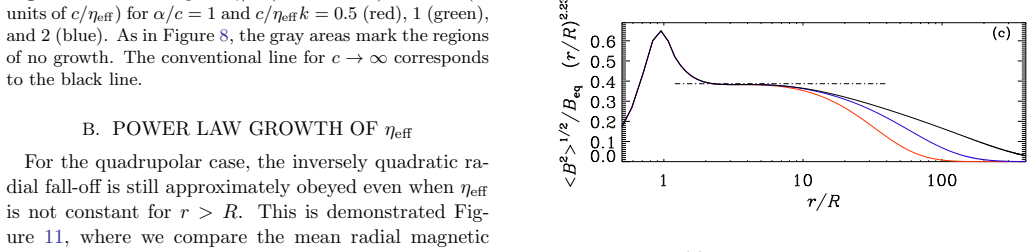
The exteriors of stellar and galactic dynamos are usually modeled as current-free potential fields. A more realistic description might instead be that of a force-free magnetic field. Here, we suggest that, in the absence of outflows, neither of these reflect the actual behavior when the magnetic field spreads diffusively into a more poorly conducting turbulent exterior outside dynamo. In particular, we explain why the usual ordering, in which the dipole magnetic field is the most slowly decaying one, is altered, and why the quadrupole can develop a toroidal component that decays even more slowly with radial distance. This is a robust feature that persists even for spatially nonuniform magnetic diffusivities. It is most clearly seen for spherical dynamo volumes and becomes more complicated for oblate ones. In either case, however, these fields are confined within a magnetosphere, beyond which the field strength drops exponentially. We demonstrate that the Faraday displacement current, which plays a role in a vacuum, can safely be neglected in all cases. The superposition of magnetic fields from galaxies in the outskirts of voids between galaxy clusters therefore cannot explain the magnetization of the intergalactic medium in voids, reinforcing the conventional expectation that these fields are of primordial origin. For quadrupolar configurations, the synchrotron emission from the magnetosphere is found to be constant along concentric rings. The dipolar and quadrupolar configurations display large-scale radial trends that are potentially distinguishable with existing radio telescopes.
Editorial analysis
A structured set of objections, weighed in public.
Referee Report
Summary. The manuscript argues that magnetic fields from stellar and galactic dynamos spread diffusively into a poorly conducting turbulent exterior rather than as current-free potential or force-free fields. This diffusive spreading alters the usual radial decay ordering, allowing a quadrupolar configuration to develop a toroidal component that decays more slowly with radius than the dipole; the result is claimed to be robust even for spatially nonuniform magnetic diffusivities. The fields remain confined within a magnetosphere, beyond which the strength drops exponentially. Implications are drawn for the non-primordial magnetization of the intergalactic medium in voids and for distinguishable large-scale radial trends in synchrotron emission from dipolar versus quadrupolar configurations.
Significance. If the purely diffusive exterior model without induced flows is valid, the altered decay ordering and magnetosphere confinement would challenge standard potential-field approximations for stellar and galactic exteriors, with direct consequences for radio observations and the interpretation of void magnetization. The robustness claim for arbitrary diffusivity profiles is a potentially valuable technical result, but its scope is limited by the neglect of velocity fields.
major comments (3)
- [Abstract / model setup] Abstract and model derivation: the claim that the quadrupolar toroidal component decays even more slowly rests on solutions to the steady induction equation with scalar diffusivity and no velocity term; the manuscript must show that this ordering survives when the full steady MHD system (including Lorentz-driven flows) is considered, as even weak v alters the effective radial operator and can reverse the claimed decay hierarchy.
- [Results / robustness analysis] Results section on robustness: the assertion that the slower quadrupolar decay persists for arbitrary nonuniform η(r) is stated without explicit demonstration (e.g., numerical eigenmode solutions or analytic limits for power-law or step-function profiles); this is load-bearing for the central claim and requires at least one concrete counter-example or proof that the ordering is independent of the specific η(r) shape.
- [Boundary conditions / eigenmode analysis] Boundary conditions: continuity of B and tangential E at the dynamo-exterior interface is invoked to obtain the eigenmodes, but the manuscript does not display the explicit radial dependence or the characteristic equation that yields the slower quadrupolar decay; without these, the quantitative support for the ordering cannot be assessed.
minor comments (3)
- [Discussion] The definition of the magnetosphere boundary (where exponential cutoff begins) should be stated quantitatively, e.g., in terms of a critical conductivity or radius.
- [Appendix or methods] The statement that Faraday displacement current can be neglected would benefit from a brief order-of-magnitude estimate comparing displacement to conduction current for typical stellar/galactic parameters.
- [Figure captions] Figure captions for synchrotron emission should explicitly note the assumed frequency and the radial range over which the constant-ring pattern holds.
Simulated Author's Rebuttal
We thank the referee for their constructive and detailed report. We address each major comment point by point below. Where appropriate, we have revised the manuscript to incorporate additional details and checks.
read point-by-point responses
-
Referee: [Abstract / model setup] Abstract and model derivation: the claim that the quadrupolar toroidal component decays even more slowly rests on solutions to the steady induction equation with scalar diffusivity and no velocity term; the manuscript must show that this ordering survives when the full steady MHD system (including Lorentz-driven flows) is considered, as even weak v alters the effective radial operator and can reverse the claimed decay hierarchy.
Authors: Our model is deliberately restricted to the purely diffusive exterior in the absence of outflows, as stated in the abstract and introduction, to isolate the effect of diffusive spreading. We agree that a full steady MHD treatment including Lorentz-driven flows would be more complete and could modify the effective operator. However, in the low-conductivity turbulent exterior the induced velocities are expected to remain small. In the revised manuscript we have added a paragraph in the discussion section justifying the v = 0 approximation and explicitly noting that a complete MHD analysis is left for future work. revision: partial
-
Referee: [Results / robustness analysis] Results section on robustness: the assertion that the slower quadrupolar decay persists for arbitrary nonuniform η(r) is stated without explicit demonstration (e.g., numerical eigenmode solutions or analytic limits for power-law or step-function profiles); this is load-bearing for the central claim and requires at least one concrete counter-example or proof that the ordering is independent of the specific η(r) shape.
Authors: We have performed the requested explicit checks. Numerical eigenmode solutions were obtained for power-law profiles η(r) ∝ r^α (α = −1, 0, +1) and for a step-function profile with a sharp transition at the dynamo boundary. In every case the quadrupolar toroidal component retains the slowest radial decay. A new subsection and accompanying figure have been added to the revised manuscript to document these results. revision: yes
-
Referee: [Boundary conditions / eigenmode analysis] Boundary conditions: continuity of B and tangential E at the dynamo-exterior interface is invoked to obtain the eigenmodes, but the manuscript does not display the explicit radial dependence or the characteristic equation that yields the slower quadrupolar decay; without these, the quantitative support for the ordering cannot be assessed.
Authors: We agree that these details strengthen the presentation. The revised manuscript now includes a new appendix that gives the explicit radial functional forms for the poloidal and toroidal components and derives the characteristic equation obtained by enforcing continuity of B and tangential E at the interface. This allows direct verification of the decay ordering. revision: yes
- Demonstration that the claimed decay ordering survives in the full steady MHD system when self-consistent Lorentz-driven velocity fields are included.
Circularity Check
No significant circularity in the derivation chain.
full rationale
The paper derives the exterior field structure by solving the steady diffusive induction equation ∇×(η∇×B)=0 subject to continuity of B and tangential E at the dynamo boundary, obtaining eigenmodes whose radial decay rates (including the slower quadrupolar toroidal falloff) follow directly from the resulting ordinary differential equation for arbitrary η(r). This ordering is a mathematical property of the operator and boundary-value problem rather than a redefinition or fit to the same quantities. The neglect of velocity is an explicit modeling assumption stated in the abstract and introduction, not a hidden self-definition. No load-bearing self-citations, ansatz smuggling, or renaming of empirical patterns occur; the central results are obtained from the presented equations without reduction to the inputs by construction.
Axiom & Free-Parameter Ledger
axioms (1)
- domain assumption Magnetic field spreads diffusively in poorly conducting turbulent exterior outside the dynamo volume
invented entities (1)
-
magnetosphere
no independent evidence
Lean theorems connected to this paper
-
IndisputableMonolith/Foundation/AlexanderDuality.leanalexander_duality_circle_linking unclear?
unclearRelation between the paper passage and the cited Recognition theorem.
the quadrupole can develop a toroidal component that decays even more slowly with radial distance... these fields are confined within a magnetosphere, beyond which the field strength drops exponentially
What do these tags mean?
- matches
- The paper's claim is directly supported by a theorem in the formal canon.
- supports
- The theorem supports part of the paper's argument, but the paper may add assumptions or extra steps.
- extends
- The paper goes beyond the formal theorem; the theorem is a base layer rather than the whole result.
- uses
- The paper appears to rely on the theorem as machinery.
- contradicts
- The paper's claim conflicts with a theorem or certificate in the canon.
- unclear
- Pith found a possible connection, but the passage is too broad, indirect, or ambiguous to say the theorem truly supports the claim.
Reference graph
Works this paper leans on
-
[1]
Aramburo-García, A., et al. 2021, Mon. Not. R. Astron. Soc., 502, 6012, 10.1093/mnras/stab391
-
[2]
---. 2022, Mon. Not. R. Astron. Soc., 514, 2656, 10.1093/mnras/stac1460
-
[3]
Armillotta , L., Ostriker , E. C., & Linzer , N. B. 2025, , 989, 140, 10.3847/1538-4357/adea68
- [4]
-
[5]
2016, , 833, L22, 10.3847/2041-8213/833/2/L22
Bonanno , A. 2016, , 833, L22, 10.3847/2041-8213/833/2/L22
-
[6]
2017, , 605, A33, 10.1051/0004-6361/201731330
Bonanno , A., & Del Sordo , F. 2017, , 605, A33, 10.1051/0004-6361/201731330
-
[7]
Bondarenko, K., Boyarsky, A., Korochkin, A., et al. 2022, A&A, 660, A80
work page 2022
-
[8]
Brandenburg , A., Donner , K. J., Moss , D., et al. 1993, , 271, 36
work page 1993
-
[9]
2014, , 786, 91, 10.1088/0004-637X/786/2/91
Brandenburg , A., & Stepanov , R. 2014, , 786, 91, 10.1088/0004-637X/786/2/91
-
[10]
Brandenburg , A., Tuominen , I., & Krause , F. 1990, Geophys. Astrophys. Fluid Dynam., 50, 95, 10.1080/03091929008219875
-
[11]
Chandrasekhar , S., & Kendall , P. C. 1957, , 126, 457, 10.1086/146413
-
[12]
Chiu , H.-H. S., Ruszkowski , M., Thomas , T., Werhahn , M., & Pfrommer , C. 2024, , 976, 136, 10.3847/1538-4357/ad84e9
-
[13]
Einstein , A. 1905, Ann. Phys., 322, 549, 10.1002/andp.19053220806
-
[14]
Elstner , D., Golla , G., R\"udiger , G., & Wielebinski , R. 1995, , 297, 77
work page 1995
-
[15]
Elstner , D., Meinel , R., & R \"u diger , G. 1990, Geophys. Astrophys. Fluid Dynam., 50, 85, 10.1080/03091929008219874
- [16]
-
[17]
Ghasemi-Nodehi , M., Tabatabaei , F. S., Sargent , M., et al. 2022, , 515, 1158, 10.1093/mnras/stac1393
-
[18]
Ghosh, O., Brandenburg, A., Caprini, C., Neronov, A., & Vazza, F. 2025, Phys. Rev. D, in press. 2510.26918
-
[19]
Ginzburg , V. L., & Syrovatskii , S. I. 1965, , 3, 297, 10.1146/annurev.aa.03.090165.001501
- [20]
-
[21]
2013, , 556, A106, 10.1051/0004-6361/201321353
Jabbari , S., Brandenburg , A., Kleeorin , N., Mitra , D., & Rogachevskii , I. 2013, , 556, A106, 10.1051/0004-6361/201321353
-
[22]
2015, , 805, 166, 10.1088/0004-637X/805/2/166
---. 2015, , 805, 166, 10.1088/0004-637X/805/2/166
-
[23]
2021, , 647, A18, 10.1051/0004-6361/202038564
Jakab , P., & Brandenburg , A. 2021, , 647, A18, 10.1051/0004-6361/202038564
-
[24]
1980, Mean-Field Magnetohydrodynamics and Dynamo Theory (Oxford: Pergamon Press)
Krause , F., & R \"a dler , K.-H. 1980, Mean-Field Magnetohydrodynamics and Dynamo Theory (Oxford: Pergamon Press)
work page 1980
- [25]
-
[26]
Moffatt , H. K. 1978, Magnetic Field Generation in Electrically Conducting Fluids (Cambridge: Cambridge University Press)
work page 1978
-
[27]
Murray , J. D., Stanley , E. A., & Brown , D. L. 1986, Proc. Roy. Soc. Lond. Ser. B, 229, 111, 10.1098/rspb.1986.0078
-
[28]
Oei , M. S. S. L. 2025, private information
work page 2025
-
[29]
Parker , E. N. 1979, Cosmical Magnetic Fields: Their Origin and Their Activity (Oxford: Clarendon Press)
work page 1979
-
[30]
Pencil Code Collaboration , Brandenburg , A., Johansen , A., et al. 2021, J. Open Source Software, 6, 2807, 10.21105/joss.02807
-
[31]
2021, , 907, L11, 10.3847/2041-8213/abcaa9
Peron , G., Aharonian , F., Casanova , S., Yang , R., & Zanin , R. 2021, , 907, L11, 10.3847/2041-8213/abcaa9
-
[32]
S., Strugarek , A., & R \'e ville , V
Perri , B., Brun , A. S., Strugarek , A., & R \'e ville , V. 2021, , 910, 50, 10.3847/1538-4357/abe2ac
-
[33]
Pfrommer , C., Werhahn , M., Pakmor , R., Girichidis , P., & Simpson , C. M. 2022, , 515, 4229, 10.1093/mnras/stac1808
-
[34]
Priest , E. R. 1982, Solar magnetohydrodynamics. , Vol. 21 (Cambridge University Press)
work page 1982
-
[35]
Rybicki , G. B., & Lightman , A. P. 1986, Radiative Processes in Astrophysics (Wiley-VCH Verlag GmbH & Co. KGaA)
work page 1986
-
[36]
On the contribution of galaxies to the magnetic field in cosmic voids
Seller, K., & Sigl, G. 2025, On the contribution of galaxies to the magnetic field in cosmic voids. 2510.08025
work page internal anchor Pith review Pith/arXiv arXiv 2025
-
[37]
Steenbeck , M., & Krause , F. 1969, Astron. Nachr., 291, 49, 10.1002/asna.19692910201
- [38]
-
[39]
2025, , 696, A58, 10.1051/0004-6361/202451709
Vazza , F., Gheller , C., Zanetti , F., et al. 2025, , 696, A58, 10.1051/0004-6361/202451709
-
[40]
2021, , 505, 3273, 10.1093/mnras/stab1324
Werhahn , M., Pfrommer , C., Girichidis , P., Puchwein , E., & Pakmor , R. 2021, , 505, 3273, 10.1093/mnras/stab1324
-
[41]
Yang , W. H., Sturrock , P. A., & Antiochos , S. K. 1986, , 309, 383, 10.1086/164610
discussion (0)
Sign in with ORCID, Apple, or X to comment. Anyone can read and Pith papers without signing in.