A pressure-projection formulation in a least-squares meshfree method for the incompressible Navier-Stokes equations using a staggered-variable arrangement
Pith reviewed 2026-05-16 21:04 UTC · model grok-4.3
The pith
A staggered primal-dual arrangement in a least-squares meshfree method ensures consistent pressure projection and locally divergence-free velocities for incompressible Navier-Stokes flows.
A machine-rendered reading of the paper's core claim, the machinery that carries it, and where it could break.
Core claim
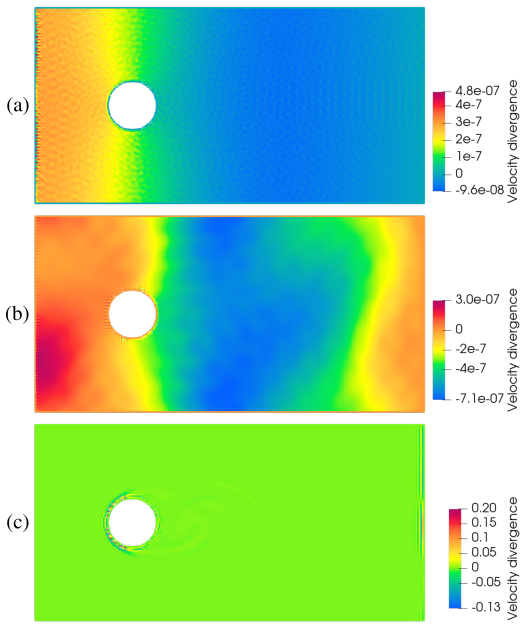
By constructing a virtual dual cell solely from the local connectivity among nodes within the mesh-constrained discrete point method, consistent discrete operators are obtained on both sides of the pressure Poisson equation. Time evolution converting is then applied to evolve the velocity on cell interfaces, producing a staggered-variable arrangement that enforces a local divergence-free velocity field up to an arbitrarily small discrete error while retaining the meshfree nature of the discretization.
What carries the argument
The virtual dual cell defined solely from local connectivity among nodes in a staggered primal-dual grid, which supplies matching discrete divergence and gradient operators for the pressure Poisson equation.
If this is right
- Local divergence-free velocity is ensured up to an arbitrarily small discrete error.
- The expected spatial convergence order is recovered in the computed solutions.
- Flow features are accurately reproduced across a wide range of Reynolds numbers.
- Arbitrary geometries can be treated without constructing a global mesh system.
Where Pith is reading between the lines
- The same local-connectivity construction could be reused in other projection-based meshfree schemes to remove operator inconsistency without adding global data structures.
- Because the dual cell is rebuilt from instantaneous node links, the method may adapt more readily to problems with moving or deforming boundaries than fixed-grid staggered schemes.
- Extension of the time-evolution conversion step to higher-order Runge-Kutta integrators would test whether the staggered coupling remains stable under stronger time-step restrictions.
Load-bearing premise
The virtual dual cell constructed from local connectivity produces consistent discrete operators on both sides of the pressure Poisson equation without introducing new inconsistencies or accuracy loss.
What would settle it
Numerical experiments in which the discrete divergence of the velocity field fails to approach zero under successive refinement, or in which the observed spatial convergence order falls below the design rate, would show that the operator consistency has not been achieved.
Figures




read the original abstract
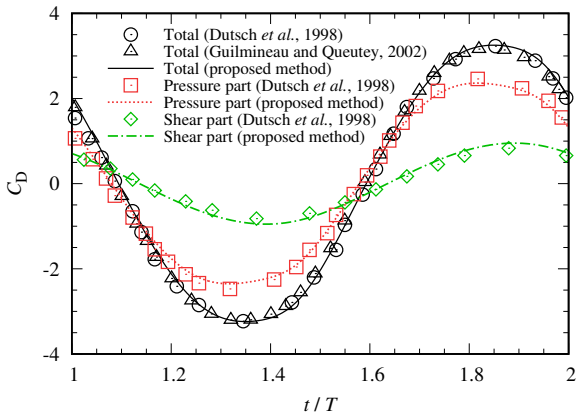
Incompressible flow solvers based on strong-form meshfree methods represent arbitrary geometries without the need for a global mesh system. However, their local evaluations make it difficult to satisfy incompressibility at the discrete level. Moreover, the collocated arrangement of velocity and pressure variables tends to induce a zero-energy mode, leading to decoupling between the two variables. In projection-based approaches, a spatial discretization scheme based on a conventional node-based moving least-squares method for the pressure causes inconsistency between the discrete operators on both sides of the Poisson equation. Thus, a solenoidal velocity field cannot be ensured numerically. In this study, a numerical method for the incompressible Navier-Stokes equations is developed by introducing a local primal-dual grid into the mesh-constrained discrete point method, enabling consistent discrete operators. The constructed virtual dual cell is defined solely from the local connectivity among nodes, and thus the method retains its meshfree nature. To achieve a consistent coupling between velocity and pressure variables under the primal-dual arrangement, time evolution converting is applied to evolve the velocity on cell interfaces. For numerical validation, a linear acoustic equation is solved to confirm the effectiveness of the staggered-variable arrangement based on the local primal-dual grid. Then, incompressible Navier-Stokes equations are solved, and the proposed method is demonstrated to ensure a local divergence-free velocity field up to an arbitrarily small discrete error, achieve the expected spatial convergence order, and accurately reproduce flow features over a wide range of Reynolds numbers.
Editorial analysis
A structured set of objections, weighed in public.
Referee Report
Summary. The manuscript proposes a pressure-projection formulation for the incompressible Navier-Stokes equations within a least-squares meshfree framework. By introducing a virtual dual cell defined from local node connectivity to create a staggered arrangement, the method aims to ensure consistent discrete gradient and divergence operators in the pressure Poisson equation, thereby achieving a locally divergence-free velocity field up to arbitrarily small discrete error while preserving the meshfree nature of the discretization. Validation includes a linear acoustic problem and Navier-Stokes flows demonstrating expected convergence rates and accurate flow reproduction across Reynolds numbers.
Significance. If the consistency of the primal-dual operators is rigorously established, this approach would represent a meaningful contribution to meshfree methods for incompressible flows, addressing a common limitation in strong-form discretizations without introducing global meshing requirements. The ability to handle arbitrary geometries with high-fidelity incompressibility enforcement could be valuable for engineering applications.
major comments (1)
- [Construction of virtual dual cell and discrete operators] The central claim that the method ensures a local divergence-free velocity field up to arbitrarily small discrete error depends on the virtual dual cell yielding adjoint-consistent operators for the pressure Poisson equation. However, the manuscript does not appear to provide an explicit proof of a discrete integration-by-parts identity or adjoint property for arbitrary local connectivities in the least-squares approximation. This is load-bearing for the claim, as without it, residual divergence may remain at the order of the approximation error rather than machine epsilon, particularly on irregular node sets.
minor comments (1)
- [Validation section] The details of how the 'arbitrarily small discrete error' is quantified (e.g., specific tolerance or norm used) should be clarified for reproducibility.
Simulated Author's Rebuttal
We thank the referee for the constructive review and positive assessment of the manuscript's potential contribution. We address the major comment point by point below, agreeing that an explicit derivation will strengthen the theoretical claims, and will revise the manuscript accordingly.
read point-by-point responses
-
Referee: [Construction of virtual dual cell and discrete operators] The central claim that the method ensures a local divergence-free velocity field up to arbitrarily small discrete error depends on the virtual dual cell yielding adjoint-consistent operators for the pressure Poisson equation. However, the manuscript does not appear to provide an explicit proof of a discrete integration-by-parts identity or adjoint property for arbitrary local connectivities in the least-squares approximation. This is load-bearing for the claim, as without it, residual divergence may remain at the order of the approximation error rather than machine epsilon, particularly on irregular node sets.
Authors: We appreciate the referee's identification of this key theoretical point. The virtual dual cell is constructed directly from local node connectivity to enforce that the discrete divergence operator is the adjoint of the gradient operator within the least-squares framework, ensuring consistency in the pressure Poisson equation by design (analogous to staggered finite-volume schemes). Numerical results in the manuscript already demonstrate divergence errors at levels consistent with machine precision for the tested node distributions. However, we agree that an explicit proof of the discrete integration-by-parts identity for arbitrary connectivities would provide rigorous support and address potential concerns on irregular sets. In the revised manuscript, we will add a new appendix deriving this adjoint property, showing that any residual divergence is bounded by the controllable least-squares approximation error (which can be driven arbitrarily small by increasing polynomial degree or support radius). This will confirm the local divergence-free property up to this discrete tolerance. revision: yes
Circularity Check
No circularity: construction and validation remain independent
full rationale
The derivation introduces a virtual dual cell defined from local node connectivity to produce consistent discrete gradient and divergence operators on the staggered primal-dual arrangement. This construction is presented as a direct definition that preserves meshfree character while enforcing adjoint consistency for the pressure Poisson equation; the resulting local divergence-free property is then demonstrated numerically rather than asserted by algebraic identity or fitted parameter. No step equates the target result to its own inputs by construction, no uniqueness theorem is imported from the authors' prior work, and no ansatz is smuggled via self-citation. The central claim therefore rests on the explicit staggered discretization and its numerical verification, not on a self-referential reduction.
Axiom & Free-Parameter Ledger
axioms (2)
- domain assumption Incompressible Navier-Stokes equations govern the flow
- ad hoc to paper Local connectivity among nodes defines consistent dual cells
invented entities (1)
-
local primal-dual grid
no independent evidence
Lean theorems connected to this paper
-
IndisputableMonolith/Foundation/AlexanderDuality.leanalexander_duality_circle_linking unclear?
unclearRelation between the paper passage and the cited Recognition theorem.
The constructed virtual dual cell is defined solely from the local connectivity among nodes... enabling consistent discrete operators... solenoidal velocity field up to an arbitrarily small discrete error
-
IndisputableMonolith/Cost/FunctionalEquation.leanwashburn_uniqueness_aczel unclear?
unclearRelation between the paper passage and the cited Recognition theorem.
MLS reconstruction with radial components... consistent discrete gradient and divergence operators
What do these tags mean?
- matches
- The paper's claim is directly supported by a theorem in the formal canon.
- supports
- The theorem supports part of the paper's argument, but the paper may add assumptions or extra steps.
- extends
- The paper goes beyond the formal theorem; the theorem is a base layer rather than the whole result.
- uses
- The paper appears to rely on the theorem as machinery.
- contradicts
- The paper's claim conflicts with a theorem or certificate in the canon.
- unclear
- Pith found a possible connection, but the passage is too broad, indirect, or ambiguous to say the theorem truly supports the claim.
Reference graph
Works this paper leans on
-
[1]
T. Belytschko, Y. Y. Lu, L. Gu, Element-free Galerkin methods, Int. J. Numer. Methods Eng. 37 (2) (1994) 229–256.doi:10.1002/nme.1620370205
-
[2]
X. Wang, J. Ouyang, J. Su, B. Yang, On the superiority of the mixed element free Galerkin method for solving the steady incompressible flow problems, Eng. Anal. Bound. Elem. 36 (11) (2012) 1618–1630. doi:10.1016/j.enganabound.2012.05.006
-
[3]
S. N. Atluri, T. Zhu, A new Meshless Local Petrov-Galerkin (MLPG) approach in computational me- chanics, Comput. Mech. 22 (2) (1998) 117–127.doi:10.1007/s004660050346
-
[4]
M. Abbaszadeh, M. Dehghan, Direct meshless local Petrov–Galerkin (DMLPG) method for time- fractional fourth-order reaction–diffusion problem on complex domains, Comput. Math. Appl. 79 (3) (2020) 876–888.doi:10.1016/j.camwa.2019.08.001
-
[5]
W. K. Liu, S. Jun, Y. F. Zhang, Reproducing kernel particle methods, Int. J. Numer. Methods Fluids 20 (8-9) (1995) 1081–1106.doi:10.1002/fld.1650200824
-
[6]
R. A. Gingold, J. J. Monaghan, Smoothed particle hydrodynamics: Theory and application to non- spherical stars, Mon. Not. R. Astron. Soc. 181 (3) (1977) 375–389.doi:10.1093/mnras/181.3.375
-
[7]
S. Koshizuka, Y. Oka, Moving-Particle Semi-Implicit Method for Fragmentation of Incompressible Fluid, Nucl. Sci. Eng. 123 (3) (1996) 421–434.doi:10.13182/NSE96-A24205
-
[8]
E. O˜ nate, S. Idelsohn, O. C. Zienkiewicz, R. L. Taylor, C. Sacco, A stabilized finite point method for analysis of fluid mechanics problems, Comput. Methods Appl. Mech. Eng. 139 (1) (1996) 315–346. doi:10.1016/S0045-7825(96)01088-2
-
[9]
N. Perrone, R. Kao, A general finite difference method for arbitrary meshes, Comput. Struct. 5 (1) (1975) 45–57.doi:10.1016/0045-7949(75)90018-8
-
[10]
T. Liszka, J. Orkisz, The finite difference method at arbitrary irregular grids and its application in applied mechanics, Comput. Struct. 11 (1) (1980) 83–95.doi:10.1016/0045-7949(80)90149-2
-
[11]
J. J. Benito, F. Ure˜ na, L. Gavete, Solving parabolic and hyperbolic equations by the generalized finite difference method, J. Comput. Appl. Math. 209 (2) (2007) 208–233.doi:10.1016/j.cam.2006.10.090. 24
-
[12]
F. U. Prieto, J. J. Benito Mu˜ noz, L. G. Corvinos, Application of the generalized finite difference method to solve the advection–diffusion equation, J. Comput. Appl. Math. 235 (7) (2011) 1849–1855.doi: 10.1016/j.cam.2010.05.026
- [13]
-
[14]
G. A. Dilts, Moving-least-squares-particle hydrodynamics—I. Consistency and stability, Int. J. Nu- mer. Methods Eng. 44 (8) (1999) 1115–1155.doi:10.1002/(SICI)1097-0207(19990320)44:8<1115:: AID-NME547>3.0.CO;2-L
-
[15]
P. Suchde, J. Kuhnert, S. Tiwari, On meshfree GFDM solvers for the incompressible Navier–Stokes equations, Comput. Fluids 165 (2018) 1–12.doi:10.1016/j.compfluid.2018.01.008
-
[16]
T. Tamai, S. Koshizuka, Least squares moving particle semi-implicit method, Comput. Part. Mech. 1 (3) (2014) 277–305.doi:10.1007/s40571-014-0027-2
-
[17]
T. Matsunaga, A. S¨ odersten, K. Shibata, S. Koshizuka, Improved treatment of wall boundary conditions for a particle method with consistent spatial discretization, Comput. Methods Appl. Mech. Eng. 358 (2020) 112624.doi:10.1016/j.cma.2019.112624
-
[18]
Y. Vasyliv, A. Alexeev, Simulating incompressible flow on moving meshfree grids, Comput. Fluids 200 (2020) 104464.doi:10.1016/j.compfluid.2020.104464
-
[19]
T. Matsuda, K. Tsukui, S. Ii, A particle-based method using the mesh-constrained discrete point ap- proach for two-dimensional Stokes flows, Mech. Eng. J. 9 (5) (2022) 22–00204.doi:10.1299/mej. 22-00204
work page doi:10.1299/mej 2022
-
[20]
T. Matsuda, S. Ii, A mesh-constrained discrete point method for incompressible flows with moving boundaries, J. Comput. Phys. 532 (2025) 113945.doi:10.1016/j.jcp.2025.113945
-
[21]
P. Lancaster, K. Salkauskas, Surfaces generated by moving least squares methods, Math. Comput. 37 (155) (1981) 141–158.doi:10.1090/S0025-5718-1981-0616367-1
-
[22]
T. Matsunaga, S. Koshizuka, Stabilized LSMPS method for complex free-surface flow simulation, Com- put. Methods Appl. Mech. Eng. 389 (2022) 114416.doi:10.1016/j.cma.2021.114416
-
[23]
Matsunaga, High-order time-marching schemes for incompressible flow in particle methods, Comput
T. Matsunaga, High-order time-marching schemes for incompressible flow in particle methods, Comput. Methods Appl. Mech. Eng. 447 (2025) 118395.doi:10.1016/j.cma.2025.118395
-
[24]
J. A. Hopman, D. Santos, `A. Alsalti-Baldellou, J. Rigola, F. X. Trias, Quantifying the checkerboard problem to reduce numerical dissipation, J. Comput. Phys. 521 (2025) 113537.doi:10.1016/j.jcp. 2024.113537
-
[25]
J. W. Swegle, S. W. Attaway, M. W. Heinstein, F. J. Mello, D. L. Hicks, An analysis of smoothed particle hydrodynamics, Tech. Rep. SAND–93-2513, Sandia National Labs., Albuquerque, NM (United States) (Feb. 1994).doi:10.2172/10159839
-
[26]
S. Liu, X. He, Y. Guo, Y. Chang, W. Wang, A Dual-Particle Approach for Incompressible SPH Fluids, ACM Trans. Graph. 43 (3) (2024) 28:1–28:18.doi:10.1145/3649888
-
[27]
C. T. Dyka, R. P. Ingel, An approach for tension instability in smoothed particle hydrodynamics (SPH), Comput. Struct. 57 (4) (1995) 573–580.doi:10.1016/0045-7949(95)00059-P
-
[28]
P. W. Randles, L. D. Libersky, Normalized SPH with stress points, Int. J. Numer. Methods Eng. 48 (10) (2000) 1445–1462.doi:10.1002/1097-0207(20000810)48:10<1445::AID-NME831>3.0.CO;2-9
-
[29]
C. M. Chalk, M. Pastor, J. Peakall, D. J. Borman, P. A. Sleigh, W. Murphy, R. Fuentes, Stress-Particle Smoothed Particle Hydrodynamics: An application to the failure and post-failure behaviour of slopes, Comput. Methods Appl. Mech. Eng. 366 (2020) 113034.doi:10.1016/j.cma.2020.113034. 25
-
[30]
X. He, N. Liu, G. Wang, F. Zhang, S. Li, S. Shao, H. Wang, Staggered meshless solid-fluid coupling, ACM Trans. Graph. 31 (6) (2012) 149:1–149:12.doi:10.1145/2366145.2366168
-
[31]
X. He, H. Wang, G. Wang, H. Wang, E. Wu, A Variational Staggered Particle Framework for Incom- pressible Free-Surface Flows (Jan. 2020).arXiv:2001.09421,doi:10.48550/arXiv.2001.09421
-
[32]
S.-K. Park, G. Jo, H. J. Choe, Existence and stability in the virtual interpolation point method for the Stokes equations, J. Comput. Phys. 307 (2016) 535–549.doi:10.1016/j.jcp.2015.12.002
-
[33]
N. Trask, M. Perego, P. Bochev, A high-order staggered meshless method for elliptic problems, SIAM J. Sci. Comput. 39 (2) (2017) A479–A502.doi:10.1137/16M1055992
-
[34]
N. Trask, M. Maxey, X. Hu, A compatible high-order meshless method for the Stokes equations with applications to suspension flows, J. Comput. Phys. 355 (2018) 310–326.doi:10.1016/j.jcp.2017.10. 039
-
[35]
A. J. Chorin, Numerical solution of the Navier-Stokes equations, Math. Comput. 22 (104) (1968) 745– 762.doi:10.1090/S0025-5718-1968-0242392-2
-
[36]
Xiao, A Simple CIP Finite Volume Method for Incompressible Flows, JSME Int
F. Xiao, A Simple CIP Finite Volume Method for Incompressible Flows, JSME Int. J. Ser. B Fluids Thermal Eng. 47 (4) (2004) 664–671.doi:10.1299/jsmeb.47.664
-
[37]
F. Xiao, A. Ikebata, T. Hasegawa, Numerical simulations of free-interface fluids by a multi-integrated moment method, Computers & Structures 83 (6) (2005) 409–423.doi:10.1016/j.compstruc.2004. 06.005
-
[38]
F. Xiao, R. Akoh, S. Ii, Unified formulation for compressible and incompressible flows by using multi- integrated moments II: Multi-dimensional version for compressible and incompressible flows, Journal of Computational Physics 213 (1) (2006) 31–56.doi:10.1016/j.jcp.2005.08.002
-
[39]
C. M. Rhie, W. L. Chow, Numerical study of the turbulent flow past an airfoil with trailing edge separation, AIAA J. 21 (11) (1983) 1525–1532.doi:10.2514/3.8284
-
[40]
S. Zhang, X. Zhao, S. Bayyuk, Generalized formulations for the Rhie–Chow interpolation, J. Comput. Phys. 258 (2014) 880–914.doi:10.1016/j.jcp.2013.11.006
-
[41]
F. H. Harlow, The particle-in-cell method for numerical solution of problems in fluid dynamics, Tech. Rep. LADC-5288, Los Alamos Scientific Lab., N. Mex. (Feb. 1962).doi:10.2172/4769185
-
[42]
J. U. Brackbill, H. M. Ruppel, FLIP: A method for adaptively zoned, particle-in-cell calculations of fluid flows in two dimensions, J. Comput. Phys. 65 (2) (1986) 314–343.doi:10.1016/0021-9991(86) 90211-1
-
[43]
X. K. Zhang, K.-C. Kwon, S.-K. Youn, The least-squares meshfree method for the steady incompressible viscous flow, J. Comput. Phys. 206 (1) (2005) 182–207.doi:10.1016/j.jcp.2004.11.033
-
[44]
B. Chandra, R. Hashimoto, S. Matsumi, K. Kamrin, K. Soga, Stabilized mixed material point method for incompressible fluid flow analysis, Comput. Methods Appl. Mech. Eng. 419 (2024) 116644.doi: 10.1016/j.cma.2023.116644
-
[45]
K.-Y. He, Y.-F. Jin, X.-W. Zhou, Z.-Y. Yin, X. Chen, An improved MPM formulation for free surface flow problems based on finite volume method, Comput. Methods Appl. Mech. Eng. 446 (2025) 118264. doi:10.1016/j.cma.2025.118264
-
[46]
Y. Xu, G. Yang, Y. Zhu, D. Hu, A coupled SPH–FVM method for simulating incompressible interfacial flows with large density difference, Eng. Anal. Bound. Elem. 128 (2021) 227–243.doi:10.1016/j. enganabound.2021.04.005
work page doi:10.1016/j 2021
-
[47]
K. Nishiguchi, T. Shimada, C. Peco, K. Kondo, S. Okazawa, M. Tsubokura, Eulerian finite volume method using Lagrangian markers with reference map for incompressible fluid–structure interaction problems, Comput. Fluids 274 (2024) 106210.doi:10.1016/j.compfluid.2024.106210. 26
-
[48]
H. A. van der Vorst, Bi-CGSTAB: A Fast and Smoothly Converging Variant of Bi-CG for the Solution of Nonsymmetric Linear Systems, SIAM J. Sci. and Stat. Comput. 13 (2) (1992) 631–644.doi:10. 1137/0913035
work page 1992
-
[49]
U. Ghia, K. N. Ghia, C. T. Shin, High-Re solutions for incompressible flow using the Navier-Stokes equa- tions and a multigrid method, J. Comput. Phys. 48 (3) (1982) 387–411.doi:10.1016/0021-9991(82) 90058-4
-
[50]
S. Hou, Q. Zou, S. Chen, G. Doolen, A. C. Cogley, Simulation of Cavity Flow by the Lattice Boltzmann Method, J. Comput. Phys. 118 (2) (1995) 329–347.doi:10.1006/jcph.1995.1103
-
[51]
Y.-F. Peng, Y.-H. Shiau, R. R. Hwang, Transition in a 2-D lid-driven cavity flow, Comput. Fluids 32 (3) (2003) 337–352.doi:10.1016/S0045-7930(01)00053-6
- [52]
-
[53]
H. D¨ utsch, F. Durst, S. Becker, H. Lienhart, Low-Reynolds-number flow around an oscillating circu- lar cylinder at low Keulegan–Carpenter numbers, J. Fluid Mech. 360 (1998) 249–271.doi:10.1017/ S002211209800860X
work page 1998
-
[54]
E. Guilmineau, P. Queutey, A NUMERICAL SIMULATION OF VORTEX SHEDDING FROM AN OSCILLATING CIRCULAR CYLINDER, J. Fluid. Struct. 16 (6) (2002) 773–794.doi:10.1006/jfls. 2002.0449
-
[55]
C. Chi, A. Abdelsamie, D. Th´ evenin, A directional ghost-cell immersed boundary method for incom- pressible flows, J. Comput. Phys. 404 (2020) 109122.doi:10.1016/j.jcp.2019.109122
-
[56]
M. B. Ghomizad, H. Kor, K. Fukagata, A sharp interface direct-forcing immersed boundary method using the moving least square approximation, J. Fluid Sci. Technol. 16 (2) (2021) JFST0013–JFST0013. doi:10.1299/jfst.2021jfst0013. 27
discussion (0)
Sign in with ORCID, Apple, or X to comment. Anyone can read and Pith papers without signing in.