REVIEW 5 major objections 5 minor 42 references
Learning to Sample in Variable Neighborhood Search Algorithm for Urban Cable Routing Optimization
T0 review · 5 major / 5 minor · reviewed 2026-08-03 · deepseek-v4-flash
Pith's one-line read Co-optimizing substation connectivity and road-constrained cable paths, with shared-trench costs internalized, cuts urban cable construction cost by roughly 30–50% compared with representative 2024 approaches.
desk verdict Solid engineering paper with an overstated headline: the 30–50% cost saving is a modeling effect, not an algorithmic breakthrough; fair comparisons show 1–8% gains. read the letter →
The pith
A machine-rendered reading of the paper's core claim, the machinery that carries it, and where it could break.
The reading
What carries the argument
The carrying mechanism is a two-level formulation: a substation-level graph encodes which feeders connect which substations, and a road-level graph encodes which road segments are trenched and how many parallel cables each carries. The algorithm iteratively destroys and repairs both levels: three destruction operators (path-related removal, intra-feeder 2-opt, and inter-feeder 2-opt) alter the candidate network, a modified A* repair re-plans affected paths while counting trench-sharing costs, and an adaptive perturbation size balances exploration and exploitation. In L-MVNS, three lightweight agents (each an LSTM plus multi-head attention) read the current solution and output a probability f
What would settle it
Run L-MVNS and a relation-only baseline (e.g., MCWS) on a real GIS road network with actual trenching and cable cost data for a mid-size city; if the cost gap is well below 30%, the headline savings do not generalize. Alternatively, on the paper's own Case-1 instance, set the trench-to-cable cost ratio to 1:1 and check whether the reported gap between path-aware and relation-only methods collapses—which would show the savings are tied to the cost assumption.
Extended reading notes
Core claim
The paper's central claim is that co-optimizing which substations to connect and exactly which road segments to excavate, with shared-trench savings internalized, reduces total construction cost by approximately 30–50% against representative 2024 planning approaches. The evidence comes from four synthetic regular-lattice benchmarks, where path-aware methods consistently beat relation-only baselines (MCWS and HGS) that use precomputed shortest paths and ignore trench sharing; the multi-operator variable neighborhood search (MVNS) and its learning-assisted version (L-MVNS) give the lowest costs, and L-MVNS adds moderate gains and markedly lower variance on larger cases.
Load-bearing premise
The claim that planning with explicit roads and shared trenches saves 30–50% rests on four synthetic regular-grid benchmarks with a fixed 3:1 trench-to-cable cost ratio standing in for real urban road networks; if those benchmarks are not representative, the savings figure may not transfer to actual cities.
Editorial extensions
If this is right
- Using path-aware, trench-sharing planning instead of relation-only planning is reported to cut total construction cost by roughly 30–50% on the benchmark suite.
- The multi-agent DRL guidance reduces run-to-run variance, making cost estimates from the algorithm more predictable on large instances.
- The four regular-lattice instances form a standardized, scalable benchmark for future urban cable routing algorithms.
- The auxiliary-task initialization (hybrid genetic search for connections, A* for paths) produces feasible starting points that accelerate the subsequent neighborhood search without special tuning.
- The method's gap to the best single-operator search is small but consistent, indicating that combining complementary destruction operators is more effective than any one operator alone.
Reading between the lines
- The 30–50% figure is measured against MCWS and HGS on synthetic grids; whether it transfers to real street networks with irregular geometry and non-uniform costs is untested in the body of the paper, even though the abstract promises GIS-derived instances that do not appear in the reported experiments.
- The benefit likely depends on the trench-to-cable cost ratio: if the ratio approaches 1:1, the incentive to share trenches weakens and the gap between path-aware and relation-only planning should shrink—the paper's sensitivity analysis varies only algorithmic parameters, not the cost ratio.
- The same connectivity–path co-optimization pattern, with trench sharing priced in, could be applied to other shared-infrastructure networks such as district heating, fiber optics, or water mains, where routing constraints and joint excavation costs dominate.
- Because the DRL module's gains over the non-learning MVNS are modest (sub-2% on reported cases), a sharper test would be to evaluate whether a learned destruction policy generalizes across instance scales and cost structures without per-instance fine-tuning.
Editorial analysis
A structured set of objections, weighed in public.
Referee Report
Summary. The paper formulates urban cable routing as a bilevel connectivity–path co-optimization problem on a road graph, with costs for trenching and cable laying where parallel cables can share a trench. It proposes MVNS, a multi-operator variable neighborhood search with three destruction operators and A* repair, and L-MVNS, a DRL-guided variant in which three agents are trained to bias neighborhood sampling. Experiments are run on four synthetic regular-lattice benchmark cases (Section 3.5) with 10 independent runs per method. The paper claims that MVNS and L-MVNS reduce total construction costs by approximately 30–50% relative to representative 2024 approaches, and that L-MVNS further improves accuracy and variance on larger instances.
Significance. The practical problem is relevant: accounting for road-constrained routes and trench sharing can substantially change planning outcomes. If the algorithmic claims were cleanly established, the DRL-guided neighborhood selection in L-MVNS would be a useful contribution. The paper also provides a reproducible benchmark suite, though only four synthetic cases are actually used. However, the headline 30–50% cost reduction is an artifact of comparing against baselines that optimize a different cost model; the fair path-aware comparison shows only 0.12–8% gains. The abstract also promises 12 benchmark and 3 GIS instances that do not appear in the body. These issues undermine the central claims as currently stated.
major comments (5)
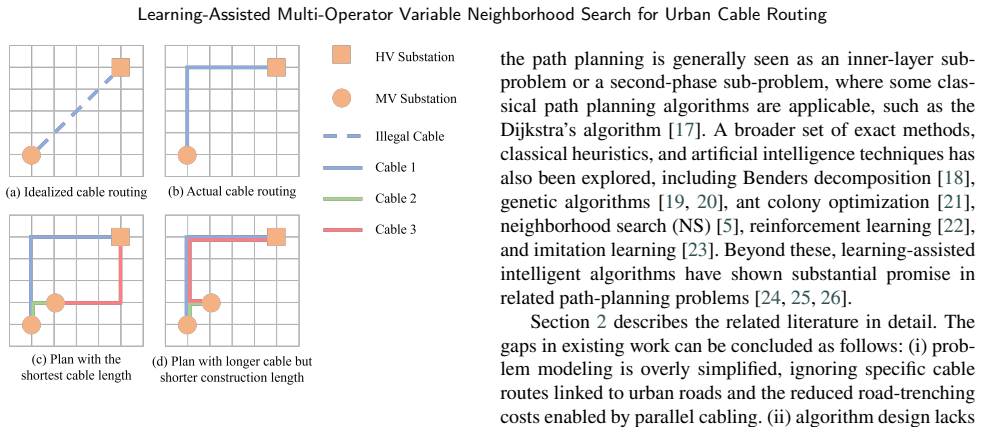
- [Abstract, §5.2, Table 2] The claim that MVNS/L-MVNS reduce total construction costs by approximately 30–50% is not supported by the paper's own fair algorithmic comparisons. Table 2 shows that this large gap appears only against MCWS and HGS, which optimize the Stage-I objective (Eq. (2)) and explicitly ignore trench sharing. Against path-aware baselines SNS-1/2/3, which use the same cost model (Eq. (6)), MVNS/L-MVNS are only 0.12–8.00% better (Case-2: 0.12%, Case-4: 0.18%). The 30–50% figure is therefore a modeling effect of allowing shared trenches, not an algorithmic improvement. The abstract and conclusion should be reframed to separate the modeling benefit from the algorithmic advantage.
- [Abstract vs. Sections 3.5 and 5] The abstract states 'Comprehensive experiments on 12 benchmark instances and 3 GIS-derived instances' and claims reductions of 0.92% to 73.72%. The body constructs only four synthetic lattice cases (Section 3.5) and reports results only for those cases (Table 2, Fig. 8). No GIS-derived instances or 12-instance suite appears anywhere in the experimental section. This is a major discrepancy between claimed and actual evidence. Either supply the promised experiments or remove/correct the abstract statement.
- [§3.2–3.3, Eqs. (3) and (7)] The feasibility constraints are only specified as abstract sets X and Y, with the statement that the 'full algebraic specification' is deliberately omitted. The network topology constraints (ring/interconnected, capacity, connectivity realization, trenching-cabling consistency) are central to the problem and to the feasibility of the repair operator. Without a precise statement of these constraints, the problem is not fully defined and the implementation cannot be independently verified. This is not a presentation nicety: the claim that the proposed method finds feasible optimal solutions depends on these sets being correctly encoded and enforced.
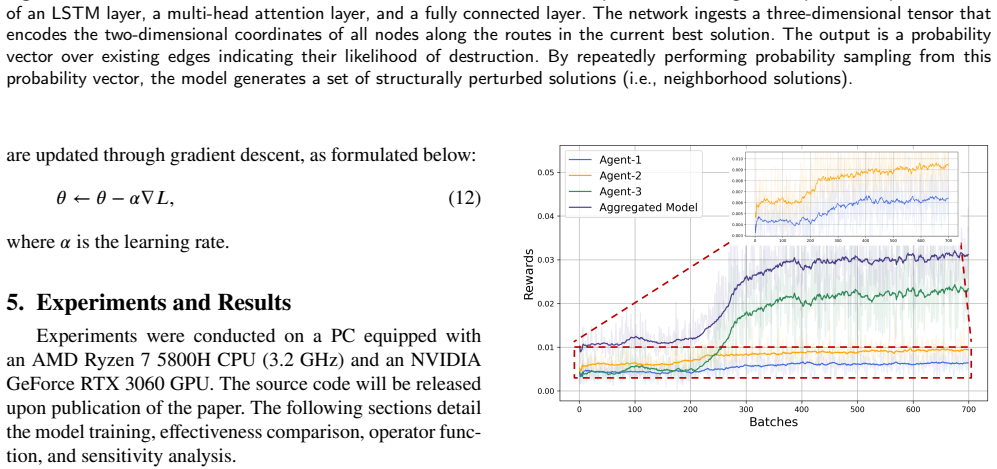
- [§5.1, L-MVNS evaluation protocol] L-MVNS is pretrained on Case-0 and then 'online fine-tuned' on the first 200 iterations of the target instance before being evaluated. This means the DRL policy has already seen part of the test instance's search trajectory, so the comparison between L-MVNS and MVNS is not out-of-sample. The claim that L-MVNS 'delivers additional gains on larger instances' is therefore at risk of in-sample tuning artifact. To support generalization, report L-MVNS without online fine-tuning (pretrained only), or use a train/test instance split and show that fine-tuning on the test instance does not materially change the conclusions.
- [Table 2, §5.2.4] The comparisons are based on only 10 independent runs per case. Several gaps are small (e.g., Case-2 MVNS 5295.26 vs. SNS-1 5325.11, 0.68%; Case-1 L-MVNS 2489.23 vs. MVNS 2481.42, L-MVNS is actually worse but the text only notes Case-1 is an exception). No statistical tests (e.g., Wilcoxon signed-rank, Mann–Whitney U) or confidence intervals are given. Claims of 'consistently yields the best' and 'higher stability' need quantitative support, especially for differences of a few percent.
minor comments (5)
- [§3.5] The benchmark generation says 'with random seed 42, we generate four scales' but the specific seeds for K-means and demand draws are not documented, which hampers exact reproducibility.
- [§3.5] Typo: 'CNY0.5 million CNY/km' should be '0.5 million CNY/km' or 'CNY 0.5 million/km'.
- [§3.4] The notation for the number of feeders, arcs, and road edges is introduced as |F|, |A|, |R|, but the earlier notation uses script letters and the symbol F is not formally defined; please align the notation.
- [§5.2] The text says SNS-1/2/3 use a neighborhood size of 30, while MVNS/L-MVNS use 10 per operator (total 30). This is fair, but the per-operator budget difference (30 vs. 10) should be explicitly acknowledged when interpreting operator-frequency statistics in Fig. 10.
- [§5.1, Eq. (10)] The reward is defined only on improvement; the baseline function b(s_i) is described as a three-layer fully connected network but its inputs and training target are not specified. A short clarification would help reproducibility.
Circularity Check
No significant circularity: the optimization and evaluation chain is self-contained; the noted issues are validation/interpretation gaps, not definitional reductions.
full rationale
The paper's claimed derivation chain starts from a defined two-stage objective (Eqs. (2) and (6)) and an integrated formulation (Eq. (8)); it does not import that objective from the algorithm's outputs. Initialization (HGS + A*) and the MVNS operators are evaluated with the same Eq. (6) cost function, so the search is optimizing the stated criterion rather than re-labeling a fitted value. The external baselines MCWS and HGS are independent methods from the literature, and SNS-1/2/3 are ablations of the proposed operator set, so the core algorithmic comparison is not self-referential. The two concerns that deserve attention are not circularities: (i) L-MVNS is fine-tuned on the first 200 iterations of each target instance before being compared on that same instance (Section 5.1), so the DRL's reported gain over MVNS is in-sample rather than an out-of-sample prediction; (ii) the 30–50% headline compares path-aware methods with relation-only baselines that are evaluated under a different cost model ('equating trench length with cable length,' Section 5.2), so that number reflects the trench-sharing formulation and the 3:1 cost ratio more than an independent algorithmic prediction. The abstract's promised GIS-derived instances are also absent from the body, an external-validity gap. None of these make any equation equal to its own input or make a fitted parameter masquerade as a derivation.
Assumptions & free parameters
free parameters (5)
- trenching-to-cable cost ratio =
c_tr = 1.5, c_ca = 0.5 M CNY/km (3:1)
- benchmark instance parameters =
Q=10 MVA, demand U[2,5] MVA, C_max=6, seed 42
- perturbation size schedule thresholds =
kappa=2/4/6/8 at stagnation thresholds 20/30/40
- DRL exploration probability =
70% agent / 30% random
- running hyperparameters =
N=10 per operator, 600 iterations, 200s initialization time
assumptions (4)
- ad hoc to paper The omitted combinatorial constraints in abstract sets X (Eq. 3) and Y (Eq. 7) are correctly encoded and satisfied by HGS, A*, and MVNS repair.
- domain assumption Road networks can be modeled as directed graphs with cables restricted to edges and linear cost functions (Section 3.3).
- ad hoc to paper The DRL policy pretrained on Case-0 and fine-tuned for 200 iterations on the target instance transfers usefully to larger instances (Section 5.1).
- domain assumption Synthetic lattice instances approximate real urban layouts (Section 3.5).
Cite this review
Pith. "Pith review of Learning to Sample in Variable Neighborhood Search Algorithm for Urban Cable Routing Optimization." pith.science (2026). https://pith.science/paper/DY6VVHYA
@misc{pith2026251219321,
  author       = {Pith},
  title        = {Pith review of: Learning to Sample in Variable Neighborhood Search Algorithm for Urban Cable Routing Optimization},
  year         = {2026},
  howpublished = {\url{https://pith.science/paper/DY6VVHYA}},
  note         = {Machine review of arXiv:2512.19321}
}
read the original abstract
Urban underground cable construction is essential for enhancing power grid reliability, yet the high construction costs demand systematic optimization. Constrained by road network infrastructure, this problem requires consideration of both connectivity relationships between substations and specific routing strategies along road networks, constituting a large-scale bilevel combinatorial optimization problem. Insufficient attention to routing subproblems in traditional research and simplistic algorithmic designs ill-equipped for large-scale optimization leave substantial room for advancement. To navigate the enormous combinatorial search space, we propose a learning-assisted variable neighborhood search (L-VNS) algorithm integrating four key components. First, an auxiliary task focusing on the upper-level connectivity subproblem generates high-quality initial solutions by employing hybrid genetic search for connection optimization and A* for detailed path routing. Subsequently, the algorithm iteratively refines the connectivity topology using variable neighborhood search with three complementary operators. A multi-agent deep reinforcement learning module adaptively guides probabilistic neighborhood sampling by jointly encoding upper-level connectivity patterns and lower-level routing structures, effectively exploiting problem structure. Finally, a modified A* operator re-plans lower-level paths affected by neighborhood modifications to ensure feasibility and solution completeness. Comprehensive experiments on 12 benchmark instances and 3 GIS-derived instances demonstrate the superiority of L-VNS, achieving total construction cost reductions of 0.92% to 73.72% compared to representative approaches. Ablation studies and sensitivity analyses further validate the effectiveness and robustness of the proposed algorithm.
Figures


Figures from the paper (8 more)




Reference graph
Works this paper leans on
-
[1]
Low-carbon urban–rural modern energy systems with en- ergy resilience under climate change and extreme events in china—a state-of-the-art review
Zhou, Y.. Low-carbon urban–rural modern energy systems with en- ergy resilience under climate change and extreme events in china—a state-of-the-art review. Energy and Buildings 2024;:114661
2024
-
[2]
A multi-period multi-criteria replacement and rejuvenation planning of underground cables in urban distribution networks
Milošević, N.D., Popović, Ž.N., Kovački, N.V.. A multi-period multi-criteria replacement and rejuvenation planning of underground cables in urban distribution networks. International Journal of Elec- trical Power & Energy Systems 2023;149:109018
2023
-
[3]
Applicationofevolutionary algorithmsfortheplanningofurbandistributionnetworksofmedium voltage
Diaz-Dorado, E.,Cidrás, J.,Míguez, E.. Applicationofevolutionary algorithmsfortheplanningofurbandistributionnetworksofmedium voltage. IEEE Transactions on Power Systems 2002;17(3):879–884
2002
-
[4]
Optimal wind farm collector system topol- ogy design considering total trenching length
Dutta, S., Overbye, T.J.. Optimal wind farm collector system topol- ogy design considering total trenching length. IEEE Transactions on Sustainable Energy 2012;3(3):339–348
2012
-
[5]
Heuristicalgorithmsforthe windfarmcableroutingproblem
Cazzaro, D.,Fischetti, M.,Fischetti, M.. Heuristicalgorithmsforthe windfarmcableroutingproblem. AppliedEnergy2020;278:115617
-
[6]
Hazard identification and analysis of urban utility tunnels in china
Bai, Y., Zhou, R., Wu, J.. Hazard identification and analysis of urban utility tunnels in china. Tunnelling and Underground Space Technology 2020;106:103584
2020
-
[7]
Electrical layout optimization of onshore wind farms based on a two-stage approach
Deveci, K., Barutçu, B., Alpman, E., Taşcıkaraoğlu, A., Erdinç, O.. Electrical layout optimization of onshore wind farms based on a two-stage approach. IEEE Transactions on Sustainable Energy 2019;11(4):2407–2416
2019
-
[8]
Combined layout and cable optimizationofoffshorewindfarms.EuropeanJournalofOperational Research 2023;311(1):301–315
Cazzaro, D., Koza, D.F., Pisinger, D.. Combined layout and cable optimizationofoffshorewindfarms.EuropeanJournalofOperational Research 2023;311(1):301–315
2023
Show all 42 references
-
[9]
Optimization of cable layout designs for large offshore wind farms
Ulku, I., Alabas-Uslu, C.. Optimization of cable layout designs for large offshore wind farms. International Journal of Energy Research 2020;44(8):6297–6312
2020
-
[10]
Adesignmethod- ology for wind farm layout considering cable routing and economic benefitbasedongeneticalgorithmandgeosteiner
Wu, Y.,Zhang, S.,Wang, R.,Wang, Y.,Feng, X.. Adesignmethod- ology for wind farm layout considering cable routing and economic benefitbasedongeneticalgorithmandgeosteiner. RenewableEnergy 2020;146:687–698
2020
-
[11]
Optimal cabling of deep-sea far-shore wind farm considering complex seabed and restricted zones
Tao, S., Jiang, F., Yang, J., Feijóo-Lorenzo, A.E.. Optimal cabling of deep-sea far-shore wind farm considering complex seabed and restricted zones. IEEE Transactions on Industrial Informatics 2025;21(7):5557–5568
2025
-
[12]
Optimal feeder routing in urban distribution networks planning with layout constraints and losses
Bosisio, A.,Berizzi, A.,Amaldi, E.,Bovo, C.,Sun, X.A.. Optimal feeder routing in urban distribution networks planning with layout constraints and losses. Journal of Modern Power Systems and Clean Energy 2020;8(5):1005–1014
2020
-
[13]
Gis-based urban distribution networks planning with 2-step ladder topology considering electric power cable joints
Bosisio, A.,Berizzi, A.,Bovo, C.,Amaldi, E.,Fratti, S.. Gis-based urban distribution networks planning with 2-step ladder topology considering electric power cable joints. In: 2018 AEIT International Annual Conference. IEEE; 2018, p. 1–6
2018
-
[14]
A gis-based approach for high-level distribution networks expansionplanninginnormalandcontingencyoperationconsidering reliability
Bosisio, A.,Berizzi, A.,Amaldi, E.,Bovo, C.,Morotti, A.,Greco, B., et al. A gis-based approach for high-level distribution networks expansionplanninginnormalandcontingencyoperationconsidering reliability. Electric Power Systems Research 2021;190:106684
2021
-
[15]
Apracticalurbandistribution networkplanningmethodwithgeographicinformationsystem
Wang, Z.,Shen, X.,Sun, H.,Wu, Q.. Apracticalurbandistribution networkplanningmethodwithgeographicinformationsystem. IEEE Transactions on Power Systems 2024
2024
-
[16]
An milp model for urban distribution network planning considering street layout and block loads
Li, Z., Wu, W., Zhang, B., Tai, X.. An milp model for urban distribution network planning considering street layout and block loads. In: 2019 IEEE Power & Energy Society General Meeting (PESGM). IEEE; 2019, p. 1–5
2019
-
[17]
Substation secondary cable path optimization design based on 3d simulation and improved dijkstra algorithm
Li, S., Zhang, Y., Ling, Z., Zhang, X.. Substation secondary cable path optimization design based on 3d simulation and improved dijkstra algorithm. In: Journal of Physics: Conference Series; vol
-
[18]
Optimal routing and design of radial medium voltage power distribution networks considering cables short cir- cuit withstand-capacity
Youssef, K.H.. Optimal routing and design of radial medium voltage power distribution networks considering cables short cir- cuit withstand-capacity. IEEE Transactions on Power Delivery 2022;37(4):2429–2439
2022
-
[19]
Genetic algorithm and gis enhancedlongtermplanningoflargelinkstructureddistributionsys- tems.In:LESCOPE’02.2002LargeEngineeringSystemsConference on Power Engineering
Skok, M., Skrlec, D., Krajcar, S.. Genetic algorithm and gis enhancedlongtermplanningoflargelinkstructureddistributionsys- tems.In:LESCOPE’02.2002LargeEngineeringSystemsConference on Power Engineering. Conference Proceedings. IEEE; 2002, p. 55– 60
2002
-
[20]
A genetic algorithm for finding microgrid cable layouts
Göttlicher, M., Wolf, M.. A genetic algorithm for finding microgrid cable layouts. In: Proceedings of the Thirteenth ACM International Conference on Future Energy Systems. 2022, p. 1–16
2022
-
[21]
A route optimization method for urban powerpipelinenetworklayout
Liu, R., Li, J., Chen, Q.. A route optimization method for urban powerpipelinenetworklayout. In:20165thInternationalConference on Computer Science and Network Technology (ICCSNT). IEEE; 2016, p. 381–385
2016
-
[22]
Multi-objective optimization for submarine optical cable route planning based on cross reinforcement learning
Zhao, Z., Gao, G., Gan, W., Zhang, J., Wang, Z., Wang, H., et al. Multi-objective optimization for submarine optical cable route planning based on cross reinforcement learning. Journal of Optical Communications and Networking 2024;16(10):1018–1033
2024
-
[23]
Multistagecableroutingthroughhierarchicalimitationlearning
Luo, J., Xu, C., Geng, X., Feng, G., Fang, K., Tan, L., etal. Multistagecableroutingthroughhierarchicalimitationlearning. IEEE Transactions on Robotics 2024;40:1476–1491
2024
-
[24]
Knowledge classification-assisted evolutionary multitasking for two- task multiobjective optimization problems
Wang, X., Kang, Q., Zhou, M., Deng, Q., Fan, Z., Liu, H.. Knowledge classification-assisted evolutionary multitasking for two- task multiobjective optimization problems. IEEE/CAA Journal of Automatica Sinica 2025;12(6):1176–1193
2025
-
[25]
Machine learning assisted multiobjective evolutionary algorithm for routing andpacking
Liu, F., Zhang, Q., Zhu, Q., Tong, X., Yuan, M.. Machine learning assisted multiobjective evolutionary algorithm for routing andpacking. IEEETransactionsonEvolutionaryComputation2024
-
[26]
Hybridizationofevolutionaryalgorithmanddeepreinforcement learningformultiobjectiveorienteeringoptimization
Liu, W., Wang, R., Zhang, T., Li, K., Li, W., Ishibuchi, H., etal. Hybridizationofevolutionaryalgorithmanddeepreinforcement learningformultiobjectiveorienteeringoptimization. IEEETransac- tions on Evolutionary Computation 2023;27(5):1260–1274
2023
-
[27]
Computers & Operations Research 2022;140:105643
Vidal, T..Hybridgeneticsearchforthecvrp:Open-sourceimplemen- tation and swap* neighborhood. Computers & Operations Research 2022;140:105643
2022
-
[28]
IEEEtransactionsonSystems Science and Cybernetics 1968;4(2):100–107
Hart, P.E.,Nilsson, N.J.,Raphael, B..Aformalbasisfortheheuristic determinationofminimumcostpaths. IEEEtransactionsonSystems Science and Cybernetics 1968;4(2):100–107
1968
-
[29]
Variable-depth large neighborhood search algorithm for cable routing in distributed photovoltaic systems
Qiu, A., Yang, Z.. Variable-depth large neighborhood search algorithm for cable routing in distributed photovoltaic systems. Au- tomation in Construction 2024;168:105839
2024
-
[30]
Gis spatial analysis applied to electric line routing optimization
Monteiro, C., Ramírez-Rosado, I.J., Miranda, V., Zorzano- Santamaría, P.J.,García-Garrido, E.,Fernández-Jiménez, L.A.. Gis spatial analysis applied to electric line routing optimization. IEEE transactions on Power Delivery 2005;20(2):934–942
2005
-
[31]
Optimizingpowercableroutingusingai
Larsson, J.. Optimizingpowercableroutingusingai. Master’sthesis; Chalmers University of Technology; Gothenburg, Sweden; 2025
2025
-
[32]
Electric Power Systems Research 2022;211:108217
Trageser, M., Pape, M., Frings, K., Erlinghagen, P., Kurth, M., Vertgewall, C.M.,etal.Automatedroutingoffeedersinelectricaldis- tribution grids. Electric Power Systems Research 2022;211:108217
2022
-
[33]
Optimal routing an ungrounded electrical distribution system based on heuristic method with micro grids integration
Pavón, W., Inga, E., Simani, S.. Optimal routing an ungrounded electrical distribution system based on heuristic method with micro grids integration. Sustainability 2019;11(6):1607
2019
-
[34]
Planning of a resilient undergrounddistributionnetworkusinggeoreferenceddata
Valenzuela, A., Inga, E., Simani, S.. Planning of a resilient undergrounddistributionnetworkusinggeoreferenceddata. Energies 2019;12(4):644
2019
-
[35]
A practical large-scale distribution network planning model based on elite ant-q
Wang, Z., Lin, D., Zeng, G., Yu, T.. A practical large-scale distribution network planning model based on elite ant-q. IEEE Access 2020;8:58912–58922
2020
-
[36]
Integrated reliability centered distribution system planning—cable routing and switch placement
Duvnjak Zarkovic, S., Shayesteh, E., Hilber, P.. Integrated reliability centered distribution system planning—cable routing and switch placement. Energy Reports 2021;7:3099–3115
2021
-
[37]
Transmission and distribution electrical engineering
Bayliss, C., Hardy, B.. Transmission and distribution electrical engineering. Elsevier; 2012
2012
-
[38]
Gu, D., Dai, H., Zeng, J.. Full-cable medium voltage distribution networkplanningbasedonincrementalshortestpathmethod.Electric First Author et al.:Preprint submitted to Elsevier Page 13 of 14 Learning-Assisted Multi-Operator Variable Neighborhood Search for Urban Cable Routing...
2019
-
[39]
PyVRP:ahigh-performanceVRP solver package
Wouda, N.A.,Lan, L.,Kool, W.. PyVRP:ahigh-performanceVRP solver package. INFORMS Journal on Computing 2024;36(4):943– 955
2024
-
[40]
Longshort-termmemory
Graves, A.. Longshort-termmemory. Supervisedsequencelabelling with recurrent neural networks 2012;:37–45
2012
-
[41]
Attention is all you need
Vaswani, A., Shazeer, N., Parmar, N., Uszkoreit, J., Jones, L., Gomez, A.N., et al. Attention is all you need. Advances in neural information processing systems 2017;30. First Author et al.:Preprint submitted to Elsevier Page 14 of 14
2017
-
[2136]
IOP Publishing; 2021, p. 012009
2021
Reviewed August 3, 2026 · model on record in the stance chip above.
Discussion (0). Continue with ORCID to comment.