Towards Reliable Connectivity: Measurement-Driven Assessment of Starlink and OneWeb Non-Terrestrial and 5G Terrestrial Networks
Pith reviewed 2026-05-16 20:19 UTC · model grok-4.3
The pith
Combining Starlink and OneWeb satellite links with 5G terrestrial networks reduces urban outage probability from 12-21% to 2%.
A machine-rendered reading of the paper's core claim, the machinery that carries it, and where it could break.
Core claim
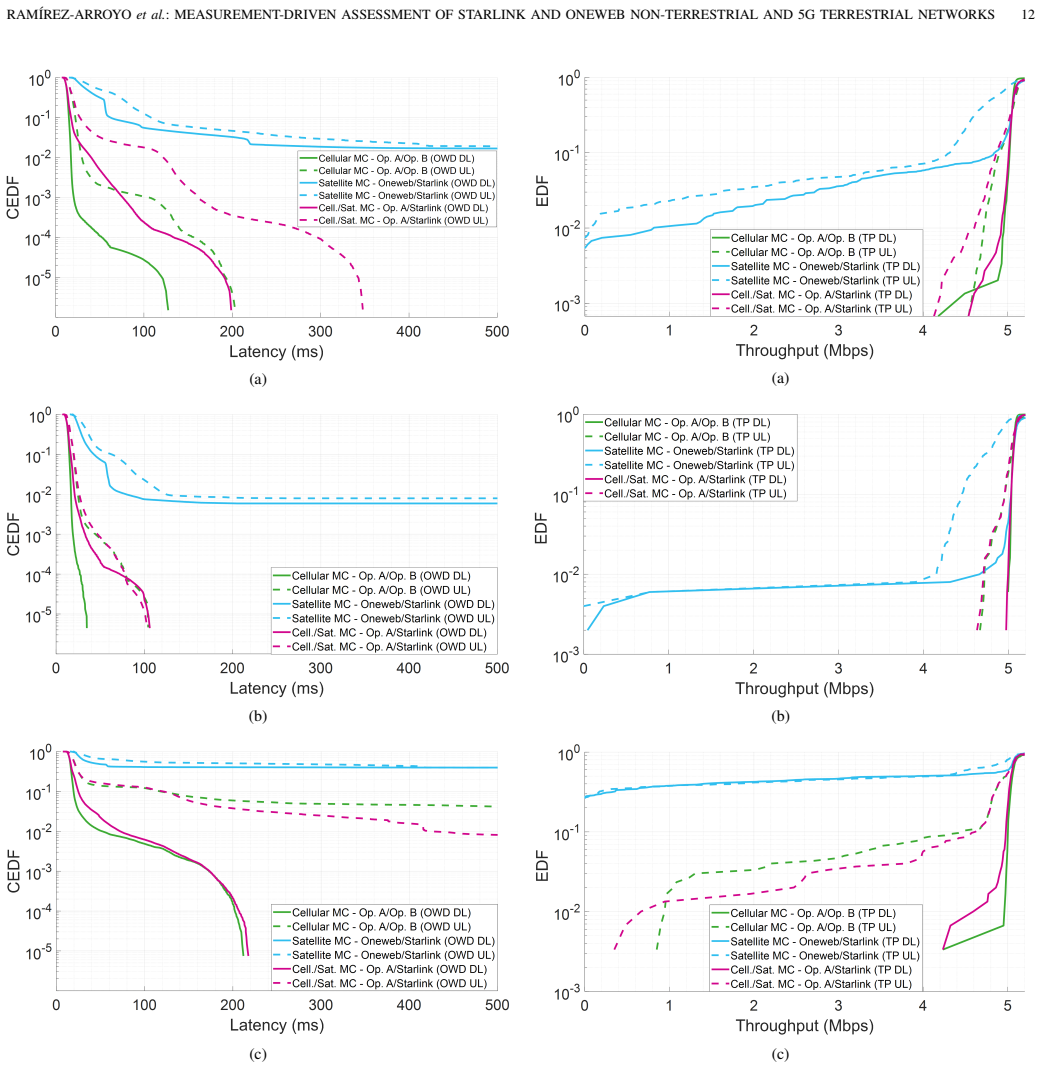
Measurements of KPIs show that Starlink and OneWeb together cut urban outage probability from approximately 12-21% to 2%. The same joint analysis across urban, suburban, and forest sites indicates that adding terrestrial 5G links further extends coverage and raises reliability, especially when terrestrial infrastructure is disrupted.
What carries the argument
Multi-connectivity techniques that combine non-terrestrial satellite links with terrestrial 5G, assessed through direct KPI collection in three real-world environments.
If this is right
- Multi-connectivity lowers the chance of complete loss of service during terrestrial failures such as natural disasters.
- Performance gains appear in difficult settings like forests where single-technology coverage is weak.
- Joint satellite-terrestrial operation extends reliable connectivity beyond the reach of conventional cellular towers.
- The approach supports more resilient networks by leveraging complementary strengths of each technology.
Where Pith is reading between the lines
- Hybrid satellite-terrestrial designs may become standard for future mobile networks that must operate in remote or disaster-prone areas.
- The measured outage reductions could guide operator choices about when to activate secondary links in user devices.
- Similar measurement campaigns in other countries would test whether the 2% urban figure generalizes across different regulatory and terrain conditions.
Load-bearing premise
The chosen measurement locations and KPI collection methods represent typical real-world conditions, and simultaneous satellite-terrestrial use is feasible without major overhead.
What would settle it
Repeating the outage measurements at additional urban sites during periods of actual terrestrial network stress, such as power outages or severe weather, would confirm whether the reported 2% figure persists.
Figures
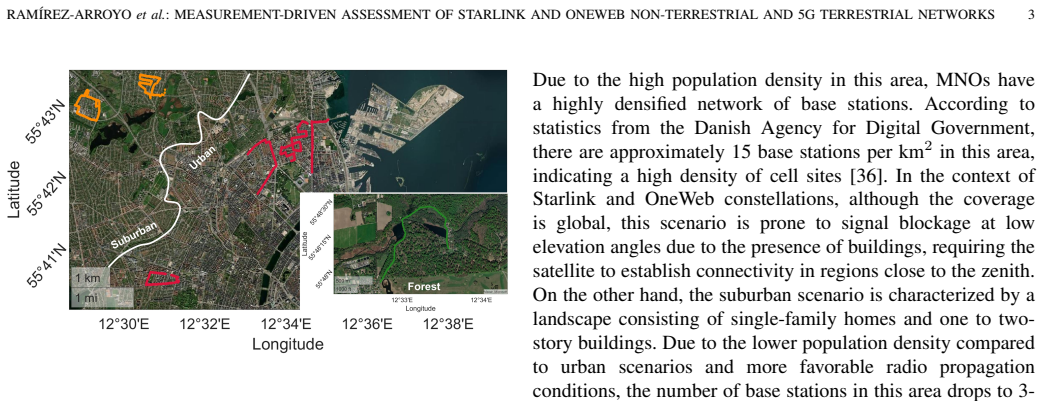
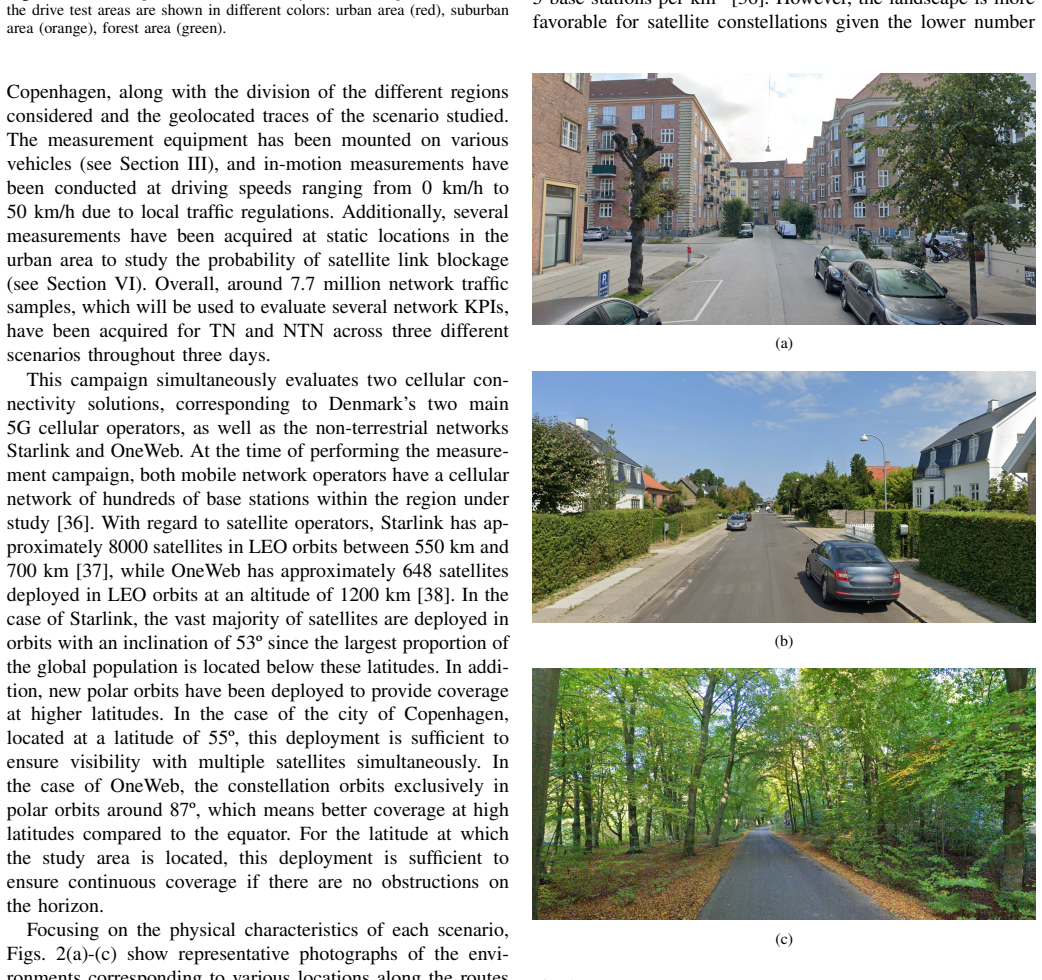
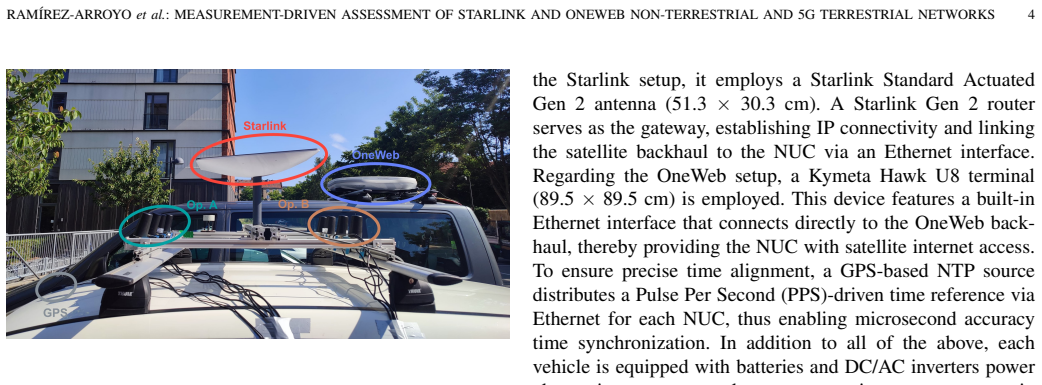
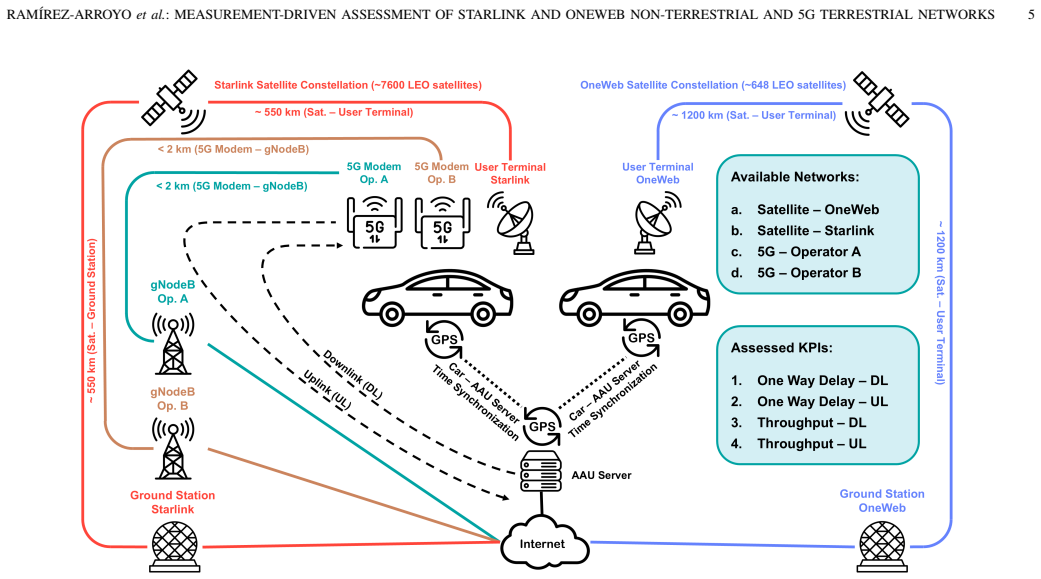
read the original abstract
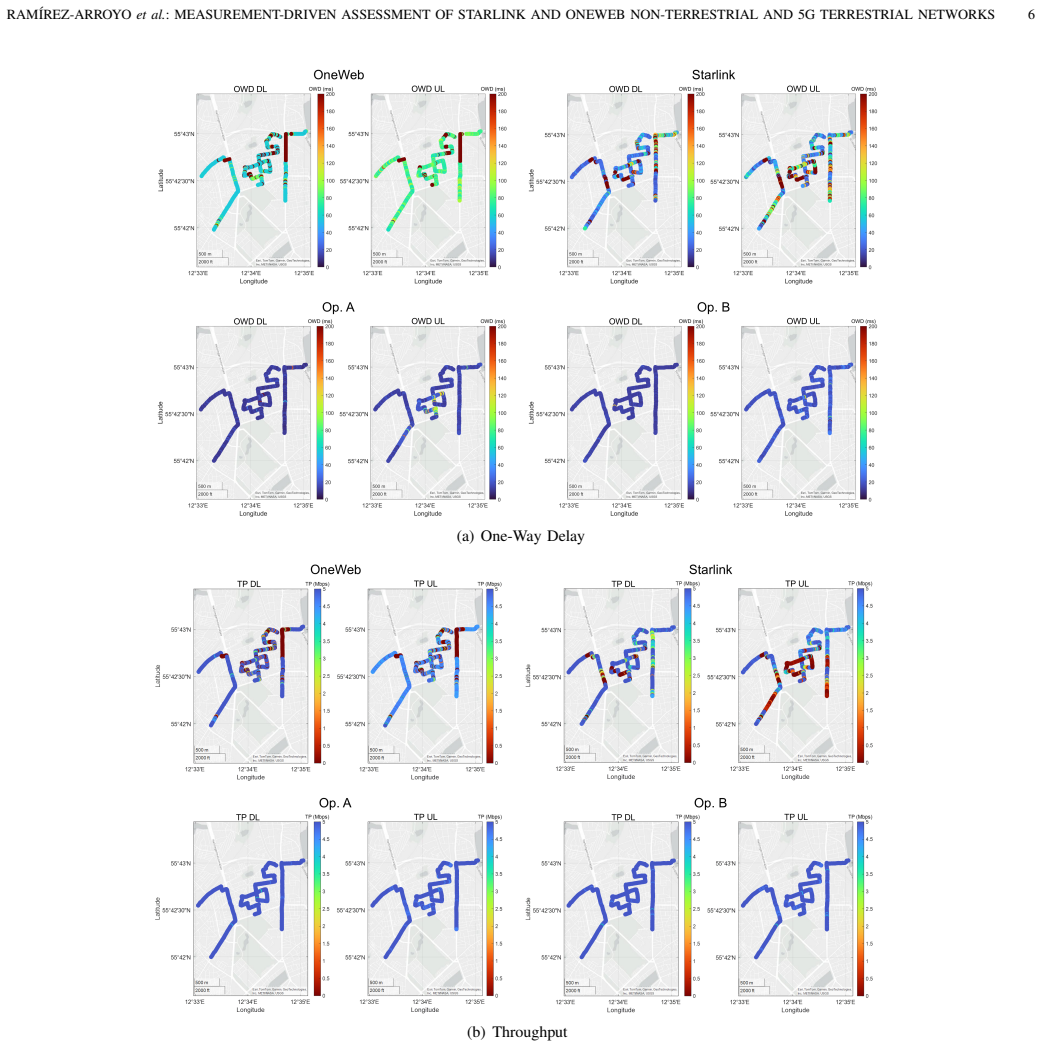
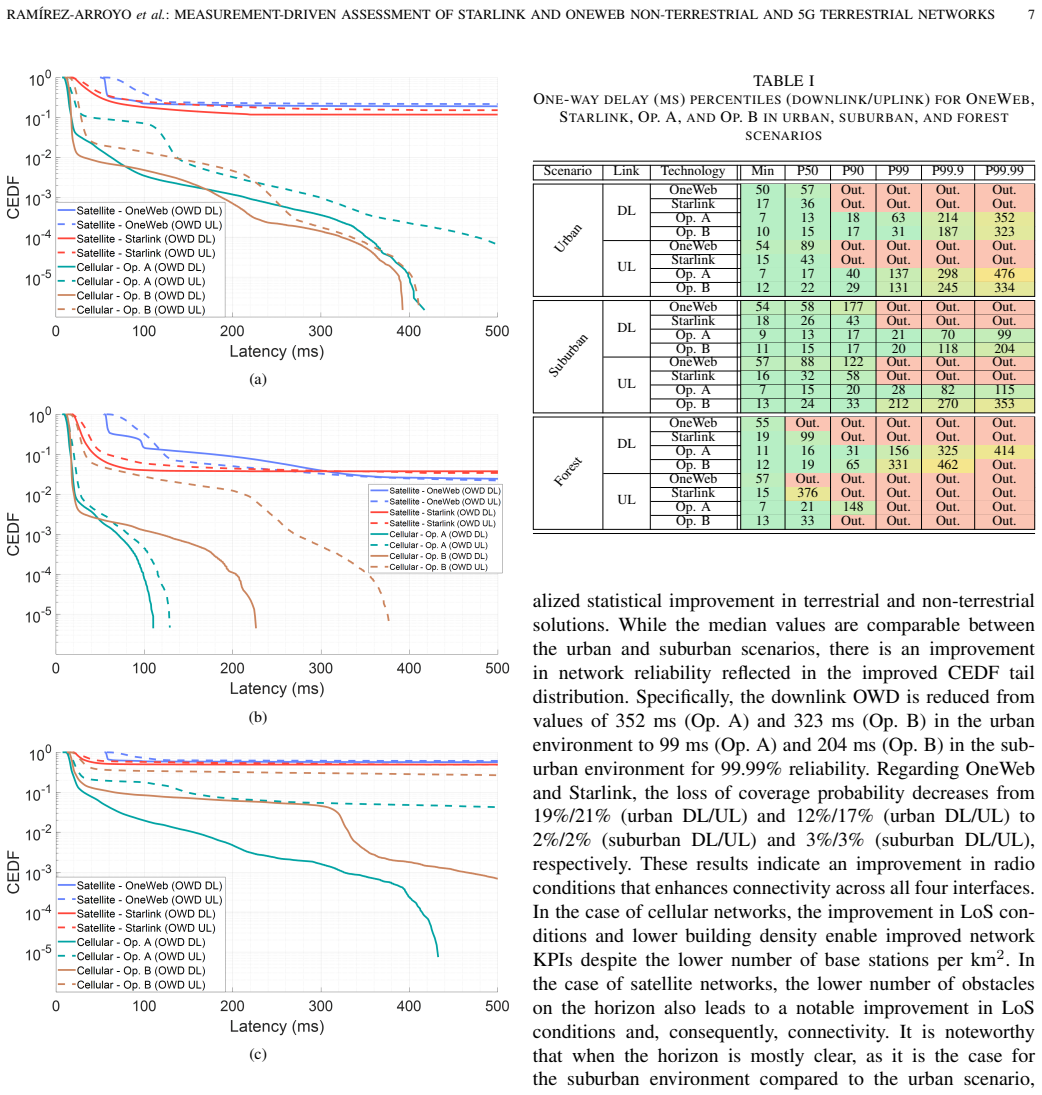
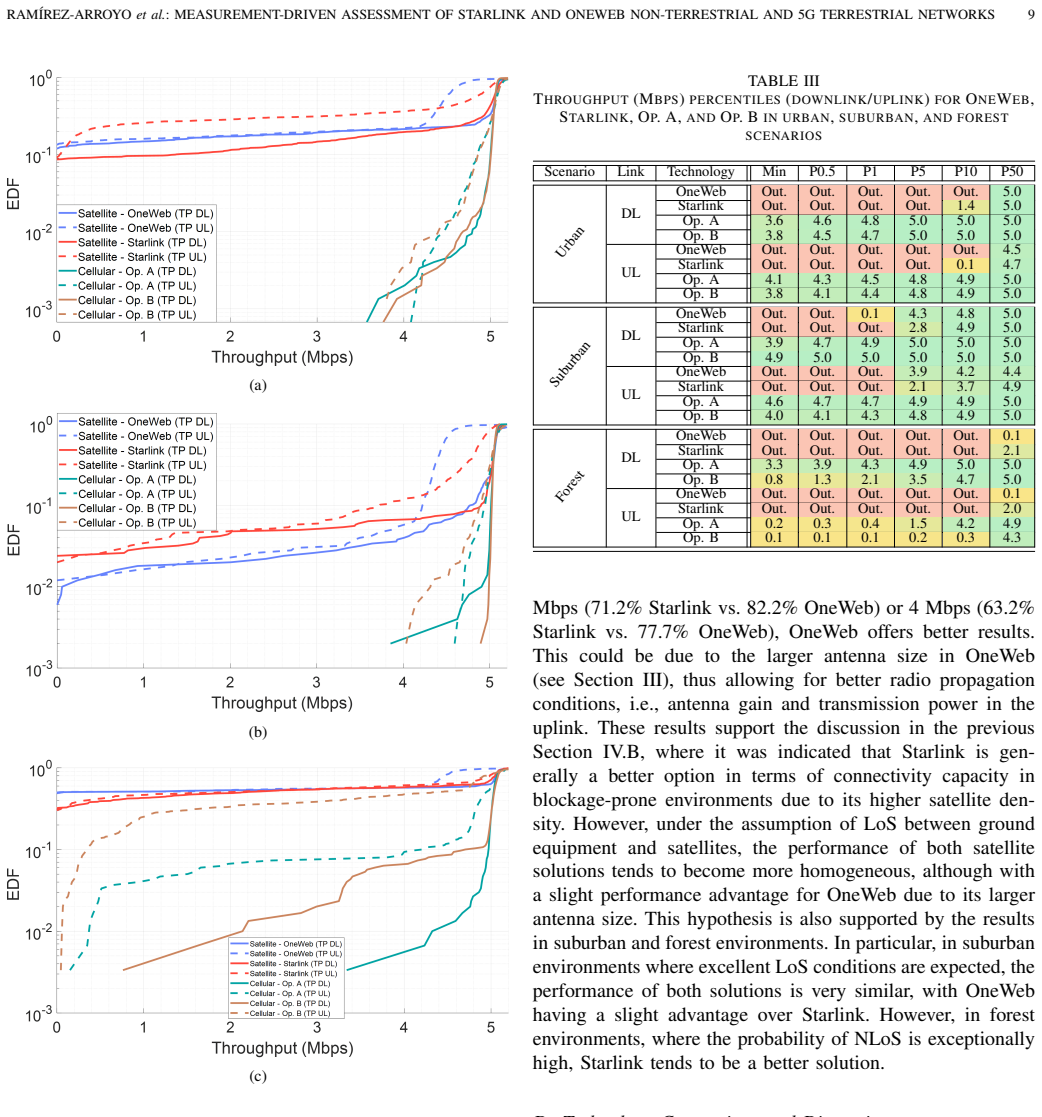
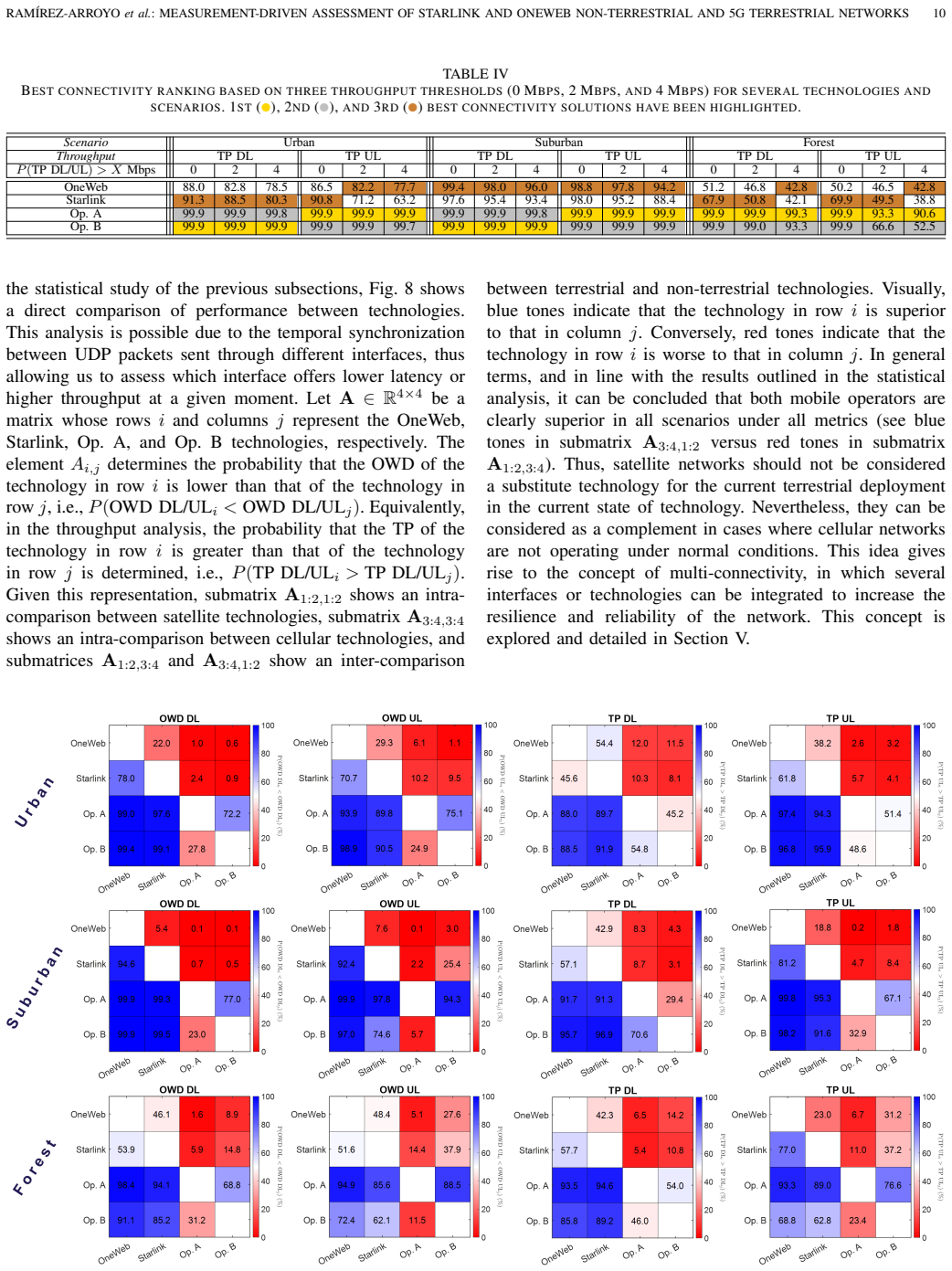
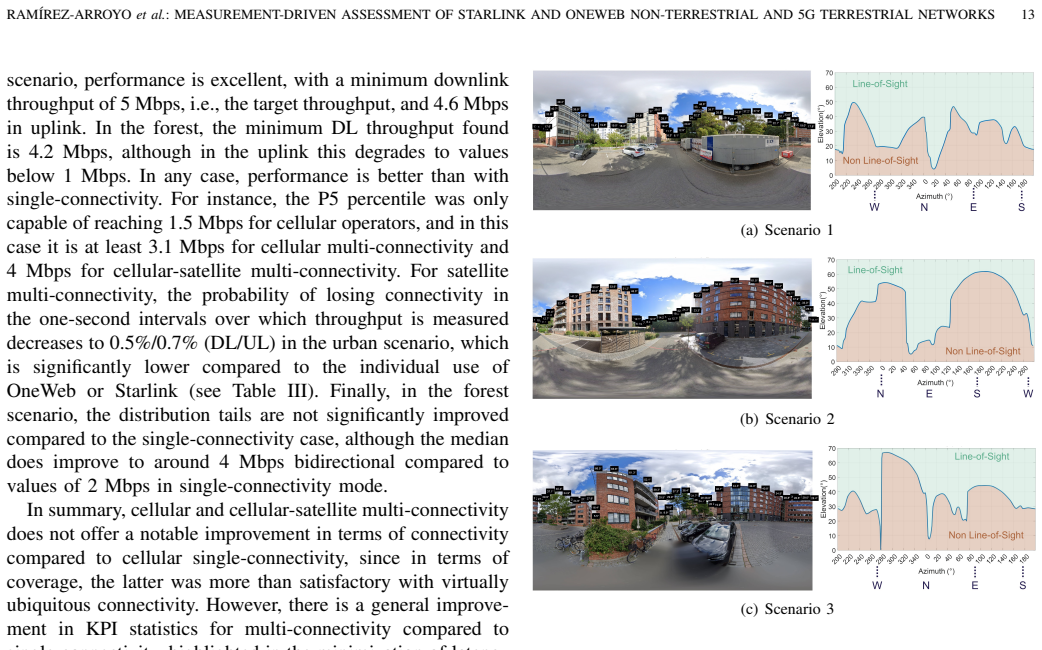
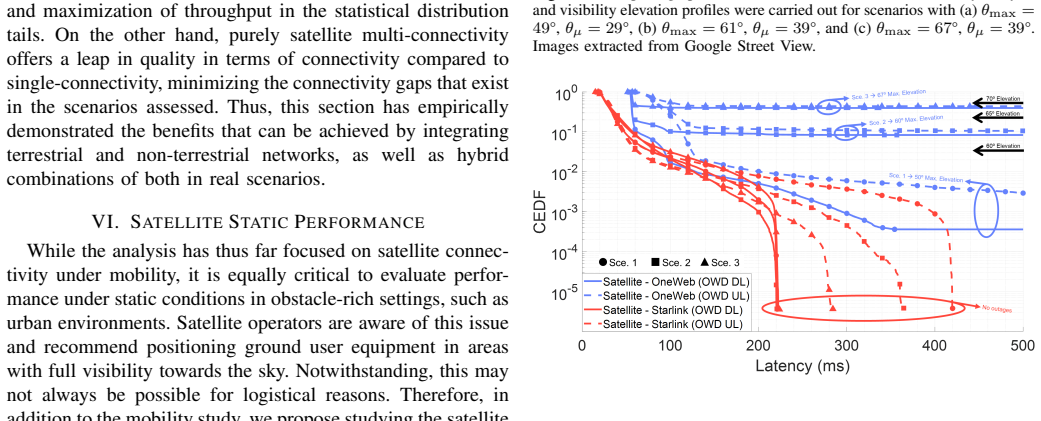
The emergence of commercial satellite communications networks, such as Starlink and OneWeb, has significantly transformed the communications landscape over the last years. As a complement to terrestrial cellular networks, non-terrestrial systems enable coverage extension and reliability enhancement beyond the limits of conventional infrastructure. Currently, the high reliance on terrestrial networks exposes communications to vulnerabilities in the event of terrestrial infrastructure failures, e.g., due to natural disasters. Therefore, this work proposes the joint evaluation of Key Performance Indicators (KPIs) for two non-terrestrial satellite networks (Starlink and OneWeb) and two terrestrial cellular networks to assess the current performance of these technologies across three different environments: (i) urban, (ii) suburban, and (iii) forest scenarios. Additionally, multi-connectivity techniques are explored to determine the benefits in connectivity when two technologies are used simultaneously. For instance, the outage probability of Starlink and OneWeb in urban areas is reduced from approximately 12-21% to 2% when both solutions are employed together. Finally, the joint analysis of KPIs in both terrestrial and non-terrestrial networks demonstrates that their integration enhances coverage, improves performance, and increases reliability, highlighting the benefits of combining satellite and terrestrial systems in the analyzed environments.
Editorial analysis
A structured set of objections, weighed in public.
Referee Report
Summary. The paper conducts measurement-driven assessments of Starlink, OneWeb, and 5G networks in urban, suburban, and forest scenarios, evaluating KPIs and multi-connectivity benefits. It claims that combining Starlink and OneWeb reduces urban outage probability from 12-21% to 2%, and that integrating non-terrestrial and terrestrial networks enhances coverage, performance, and reliability.
Significance. Should the empirical findings hold under scrutiny, this study contributes valuable data on hybrid network performance, supporting the case for multi-connectivity in achieving reliable communications, especially in areas prone to terrestrial failures or with limited infrastructure.
major comments (2)
- [Abstract] Abstract: The outage probability reduction to 2% for joint Starlink and OneWeb use is presented without supporting joint measurement data. This figure aligns with the product of individual rates, suggesting an unverified independence assumption; shared environmental factors could lead to correlated outages, undermining the reliability claim.
- [Results] Results section: The manuscript lacks information on the number of measurement samples, confidence intervals, calibration procedures, and criteria for data inclusion/exclusion, making it difficult to assess the robustness of the reported KPI improvements and outage statistics.
minor comments (2)
- Clarify the specific measurement locations and equipment used to allow reproducibility and evaluation of representativeness.
- Discuss potential practical challenges of simultaneous multi-connectivity, such as interference or overhead, to strengthen the feasibility argument.
Simulated Author's Rebuttal
We thank the referee for the constructive and detailed feedback on our manuscript. We address each major comment below and will revise the manuscript accordingly to improve clarity and robustness.
read point-by-point responses
-
Referee: [Abstract] Abstract: The outage probability reduction to 2% for joint Starlink and OneWeb use is presented without supporting joint measurement data. This figure aligns with the product of individual rates, suggesting an unverified independence assumption; shared environmental factors could lead to correlated outages, undermining the reliability claim.
Authors: We acknowledge the validity of this observation. The 2% figure in the abstract was obtained by multiplying the separately measured individual outage probabilities for Starlink and OneWeb (approximately 12% and 21%), which assumes statistical independence of outages. The manuscript does not present simultaneous joint measurement data for this specific combination. In the revised manuscript, we will explicitly clarify this calculation method, discuss the possibility of correlated outages due to shared factors such as weather or local obstructions, and qualify the multi-connectivity claim to reflect the assumption. We will also note this as a limitation and suggest it as an area for future joint measurements. revision: yes
-
Referee: [Results] Results section: The manuscript lacks information on the number of measurement samples, confidence intervals, calibration procedures, and criteria for data inclusion/exclusion, making it difficult to assess the robustness of the reported KPI improvements and outage statistics.
Authors: We agree that these methodological details are essential for evaluating the reliability of the results. In the revised manuscript, we will expand the Results section to include the total number of samples collected per scenario and technology, statistical confidence intervals for all reported KPIs and outage probabilities, a description of the calibration procedures applied to the measurement devices, and explicit criteria for data inclusion/exclusion (such as removal of samples affected by equipment malfunction or transient errors). revision: yes
Circularity Check
Empirical measurement study with no derivation chain or fitted predictions
full rationale
This paper reports field measurements of KPIs (outage, throughput, latency) across Starlink, OneWeb, and 5G in urban/suburban/forest locations. The abstract's 12-21% to 2% outage reduction is stated as an empirical outcome of simultaneous use; no equations, parameter fits, or first-principles derivations appear. No self-citations are load-bearing for any uniqueness claim. The work is self-contained against external benchmarks of real-world satellite/terrestrial performance and receives score 0.
Axiom & Free-Parameter Ledger
Reference graph
Works this paper leans on
-
[1]
5G: Personal mobile internet beyond what cellular did to telephony,
G. Fettweis and S. Alamouti, “5G: Personal mobile internet beyond what cellular did to telephony,”IEEE Communications Magazine, vol. 52, no. 2, pp. 140-145, 2014
work page 2014
-
[2]
Cellular, Wide-Area, and Non-Terrestrial IoT: A Survey on 5G Advances and the Road Toward 6G,
M. Vaeziet al., “Cellular, Wide-Area, and Non-Terrestrial IoT: A Survey on 5G Advances and the Road Toward 6G,”IEEE Communications Surveys & Tutorials, vol. 24, no. 2, pp. 1117-1174, 2022
work page 2022
-
[3]
A Survey on 5G Usage Scenarios and Traffic Models,
J. Navarro-Ortiz, P. Romero-Diaz, S. Sendra, P. Ameigeiras, J. J. Ramos- Munoz and J. M. Lopez-Soler, “A Survey on 5G Usage Scenarios and Traffic Models,”IEEE Communications Surveys & Tutorials, vol. 22, no. 2, pp. 905-929, 2020
work page 2020
- [4]
-
[5]
Fair Communications in UA V Networks for Rescue Applications,
Q. Shenet al., “Fair Communications in UA V Networks for Rescue Applications,”IEEE Internet of Things Journal, vol. 10, no. 23, pp. 21013-21025, 2023
work page 2023
-
[6]
Post- Disaster Communications: Enabling Technologies, Architectures, and Open Challenges,
M. Matracia, N. Saeed, M. A. Kishk and M. -S. Alouini, “Post- Disaster Communications: Enabling Technologies, Architectures, and Open Challenges,”IEEE Open Journal of the Communications Society, vol. 3, pp. 1177-1205, 2022
work page 2022
-
[7]
An Overview of Post-Disaster Emergency Communication Systems in the Future Networks,
D. G.C., A. Ladas, Y . A. Sambo, H. Pervaiz, C. Politis and M. A. Imran, “An Overview of Post-Disaster Emergency Communication Systems in the Future Networks,”IEEE Wireless Communications, vol. 26, no. 6, pp. 132-139, 2019
work page 2019
-
[8]
Satellite Communications in the New Space Era: A Survey and Future Challenges,
O. Kodheliet al., “Satellite Communications in the New Space Era: A Survey and Future Challenges,”IEEE Communications Surveys& Tutorials, vol. 23, no. 1, pp. 70-109, 2021
work page 2021
-
[9]
Non-Terrestrial Networks in the 6G Era: Challenges and Opportunities,
M. Giordani and M. Zorzi, “Non-Terrestrial Networks in the 6G Era: Challenges and Opportunities,”IEEE Network, vol. 35, no. 2, pp. 244- 251, 2021
work page 2021
-
[10]
Emerging Technologies for 6G Non-Terrestrial- Networks: From Academia to Industrial Applications,
C. T. Nguyenet al., “Emerging Technologies for 6G Non-Terrestrial- Networks: From Academia to Industrial Applications,”IEEE Open Journal of the Communications Society, vol. 5, pp. 3852-3885, 2024
work page 2024
-
[11]
N. Saeed, H. Almorad, H. Dahrouj, T. Y . Al-Naffouri, J. S. Shamma and M. -S. Alouini, “Point-to-Point Communication in Integrated Satellite- Aerial 6G Networks: State-of-the-Art and Future Challenges,”IEEE Open Journal of the Communications Society, vol. 2, pp. 1505-1525, 2021
work page 2021
-
[12]
5G from Space: An Overview of 3GPP Non-Terrestrial Networks,
X. Lin, S. Rommer, S. Euler, E. A. Yavuz and R. S. Karlsson, “5G from Space: An Overview of 3GPP Non-Terrestrial Networks,”IEEE Communications Standards Magazine, vol. 5, no. 4, pp. 147-153, 2021
work page 2021
-
[13]
Non-Terrestrial Networks: An Overview of 3GPP Release 17 & 18,
M. M. Saad, M. A. Tariq, M. T. R. Khan and D. Kim, “Non-Terrestrial Networks: An Overview of 3GPP Release 17 & 18,”IEEE Internet of Things Magazine, vol. 7, no. 1, pp. 20-26, 2024
work page 2024
-
[14]
3GPP Release-18 Physical Layer Enhancements for IoT-NTN,
G. A. Medina-Acosta, R. K. Mungara, S. G. Eriksson and T. Khan, “3GPP Release-18 Physical Layer Enhancements for IoT-NTN,”IEEE Communications Standards Magazine, vol. 8, no. 3, pp. 18-24, 2024
work page 2024
-
[15]
Broadband LEO Satellite Communications: Architectures and Key Technologies,
Y . Su, Y . Liu, Y . Zhou, J. Yuan, H. Cao and J. Shi, “Broadband LEO Satellite Communications: Architectures and Key Technologies,”IEEE Wireless Communications, vol. 26, no. 2, pp. 55-61, 2019
work page 2019
-
[16]
LEO Small-Satellite Constellations for 5G and Beyond-5G Communications,
I. Leyva-Mayorgaet al., “LEO Small-Satellite Constellations for 5G and Beyond-5G Communications,”IEEE Access, vol. 8, pp. 184955-184964, 2020
work page 2020
-
[17]
I. del Portillo, B. G. Cameron, and E. F. Crawley, “A technical compar- ison of three low earth orbit satellite constellation systems to provide global broadband”,Acta Astronautica, vol. 159, pp. 123–135, 2019
work page 2019
-
[18]
Ad Astra: Simultaneous Tracking and Navigation With Megaconstellation LEO Satellites,
Z. M. Kassas, N. Khairallah and S. Kozhaya, “Ad Astra: Simultaneous Tracking and Navigation With Megaconstellation LEO Satellites,”IEEE Aerospace and Electronic Systems Magazine, vol. 39, no. 9, pp. 46-71, Sept. 2024
work page 2024
-
[19]
M. Hosseinian, J. P. Choi, S. -H. Chang and J. Lee, “Review of 5G NTN Standards Development and Technical Challenges for Satellite Integration With the 5G Network,”IEEE Aerospace and Electronic Systems Magazine, vol. 36, no. 8, pp. 22-31, 2021
work page 2021
-
[20]
NB-IoT over Non-Terrestrial Networks: Link Budget Analysis,
M. Conti, A. Guidotti, C. Amatetti and A. Vanelli-Coralli, “NB-IoT over Non-Terrestrial Networks: Link Budget Analysis,” inGLOBECOM 2020 - 2020 IEEE Global Communications Conference, Taipei, Taiwan, pp. 1-6, 2020
work page 2020
-
[21]
Outdoor Wideband Channel Measurements and Modeling in the 3–18 GHz Band,
V . Kristem, C. U. Bas, R. Wang and A. F. Molisch, “Outdoor Wideband Channel Measurements and Modeling in the 3–18 GHz Band,”IEEE Transactions on Wireless Communications, vol. 17, no. 7, pp. 4620- 4633, 2018
work page 2018
-
[22]
Channel Measurements and Modeling for 400–600-MHz Bands in Urban and Suburban Scenarios,
J. Huang, C. -X. Wang, Y . Yang, Y . Liu, J. Sun and W. Zhang, “Channel Measurements and Modeling for 400–600-MHz Bands in Urban and Suburban Scenarios,”IEEE Internet of Things Journal, vol. 8, no. 7, pp. 5531-5543, 2021
work page 2021
-
[23]
H. Miaoet al., “Sub-6 GHz to mmWave for 5G-Advanced and Beyond: Channel Measurements, Characteristics and Impact on System Perfor- mance,”IEEE Journal on Selected Areas in Communications, vol. 41, no. 6, pp. 1945-1960, 2023
work page 1945
-
[24]
Cellular Wireless Networks in the Upper Mid-Band,
S. Kanget al., “Cellular Wireless Networks in the Upper Mid-Band,” IEEE Open Journal of the Communications Society, vol. 5, pp. 2058- 2075, 2024
work page 2058
-
[25]
Improving Throughput of 5G Cellular Networks via 3D Placement Optimization of Logistics Drones,
S. Iranmanesh, F. S. Abkenar, R. Raad and A. Jamalipour, “Improving Throughput of 5G Cellular Networks via 3D Placement Optimization of Logistics Drones,”IEEE Transactions on Vehicular Technology, vol. 70, no. 2, pp. 1448-1460, 2021
work page 2021
-
[26]
C. L. Vielhauset al., ”vBerlinV2N: Recreating a Cellular Network Measurement Campaign With Simulations,”IEEE Access, vol. 13, pp. 127023-127044, 2025
work page 2025
-
[27]
S. Aertset al., “In-situ Measurement Methodology for the Assessment of 5G NR Massive MIMO Base Station Exposure at Sub-6 GHz Frequencies,”IEEE Access, vol. 7, pp. 184658-184667, 2019
work page 2019
-
[28]
EMF Exposure in 5G Standalone mm-Wave Deployments: What Is the Impact of Downlink Traffic?,
L. Chiaraviglioet al., “EMF Exposure in 5G Standalone mm-Wave Deployments: What Is the Impact of Downlink Traffic?,”IEEE Open Journal of the Communications Society, vol. 3, pp. 1445-1465, 2022
work page 2022
-
[29]
S. Mohebi, F. Michelinakis, A. Elmokashfi, O. Grøndalen, K. Mahmood and A. Zanella, “Sectors, Beams and Environmental Impact on the Performance of Commercial 5G mmWave Cells: An Empirical Study,” IEEE Access, vol. 10, pp. 133309-133323, 2022
work page 2022
-
[30]
D. -H. Jung, J. -G. Ryu, W. -J. Byun and J. Choi, “Performance Analysis of Satellite Communication System Under the Shadowed- Rician Fading: A Stochastic Geometry Approach,”IEEE Transactions on Communications, vol. 70, no. 4, pp. 2707-2721, 2022
work page 2022
-
[31]
M. Y . Abdelsadek, G. Karabulut-Kurt, H. Yanikomeroglu, P. Hu, G. Lamontagne and K. Ahmed, “Broadband Connectivity for Handheld Devices via LEO Satellites: Is Distributed Massive MIMO the Answer?,” IEEE Open Journal of the Communications Society, vol. 4, pp. 713-726, 2023
work page 2023
-
[32]
Starlink on the Road: A First Look at Mobile Starlink Performance in Central Europe,
D. Laniewski, E. Lanfer, S. Beginn, J. Dunker, M. D ¨uckers and N. Aschenbruck, “Starlink on the Road: A First Look at Mobile Starlink Performance in Central Europe,” in2024 8th Network Traffic Measure- ment and Analysis Conference (TMA), Dresden, Germany, pp. 1-8, 2024
work page 2024
-
[33]
Measuring Mobile Starlink Performance: A Comprehensive Look,
D. Laniewski, E. Lanfer and N. Aschenbruck, “Measuring Mobile Starlink Performance: A Comprehensive Look,”IEEE Open Journal of the Communications Society, vol. 6, pp. 1266-1283, 2025
work page 2025
-
[34]
A. Ram ´ırez-Arroyo, M. L ´opez, I. Rodr ´ıguez, S. B. Damsgaard, and P. Mogensen, “Multi-connectivity solutions for rural areas: Integrating terrestrial 5G and satellite networks to support innovative IoT use cases”, Smart Agricultural Technology, vol. 12, p. 101260, 2025
work page 2025
-
[35]
A. Ram ´ırez-Arroyo, T. B. Sørensen and P. Mogensen, “Terrestrial 5G and Starlink NTN Multi-Connectivity Toward 6G Communications Integration Era: An Empirical Assessment,”IEEE Open Journal of the Communications Society, vol. 6, pp. 5269-5283, 2025
work page 2025
-
[36]
Available: https://www.mastedatabasen.dk/viskort/PageMap.aspx
Danish Agency for Digital Government: Base Station Database [Online]. Available: https://www.mastedatabasen.dk/viskort/PageMap.aspx
-
[37]
Starlink-Based Passive Radar for Earth’s Surface Imaging: First Experimental Results,
P. Gomez-del-Hoyo and P. Samczynski, “Starlink-Based Passive Radar for Earth’s Surface Imaging: First Experimental Results,”IEEE Journal of Selected Topics in Applied Earth Observations and Remote Sensing, vol. 17, pp. 13949-13965, 2024
work page 2024
-
[38]
A First Look at the OneWeb LEO Constellation: Beacons, Beams, and Positioning,
S. Kozhaya and Z. M. Kassas, “A First Look at the OneWeb LEO Constellation: Beacons, Beams, and Positioning,”IEEE Transactions on Aerospace and Electronic Systems, vol. 60, no. 5, pp. 7528-7534, 2024. [39]multi-connect - The open source multi-path connectivity tool, S. B. Damsgaard, 2024. [Online]. Available: https://github.com/drblah/ multi-connect/
work page 2024
-
[39]
Revisiting Space- track Report #3: Rev 1,
D. Vallado, P. Crawford, R. Hujsak, and T. S. Kelso, “Revisiting Space- track Report #3: Rev 1,” inConf. AIAA/AAS Astrodynamics Specialist Conference and Exhibit, Keystone,USA, pp. 1-92, 2006
work page 2006
discussion (0)
Sign in with ORCID, Apple, or X to comment. Anyone can read and Pith papers without signing in.