REVIEW 5 minor 51 references
Milstein-type Schemes for Hyperbolic SPDEs
T0 review · 0 major / 5 minor · reviewed 2026-08-03 · deepseek-v4-flash
Pith's one-line read Milstein schemes reach first-order convergence for hyperbolic SPDEs.
desk verdict This paper delivers the first rigorous rate-1 (up to log) pathwise-uniform error analysis for Milstein schemes in a hyperbolic SPDE setting, resolving a real open problem; the proof skeleton checks out, and the main caveats are the ones the authors themselves flag. read the letter →
The pith
A machine-rendered reading of the paper's core claim, the machinery that carries it, and where it could break.
The reading
What carries the argument
The central object is the Milstein correction (G′G)(u_i)Δ²W_{i+1} — the iterated stochastic integral of the noise coefficient's derivative along the noise — added to each Euler step. The argument is carried by a two-space framework: the scheme is stable on a smoother subspace Y, while differentiability is used in a mixed way (directional differentiability on X, full differentiability from Y to X, and (2α−1)-order continuity of derivatives), which allows genuinely nonlinear Nemytskii-type operators to be treated. The rational-scheme analysis hinges on a logarithmic square-function estimate for discrete stochastic convolutions, which produces the √log(T/h) factor, and a discrete comparison lem
What would settle it
Simulate the linear stochastic Schrödinger setting of Section 7.1 with reference step size 2^{-16} and step sizes down to 2^{-12}; if the measured exponential-Milstein slope is below 0.9, the claimed order-one rate fails to show up numerically; if the rational-Milstein slope matches h√log(T/h) rather than h, the logarithmic factor is real.
Extended reading notes
Core claim
Under a set of regularity assumptions — a smoother subspace Y embedded in the state space X, Lipschitz drift and noise on X, linear growth and full differentiability on Y, and a (2α−1)-order continuity condition on the derivatives — the rational Milstein scheme converges at rate min{α,1} in pathwise uniform L^p norm, with the error bounded by a constant times h^α√log(T/h), while the exponential Milstein scheme achieves the same rate without the logarithmic factor. This is the first rigorous error analysis showing that Milstein schemes can break the 1/2-order barrier for hyperbolic SPDEs, improving on results for exponential Euler and rational schemes that use only Wiener increments.
Load-bearing premise
The result depends on the derivatives of the drift and noise being smooth enough on a smaller subspace Y — continuity of order 2α−1 — and on the combined noise sensitivity G′G being Lipschitz on the state space; without that, the Milstein correction cannot be controlled and only the old 1/2 rate is known.
Editorial extensions
If this is right
- For hyperbolic SPDEs with contractive non-analytic semigroups, Milstein schemes achieve convergence rate min{α,1} in pathwise uniform L^p sense, improving the previously best-known 1/2 rate.
- The exponential Milstein scheme attains rate 1 without any logarithmic factor when Y = D(A), matching the order of the Itô–Taylor expansion in the SDE case.
- Rational A-stable schemes such as implicit Euler and Crank–Nicolson Milstein variants inherit the same rates, with Crank–Nicolson reaching 2/3 for Maxwell's equations under natural regularity assumptions.
- The error estimates are pathwise uniform (max over time inside the expectation), not just pointwise root-mean-square bounds, and hold in every L^p moment for p in [2,∞).
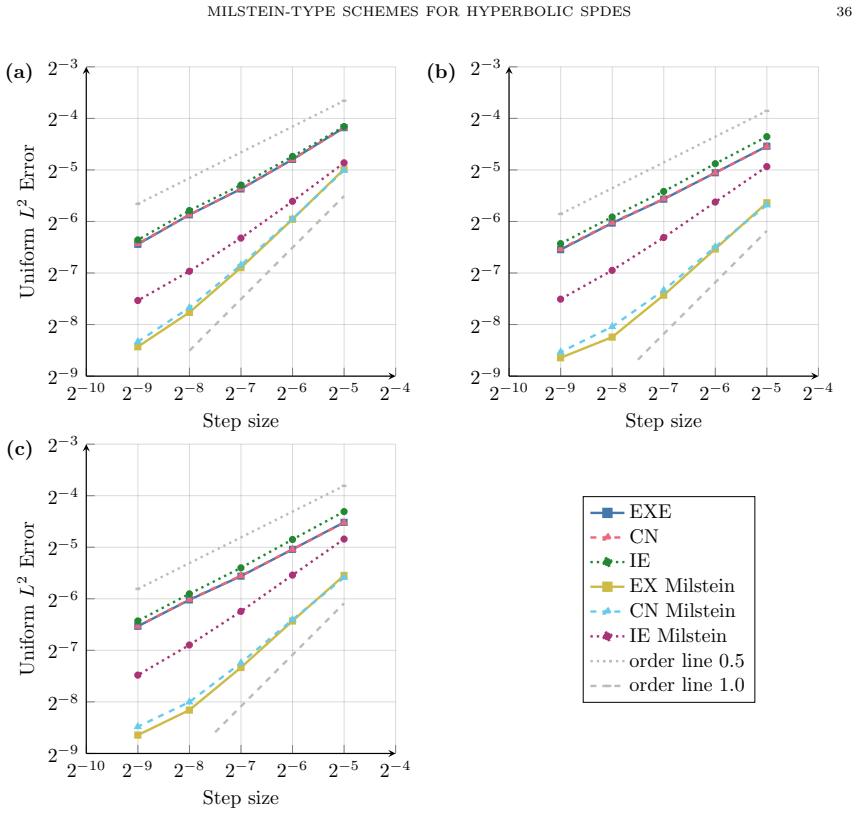
- For linear stochastic Schrödinger equations with sufficiently smooth potential and noise, the exponential Milstein scheme converges at rate 1, and numerical experiments confirm rates close to 1.
Reading between the lines
- Editorial inference: The same two-space template should extend to locally Lipschitz nonlinearities via a stopping-time argument; the paper's own Section 7.3 simulation with a Nemytskii nonlinearity outside the assumptions already shows numerical rates near 1, suggesting the regularity conditions are sufficient rather than necessary.
- Editorial inference: The logarithmic factor for rational schemes appears tied to the logarithmic square-function estimate; a sharper analysis of the discrete stochastic convolution might remove it for A-stable rational schemes as well, yielding a unified no-log theory.
- Editorial inference: For stochastic wave equations, the authors note their approach does not improve on rate 3/2 obtained by a specialized scheme; combining the Milstein correction with the wave equation's extra smoothing is a natural next step to recover such higher rates within a unified framework.
- Editorial inference: For non-commutative noise, exact simulation of the iterated integral is not currently known; combining the present error analysis with a derivative-free Milstein approximation would give a fully implementable first-order scheme for hyperbolic SPDEs.
Editorial analysis
A structured set of objections, weighed in public.
Referee Report
Summary. The paper develops a temporal Milstein theory for semilinear hyperbolic SPDEs of the form dU + AU dt = F(U)dt + G(U)dW on a Hilbert space X, where -A generates a contractive, not necessarily analytic C0-semigroup. It introduces rational and exponential Milstein schemes, proves pathwise-uniform strong error bounds in L^p(Ω) of order min{α,1} up to a logarithmic factor for rational schemes and without the logarithmic factor for the exponential scheme, under a two-space Kato framework Y↪X with α-Hölder type regularity assumptions (Assumptions A1-A4). The central result, Theorem 5.3 and its exponential counterpart Theorem 5.7, is applied to stochastic Schrödinger, Maxwell, and transport equations, and numerical experiments for the stochastic Schrödinger equation confirm the predicted rates.
Significance. If the result holds, it resolves an open problem posed in [26, p. 324] and [31, Rem. 6.7] by giving the first rigorous convergence rates above 1/2 for Milstein schemes in the hyperbolic, non-analytic semigroup setting. The proof is substantial: it introduces two auxiliary processes, a three-term error split, stochastic Fubini, maximal inequalities for stochastic convolutions, a logarithmic square-function estimate, and a discrete Grönwall closure. The manuscript is unusually careful about constants, Gâteaux vs. Fréchet differentiability, and the distinction between pointwise and pathwise-uniform errors. It also provides publicly available code (DOI 10.5281/ZENODO.18229440) and openly discusses limitations, including the exact-simulation problem for iterated integrals in the non-commutative case and the linear-growth-on-Y restriction that excludes some Nemytskii nonlinearities. These caveats narrow the practical scope but do not contradict the internal mathematical claims.
minor comments (5)
- [Lemma 5.2] The assumption states g ∈ L∞(0,T;L^p(Ω;L_2^{(2)}(H,X))), but g is the linear noise value taking values in L_2(H,X), and the proof uses |||g|||∞,p,Y, i.e. the L_2(H,Y)-norm. The bilinear space L_2^{(2)} appears to be a typo; it should be L_2(H,X) (or L_2(H,Y) under the Y-invariance already assumed in A2(c)).
- [Section 7, last paragraph] The paper openly states that for non-commutative noise the exact iterated integrals cannot currently be simulated, so the implemented scheme in that case is not the analyzed scheme. Since this is a significant practical caveat, it should be stated more prominently in the introduction or abstract, not only in the numerical section.
- [Proposition 4.4] The application of the discrete Grönwall lemma is compressed. After φ(j) ≤ c + C(h∑φ(i)^2)^{1/2}, the identification β = C√h gives β²j ≤ C²T, which is what yields the (1+C²T)^{1/2} exp((1+C²T)/2) factor. Stating this identification explicitly would improve readability.
- [Theorem 1.1] The introduction states Y↪D(A^α) continuously, while Assumption A1 uses the real interpolation space D_A(α,∞) for α<1. The relationship should be clarified, since D(A^α) embeds into D_A(α,∞) but the two conditions are not identical in the statement of the theorem.
- [Section 7.1, Figure 1 and Table 2] The numerical rates are obtained from 100 samples and a reference solution at h=2^{-14}. Reporting confidence intervals or standard errors would strengthen the comparison against the theoretical rates, especially for the small step sizes where the reference error may bias the observed rates.
Circularity Check
No significant circularity: the convergence proof derives the error bound from stated regularity and approximation assumptions without fitted parameters or definitional reductions.
full rationale
The derivation chain is self-contained and non-circular. Theorem 5.3 splits the error E(m) into E1 (solution regularity/Taylor expansion), E2 (difference v1-v2), and E3 (semigroup approximation), then closes the estimate with the discrete Grönwall inequality (Lemma 2.11). All constants are expressed in terms of the assumed Lipschitz/Hölder constants, the semigroup approximation constant C_alpha, the well-posedness/stability constants C_WP and C_stab, and the fixed L_p constants B_p. The rate alpha is a hypothesis parameter in Assumptions A1-A4 (scheme approximation order on Y and (2alpha-1)-Hölder regularity of F' and G'), not a fitted or inferred quantity; the theorem derives h^alpha from those inputs rather than defining them in terms of the target error. Lemma 5.6 uses the logarithmic square function estimate from [31, Prop. 2.3] and [14, Thm. 3.1], while Lemma 2.11 comes from [31, Lem. 2.7]; these are published, independently usable tools, and their self-citation status does not make the present conclusion equivalent to its assumptions. The exponential Milstein improvement (Theorem 5.7) follows structurally because E3 vanishes when R=S. The paper explicitly acknowledges limitations - e.g., Nemytskii nonlinearities on Y=H^1 prohibit optimal rates, and exact simulation of iterated integrals is currently known only under a commutativity condition - but these are implementation/scope gaps, not circular steps. No equation is defined in terms of the error being estimated, and no fitted quantity is renamed as a prediction.
Assumptions & free parameters
assumptions (8)
- standard math Maximal inequality for stochastic convolutions with quasi-contractive semigroups (Thm. 2.3)
- standard math Logarithmic square function estimate (Prop. 2.4) with constant K=4 exp(1+1/(2e))
- standard math Stochastic Fubini theorem [47, Thm. 2.2]
- domain assumption Semigroup difference decay ∥S(t)−S(s)∥_{L(Y,X)} ≤ 2C_Y(t−s)^α from Y ↪ D_A(α,∞) or Y ↪ D(A) (Lemma 3.1)
- domain assumption Contractivity of the scheme R on both X and Y, and of S on Y (Assumptions A1, A3)
- domain assumption (2α−1)-Hölder continuity of Gâteaux derivatives on Y and Lipschitz continuity of G′G on X (Assumptions A4(a),(b); A2(e))
- standard math Well-posedness of (SEE) in X and Y (Thm. 4.2)
- standard math Discrete Grönwall inequality (Lemma 2.11)
Cite this review
Pith. "Pith review of Milstein-type Schemes for Hyperbolic SPDEs." pith.science (2026). https://pith.science/paper/KCXQMEXP
@misc{pith2026251219647,
  author       = {Pith},
  title        = {Pith review of: Milstein-type Schemes for Hyperbolic SPDEs},
  year         = {2026},
  howpublished = {\url{https://pith.science/paper/KCXQMEXP}},
  note         = {Machine review of arXiv:2512.19647}
}
abstract
This article studies the temporal approximation of hyperbolic semilinear stochastic evolution equations with multiplicative Gaussian noise by Milstein-type schemes. We take the term hyperbolic to mean that the leading operator generates a contractive, not necessarily analytic $C_0$-semigroup. Optimal convergence rates are derived for the pathwise uniform strong error \[ E_h^\infty := \Big(\mathbb{E}\Big[\max_{1\le j \le M}\|U_{t_j}-u_j\|_X^p\Big]\Big)^{1/p} \] on a Hilbert space $X$ for $p\in [2,\infty)$. Here, $U$ is the mild solution and $u_j$ its Milstein approximation at time $t_j=jh$ with step size $h>0$ and final time $T=Mh>0$. For sufficiently regular nonlinearity and noise, we establish strong convergence of order one, with the error satisfying $E_h^\infty\lesssim h\sqrt{\log(T/h)}$ for rational Milstein schemes and $E_h^\infty \lesssim h$ for exponential Milstein schemes. This extends previous results from parabolic to hyperbolic SPDEs and from exponential to rational Milstein schemes. Moreover, root-mean-square error estimates are strengthened to pathwise uniform estimates. Numerical experiments validate the convergence rates for the stochastic Schr\"odinger equation. Further applications to Maxwell's and transport equations are included.
Figures
Reference graph
Works this paper leans on
-
[31]
K. Klioba and M. Veraar. Pathwise uniform convergence of time discretization schemes for SPDEs.IMA J. Numer. Anal., pages 2060–2131, 2024.doi:10.1093/imanum/drae055
-
[1]
Ambrosetti and G
A. Ambrosetti and G. Prodi.A Primer of Nonlinear Analysis. Number 34 in Cambridge studies in advanced mathematics. Cambridge Univ. Press, Cambridge, 1. paperback edition, 1995
1995
-
[2]
R. Anton and D. Cohen. Exponential integrators for stochastic Schr¨ odinger equations driven by Itˆ o noise.J. Comput. Math., 36(2):276–309, 2018.doi:10.4208/jcm.1701-m2016-0525
-
[3]
L. Banjai, G. Lord, and J. Molla. Strong convergence of a Verlet integrator for the semilinear stochastic wave equation.SIAM J. Numer. Anal., 59(4):1976–2003, 2021.doi:10.1137/20M1364746
-
[4]
A. Barth and A. Lang. Milstein approximation for advection-diffusion equations driven by multiplicative noncon- tinuous martingale noises.Appl. Math. Optim., 66(3):387–413, 2012.doi:10.1007/s00245-012-9176-y
-
[5]
A. Barth and A. Lang.L p and almost sure convergence of a Milstein scheme for stochastic partial differential equations.Stoch. Proc. Appl., 123(5):1563–1587, 2013.doi:10.1016/j.spa.2013.01.003
-
[6]
J. Bezanson, A. Edelman, S. Karpinski, and V.B. Shah. Julia: A fresh approach to numerical computing.SIAM Rev., 59(1):65–98, 2017.doi:10.1137/141000671
-
[7]
C.-E. Br´ ehier and D. Cohen. Analysis of a splitting scheme for a class of nonlinear stochastic Schr¨ odinger equa- tions.Appl. Numer. Math., 186:57–83, 2023.doi:10.1016/j.apnum.2023.01.002
Show all 51 references
-
[8]
Brenner and V
P. Brenner and V. Thom´ ee. On rational approximations of semigroups.SIAM J. Numer. Anal., 16(4):683–694, 1979
1979
-
[9]
Cohen, J
D. Cohen, J. Cui, J. Hong, and L. Sun. Exponential integrators for stochastic Maxwell’s equations driven by Itˆ o noise.J. Comput. Phys., 410:109382, 21, 2020.doi:10.1016/j.jcp.2020.109382
2020
-
[10]
Cohen and A
D. Cohen and A. Lang. Numerical approximation and simulation of the stochastic wave equation on the sphere. Calcolo, 59(3):Paper No. 32, 32, 2022.doi:10.1007/s10092-022-00472-7
2022 doi
-
[11]
Cohen, S
D. Cohen, S. Larsson, and M. Sigg. A trigonometric method for the linear stochastic wave equation.SIAM J. Numer. Anal., 51(1):204–222, 2013.doi:10.1137/12087030X. MILSTEIN-TYPE SCHEMES FOR HYPERBOLIC SPDES 38
2013 doi
-
[12]
Cohen and L
D. Cohen and L. Quer-Sardanyons. A fully discrete approximation of the one-dimensional stochastic wave equa- tion.IMA J. Numer. Anal., 36(1):400–420, 2016.doi:10.1093/imanum/drv006
2016 doi
-
[13]
S. Cox, M. Hutzenthaler, A. Jentzen, J. van Neerven, and T. Welti. Convergence in H¨ older norms with applications to Monte Carlo methods in infinite dimensions.IMA J. Numer. Anal., 41(1):493–548, 04 2020.doi:10.1093/ imanum/drz063
2020
-
[14]
Cox and J
S. Cox and J. van Winden. Sharp supremum and H¨ older bounds for stochastic integrals indexed by a parameter, 2024.arXiv:2409.13615
2024 arXiv
-
[15]
J. Cui. Explicit approximation for stochastic nonlinear schr¨ odinger equation.J. Differential Equations, 419:1–39, 2025.doi:10.1016/j.jde.2024.11.022
2025 doi
-
[16]
Da Prato, A
G. Da Prato, A. Jentzen, and M. R¨ ockner. A mild Itˆ o formula for SPDEs.Trans. Amer. Math. Soc., 372(6):3755– 3807, 2019.doi:10.1090/tran/7165
2019 doi
-
[17]
Da Prato and J
G. Da Prato and J. Zabczyk.Stochastic equations in infinite dimensions, volume 152 ofEncyclopedia of Math- ematics and its Applications. Cambridge University Press, Cambridge, second edition, 2014.doi:10.1017/ CBO9781107295513
2014
-
[18]
Dahlquist
G.G. Dahlquist. A special stability problem for linear multistep methods.Nordisk Tidskr. Informationsbehandling (BIT), 3:27–43, 1963.doi:10.1007/bf01963532
1963 doi
-
[19]
Djurdjevac, M
A. Djurdjevac, M. Gerencs´ er, and H. Kremp. Higher order approximation of nonlinear spdes with additive space- time white noise, 2024.arXiv:2406.03058
2024 arXiv
-
[20]
Engel and R
K.-J. Engel and R. Nagel.One-parameter semigroups for linear evolution equations, volume 194 ofGraduate Texts in Mathematics. Springer-Verlag, New York, 2000.doi:10.1007/b97696
-
[21]
Feng, A.A
X. Feng, A.A. Panda, and A. Prohl. Higher order time discretization for the stochastic semilinear wave equation with multiplicative noise.IMA J. Numer. Anal., 44(2):836–885, 2024.doi:10.1093/imanum/drad024
2024 doi
-
[22]
Gy¨ ongy and A
I. Gy¨ ongy and A. Millet. Rate of convergence of space time approximations for stochastic evolution equations. Potential Anal., 30(1):29–64, 2009.doi:10.1007/s11118-008-9105-5
2009 doi
-
[23]
Hausenblas and J
E. Hausenblas and J. Seidler. Stochastic convolutions driven by martingales: maximal inequalities and exponential integrability.Stoch. Anal. Appl., 26(1):98–119, 2008.doi:10.1080/07362990701673047
2008 doi
-
[24]
J. Hong, B. Hou, and L. Sun. Energy-preserving fully-discrete schemes for nonlinear stochastic wave equations with multiplicative noise.J. Comput. Phys., 451:Paper No. 110829, 20, 2022.doi:10.1016/j.jcp.2021.110829
2022
-
[25]
Hyt¨ onen, J.M.A.M
T.P. Hyt¨ onen, J.M.A.M. van Neerven, M.C. Veraar, and L. Weis.Analysis in Banach Spaces. Volume II. Proba- bilistic Methods and Operator Theory, volume 67 ofErgebnisse der Mathematik und ihrer Grenzgebiete. 3. Folge. Springer, 2017.doi:10.1007/978-3-319-69808-3
2017 doi
-
[26]
Jentzen and M
A. Jentzen and M. R¨ ockner. A Milstein scheme for SPDEs.Found. Comput. Math., 15(2):313–362, 2015.doi: 10.1007/s10208-015-9247-y
2015 doi
-
[27]
Kamrani and D
M. Kamrani and D. Bl¨ omker. Pathwise convergence of a numerical method for stochastic partial differential equations with correlated noise and local Lipschitz condition.J. Comput. Appl. Math., 323:123–135, 2017.doi: 10.1016/j.cam.2017.04.012
2017 doi
-
[28]
Kastner and K
F. Kastner and K. Klioba. Simulation code: Milstein-type schemes for hyperbolic SPDEs, 2026.doi:10.5281/ ZENODO.18229440
2026
-
[29]
Kastner and A
F. Kastner and A. R¨ oßler. An analysis of approximation algorithms for iterated stochastic integrals and a Julia andmatlabsimulation toolbox.Numer. Algorithms, 93(1):27–66, 2023.doi:10.1007/s11075-022-01401-z
2023 doi
-
[30]
T. Kato. Quasi-linear equations of evolution, with applications to partial differential equations. InSpectral theory and differential equations (Proc. Sympos.), Lecture Notes in Math., Vol. 448, pages 25–70. Springer, Berlin, 1975
1975
-
[32]
Klioba and M
K. Klioba and M. Veraar. Temporal approximation of stochastic evolution equations with irregular nonlinearities. J. Evol. Equ., 24(2):Paper No. 43, 2024.doi:10.1007/s00028-024-00975-6
2024 doi
-
[33]
Kloeden and E
P.E. Kloeden and E. Platen.Numerical solution of stochastic differential equations. Applications of mathematics
-
[34]
Springer, Berlin, 3rd edition, 1999
1999
-
[35]
Kov´ acs, A
M. Kov´ acs, A. Lang, and A. Petersson. Weak convergence of fully discrete finite element approximations of semilinear hyperbolic SPDE with additive noise.ESAIM Math. Model. Numer. Anal., 54(6):2199–2227, 2020. doi:10.1051/m2an/2020012
2020
-
[36]
R. Kruse. Consistency and stability of a Milstein–Galerkin finite element scheme for semilinear SPDE.Stoch. Partial Differ. Equ. Anal. Comput., 2(4):471–516, 2014.doi:10.1007/s40072-014-0037-3
2014 doi
-
[37]
Kruse.Strong and weak approximation of semilinear stochastic evolution equations
R. Kruse.Strong and weak approximation of semilinear stochastic evolution equations. Springer, 2014.doi: 10.1007/978-3-319-02231-4
2014 doi
-
[38]
K¨ uhn and R.L
F. K¨ uhn and R.L. Schilling. Convolution inequalities for Besov and Triebel–Lizorkin spaces, and applications to convolution semigroups.Studia Math., 262(1):93–119, 2022.doi:10.4064/sm210127-23-3
2022 doi
-
[39]
Leonhard and A
C. Leonhard and A. R¨ oßler. Iterated stochastic integrals in infinite dimensions: approximation and error estimates. Stoch. Partial Differ. Equ.: Anal. Comput., 7(2):209–239, 9 2018.doi:10.1007/s40072-018-0126-9
2018 doi
-
[40]
Li and X
J. Li and X. Li. Exponential integrators for stochastic Schr¨ odinger equations.Phys. Rev. E, 101(1):013312, 10, 2020.doi:10.1103/physreve.101.013312. MILSTEIN-TYPE SCHEMES FOR HYPERBOLIC SPDES 39
2020 doi
-
[41]
Lunardi.Analytic semigroups and optimal regularity in parabolic problems
A. Lunardi.Analytic semigroups and optimal regularity in parabolic problems. Progress in Nonlinear Differential Equations and their Applications, 16. Birkh¨ auser Verlag, Basel, 1995
1995
-
[42]
Mil’shtejn
G.N. Mil’shtejn. Approximate integration of stochastic differential equations.Theory of Probability & its Appli- cations, 19(3):557–562, 1975.doi:10.1137/1119062
1975 doi
-
[43]
Monk.Finite element methods for Maxwell’s equations
P. Monk.Finite element methods for Maxwell’s equations. Oxford University Press, 2003.doi:10.1093/acprof: oso/9780198508885.001.0001
2003
-
[44]
M¨ uller-Gronbach
T. M¨ uller-Gronbach. The optimal uniform approximation of systems of stochastic differential equations.Ann. Appl. Probab., 12(2):664–690, 2002.doi:10.1214/aoap/1026915620
2002
-
[45]
Taylor.Tools for PDE: Pseudodifferential operators, paradifferential operators, and layer potentials, vol- ume 81 ofMathematical Surveys and Monographs
M.E. Taylor.Tools for PDE: Pseudodifferential operators, paradifferential operators, and layer potentials, vol- ume 81 ofMathematical Surveys and Monographs. American Mathematical Society, Providence, RI, 2000. doi:10.1090/surv/081
-
[46]
Triebel.Interpolation theory, function spaces, differential operators
H. Triebel.Interpolation theory, function spaces, differential operators. Johann Ambrosius Barth, Heidelberg, second edition, 1995
1995
-
[47]
van Neerven and M.C
J.M.A.M. van Neerven and M.C. Veraar. Maximal inequalities for stochastic convolutions and pathwise uniform convergence of time discretisation schemes.Stoch. Partial Differ. Equ. Anal. Comput., 10(2):516–581, 2022. doi:10.1007/s40072-021-00204-y
2022 doi
-
[48]
M. Veraar. The stochastic Fubini theorem revisited.Stochastics, 84(4):543–551, 2012.doi:10.1080/17442508. 2011.618883
2012
-
[49]
von Hallern and A
C. von Hallern and A. R¨ ossler. An analysis of the Milstein scheme for SPDEs without a commutative noise condition. InMonte Carlo and quasi-Monte Carlo methods, volume 324 ofSpringer Proc. Math. Stat., pages 503–521. Springer, Cham, 2020.doi:10.1007/978-3-030-43465-6_25
2020 doi
-
[50]
von Hallern and A
C. von Hallern and A. R¨ oßler. A derivative-free Milstein type approximation method for SPDEs covering the non-commutative noise case.Stoch. Partial Differ. Equ. Anal. Comput., 11(4):1672–1731, 2023.doi:10.1007/ s40072-022-00274-6
2023
-
[51]
Wang and S
X. Wang and S. Gan. A Runge–Kutta type scheme for nonlinear stochastic partial differential equations with multiplicative trace class noise.Numer. Algorithms, 62(2):193–223, 2013.doi:10.1007/s11075-012-9568-8. Department of Mathematics, University of Hamburg, Bundesstraße 55, ...
2013 doi
Reviewed August 3, 2026 · model on record in the stance chip above.
Discussion (0). Continue with ORCID to comment.