A Tutorial to Multirate Extended Kalman Filter Design for Monitoring of Agricultural Anaerobic Digestion Plants
Pith reviewed 2026-05-16 20:33 UTC · model grok-4.3
The pith
A multirate extended Kalman filter fuses delayed offline measurements with noisy online sensors to estimate states in anaerobic digestion plants.
A machine-rendered reading of the paper's core claim, the machinery that carries it, and where it could break.
Core claim
The MR-EKF implemented via sample state augmentation reliably estimates the anaerobic digestion process state by fusing delayed offline measurements and smoothing noisy online measurements when supplied with adequate tuning; delay length does not critically affect results if observability is preserved during the delays.
What carries the argument
Sample state augmentation, which augments the filter state vector with past values to align delayed measurements with the prediction-update cycle of the extended Kalman filter.
If this is right
- Convergence and accuracy depend more strongly on initial state accuracy and plant-model mismatch than on the level of measurement noise.
- Systematic tuning is required to make the filter effective on the specific nonlinear anaerobic digestion model.
- Reliable state estimates enable demand-driven operation of biogas plants that can help stabilize the renewable electricity grid.
Where Pith is reading between the lines
- The same augmentation technique could be applied to other bioprocesses that combine frequent online sensors with delayed laboratory assays.
- Embedded implementation would need to bound the growth of the augmented state dimension for long or variable delays.
- Coupling the filter output to model-predictive control could allow proactive adjustment of feed rates based on estimated internal states.
Load-bearing premise
Observability remains intact during intervals of delayed offline measurements and a workable tuning procedure can be identified for the nonlinear model despite plant-model mismatch.
What would settle it
A simulation run in which the filter diverges or yields persistently large errors after offline measurements are delayed, even after applying the proposed tuning procedure and starting from reasonable initial conditions.
Figures




read the original abstract
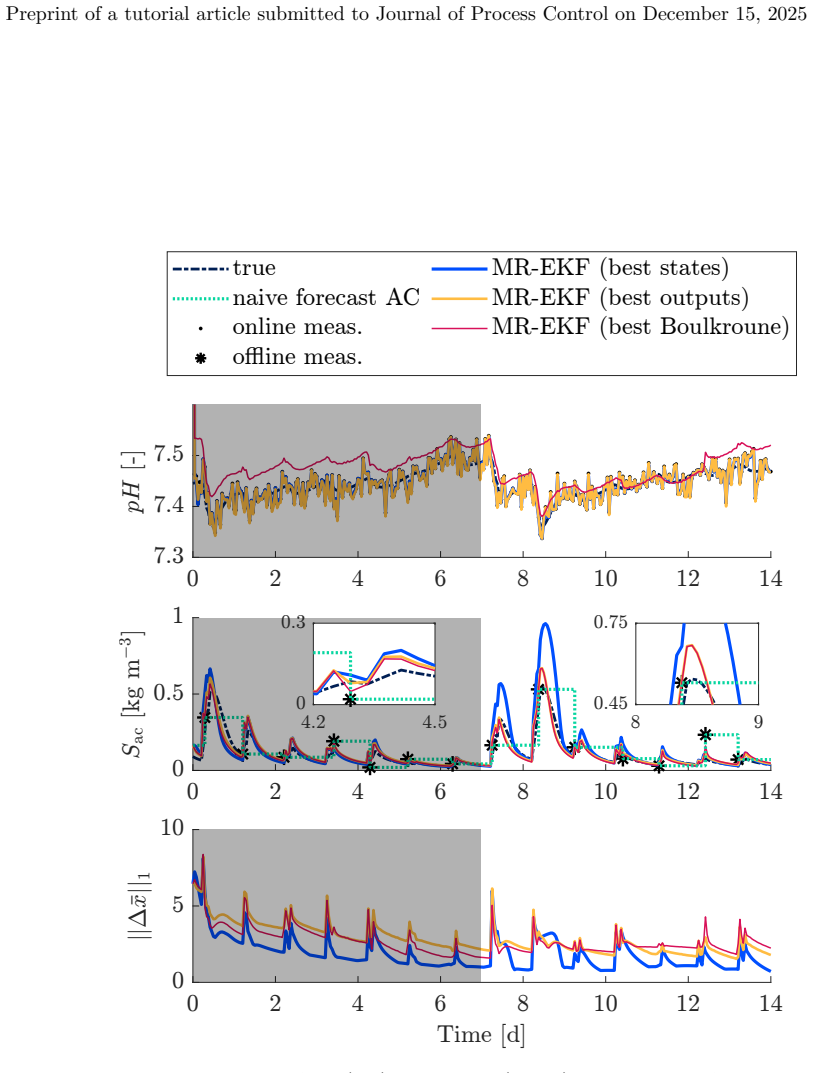
In many applications of biotechnology, measurements are available at different sampling rates, e.g., due to online sensors and offline lab analysis. Offline measurements typically involve time delays that may be unknown a priori due to the underlying laboratory procedures. This multirate (MR) setting poses a challenge to Kalman filtering, where conventionally measurement data is assumed to be available on an equidistant time grid and without delays. This tutorial paper derives the MR version of an extended Kalman filter (EKF) based on sample state augmentation, and applies it to the anaerobic digestion (AD) process in a simulative agricultural setting. The performance of the MR-EKF is investigated for various scenarios including varying delay lengths, measurement noise levels, plant-model mismatch (PMM), and initial state error. Provided with an adequate tuning, the MR-EKF can reliably estimate the process state and, thus, appropriately fuse the delayed offline measurements and smooth the noisy online measurements. Because of the sample state augmentation approach, the delay length of offline measurements does not critically effect the performance of the state estimation, provided that observability is not lost during the delays. Poor state initialization and PMM affect convergence more than measurement noise levels. Furthermore, selecting an appropriate tuning was found to be critically important for successful application of the MR-EKF for which a systematic approach is presented. This tutorial provides implementation guidance for practitioners seeking to successfully apply state estimation for multirate systems. Thus, it contributes to the development of demand-driven operation of biogas plants, which may aid in stabilizing a renewable electricity grid.
Editorial analysis
A structured set of objections, weighed in public.
Referee Report
Summary. The manuscript is a tutorial deriving a multirate extended Kalman filter (MR-EKF) via sample-state augmentation to fuse delayed offline lab measurements with noisy online sensor data for state estimation in a four-state anaerobic digestion (AD) model. It presents simulation experiments across delay lengths, noise levels, plant-model mismatch, and initialization errors, claiming that adequate tuning enables reliable state estimation, appropriate measurement fusion, and smoothing, with performance largely insensitive to delay length provided observability is preserved.
Significance. If the robustness claims hold under the reported conditions, the work supplies practical implementation guidance and a systematic tuning procedure for multirate filtering in biotechnological processes. This could support improved monitoring and demand-driven operation of agricultural biogas plants, contributing to renewable energy grid stability.
major comments (3)
- [Simulation experiments] Simulation experiments section: The claim that performance is insensitive to delay length (provided observability holds) is not supported by analytic bounds on linearization error accumulation or by simulations that deliberately probe divergence under the reported plant-model mismatch; for the stiff AD kinetics, delays comparable to dominant time constants risk inaccurate covariance propagation and gain computation in the EKF prediction step.
- [Tuning procedure] Tuning procedure section: The systematic tuning approach for process noise covariance Q and measurement noise covariance R is presented as critical for success, yet the description reduces to manual adjustment without an automated optimization or convergence guarantee that accounts for the nonlinear AD model under realistic mismatch.
- [Derivation of augmented system] Derivation of augmented system: Observability preservation during offline measurement delays is asserted as a sufficient condition, but no explicit rank check or eigenvalue analysis is supplied for the augmented nonlinear system under the specific AD parameters and stiff reaction rates.
minor comments (3)
- [Figures] Figure captions lack quantitative performance metrics (e.g., RMSE values or convergence times) for the different delay and mismatch scenarios, reducing clarity of the qualitative statements.
- [Notation] Notation for the augmented state vector and delay indexing is occasionally inconsistent between the derivation and the simulation implementation; add a consistent table of symbols.
- [Introduction] Add a short discussion of alternative multirate approaches (e.g., intermittent Kalman filters) to better position the sample-augmentation choice.
Simulated Author's Rebuttal
We thank the referee for the constructive and detailed comments, which have helped us improve the clarity and rigor of our tutorial manuscript. We address each major comment point by point below, providing the strongest honest defense of the work while acknowledging its scope as a practical tutorial focused on derivation and simulation rather than theoretical analysis. Revisions have been made where they strengthen the presentation without altering the core contributions.
read point-by-point responses
-
Referee: Simulation experiments section: The claim that performance is insensitive to delay length (provided observability holds) is not supported by analytic bounds on linearization error accumulation or by simulations that deliberately probe divergence under the reported plant-model mismatch; for the stiff AD kinetics, delays comparable to dominant time constants risk inaccurate covariance propagation and gain computation in the EKF prediction step.
Authors: We agree that the manuscript does not derive analytic bounds on linearization error accumulation, which would require a separate theoretical treatment beyond the tutorial's practical focus. Our simulation experiments do cover a range of delay lengths, including values comparable to the dominant time constants of the AD model, across multiple plant-model mismatch levels and noise conditions. In all tested cases with adequate tuning, the MR-EKF exhibited stable convergence and reliable fusion without divergence. To address the concern, we have revised the simulation section to include additional cases that more explicitly probe potential divergence under increased mismatch and to add a discussion of the risks associated with covariance propagation in stiff systems. We maintain that the sample-state augmentation approach provides practical robustness in the reported scenarios, though we now explicitly note the absence of general analytic guarantees. revision: partial
-
Referee: Tuning procedure section: The systematic tuning approach for process noise covariance Q and measurement noise covariance R is presented as critical for success, yet the description reduces to manual adjustment without an automated optimization or convergence guarantee that accounts for the nonlinear AD model under realistic mismatch.
Authors: The tuning procedure is presented as systematic in that it follows a structured, iterative workflow based on standard EKF practices: initializing Q and R from physical uncertainty estimates, monitoring innovation statistics, and refining until consistent performance is achieved across scenarios. This manual approach is intentional for a tutorial aimed at practitioners, as automated optimization methods for nonlinear systems under mismatch typically lack convergence guarantees and require problem-specific assumptions not suitable for general guidance. We have revised the section to clarify the iterative steps in more detail, include example tuning sequences from our simulations, and add an explicit statement that no formal convergence proof is provided and that empirical validation (as demonstrated) is required. revision: partial
-
Referee: Derivation of augmented system: Observability preservation during offline measurement delays is asserted as a sufficient condition, but no explicit rank check or eigenvalue analysis is supplied for the augmented nonlinear system under the specific AD parameters and stiff reaction rates.
Authors: We have added an explicit numerical observability analysis to the revised derivation section. For the specific AD model parameters and stiff kinetics, we evaluate the rank of the observability matrix of the linearized augmented system at representative operating points, confirming full rank (and thus local observability) for the delay lengths considered in the simulations. Eigenvalue analysis of the augmented state transition is also included to illustrate that the delay-augmented dynamics do not introduce unobservable modes within the tested range. This supports the original assertion while making the check transparent and reproducible. revision: yes
Circularity Check
Standard sample-state-augmentation derivation for MR-EKF is self-contained and independent of fitted inputs or self-citations
full rationale
The paper presents a tutorial derivation of the multirate EKF via the standard sample-state-augmentation construction, which is a well-established technique in the Kalman filtering literature and does not reduce any core equations or performance claims to quantities defined by the same simulation data or prior self-citations. The central claim that the MR-EKF can reliably estimate states when adequately tuned is evaluated through explicit simulation scenarios with separate discussion of tuning procedures, observability preservation, and sensitivity to delays/PMM/initialization; no load-bearing step equates a prediction to its own fitted input by construction, and the derivation remains independent of the target AD model specifics beyond standard nonlinear propagation.
Axiom & Free-Parameter Ledger
free parameters (1)
- Process noise covariance Q and measurement noise covariance R
axioms (1)
- domain assumption The nonlinear process model is known and the augmented system remains observable when delayed measurements eventually arrive.
Lean theorems connected to this paper
-
IndisputableMonolith/Foundation/RealityFromDistinction.leanreality_from_one_distinction unclear?
unclearRelation between the paper passage and the cited Recognition theorem.
The present study derives the MR version of an extended Kalman filter (EKF) based on sample state augmentation, and applies it to the anaerobic digestion (AD) process...
-
IndisputableMonolith/Cost/FunctionalEquation.leanwashburn_uniqueness_aczel unclear?
unclearRelation between the paper passage and the cited Recognition theorem.
tuning of measurement uncertainty was modified by an amplification factor kR ... process uncertainty, individual values of a diagonal matrix Q
What do these tags mean?
- matches
- The paper's claim is directly supported by a theorem in the formal canon.
- supports
- The theorem supports part of the paper's argument, but the paper may add assumptions or extra steps.
- extends
- The paper goes beyond the formal theorem; the theorem is a base layer rather than the whole result.
- uses
- The paper appears to rely on the theorem as machinery.
- contradicts
- The paper's claim conflicts with a theorem or certificate in the canon.
- unclear
- Pith found a possible connection, but the passage is too broad, indirect, or ambiguous to say the theorem truly supports the claim.
Forward citations
Cited by 1 Pith paper
-
LMI Optimization Based Multirate Steady-State Kalman Filter Design
An LMI-based framework designs multirate steady-state Kalman filters that support multi-objective constraints and achieve position estimation RMSE below GPS noise levels in automotive examples.
Reference graph
Works this paper leans on
-
[2]
V. Alcaraz-Gonz´ alez, F. A. Fregoso-S´ anchez, V. Gonz´ alez-Alvarez, and J.-P. Steyer. Multivariable Robust Regulation of Alkalinities in Continuous Anaerobic Digestion Processes: Experimental Val- idation. Processes, 9(7):1153, 2021. ISSN 2227-9717. doi: 10.3390/pr9071153
-
[3]
H. L. Alexander. State estimation for distributed systems with sensing delay. In V. Libby, editor, Data Structures and Target Classification, SPIE Proceedings, pages 103–111. SPIE, 1991. doi: 10.1 117/12.44843
work page 1991
-
[4]
I. Angelidaki, L. Ellegaard, and B. K. Ahring. A Mathematical Model for Dynamic Sim- ulation of Anaerobic Digestion of Complex Substrates: Focusing on Ammonia Inhibition. Biotechnology and Bioengineering, 42(2):159–166, 1993. ISSN 0006-3592. doi: 10.1002/bit.2604 20203
- [5]
-
[6]
Y. Bar-Shalom, X.-R. Li, and T. Kirubarajan. Estimation with Applications to Tracking and Navigation: Theory, Algorithms and Software. Wiley, 2002. ISBN 9780471416555. doi: 10.100 2/0471221279
work page 2002
-
[7]
G. Bastin and D. Dochain. On-line Estimation and Adaptive Control of Bioreactors. Elsevier, 1990. ISBN 9780444884305. doi: 10.1016/C2009-0-12088-3
-
[8]
D. J. Batstone, J. Keller, I. Angelidaki, S. V. Kalyuzhnyi, S. G. Pavlostathis, A. Rozzi, W. Sanders, H. Siegrist, and V. A. Vavilin. The IWA Anaerobic Digestion Model No 1 (ADM1). Water Science and Technology, 45(10):65–73, 2002. ISSN 0273-1223. doi: 10.2166/wst.2002.0292
-
[9]
O. Bernard, Z. Hadj-Sadok, D. Dochain, A. Genovesi, and J. P. Steyer. Dynamical mo- del development and parameter identification for an anaerobic wastewater treatment process. Biotechnology and Bioengineering, 75(4):424–438, 2001. ISSN 0006-3592. doi: 10.1002/bit.10036. 43 Preprint of a tutorial article submitted to Journal of Process Control on December 15, 2025
-
[10]
K. Boe, D. J. Batstone, and I. Angelidaki. An innovative online VFA monitoring system for the anerobic process, based on headspace gas chromatography. Biotechnology and Bioengineering, 96 (4):712–721, 2007. ISSN 0006-3592. doi: 10.1002/bit.21131
-
[11]
F. Bonk, D. Popp, S. Weinrich, H. Str¨ auber, S. Kleinsteuber, H. Harms, and F. Centler. Intermittent fasting for microbes: how discontinuous feeding increases functional stability in anaerobic digestion. Biotechnology for Biofuels and Bioproducts, 11:274, 2018. ISSN 1754-6834. doi: 10.1186/s13068-0 18-1279-5
-
[12]
B. Boulkroune, K. Geebelen, J. Wan, and E. van Nunen. Auto-tuning extended Kalman filters to improve state estimation. In 2023 IEEE Intelligent Vehicles Symposium (IV), pages 1–6. IEEE,
work page 2023
-
[13]
doi: 10.1109/IV55152.2023.10186760
ISBN 979-8-3503-4691-6. doi: 10.1109/IV55152.2023.10186760
-
[14]
Bundesministeriums der Justiz. Gesetz f¨ ur den Ausbau erneuerbarer Energien (Erneuerbare- Energien-Gesetz - EEG 2023): EEG 2023, 2025. URLhttps://www.clearingstelle-eeg-k wkg.de/eeg2023
work page 2023
-
[15]
D. Carecci, A. Catenacci, S. Rossi, F. Casagli, G. Ferretti, A. Leva, and E. Ficara. A plant- wide modelling framework to describe microalgae growth on liquid digestate in agro-zootechnical biomethane plants. Chemical Engineering Journal, 485:149981, 2024. ISSN 13858947. doi: 10.101 6/j.cej.2024.149981
-
[16]
Y. Chen, J. J. Cheng, and K. S. Creamer. Inhibition of anaerobic digestion process: A review. Bioresource Technology, 99(10):4044–4064, 2008. doi: 10.1016/j.biortech.2007.01.057
-
[17]
Z. Chen, N. Ahmed, S. Julier, and C. Heckman. Kalman Filter Tuning with Bayesian Optimization. arXiv:1912.08601 [eess.SY], 2019. doi: 10.48550/arXiv.1912.08601
-
[18]
Z. Chen, H. Biggie, N. Ahmed, S. Julier, and C. Heckman. Kalman Filter Auto-Tuning With Consis- tent and Robust Bayesian Optimization. IEEE Transactions on Aerospace and Electronic Systems, 60(2):2236–2250, 2024. ISSN 0018-9251. doi: 10.1109/TAES.2024.3350587
-
[19]
I. A. Cruz, L. R. Andrade, R. N. Bharagava, A. K. Nadda, M. Bilal, R. T. Figueiredo, and L. F. Ferreira. An overview of process monitoring for anaerobic digestion. Biosystems Engineering, 207 (1):106–119, 2021. ISSN 15375110. doi: 10.1016/j.biosystemseng.2021.04.008
-
[20]
A. Curtis, M. Powell, and J. Reid. On the Estimation of Sparse Jacobian Matrices. IMA Journal of Applied Mathematics, 13(1):117–119, 1974. ISSN 0272-4960. doi: 10.1093/imamat /13.1.117
-
[21]
A. Daid, E. Busvelle, and M. Aidene. On the convergence of the unscented Kalman filter. European Journal of Control, 57:125–134, 2021. ISSN 09473580. doi: 10.1016/j.ejcon.2020.05.003
-
[22]
J. Daniel-Gromke, N. Rensberg, V. Denysenko, W. Stinner, T. Schmalfuß, M. Scheftelowitz, M. Nelles, and J. Liebetrau. Current Developments in Production and Utilization of Biogas and Biomethane in Germany. Chemie Ingenieur Technik, 90(1-2):17–35, 2018. doi: 10.1002/cite.20170 0077
-
[23]
F. S. Delory, P. Neubauer, and S. Weinrich. Uncertainty analysis of a simplified anaerobic digestion model applied to dynamic agricultural experimental data. Water Science and Technology, 92(4): 610–634, 2025. ISSN 0273-1223. doi: 10.2166/wst.2025.104
-
[24]
C. Dittmer, B. Ohnmacht, J. Kr¨ umpel, and A. Lemmer. Model Predictive Control: Demand- Orientated, Load-Flexible, Full-Scale Biogas Production. Microorganisms, 10(4), 2022. ISSN 2076-
work page 2022
-
[25]
doi: 10.3390/microorganisms10040804
-
[26]
D. Dochain. State and parameter estimation in chemical and biochemical processes: a tutorial. Journal of Process Control, 13(8):801–818, 2003. ISSN 09591524. doi: 10.1016/S0959-1524(03)000 26-X. 44 Preprint of a tutorial article submitted to Journal of Process Control on December 15, 2025
-
[27]
A. Donoso-Bravo, M. C. Sadino-Riquelme, E. Valdebenito-Rolack, D. Paulet, D. G´ omez, and F. Hansen. Comprehensive ADM1 Extensions to Tackle Some Operational and Metabolic Aspects in Anaerobic Digestion. Microorganisms, 10(5), 2022. ISSN 2076-2607. doi: 10.3390/microorganis ms10050948
-
[28]
R. D¨ urr, S. Duvigneau, C. Seidel, A. Kienle, and A. B¨ uck. Multi-Rate Data Fusion for State and Parameter Estimation in (Bio-)Chemical Process Engineering. Processes, 9(11):1990, 2021. ISSN 2227-9717. doi: 10.3390/pr9111990
-
[29]
M. Elsheikh, R. Hille, A. Tatulea-Codrean, and S. Kr¨ amer. A comparative review of multi-rate moving horizon estimation schemes for bioprocess applications.Computers & Chemical Engineering, 146:107219, 2021. ISSN 00981354. doi: 10.1016/j.compchemeng.2020.107219
-
[30]
In: 2024 European Control Conference (ECC)
J.-H. Ewering, Z. Ziaukas, S. F. G. Ehlers, and T. Seel. Reliable State Estimation in a Truck- Semitrailer Combination Using an Artificial Neural Network-Aided Extended Kalman Filter. In 2024 European Control Conference (ECC), pages 456–463. IEEE, 6/25/2024 - 6/28/2024. ISBN 978-3-9071-4410-7. doi: 10.23919/ECC64448.2024.10590814
-
[31]
E. Ficara, S. Hassam, A. Allegrini, A. Leva, F. Malpei, and G. Ferretti. Anaerobic Digestion Models: A Comparative Study. IFAC Proceedings Volumes, 45(2):1052–1057, 2012. ISSN 14746670. doi: 10.3182/20120215-3-AT-3016.00186
-
[32]
D. Gaida, C. Wolf, C. Meyer, A. Stuhlsatz, J. Lippel, T. B¨ ack, M. Bongards, and S. McLoone. State estimation for anaerobic digesters using the ADM1. Water Science and Technology, 66(5): 1088–1095, 2012. ISSN 0273-1223. doi: 10.2166/wst.2012.286
-
[33]
D. Gaida, C. Wolf, and M. Bongards. Feed control of anaerobic digestion processes for renewable energy production: A review. Renewable and Sustainable Energy Reviews, 68:869–875, 2017. ISSN 13640321. doi: 10.1016/j.rser.2016.06.096
-
[34]
A. Gopalakrishnan, N. S. Kaisare, and S. Narasimhan. Incorporating delayed and infrequent mea- surements in Extended Kalman Filter based nonlinear state estimation. Journal of Process Control, 21(1):119–129, 2011. ISSN 09591524. doi: 10.1016/j.jprocont.2010.10.013
-
[35]
R. D. Gudi, S. L. Shah, and M. R. Gray. Adaptive multirate state and parameter estimation strategies with application to a bioreactor. AIChE Journal, 41(11):2451–2464, 1995. ISSN 0001-
work page 1995
-
[36]
doi: 10.1002/aic.690411111
- [37]
-
[38]
doi: 10.1155/2014/572621
-
[39]
S. Hellmann, A.-J. Hempel, S. Streif, and S. Weinrich. Observability and Identi- fiability Analyses of Process Models for Agricultural Anaerobic Digestion Plants. In 2023 24th International Conference on Process Control (PC), pages 84–89. IEEE, 2023. ISBN 979- 8-3503-4763-0. doi: 10.1109/PC58330.2023.10217587
-
[40]
S. Hellmann, J. Frontzek, D. M. Zarate, T. Wilms, K. Koch, S. Knorn, S. Streif, and S. Weinrich. Multi-stage model predictive control of agricultural anaerobic digestion plant with uncertain sub- strate characterization. Bioresource Technology, 441:133568, 2025. doi: 10.1016/j.biortech.2025.13 3568
-
[41]
In: 2024 European Control Conference (ECC)
S. Hellmann, T. Wilms, S. Streif, and S. Weinrich. Comparison of Unscented Kalman Filter Design for Agricultural Anaerobic Digestion Model. In 2024 European Control Conference (ECC), pages 1729–1735. IEEE, 6/25/2024 - 6/28/2024. ISBN 978-3-9071-4410-7. doi: 10.23919/ECC64448.2024 .10591126. 45 Preprint of a tutorial article submitted to Journal of Process...
-
[42]
J. Jimenez, E. Latrille, J. Harmand, ´A. Robles, J. Ferrer, D. Gaida, C. Wolf, F. Mairet, O. Bernard, V. Alcaraz-Gonzalez, H. Mendez-Acosta, D. Zitomer, D. Totzke, H. Spanjers, F. Jacobi, A. Guwy, R. Dinsdale, G. Premier, S. Mazhegrane, G. Ruiz-Filippi, A. Seco, T. Ribeiro, A. Pauss, and J.-P. Steyer. Instrumentation and control of anaerobic digestion pro...
-
[43]
P. Kazemi, J.-P. Steyer, C. Bengoa, J. Font, and J. Giralt. Robust Data-Driven Soft Sensors for Online Monitoring of Volatile Fatty Acids in Anaerobic Digestion Processes. Processes, 8(1):67,
- [44]
-
[45]
T. Kegl, E. Torres Jim´ enez, B. Kegl, A. Kovaˇ c Kralj, and M. Kegl. Modeling and optimization of anaerobic digestion technology: Current status and future outlook. Progress in Energy and Combustion Science, 106:101199, 2025. ISSN 03601285. doi: 10.1016/j. pecs.2024.101199
work page doi:10.1016/j 2025
-
[46]
A. Kemmer, N. Fischer, T. Wilms, L. Cai, S. Groß, R. King, P. Neubauer, and M. N. Cruz Bourna- zou. Nonlinear state estimation as tool for online monitoring and adaptive feed in high throughput cultivations. Biotechnology and Bioengineering, 120(11):3261–3275, 2023. ISSN 0006-3592. doi: 10.1002/bit.28509
-
[47]
J. W. Kim, N. Krausch, J. Aizpuru, T. Barz, S. Lucia, P. Neubauer, and M. N. Cruz Bournazou. Model predictive control and moving horizon estimation for adaptive optimal bolus feeding in high- throughput cultivation ofE. coli. Computers & Chemical Engineering, 172:108158, 2023. ISSN 00981354. doi: 10.1016/j.compchemeng.2023.108158
-
[48]
S. Kol˚ as, B. A. Foss, and T. S. Schei. Constrained nonlinear state estimation based on the UKF approach. Computers & Chemical Engineering, 33(8):1386–1401, 2009. ISSN 00981354. doi: 10.101 6/j.compchemeng.2009.01.012
work page 2009
-
[49]
S. Kr¨ amer and R. Gesthuisen. Multirate State Estimation Using Moving Horizon Estimation. IFAC Proceedings Volumes, 38(1):1–6, 2005. ISSN 14746670. doi: 10.3182/20050703-6-CZ-190 2.00654
- [50]
-
[51]
IEEE Service Center. ISBN 0-7803-9098-9. doi: 10.1109/ACC.2005.1470723
-
[52]
T. D. Larsen, N. A. Andersen, O. Ravn, and N. K. Poulsen. Incorpo- ration of time delayed measurements in a discrete-time Kalman filter. In Proceedings of the 37th IEEE Conference on Decision and Control (Cat. No.98CH36171), pages 3972–3977. IEEE, 1998. ISBN 0-7803-4394-8. doi: 10.1109/CDC.1998.761918
-
[53]
R. Li, A. B. Corripio, M. A. Henson, and M. J. Kurtz. On-line state and parame- ter estimation of EPDM polymerization reactors using a hierarchical extended Kalman filter. Journal of Process Control, 14(8):837–852, 2004. ISSN 09591524. doi: 10.1016/j.jprocont.2004. 03.002
-
[54]
J. Liebetrau and D. Pfeiffer, editors. Collection of Methods for Biogas: Methods to determine parameters for analysis purposes and parameters that describe processes in the biogas sector, vol- ume 7 of Biomass energy use. Leipzig, 2nd edition edition, 2020. ISBN 978-3-946629-47-4. doi: 10.48480/z641-5235
-
[55]
R. L´ opez-Negrete and L. T. Biegler. A Moving Horizon Estimator for processes with multi-rate measurements: A Nonlinear Programming sensitivity approach. Journal of Process Control, 22(4): 677–688, 2012. ISSN 09591524. doi: 10.1016/j.jprocont.2012.01.013. 46 Preprint of a tutorial article submitted to Journal of Process Control on December 15, 2025
-
[56]
V. Lyubenova, G. Kostov, and R. Denkova-Kostova. Model-Based Monitoring of Biotechnological Processes—A Review. Processes, 9(6):908, 2021. ISSN 2227-9717. doi: 10.3390/pr9060908
-
[57]
M. Madsen, J. B. Holm-Nielsen, and K. H. Esbensen. Monitoring of anaerobic digestion processes: A review perspective. Renewable and Sustainable Energy Reviews, 15(6):3141–3155, 2011. ISSN 13640321. doi: 10.1016/j.rser.2011.04.026
-
[58]
E. Mauky, S. Weinrich, H.-J. N¨ agele, H. F. Jacobi, J. Liebetrau, and M. Nelles. Model Predictive Control for Demand-Driven Biogas Production in Full Scale. Chemical Engineering & Technology, 39(4):652–664, 2016. ISSN 0930-7516. doi: 10.1002/ceat.201500412
-
[59]
E. Mauky, S. Weinrich, H.-F. Jacobi, H.-J. N¨ agele, J. Liebetrau, and M. Nelles. Demand-driven bio- gas production by flexible feeding in full-scale - Process stability and flexibility potentials. Anaerobe, 46:86–95, 2017. doi: 10.1016/j.anaerobe.2017.03.010
-
[60]
M. D. McKay, R. J. Beckman, and W. J. Conover. A Comparison of Three Methods for Selecting Values of Input Variables in the Analysis of Output from a Computer Code. Technometrics, 21(2): 239, 1979. ISSN 00401706. doi: 10.2307/1268522
-
[61]
H. O. M´ endez-Acosta, D. U. Campos-Delgado, R. Femat, and V. Gonz´ alez-Alvarez. A robust feedfor- ward/feedback control for an anaerobic digester. Computers & Chemical Engineering, 29(7):1613– 1623, 2005. ISSN 00981354. doi: 10.1016/j.compchemeng.2005.01.005
-
[62]
H.-J. Naegele, A. Lemmer, H. Oechsner, and T. Jungbluth. Electric Energy Consumption of the Full Scale Research Biogas Plant “Unterer Lindenhof”: Results of Longterm and Full Detail Mea- surements. Energies, 5(12):5198–5214, 2012. ISSN 1996-1073. doi: 10.3390/en5125198
-
[63]
D. Nguyen, V. Gadhamshetty, S. Nitayavardhana, and S. K. Khanal. Automatic process control in anaerobic digestion technology: A critical review. Bioresource Technology, 193:513–522, 2015. doi: 10.1016/j.biortech.2015.06.080
-
[64]
P. Nimmegeers, J. Lauwers, D. Telen, F. Logist, and J. van Impe. Identifiability of large-scale non- linear dynamic network models applied to the ADM1-case study. Mathematical biosciences, 288: 21–34, 2017. doi: 10.1016/j.mbs.2017.02.008
-
[65]
T. Noike, G. Endo, J. E. Chang, J. Yaguchi, and J. Matsumoto. Characteristics of carbohydrate degradation and the rate-limiting step in anaerobic digestion. Biotechnology and Bioengineering, 27 (10):1482–1489, 1985. ISSN 0006-3592. doi: 10.1002/bit.260271013
-
[66]
L. Perea, J. How, L. Breger, and P. Elosegui. Nonlinearity in Sensor Fu- sion: Divergence Issues in EKF, Modified Truncated GSF, and UKF. In AIAA Guidance, Navigation and Control Conference and Exhibit, Reston, Virigina, 08202007. American Institute of Aeronautics and Astronautics. ISBN 978-1-62410-015-4. doi: 10.2514/6.2007-6514
-
[67]
E. Petre, D. Seli¸ steanu, C. S ¸ulea-Iorgulescu, and S. Mehedint ¸eanu. Multivariable Adap- tive Control Strategy for an Activated Sludge Process Inside a Wastewater Treatment Plant. 21th International Carpathian Control Conference (ICCC), 2020. doi: 10.1109/ICCC49264.2020 .9257214
-
[68]
A. Petroviˇ c, M. Simoniˇ c, and L.ˇCuˇ cek. Nutrient recovery from the digestate obtained by rumen fluid enhanced anaerobic co-digestion of sewage sludge and cattail: Precipitation by MgCl2 and ion exchange using zeolite. Journal of Environmental Management, 290:112593, 2021. doi: 10.1016/j.je nvman.2021.112593
-
[69]
D. J. Prasanna Kumar, R. K. Mishra, S. Chinnam, P. Binnal, and N. Dwivedi. A comprehensive study on anaerobic digestion of organic solid waste: A review on configurations, operating parameters, techno-economic analysis and current trends. Biotechnology notes (Amsterdam, Netherlands), 5: 33–49, 2024. doi: 10.1016/j.biotno.2024.02.001. 47 Preprint of a tuto...
-
[70]
A. Purkus, E. Gawel, N. Szarka, M. Lauer, V. Lenz, A. Ortwein, P. Tafarte, M. Eichhorn, and D. Thr¨ an. Contributions of flexible power generation from biomass to a secure and cost-effective electricity supply—a review of potentials, incentives and obstacles in Germany. Energy, Sustainability and Society, 8(1), 2018. doi: 10.1186/s13705-018-0157-0
-
[71]
N. Raeyatdoost, R. Eccleston, and C. Wolf. Flexible Methane Production Using a Proportional Integral Controller with Simulation–Based Soft Sensor. Chemical Engineering & Technology, 43(1): 75–83, 2019. ISSN 0930-7516. doi: 10.1002/ceat.201900401
-
[72]
N. Raeyatdoost, M. Bongards, T. B¨ ack, and C. Wolf. Robust state estimation of the anaerobic digestion process for municipal organic waste using an unscented Kalman filter. Journal of Process Control, 121(1):50–59, 2023. ISSN 09591524. doi: 10.1016/j.jprocont.2022.11.013
-
[73]
E. Rocha-Cozatl, M. Sbarciog, L. Dewasme, J. A. Moreno, and A. V. Wouwer. State and Input Estimation of an Anaerobic Digestion Reactor using a Continuous-discrete Unknown Input Observer. IFAC-PapersOnLine, 48(8):129–134, 2015. ISSN 24058963. doi: 10.1016/j.ifacol.2015.08.169
-
[74]
J. Rodr´ ıguez, E. Roca, J. M. Lema, and O. Bernard. Determination of the ade- quate minimum model complexity required in anaerobic bioprocesses using experimental data. Journal of Chemical Technology & Biotechnology, 83(12):1694–1702, 2008. ISSN 0268-2575. doi: 10.1002/jctb.1990
-
[75]
M. Sbarciog, J. A. Moreno, and A. Vande Wouwer. Application of super-twisting ob- servers to the estimation of state and unknown inputs in an anaerobic digestion system. Water Science and Technology, 69(2):414–421, 2014. ISSN 0273-1223. doi: 10.2166/wst.2013.726
-
[76]
A. Schaum, J. Alvarez, J. P. Garcia-Sandoval, and V. M. Gonzalez-Alvarez. On the dynamics and control of a class of continuous digesters.Journal of Process Control, 34:82–96, 2015. ISSN 09591524. doi: 10.1016/j.jprocont.2015.07.004
-
[77]
R. Schneider and C. Georgakis. How To NOT Make the Extended Kalman Filter Fail. Industrial & Engineering Chemistry Research, 52(9):3354–3362, 2013. ISSN 0888-5885. doi: 10.1 021/ie300415d
work page 2013
-
[78]
T. Segura, P. Zanoni, U. Br´ emond, C. Lucet-B´ erille, A. Pradel, R. Escudi´ e, and J.-P. Steyer. Mod- elling anaerobic digestion of agricultural waste: From lab to full scale. Waste Management, 200: 114739, 2025. doi: 10.1016/j.wasman.2025.114739
-
[79]
D. Simon. Optimal state estimation: Kalman, H-infinity, and nonlinear approaches. Wiley- Interscience, Hoboken, NJ, 2006. ISBN 978-0-471-70858-2. ISBN: 978-0-471-70858-2
work page 2006
-
[80]
H. Spanjers and J. B. van Lier. Instrumentation in anaerobic treatment–research and practice. Water Science and Technology, 53(4-5):63–76, 2006. ISSN 0273-1223. doi: 10.2166/wst.2006.111
-
[81]
M. Steindl, T. J. Venus, and K. Koch. A new framework for the technical biogas poten- tial: Concept design, method development, and analytical application in a case study from Germany. Renewable and Sustainable Energy Reviews, 216:115645, 2025. ISSN 13640321. doi: 10.1016/j.rser.2025.115645
discussion (0)
Sign in with ORCID, Apple, or X to comment. Anyone can read and Pith papers without signing in.