Framing Lattices and Flow Polytopes
Pith reviewed 2026-05-16 20:08 UTC · model grok-4.3
The pith
Framing lattices unify the Tamari lattice, Boolean lattice, and weak order on permutations as duals to framed triangulations of flow polytopes.
A machine-rendered reading of the paper's core claim, the machinery that carries it, and where it could break.
Core claim
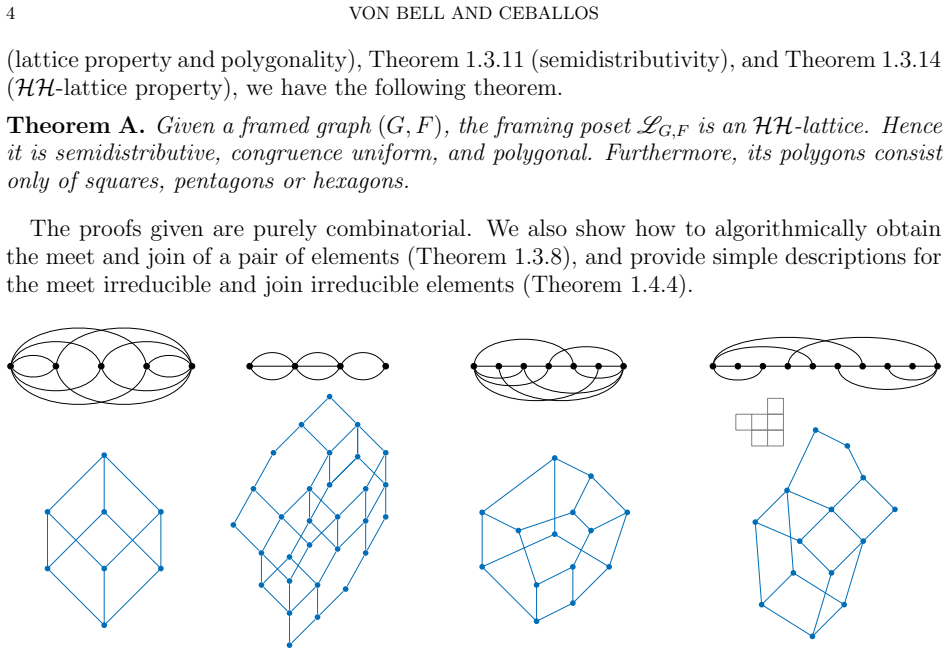
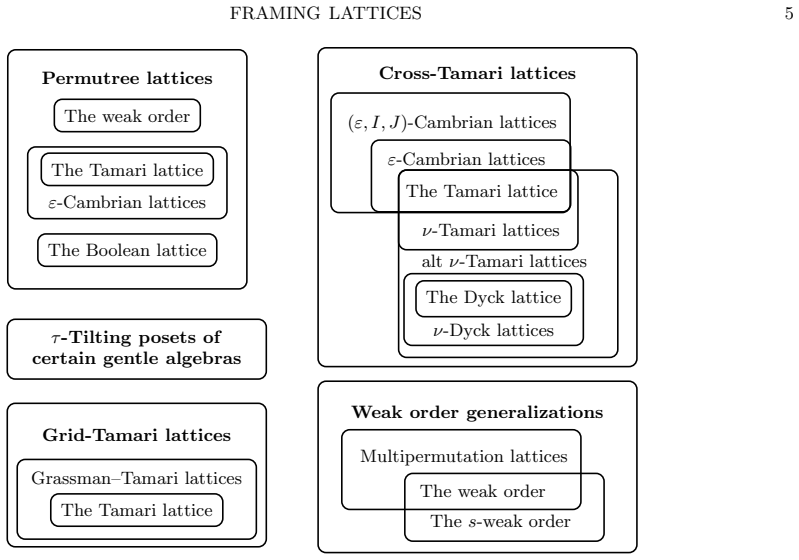
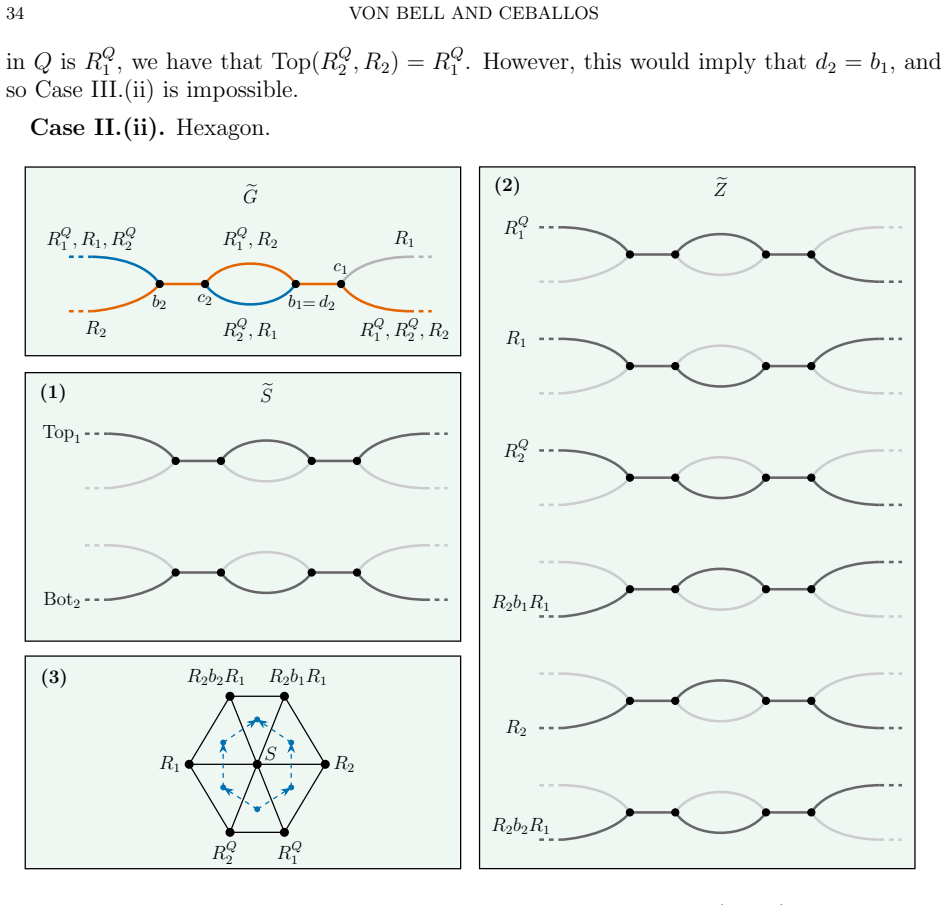
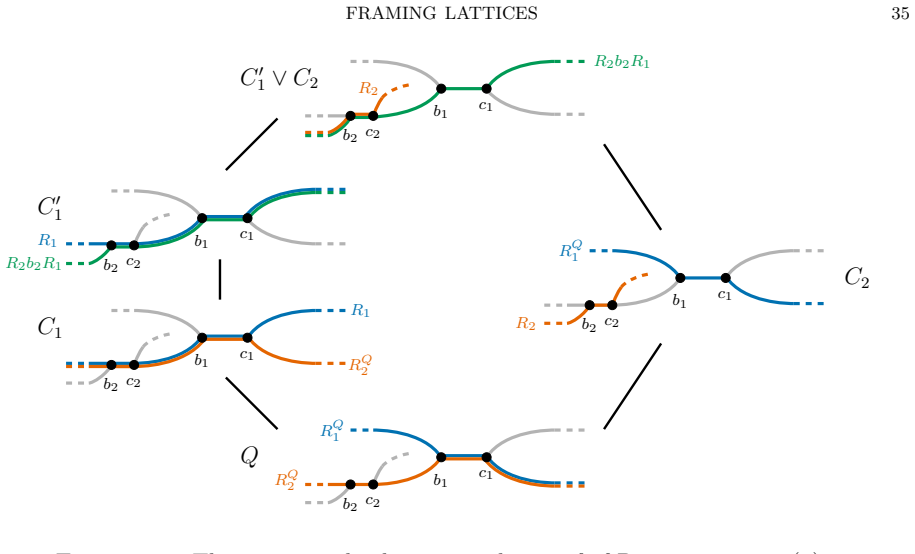
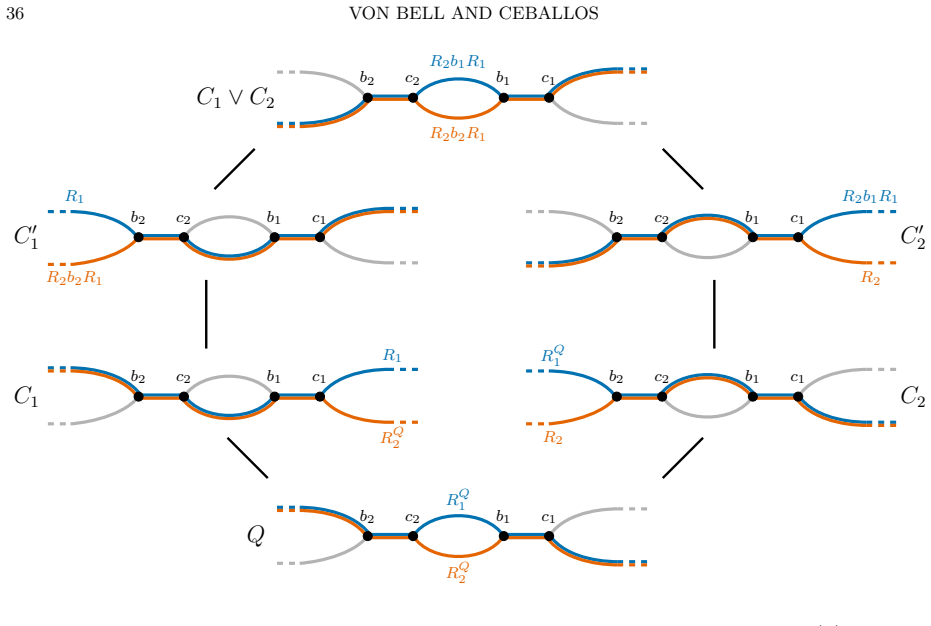
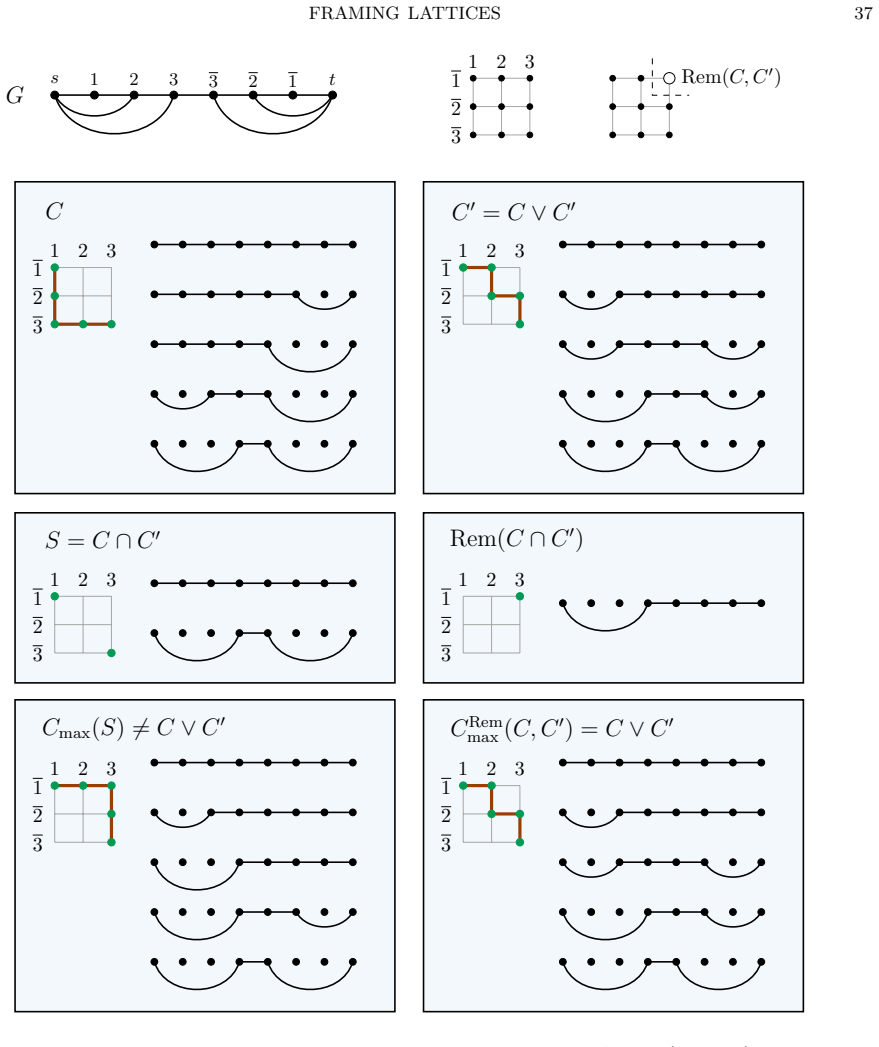
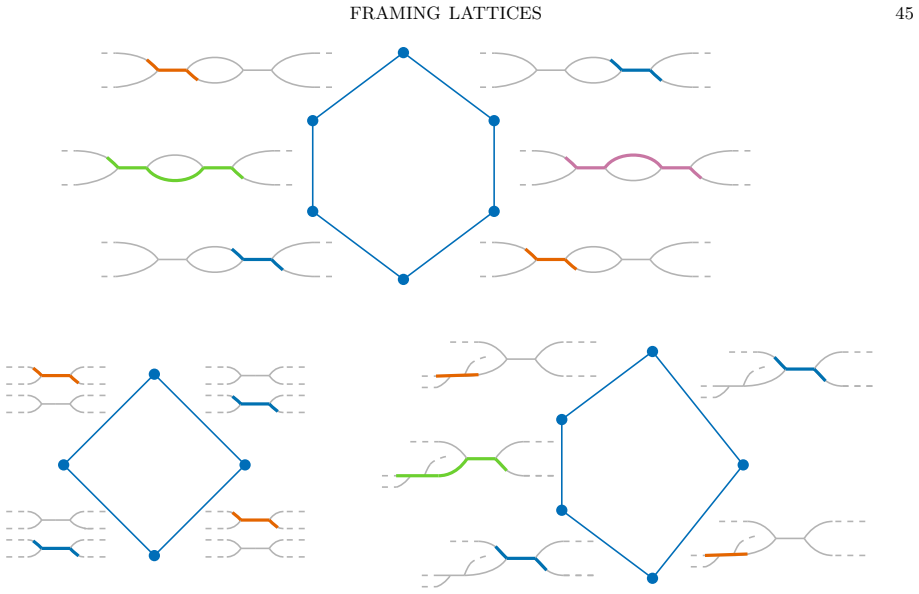
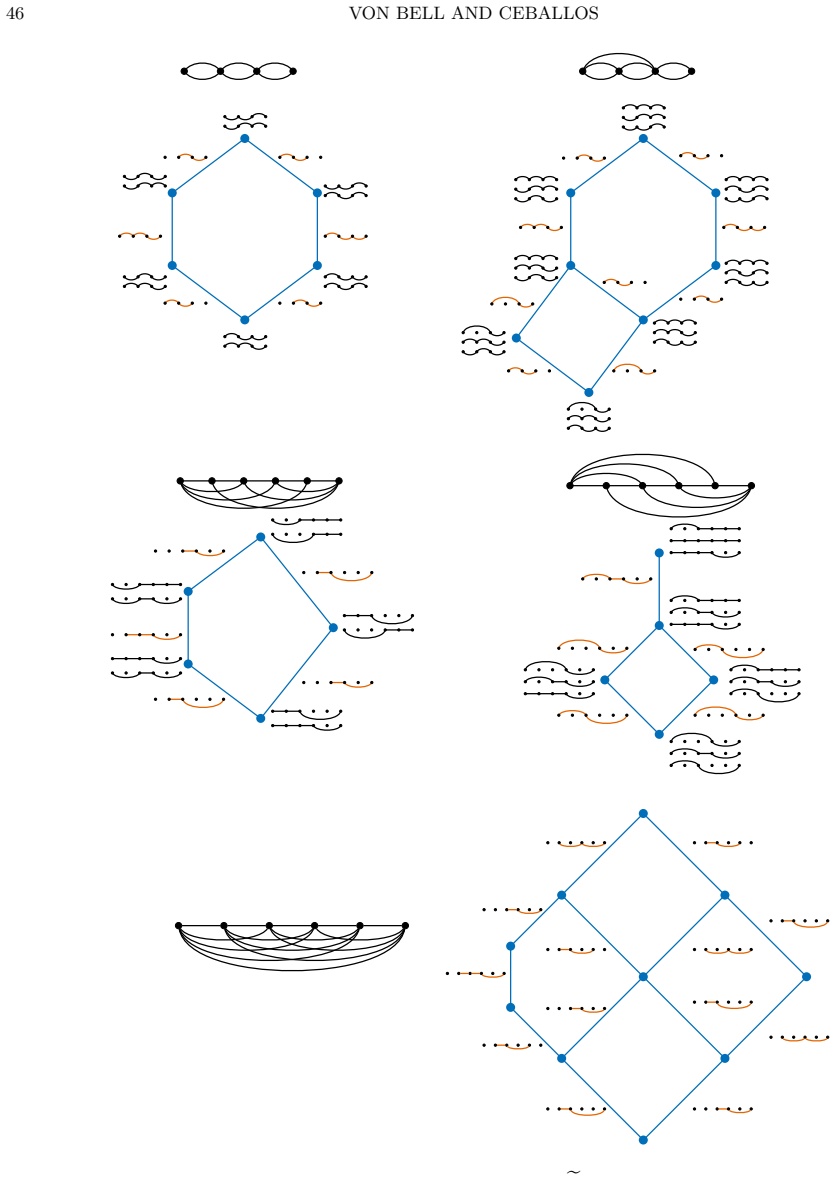
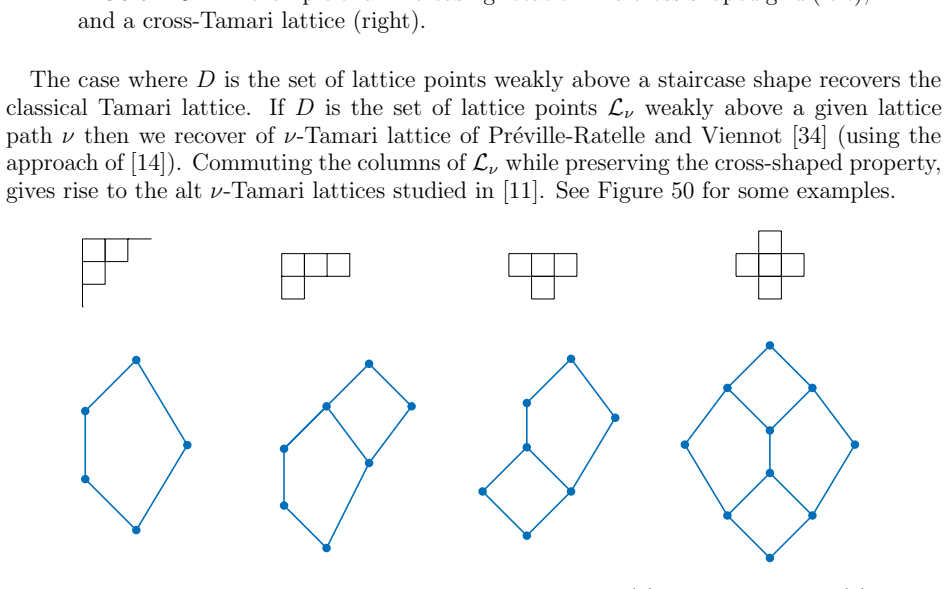
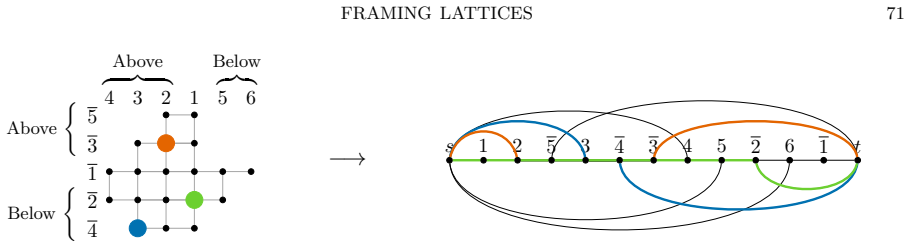
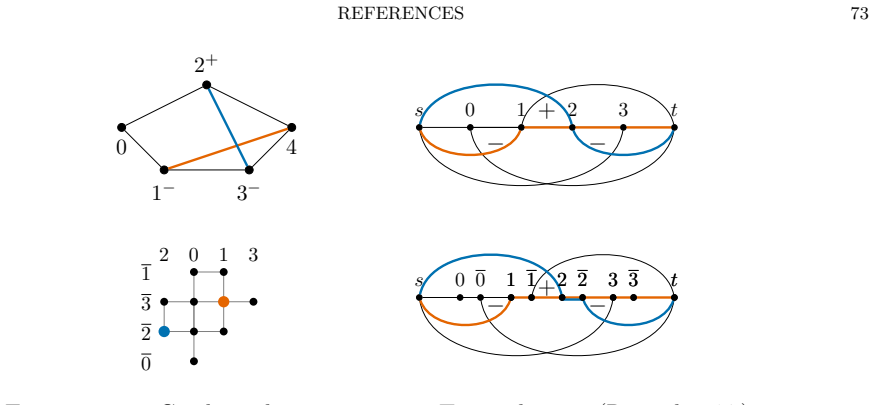
Framing lattices are defined from framed graphs so that their Hasse diagrams are dual to framed triangulations of the corresponding flow polytopes. They form a semidistributive, congruence-uniform class of polygonal lattices whose polygons are squares, pentagons, and hexagons. The construction subsumes the Boolean lattice, Tamari lattice, weak order, all type-A Cambrian lattices, Grassmann and grid-Tamari lattices, alt-nu-Tamari and cross-Tamari lattices, permutree lattices, and tau-tilting posets of certain gentle algebras, while also yielding connections to noncrossing partitions through Reading's core label orders and to lattice congruences induced by M-moves.
What carries the argument
The framing lattice of a framed graph, whose Hasse diagram is defined to be dual to a framed triangulation of the flow polytope.
If this is right
- All listed classical lattices inherit semidistributivity, congruence uniformity, and the restricted polygon types from the single geometric source.
- Join- and meet-irreducible elements admit simple combinatorial descriptions in terms of the underlying framed graph.
- Lattice congruences and quotients correspond to M-moves on the graph, giving explicit maps between different framing lattices.
- Connections to noncrossing partitions become uniform via core label orders on the framing lattices.
Where Pith is reading between the lines
- Volume computations for flow polytopes could be rephrased as enumeration problems inside the corresponding framing lattices.
- The restriction to three polygon types may extend to other families of polytopes whose triangulations admit similar dual-lattice constructions.
- M-moves could supply a rewriting system for moving between different lattice quotients, potentially simplifying algorithms for lattice-theoretic operations.
Load-bearing premise
Every framed triangulation of a flow polytope has a dual graph that forms a lattice satisfying the semidistributivity and polygonal-face conditions.
What would settle it
A single framed graph whose framed triangulation produces a dual graph that is not a semidistributive lattice or that contains a face with more or fewer than four, five, or six sides.
Figures


read the original abstract
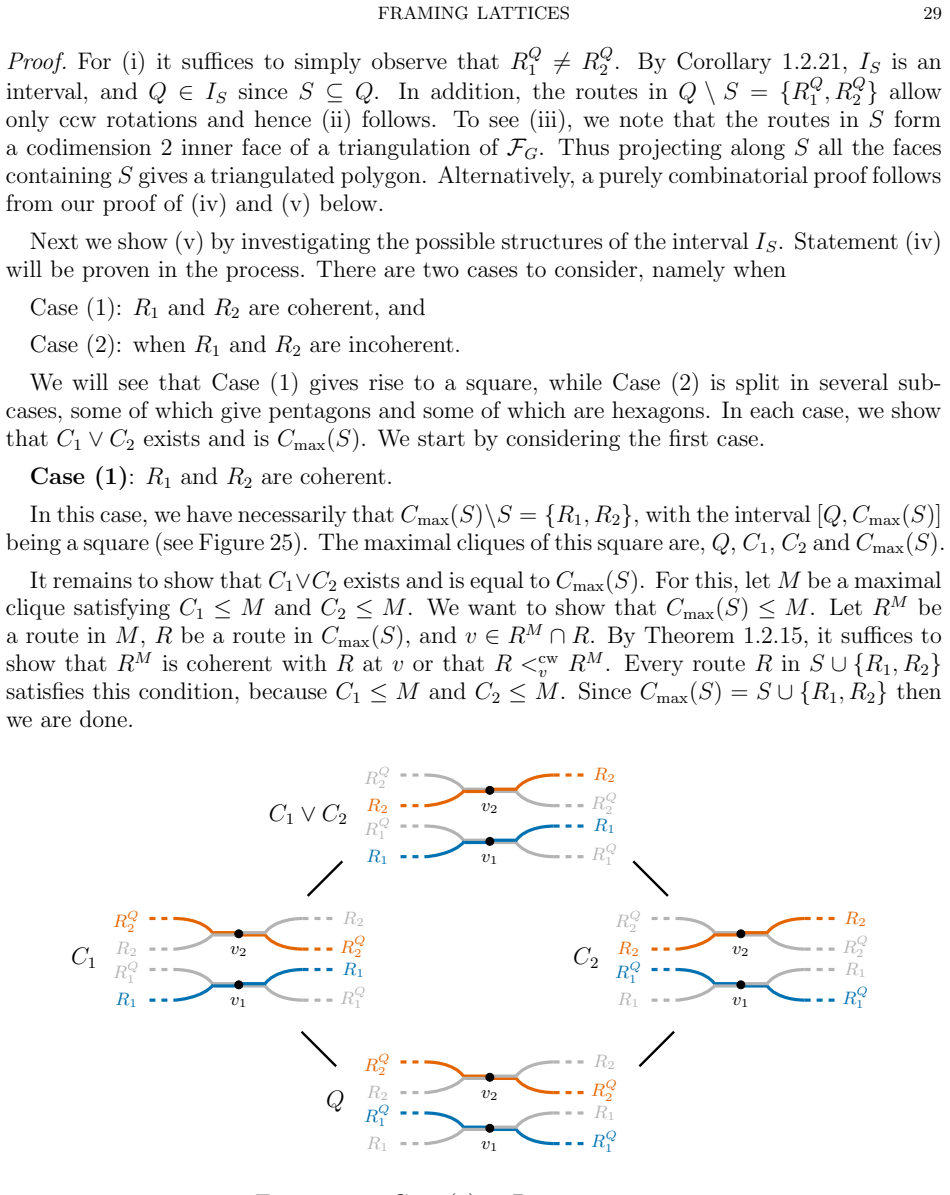
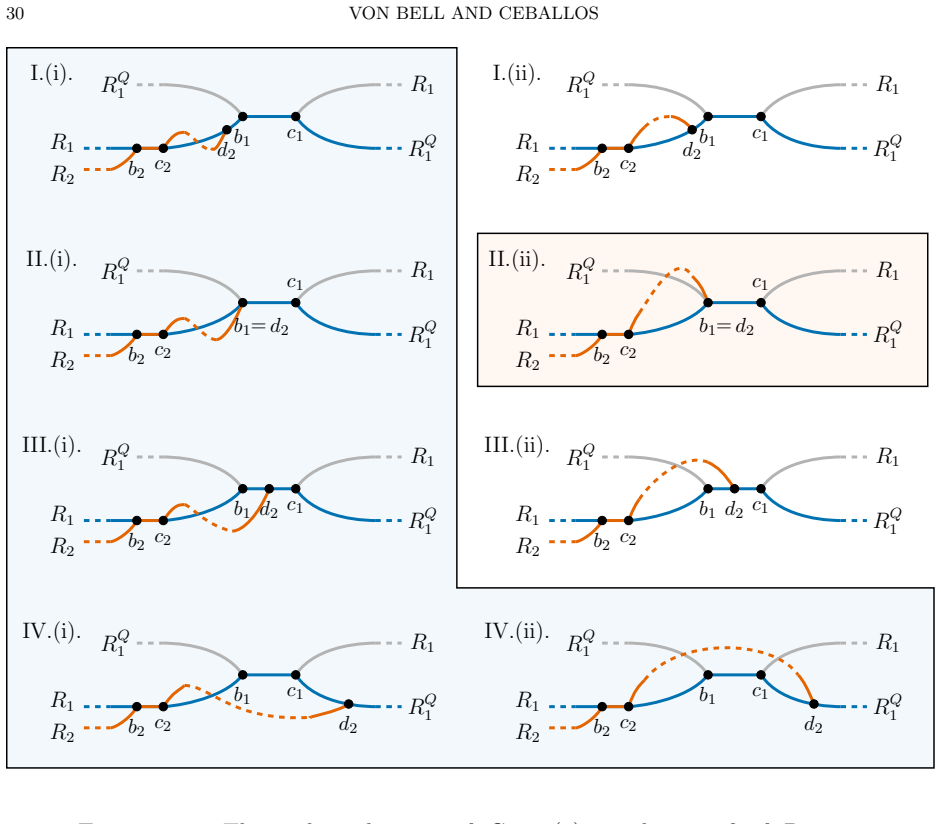
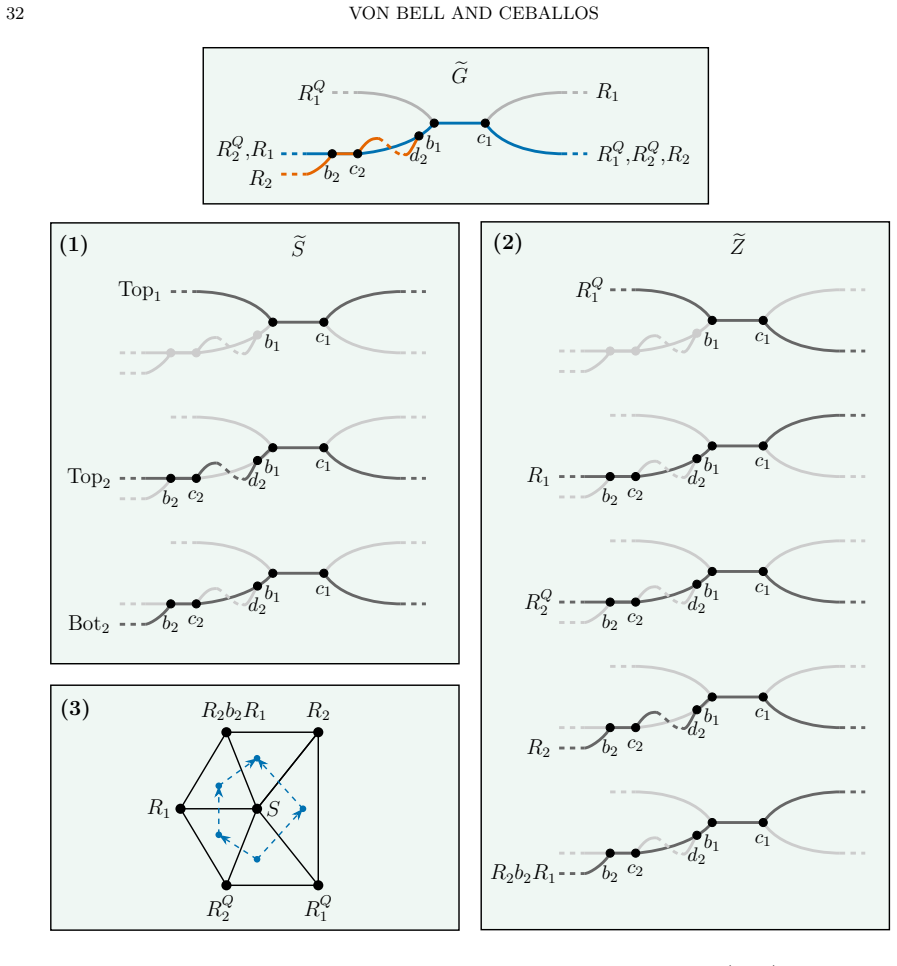
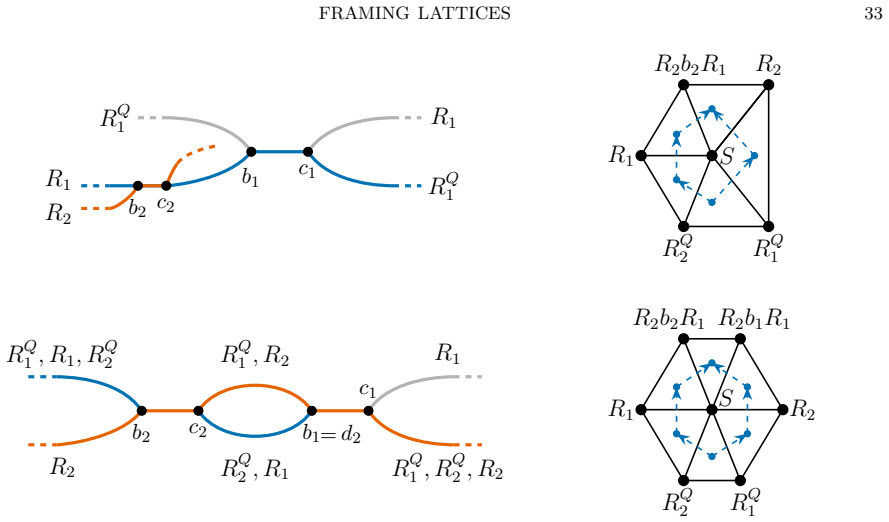
Flow polytopes of acyclic oriented graphs arise naturally in combinatorial optimization, and the study of their volumes and triangulations has revealed intriguing connections across combinatorics, geometry, algebra, and representation theory. In this work, we introduce the framing lattice associated with a framed graph, whose Hasse diagram is dual to a framed triangulation of the corresponding flow polytope. Framing lattices are remarkable in that they provide a unifying framework encompassing many classical and well-studied lattice structures, including the Boolean lattice, the Tamari lattice, and the weak order on permutations. They further subsume a broad array of examples such as all type-A Cambrian lattices, the Grassmann and grid-Tamari lattices, the alt-$\nu$-Tamari and cross-Tamari lattices, the permutree lattices, and the $\tau$-tilting posets of certain gentle algebras. We show, among several foundational structural properties, that the framing lattice is a semidistributive, congruence uniform, and polygonal lattice, with its polygons consisting of squares, pentagons, and hexagons. We study its connections to noncrossing partitions via Reading's core label orders, simple representations of its join and meet irreducible elements, and several of its lattice congruences and quotients induced by a graph operation called an M-move.
Editorial analysis
A structured set of objections, weighed in public.
Referee Report
Summary. The manuscript introduces framing lattices for framed graphs, defined such that their Hasse diagram is the dual of a framed triangulation of the flow polytope of the graph. It asserts that this construction unifies numerous classical lattices including the Boolean lattice, Tamari lattice, weak order on permutations, type-A Cambrian lattices, Grassmann and grid-Tamari lattices, alt-ν-Tamari and cross-Tamari lattices, permutree lattices, and τ-tilting posets of certain gentle algebras. The paper establishes that framing lattices are semidistributive, congruence uniform, and polygonal lattices whose polygons are squares, pentagons, and hexagons. It further investigates connections to noncrossing partitions via core label orders, join and meet irreducibles, and lattice congruences induced by M-moves.
Significance. If the central duality holds and the structural theorems are verified, this work offers a significant unifying framework connecting geometric objects (flow polytopes and triangulations) with algebraic and combinatorial structures (various lattices and posets). It could provide new geometric interpretations and proofs for properties of these lattices, advancing understanding of their relationships in combinatorial geometry and lattice theory.
major comments (2)
- [§2] §2 (Definition): The framing lattice is defined by declaring its Hasse diagram to be dual to a framed triangulation of the flow polytope, but the manuscript supplies no independent combinatorial description of the covering relations and no explicit base-case verification that this recovers the known Hasse diagrams of the Tamari lattice or Boolean lattice. This is load-bearing for the unification claims in the abstract and all subsequent structural results.
- [§4] §4 (Polygonal structure): The claim that all polygons are squares, pentagons, or hexagons is asserted from the triangulation, but the derivation does not include a concrete enumeration or small-graph example showing how the framed triangulation restricts polygon types; without this, the polygonal property remains unverified for the claimed examples.
minor comments (2)
- [Introduction] Notation for alt-ν-Tamari and cross-Tamari lattices should be defined explicitly on first use with a reference to prior work.
- [Figures] Figure captions for triangulations should label vertices or edges corresponding to lattice elements to aid readability.
Simulated Author's Rebuttal
We thank the referee for their thoughtful and constructive report. The two major comments identify places where the manuscript would benefit from additional explicit verifications and small examples. We agree with both points and will revise the paper to address them directly.
read point-by-point responses
-
Referee: [§2] §2 (Definition): The framing lattice is defined by declaring its Hasse diagram to be dual to a framed triangulation of the flow polytope, but the manuscript supplies no independent combinatorial description of the covering relations and no explicit base-case verification that this recovers the known Hasse diagrams of the Tamari lattice or Boolean lattice. This is load-bearing for the unification claims in the abstract and all subsequent structural results.
Authors: We acknowledge that the current definition is primarily geometric and that an independent combinatorial description of the covering relations, together with explicit base-case checks, would make the unification claims more self-contained. In the revised version we will add a direct combinatorial characterization of the covering relations in terms of the framed graph (using the M-moves and local flips already present in §3). We will also insert explicit verifications for the Boolean lattice (the case of the empty framing on a complete graph) and the Tamari lattice (the path graph with the standard framing), confirming that the resulting Hasse diagrams coincide with the classical ones. These additions will be placed immediately after the definition in §2. revision: yes
-
Referee: [§4] §4 (Polygonal structure): The claim that all polygons are squares, pentagons, or hexagons is asserted from the triangulation, but the derivation does not include a concrete enumeration or small-graph example showing how the framed triangulation restricts polygon types; without this, the polygonal property remains unverified for the claimed examples.
Authors: The referee correctly notes the absence of a concrete small example. We will add a fully worked example in the revised §4 using the flow polytope of a 4-vertex acyclic graph with a simple framing. We will list all maximal simplices of the framed triangulation, compute the dual 2-faces, and enumerate the resulting polygons, verifying that only squares, pentagons, and hexagons appear. This explicit enumeration will illustrate the restriction imposed by the framing and support the general claim. revision: yes
Circularity Check
No significant circularity: framing lattice defined geometrically and shown to recover classical examples by explicit correspondence.
full rationale
The paper introduces the framing lattice by definition as the poset whose Hasse diagram is dual to a framed triangulation of the flow polytope of a framed graph. All subsequent structural results (semidistributivity, congruence uniformity, polygonal structure) and unification claims (recovering Boolean, Tamari, Cambrian, permutree lattices, etc.) follow from this geometric construction and from exhibiting specific framed graphs whose triangulations reproduce the known covering relations of the classical lattices. No equation reduces a derived quantity to a fitted parameter or to the target result by construction; no self-citation chain is invoked to justify the central definition; the unification is obtained by direct comparison rather than by renaming or self-reference. The derivation is therefore self-contained against the external combinatorial benchmarks it claims to unify.
Axiom & Free-Parameter Ledger
axioms (1)
- domain assumption Hasse diagram of framing lattice is dual to a framed triangulation of the flow polytope
invented entities (1)
-
framing lattice
no independent evidence
Lean theorems connected to this paper
-
IndisputableMonolith/Foundation/AlexanderDuality.leanalexander_duality_circle_linking unclear?
unclearRelation between the paper passage and the cited Recognition theorem.
whose Hasse diagram is dual to a framed triangulation of the corresponding flow polytope... framing lattice is a semidistributive, congruence uniform, and polygonal lattice, with its polygons consisting of squares, pentagons, and hexagons
-
IndisputableMonolith/Foundation/Cost/FunctionalEquation.leanwashburn_uniqueness_aczel unclear?
unclearRelation between the paper passage and the cited Recognition theorem.
Theorem A. ... HH-lattice. Hence it is semidistributive, congruence uniform, and polygonal.
What do these tags mean?
- matches
- The paper's claim is directly supported by a theorem in the formal canon.
- supports
- The theorem supports part of the paper's argument, but the paper may add assumptions or extra steps.
- extends
- The paper goes beyond the formal theorem; the theorem is a base layer rather than the whole result.
- uses
- The paper appears to rely on the theorem as machinery.
- contradicts
- The paper's claim conflicts with a theorem or certificate in the canon.
- unclear
- Pith found a possible connection, but the passage is too broad, indirect, or ambiguous to say the theorem truly supports the claim.
Reference graph
Works this paper leans on
-
[1]
Kostant partitions functions and flow poly- topes
Welleda Baldoni and Mich` ele Vergne. “Kostant partitions functions and flow poly- topes”. In:Transform. Groups13.3-4 (2008), pp. 447–469
work page 2008
-
[2]
On flow polytopes, nu-associahedra, and the subdivision algebra
Matias von Bell. “On flow polytopes, nu-associahedra, and the subdivision algebra”. In:Theses and Dissertations–Mathematics. 90(2022).url:https://uknowledge. uky.edu/math_etds/90
work page 2022
-
[3]
Framing lattices and flow polytopes
Matias von Bell and Cesar Ceballos. “Framing lattices and flow polytopes”. In:S´ em. Lothar. Combin.91 (2024), p. 9812
work page 2024
-
[4]
Matias von Bell, Cesar Ceballos, and Sergio Fernandez de soto Guerrero.Framingtopes. Unpublished work in progress. In preparation. 2025. 74 REFERENCES
work page 2025
-
[5]
A Unifying Framework for thenu-Tamari Lattice and Principal Order Ideals in Young’s Lattice
Matias von Bell et al. “A Unifying Framework for thenu-Tamari Lattice and Principal Order Ideals in Young’s Lattice”. In:Combinatorica(2023), pp. 1–26
work page 2023
-
[6]
Triangulations of flow polytopes, ample framings, and gentle algebras
Matias von Bell et al. “Triangulations of flow polytopes, ample framings, and gentle algebras”. In:Selecta Mathematica30.3 (2024), p. 55
work page 2024
-
[7]
A combinatorial model for computing volumes of flow poly- topes
Carolina Benedetti et al. “A combinatorial model for computing volumes of flow poly- topes”. In:Trans. Amer. Math. Soc.372.5 (2019), pp. 3369–3404
work page 2019
-
[8]
Two families of Newman lattices
Mary K Bennett and Garrett Birkhoff. “Two families of Newman lattices”. In:Algebra Universalis32 (1994), pp. 115–144
work page 1994
-
[9]
Wilting theory of flow polytopes
Jonah Berggren and Khrystyna Serhiyenko. “Wilting theory of flow polytopes”. In: S´ em. Lothar. Combin.91 (2024)
work page 2024
-
[10]
Cayley lat- tices of finite Coxeter groups are bounded
Nathalie Caspard, Claude Le Conte de Poly-Barbut, and Michel Morvan. “Cayley lat- tices of finite Coxeter groups are bounded”. In:Advances in Applied Mathematics33.1 (2004), pp. 71–94
work page 2004
-
[11]
On linear intervals in the altν-Tamari lat- tices
Cesar Ceballos and Cl´ ement Chenevi` ere. “On linear intervals in the altν-Tamari lat- tices”. In:Combinatorial Theory4.2 (2024)
work page 2024
-
[12]
Dyck path triangulations and extendability
Cesar Ceballos, Arnau Padrol, and Camilo Sarmiento. “Dyck path triangulations and extendability”. In:J. Combin. Theory Ser. A131 (2015), pp. 187–208.issn: 0097- 3165,1096-0899
work page 2015
-
[13]
Geometry ofν-Tamari lattices in typesAandB
Cesar Ceballos, Arnau Padrol, and Camilo Sarmiento. “Geometry ofν-Tamari lattices in typesAandB”. In:Trans. Amer. Math. Soc.371.4 (2019), pp. 2575–2622
work page 2019
-
[14]
Theν-Tamari lattice viaν- trees,ν-bracket vectors, and subword complexes
Cesar Ceballos, Arnau Padrol, and Camilo Sarmiento. “Theν-Tamari lattice viaν- trees,ν-bracket vectors, and subword complexes”. In:Electron. J. Comb27 (2020)
work page 2020
-
[15]
Thes-weak order ands-permutahedra I: combina- torics and lattice structure
Cesar Ceballos and Viviane Pons. “Thes-weak order ands-permutahedra I: combina- torics and lattice structure”. In:arXiv preprint arXiv:2212.11556(2022)
-
[16]
On the volume of a certain polytope
Clara S Chan, David P Robbins, and David S Yuen. “On the volume of a certain polytope”. In:Experimental Mathematics9.1 (2000), pp. 91–99
work page 2000
-
[17]
Coherent fans in the space of flows in framed graphs
Vladimir I. Danilov, Alexander V. Karzanov, and Gleb A. Koshevoy. “Coherent fans in the space of flows in framed graphs”. In:24th International Conference on For- mal Power Series and Algebraic Combinatorics (FPSAC 2012). Discrete Math. Theor. Comput. Sci. Proc., AR. 2012, pp. 481–490
work page 2012
-
[18]
Splitting lattices generate all lattices
Alan Day. “Splitting lattices generate all lattices”. In:Algebra Universalis7 (1977), pp. 163–169
work page 1977
-
[19]
De Loera, J¨ org Rambau, and Francisco Santos.Triangulations
Jes´ us A. De Loera, J¨ org Rambau, and Francisco Santos.Triangulations. Vol. 25. Algo- rithms and Computation in Mathematics. Structures for algorithms and applications. Springer-Verlag, Berlin, 2010, pp. xiv+535.isbn: 978-3-642-12970-4
work page 2010
-
[20]
Oriented flip graphs of polygonal subdi- visions and noncrossing tree partitions
Alexander Garver and Thomas McConville. “Oriented flip graphs of polygonal subdi- visions and noncrossing tree partitions”. In:J. Combin. Theory Ser. A158 (), pp. 126– 175.issn: 0097-3165,1096-0899
-
[21]
Realizing thes-permutahedron via flow polytopes
Rafael Gonz´ alez D’Le´ on et al. “Realizing thes-permutahedron via flow polytopes”. In: Transactions of the American Mathematical Society378.11 (2025), pp. 7625–7666
work page 2025
-
[22]
Lutz Hille. “Quivers, cones and polytopes”. In:Linear algebra and its applications365 (2003), pp. 215–237
work page 2003
-
[23]
Gelfand–Tsetlin Polytopes: A Story of Flow and Order Polytopes
Ricky I Liu, Karola M´ esz´ aros, and Avery St Dizier. “Gelfand–Tsetlin Polytopes: A Story of Flow and Order Polytopes”. In:SIAM Journal on Discrete Mathematics33.4 (2019), pp. 2394–2415. REFERENCES 75
work page 2019
-
[24]
Lattice structure of Grid–Tamari orders
Thomas McConville. “Lattice structure of Grid–Tamari orders”. In:Journal of Com- binatorial Theory, Series A148 (2017), pp. 27–56
work page 2017
-
[25]
Volumes and Ehrhart polynomials of flow polytopes
Karola M´ esz´ aros and Alejandro H. Morales. “Volumes and Ehrhart polynomials of flow polytopes”. In:Math. Z.293.3-4 (2019), pp. 1369–1401
work page 2019
-
[26]
The polytope of Tesler matrices
Karola M´ esz´ aros, Alejandro H Morales, and Brendon Rhoades. “The polytope of Tesler matrices”. In:Selecta Mathematica23.1 (2017), pp. 425–454
work page 2017
-
[27]
From generalized permutahedra to Grothendieck polynomials via flow polytopes
Karola M´ esz´ aros and Avery St Dizier. “From generalized permutahedra to Grothendieck polynomials via flow polytopes”. In:Algebraic Combinatorics3.5 (2020), pp. 1197– 1229
work page 2020
-
[28]
The core label order of a congruence-uniform lattice
Henri M¨ uhle. “The core label order of a congruence-uniform lattice”. In:Algebra Uni- versalis80.1 (2019), Paper No. 10, 22.issn: 0002-5240,1420-8911
work page 2019
-
[29]
Cambrian triangulations and their tropical realizations
Vincent Pilaud. “Cambrian triangulations and their tropical realizations”. In:European Journal of Combinatorics83 (2020), p. 102997
work page 2020
-
[30]
Vincent Pilaud and Viviane Pons. “Permutrees”. In:Algebraic Combinatorics1.2 (2018), pp. 173–224
work page 2018
-
[31]
Vincent Pilaud and Francisco Santos. “Quotientopes”. In:Bulletin of the London Math- ematical Society51.3 (2019), pp. 406–420
work page 2019
-
[32]
Celebrating Loday’s associ- ahedron
Vincent Pilaud, Francisco Santos, and G¨ unter M Ziegler. “Celebrating Loday’s associ- ahedron”. In:Archiv der Mathematik121.5 (2023), pp. 559–601
work page 2023
-
[33]
A polytope related to empirical distributions, plane trees, parking functions, and the associahedron
Jim Pitman and Richard P. Stanley. “A polytope related to empirical distributions, plane trees, parking functions, and the associahedron”. In:Discrete Comput. Geom. 27.4 (2002), pp. 603–634
work page 2002
-
[34]
The enumeration of generalized Tamari intervals
Louis-Fran¸ cois Pr´ eville-Ratelle and Xavier Viennot. “The enumeration of generalized Tamari intervals”. In:Trans. Amer. Math. Soc.369.7 (2017), pp. 5219–5239
work page 2017
-
[35]
Nathan Reading. “Cambrian lattices”. In:Advances in Mathematics205.2 (2006), pp. 313–353
work page 2006
-
[36]
Lattice and order properties of the poset of regions in a hyperplane arrangement
Nathan Reading. “Lattice and order properties of the poset of regions in a hyperplane arrangement”. In:Algebra Universalis50 (2003), pp. 179–205
work page 2003
-
[37]
Lattice theory of the poset of regions
Nathan Reading. “Lattice theory of the poset of regions”. In:Lattice Theory: Special Topics and Applications: Volume 2. Ed. by George Gr¨ atzer and Wehrung Friedrich. Springer, 2016, pp. 399–487
work page 2016
-
[38]
Noncrossing partitions and the shard intersection order
Nathan Reading. “Noncrossing partitions and the shard intersection order”. In:J. Algebraic Combin.33.4 (2011), pp. 483–530.issn: 0925-9899,1572-9192
work page 2011
-
[39]
Maximal 0-1-fillings of moon polyominoes with restricted chain lengths and rc-graphs
Martin Rubey. “Maximal 0-1-fillings of moon polyominoes with restricted chain lengths and rc-graphs”. In:Adv. in Appl. Math.48.2 (2012), pp. 290–305.issn: 0196-8858,1090- 2074
work page 2012
-
[40]
Noncrossing sets and a Grassmann associahedron
Francisco Santos, Christian Stump, and Volkmar Welker. “Noncrossing sets and a Grassmann associahedron”. In:Forum of Mathematics, Sigma. Vol. 5. Cambridge Uni- versity Press. 2017, e5
work page 2017
-
[41]
Maximal fillings of moon polyominoes, simplicial complexes, and Schubert polynomials
Luis Serrano and Christian Stump. “Maximal fillings of moon polyominoes, simplicial complexes, and Schubert polynomials”. In:Electron. J. Combin.19.1 (2012), Paper 16, 18.issn: 1077-8926
work page 2012
-
[42]
Combinatorics of Permutreehedra and Geometry ofs-Permutahedra
Daniel Tamayo Jim´ enez. “Combinatorics of Permutreehedra and Geometry ofs-Permutahedra”. In:arXiv preprint arXiv:2310.19732(2023). 76 REFERENCES (von Bell)Institute of Geometry, Graz University of Technology, Email address:matias.vonbell@gmail.com (Ceballos)Institute of Geometry, Graz University of Technology, Email address:cesar.ceballos@tugraz.at
discussion (0)
Sign in with ORCID, Apple, or X to comment. Anyone can read and Pith papers without signing in.