Three-Dimensional Almost Contact Metric Manifolds Revisited via the Newman-Penrose Formalism
Pith reviewed 2026-05-16 19:52 UTC · model grok-4.3
The pith
The Newman-Penrose formalism reformulates properties of three-dimensional almost contact metric manifolds and classifies compact normal ones that admit an η-Einstein metric.
A machine-rendered reading of the paper's core claim, the machinery that carries it, and where it could break.
Core claim
By transferring the Newman-Penrose spin-coefficient machinery to three-dimensional almost contact metric structures, known geometric notions become expressible in terms of a small set of complex scalars, and the curvature and torsion conditions simplify to algebraic relations among these scalars. This translation produces an explicit list of the possible compact normal ACM manifolds that admit an η-Einstein metric, equivalently the trans-Sasakian manifolds with the same property.
What carries the argument
The Newman-Penrose formalism adapted to three-dimensional almost contact metric structures, which encodes the metric, contact form, and almost complex structure through a null frame and associated spin coefficients.
If this is right
- Standard curvature and torsion identities for almost contact metric manifolds become algebraic equations in the NP coefficients.
- The classification exhausts all compact normal ACM manifolds carrying an η-Einstein metric and identifies them with the corresponding trans-Sasakian examples.
- Local invariants previously studied by other methods can now be read off directly from the NP scalars.
- The same frame technique supplies a uniform language for comparing normal, Sasakian, and trans-Sasakian structures in three dimensions.
Where Pith is reading between the lines
- The same NP reduction may simplify the study of other curvature conditions, such as constant φ-sectional curvature, on three-dimensional contact manifolds.
- If the formalism extends without obstruction to pseudo-Riemannian signatures, it could link contact geometry to Lorentzian three-manifolds arising in low-dimensional gravity models.
- Explicit NP expressions for the η-Einstein condition give a practical test that can be applied to any candidate contact metric structure on a compact three-manifold.
Load-bearing premise
The Newman-Penrose formalism, built for four-dimensional Lorentzian geometry, carries over to three-dimensional Riemannian or pseudo-Riemannian almost contact metric manifolds while preserving every relevant geometric quantity.
What would settle it
A concrete three-dimensional compact normal ACM manifold known to admit an η-Einstein metric whose NP coefficients violate one of the algebraic relations derived in the classification.
Figures
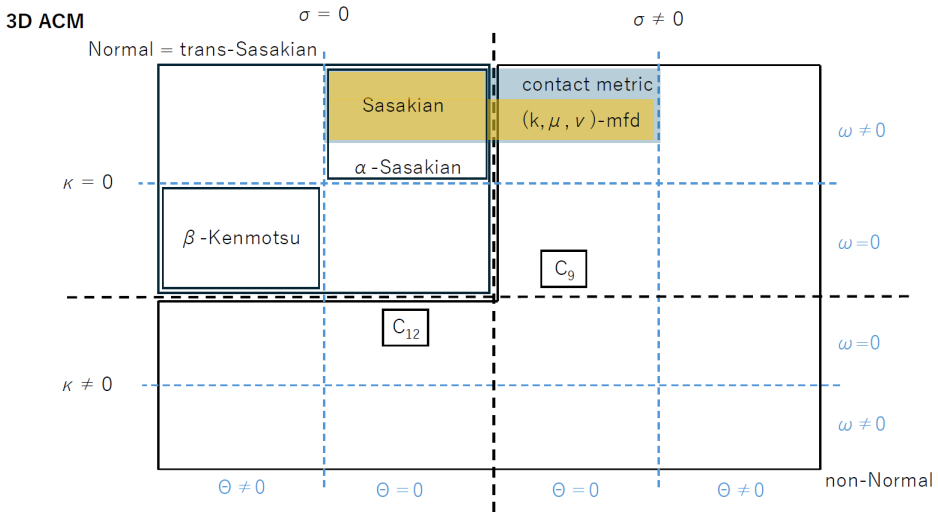
read the original abstract
This paper applies the Newman-Penrose formalism-a technique primarily used in General Relativity-to the analysis of three-dimensional almost contact metric (ACM) manifolds. We reformulate and discuss several known notions and properties within the Newman-Penrose framework, demonstrating the applicability of the method in this geometric context. Furthermore, as an application showcasing the utility of the formalism, we address the classification of three-dimensional compact normal ACM manifolds, or equivalently trans-Sasakian manifolds, that admit an $\eta$-Einstein metric.
Editorial analysis
A structured set of objections, weighed in public.
Referee Report
Summary. The paper applies the Newman-Penrose formalism, originally developed for 4D Lorentzian spacetimes, to three-dimensional almost contact metric manifolds. It reformulates standard notions such as normality, the trans-Sasakian condition, and curvature properties within this framework, and uses the adapted formalism to classify compact normal ACM (equivalently trans-Sasakian) manifolds that admit an η-Einstein metric.
Significance. If the adaptation of the NP tetrad and spin coefficients is shown to be faithful and complete, the work supplies a new computational tool for ACM geometry that may streamline curvature calculations and classification results. The classification of compact η-Einstein normal ACM manifolds is a concrete application that could be of interest to researchers working on contact and almost-contact structures.
major comments (2)
- [§3] §3 (adapted NP tetrad and structure equations): the paper identifies one null leg with the Reeb vector and defines the remaining frame on the contact distribution, but does not derive the full set of connection and curvature equations from the 3D Riemannian metric and contact form; without this explicit derivation it is impossible to confirm that the standard definitions of normality (vanishing Nijenhuis tensor) and the trans-Sasakian condition are recovered exactly rather than redefined.
- [§5] §5 (classification theorem): the claim that all compact normal ACM manifolds admitting an η-Einstein metric fall into a short list of explicit forms rests on the NP curvature scalars; an independent verification (e.g., direct computation of the Ricci tensor or the η-Einstein condition in classical coordinates) is required to rule out the possibility that the 3D adaptation omits contact-distribution invariants.
minor comments (1)
- [§2] Notation for the adapted spin coefficients is introduced without a side-by-side comparison table to the classical almost-contact tensors; adding such a table would improve readability.
Simulated Author's Rebuttal
We thank the referee for the careful reading and constructive comments on our manuscript. The suggestions will improve the clarity and rigor of the presentation. We address each major comment below and have revised the manuscript accordingly.
read point-by-point responses
-
Referee: [§3] §3 (adapted NP tetrad and structure equations): the paper identifies one null leg with the Reeb vector and defines the remaining frame on the contact distribution, but does not derive the full set of connection and curvature equations from the 3D Riemannian metric and contact form; without this explicit derivation it is impossible to confirm that the standard definitions of normality (vanishing Nijenhuis tensor) and the trans-Sasakian condition are recovered exactly rather than redefined.
Authors: We agree that an explicit derivation is required for full rigor. In the revised manuscript we add a dedicated subsection deriving the complete set of connection 1-forms and curvature 2-forms directly from the 3D Riemannian metric g and contact form η. Starting from the orthonormal frame adapted to the Reeb vector and contact distribution, we compute the spin coefficients and show that the vanishing of the Nijenhuis tensor and the trans-Sasakian condition are recovered identically in the Newman-Penrose scalars, with no redefinition. revision: yes
-
Referee: [§5] §5 (classification theorem): the claim that all compact normal ACM manifolds admitting an η-Einstein metric fall into a short list of explicit forms rests on the NP curvature scalars; an independent verification (e.g., direct computation of the Ricci tensor or the η-Einstein condition in classical coordinates) is required to rule out the possibility that the 3D adaptation omits contact-distribution invariants.
Authors: We accept that an independent check strengthens the result. In the revised version we include an appendix performing the direct computation of the Ricci tensor in classical coordinates for each case in the classification. This verifies that the η-Einstein condition holds exactly for the listed manifolds and confirms that the contact-distribution invariants are fully captured by the adapted NP scalars, with no omissions. revision: yes
Circularity Check
No circularity: NP formalism imported from independent GR literature and applied to ACM structures
full rationale
The paper imports the Newman-Penrose formalism from the general relativity literature and uses it to reformulate known notions of three-dimensional almost contact metric manifolds, including normality and the trans-Sasakian condition, before applying the framework to classify compact normal ACM manifolds admitting an η-Einstein metric. No self-citations, self-definitional steps, fitted inputs renamed as predictions, or ansatzes smuggled via author prior work appear in the provided abstract or claims. The derivation chain remains self-contained because the structure equations and classification rest on the transplanted external formalism together with standard almost-contact axioms, without reducing any central result to its own inputs by construction.
Axiom & Free-Parameter Ledger
axioms (1)
- domain assumption Standard axioms and definitions of almost contact metric manifolds and the Newman-Penrose formalism
Lean theorems connected to this paper
-
IndisputableMonolith/Foundation/AlexanderDuality.leanalexander_duality_circle_linking unclear?
unclearRelation between the paper passage and the cited Recognition theorem.
Let (M,ϕ,ξ,η,g) be a three-dimensional almost contact metric manifold... The almost contact metric structure is normal if and only if the Reeb vector field ξ generates a shear-free geodesic congruence.
What do these tags mean?
- matches
- The paper's claim is directly supported by a theorem in the formal canon.
- supports
- The theorem supports part of the paper's argument, but the paper may add assumptions or extra steps.
- extends
- The paper goes beyond the formal theorem; the theorem is a base layer rather than the whole result.
- uses
- The paper appears to rely on the theorem as machinery.
- contradicts
- The paper's claim conflicts with a theorem or certificate in the canon.
- unclear
- Pith found a possible connection, but the passage is too broad, indirect, or ambiguous to say the theorem truly supports the claim.
Forward citations
Cited by 1 Pith paper
-
Newman--Penrose formalism in $3$-dimensional trans-Sasakian manifolds
In 3D trans-Sasakian manifolds the Newman-Penrose equations encode the structure vector field via spin coefficients and prove that compatible structures on non-space-form E(κ,τ) metrics must be the canonical vertical ones.
Reference graph
Works this paper leans on
-
[1]
R.P.Geroch, A.Held and R.Penrose, ”A space-time calculus based on pairs of null direc- tions”, J. Math. Phys. 14, 874-881 (1973)
work page 1973
-
[2]
Aazami, Amir Babak. ”The Newman-Penrose formalism for Riemann ian 3-manifolds.” Journal of Geometry and Physics 94 (2015): 1-7
work page 2015
-
[3]
Zbigniew Olszak. ”Normal almost contact metric manifolds of dimen sion three.” Annales Polonici Mathematici 47.1 (1986): 41-50
work page 1986
-
[4]
Marrero, J. C. ”The local structure of trans-Sasakian manifo lds.” Annali di Matematica Pura ed Applicata 162.1 (1992): 77-86
work page 1992
-
[5]
De, U. C., and Mukut Mani Tripathi. ”Ricci tensor in 3-dimensional trans-Sasakian man- ifolds.” Kyungpook mathematical journal 43.2 (2003): 247-255
work page 2003
-
[6]
”On three-dimensional tran s-Sasakian manifolds.” (2008)
De, Uday Chand, and Avijit Sarkar. ”On three-dimensional tran s-Sasakian manifolds.” (2008). 17
work page 2008
-
[7]
”On η-Einstein trans- Sasakian manifolds.” An
Al-Solamy, F ALLEH R., Jeong-Sik Kim, and Mukut Mani Tripathi. ”On η-Einstein trans- Sasakian manifolds.” An. Stiint. Univ. Al. I. Cuza Iasi, Ser. Noua, Mat 57 (2011): 417-440
work page 2011
-
[8]
”On tr ans-Sasakian 3- manifolds as η-Einstein solitons.” arXiv preprint arXiv:2104.04791 (2021)
Ganguly, Dipen, Santu Dey, and Arindam Bhattacharyya. ”On tr ans-Sasakian 3- manifolds as η-Einstein solitons.” arXiv preprint arXiv:2104.04791 (2021)
-
[9]
Ho, Pak Tung. ”On the invariant surface area functionals in 3-dim ensional CR geometry.” arXiv preprint arXiv:2510.02632 (2025)
-
[10]
Bony, Jean-Michel. Principe du maximum, in´ egalit´ e de Harnack et unicit´ e du probl` eme de Cauchy pour les op´ erateurs elliptiques d´ eg´ en´ er´ es. Annales de l’Institut Fourier, Volume 19 (1969) no. 1, pp. 277-304. doi: 10.5802/aif.319
-
[11]
Cho, Jong Taek, and Ramesh Sharma. ”Contact geometry and Ricci solitons.” Interna- tional Journal of Geometric Methods in Modern Physics 7.06 (2010) : 951-960
work page 2010
-
[12]
Blair, David E., Themis Koufogiorgos, and Ramesh Sharma. ”A clas sification of 3- dimensional contact metric manifolds with Qφ = φQ.” Kodai Mathematical Journal 13.3 (1990): 391-401. 18
work page 1990
discussion (0)
Sign in with ORCID, Apple, or X to comment. Anyone can read and Pith papers without signing in.