Elliptical liquid jets in a supersonic cross-flow: Influence of J on atomization mechanism and unsteadiness
Pith reviewed 2026-05-16 19:44 UTC · model grok-4.3
The pith
For elliptical liquid jets with aspect ratios 0.3 and 1 in Mach 2.5 cross-flow, Kelvin-Helmholtz instabilities on the lateral surfaces drive primary atomization regardless of momentum flux ratio J.
A machine-rendered reading of the paper's core claim, the machinery that carries it, and where it could break.
Core claim
Lower J produces large unsteadiness with longer-wavelength Rayleigh-Taylor waves on the windward surface and highly time-varying corrugated shocks caused by intense liquid-boundary-layer streak interactions. Higher J reduces jet deflection, increases drag, and yields smaller, more regular Rayleigh-Taylor wavelengths together with steadier shocks. Irrespective of J, the primary atomization mechanism for AR = 0.3 and 1 remains Kelvin-Helmholtz instabilities on the lateral surfaces.
What carries the argument
The momentum flux ratio J, which sets the jet's penetration, deflection angle, and interaction strength with the oncoming boundary layer, thereby controlling wave size, shock steadiness, and the relative importance of lateral surface instabilities.
If this is right
- Higher J produces visibly steadier upstream shock structures with reduced temporal corrugation.
- Boundary-layer streak interactions become the dominant source of large-scale unsteadiness only at low J.
- Atomization mode for AR = 0.3 and 1 stays fixed as KHI even while overall jet behavior changes with J.
- Shock and surface features become more repeatable as J rises because jet deflection and drag both increase.
Where Pith is reading between the lines
- Designers of supersonic fuel injectors could favor higher J to obtain more repeatable atomization timing while still relying on lateral KHI for the actual breakup.
- Selecting low aspect ratios may lock in a consistent breakup route even when operating conditions vary J.
- Quantitative wave measurements would be a direct next step to confirm the visual instability assignments.
Load-bearing premise
Visual classification of wave types and unsteadiness sources from high-speed movies correctly identifies the dominant physical mechanism without quantitative checks such as measured growth rates or frequency spectra.
What would settle it
Spectral or growth-rate measurements on the lateral surfaces that match Rayleigh-Taylor rather than Kelvin-Helmholtz predictions would contradict the claim that KHI is the primary atomization driver.
Figures


read the original abstract
In our previous study [Medipati \textit{et al}., (2025) \textit{J. Fluid Mech}. \textbf{1014}, A34] \cite{medipati2025elliptic}, a detailed experimental investigation is performed on the elliptical liquid jets in a supersonic cross-flow ($M_{\infty}$ = 2.5), focusing on the effect of orifice aspect ratio ($AR$ = spanwise dimension/streamwise dimension) on the atomization mechanism for a fixed momentum flux ratio ($J$). In this paper, we present experimental studies that show the influence of $J$ on the jet breakup mechanism, shock structures, and unsteady interactions for each $AR$. A wide range of $J$ values (1.5 to 9.7) and three $AR$ cases (0.3, 1, and 3.3) are chosen for the study. We find that in the case of lower $J$, the jet exhibits large unsteadiness, with larger wavelength Rayleigh-Taylor (RT) waves on the windward surface. In contrast, as the $J$ increases, the unsteadiness decreases, smaller and more regular RT wavelength is formed due to the enhanced drag resulting from the reduced jet deflection. However, irrespective of $J$, in the case of $AR$ = 0.3 and 1, the primary atomization mechanism is due to the formation of Kelvin-Helmholtz instabilities (KHI) on the lateral surfaces. Furthermore, in the case of lower $J$, the shock waves formed upstream of the jet are highly corrugated with significant variations in time. The intense interaction of the liquid jet with the oncoming boundary layer streaks, in the case of lower $J$, is the primary source of large-scale unsteadiness. These findings highlight the significance of $J$ on the atomization mechanism in supersonic cross-flow.
Editorial analysis
A structured set of objections, weighed in public.
Referee Report
Summary. The manuscript experimentally examines the influence of momentum flux ratio J (range 1.5–9.7) on atomization mechanisms, shock structures, and unsteadiness for elliptical liquid jets in a Mach 2.5 cross-flow, using three aspect ratios (AR = 0.3, 1, 3.3). It reports that low J produces large-wavelength RT waves on the windward surface and high unsteadiness from boundary-layer streak interactions and corrugated upstream shocks, while high J yields smaller, more regular RT waves due to reduced jet deflection. The central claim is that, irrespective of J, the primary atomization mechanism for AR = 0.3 and 1 is Kelvin-Helmholtz instabilities on the lateral surfaces, identified via high-speed imaging.
Significance. If the instability classifications hold, the work supplies useful observational trends on how J modulates breakup and unsteadiness in supersonic elliptical-jet injection, extending the authors’ prior fixed-J study. Such data can inform reduced-order models for fuel atomization in high-speed propulsion, particularly where orifice shape and momentum ratio are design variables.
major comments (1)
- [Abstract] Abstract: the claim that KHI on lateral surfaces is the primary atomization mechanism for AR = 0.3 and 1 at all tested J rests solely on visual classification of high-speed shadowgraph/schlieren sequences. No quantitative support—such as extracted dominant wavelengths, temporal growth rates, or direct comparison to the appropriate shear-layer dispersion relation—is provided to distinguish KHI from projected RT structures or boundary-layer-induced features.
minor comments (1)
- [Abstract] Abstract: the statement that unsteadiness decreases with increasing J due to “enhanced drag resulting from the reduced jet deflection” would benefit from a brief reference to the supporting imaging or deflection-angle data in the results section.
Simulated Author's Rebuttal
We thank the referee for their careful and constructive review of our manuscript. The single major comment identifies a genuine limitation in the current presentation of the KHI classification, which we address directly below by committing to added quantitative analysis in revision.
read point-by-point responses
-
Referee: [Abstract] Abstract: the claim that KHI on lateral surfaces is the primary atomization mechanism for AR = 0.3 and 1 at all tested J rests solely on visual classification of high-speed shadowgraph/schlieren sequences. No quantitative support—such as extracted dominant wavelengths, temporal growth rates, or direct comparison to the appropriate shear-layer dispersion relation—is provided to distinguish KHI from projected RT structures or boundary-layer-induced features.
Authors: We agree that the original manuscript relies on visual identification from high-speed imaging sequences, which is a standard experimental approach for classifying surface instabilities in jet breakup studies. However, the referee correctly notes that this leaves the claim open to alternative interpretations. In the revised manuscript we will add quantitative support by extracting dominant wavelengths from the lateral surfaces in the high-speed sequences for AR = 0.3 and 1 across the J range, estimating temporal growth rates where frame rates permit, and comparing these values to the expected scales from the compressible shear-layer dispersion relation. We will also explicitly discuss why the observed lateral features are inconsistent with projected RT waves or boundary-layer streak signatures. These additions will be placed in the results section and the abstract will be updated to reflect the strengthened evidence. revision: yes
Circularity Check
No significant circularity in experimental observations
full rationale
This is a purely experimental study reporting direct observations from high-speed shadowgraph/schlieren imaging of jet breakup, shock structures, and unsteadiness across J values and AR cases. No mathematical derivations, dispersion relations, fitted parameters, or predictions exist that could reduce to inputs by construction. The single self-citation to the authors' prior work (Medipati et al. 2025) supplies only contextual background on fixed-J behavior and does not bear the load of the present claims, which rest on new imaging data for varying J. Visual classification of KHI vs. RT features is an interpretive step but does not constitute a self-referential loop or fitted-input prediction. The derivation chain is therefore self-contained against external benchmarks.
Axiom & Free-Parameter Ledger
axioms (1)
- domain assumption Surface waves on the jet can be reliably classified as Rayleigh-Taylor or Kelvin-Helmholtz instabilities from high-speed shadowgraph or schlieren images alone.
Reference graph
Works this paper leans on
-
[1]
Elliptic liquid jets in a supersonic cross-flow,
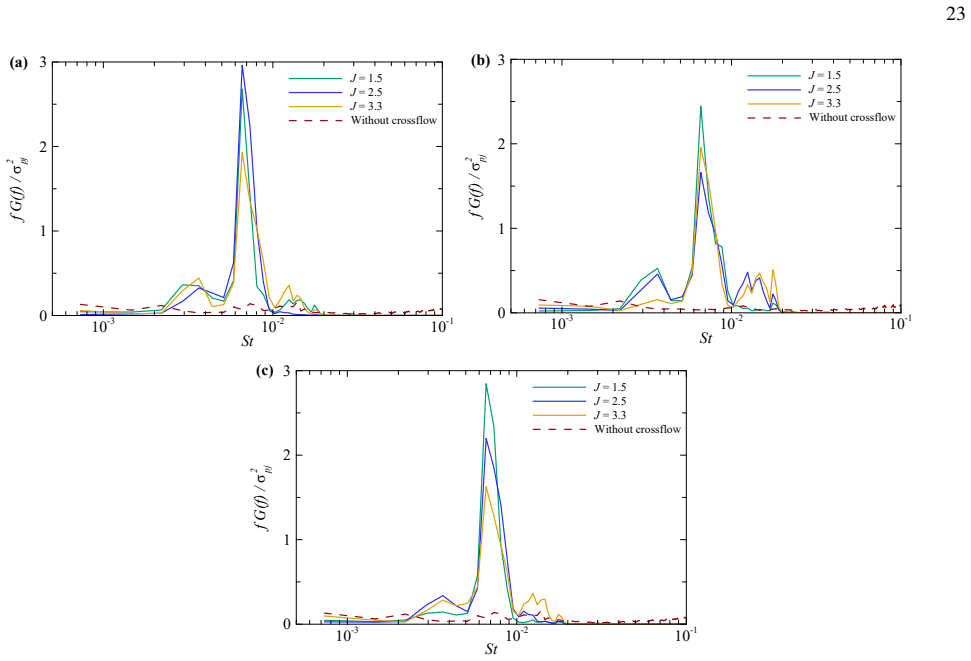
The dominant peak in St is independent of J and AR, implying a general similarity of the flow-field upstream of the jet, similar to protuberances in supersonic flow51,52. To conclude, the present experimental investigation reveals that the momentum flux ratio (J) significantly influences var- ious aspects of the flow-field interaction, in addition to the ...
work page 2025
-
[2]
V ortical structure in the wake of a transverse jet,
5T. Fric and A. Roshko, “V ortical structure in the wake of a transverse jet,” Journal of Fluid Mechanics 279, 1–47 (1994). 6K. Mahesh, “The interaction of jets with crossflow,” Annual Review of Fluid Mechanics 45, 379–407 (2013). 7M. Broumand and M. Birouk, “Liquid jet in a subsonic gaseous crossflow: Recent progress and remaining challenges,” Progress i...
work page 1994
-
[3]
Shock/boundary-layer interactions: Possi- ble sources of unsteadiness,
26J. Dussauge and S. Piponniau, “Shock/boundary-layer interactions: Possi- ble sources of unsteadiness,” Journal of Fluids and Structures 24, 1166– 1175 (2008). 27B. Ganapathisubramani, N. Clemens, and D. Dolling, “Effects of upstream boundary layer on the unsteadiness of shock-induced separation,” Journal of Fluid Mechanics 585, 369–394 (2007). 28S. Bere...
work page 2008
-
[4]
33C. Ghenai, H. Sapmaz, and C. Lin, “Penetration height correlations for non-aerated and aerated transverse liquid jets in supersonic cross flow,” Ex- periments in Fluids 46, 121–129 (2009). 34K. Sathiyamoorthy, T. Danish, V . Iyengar, J. Srinivas, X. Harikrishna, T. Muruganandam, and S. Chakravarthy, “Penetration and combustion studies of tandem liquid j...
work page 2009
-
[5]
Shock induced aerobreakup of a droplet,
54S. Sharma, A. P. Singh, S. S. Rao, A. Kumar, and S. Basu, “Shock induced aerobreakup of a droplet,” Journal of Fluid Mechanics 929, A27 (2021). 55P. Wu, K. Kirkendall, R. Fuller, and A. Nejad, “Spray structures of liquid jets atomized in subsonic crossflows,” Journal of Propulsion and Power14, 173–182 (1998). 56J. Beloki Perurena, C. Asma, R. Theunissen...
work page 2021
discussion (0)
Sign in with ORCID, Apple, or X to comment. Anyone can read and Pith papers without signing in.