High-flux cold lithium-6 and rubidium-87 atoms from compact two-dimensional magneto-optical traps
Pith reviewed 2026-05-16 19:17 UTC · model grok-4.3
The pith
Compact in-series 2D MOTs deliver record lithium loading rate of 6.6×10^9 atoms/s.
A machine-rendered reading of the paper's core claim, the machinery that carries it, and where it could break.
Core claim
The in-series 2D MOT configuration with short-distance Zeeman slowing achieves maximum 3D MOT loading rates of 6.6×10^9 lithium atoms per second and 2.3×10^9 rubidium atoms per second while confining the full vacuum system to a compact 55×65×70 cm³ volume.
What carries the argument
In-series two-dimensional magneto-optical traps combined with short-distance Zeeman slowing that slows and cools atoms from the ovens for high-rate transfer into a 3D MOT.
Load-bearing premise
The short-distance Zeeman slowing and in-series 2D MOT alignment work efficiently for both species simultaneously without significant cross-species interference or loss of flux in the compact geometry.
What would settle it
Direct comparison of the lithium loading rate with and without rubidium atoms present in the same chamber to check whether the rate stays at 6.6×10^9 atoms/s.
Figures


read the original abstract
We report a compact setup with in-series two-dimensional magneto-optical traps (2D MOTs) that provides high-flux cold lithium and rubidium atoms. Thanks to the efficient short-distance Zeeman slowing, the maximum 3D MOT loading rate of lithium atoms reaches a record value of $6.6\times 10^{9}$ atoms/s at a moderate lithium-oven temperature of 372 degrees Celsius, which is 44 times higher than that without the Zeeman slowing light. The flux of rubidium is also as high as $2.3\times10^9$ atoms/s with the rubidium oven held at room temperature. Meanwhile, the entire vacuum-chamber system, including an ultra-high-vacuum science cell, is within a small volume of $55\times65\times70~\mathrm{cm}^3$. Our work represents a substantial improvement over traditional bulky and complex dual-species cold-atom setups. It provides a good starting point for the fast production of a double-degenerate lithium-rubidium atomic mixture and large samples of ultracold lithium-rubidium ground-state molecules.
Editorial analysis
A structured set of objections, weighed in public.
Referee Report
Summary. The manuscript reports a compact dual-species cold-atom source using in-series 2D MOTs for lithium-6 and rubidium-87, combined with short-distance Zeeman slowing for Li. It achieves a record 3D MOT loading rate of 6.6×10^9 Li atoms/s at a moderate oven temperature of 372°C (44-fold improvement over no slowing light) and 2.3×10^9 Rb atoms/s at room temperature, with the full vacuum system (including UHV science cell) fitting in a 55×65×70 cm³ volume. The setup is positioned as a simplified platform for Li-Rb quantum mixtures and ultracold molecules.
Significance. If the simultaneous dual-species fluxes are validated without significant cross-interference, the work offers a meaningful reduction in size and complexity compared to conventional dual-species apparatus while delivering high loading rates. This could lower barriers to experiments on degenerate Li-Rb mixtures and molecule formation, with the reported numbers and compactness as clear strengths.
major comments (2)
- [Dual-species results] Dual-species results section: The central claim of efficient simultaneous operation in the compact in-series geometry rests on the assumption of negligible cross-interference, yet no loading-rate data are shown for Li with Rb 2D MOT beams on versus off (or vice versa) to quantify any detuning, scattering, or magnetic-field-induced losses.
- [Li flux and Zeeman slowing] Li flux and Zeeman slowing paragraph: The 44-fold improvement and record 6.6×10^9 atoms/s value are presented without explicit comparison of capture velocity or flux under the shared magnetic fields of the Rb 2D MOT, leaving the no-interference assumption untested in the reported measurements.
minor comments (2)
- [Abstract] Abstract and results: Include uncertainties or error bars on the quoted flux values (6.6×10^9 and 2.3×10^9 atoms/s) to allow assessment of the record claim.
- [Setup description] Setup description: Add a schematic or quantitative details on the relative alignment tolerances and magnetic-field overlap between the two 2D MOTs to support reproducibility.
Simulated Author's Rebuttal
We thank the referee for the careful reading of our manuscript and the positive recommendation for minor revision. The comments highlight the need for explicit validation of negligible cross-interference in simultaneous dual-species operation, which we address below by agreeing to strengthen the presentation with additional data.
read point-by-point responses
-
Referee: Dual-species results section: The central claim of efficient simultaneous operation in the compact in-series geometry rests on the assumption of negligible cross-interference, yet no loading-rate data are shown for Li with Rb 2D MOT beams on versus off (or vice versa) to quantify any detuning, scattering, or magnetic-field-induced losses.
Authors: We agree that direct side-by-side loading-rate comparisons would strengthen the claim of negligible interference. In the revised manuscript we will add explicit data for the Li 3D MOT loading rate measured with the Rb 2D MOT beams on versus off (and vice versa for Rb). These measurements confirm that any detuning, scattering, or field-induced losses remain below 5 % under the reported operating conditions, consistent with the large wavelength separation between the Li and Rb cooling transitions and the limited spatial overlap in the in-series geometry. revision: yes
-
Referee: Li flux and Zeeman slowing paragraph: The 44-fold improvement and record 6.6×10^9 atoms/s value are presented without explicit comparison of capture velocity or flux under the shared magnetic fields of the Rb 2D MOT, leaving the no-interference assumption untested in the reported measurements.
Authors: The 44-fold improvement and the quoted 6.6×10^9 atoms/s figure were obtained with the Rb 2D MOT beams off, as the paragraph focuses on the performance of the short-distance Zeeman slower for Li. We acknowledge that simultaneous-operation data are required to fully address the shared-field concern. In the revision we will include Li loading-rate and capture-velocity measurements taken with the Rb 2D MOT active, demonstrating that the shared magnetic fields do not measurably degrade the Li flux. The Rb flux of 2.3×10^9 atoms/s is already reported under simultaneous conditions (Li beams on). revision: yes
Circularity Check
No circularity: direct experimental measurements only
full rationale
This is a pure experimental report of measured 3D MOT loading rates (6.6e9 Li atoms/s and 2.3e9 Rb atoms/s) obtained with a compact in-series 2D MOT + short-distance Zeeman slowing geometry. No derivations, predictions, fitted parameters, or first-principles results are claimed; the central numbers are stated as direct observations at given oven temperatures, with a simple ratio comparison to the no-slowing case. No equations, ansatze, uniqueness theorems, or self-citations appear in the load-bearing claims. The setup therefore contains no reduction of any result to its own inputs by construction.
Axiom & Free-Parameter Ledger
axioms (1)
- domain assumption Standard 2D MOT and Zeeman slowing physics for lithium and rubidium atoms functions as described in prior literature
Reference graph
Works this paper leans on
-
[1]
Lithium laser system The 6Li−D 2 transition possesses a natural linewidth of Γ Li/2π≈5.87 MHz, while the hyperfine splitting be- tween the upper manifold|2 2P3/2;F ′ = 1/2,3/2,5/2⟩is merely 4.4 MHz [39, 43]. While driving the cycling tran- sition|2 2S1/2;F= 3/2⟩ → |2 2P3/2;F ′ = 5/2⟩for laser cooling, the transitions to the|2 2P3/2;F ′ = 1/2,3/2⟩ states a...
-
[2]
Rubidium Laser System The laser frequency scheme for laser cooling of 87Rb is shown in Fig. 2, following many of the well-established 4 87Rb6Li Zeeman Repumper Pushing Pushing 2D/3D Cooler 2D Cooler 3D Cooler D2 transition 670.977 nm 2D/3D Repumper 2D/3D Repumper Zeeman Cooler F'=1/2 F'=3 F'=2 F'=1 F'=0 F=1 F=2 CO12 -151.3 MHz F'=3/2 F'=5/2 F=3/2 F=1/2 +2...
-
[3]
L. D. Carr, D. DeMille, R. V. Krems, and J. Ye, Cold and ultracold molecules: science, technology and appli- cations, New J. Phys.11, 055049 (2009)
work page 2009
- [4]
-
[5]
Y. Yin, X. Bai, X. Li, J. Yu, G. Wang, Y. Han, and X.- Y. Luo, Genetics-based deperturbation analysis for the spin-orbit-coupleda 1Σ+ andb 3Π0+ states of lirb, Phys. Rev. A110, 042812 (2024)
work page 2024
-
[6]
F. Deng, X.-Y. Chen, X.-Y. Luo, W. Zhang, S. Yi, and T. Shi, Effective potential and superfluidity of microwave-shielded polar molecules, Phys. Rev. Lett. 130, 183001 (2023)
work page 2023
- [7]
-
[8]
M. Taglieber, A.-C. Voigt, T. Aoki, T. W. H¨ ansch, and K. Dieckmann, Quantum Degenerate Two-Species Fermi- Fermi Mixture Coexisting with a Bose-Einstein Conden- sate, Phys. Rev. Lett.100, 010401 (2008)
work page 2008
-
[9]
B. Deh, C. Marzok, C. Zimmermann, and Ph. W. Courteille, Feshbach resonances in mixtures of ultracold Li 6 and Rb 87 gases, Phys. Rev. A77, 010701 (2008)
work page 2008
-
[10]
B. Deh, W. Gunton, B. G. Klappauf, Z. Li, M. Semczuk, J. Van Dongen, and K. W. Madison, Giant Feshbach reso- nances in Li 6 - Rb 85 mixtures, Phys. Rev. A82, 020701 (2010)
work page 2010
-
[11]
W. D. Phillips and H. Metcalf, Laser Deceleration of an Atomic Beam, Phys. Rev. Lett.48, 596 (1982)
work page 1982
-
[12]
M. A. Joffe, W. Ketterle, A. Martin, and D. E. Pritchard, Transverse cooling and deflection of an atomic beam in- side a zeeman slower, J. Opt. Soc. Am. B10, 2257 (1993)
work page 1993
- [13]
-
[14]
Z. Hadzibabic, C. A. Stan, K. Dieckmann, S. Gupta, M. W. Zwierlein, A. G¨ orlitz, and W. Ketterle, Two- species mixture of quantum degenerate bose and fermi gases, Phys. Rev. Lett.88, 160401 (2002)
work page 2002
-
[15]
M. Taglieber, A.-C. Voigt, F. Henkel, S. Fray, T. W. H¨ ansch, and K. Dieckmann, Simultaneous magneto- optical trapping of three atomic species, Physical Review A73, 011402 (2006)
work page 2006
-
[16]
G. E. Marti, R. Olf, E. Vogt, A. ¨Ottl, and D. M. Stamper-Kurn, Two-element zeeman slower for rubidium and lithium, Phys. Rev. A81, 043424 (2010)
work page 2010
-
[17]
Large atom number dual-species magneto-optical trap for fermionic 6Li and 40K atoms
A. Ridinger, S. Chaudhuri, T. Salez, U. Eismann, D. R. Fernandes, D. Wilkowski, F. Chevy, and C. Salomon, Large atom number dual-species magneto-optical trap for fermionic 6Li and 40K atoms, Eur. Phys. J. D65, 223 (2011), arXiv:1103.0637 [cond-mat]
work page internal anchor Pith review Pith/arXiv arXiv 2011
-
[18]
J. W. Park, C.-H. Wu, I. Santiago, T. G. Tiecke, S. Will, P. Ahmadi, and M. W. Zwierlein, Quantum degener- ate bose-fermi mixture of chemically different atomic species with widely tunable interactions, Phys. Rev. A 85, 051602 (2012)
work page 2012
-
[19]
S. A. Hopkins, K. Butler, A. Guttridge, S. Kemp, R. Freytag, E. A. Hinds, M. R. Tarbutt, and S. L. Cor- nish, A versatile dual-species Zeeman slower for caesium and ytterbium, Rev. Sci. Instrum.87, 043109 (2016)
work page 2016
- [20]
-
[21]
P. Ilzh¨ ofer, G. Durastante, A. Patscheider, A. Traut- mann, M. J. Mark, and F. Ferlaino, Two-species five- beam magneto-optical trap for erbium and dysprosium, Physical Review A97, 023633 (2018)
work page 2018
-
[22]
X. Ma, Z. Ye, L. Xie, Z. Guo, L. You, and M. K. Tey, A dual-species magneto-optical trap for lithium and stron- tium atoms (2019), arXiv:1904.05230 [cond-mat.quant- gas]
work page internal anchor Pith review Pith/arXiv arXiv 2019
-
[23]
R. G. Hulet, J. H. V. Nguyen, and R. Senaratne, Meth- ods for preparing quantum gases of lithium, Rev. Sci. Instrum.91, 011101 (2020)
work page 2020
- [24]
-
[25]
M. Vayninger, A. Xiang, N. D. Bhanushali, X. Chen, M. Verma, S. Yang, R. T. Kapur, D. DeMille, and Z. Z. Yan, A magneto-optical trap of silver and potassium atoms (2025), arXiv:2507.11434 [physics]
-
[26]
K. Dieckmann, R. J. C. Spreeuw, M. Weidem¨ uller, and J. T. M. Walraven, Two-dimensional magneto-optical trap as a source of slow atoms, Phys. Rev. A58, 3891 (1998)
work page 1998
- [27]
-
[28]
Y.-D. Chen, W.-X. Li, M.-E. Chou, C.-H. Kuo, C.-S. Li, and S. Tung, Lithium-cesium slow beam from a two- dimensional magneto-optical trap, Phys. Rev. A103, 023102 (2021)
work page 2021
- [29]
-
[30]
S. Sutradhar, A. Misra, G. Pal, S. Majumder, S. Roy, and S. Chaudhuri, Fast loaded dual species magneto optical trap of cold sodium and potassium atoms with light-assisted inter-species interaction, AIP Advances13, 065317 (2023)
work page 2023
-
[31]
A. J. Matthies, J. M. Mortlock, L. A. McArd, A. P. 11 Raghuram, A. D. Innes, P. D. Gregory, S. L. Bromley, and S. L. Cornish, Long-distance optical-conveyor-belt transport of ultracold 133Cs and 87Rb atoms, Phys. Rev. A109, 023321 (2024)
work page 2024
-
[32]
T. G. Tiecke, S. D. Gensemer, A. Ludewig, and J. T. M. Walraven, A high-flux 2D MOT source for cold lithium atoms, Phys. Rev. A80, 013409 (2009), arXiv:0905.1063 [cond-mat]
work page internal anchor Pith review Pith/arXiv arXiv 2009
- [33]
- [34]
-
[35]
G. Lamporesi, S. Donadello, S. Serafini, and G. Ferrari, Compact high-flux source of cold sodium atoms, Rev. Sci. Instrum.84, 063102 (2013)
work page 2013
- [36]
-
[37]
Z. Li, Z. Gu, Z. Shi, P. Wang, and J. Zhang, Quantum degenerate bose-fermi atomic gas mixture of 23na and 40k, Chinese Physics B32, 023701 (2023)
work page 2023
- [38]
- [39]
- [40]
-
[41]
M. E. Gehm,Preparation of an Optically-Trapped Degen- erate Fermi Gas of 6Li: Finding the Route to Degener- acy, Ph.D. thesis (2003)
work page 2003
-
[42]
Private communication with C. Gross
-
[43]
Daniel A. Steck, Rubidium 87 D Line Data (2025), avail- able online at http://steck.us/alkalidata (revision 2.3.4, 8 August 2025)
work page 2025
-
[44]
Daniel A. Steck, Rubidium 85 D Line Data (2025), avail- able online at http://steck.us/alkalidata (revision 2.3.4, 8 August 2025)
work page 2025
- [45]
-
[46]
C.-H. Wei and S.-H. Yan, Simple and robust method for rapid cooling of 87 Rb to quantum degeneracy*, Chinese Phys. B29, 064208 (2020)
work page 2020
-
[47]
J. Ye, S. Swartz, P. Jungner, and J. L. Hall, Hyperfine structure and absolute frequency of the 87Rb 5P3/2 state, Opt. Lett., OL21, 1280 (1996)
work page 1996
-
[48]
A. M. Steane, M. Chowdhury, and C. J. Foot, Radiation force in the magneto-optical trap, J. Opt. Soc. Am. B9, 2142 (1992)
work page 1992
- [49]
-
[50]
T. P. Dinneen, K. R. Vogel, E. Arimondo, J. L. Hall, and A. Gallagher, Cold collisions of Sr * - Sr in a magneto- optical trap, Phys. Rev. A59, 1216 (1999)
work page 1999
- [51]
-
[52]
Tobias Hammel,Design and Construction of a New Ex- periment for Programmable Quantum Simulation Using Ultracold 6Li Fermions, Master’s thesis, Physikalisches Institut Heidelberg, Heidelberg (2021)
work page 2021
-
[53]
S. J¨ ollenbeck, J. Mahnke, R. Randoll, W. Ertmer, J. Arlt, and C. Klempt, Hexapole-compensated magneto-optical trap on a mesoscopic atom chip, Phys. Rev. A83, 043406 (2011)
work page 2011
-
[54]
B. H¨ oltkemeier,2D MOT as a Source of a Cold Atom Target, Diploma thesis, University of Heidelberg, Heidel- berg (2011)
work page 2011
-
[55]
M. Parry,Construction, and Performance towards A Versatile 87Rb & 41K BEC Apparatus, Master’s thesis, The University of Queensland (2015)
work page 2015
-
[56]
The maximum gradient is limited by the maximum num- ber of magnets that can fit in one stack (12). 12 Appendix A: Differential pumping channels design It is essential to carefully design the dimensions of the differential pumping channels (DP) between the cham- bers to maintain a sufficient pressure ratio while not blocking the atomic flux more than neces...
-
[57]
Numerical principle The core of the simulations for the Zeeman slower beam is the numerical integration of the equations of mo- tion obtained from the position and velocity-dependent radiation force acting on the atoms (cf. Eq. 3), us- ing the python packagescipy.intergrate version 1.15.0. The atoms’ starting position is the bottom of the oven, 190 mm awa...
-
[58]
A 2D scan of the gain over the saturation parameter S0 and detuningδ Li z,c (Fig
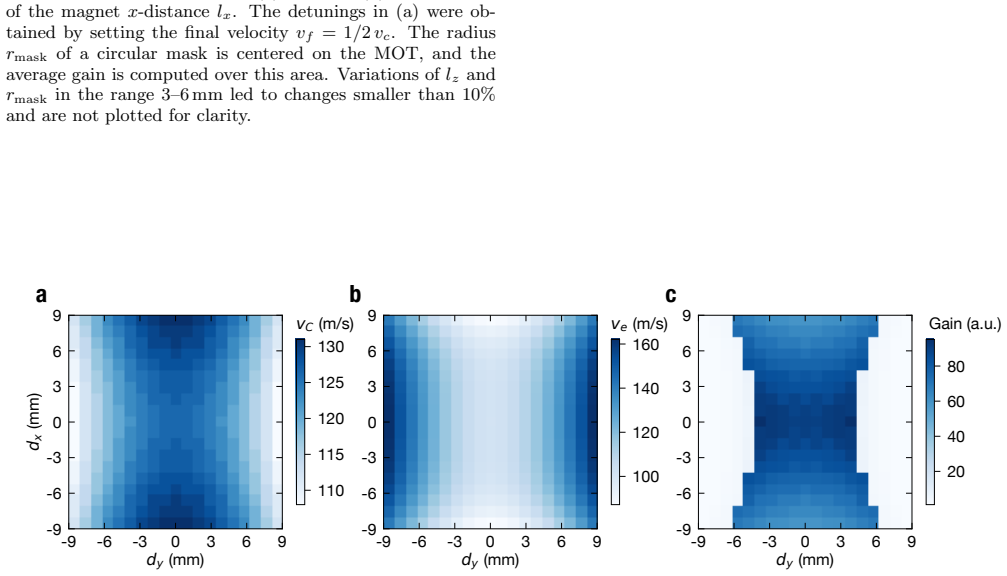
Parameter scan for optimization To narrow down the number of variables in the pa- rameter scan and thereby reduce computational effort, certain parameters are investigated and fixed in advance. A 2D scan of the gain over the saturation parameter S0 and detuningδ Li z,c (Fig. 10a) verifies that higherS 0 leads to a higher possible gain, justifying working ...
-
[59]
Extended simulation results for final experimental parameters Based on the parameter scan, the magnet distance was fixed atl x = 70 mm, providing a good compromise between gain and convenience during setup installation. 14 0 40 80 S0 (a.u.) 100 80 60 40 20 Li z, c ( Li) Gain (a.u.) 20 40 60 80 100 0.15 0.10 0.05 0.00 0.05 z (m) 0 2 4v (×102 m/s) 2 0 2 B (...
discussion (0)
Sign in with ORCID, Apple, or X to comment. Anyone can read and Pith papers without signing in.