A structure-preserving parametric approximation for anisotropic geometric flows via an α-surface energy matrix
Pith reviewed 2026-05-16 18:39 UTC · model grok-4.3
The pith
For anisotropic geometric flows, the surface energy matrix with α set to -1 achieves optimal energy stability under the weakest necessary condition on the anisotropy function.
A machine-rendered reading of the paper's core claim, the machinery that carries it, and where it could break.
Core claim
We introduce the unified surface energy matrix Ĝ_k^α(θ) parameterized by α that contains all existing surface energy matrices as special cases, and we prove that α = -1 is the unique choice that attains optimal energy stability under the necessary and sufficient condition 3γ̂(θ) ≥ γ̂(θ - π); every α ≠ -1 requires a strictly stronger condition on γ̂. The construction supplies a velocity discretization that extends the same stability guarantee to general anisotropic geometric flows.
What carries the argument
The hyperparameterized surface energy matrix Ĝ_k^α(θ) that unifies prior discretizations and determines the energy-stability threshold for parametric approximations of anisotropic curvature flow.
If this is right
- Energy stability holds for any anisotropy function satisfying only the condition 3γ̂(θ) ≥ γ̂(θ - π) when α equals -1.
- All other values of α force the user to impose a stricter inequality on the anisotropy function to retain stability.
- The same matrix construction and velocity discretization extend energy stability to general anisotropic geometric flows beyond pure curvature flow.
- Numerical implementations using α equals -1 exhibit the predicted robustness without extra stabilization.
Where Pith is reading between the lines
- Long-time simulations become feasible for a larger set of physically relevant anisotropy functions that would otherwise violate the stricter conditions required by non-optimal α.
- The unified discretization may be inserted into existing parametric codes with only the change of a single matrix definition.
- The optimality result suggests testing whether α equals -1 also improves accuracy in related structure-preserving schemes for volume-preserving or area-preserving anisotropic flows.
Load-bearing premise
The family of matrices Ĝ_k^α(θ) can be substituted into an existing discretization framework without introducing fresh instabilities or violating the geometric assumptions of the flow.
What would settle it
A concrete numerical run of anisotropic curvature flow on an initial curve where, for any α other than -1, the discrete energy increases over time steps even though the continuous flow energy is known to decrease.
Figures





read the original abstract
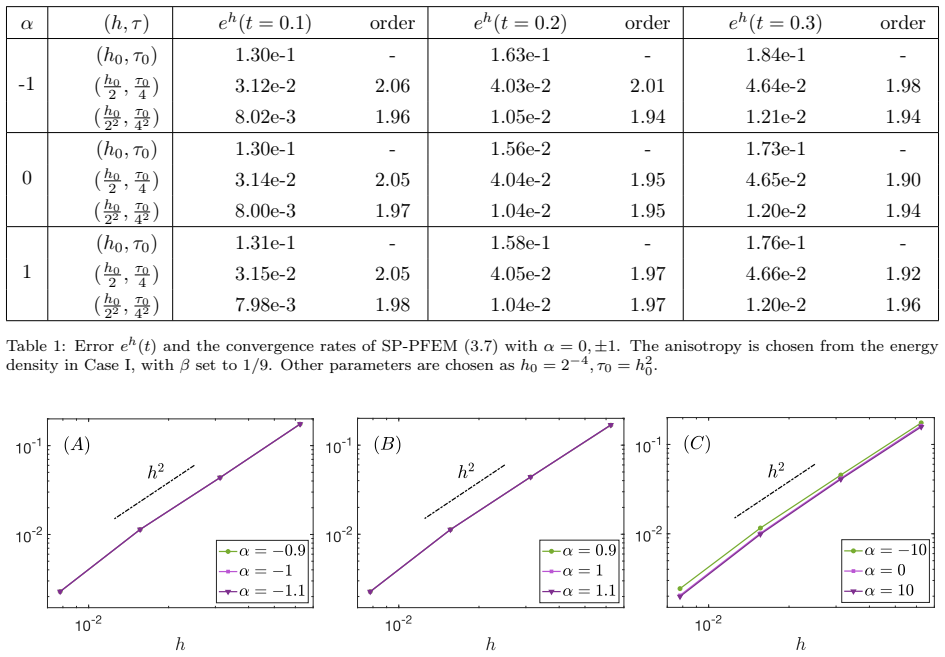
We propose a structure-preserving parametric approximation for geometric flows with general anisotropic effects. By introducing a hyperparameter $\alpha$, we construct a unified surface energy matrix $\hat{\boldsymbol{G}}_k^\alpha(\theta)$ that encompasses all existing formulations of surface energy matrices, and apply it to anisotropic curvature flow. We prove that $\alpha=-1$ is the unique choice achieving optimal energy stability under the necessary and sufficient condition $3\hat{\gamma}(\theta)\geq\hat{\gamma}(\theta-\pi)$, while all other $\alpha\neq-1$ require strictly stronger conditions. The framework extends naturally to general anisotropic geometric flows through a unified velocity discretization that ensures energy stability. Numerical experiments validate the theoretical optimality of $\alpha=-1$ and demonstrate the effectiveness and robustness.
Editorial analysis
A structured set of objections, weighed in public.
Referee Report
Summary. The manuscript introduces a hyperparameter α to construct a unified parametric family of surface energy matrices Ĝ_k^α(θ) that encompasses prior formulations for anisotropic geometric flows. It proves that α = −1 is the unique choice yielding optimal energy stability under the necessary and sufficient condition 3γ̂(θ) ≥ γ̂(θ − π), while all other α require strictly stronger conditions; the framework is extended via a unified velocity discretization that preserves the energy law, and numerical experiments are presented to confirm the optimality of α = −1.
Significance. If the discrete-continuous energy identity holds exactly, the result supplies a principled, parameter-free selection rule for structure-preserving discretizations of anisotropic curvature flows and unifies existing matrix constructions under a single stability analysis. This would strengthen the theoretical foundation for robust numerical schemes in geometric PDEs with anisotropy.
major comments (1)
- [stability analysis / discrete energy law] The uniqueness and necessity claim for α = −1 rests on the discrete energy dissipation law reproducing the continuous variational identity without α-dependent remainder terms. The manuscript must explicitly verify (in the section deriving the discrete energy law) that insertion of the parametric matrix Ĝ_k^α(θ) into the velocity discretization—via any quadrature, interpolation, or inner-product approximation—introduces no truncation errors that depend on α and could therefore relax or invalidate the stated necessary-and-sufficient condition.
minor comments (1)
- Notation for the anisotropic metric γ̂ and the matrix family Ĝ_k^α(θ) should be introduced with a single consistent definition before the stability theorem to avoid forward references.
Simulated Author's Rebuttal
We thank the referee for the careful reading and constructive feedback on our manuscript. The major comment raises an important point about the exactness of the discrete energy law, which we address below. We plan to incorporate a clarification to strengthen the presentation.
read point-by-point responses
-
Referee: The uniqueness and necessity claim for α = −1 rests on the discrete energy dissipation law reproducing the continuous variational identity without α-dependent remainder terms. The manuscript must explicitly verify (in the section deriving the discrete energy law) that insertion of the parametric matrix Ĝ_k^α(θ) into the velocity discretization—via any quadrature, interpolation, or inner-product approximation—introduces no truncation errors that depend on α and could therefore relax or invalidate the stated necessary-and-sufficient condition.
Authors: We appreciate this observation. In Section 3.2, the discrete energy law is obtained by direct substitution of Ĝ_k^α(θ) into the weak formulation of the velocity discretization. Because the chosen quadrature and inner-product rules are variationally consistent (i.e., they reproduce the exact integration-by-parts identity that underlies the continuous variational structure), no α-dependent remainder terms arise; the α-dependence is confined to the algebraic properties of the matrix that determine the stability threshold. The necessary-and-sufficient condition 3γ̂(θ) ≥ γ̂(θ−π) therefore remains valid for α = −1 independently of discretization details. To make this explicit as requested, we will add a short remark immediately after the energy-law derivation that states and briefly proves the absence of α-dependent truncation errors. revision: yes
Circularity Check
No circularity: parametric family and stability derived independently
full rationale
The paper introduces a new hyperparameter α to construct the unified matrix family Ĝ_k^α(θ) that generalizes prior formulations, then derives the optimality of α=-1 from first-principles comparison of the discrete energy dissipation to the continuous variational structure under the external condition 3γ̂(θ)≥γ̂(θ-π). This condition is stated as necessary and sufficient without being fitted from the same data or defined circularly; the proof does not reduce any prediction to an input by construction, nor does it rely on self-citations as load-bearing for the uniqueness claim. Numerical experiments serve only as validation, not as the source of the result. The derivation chain remains self-contained against the stated geometric assumptions.
Axiom & Free-Parameter Ledger
free parameters (1)
- α
axioms (1)
- domain assumption The proposed matrix Ĝ_k^α(θ) can be substituted into standard parametric discretizations of anisotropic curvature flow while preserving the geometric structure.
invented entities (1)
-
unified surface energy matrix Ĝ_k^α(θ)
no independent evidence
Lean theorems connected to this paper
-
Foundation/AlphaCoordinateFixation.leanalpha_pin_under_high_calibration echoes?
echoesECHOES: this paper passage has the same mathematical shape or conceptual pattern as the Recognition theorem, but is not a direct formal dependency.
We introduce a hyperparameter α∈R and construct the unified α-surface energy matrix Ĝ_k^α(θ) := γ̂(θ)I₂ - nξᵀ + αξnᵀ + k(θ)nnᵀ … We prove that α=-1 is the unique choice achieving optimal energy stability under the necessary and sufficient condition 3γ̂(θ)≥γ̂(θ-π)
-
Foundation/BranchSelection.leanbranch_selection echoes?
echoesECHOES: this paper passage has the same mathematical shape or conceptual pattern as the Recognition theorem, but is not a direct formal dependency.
the symmetric choice α=-1 is the only formulation achieving unconditional energy stability under … 3γ̂(θ)-γ̂(θ-π)≥0 … All other formulations require the strictly stronger condition
What do these tags mean?
- matches
- The paper's claim is directly supported by a theorem in the formal canon.
- supports
- The theorem supports part of the paper's argument, but the paper may add assumptions or extra steps.
- extends
- The paper goes beyond the formal theorem; the theorem is a base layer rather than the whole result.
- uses
- The paper appears to rely on the theorem as machinery.
- contradicts
- The paper's claim conflicts with a theorem or certificate in the canon.
- unclear
- Pith found a possible connection, but the passage is too broad, indirect, or ambiguous to say the theorem truly supports the claim.
Reference graph
Works this paper leans on
-
[1]
L. Alvarez, F. Guichard, P.-L. Lions and J.-M. Morel,Axioms and fundamental equations of image processing, Arch. Ration. Mech. Anal., 123 (1993), pp. 199– 257
work page 1993
- [2]
-
[3]
W. Bao, W. Jiang and Y. Li,A symmetrized parametric finite element method for anisotropic surface diffusion of closed curves, SIAM J. Numer. Anal., 61(2) (2023), pp. 617– 641
work page 2023
- [4]
- [5]
-
[6]
W. Bao, Y. Li and Q. Zhao,A structure-preserving parametric finite element method for solid-state dewetting on curved substrates, Commun. Nonlinear Sci. Numer. Simul. (2025), pp. 108767
work page 2025
- [7]
- [8]
-
[9]
W. Bao, W. Jiang, Y. Wang and Q. Zhao,A parametric finite element method for solid-state dewetting problems with anisotropic surface energies, J. Comput. Phys., 330 (2017), pp. 380– 400
work page 2017
-
[10]
W. Bao, H. Garcke, R. Nürnberg and Q. Zhao,Volume-preserving parametric finite element methods for axisymmetric geometric evolution equations, J. Comput. Phys., 460 (2022), pp. 111180
work page 2022
-
[11]
J. Barrett, H. Garcke and R. Nürnberg,A parametric finite element method for fourth order geometric evolution equations, J. Comput. Phys., 222(1) (2007), pp. 441– 467
work page 2007
-
[12]
J. Barrett, H. Garcke and R. Nürnberg,On the variational approximation of combined second and fourth order geometric evolution equations, SIAM J. Sci. Comput., 29(3) (2007), pp. 1006– 1041
work page 2007
-
[13]
J. Barrett, H. Garcke and R. Nürnberg,A variational formulation of anisotropic geometric evolution equations in higher dimensions, Numer. Math., 109(1) (2008), pp. 1– 44
work page 2008
-
[14]
J. Barrett, H. Garcke and R. Nürnberg,Numerical approximation of anisotropic geometric evolution equations in the plane, IMA J. Numer. Anal., 28(2) (2008), pp. 292– 330
work page 2008
-
[15]
J. Barrett, H. Garcke and R. Nürnberg,On the parametric finite element approximation of evolving hypersurfaces in R3, J. Comput. Phys., 227(9) (2008), pp. 4281– 4307
work page 2008
-
[16]
J. Barrett, H. Garcke and R. Nürnberg,On stable parametric finite element methods for the Stefan problem and the Mullins–Sekerka problem with applications to dendritic growth, J. Comput. Phys., 229(18) (2010), pp. 6270– 6299
work page 2010
-
[17]
J. Barrett, H. Garcke and R. Nürnberg,Parametric approximation of surface clusters driven by isotropic and anisotropic surface energies, Interfaces Free Bound., 12(2) (2010), pp. 187– 234
work page 2010
-
[18]
J. Barrett, H. Garcke and R. Nürnberg,Parametric finite element approximations of curvature-driven interface evolutions, , 21 (2020), pp. 275– 423
work page 2020
-
[19]
M. Brassel and E. Bretin,A modified phase field approximation for mean curvature flow with conser- vation of the volume, Math. Methods Appl. Sci., 34(10) (2011), pp. 1157– 1180. 31
work page 2011
- [20]
-
[21]
U. Clarenz, U. Diewald and M. Rumpf,Anisotropic geometric diffusion in surface processing, (2000)
work page 2000
-
[22]
K. Deckelnick, G. Dziuk and C. Elliott,Computation of geometric partial differential equations and mean curvature flow, Acta Numer., 14 (2005), pp. 139– 232
work page 2005
-
[23]
K. Deckelnick, G. Dziuk and C. Elliott,Fully discrete finite element approximation for anisotropic surface diffusion of graphs, SIAM J. Numer. Anal., 43(3) (2005), pp. 1112– 1138
work page 2005
-
[24]
E. Dornel, J.-C. Barbe, F. De Crécy, G. Lacolle and J. Eymery,Surface diffusion dewetting of thin solid films: Numerical method and application to Si/ SiO 2, Phys. Rev. B, 73(11) (2006), pp. 115427
work page 2006
-
[25]
P. Du, M. Khenner and H. Wong,A tangent-plane marker-particle method for the computation of three-dimensional solid surfaces evolving by surface diffusion on a substrate, J. Comput. Phys., 229(3) (2010), pp. 813– 827
work page 2010
- [26]
-
[27]
Dziuk,An algorithm for evolutionary surfaces, Numer
G. Dziuk,An algorithm for evolutionary surfaces, Numer. Math., 58(1) (1990), pp. 603– 611
work page 1990
-
[28]
Dziuk,Convergence of a semi-discrete scheme for the curve shortening flow, Math
G. Dziuk,Convergence of a semi-discrete scheme for the curve shortening flow, Math. Models Methods Appl. Sci., 4(04) (1994), pp. 589– 606
work page 1994
-
[29]
Dziuk,Discrete anisotropic curve shortening flow, SIAM J
G. Dziuk,Discrete anisotropic curve shortening flow, SIAM J. Numer. Anal., 36(6) (1999), pp. 1808– 1830
work page 1999
-
[30]
Einstein,Equilibrium shape of crystals, (2015), pp
T. Einstein,Equilibrium shape of crystals, (2015), pp. 215– 264
work page 2015
-
[31]
C. Elliott and H. Garcke,Diffusional phase transitions in multicomponent systems with a concentration dependent mobility matrix, Physica D, 109(3-4) (1997), pp. 242– 256
work page 1997
- [32]
- [33]
- [34]
-
[35]
I. Fonseca, A. Pratelli and B. Zwicknagl,Shapes of epitaxially grown quantum dots, Arch. Ration. Mech. Anal., 214 (2014), pp. 359– 401
work page 2014
- [36]
- [37]
-
[38]
M.GurtinandM.Jabbour,Interface Evolution in Three Dimensions with Curvature-Dependent Energy and Surface Diffusion: Interface-Controlled Evolution, Phase Transitions, Epitaxial Growth of Elastic Films, Arch. Ration. Mech. Anal., 163 (2002), pp. 171– 208
work page 2002
-
[39]
J.HuandB.Li,Evolving finite element methods with an artificial tangential velocity for mean curvature flow and Willmore flow, Numer. Math., 152(1) (2022), pp. 127– 181. 32
work page 2022
-
[40]
W.JiangandQ.Zhao,Sharp-interface approach for simulating solid-state dewetting in two dimensions: A Cahn–Hoffmanξ-vector formulation, Physica D, 390 (2019), pp. 69– 83
work page 2019
- [41]
- [42]
- [43]
- [44]
- [45]
- [46]
-
[47]
Y. Li, W. Ying and Y. Zhang,A structure-preserving parametric finite element method with optimal energy stability condition for anisotropic surface diffusion, J. Sci. Comput., 104(3) (2025), pp. 76
work page 2025
-
[48]
A. Maxwell, C. Thompson and W. Carter,A level-set method for simulating solid-state dewetting in systems with strong crystalline anisotropy, Acta Mater., 282 (2025), pp. 120368
work page 2025
-
[49]
S. Osher and R. Fedkiw,Level set methods: an overview and some recent results, J. Comput. Phys., 169(2) (2001), pp. 463– 502
work page 2001
-
[50]
Palmer,Stability of the Wulff shape, Proc
B. Palmer,Stability of the Wulff shape, Proc. Amer. Math. Soc., 126(12) (1998), pp. 3661– 3667
work page 1998
-
[51]
S. Randolph, J. Fowlkes, A. Melechko, K. Klein, H. Meyer, M. Simpson and P. Rack,Controlling thin film structure for the dewetting of catalyst nanoparticle arrays for subsequent carbon nanofiber growth, Nanotechnology, 18(46) (2007), pp. 465304
work page 2007
-
[52]
Reynolds,Papers on mechanical and physical subjects, (1983)
O. Reynolds,Papers on mechanical and physical subjects, (1983)
work page 1983
-
[53]
G. Sapiro and A. Tannenbaum,On affine plane curve evolution, J. Funct. Anal., 119(1) (1994), pp. 79– 120
work page 1994
-
[54]
D. Sevcovic and K. Mikula,Evolution of plane curves driven by a nonlinear function of curvature and anisotropy, SIAM J. Appl. Math., 61(5) (2001), pp. 1473– 1501
work page 2001
-
[55]
Taylor,II—mean curvature and weighted mean curvature, Acta Metall
J. Taylor,II—mean curvature and weighted mean curvature, Acta Metall. Mater., 40(7) (1992), pp. 1475– 1485
work page 1992
-
[56]
J. Taylor and J. Cahn,Linking anisotropic sharp and diffuse surface motion laws via gradient flows, J. Statist. Phys., 77 (1994), pp. 183– 197
work page 1994
-
[57]
Thompson,Solid-state dewetting of thin films, Annu
C. Thompson,Solid-state dewetting of thin films, Annu. Rev. Mater. Res., 42 (2012), pp. 399– 434
work page 2012
-
[58]
Y. Wang,Modeling and simulation for solid-state dewetting problems in two dimensions, National University of Singapore (2016)
work page 2016
- [59]
-
[60]
Yazaki,On an area-preserving crystalline motion, Calc
S. Yazaki,On an area-preserving crystalline motion, Calc. Var. Partial Differential Equations, 14 (2002), pp. 85– 105
work page 2002
- [61]
- [62]
-
[63]
Q. Zhao, W. Jiang and W. Bao,An energy-stable parametric finite element method for simulating solid-state dewetting, IMA J. Numer. Anal., 41(3) (2021), pp. 2026– 2055. 34
work page 2021
discussion (0)
Sign in with ORCID, Apple, or X to comment. Anyone can read and Pith papers without signing in.