REVIEW 3 major objections 6 minor 40 references
Model Predictive Control-Based Optimal Energy Management of Autonomous Electric Vehicles Under Cold Temperatures
T0 review · 3 major / 6 minor · reviewed 2026-08-07 · deepseek-v4-flash
Pith's one-line read A real-time MPC framework allocates battery energy among propulsion, cabin heating, and battery preconditioning so a cold autonomous EV can reach a charger with the battery ready to charge immediately.
desk verdict Integrated MPC for cold-weather AEV energy management is a real contribution, but the setpoint-as-control assumption makes the results unverified; worth a serious rewrite, not a desk reject. read the letter →
The pith
A machine-rendered reading of the paper's core claim, the machinery that carries it, and where it could break.
The reading
What carries the argument
The load-bearing object is the receding-horizon MPC with cost $J=\sum_{k=1}^{N}\left[w_1 E_{\mathrm{HVAC}}(T_{\mathrm{CabinReq}}(k)) + w_2 E_{\mathrm{propulsion}}(F_{\mathrm{Propulsion}}(k)) + w_3 E_{\mathrm{heater}}(T_{\mathrm{BattSet}}(k))\right]$ over a horizon of $N$ steps. Instead of commanding compressor speed directly, the system-level controller treats cabin and battery temperature setpoints as control variables, and lower-level proportional controllers track them via compressor RPM and battery-heater current. This decouples the nonlinear refrigerant dynamics from the linear MPC, while HVAC energy is still estimated from the refrigeration-cycle enthalpy balance, so that propulsion, cabin heating, and battery preconditioning are all expressed in the same energy units and can be optimized jointly.
What would settle it
Add a hard cap on compressor speed and set the ambient temperature to, say, 250 K for both case studies, then re-run the closed loop; if the lower-level HVAC controller can no longer hold the cabin setpoint, the MPC's predicted HVAC energy is understated and the vehicle would arrive with the battery outside the 313.15-315.15 K charging window. A bench test with a real heat-pump compressor driving the same battery pack would give a definitive answer.
Extended reading notes
Core claim
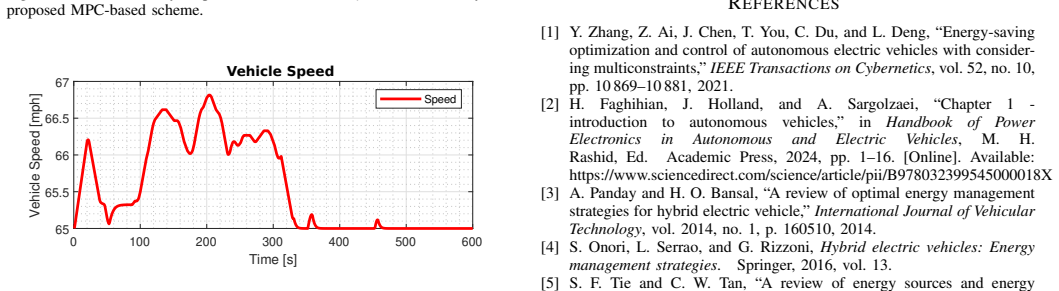
The central claim of this paper is that a linear, receding-horizon MPC can solve the AEV cold-weather energy management problem without sacrificing thermal comfort or battery health. The MPC's decision variables are the cabin temperature setpoint, the battery temperature setpoint, and the propulsion force; its states are state of charge, battery temperature, and vehicle speed. The cost function is the weighted sum of the HVAC compressor energy, the propulsion energy, and the battery-heater energy over a prediction horizon of N steps, with constraints on SoC, temperatures, and speed. Using refrigerant property lookup data for R134a, the compressor work is computed from the enthalpy rise between evaporator outlet and condenser outlet, so the MPC can trade off cabin heating against battery heating against propulsion in energy terms. The two case studies start the vehicle at 20% SoC and 293 K battery temperature in a roughly 268 K ambient, and both end with the battery heated into the 313.15-315.15 K charging window and the destination reached, with energy and speed profiles that respond to the road grade.
Load-bearing premise
The whole scheme rests on the premise that the compressor or heat pump can always supply the heating capacity the MPC asks for, so cabin and battery temperatures will track their commanded setpoints; if that capacity is unavailable at very cold ambient temperatures or near compressor limits, the predicted energy split and the promised arrival conditions would not hold.
Editorial extensions
If this is right
- If the MPC performs as demonstrated, an autonomous EV at low state of charge can plan heating and battery preconditioning jointly with propulsion, removing the need to choose between range and comfort.
- Changing the weights $w_1, w_2, w_3$ re-tunes the trade-off: heavier thermal weights keep the cabin and battery warmer at the cost of range, while heavier propulsion weights preserve speed at the cost of thermal readiness.
- The setpoint-based architecture extends naturally to HVAC cooling mode and to building HVAC systems, since the cost structure separates the thermal plants from the vehicle dynamics.
- Because the MPC uses only measurements available from cameras, GPS, inertial units, and temperature sensors, it fits within an autonomous vehicle's existing perception stack.
Reading between the lines
- The two case studies cover a 600-second trip; a longer trip or a colder ambient would stress the assumption that the compressor can always meet the setpoint, since the MPC does not model compressor saturation.
- The benefit of the lookahead grade data scales with the quality of the grade and ambient forecast: errors in those inputs would translate directly into suboptimal power splits, suggesting a robust or stochastic extension would be a natural next step.
- Injecting a hard compressor-speed limit into the simulation is the most direct test of the setpoint assumption; if tracking fails, the controller would need a more detailed HVAC model to preserve its claims.
- The battery-heater model uses a proportional controller on heater current with no current limit; a real vehicle would need to account for that limit and internal thermal gradients before the approach can be deployed.
Signed reviews
Editorial analysis
A structured set of objections, weighed in public.
Referee Report
Summary. The paper proposes a model predictive control (MPC) strategy for autonomous electric vehicles (AEVs) operating at low state of charge and cold ambient temperatures. The MPC is designed to split battery energy among propulsion, cabin HVAC heating, and battery preconditioning so that the vehicle reaches a charging station with the battery at a temperature suitable for immediate charging. The authors model the vehicle longitudinal dynamics, a simplified cabin thermal model, a heat-pump HVAC system using CoolProp refrigerant properties, and a first-order equivalent-circuit battery model with thermal dynamics. The system-level MPC commands propulsion force and cabin/battery temperature setpoints; lower-level controllers track these setpoints. Two simulation case studies are presented: one with synthetic sinusoidal road grade and ambient temperature, and one with real-world road grade data from the High Peaks Scenic Byway. The results show the vehicle reaching the destination with the battery temperature near the desired 313.15–315.15 K range while maintaining cabin comfort.
Significance. If the proposed framework were validated against baselines and shown to be robust to actuator limitations, it would address a practically important problem in AEV energy management: the joint optimization of propulsion, cabin heating, and battery preconditioning under low-SoC, cold-weather conditions. The paper's use of an open-source refrigerant library (CoolProp), real-world road grade data, and a clearly stated system architecture are strengths, and the manuscript is generally clearly written. However, the core claim of 'optimal' and 'energy-efficient' energy allocation is currently supported only by trajectories produced by the controller's own cost function, without any baseline comparison or sensitivity analysis, and the feasibility of the temperature-setpoint control assumption is not established.
major comments (3)
- [Section IV, Eqs. (13)-(16)]
- [Section V, no baseline comparison]
- [Section IV and Eq. (13)]
minor comments (6)
- [Section IV, Eq. (13)]
- [Section IV, Eq. (14)]
- [Section III-D, Eq. (10) and Table I]
- [Section V, Fig. 4 and Fig. 9]
- [Section V-A, Fig. 6]
- [Section IV]
Circularity Check
No significant circularity: the MPC trajectories are a self-contained closed-loop simulation of the authors' own cost, and the HVAC setpoint assumption is a fidelity limitation rather than a circular reduction.
full rationale
Walking the paper's derivation chain: subsystem models are assembled from external sources (CoolProp for refrigerant properties; references [22]-[28] for propulsion, cabin, HVAC, and battery dynamics; RPT-identified cell parameters from [31]); an MPC is then posed with a weighted energy cost and SoC/temperature constraints; and the reported plots are closed-loop simulations of that same MPC. No quantity that is later called a prediction is fitted to the reported outputs: the weights w1-w3 are not tuned to reproduce the trajectories, the battery parameters are presented as RPT measurements, and the cited prior work by the same authors ([7], [17], [31], [37], [38]) supplies background or parameter values rather than a uniqueness argument or a forced ansatz. The one load-bearing simplification, 'assuming that the compressor or heat pump has the ability to provide the heating capacity to achieve the requested temperatures' (Section IV), is an acknowledged model-fidelity gap: without compressor saturation or lower-level tracking limits, the simulated cabin and battery setpoint tracking and the associated energy split may not transfer to hardware. That is a correctness and realism risk, not a circular step, because the plant in the simulation is governed by the same simplified model and the paper makes no claim of independent experimental validation. Accordingly, no step reduces by construction to its input, and the circularity score is 0.
Assumptions & free parameters
free parameters (5)
- w1, w2, w3 (MPC cost weights) =
not reported
- Prediction horizon N =
not reported
- Sampling time dt =
not reported
- Proportional gains K_b and K_h =
not reported
- Constraint bounds (SoC_min/max, T_Batt_min/max, v_min/max, F_min/max, T_set_min/max) =
not reported
assumptions (5)
- domain assumption Cabin air is a well-mixed volume with uniform temperature; heat loss through the cabin surface is linear in the cabin-ambient temperature difference.
- ad hoc to paper The heat pump/compressor can realize any requested cabin and battery temperature setpoint within the MPC bounds.
- domain assumption Refrigerant State 1 is approximately 5 K below ambient and State 3 is 5-10 K above the target air inlet temperature, with isobaric condensation and isentropic compression.
- domain assumption Future road grade and ambient temperature are known exactly over the MPC prediction horizon.
- domain assumption Battery equivalent circuit and thermal parameters from prior work (Refs. [27], [31]) are representative of the simulated cell.
Cite this review
Pith. "Pith review of Model Predictive Control-Based Optimal Energy Management of Autonomous Electric Vehicles Under Cold Temperatures." pith.science (2026). https://pith.science/paper/25GC6ITT
@misc{pith2026250610221,
  author       = {Pith},
  title        = {Pith review of: Model Predictive Control-Based Optimal Energy Management of Autonomous Electric Vehicles Under Cold Temperatures},
  year         = {2026},
  howpublished = {\url{https://pith.science/paper/25GC6ITT}},
  note         = {Machine review of arXiv:2506.10221}
}
read the original abstract
In autonomous electric vehicles (AEVs), battery energy must be judiciously allocated to satisfy primary propulsion demands and secondary auxiliary demands, particularly the Heating, Ventilation, and Air Conditioning (HVAC) system. This becomes especially critical when the battery is in a low state of charge under cold ambient conditions, and cabin heating and battery preconditioning (prior to actual charging) can consume a significant percentage of available energy, directly impacting the driving range. In such cases, one usually prioritizes propulsion or applies heuristic rules for thermal management, often resulting in suboptimal energy utilization. There is a pressing need for a principled approach that can dynamically allocate battery power in a way that balances thermal comfort, battery health and preconditioning, along with range preservation. This paper attempts to address this issue using real-time Model Predictive Control to optimize the power consumption between the propulsion, HVAC, and battery temperature preparation so that it can be charged immediately once the destination is reached.
Figures


Figures from the paper (7 more)


Reference graph
Works this paper leans on
-
[1]
Y . Zhang, Z. Ai, J. Chen, T. You, C. Du, and L. Deng, “Energy-saving optimization and control of autonomous electric vehicles with consider- ing multiconstraints,”IEEE Transactions on Cybernetics, vol. 52, no. 10, pp. 10 869–10 881, 2021
work page 2021
-
[2]
Chapter 1 - introduction to autonomous vehicles,
H. Faghihian, J. Holland, and A. Sargolzaei, “Chapter 1 - introduction to autonomous vehicles,” inHandbook of Power Electronics in Autonomous and Electric V ehicles, M. H. Rashid, Ed. Academic Press, 2024, pp. 1–16. [Online]. Available: https://www.sciencedirect.com/science/article/pii/B978032399545000018X
work page 2024
-
[3]
A review of optimal energy management strategies for hybrid electric vehicle,
A. Panday and H. O. Bansal, “A review of optimal energy management strategies for hybrid electric vehicle,”International Journal of V ehicular Technology, vol. 2014, no. 1, p. 160510, 2014
work page 2014
- [4]
-
[5]
A review of energy sources and energy management system in electric vehicles,
S. F. Tie and C. W. Tan, “A review of energy sources and energy management system in electric vehicles,”Renewable and sustainable energy reviews, vol. 20, pp. 82–102, 2013. 10
work page 2013
-
[6]
A review of recent research on automotive hvac systems for evs,
B. H. Kang and H. J. Lee, “A review of recent research on automotive hvac systems for evs,”International Journal of Air-Conditioning and Refrigeration, vol. 25, no. 04, p. 1730003, 2017
work page 2017
-
[7]
Online detection and identification of cathode cracking in lithium-ion battery cells,
S. K. Padisala, S. Sattarzadeh, and S. Dey, “Online detection and identification of cathode cracking in lithium-ion battery cells,”Journal of Energy Storage, vol. 95, p. 112441, 2024. [Online]. Available: https://www.sciencedirect.com/science/article/pii/S2352152X24020279
work page 2024
-
[8]
An optimal energy management system for battery electric vehicles,
B. Sakhdari and N. Azad, “An optimal energy management system for battery electric vehicles,”IF AC-PapersOnLine, vol. 48, no. 15, pp. 86– 92, 2015
work page 2015
Show all 40 references
-
[9]
Control trajectory optimisation and optimal control of an electric vehicle hvac system for favourable efficiency and thermal comfort,
I. Cvok, B. ˇSkugor, and J. Deur, “Control trajectory optimisation and optimal control of an electric vehicle hvac system for favourable efficiency and thermal comfort,”Optimization and Engineering, vol. 22, no. 1, pp. 83–102, 2021
2021
-
[10]
Optimal management of thermal comfort and driving range in electric vehicles,
A. Lahlou, F. Ossart, E. Boudard, F. Roy, and M. Bakhouya, “Optimal management of thermal comfort and driving range in electric vehicles,” Energies, vol. 13, no. 17, p. 4471, 2020
2020
-
[11]
Energy management system in battery electric vehicle based on fuzzy logic control to optimize the energy consumption in hvac system,
A. A. Abulifa, A. C. Soh, M. K. Hassan, R. M. K. R. Ahmad, and M. A. M. Radzi, “Energy management system in battery electric vehicle based on fuzzy logic control to optimize the energy consumption in hvac system,”International Journal of Integrated Engineering, vol. 11, no. 4, 2019
2019
-
[12]
A-ecms: An adaptive algorithm for hybrid electric vehicle energy management,
C. Musardo, G. Rizzoni, Y . Guezennec, and B. Staccia, “A-ecms: An adaptive algorithm for hybrid electric vehicle energy management,” European journal of control, vol. 11, no. 4-5, pp. 509–524, 2005
2005
-
[13]
Mpc-based real-time energy management of freight hybrid locomotives **this research was supported by the u.s. department of energy through arpae grant number 148068
N. Ahuja, K. Bhaskar, J. D. Martin, C. D. Rahn, and H. C. Pangborn, “Mpc-based real-time energy management of freight hybrid locomotives **this research was supported by the u.s. department of energy through arpae grant number 148068.”IF AC- PapersOnLine, vol. 58, no. 28, pp. ...
2024
-
[14]
Model predictive climate control of electric vehicles for improved battery lifetime,
D. Rong, B. Yang, and C. Chen, “Model predictive climate control of electric vehicles for improved battery lifetime,” in2019 Chinese automation congress (CAC). IEEE, 2019, pp. 5457–5462
2019
-
[15]
An improved intelligent model predictive controller for cooling system of electric vehicle,
Y . Xie, Z. Liu, K. Li, J. Liu, Y . Zhang, D. Dan, C. Wu, P. Wang, and X. Wang, “An improved intelligent model predictive controller for cooling system of electric vehicle,”Applied Thermal Engineering, vol. 182, p. 116084, 2021
2021
-
[16]
Model predictive control of hvac system in a battery electric vehicle with fan power adaptation for improved efficiency and online estimation of ambient temperature,
M. Alizadeh, S. Dhale, and A. Emadi, “Model predictive control of hvac system in a battery electric vehicle with fan power adaptation for improved efficiency and online estimation of ambient temperature,” in IECON 2021–47th Annual Conference of the IEEE Industrial Electronics ...
2021
-
[17]
Feedback-based fault-tolerant and health-adaptive optimal charging of batteries,
S. Sattarzadeh, S. K. Padisala, Y . Shi, P. P. Mishra, K. Smith, and S. Dey, “Feedback-based fault-tolerant and health-adaptive optimal charging of batteries,”Applied Energy, vol. 343, p. 121187, 2023. [Online]. Available: https://www.sciencedirect.com/science/article/pii/S030...
2023
-
[18]
Batteries, battery management, and battery charging technology,
R. S. Balog and A. Davoudi, “Batteries, battery management, and battery charging technology,” inElectric, Hybrid, and Fuel Cell V ehicles. Springer, 2021, pp. 315–352
2021
-
[19]
Battery charging technologies and standards for electric vehicles: A state-of-the-art review, challenges, and future research prospects,
M. T. Shahed and A. H.-u. Rashid, “Battery charging technologies and standards for electric vehicles: A state-of-the-art review, challenges, and future research prospects,”Energy Reports, vol. 11, pp. 5978–5998, 2024
2024
-
[20]
Research on the battery charging strategy with charging and temperature rising control awareness,
M. Ye, H. Gong, R. Xiong, and H. Mu, “Research on the battery charging strategy with charging and temperature rising control awareness,”IEEE Access, vol. 6, pp. 64 193–64 201, 2018
2018
-
[21]
Towards a smarter battery management system: A critical review on optimal charging methods of lithium ion batteries,
Q. Lin, J. Wang, R. Xiong, W. Shen, and H. He, “Towards a smarter battery management system: A critical review on optimal charging methods of lithium ion batteries,” Energy, vol. 183, pp. 220–234, 2019. [Online]. Available: https://www.sciencedirect.com/science/article/pii/S03...
2019
-
[22]
A vehicle longitudinal dynamical model for propulsion system tailoring,
T. Ghandriz and B. J. Jacobson, “A vehicle longitudinal dynamical model for propulsion system tailoring,”Chalmers University of Technology, Technical Report, 2020. [Online]. Available: https://core.ac.uk/reader/304702920
2020
-
[23]
Transient thermal model of a vehicle’s cabin validated under variable ambient conditions,
B. Torregrosa-Jaime, F. Bjurling, J. M. Corber ´an, F. Di Sciullo, and J. Pay ´a, “Transient thermal model of a vehicle’s cabin validated under variable ambient conditions,”Applied Thermal Engineering, vol. 75, pp. 45–53, 2015
2015
-
[24]
Advances on air conditioning and heat pump system in electric vehicles–a review,
Z. Qi, “Advances on air conditioning and heat pump system in electric vehicles–a review,”Renewable and Sustainable Energy Reviews, vol. 38, pp. 754–764, 2014
2014
-
[25]
Optimal operation of refrigeration cycles,
J. B. Jensen, “Optimal operation of refrigeration cycles,”PhD Thesis, 2008
2008
-
[26]
Power and thermal management with bat- tery degradation for hybrid electric vehicles,
S. Park and H. C. Pangborn, “Power and thermal management with bat- tery degradation for hybrid electric vehicles,” in2021 IEEE Conference on Control Technology and Applications (CCTA). IEEE, 2021, pp. 832–838
2021
-
[27]
A systematic review of lumped- parameter equivalent circuit models for real-time estimation of lithium- ion battery states,
S. Nejad, D. Gladwin, and D. Stone, “A systematic review of lumped- parameter equivalent circuit models for real-time estimation of lithium- ion battery states,”Journal of Power Sources, vol. 316, pp. 183–196, 2016
2016
-
[28]
Single-particle model for a lithium-ion cell: Thermal behavior,
M. Guo, G. Sikha, and R. E. White, “Single-particle model for a lithium-ion cell: Thermal behavior,”Journal of The Electrochemical Society, vol. 158, no. 2, p. A122, dec 2010. [Online]. Available: https://dx.doi.org/10.1149/1.3521314
2010 doi
-
[29]
Pure and pseudo- pure fluid thermophysical property evaluation and the open-source thermophysical property library coolprop,
I. H. Bell, J. Wronski, S. Quoilin, and V . Lemort, “Pure and pseudo- pure fluid thermophysical property evaluation and the open-source thermophysical property library coolprop,”Industrial & engineering chemistry research, vol. 53, no. 6, pp. 2498–2508, 2014
2014
-
[30]
Yalmip: A toolbox for modeling and optimization in mat- lab,
J. Lofberg, “Yalmip: A toolbox for modeling and optimization in mat- lab,” in2004 IEEE international conference on robotics and automation (IEEE Cat. No. 04CH37508). IEEE, 2004, pp. 284–289
2004
-
[31]
Exploring adversarial threat models in cyber physical battery systems,
S. K. Padisala, S. D. Vyas, and S. Dey, “Exploring adversarial threat models in cyber physical battery systems,”IEEE Journal of Emerging and Selected Topics in Industrial Electronics, pp. 1–11, 2025
2025
-
[32]
Batteries and battery management systems for electric vehicles,
M. Brandl, H. Gall, M. Wenger, V . Lorentz, M. Giegerich, F. Baronti, G. Fantechi, L. Fanucci, R. Roncella, R. Saletti, S. Saponara, A. Thaler, M. Cifrain, and W. Prochazka, “Batteries and battery management systems for electric vehicles,” in2012 Design, Automation & Test in E...
2012
-
[33]
Xu and Z
B. Xu and Z. Arjmandzadeh, “Parametric study on thermal management system for the range of full (tesla model s)/compact-size (tesla model
-
[34]
electric vehicles,”Energy Conversion and Management, vol. 278, p. 116753, 2023
2023
-
[35]
Quantifying the state of the art of electric powertrains in battery electric vehicles: Comprehensive analysis of the tesla model 3 on the vehicle level,
N. Rosenberger, P. Rosner, P. Bilfinger, J. Sch ¨oberl, O. Teichert, J. Schneider, K. Abo Gamra, C. Allg ¨auer, B. Dietermann, M. Schreiber et al., “Quantifying the state of the art of electric powertrains in battery electric vehicles: Comprehensive analysis of the tesla model...
2024
-
[36]
Planet dump retrieved from https://planet.osm.org ,
OpenStreetMap contributors, “Planet dump retrieved from https://planet.osm.org ,” https://www.openstreetmap.org , 2017
2017
-
[37]
Shuttle radar topography mission (srtm) global,
NASA Shuttle Radar Topography Mission (SRTM), “Shuttle radar topography mission (srtm) global,” Distributed by OpenTopography, 2013, accessed: 2025-05-20. [Online]. Available: https://doi.org/10.5069/G9445JDF
2013 doi
-
[38]
Development of frameworks for environment dependent traffic simulation and adas algorithm testing,
S. K. Padisala, “Development of frameworks for environment dependent traffic simulation and adas algorithm testing,” Master’s thesis, The Ohio State University, 2021
2021
-
[39]
Environmental traffic modeling and simulation sil toolset for electrified vehicles,
S. K. Padisala and B. Yurkovich, “Environmental traffic modeling and simulation sil toolset for electrified vehicles,” SAE Technical Paper, Tech. Rep., 2021
2021
-
[40]
Assessing geographical and seasonal influences on energy efficiency of electric drayage trucks,
A. Shiledar, M. Villani, J. N. Lucero, R. Sun, V . A. Sujan, S. Onori, and G. Rizzoni, “Assessing geographical and seasonal influences on energy efficiency of electric drayage trucks,”arXiv preprint arXiv:2504.02575, 2025. Shanthan Kumar Padisalareceived B.E. in Man- ufacturin...
2025 arXiv
Reviewed August 7, 2026 · model on record in the stance chip above.
Discussion (0). Continue with ORCID to comment.