A condition for the identification of multivariate models with binary instruments -- with Corrigendum and Addendum
Pith reviewed 2026-07-03 00:49 UTC · model grok-4.3
The pith
Cyclic monotonicity of the first stage allows point identification of multivariate IV models with only a binary instrument.
A machine-rendered reading of the paper's core claim, the machinery that carries it, and where it could break.
Core claim
Under cyclic monotonicity of the first stage, an observable condition on the distributions of the endogenous variables conditional on the binary instrument identifies the structural function pointwise, even for nonlinear models with general heterogeneity.
What carries the argument
Cyclic monotonicity of the first-stage mapping, which generalizes rank invariance and supports fixed-set convergence of cyclically monotone maps between the relevant conditional distributions.
If this is right
- Nonlinear multivariate IV models become point-identified with binary instruments and unrestricted heterogeneity.
- The identification condition can be checked in practice using asymptotic convergence results for observable distributions.
- The corrected argument applies to a broader class of distributions, including smooth multimodal densities, provided the rank fixed set satisfies nondegeneracy.
Where Pith is reading between the lines
- The same observable condition might be used to verify identification in other limited-support instrument settings, such as discrete treatments.
- Empirical tests of the condition could be implemented by estimating the relevant conditional distributions and checking their rank fixed sets.
- Links to optimal transport suggest the approach could connect to identification problems that rely on monotone transport maps in other economic contexts.
Load-bearing premise
The first-stage mapping from the binary instrument to the multivariate endogenous variables must satisfy cyclic monotonicity.
What would settle it
A dataset in which the empirical conditional distributions fail to exhibit the required fixed-set convergence under inverse Brenier maps would show that the identification condition does not hold.
Figures



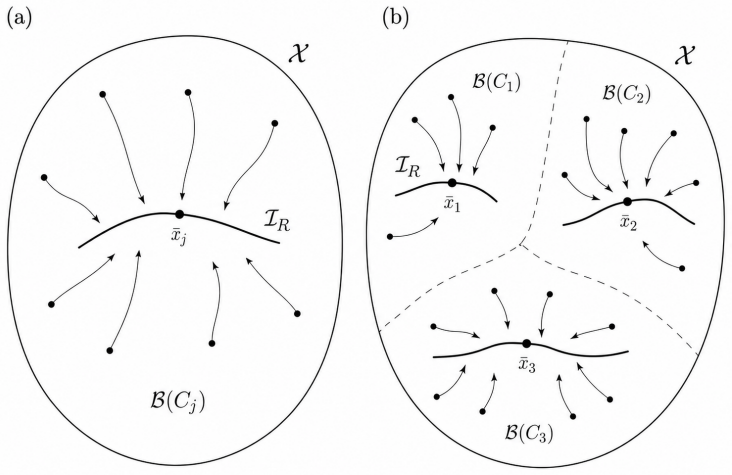
read the original abstract
This article introduces an empirical condition for the nonparametric point-identification of multivariate instrumental variable models with continuous endogenous variables using binary instruments. Verifying this condition can confirm point-identification in settings in which traditional approaches are not applicable. In particular, it shows that nonlinear instrumental variable models with general heterogeneity can be point-identified with only a binary instrument. This generalizes existing identification results which either restrict the unobserved heterogeneity substantially or require the instrument to have a large support. The main assumption on the instrumental variable model is cyclic monotonicity of its first stage, a multivariate generalization of the classical rank-invariance assumption for univariate models. Asymptotic convergence results for the empirical observable distributions are derived that allow to check the condition in practice. The identification rests on a fixed-set convergence result of cyclically monotone maps between quasi-concave functions. The corrigendum corrects the proof of Lemma 1. The proof given there incorrectly identifies preservation of distributional level sets with preservation of the underlying probability measure via Brenier maps. We replace that argument by one based on inverse Brenier maps, which play the role of multivariate ranks. The corrected argument applies to a different but significantly more flexible class of distributions than the quasi-concave class considered in the original paper. In particular, it allows for smooth non-quasi-concave and multimodal densities on compact supports, provided the associated rank fixed set satisfies a nondegeneracy condition. Moreover, it is generically satisfied for smooth parmetric classes of distributions.
Editorial analysis
A structured set of objections, weighed in public.
Referee Report
Summary. The paper introduces an empirical condition for the nonparametric point-identification of multivariate instrumental variable models with continuous endogenous variables and binary instruments. The central claim is that nonlinear IV models with general heterogeneity are point-identified under cyclic monotonicity of the first stage (a multivariate generalization of rank invariance). Asymptotic results are derived to check the condition empirically. The corrigendum corrects the original proof of Lemma 1, which incorrectly equated preservation of distributional level sets with preservation of the probability measure; the replacement argument uses inverse Brenier maps and applies to smooth non-quasi-concave and multimodal densities on compact supports provided a nondegeneracy condition holds on the associated rank fixed set. The corrigendum states that the condition is generically satisfied for smooth parametric classes of distributions.
Significance. If the corrected identification result holds, the paper would provide a meaningful generalization of existing IV identification results by relaxing both restrictions on heterogeneity and requirements on instrument support. The empirical convergence results for observable distributions would allow practical verification of the condition. The corrigendum's broadening of the admissible distribution class is a positive development, though its applicability to the paper's target models remains to be confirmed.
major comments (1)
- [Corrigendum] Corrigendum: The corrected proof of Lemma 1 requires that the rank fixed set satisfy a nondegeneracy condition for the inverse Brenier map argument to establish the fixed-set convergence result. The manuscript asserts that this condition 'is generically satisfied for smooth parametric classes of distributions' but provides no verification that it holds for the (nonparametric) heterogeneity distributions arising in the nonlinear IV models with general heterogeneity that constitute the paper's main application. Without such verification, the point-identification claim does not follow for the stated class.
Simulated Author's Rebuttal
We thank the referee for their careful reading of the paper and the corrigendum. We address the single major comment below.
read point-by-point responses
-
Referee: [Corrigendum] Corrigendum: The corrected proof of Lemma 1 requires that the rank fixed set satisfy a nondegeneracy condition for the inverse Brenier map argument to establish the fixed-set convergence result. The manuscript asserts that this condition 'is generically satisfied for smooth parametric classes of distributions' but provides no verification that it holds for the (nonparametric) heterogeneity distributions arising in the nonlinear IV models with general heterogeneity that constitute the paper's main application. Without such verification, the point-identification claim does not follow for the stated class.
Authors: We agree that the nondegeneracy condition on the rank fixed set is required for the inverse Brenier map argument in the corrected proof of Lemma 1. The identification theorem is therefore stated conditional on this condition holding for the distribution of unobserved heterogeneity. The statement that the condition 'is generically satisfied for smooth parametric classes of distributions' is offered only as an illustration of its mildness in standard parametric settings; it is not claimed to cover the fully nonparametric heterogeneity distributions that arise in the paper's main IV applications. For those nonparametric cases the condition remains a maintained assumption that can be assessed either theoretically in a given model or empirically via the convergence results developed in the paper. We will revise the manuscript to make this distinction explicit and to clarify that point identification holds provided the nondegeneracy condition is satisfied. revision: yes
Circularity Check
No significant circularity detected; identification rests on explicit domain assumption and external convergence result
full rationale
The paper's central identification result for multivariate IV models with binary instruments is derived from the stated assumption of cyclic monotonicity of the first stage (a multivariate rank-invariance condition) together with a fixed-set convergence theorem for cyclically monotone maps. The corrigendum replaces an invalid step in the original Lemma 1 proof with an argument using inverse Brenier maps that holds under an additional nondegeneracy condition on the rank fixed set. Neither the assumption nor the convergence result is shown to reduce to the target identification claim by construction, self-definition, or self-citation loop; the result remains conditional on these inputs rather than tautological. No fitted parameters are relabeled as predictions, and no uniqueness theorem is imported solely from the author's prior work to force the conclusion. The derivation chain is therefore self-contained against the stated assumptions.
Axiom & Free-Parameter Ledger
axioms (1)
- domain assumption Cyclic monotonicity of the first stage in the multivariate IV model
Reference graph
Works this paper leans on
-
[1]
The Review of Economic Studies , volume=
Instrumental variables with unrestricted heterogeneity and continuous treatment , author=. The Review of Economic Studies , volume=. 2014 , publisher=
2014
-
[2]
Econometrica , volume=
Nonparametric instrumental regression , author=. Econometrica , volume=. 2011 , publisher=
2011
-
[3]
1997 , publisher=
Introduction to the modern theory of dynamical systems , author=. 1997 , publisher=
1997
-
[4]
2005 , note=
Threshold crossing models and bounds on treatment effects: a nonparametric analysis , author=. 2005 , note=
2005
-
[5]
2017 , note =
Identifying a model of screening with multidimensional consumer heterogeneity , author =. 2017 , note =
2017
-
[6]
Econometrica , volume=
Weighted Minimum Mean--Square Distance from Independence Estimation , author=. Econometrica , volume=. 2002 , publisher=
2002
-
[7]
Econometrica , volume=
Semi-Nonparametric IV Estimation of Shape-Invariant Engel Curves , author=. Econometrica , volume=. 2007 , publisher=
2007
-
[8]
Econometric society monographs , volume=
Endogeneity in nonparametric and semiparametric regression models , author=. Econometric society monographs , volume=. 2003 , publisher=
2003
-
[9]
Statistica Neerlandica , volume=
Conditioning as disintegration , author=. Statistica Neerlandica , volume=
-
[10]
Optimal transport via a
Lindsey, Michael and Rubinstein, Yanir A , journal=. Optimal transport via a
-
[11]
1997 , publisher=
Topology from the differentiable viewpoint , author=. 1997 , publisher=
1997
-
[12]
Econometrica , volume=
Markets with a continuum of traders , author=. Econometrica , volume=. 1964 , publisher=
1964
-
[13]
Random measure preserving transformations
Aumann, Robert J. Random measure preserving transformations. Proceedings of the Fifth Berkeley Symposium on Mathematical Statistics and Probability, Volume 2: Contributions to Probability Theory, Part 2. 1967
1967
-
[14]
Econometrica , volume=
An IV model of quantile treatment effects , author=. Econometrica , volume=. 2005 , publisher=
2005
-
[15]
Econometrica , volume=
Identification in differentiated products markets using market level data , author=. Econometrica , volume=. 2014 , publisher=
2014
-
[16]
Econometrica , volume=
Automobile Prices in Market Equilibrium , author=. Econometrica , volume=
-
[17]
2016 , note=
Nonparametric Instrumental Variables Identification and Estimation of Nonseparable Panel Models , author=. 2016 , note=
2016
-
[18]
Analysis of polarity , author=. arXiv:1312.2516 , year=
work page internal anchor Pith review Pith/arXiv arXiv
-
[19]
Smoothness of certain metric projections on
Holmes, Richard B , journal=. Smoothness of certain metric projections on
-
[20]
Proximit
Moreau, Jean-Jacques , journal=. Proximit
-
[21]
Acta Mathematica , volume=
The geometry of optimal transportation , author=. Acta Mathematica , volume=. 1996 , publisher=
1996
-
[22]
The American Economic Review , volume=
Children's resources in collective households: identification, estimation, and an application to child poverty in Malawi , author=. The American Economic Review , volume=. 2013 , publisher=
2013
-
[23]
Proceedings of the Royal Society of London A: Mathematical, Physical and Engineering Sciences , volume=
Exact solutions to the transportation problem on the line , author=. Proceedings of the Royal Society of London A: Mathematical, Physical and Engineering Sciences , volume=. 1999 , organization=
1999
-
[24]
The Mathematical Intelligencer , volume=
Long history of the Monge-Kantorovich transportation problem , author=. The Mathematical Intelligencer , volume=. 2013 , publisher=
2013
-
[25]
Monge, Gaspard , year=. M
-
[26]
1989 , publisher=
The theory of general economic equilibrium: A differentiable approach , author=. 1989 , publisher=
1989
-
[27]
Optimal transportation and applications , pages=
Existence and stability results in the L1 theory of optimal transportation , author=. Optimal transportation and applications , pages=. 2003 , publisher=
2003
-
[28]
1998 , publisher=
Mass Transportation Problems: Volume I: Theory , author=. 1998 , publisher=
1998
-
[29]
Econometrica , volume=
On the nonparametric identification of nonlinear simultaneous equations models: Comment on Brown (1983) and Roehrig (1988) , author=. Econometrica , volume=. 2006 , publisher=
1983
-
[30]
2010 , institution=
Conditions for the existence of control functions in nonseparable simultaneous equations models , author=. 2010 , institution=
2010
-
[31]
Quantitative Economics , volume=
Control functions in nonseparable simultaneous equations models , author=. Quantitative Economics , volume=. 2014 , publisher=
2014
-
[32]
2013 , institution=
Nonlinear difference-indifferences in repeated cross sections with continuous treatments , author=. 2013 , institution=
2013
-
[33]
Econometrica , volume=
Identification of marginal effects in nonseparable models without monotonicity , author=. Econometrica , volume=. 2007 , publisher=
2007
-
[34]
The Econometrics Journal , volume=
Identification and estimation of local average derivatives in non-separable models without monotonicity , author=. The Econometrics Journal , volume=. 2009 , publisher=
2009
-
[35]
Econometrica , volume=
Identification of nonparametric simultaneous equations models with a residual index structure , author=. Econometrica , volume=. 2018 , publisher=
2018
-
[36]
Journal of Econometrics , volume=
Local indirect least squares and average marginal effects in nonseparable structural systems , author=. Journal of Econometrics , volume=. 2012 , publisher=
2012
-
[37]
Journal of the American statistical Association , volume=
Identification of binary response models , author=. Journal of the American statistical Association , volume=. 1988 , publisher=
1988
-
[38]
Econometrica , volume=
Structural equations, treatment effects, and econometric policy evaluation1 , author=. Econometrica , volume=. 2005 , publisher=
2005
-
[39]
Econometrica , volume=
Identification of nonseparable triangular models with discrete instruments , author=. Econometrica , volume=. 2015 , publisher=
2015
-
[40]
Supplement to
Torgovitsky, Alexander , journal=. Supplement to
-
[41]
2011 , note=
Identification of Nonseparable Models with General Instruments , author=. 2011 , note=
2011
-
[42]
Annals of Mathematical Statistics , volume=
Remarks on a multivariate transformation , author=. Annals of Mathematical Statistics , volume=. 1952 , publisher=
1952
-
[43]
The Michigan Mathematical Journal , volume=
Contributions to the theory of convex bodies , author=. The Michigan Mathematical Journal , volume=. 1957 , publisher=
1957
-
[44]
2016 , publisher=
Optimal Transport Methods in Economics , author=. 2016 , publisher=
2016
-
[45]
Mathematical Research Letters , volume=
Regularity of optimal transportation between spaces with different dimensions , author=. Mathematical Research Letters , volume=
-
[46]
Advances in Economics and Econometrics, Theory and Applications , author=
Heterogeneous Choice. Advances in Economics and Econometrics, Theory and Applications , author=. Ninth World Congress of the Econometric Society , year=
-
[47]
Journal of Econometrics , volume=
Minimum distance from independence estimation of nonseparable instrumental variables models , author=. Journal of Econometrics , volume=. 2017 , publisher=
2017
-
[48]
The Econometrics Journal , volume=
Semi-parametric estimation of non-separable models: a minimum distance from independence approach , author=. The Econometrics Journal , volume=. 2010 , publisher=
2010
-
[49]
2015 , publisher=
Values of non-atomic games , author=. 2015 , publisher=
2015
-
[50]
Communications on Pure and Applied Mathematics , volume=
Multi-to One-Dimensional Optimal Transport , author=. Communications on Pure and Applied Mathematics , volume=. 2017 , publisher=
2017
-
[51]
2013 , publisher=
Ergodic Theory---with a view towards Number Theory , author=. 2013 , publisher=
2013
-
[52]
Progress in Nonlinear Differential Equations and their applications , volume=
Optimal transport for applied mathematicians , author=. Progress in Nonlinear Differential Equations and their applications , volume=. 2015 , publisher=
2015
-
[53]
Journal of Econometrics , volume=
Instrumental variable estimation of nonseparable models , author=. Journal of Econometrics , volume=. 2007 , publisher=
2007
-
[54]
Econometrica , volume=
Nonparametric estimation of nonadditive random functions , author=. Econometrica , volume=. 2003 , publisher=
2003
-
[55]
Econometrica , volume=
Estimation of nonparametric models with simultaneity , author=. Econometrica , volume=. 2015 , publisher=
2015
-
[56]
Econometrica , volume=
Instrumental variable treatment of nonclassical measurement error models , author=. Econometrica , volume=. 2008 , publisher=
2008
-
[57]
2007 , publisher=
Bogachev, Vladimir I , volume=. 2007 , publisher=
2007
-
[58]
Econometrica , volume=
Identification and inference in nonlinear difference-in-differences models , author=. Econometrica , volume=. 2006 , publisher=
2006
-
[59]
Journal of political economy , volume=
Identification and estimation of hedonic models , author=. Journal of political economy , volume=. 2004 , publisher=
2004
-
[60]
Economic Theory , volume=
Hedonic price equilibria, stable matching, and optimal transport: equivalence, topology, and uniqueness , author=. Economic Theory , volume=. 2010 , publisher=
2010
-
[61]
Economic Theory , volume=
Existence, uniqueness and efficiency of equilibrium in hedonic markets with multidimensional types , author=. Economic Theory , volume=. 2010 , publisher=
2010
-
[62]
Econometrica , volume=
Nonparametric Identification and Estimation of Nonadditive Hedonic Models , author=. Econometrica , volume=. 2010 , publisher=
2010
-
[63]
Handbook of Econometrics , volume=
Nonparametric identification , author=. Handbook of Econometrics , volume=. 2007 , publisher=
2007
-
[64]
2017 , note=
A nonlinear principal component decomposition , author=. 2017 , note=
2017
-
[65]
Journal of Multivariate Analysis , volume=
Optimal coupling of multivariate distributions and stochastic processes , author=. Journal of Multivariate Analysis , volume=. 1993 , publisher=
1993
-
[66]
2013 , publisher=
An introduction to copulas , author=. 2013 , publisher=
2013
-
[67]
Measure-preserving transformations, copul
Koles. Measure-preserving transformations, copul. Mediterranean Journal of Mathematics , volume=. 2008 , publisher=
2008
-
[68]
2015 , publisher=
Principles of copula theory , author=. 2015 , publisher=
2015
-
[69]
Springer Ser
Mathematical risk analysis , author=. Springer Ser. Oper. Res. Financ. Eng. Springer, Heidelberg , year=
-
[70]
Fonctions de r
Sklar, Abe , year=. Fonctions de r. Publ Inst Stat de Universit
-
[71]
2006 , publisher=
Infinite Dimensional Analysis: a hitchhiker's guide , author=. 2006 , publisher=
2006
-
[72]
2008 , publisher=
Optimal transport: old and new , author=. 2008 , publisher=
2008
-
[73]
Communications on pure and applied mathematics , volume=
Polar factorization and monotone rearrangement of vector-valued functions , author=. Communications on pure and applied mathematics , volume=. 1991 , publisher=
1991
-
[74]
Journal of Econometrics , volume=
On independence conditions in nonseparable models: Observable and unobservable instruments , author=. Journal of Econometrics , volume=. 2016 , publisher=
2016
-
[75]
Archive for rational Mechanics and Analysis , volume=
Regularity of potential functions of the optimal transportation problem , author=. Archive for rational Mechanics and Analysis , volume=. 2005 , publisher=
2005
-
[76]
2013 , publisher=
Measure and category: A survey of the analogies between topological and measure spaces , author=. 2013 , publisher=
2013
-
[77]
Proceedings of the American Mathematical Society , volume=
A Polish topology for the closed subsets of a Polish space , author=. Proceedings of the American Mathematical Society , volume=
-
[78]
Set-Valued Analysis , volume=
Wijsman convergence: a survey , author=. Set-Valued Analysis , volume=. 1994 , publisher=
1994
-
[79]
Mathematical Structures in Computer Science , pages=
On computability and disintegration , author=. Mathematical Structures in Computer Science , pages=
-
[80]
Publications math
Partial regularity for optimal transport maps , author=. Publications math. 2015 , publisher=
2015
discussion (0)
Sign in with ORCID, Apple, or X to comment. Anyone can read and Pith papers without signing in.