REVIEW 3 major objections 3 minor 24 references
Generation and characterization of few-pulse attosecond pulse trains at 100kHz repetition rate
T0 review · 3 major / 3 minor · reviewed 2026-08-14 · deepseek-v4-flash
Pith's one-line read At 100 kHz repetition rate, a few-cycle laser driver produces a six-pulse attosecond train whose central pulse lasts 240 as and is fully measured.
desk verdict The first complete FROG-CRAB characterization of a 100 kHz NOPCPA-driven attosecond pulse train is a real step forward, and the 240 as central pulse is plausible, but the retrieval's systematic error budget is not fully quantified. read the letter →
The pith
A machine-rendered reading of the paper's core claim, the machinery that carries it, and where it could break.
The reading
What carries the argument
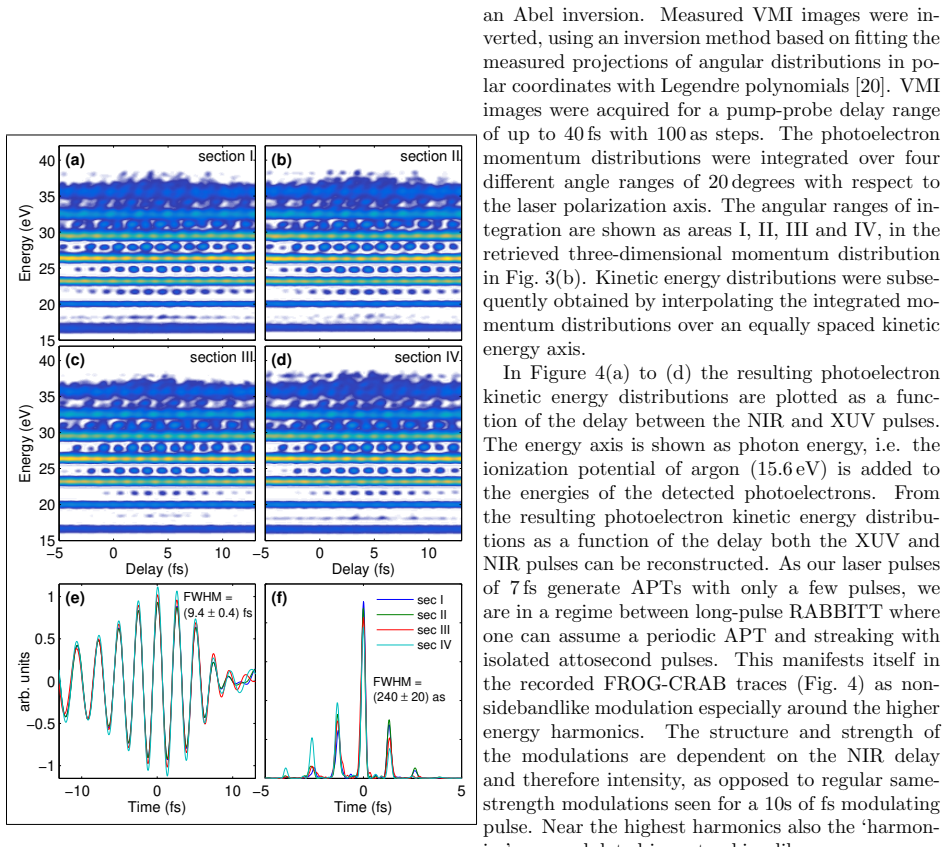
The instrument is the FROG-CRAB trace: photoelectron kinetic-energy spectra measured as a function of delay between the XUV train and a weak NIR dressing field, acquired with a velocity-map imaging spectrometer and angularly integrated over four 20-degree wedges around the polarization axis. The reconstruction engine is time-domain ptychography in its extended ptychographic iterative engine (ePIE) form, which iteratively retrieves the complex amplitudes and phases of both the electron wavepacket and the dressing field; subtracting the argon dipole transition phases then converts the wavepacket into the XUV electric field. Running the retrieval separately on four angular traces is what turns a single spectrogram into a characterization of the actual pulse train rather than a model-dependent fit.
What would settle it
Measure the same attosecond train with a second, independent technique--for example, streaking against an NIR pulse whose temporal profile has been verified by a separate frequency-resolved optical gating measurement, or using a different target gas with known dipole phases--and check whether the retrieved train still has six pulses and a central pulse of $240 \pm 20$ as. A reconstruction that changes under this cross-check would show the quoted pulse train is an artifact of the retrieval rather than a property of the source.
Extended reading notes
Core claim
The central claim is that high-order harmonic generation with a few-cycle NOPCPA driver at 100 kHz yields an XUV attosecond pulse train that is not just intense but completely measurable pulse by pulse. The retrieved field consists of six attosecond pulses with one dominant central pulse of $240 \pm 20$ as duration, spanning the 15-40 eV range, and the same FROG-CRAB retrieval returns the dressing near-infrared pulse at $9.4 \pm 0.4$ fs. Because the measured traces show non-sideband-like, streaking-like modulation near the high harmonics, the paper argues that a periodic RABBITT sideband analysis would be invalid in this few-pulse regime and that time-domain ptychography is the appropriate reconstruction tool. The paper further claims this is the first complete characterization of attosecond pulses produced by a high-repetition-rate OPCPA driver, which matters because such drivers have faced concerns about spatio-temporal couplings that can distort the pulse.
Load-bearing premise
Everything reported about the pulse shape--the six-pulse structure and the 240 as main pulse--depends on the numerical retrieval finding the true XUV and NIR fields when applied to each measured trace, and on the argon phase correction being accurate; the paper gives no independent measurement of the reconstructed pulses to confirm this.
Editorial extensions
If this is right
- Coincidence-detection pump-probe experiments become practical with this source, since 100 kHz and roughly $1.8\times 10^6$ photons per shot satisfy the single-ionization-per-shot condition while maintaining statistics.
- The reconstructed $9.4 \pm 0.4$ fs NIR pulse provides a phase-locked few-cycle partner for the XUV, so pump-probe delays can be scanned with attosecond-level stabilization.
- For high-repetition-rate OPCPA drivers, full attosecond pulse characterization is achievable despite earlier worries about spatio-temporal couplings in the parametric amplifier.
- A characterized train of a few attosecond pulses can be used directly in molecular photoionization studies without requiring an isolated attosecond pulse.
Reading between the lines
- A natural extension the paper does not report is to turn the four independent angular retrievals into a quantitative uncertainty: the spread across sections I-IV would give a measured error bar on the pulse train itself.
- If the retrieval reliability holds for this driver, the same ePIE-based FROG-CRAB characterization could be applied to other high-repetition-rate sources, potentially removing the need to assume periodic pulse trains in RABBITT-style analysis.
- Since the dipole-phase correction relies on argon, repeating the retrieval with neon or another target gas would provide an independent check of the 240 as value and of the retrieved pulse train.
Signed reviews
Editorial analysis
A structured set of objections, weighed in public.
Referee Report
Summary. The paper reports the generation of few-pulse attosecond pulse trains (APTs) at 100 kHz repetition rate, driven by a NOPCPA laser delivering 7 fs, 800 nm pulses, and claims the first complete characterization of such high-repetition-rate APTs. The characterization is performed with FROG-CRAB traces recorded on a velocity map imaging spectrometer, with argon as the target gas, and the XUV and NIR fields are retrieved using time-domain ptychography (ePIE). The retrieved APT consists of six attosecond pulses with a dominant central pulse of 240 ± 20 as duration. The authors also report an XUV flux above 1.8 × 10^11 photons/s on target and attosecond-level delay stability, and they argue that the source is suitable for coincidence-detection attosecond pump-probe experiments.
Significance. If the reconstructed APT is correct, this is a noteworthy advance: it demonstrates that a high-repetition-rate OPCPA system can produce and be used to fully characterize attosecond pulse trains, addressing earlier concerns about spatio-temporal couplings in such drivers. The use of four independent angular sections for separate ePIE retrievals, with consistent results, is a genuine strength, as is the practical demonstration of photon flux and delay stability at 100 kHz. The paper would be strengthened by machine-checkable or fully reproducible data processing, which is not provided. The central quantitative claims depend on a retrieval pipeline whose validation, relative to known fields or synthetic data, is the key missing element.
major comments (3)
- [Retrieval methodology, Fig. 4] The ePIE retrieval is the sole basis for the six-pulse structure and the 240 ± 20 as central-pulse duration, but no synthetic-data test or independent cross-check is presented. FROG-CRAB retrievals can in principle converge to local minima or depend on initialization, so a simulated trace generated from known XUV and NIR fields and processed through the same Abel inversion, resampling, and ePIE pipeline is needed to demonstrate that the retrieved pulses are accurate and not merely self-consistent. This validation is load-bearing for the paper's central claim.
- [Dipole phase subtraction, final paragraph of the characterization section] The conversion of the retrieved electron wavepacket into the APT is described only as 'subtracting the dipole transition phases [24]'. The paper does not state whether these phases are energy- and angle-resolved or a single scalar per harmonic. Because the traces are integrated over 20-degree angular cones and processed by Abel inversion, any angle dependence or inaccuracy in the argon dipole phases from ref. [24] enters directly as a phase error on the retrieved APT. The four angular sections share this potential systematic bias, so their agreement does not rule it out; the quoted ±20 as uncertainty does not include this contribution.
- [Uncertainty of the central-pulse duration, Fig. 4(f)] The origin of the '240 ± 20 as' uncertainty is not specified. If it is the spread of the four section reconstructions, it reflects only the statistical variation over common systematic errors; if it is a convergence tolerance of ePIE, that should be stated. A clear error budget separating retrieval convergence, delay calibration, Abel inversion, and dipole-phase systematics is required to support the phrase 'fully characterized'.
minor comments (3)
- [Fig. 4(a)-(d)] The FROG-CRAB traces are shown without a color scale, making quantitative assessment of the modulation depths and noise levels difficult.
- [Reproducibility] No raw VMI images, processed FROG-CRAB traces, or retrieval code are provided; depositing these would strengthen the characterization claim and allow independent verification.
- [Experimental parameters] The text states that VMI images were acquired over a delay range of up to 40 fs with 100 as steps, but the displayed traces cover only about 20 fs; the relation between the acquired range and the displayed range should be clarified.
Circularity Check
No significant circularity: the APT and NIR fields are retrieved from measured FROG-CRAB traces with an independently established iterative algorithm, and no fitted parameter is renamed as a prediction.
full rationale
The paper's central claim is an experimental characterization: a FROG-CRAB measurement with a time-domain ptychography (ePIE) retrieval. The XUV attosecond pulse train and the NIR dressing field are reconstructed jointly from the measured delay-resolved photoelectron spectra. No parameter is fitted to the claimed 240 as central-pulse duration or to the six-pulse structure; these are outputs of the retrieval. The dipole-phase subtraction uses an external reference (Mauritsson, Gaarde, and Schafer, Phys. Rev. A 72, 013401 (2005)), not an assumption supplied by the present authors. The four angular sectors share the same Abel inversion, ePIE engine, and scalar dipole-phase model, so they are not fully independent cross-checks, but this is a limitation in validation strength, not circularity. The self-citations in the paper concern the NOPCPA laser system ([16], [18]) and a ptychographic implementation ([23]); these are not load-bearing for the attosecond reconstruction, which rests on measured traces and an externally published algorithm. There is no definitional equivalence between input and output, no fitted parameter renamed as prediction, and no uniqueness claim imported from the authors' prior work. The derivation chain is therefore self-contained in the relevant sense, and the honest finding is no significant circularity.
Assumptions & free parameters
assumptions (3)
- domain assumption The FROG-CRAB trace contains sufficient information for the ePIE algorithm to retrieve the XUV and NIR electric fields uniquely.
- domain assumption Atomic dipole transition phases of argon from the literature [24] can be accurately subtracted from the retrieved electron wavepacket to obtain the attosecond pulse.
- domain assumption The photoelectron momentum distribution retains cylindrical symmetry after XUV ionization, allowing Abel inversion of the VMI images.
Cite this review
Pith. "Pith review of Generation and characterization of few-pulse attosecond pulse trains at 100kHz repetition rate." pith.science (2026). https://pith.science/paper/25TS5LSM
@misc{pith2026190807744,
  author       = {Pith},
  title        = {Pith review of: Generation and characterization of few-pulse attosecond pulse trains at 100kHz repetition rate},
  year         = {2026},
  howpublished = {\url{https://pith.science/paper/25TS5LSM}},
  note         = {Machine review of arXiv:1908.07744}
}
read the original abstract
Many experiments in attosecond science will benefit from attosecond pulses at high repetition rates with sufficient photon flux for pump-probe experiments. We use 7fs, 800nm pulses from a non-collinear optical parametric chirped pulse amplification (NOPCPA) laser system to generate few-pulse attosecond pulse trains (APTs) in the extreme ultraviolet (XUV) at a repetition rate of 100kHz. The pulse trains have been fully characterized by recording FROG-CRAB (Frequency-Resolved Optical Gating for Complete Reconstruction of Attosecond Bursts) traces with a velocity map imaging spectrometer.
Figures


Figures from the paper (2 more)

Reference graph
Works this paper leans on
-
[24]
J. Mauritsson, M. B. Gaarde, and K. J. Schafer, Physical Review A 72, 013401 (2005). 7
work page 2005
-
[1]
Krausz and M
F. Krausz and M. Ivanov, Reviews of Modern Physics 81, 163 (2009)
2009
- [2]
-
[3]
J. Ullrich, R. Moshammer, A. Dorn, R. Dorner, L. Schmidt, and H. Schmidt-Bocking, Reports on Progress in Physics 66 , 1463 (2003)
work page 2003
-
[4]
B. Feuerstein, R. Moshammer, D. Fischer, A. Dorn, C. Schrter, J. Deipenwisch, J. C. Lopez-Urrutia, C. Hhr, P. Neumayer, J. Ullrich, H. Rottke, C. Trump, M. Wittmann, G. Korn, , and W. Sandner, Physical Review Letters 87, 043003 (2001)
work page 2001
-
[5]
E. Eremina, X. Liu, H. Rottke, W. Sand- ner, M. Schatzel, A. Dreischuh, G. Paulus, H.Walther, R. Moshammer, and J. Ullrich, Physical Review Letters 92, 173001 (2004)
work page 2004
-
[6]
J. Vos, L. Cattaneo, S. Patchkovskii, T. Zim- mermann, C. Cirelli, M. Lucchini, A. Kheifets, A. S. Landsman, and U. Keller, Science 360, 1326 (2018)
work page 2018
-
[7]
L. Cattaneo, J. Vos, R. Y. Bello, A. Palacios, S. Heuser, L. Pedrelli, M. Lucchini, C. Cirelli, F. Martn, and U. Keller, Nature Physics p. 1 (2018)
work page 2018
Show all 24 references
-
[8]
Hadrich, J
S. Hadrich, J. Rothhardt, M. Krebs, S. Dem- mier, A. Klenke, A. Tunnermann, and J. Limpert, Journal of Physics B 49 , 172002 (2016)
2016
-
[9]
Harth, C
A. Harth, C. Guo, Y.-C. Cheng, A. Losquin, M. Miranda, S. Mikaelsson, C. M. Heyl, O. Prochnow, J. Ahrens, U. Morgner, A. L’Huillier, and C. L. Arnold, Journal of Optics 20, 014007 (2017)
2017
-
[10]
A. I. Gonzalez, G. Jargot, P. Rigaud, L. Lavenu, F. Guichard, A. Comby, T. Auguste, O. Suble- monties, M. Bougeard, Y. Zaouter, P. Georges, M. Hanna, and T. Ruchon,Journal of the Op- tical Society of America B 35 , A6 (2018). 6
2018
-
[11]
Lorek, E
E. Lorek, E. Larsen, C. Heyl, S. Carlstrom, D. Palecek, D. Zigmantas, and J. Mauritsson, Review of Scientific Instruments 85, 123106 (2014)
2014
-
[12]
Krebs, S
M. Krebs, S. Hadrich, S. Demmler, J. Roth- hardt, A. Zair, L. Chipperfield, J. Limpert, and A. Tunnermann, Nature Photonics Letters 7, 555 (2013)
2013
-
[13]
Hammerland, P
D. Hammerland, P. Zhang, S. Kuehn, P. Jojart, I. Seres, V. Zuba, Z. Varallyay, K. Osvay, T. T. Luu, and H. J. Woerner, arXiv:1906.07059 [physics] (2019). ArXiv: 1906.07059
2019 arXiv
-
[14]
Hammerland, P
D. Hammerland, P. Zhang, A. Bray, C. F. Perry, S. Kuehn, P. Jojart, I. Seres, V. Zuba, Z. Var- allyay, K. Osvay, A. Kheifets, T. T. Luu, and H. J. Woerner, arXiv:1907.01219 [physics] (2019). ArXiv: 1907.01219
2019 arXiv
-
[15]
Giree, M
A. Giree, M. Mero, G. Arisholm, M. J. J. Vrakking, and F. J. Furch,Optics Express 25, 3104 (2017)
2017
-
[16]
Witting, F
T. Witting, F. J. Furch, and M. J. Vrakking, Journal of Optics 20 , 044003 (2018)
2018
-
[17]
Mairesse, , and F
Y. Mairesse, , and F. Quere, Physical Review A 71, 011401 (2005)
2005
-
[18]
F. J. Furch, T. Witting, A. Giree, C. Luan, F. Schell, G. Arisholm, C. P. Schulz, and M. J. Vrakking, Optics Letters 42, 2495 (2017)
2017
-
[19]
Ghafur, W
O. Ghafur, W. Siu, P. Johnsson, M. F. Kling, M. Drescher, and M. J. Vrakking, Review of Scientific Instruments 80, 033110 (2009)
2009
-
[20]
Garcia, L
G. Garcia, L. Nahon, and I. Powis, Review of Scientific Instruments 11, 4989 (2004)
2004
-
[21]
Spangenberg, E
D. Spangenberg, E. Rohwer, M. H. Brgmann, and T. Feurer, Optics Letters 40, 1002 (2015)
2015
-
[22]
Lucchini, M.H.Brugmann, A
M. Lucchini, M.H.Brugmann, A. Ludwig, L. Gallmann, U. Keller, and T. Feurer, Optics Express 23, 29502 (2015)
2015
-
[23]
Witting, D
T. Witting, D. Greening, D. Walke, P. Matia- Hernando, T. Barillot, J. Marangos, and J. Tisch, Optics Letters 41, 4218 (2016)
2016
Reviewed August 14, 2026 · model on record in the stance chip above.
Discussion (0). Continue with ORCID to comment.