Post-Earthquake Restoration of Electricity-Gas Distribution Systems with Damage Information Collection and Repair Vehicle Routing
Pith reviewed 2026-05-16 17:11 UTC · model grok-4.3
The pith
A POMDP with belief tree search restores electricity-gas networks by adapting repairs as damage data arrives.
A machine-rendered reading of the paper's core claim, the machinery that carries it, and where it could break.
Core claim
Formulating the restoration task as a POMDP that tracks belief states over unknown damage locations, then solving it with belief tree search, lets field crews choose inspection and repair actions that adapt to newly revealed information and produce near-ideal outage costs.
What carries the argument
The belief tree search algorithm that evaluates candidate future trajectories under evolving belief states to select optimal inspection and repair routes in real time.
Load-bearing premise
The POMDP model and its belief-tree simulations correctly represent how damage information is revealed in the field and how crew actions actually affect outage durations.
What would settle it
Run the proposed method on a real utility network after a recorded earthquake and compare the realized outage cost against both the ideal full-information optimum and the 15-percent-better benchmark; if the gap exceeds a few percent or the savings disappear, the claim fails.
Figures




read the original abstract
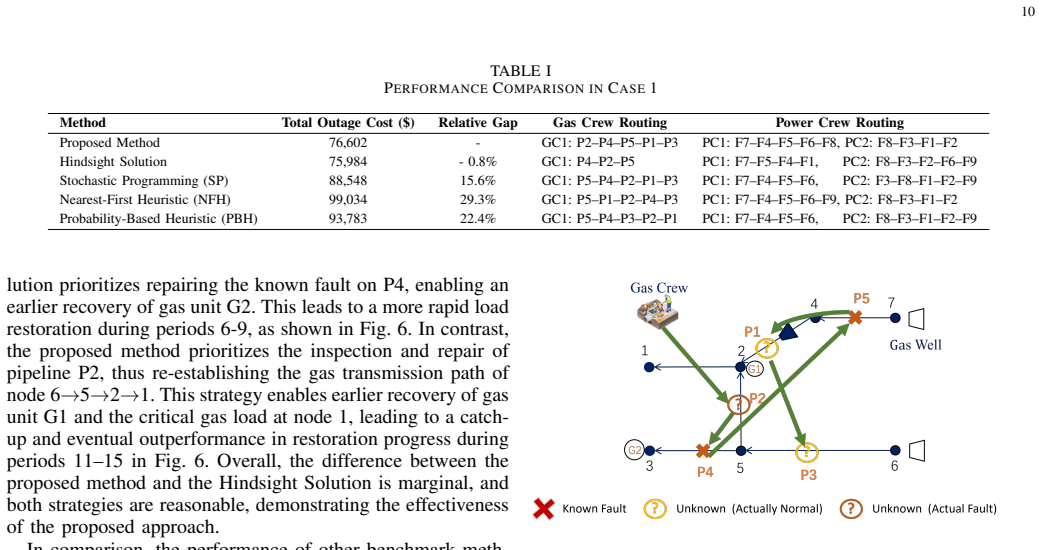
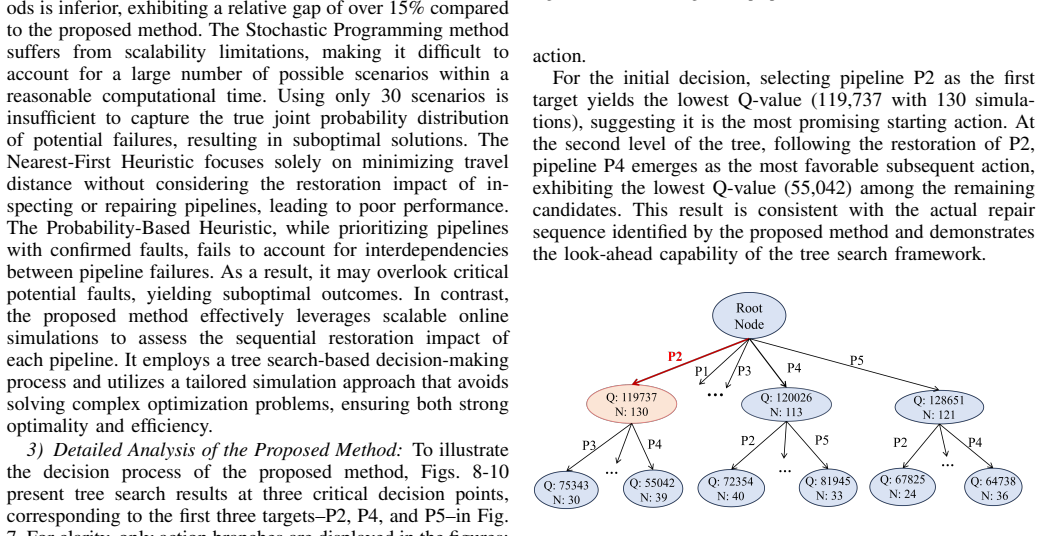
Extreme events such as earthquakes pose significant threats to integrated electricity-gas distribution systems (IEGDS) by causing widespread damage. Existing restoration approaches typically assume full awareness of damage, which may not be true if monitoring and communication infrastructures are impaired. In such circumstances, field inspection is necessary. This paper presents a novel adaptive restoration framework for IEGDS, considering dynamic damage assessment and repair. The restoration problem is formulated as a partially observable Markov decision process (POMDP), capturing the gradually revealed contingency and the evolving impact of field crew actions. To address the computational challenges of POMDPs in real-time applications, an advanced belief tree search (BTS) algorithm is introduced. This algorithm enables crew members to continuously update their actions based on evolving belief states, leveraging comprehensive simulations to evaluate potential future trajectories and identify optimal inspection and repair strategies. Based on the BTS algorithm, a unified real-time decision-making framework is developed for IEGDS restoration. Case studies on two distinct IEGDS systems demonstrate the effectiveness and scalability of the proposed method. The results indicate that the proposed approach achieves an outage cost comparable to the ideal solution, and reduces the total outage cost by more than 15% compared to strategies based on stochastic programming and heuristic methods.
Editorial analysis
A structured set of objections, weighed in public.
Referee Report
Summary. The paper formulates post-earthquake restoration of integrated electricity-gas distribution systems (IEGDS) as a POMDP that captures gradual damage revelation through crew inspections and evolving belief states. It introduces a belief tree search (BTS) algorithm to solve the POMDP in real time by simulating future trajectories and selecting inspection/repair actions. Case studies on two IEGDS instances show the approach achieves outage costs comparable to the perfect-information ideal solution while reducing total outage cost by more than 15% versus stochastic programming and heuristic baselines.
Significance. If the POMDP observation model and BTS policies prove robust, the work supplies a practical real-time adaptive framework for infrastructure restoration under partial observability, directly addressing impaired monitoring after disasters. The algorithmic contribution of BTS for large-scale networked POMDPs is technically substantive and could transfer to other partially observable repair-routing problems.
major comments (2)
- [Case Studies] Case studies section: the headline claim of >15% outage-cost reduction versus stochastic programming and heuristics is presented without reported variance, number of Monte Carlo replications, or sensitivity sweeps on inspection success probabilities; this makes it impossible to assess whether the gains are load-bearing or artifacts of the assumed observation model.
- [POMDP Model] POMDP formulation (observation model): the belief-update equations rely on inspection detection probabilities that appear set by assumption rather than calibrated to field data or literature; perturbing these values could shrink or reverse the reported advantage over the ideal baseline, undermining the central performance claims.
minor comments (2)
- [Abstract] The abstract states results on 'two distinct IEGDS systems' but provides no network sizes, number of components, or damage scenarios, hindering evaluation of scalability claims.
- [BTS Algorithm] Notation for belief states and action sets is introduced without an explicit table of symbols, which would improve readability of the BTS algorithm description.
Simulated Author's Rebuttal
We thank the referee for the constructive comments, which help strengthen the presentation of our results. We address each major comment below and indicate the revisions we will make.
read point-by-point responses
-
Referee: [Case Studies] Case studies section: the headline claim of >15% outage-cost reduction versus stochastic programming and heuristics is presented without reported variance, number of Monte Carlo replications, or sensitivity sweeps on inspection success probabilities; this makes it impossible to assess whether the gains are load-bearing or artifacts of the assumed observation model.
Authors: We agree that additional statistical details are needed to support the performance claims. In the revised manuscript we will report the number of Monte Carlo replications (100 per scenario), include standard deviations and 95% confidence intervals for all outage-cost results, and add a sensitivity sweep over inspection success probabilities (ranging from 0.6 to 0.95) to confirm that the reported advantage over stochastic programming and heuristics remains statistically significant across the tested range. revision: yes
-
Referee: [POMDP Model] POMDP formulation (observation model): the belief-update equations rely on inspection detection probabilities that appear set by assumption rather than calibrated to field data or literature; perturbing these values could shrink or reverse the reported advantage over the ideal baseline, undermining the central performance claims.
Authors: The detection probabilities were chosen from values commonly cited in the post-disaster inspection literature (e.g., visual and sensor-based success rates of 0.7–0.9). We acknowledge that direct field calibration is not performed in this study. To address robustness concerns we will insert a new sensitivity subsection that perturbs these probabilities and shows that the BTS policy retains its advantage over the baselines for the majority of the tested range; only at unrealistically low detection rates does the gap narrow. revision: partial
Circularity Check
No circularity: POMDP formulation and BTS algorithm are self-contained simulation methods
full rationale
The paper formulates the restoration problem as a POMDP to model partial observability of damage and uses a belief tree search algorithm to select inspection and repair actions via forward simulation of belief-state trajectories. Performance is assessed through case studies on two IEGDS instances by direct comparison of outage costs against an ideal perfect-information baseline, stochastic programming, and heuristics. No equations reduce to their own inputs by construction, no parameters are fitted on a subset and then relabeled as predictions, and no load-bearing claims rest on self-citations or imported uniqueness results. The derivation chain is algorithmic and externally falsifiable via the reported simulation outcomes.
Axiom & Free-Parameter Ledger
axioms (1)
- domain assumption Damage states evolve as a Markov process with partial observability through field inspections.
Lean theorems connected to this paper
-
IndisputableMonolith/Cost/FunctionalEquation.leanwashburn_uniqueness_aczel unclear?
unclearRelation between the paper passage and the cited Recognition theorem.
The restoration problem is formulated as a partially observable Markov decision process (POMDP)... cost function C(s,a) = (C_P_t + C_W_t) Δt
-
IndisputableMonolith/Foundation/RealityFromDistinction.leanreality_from_one_distinction unclear?
unclearRelation between the paper passage and the cited Recognition theorem.
advanced belief tree search (BTS) algorithm... UCB rule and progressive widening
What do these tags mean?
- matches
- The paper's claim is directly supported by a theorem in the formal canon.
- supports
- The theorem supports part of the paper's argument, but the paper may add assumptions or extra steps.
- extends
- The paper goes beyond the formal theorem; the theorem is a base layer rather than the whole result.
- uses
- The paper appears to rely on the theorem as machinery.
- contradicts
- The paper's claim conflicts with a theorem or certificate in the canon.
- unclear
- Pith found a possible connection, but the passage is too broad, indirect, or ambiguous to say the theorem truly supports the claim.
Reference graph
Works this paper leans on
-
[1]
S. Cai, Y . Xie, M. Zhang, X. Jin, Q. Wu, and J. Guo, “A stochastic sequential service restoration model for distribution systems considering microgrid interconnection,”IEEE Transactions on Smart Grid, vol. 15, no. 3, pp. 2396–2409, 2023
work page 2023
-
[2]
F. Yu, Q. Guo, J. Wu, Z. Qiao, and H. Sun, “Early warning and proactive control strategies for power blackouts caused by gas network malfunctions,”Nature Communications, vol. 15, no. 1, p. 4714, 2024
work page 2024
-
[3]
Resilience metrics for integrated power and natural gas systems,
H. Xie, X. Sun, C. Chen, Z. Bie, and J. P. Catal ˜ao, “Resilience metrics for integrated power and natural gas systems,”IEEE Transactions on Smart Grid, vol. 13, no. 3, pp. 2483–2486, 2022
work page 2022
-
[4]
Integrated model for resilience evaluation of power-gas systems under windstorms,
Y . Wang, Y . Yang, and Q. Xu, “Integrated model for resilience evaluation of power-gas systems under windstorms,”CSEE Journal of Power and Energy Systems, vol. 10, no. 4, pp. 1427–1440, 2023
work page 2023
-
[5]
Z. Wang, H. Hou, R. Wei, and Z. Li, “A distributed market-aided restoration approach of multi-energy distribution systems considering comprehensive uncertainties from typhoon disaster,”IEEE Transactions on Smart Grid, 2025, early access
work page 2025
-
[6]
W. Shi, H. Liang, and M. Bittner, “Data-driven resilience enhancement for power distribution systems against multishocks of earthquakes,” IEEE Transactions on Industrial Informatics, vol. 20, no. 5, pp. 7357– 7369, 2024
work page 2024
-
[8]
Y . Zhang, C. He, X. Liu, L. Nan, T. Liu, and L. Wu, “Coordinated restoration of integrated gas-electricity distribution system with dynamic islanding: A multi-stage stochastic model with nonanticipativity,”IEEE Transactions on Power Systems, 2024
work page 2024
-
[9]
Y . Wang, D. Qiu, X. Sun, Z. Bie, and G. Strbac, “Coordinating multi- energy microgrids for integrated energy system resilience: A multi-task learning approach,”IEEE Transactions on Sustainable Energy, vol. 15, no. 2, pp. 920–937, 2023
work page 2023
-
[10]
Dynamic service restoration for integrated energy systems under seismic stress,
Y . Shen, C. Gu, Y . Xiang, Y . Fu, D. Huo, J. Li, and P. Zhao, “Dynamic service restoration for integrated energy systems under seismic stress,” IEEE Transactions on Sustainable energy, vol. 13, no. 1, pp. 527–536, 2021
work page 2021
-
[11]
Y . Lin, B. Chen, J. Wang, and Z. Bie, “A combined repair crew dispatch problem for resilient electric and natural gas system considering reconfiguration and dg islanding,”IEEE Transactions on Power Systems, vol. 34, no. 4, pp. 2755–2767, 2019
work page 2019
-
[12]
A heuristic approach to an interdependent restoration planning and crew routing problem,
N. Tajik, K. Barker, A. D. Gonz ´alez, and A. Ermagun, “A heuristic approach to an interdependent restoration planning and crew routing problem,”Computers & Industrial Engineering, vol. 161, p. 107626, 2021
work page 2021
-
[13]
J. Wei, X. Gao, P. Cheng, W. Fu, and H. Zeng, “Coordinated post- disaster recovery and assessment method for integrated electricity-gas- transportation system,”IEEE Access, vol. 11, pp. 11 685–11 699, 2023
work page 2023
-
[14]
G. Li, K. Yan, R. Zhang, T. Jiang, X. Li, and H. Chen, “Resilience- oriented distributed load restoration method for integrated power dis- tribution and natural gas systems,”IEEE Transactions on Sustainable Energy, vol. 13, no. 1, pp. 341–352, 2021
work page 2021
-
[15]
X. Jing, W. Qin, P. Wang, X. Han, H. Yao, and Z. Zhu, “Resilience- promoting decentralized robust synthetic restoration strategy for regional integrated energy system,”CSEE Journal of Power and Energy Systems, 2025, early access
work page 2025
-
[16]
Enhancing resilience of integrated electricity-gas systems: A skeleton-network based strategy,
M. Sang, Y . Ding, M. Bao, Y . Song, and P. Wang, “Enhancing resilience of integrated electricity-gas systems: A skeleton-network based strategy,” Advances in Applied Energy, vol. 7, p. 100101, 2022
work page 2022
-
[17]
W. Wang, Y . He, H. Wang, H. Chen, and X. Xiong, “Improving interdependent urban power and gas distribution systems resilience through optimal scheduling of mobile emergency supply and repair resources,”Reliability Engineering & System Safety, vol. 250, p. 110303, 2024
work page 2024
-
[18]
X. Jiang, J. Chen, M. Chen, and Z. Wei, “Multi-stage dynamic post- disaster recovery strategy for distribution networks considering inte- grated energy and transportation networks,”CSEE Journal of Power and Energy Systems, vol. 7, no. 2, pp. 408–420, 2020
work page 2020
-
[19]
C. Chen, J. Wang, and D. Ton, “Modernizing distribution system restoration to achieve grid resiliency against extreme weather events: An integrated solution,”Proceedings of the IEEE, vol. 105, no. 7, pp. 1267–1288, 2017
work page 2017
-
[20]
Resilient distribution system restoration with communication recovery by drone small cells,
H. Zhang, C. Chen, S. Lei, and Z. Bie, “Resilient distribution system restoration with communication recovery by drone small cells,”IEEE Transactions on Smart Grid, vol. 14, no. 2, pp. 1325–1328, 2022
work page 2022
-
[21]
Integrated framework of multisource data fusion for outage location in looped distribution systems,
L. Liu, Y . Yuan, Z. Wang, Y . Yao, and F. Ding, “Integrated framework of multisource data fusion for outage location in looped distribution systems,”IEEE Transactions on Smart Grid, vol. 16, no. 3, pp. 2635– 2646, 2025
work page 2025
-
[22]
The post-disaster debris clearance problem under incomplete information,
M. C ¸ elik, ¨O. Ergun, and P. Keskinocak, “The post-disaster debris clearance problem under incomplete information,”Operations Research, vol. 63, no. 1, pp. 65–85, 2015
work page 2015
-
[23]
A review on state-of-the-art power line inspection techniques,
L. Yang, J. Fan, Y . Liu, E. Li, J. Peng, and Z. Liang, “A review on state-of-the-art power line inspection techniques,”IEEE Transactions on Instrumentation and Measurement, vol. 69, no. 12, pp. 9350–9365, 2020
work page 2020
-
[24]
Service restoration for resilient distribution systems coordinated with damage assessment,
Y . Bian, C. Chen, Y . Huang, Z. Bie, and J. P. Catal ˜ao, “Service restoration for resilient distribution systems coordinated with damage assessment,”IEEE Transactions on Power Systems, vol. 37, no. 5, pp. 3792–3804, 2021
work page 2021
-
[25]
A. Jalilian, B. Taheri, and D. K. Molzahn, “Co-optimization of damage assessment and restoration: A resilience-driven dynamic crew allocation for power distribution systems,”IEEE Transactions on Power Systems, vol. 40, no. 1, pp. 676–688, 2025
work page 2025
-
[26]
S. Sampath, K. L. Chaurasiya, P. Aryan, and B. Bhattacharya, “An inno- vative approach towards defect detection and localization in gas pipelines using integrated in-line inspection methods,”Journal of Natural Gas Science and Engineering, vol. 90, p. 103933, 2021
work page 2021
-
[27]
Energy- efficient industrial internet of uavs for power line inspection in smart grid,
Z. Zhou, C. Zhang, C. Xu, F. Xiong, Y . Zhang, and T. Umer, “Energy- efficient industrial internet of uavs for power line inspection in smart grid,”IEEE Transactions on Industrial Informatics, vol. 14, no. 6, pp. 2705–2714, 2018
work page 2018
-
[28]
Optinet: Optimising the gas network,
J. Whitmore, “Optinet: Optimising the gas network,” Cadent Gas Ltd and Wales & West Utilities, Tech. Rep., 2021, accessed: 2025-10-04. [Online]. Available: https://www.energynetworks.org/assets/images/A% 20cleaner%20greener%20gas%20network%20OptiNet.pdf
work page 2021
-
[29]
Network reconfiguration in distribution systems for loss reduction and load balancing,
M. E. Baran and F. F. Wu, “Network reconfiguration in distribution systems for loss reduction and load balancing,”IEEE Transactions on Power delivery, vol. 4, no. 2, pp. 1401–1407, 2002
work page 2002
-
[30]
Y . Zhang, Y . Hu, J. Ma, and Z. Bie, “A mixed-integer linear pro- gramming approach to security-constrained co-optimization expansion planning of natural gas and electricity transmission systems,”IEEE Transactions on Power Systems, vol. 33, no. 6, pp. 6368–6378, 2018
work page 2018
-
[31]
Impact analysis of seismic events on integrated electricity and natural gas systems,
Y . Shen, C. Gu, X. Yang, and P. Zhao, “Impact analysis of seismic events on integrated electricity and natural gas systems,”IEEE Transactions on Power Delivery, vol. 36, no. 4, pp. 1923–1931, 2020
work page 1923
-
[32]
Earthquake and post- earthquake vulnerability assessment of urban gas pipelines network,
S. Farahani, A. Tahershamsi, and B. Behnam, “Earthquake and post- earthquake vulnerability assessment of urban gas pipelines network,” Natural Hazards, vol. 101, no. 2, pp. 327–347, 2020
work page 2020
-
[33]
A survey of monte carlo tree search methods,
C. B. Browne, E. Powley, D. Whitehouse, S. M. Lucas, P. I. Cowling, P. Rohlfshagen, S. Tavener, D. Perez, S. Samothrakis, and S. Colton, “A survey of monte carlo tree search methods,”IEEE Transactions on Computational Intelligence and AI in games, vol. 4, no. 1, pp. 1–43, 2012
work page 2012
-
[34]
Data for integrated energy system restoration,
M. Li, “Data for integrated energy system restoration,” 2025. [Online]. Available: https://github.com/kxxs/IEGDS Restoration
work page 2025
discussion (0)
Sign in with ORCID, Apple, or X to comment. Anyone can read and Pith papers without signing in.