REVIEW 4 major objections 5 minor 7 references
From Imitation to Innovation: The Divergent Paths of Techno in Germany and the USA
T0 review · 4 major / 5 minor · reviewed 2026-08-03 · deepseek-v4-flash
Pith's one-line read German and US techno diverged in the recording studio years before the 1994 breakthrough, an audio analysis of over 9,000 tracks claims.
desk verdict Genuinely novel large-scale audio comparison of German vs US house/techno with a credible 1992 divergence result, but the self-curated corpus and overstrong causal wording need referee attention. read the letter →
The pith
A machine-rendered reading of the paper's core claim, the machinery that carries it, and where it could break.
The reading
What carries the argument
The central object is the four-dimensional 'recording studio feature' vector—bpm, PhaseSpace (a box-counting measure of a phase-scope point cloud, reflecting loudness, panning, and stereo distribution), ChannelCorrelation (a proxy for stereo width and mono compatibility), and CrestFactor (peak-to-RMS ratio, sensitive to percussion and dynamic-range compression). These features feed a Self-Organizing Map, which lays similar tracks on nearby map units without any metadata, and a random-forest classifier; together they convert claims about scene dynamics into measurable shifts in map location and inter-track distance.
What would settle it
Re-run the same feature extraction on an independently assembled, balanced sample of 1984–1994 German and US house/techno tracks whose producer origins are verified through interviews or label histories; if the German tracks from 1992 to 1994 no longer separate from the US cluster on a self-organizing map, the divergence finding is an artifact of corpus choice.
Extended reading notes
Core claim
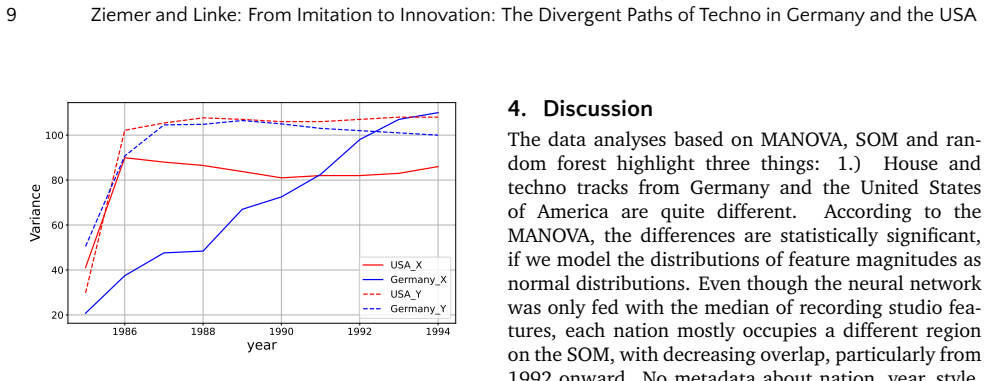
Analyzing median values of bpm, phase-space score, channel correlation, and crest factor from 9,029 tracks, the paper reports that German and US house/techno are statistically distinct (MANOVA, medium-to-large effect), that almost all US styles—Chicago house, garage, deep house, hip house, and first-wave Detroit techno—occupy the same region of a self-organizing map, and that this US region remains stable from 1986 to 1994. German tracks overlap the US region until about 1990, then begin dispersing in 1991 and by 1992 sit mostly outside it, with growing internal variance in tempo, stereo width, and compression. The authors conclude that this segregation preceded the 1994 breakthrough and the
Load-bearing premise
The analysis assumes the collection of tracks and its nation/style labels faithfully represent the German and US scenes: tracks were chosen from the authors' collection based on names in the literature, and labels were assigned by the first author from booklets and web research, so noisy or unrepresentative labels would make the measured differences reflect curation choices rather than musical reality.
Editorial extensions
If this is right
- If correct, the audio record supports several protagonists' statements: early German house imitated American house, Germans found 'their' techno in 1992, the German scene was more dynamic, and the US failed to establish unusual sub-styles.
- The analysis challenges the claim that megarares homogenized German techno: German tracks became more, not less, diverse after 1992.
- The fall of the Berlin Wall shows no immediate effect in these features, suggesting the event changed scene infrastructure more than the recorded sound, or acted with a delay.
- German subgenres can be classified from these features with 52% accuracy versus 37% for US subgenres, quantifying how much more sonically distinct German styles became.
- If diversification precedes breakthrough, the same feature-based approach could help estimate whether a current music trend will break through or fade.
Reading between the lines
- The causal claim—diversification was a catalyst, not a result—is stronger than the correlational evidence; observing diversification before 1994 does not rule out unmeasured factors like club infrastructure, radio exposure, or post-reunification economics driving both the sound change and the breakthrough.
- Because the four features omit timbre and rhythm, the finding concerns mixing and production style, not melody, harmony, or rhythmic identity; the paper itself notes that acid house and breakbeat—defined by timbre and rhythm—fail to cluster, a limitation worth weighing.
- A testable extension would be to apply the same feature pipeline to UK jungle, Dutch gabber, or post-2010 EDM to see whether rapid divergence from an origin sound predicts commercial takeoff across scenes.
- The nation labels hinge on where the producer grew up, so an independently curated corpus with verified provenance could confirm or shift the exact 1992 divergence date.
Signed reviews
Editorial analysis
A structured set of objections, weighed in public.
Referee Report
Summary. The paper analyzes 9,029 tracks from the HOTGAME corpus, a collection of early house and techno music from Germany and the USA, using four recording-studio features (bpm, PhaseSpace, ChannelCorrelation, CrestFactor). It applies two-way MANOVA, self-organizing maps, and random-forest classifiers to compare national styles, their temporal evolution, and subgenre distinctiveness. The authors report three findings: German and US house/techno are distinguishable; US styles are highly similar to each other and change little over time; German music began diversifying in 1991 and segregating from US sounds by 1992, before the 1994 mainstream breakthrough. They interpret this sequence as evidence that musical diversification was a catalyst rather than a consequence of the German breakthrough, and they map their results onto protagonists' statements in Table 1.
Significance. The study's methodological contribution is the combination of large-scale audio-feature analysis with musicological narratives, making a useful step toward audio-based validation of oral histories. Strengths include the release of feature-extraction and analysis code, the open HOTGAME feature dataset, and the complementary use of three analytical methods rather than relying on a single statistical test. If the corpus representativeness and labeling concerns are adequately addressed, the descriptive finding that US styles cluster more tightly and evolve less than German styles over this period is a valuable, falsifiable observation for MIR and popular music studies. However, the inferential claims rest on a MANOVA whose assumptions are acknowledged to be violated, and the corpus's provenance is self-curated with validation via self-citation. These issues temper the current confidence in the headline conclusions.
major comments (4)
- [Section 2.1 (Material)] The central comparisons all depend on the HOTGAME corpus, which is assembled from the first author's personal collection based on artist/label names from the literature; nation and style labels are assigned by the first author. The only validation mentioned is that students 'randomly checked' the data, and representativeness is asserted by citing [Ziemer, 2025b] without reproducing its metrics. If the collection over-represents German experimental styles or under-represents US diversity (e.g., via the literature used to select labels), the MANOVA/SOM/RF results will reflect curation choices. Please provide inter-rater reliability for labels, external representativeness metrics (e.g., comparison to Discogs or label catalogs), or at least reproduce the metrics from the cited work. Without this, the three headline observations are not securely tied to the population of early house/techno.
- [Sections 2.3 and 3.1 (MANOVA)] The authors explicitly state that MANOVA assumptions (normality, homoscedasticity) are violated, yet they report p-values and effect sizes as inferential evidence of 'significant differences' (F(4,9008)=303, p<0.00001). Under violations, these p-values are unreliable and with n≈9,000 will detect trivial differences. The paper then uses the word 'significant' in the Discussion (Section 4) as part of the central claims. Please replace or supplement the MANOVA with robust methods (e.g., PERMANOVA on rank-transformed features, bootstrap confidence intervals) or explicitly downgrade MANOVA to a descriptive screening tool and remove inferential language from the Discussion.
- [Table 1 (caption) and Section 4.1] The caption of Table 1 states that check-marks 'anticipate which statement will be supported by our audio analyses.' This pre-specifies the expected outcome of the analyses that are later qualitatively confirmed in Section 4.1. As presented, the mapping between audio observations and narrative statements is not a test but a narrative alignment, and the anticipatory marks invite confirmation bias. Please either present these as exploratory hypotheses (with pre-registration or explicit disconfirmation criteria) or remove the anticipatory check-marks so that the confirmation in Section 4.1 is not circular.
- [Conclusion (Section 5)] The claim that diversification and segregation 'was a catalyst, rather than a result of the breakthrough' over-reaches the data. Temporal precedence (1991-92 vs. 1994) is not sufficient evidence of causation; unmeasured infrastructure, economic, political, and media factors could confound the relationship. While the authors acknowledge some limitations in Section 4.2, the conclusion states it as a definite finding. Please rephrase to a more cautious claim, e.g., 'consistent with the interpretation that diversification preceded and may have contributed to the breakthrough,' or add an explicit discussion of alternative causal explanations.
minor comments (5)
- [Section 2.2] The text says 'These three strengths make the recording studio features meaningful' after listing four points (Firstly, Secondly, Thirdly, Fourthly). Should be 'four strengths.'
- [Section 2.3] Typo: 'assumotions' should be 'assumptions.'
- [Figures 14-15] The confusion matrices appear to be in percentages, but the text discusses 'recall' as percentages; make this explicit in the figure captions. Also, the final row of Figure 15 seems truncated (hip house row missing the last entry); please check the data.
- [Introduction] Minor formatting: 'over25, 000visitors' and 'over100, 000people' are missing spaces; use '25,000' and '100,000'. Also, the reference to 'Deruty Emmanuel and Tardieu Damien' should be alphabetized by surname (Emmanuel Deruty and Damien Tardieu).
- [Section 4.1] The citation '[Sumner and Needles, 2017, min. 37]' would be more standard as a timestamp textual reference or in a footnote; please check the journal's citation style.
Circularity Check
No significant circularity: audio-feature comparisons are data-driven and cross-validated; self-citations concern corpus provenance, not the target result.
full rationale
The derivation chain is data-driven and not circular. The HOTGAME corpus (Section 2.1) supplies nation/style/year labels from external discographic and curatorial sources; the four recording-studio features (Section 2.2) are extracted from audio and normalized once, independently of the Table 1 narratives. MANOVA, SOM, and random forest are applied to precomputed feature vectors: the SOM is unsupervised, and the random forest is evaluated by 100-fold cross-validation. The three headline observations are statistical/visual summaries of the resulting distributions, not quantities fitted to any protagonist statement. The only self-citations concern corpus provenance and feature validation ([Ziemer, 2025a,b, 2020, 2023, 2024]); these are not equations that reduce to the target claims, and the present paper reproduces the corpus analyses directly. Table 1's check-marks are expository previews of later results, not inputs to the algorithms. Concerns about corpus representativeness or label reliability are validity/selection-bias questions, not circularity: biased curation could produce misleading conclusions, but the paper does not build those conclusions into the analysis by construction. The Limitations section explicitly acknowledges missing timbre and rhythm dimensions, further showing that the analysis is not rigged to confirm the narratives.
Assumptions & free parameters
free parameters (2)
- SOM map dimensions and training configuration =
not reported
- Random forest tree count =
100
assumptions (5)
- domain assumption HOTGAME corpus is representative of early house/techno in Germany and the US.
- domain assumption Nation and style labels assigned by the first author are accurate.
- domain assumption MANOVA results are meaningful despite violations of normality and homoscedasticity.
- domain assumption The four recording-studio features capture relevant aspects of sound for these genres.
- standard math SOM preserves topology of the high-dimensional feature space.
Cite this review
Pith. "Pith review of From Imitation to Innovation: The Divergent Paths of Techno in Germany and the USA." pith.science (2026). https://pith.science/paper/ER2FU4IE
@misc{pith2026260104222,
  author       = {Pith},
  title        = {Pith review of: From Imitation to Innovation: The Divergent Paths of Techno in Germany and the USA},
  year         = {2026},
  howpublished = {\url{https://pith.science/paper/ER2FU4IE}},
  note         = {Machine review of arXiv:2601.04222}
}
read the original abstract
Many documentaries on early house and techno music exist. Here, protagonists from the scenes describe key elements and events that affected the evolution of the music. In the research community, there is consensus that such descriptions have to be examined critically. Yet, there have not been attempts to validate such statements on the basis of audio analyses. In this study, over 9,000 early house and techno tracks from Germany and the United States of America are analyzed using recording studio features, machine learning and inferential statistics. Three observations can be made: 1.) German and US house/techno music are distinct, 2.) US styles are much more alike, and 3.) scarcely evolved over time compared to German house/techno regarding the recording studio features. These findings are in agreement with documented statements and thus provide an audio-based perspective on why techno became a mass phenomenon in Germany but remained a fringe phenomenon in the USA. Observations like these can help the music industry estimate whether new trends will experience a breakthrough or disappear.
Figures


Figures from the paper (11 more)




Reference graph
Works this paper leans on
-
[6]
cfm?elib=21066
URLhttp://www.aes.org/e-lib/browse. cfm?elib=21066. Peter Knees, Markus Schedl, and Masataka Goto. Intel- ligent user interfaces for music discovery .Transac- tions of the International Society for Music Informa- tion Retrieval, 3(1):165–179, 2020. . 15 Ziemer and Linke: From Imitation to Innovation: The Divergent Paths of Techno in Germany and the USA Si...
2020
-
[2003]
de/books/v/volb03/pages/index.htm
URLhttps://www.epos.uni-osnabrueck. de/books/v/volb03/pages/index.htm. Marcel Reige.Deep in Techno. Die ganze Geschichte des Movements. Schwarzkopf & Schwarzkopf, 2000. Peter Scholl. Loveparade – als die liebe tanzen lernte.rbb Berlin & solo:film, 2019. URLhttps: //shorturl.at/hoLrt. Dan Sicko.Techno Rebels. Wayne State University Press, Detroit, MI, 2nd ...
-
[2017]
Oliva Henkel and Karsten Wolff.Berlin Under- ground
URLhttps://www.youtube.com/watch?v= 9Rah1F1zq1k. Oliva Henkel and Karsten Wolff.Berlin Under- ground. Techno und HipHop zwischen Mythos und Ausverkauf. FAB Verlag, Berlin, 1996. Timor Kaul. Techno. In Thomas Hecken and Marcus S. Kleiner, editors,Handbuch Popkultur, chapter 18, pages 106–110. J. B. Metzler, Stuttgart, 2017. Daniel Mateo and Sandra Passaro....
1996
-
[2021]
ISBN 978-3-030-70210-6
Springer. ISBN 978-3-030-70210-6. . Josef Schaubruch. »Von menschen, maschinen und dem minimalen«. musikanalytische Überlegungen zum techno-projekt the brandt brauer frick ensem- ble.SAMPLES. Open Access Journal for Popular Mu- sic Studies, 14:27 pages, October 2016. Jan Hemming.Methoden der Erforschung populärer Musik. Springer, Wiesbaden, 2016. Jens Ger...
2016
-
[2022]
ISBN 978-981-19-1653-3
Springer. ISBN 978-981-19-1653-3. . Tim Ziemer, Pattararat Kiattipadungkul, and Tanyarin Karuchit. Acoustic features from the recording stu- dio for music information retrieval tasks.Proceed- ings of Meetings on Acoustics, 42(1):035004, 2020. . Peter Knees, Ángel Faraldo, Perfecto Herrera, Richard Vogl, Sebastian Böck, Florian Hörschläger, and Mickael Le ...
2020
-
[2023]
Tim Ziemer, Nikita Kudakov, and Christoph Reuter
URLhttps://pub.dega-akustik.de/DAGA_ 2023/data/articles/000600.pdf. Tim Ziemer, Nikita Kudakov, and Christoph Reuter. Producer vs. rapper: Who dominates the hip hop sound?Journal of the Audio Engineering Society, 73(1/2):54–62, February 2024. . Jan Beran.Statistics in Musicology. Chapman & Hall/CRC, Boca Raton, 2004. Geoffroy Peeters. The deep learning re...
2023
-
[2024]
Karthik Yadati, Martha Larson, Cynthia C
URLhttps://aes2.org/publications/ elibrary-page/?id=22601. Karthik Yadati, Martha Larson, Cynthia C. S. Liem, and Alan Hanjalic. Detecting drops in electronic dance music: Content based approaches to a socially sig- nificant music event. In15th International Society for Music Information Retrieval Conference, pages 143–148, Taipei, Taiwan, 10 2014. Jason ...
2014
Reviewed August 3, 2026 · model on record in the stance chip above.
Discussion (0). Continue with ORCID to comment.