REVIEW 4 major objections 6 minor 1 references
Formation of massive multiple-star systems: early migration and mergers
T0 review · 4 major / 6 minor · reviewed 2026-08-03 · deepseek-v4-flash
Pith's one-line read All tight massive binaries pass through circumbinary discs
desk verdict A careful post-processing study of one high-res cluster simulation; the circumbinary-disc result is plausible for the surviving sample, but the sink-radius merger rule makes the 'all <10 au binaries' claim weaker than the abstract suggests. read the letter →
The pith
A machine-rendered reading of the paper's core claim, the machinery that carries it, and where it could break.
The reading
What carries the argument
The circumbinary disc—a single gas disc surrounding both members of a binary after their individual circumstellar discs have merged—is the central mechanism. Sustained torques from this disc extract orbital angular momentum and harden the orbit by one to three orders of magnitude over roughly 0.1 Myr, and the paper finds no sub-10 au massive binary that skipped this phase. The analysis also relies on a sink-particle merger prescription that sets the simulation's spatial resolution at 1–10 au; any pair closer than the sink radius is counted as a stellar merger, which determines which systems appear as binaries in the final census.
What would settle it
Run the same star-cluster formation simulation with sink radii reduced to 0.1 au (or with a merger criterion tied to true stellar radii rather than sink radii) and check whether any massive binary ends with separation below 10 au without having experienced a circumbinary-disc phase. Finding even one such system would disprove the claim that all tight massive binaries are made by circumbinary discs.
Extended reading notes
Core claim
On the paper's own terms, the discovery is that tight massive binaries are not born tight: they assemble at separations of ~100–10^4 au and then shrink during the embedded phase of star formation. The hardening occurs in three phases—an initial contraction from core collapse and few-body interactions, a disc–star interaction phase in which spiral arms carry off angular momentum, and a circumbinary-disc phase for systems contracting to a few tens of au. The paper states that all binaries with final separations below 10 au undergo this circumbinary phase, and that this phase is what pushes them below 10 au. It further finds that the final separation distribution becomes smooth across 1–10^4 au
Load-bearing premise
The simulation treats any pair of stars closer than its sink radius (1–10 au) as merged into a single star; if such pairs would actually survive as tight binaries in reality, the conclusion that all sub-10 au binaries require circumbinary discs may be an artifact of removing unresolved binaries from the census.
Editorial extensions
If this is right
- Tight massive binaries are produced during the embedded star-formation phase, so their orbital properties are set by disc physics rather than later binary evolution.
- Dynamical capture only makes wide binaries (>10^4 au); tight orbits always require fragmentation followed by disc-driven migration, so close binaries carry an imprint of their gas-embedded origin.
- Disc migration drives close binaries toward equal masses and circular orbits, explaining the observed correlation of high mass ratio and low eccentricity with small separation.
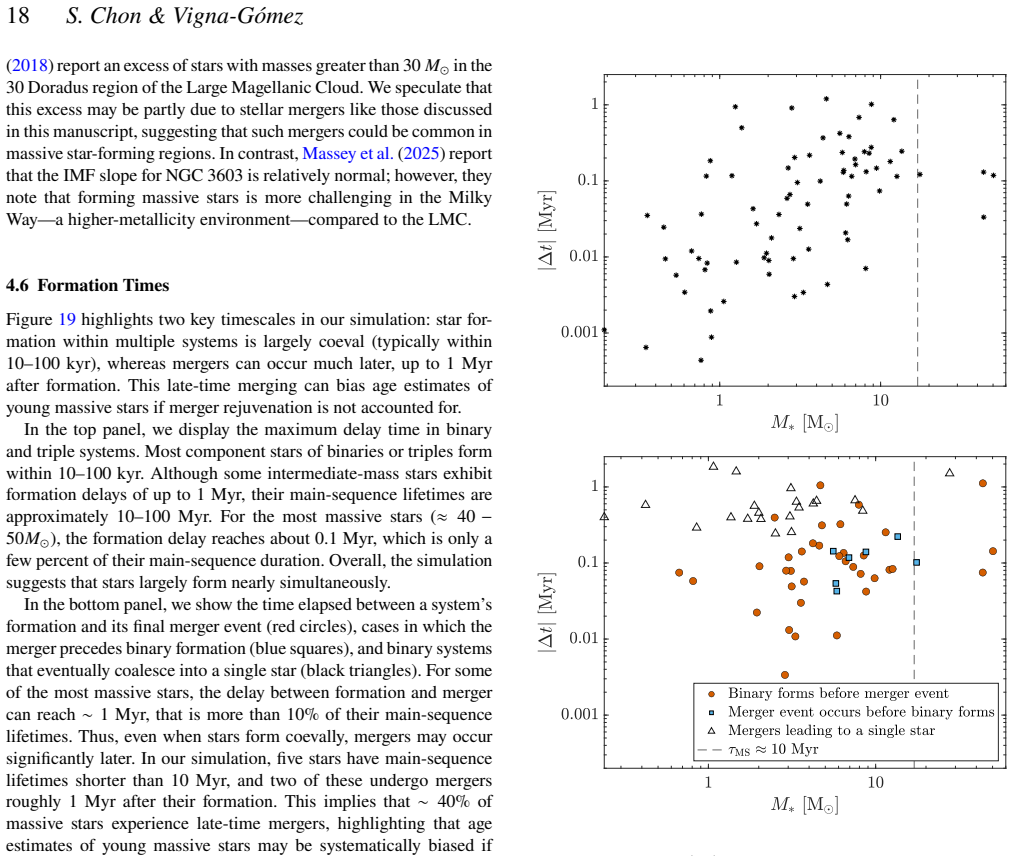
- Repeated stellar mergers, delayed by up to ~1 Myr, can bias age estimates of young massive stars and produce extreme mass-ratio (q<0.1) systems that may become compact-object binaries detectable by Gaia or as X-ray sources.
Reading between the lines
- If the circumbinary requirement is confirmed by higher-resolution runs, it predicts that essentially all embedded massive binaries with separations below 10 au should be observed with circumbinary discs; a survey that fails to find such discs would test the claim directly.
- The merger-corrected sample suggests some 'mergers' could actually be tight binaries; if so, the true multiplicity of massive stars is higher and the 'no tight binary without disc' conclusion may be an artifact of unresolved binaries being removed rather than a physical necessity.
- Isotropic mutual inclinations imply that Kozai–Lidov oscillations should be common in these triples, which would accelerate the merger rate and could connect the simulation's early mergers to later compact-object mergers.
- A clean numerical experiment would re-run the same cloud with sink radii shrunk below 0.1 au; if any sub-10 au binary emerges without a circumbinary phase, the paper's strongest claim fails.
Editorial analysis
A structured set of objections, weighed in public.
Referee Report
Summary. This paper analyzes a high-resolution radiation-hydrodynamic simulation of a 6300 Msun molecular cloud (Chon et al. 2024) to study the formation and early evolution of massive multiple-star systems. The authors identify binaries and triples among the ~750 sink particles, classify their formation channels (filament, disc, core fragmentation, dynamical capture), and track the time evolution of separations, masses, eccentricities, and inclinations. The central claim is that all binaries with final separations below 10 au are hardened with the aid of circumbinary discs, and that most massive binaries shrink by one to three orders of magnitude within the first 0.1–0.2 Myr. Additional results include a mass-dependent multiplicity fraction, frequent stellar mergers (118 events), isotropic orbital orientations, and the presence of extreme mass-ratio binaries.
Significance. If the central claim holds, the paper would identify a specific, physically plausible pathway—circumbinary disc-driven migration—as the key mechanism producing tight massive binaries, thereby connecting cluster-scale simulations to observations of close OB binaries and compact-object progenitors. The analysis is largely post-processing of a state-of-the-art simulation, with transparent methodology and qualitative comparisons to a wide range of observations. The paper also benefits from explicitly discussing caveats such as missing magnetic fields, simplified radiative transfer, and limited spatial resolution. However, the headline claim is directly weakened by the sink-radius merger prescription, and the lack of ensemble variance limits the generality of the conclusions.
major comments (4)
- [§2.2.4, Eq. (1), §5] The central claim that "all binaries whose final separations are below 10 au are hardened with the aid of circumbinary discs" is based on a sample censored by the sink-merger rule. For M*>10 Msun, r_sink = 1.2 sqrt(M*/Msun) au exceeds 3.8 au, so the sum of sink radii is typically 7–17 au. Any system that would end near or below 10 au is therefore removed as a "merger" before it can be classified. The merger-corrected sample (Section 2.2.4) resurrects all 118 mergers as binaries for multiplicity statistics, but it does not re-analyze their disc-interaction histories. Consequently, the paper demonstrates that the surviving <10 au binaries all experienced a CBD phase, but it cannot rule out that the missing systems—which in nature might survive as sub-au or few-au binaries—formed or hardened through other channels. The authors themselves note in §4.2.2 that 8 of 11 massive stars underwent m
- [Abstract, §2.1] The abstract states the simulation "resolves binaries down to 1 au separation," but Eq. (1) sets the minimum separation at the sum of sink radii, which for a 10 Msun + 10 Msun pair is ~7.6 au. The softening length is 0.2 au, but the merger criterion prevents binaries from surviving at separations smaller than ~1 au except for sub-solar-mass stars. This overstates the resolution. The abstract and Section 2.1 should clarify that the 1 au resolution applies only to low-mass stars and that the effective resolution for massive stars is set by Eq. (1).
- [§3.2.3, Fig. 9] The analysis of initial-to-final separation evolution, including the critical separation a_crit ~ 2e4 au and the bimodality in a_final/a_initial, is based on the censored sample of surviving binaries. Because the sink-radius prescription removes a substantial fraction of the tight systems, the final separation distribution may be biased against small a_final. The paper should quantify how many potential tight binaries were removed and how the conclusions change if the merger-corrected sample is used. Without this, the claim that migration drives binaries to <10 au is not robust.
- [§4.4] The simulation is a single realization. The paper acknowledges this (Section 4.4) but does not address how stochasticity in the initial turbulent field or the specific initial conditions might affect the central claim. Since the claim is stated in universal terms ("all binaries..."), the lack of ensemble variance is a limitation. A discussion of expected run-to-run scatter, or at least a softening of the language to "in this simulation," is necessary.
minor comments (6)
- [§2.1] Typo: "ultra-violed" should be "ultraviolet". Also "Gadget3" is usually written "Gadget-2" when citing Springel (2005).
- [§1] The introduction says "In Section 2.2.3, we describe the numerical methodology," but the methodology is in Sections 2.1 and 2.2. Please correct the cross-reference.
- [Figure 5 caption] The caption says "The system’s spatial resolution—calculated as the sum of the sink radii of the binary—is indicated by a dashed blue line." The text should use "spatial" instead of "spacial." Also, the blue line is labeled "sink radius" in the figure, but it is actually the sum of the two sink radii; please make the label consistent.
- [§2.2.3] The classification thresholds (v_rot/v_Kep = 0.7 for disc radius, and circumbinary disc radius > 2a) are arbitrary. The authors should state explicitly that these thresholds are applied uniformly and note how sensitive the results are to their exact values, at least in a qualitative way.
- [§4.2.2] The text says "stars more massive than M* > 2 Msun" correspond to spectral type OB stars. This is a loose statement—B stars range from about 2 to 16 Msun and O stars are more massive. Please rephrase to avoid confusion.
- [References] Several references are dated 2025–2026, which is unusual but acceptable if they are in press or preprint. Please ensure all such references are publicly available or mark them as in preparation where needed.
Circularity Check
No significant circularity: central claims emerge from a published simulation dataset and are not equivalent to fitted inputs or self-citations.
full rationale
The paper's derivation chain begins with the published Chon et al. (2024) simulation, and this paper's new analysis classifies binaries, tracks separation evolution, and attributes tightening to disc interactions. No parameter is fitted to reproduce the headline <10 au result; the disc-interaction and circumbinary classifications (Sec. 2.2.3) are morphological definitions applied uniformly to the simulation output. The statement that all <10 au binaries undergo a circumbinary phase is an emergent property of the surviving sample, not an equation that reduces to its own input. The sink-radius merger prescription (Eq. 1) and the 'merger-corrected' sample (Sec. 2.2.4) are explicitly presented as resolution caveats (Sec. 4.10.2); they bracket the true outcome but do not define the prediction. Self-citation to Chon et al. (2024) supplies the simulation data but is a published, externally verifiable input; it is not used as an unverified uniqueness/ansatz authority. No circular step of any of the enumerated kinds is present.
Assumptions & free parameters
free parameters (11)
- Initial cloud mass =
6300 M_sun
- Initial gas density and temperature =
n=10^4 cm^-3, T=200 K
- Rotation rate =
Omega=2.08e-15 s^-1 (rotational energy 0.1% of gravitational)
- Turbulence normalization and spectrum =
v_disp = c_s; P(k) ∝ k^-2
- Sink particle formation density =
2e15 cm^-3
- Sink radius formula =
r_sink = max(1.2 sqrt(M*/M_sun), 0.85) au
- Gravitational softening =
0.2 au
- SPH particle splitting thresholds =
10^5 and 10^8 cm^-3
- Disc radius and disc-interaction thresholds =
v_rot/v_Kep < 0.7 defines disc radius; circumbinary when disc radius > 2a
- Morphology classification cuts =
lambda1 > 4 lambda2 filament; lambda2 > 4 lambda3 disc; n_th < 10^4 cm^-3 capture
- Maximum multiplicity for analysis =
3
assumptions (8)
- domain assumption Sink particles represent individual stars and accreted gas is added to stellar mass.
- ad hoc to paper Sink mergers correspond to physical stellar mergers.
- ad hoc to paper Radiative feedback from only stars >10 M_sun, with simplified spherical IR dust heating, is sufficient for disc and binary evolution.
- domain assumption Magnetic fields can be neglected for the binary assembly statistics.
- domain assumption An isolated Bonnor-Ebert sphere with imposed turbulence and rotation represents massive cluster-forming clouds.
- domain assumption The simulation duration (about 2 Myr) is sufficient to capture final binary orbital architectures.
- domain assumption Post-hoc morphology classification (density threshold and axis ratios) reliably identifies the binary formation mode.
- ad hoc to paper The 'merger-corrected' sample, in which all 118 mergers survive as unresolved tight binaries, brackets the true population.
Cite this review
Pith. "Pith review of Formation of massive multiple-star systems: early migration and mergers." pith.science (2026). https://pith.science/paper/AKPDPMU3
@misc{pith2026260106251,
  author       = {Pith},
  title        = {Pith review of: Formation of massive multiple-star systems: early migration and mergers},
  year         = {2026},
  howpublished = {\url{https://pith.science/paper/AKPDPMU3}},
  note         = {Machine review of arXiv:2601.06251}
}
abstract
Massive stars are often found in multiple systems, yet how binary-star systems with very close separations ($\lesssim$ au) assemble remains unresolved. We investigate the formation and inward migration of massive-star binaries in Solar-metallicity environments using the star-cluster formation simulation of Chon et al. (2024), which forms a $1200\,M_\odot$ stellar cluster and resolves binaries down to 1 au separation. Our results indicate that stars more massive than $2\,M_{\odot}$ predominantly assemble in binary or triple configurations, in agreement with observations, with member stars forming nearly coevally. In most of these systems, the inner binary hardens by one to three orders of magnitude and reaches a steady-state within the first $0.1\,$Myr. Notably, all binaries whose final separations are below 10 au are hardened with the aid of circumbinary discs, highlighting disc-driven migration as a key to produce tight massive binaries. We further find that binaries form with random inclinations relative to the initial rotation axis of the cloud, and that mutual inclinations in triple systems follow an isotropic distribution, implying that stochastic interactions driven by turbulence and few-body dynamics are crucial during assembly and migration. Finally, stars with $M>2\,M_{\odot}$ often undergo repeated merger events during cluster evolution, yielding extreme mass ratios ($q<0.1$). Some of these products may evolve into compact-object binaries containing a black hole or neutron star, including X-ray binaries and systems detectable by Gaia.
Figures


Figures from the paper (17 more)




Reference graph
Works this paper leans on
-
[1]
P., et al., 2017, ApJ, 848, L12 Abbott B
Abbott B. P., et al., 2017, ApJ, 848, L12 Abbott B. P., et al., 2019, Physical Review X, 9, 031040 Abbott R., et al., 2021, Physical Review X, 11, 021053 Abbott R., et al., 2023, Physical Review X, 13, 041039 Abbott R., et al., 2024, Phys. Rev. D, 109, 022001 Agertz O., Kravtsov A. V., Leitner S. N., Gnedin N. Y., 2013, ApJ, 770, 25 Artymowicz P., Lubow S...
Reviewed August 3, 2026 · model on record in the stance chip above.
Discussion (0). Continue with ORCID to comment.