A higher order polytopal method for contact mechanics with Tresca friction
Pith reviewed 2026-05-16 15:00 UTC · model grok-4.3
The pith
A Discrete de Rham scheme provides a robust higher-order method for contact mechanics with Tresca friction on fractures.
A machine-rendered reading of the paper's core claim, the machinery that carries it, and where it could break.
Core claim
We design and analyze a Discrete de Rham scheme for a contact mechanics problem with Tresca friction along fractures. The scheme uses a mixed formulation with displacement approximated by vectors on mesh vertices, edges, faces and elements, and Lagrange multipliers by piecewise constants on fracture faces. We prove a discrete Korn inequality accounting for the fractures and an inf-sup condition in a non-standard H^{-1/2}-norm. The error analysis shows optimal convergence and robustness in the quasi-incompressible limit for the displacement variable.
What carries the argument
The Discrete de Rham (DDR) approximation spaces for the mixed formulation, where displacement degrees of freedom are vector-valued on vertices, edges, faces, and elements, and the Lagrange multiplier is piecewise constant on fracture faces, enabling reconstruction of quadratic displacements.
Load-bearing premise
The specific choice of vector-valued degrees of freedom on mesh entities for displacement and piecewise constant multipliers on fracture faces must satisfy the discrete Korn inequality and the inf-sup condition for the polytopal meshes and fracture geometries under consideration.
What would settle it
If numerical computations on a sequence of refined meshes for a nearly incompressible material show that the displacement error does not decrease at the expected rate or exhibits locking behavior, this would indicate that the robustness claim does not hold.
Figures





read the original abstract
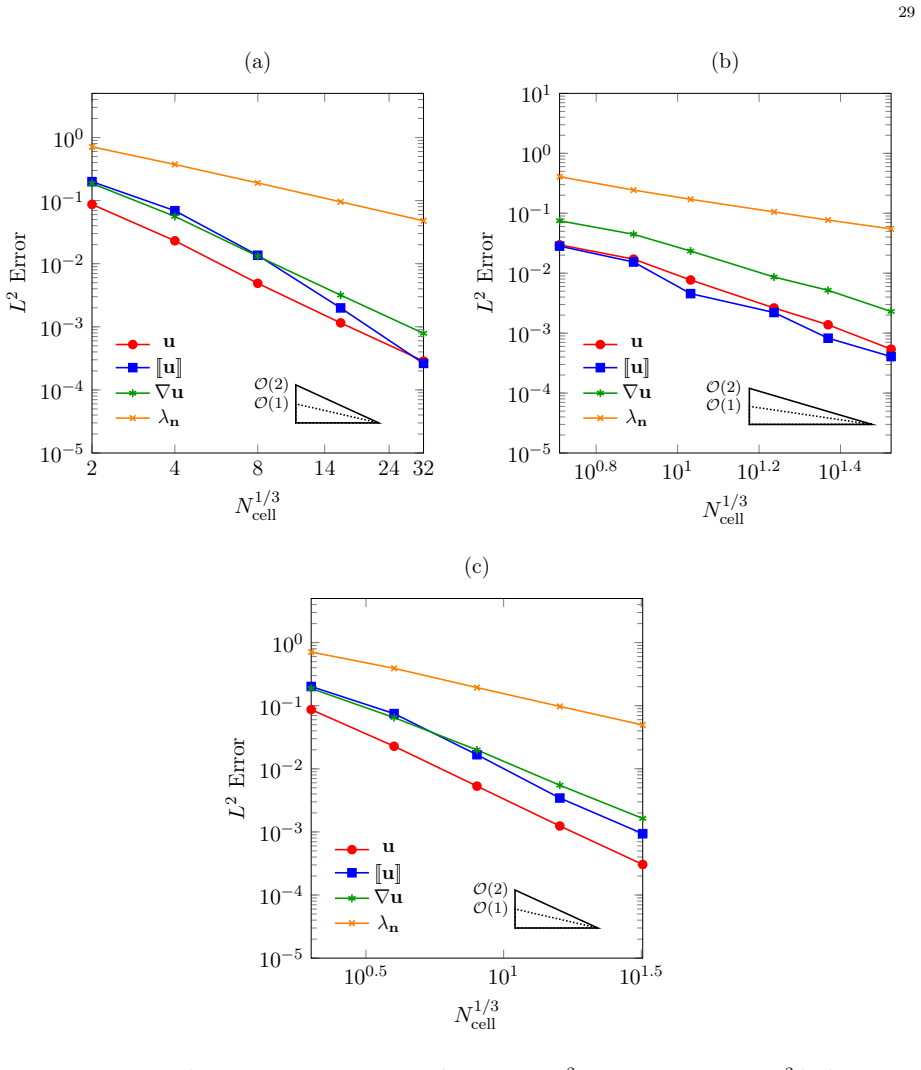
In this work, we design and analyze a Discrete de Rham (DDR) scheme for a contact mechanics problem involving fractures along which a model of Tresca friction is considered. Our approach is based on a mixed formulation involving a displacement field and a Lagrange multiplier, enforcing the contact conditions, representing tractions at fractures. The approximation space for the displacement is made of vectors values attached to each vertex, edge, face, and element, while the Lagrange multiplier space is approximated by piecewise constant vectors on each fracture face. The displacement degrees of freedom allow reconstruct piecewise quadratic approximations of this field. We prove a discrete Korn inequality that account for the fractures, as well as an inf-sup condition (in a non-standard $H^{-1/2}$-norm) between the discrete Lagrange multiplier space and the discrete displacement space. We provide an in-depth error analysis of the scheme and show that, contrary to usual low-order nodal-based schemes, our method is robust in the quasi-incompressible limit for the primal variable~(displacement). An extensive set of numerical experiments confirms the theoretical analysis and demonstrate the practical accuracy and robustness of the scheme.
Editorial analysis
A structured set of objections, weighed in public.
Referee Report
Summary. The manuscript introduces a Discrete de Rham (DDR) scheme for contact mechanics with Tresca friction along fractures. It employs a mixed formulation with a vector-valued displacement space (DOFs attached to vertices, edges, faces, and elements, permitting piecewise quadratic reconstruction) and piecewise-constant Lagrange multipliers on fracture faces. The authors establish a discrete Korn inequality that accounts for fractures and an inf-sup condition in a non-standard H^{-1/2} norm between the discrete spaces, followed by an error analysis that demonstrates robustness of the primal variable in the quasi-incompressible limit (unlike standard low-order nodal schemes). The theoretical results are supported by an extensive set of numerical experiments on polytopal meshes.
Significance. If the stability proofs and error estimates hold, the work provides a meaningful advance in numerical methods for fractured contact problems by delivering a higher-order polytopal scheme that remains stable and accurate in the quasi-incompressible regime. The explicit construction of a fracture-aware discrete Korn inequality and the non-standard inf-sup result on general polytopal meshes could serve as a foundation for extensions to other interface problems in computational mechanics.
major comments (2)
- [Section 4 (error analysis)] The error analysis claims robustness for the displacement in the quasi-incompressible limit, but the dependence of the constants on the Lamé parameters (particularly as the bulk modulus tends to infinity) is not quantified explicitly; the manuscript should derive the precise scaling of the error bound with respect to the incompressibility parameter in the relevant theorem.
- [Section 3.2 (inf-sup condition)] The discrete inf-sup condition is stated in a non-standard H^{-1/2} norm; the proof must verify that this norm is equivalent to the standard dual norm on the fracture faces under the assumed mesh regularity, otherwise the stability constant may deteriorate on highly distorted polytopal elements.
minor comments (3)
- [Abstract] The abstract contains a grammatical error: 'a discrete Korn inequality that account for the fractures' should read 'accounts'.
- [Section 2] Notation for the reconstructed quadratic displacement field and its relation to the DDR degrees of freedom should be introduced earlier and used consistently in the stability proofs.
- [Section 5] The numerical experiments section would benefit from a table summarizing observed convergence rates for different polynomial degrees and mesh families to facilitate direct comparison with the theoretical predictions.
Simulated Author's Rebuttal
We thank the referee for the positive assessment and the recommendation for minor revision. The comments are constructive and help improve the clarity of the stability and error analysis. We address each major comment below.
read point-by-point responses
-
Referee: [Section 4 (error analysis)] The error analysis claims robustness for the displacement in the quasi-incompressible limit, but the dependence of the constants on the Lamé parameters (particularly as the bulk modulus tends to infinity) is not quantified explicitly; the manuscript should derive the precise scaling of the error bound with respect to the incompressibility parameter in the relevant theorem.
Authors: We thank the referee for this observation. In the current error analysis the constants are independent of the Lamé parameter λ (equivalently, the bulk modulus) as λ → ∞, which follows directly from the λ-robust discrete Korn inequality and the inf-sup condition. To make this explicit as requested, we will revise the statement of the main error theorem in Section 4 to display the precise scaling (showing boundedness independent of λ) and add a short remark tracing the independence through the proof. This change will be incorporated in the revised manuscript. revision: yes
-
Referee: [Section 3.2 (inf-sup condition)] The discrete inf-sup condition is stated in a non-standard H^{-1/2} norm; the proof must verify that this norm is equivalent to the standard dual norm on the fracture faces under the assumed mesh regularity, otherwise the stability constant may deteriorate on highly distorted polytopal elements.
Authors: We agree that equivalence to the standard dual norm is important for interpretation. Under the shape-regularity assumptions on the polytopal meshes already stated in the paper (bounded aspect ratios and star-shaped elements), the non-standard norm is equivalent to the standard H^{-1/2} dual norm with constants depending only on the mesh-regularity parameter. We will add a brief lemma (or remark) in Section 3.2 that recalls this equivalence and confirms that the inf-sup constant remains uniform. The revision will be made in the next version. revision: yes
Circularity Check
No significant circularity; derivation rests on explicit new proofs
full rationale
The paper's central results are the proofs of a discrete Korn inequality (accounting for fractures) and an inf-sup condition between the DDR displacement space and the piecewise-constant multiplier space. These are established directly in the manuscript for the chosen polytopal approximation spaces. The subsequent error analysis and robustness statement for the quasi-incompressible limit follow from these stability estimates in a standard mixed-method fashion. No load-bearing step reduces a claimed prediction or uniqueness result to a fitted parameter, self-definition, or prior self-citation chain; the inequalities are presented as independent mathematical content verified within the work.
Axiom & Free-Parameter Ledger
axioms (2)
- domain assumption Discrete Korn inequality holds for the fractured polytopal displacement space
- domain assumption Inf-sup condition holds in the chosen non-standard H^{-1/2} norm between the multiplier and displacement spaces
Reference graph
Works this paper leans on
-
[1]
F.Abbassi,A.Karrech,M.Islam,andA.C.Seibi.“PoromechanicsofFractured/FaultedReser- voirs During Fluid Injection Based on Continuum Damage Modeling and Machine Learning”. In:Natural Resources Research32.1 (2023), pp. 413–430
work page 2023
-
[2]
A mixed formulation for frictional contact problems prone to Newton like solution methods
P. Alart and A. Curnier. “A mixed formulation for frictional contact problems prone to Newton like solution methods”. In:Computer Methods in Applied Mechanics and Engineering92.3 (1991), pp. 353–375.issn: 0045-7825
work page 1991
-
[3]
Modeling fractures as interfaces for flow and transport in porous media
C. Alboin, J. Jaffre, J. Roberts, and C. Serres. “Modeling fractures as interfaces for flow and transport in porous media”. In:Fluid flow and transport in porous media295 (2002), pp. 13– 24
work page 2002
-
[4]
Virtual elements for linear elasticity problems
L. Beirão Da Veiga, F. Brezzi, and L. Marini. “Virtual elements for linear elasticity problems”. In:SIAM Journal on Numerical Analysis51 (2013), pp. 794–812
work page 2013
-
[5]
Hybrid Finite Element Methods for the Signorini problem
F. B. Belgacem and Y. Renard. “Hybrid Finite Element Methods for the Signorini problem”. In:Mathematics of Computation72.243 (2003), pp. 1117–1145.issn: 00255718, 10886842
work page 2003
-
[6]
Finite volume discretization for poroelastic media with fractures modeled by contact mechanics
R. L. Berge, I. Berre, E. Keilegavlen, J. M. Nordbotten, and B. Wohlmuth. “Finite volume discretization for poroelastic media with fractures modeled by contact mechanics”. In:Inter- national Journal for Numerical Methods in Engineering121 (2019), pp. 644–663
work page 2019
-
[7]
F. Bonaldi, K. Brenner, J. Droniou, and R. Masson. “Gradient discretization of two-phase flows coupled with mechanical deformation in fractured porous media”. In:Computers and Mathematics with Applications98 (2021), pp. 40–68
work page 2021
-
[8]
F. Bonaldi, J. Droniou, R. Masson, and A. Pasteau. “Energy-stable discretization of two- phase flows in deformable porous media with frictional contact at matrix-fracture interfaces”. In:Journal of Computational Physics455 (2022), Paper No. 110984, 28.issn: 0021-9991
work page 2022
-
[9]
F. Bonaldi, K. Brenner, J. Droniou, R. Masson, A. Pasteau, and L. Trenty. “Gradient dis- cretization of two-phase poro-mechanical models with discontinuous pressures at matrix frac- ture interfaces”. In:ESAIM: M2AN55.5 (2021), pp. 1741–1777
work page 2021
-
[10]
S. Brenner and L. Scott.The Mathematical Theory of Finite Element Methods. Springer, 2008
work page 2008
-
[11]
F. Brezzi and M. Fortin.Mixed and hybrid finite element methods. Springer New York, NY, 1991
work page 1991
-
[12]
F. Chouly, P. Hild, V. Lleras, and Y. Renard. “Nitsche method for contact with Coulomb friction: existence results for the static and dynamic finite element formulations”. 2020
work page 2020
- [13]
-
[14]
F. Chouly, A. Ern, and N. Pignet. “A Hybrid High-Order Discretization Combined with Nitsche’sMethodforContactandTrescaFrictioninSmallStrainElasticity”.In:SIAM Journal on Scientific Computing42.4 (2020), A2300–A2324. 37
work page 2020
-
[15]
A virtual element method for 3D contact problems with non-conforming meshes
M. Cihan, B. Hudobivnik, J. Korelc, and P. Wriggers. “A virtual element method for 3D contact problems with non-conforming meshes”. In:Computer Methods in Applied Mechanics and Engineering402 (2022). A Special Issue in Honor of the Lifetime Achievements of J. Tinsley Oden, p. 115385.issn: 0045-7825
work page 2022
-
[16]
A hybrid high-order locking-free method for linear elasticity on general meshes
D. Di Pietro and A. Ern. “A hybrid high-order locking-free method for linear elasticity on general meshes”. In:Computer Methods in Applied Mechanics and Engineering283 (2015), pp. 1–21
work page 2015
-
[17]
A pressure-robust Discrete de Rham scheme for the Navier–Stokes equations
D. A. Di Pietro, J. Droniou, and J. J. Qian. “A pressure-robust Discrete de Rham scheme for the Navier–Stokes equations”. In:Comput. Meth. Appl. Mech. Engrg.421.116765 (2024)
work page 2024
-
[18]
A discrete de Rham method for the Reissner–Mindlin plate bending problem on polygonal meshes
D. A. Di Pietro and J. Droniou. “A discrete de Rham method for the Reissner–Mindlin plate bending problem on polygonal meshes”. In:Comput. Math. Appl.125.C (Nov. 2022), pp. 136– 149.issn: 0898-1221
work page 2022
-
[19]
A fully discrete plates complex on polygonal meshes with application to the Kirchhoff–Love problem
D. A. Di Pietro and J. Droniou. “A fully discrete plates complex on polygonal meshes with application to the Kirchhoff–Love problem”. In:Math. Comp.92 (339 2023), pp. 51–77
work page 2023
-
[20]
Fully discrete polynomial de Rham sequences of arbitrary degree on polygons and polyhedra
D. A. Di Pietro, J. Droniou, and F. Rapetti. “Fully discrete polynomial de Rham sequences of arbitrary degree on polygons and polyhedra”. In:Math. Models Methods Appl. Sci.30.9 (2020), pp. 1809–1855
work page 2020
-
[21]
D. A. Di Pietro and J. Droniou. “An arbitrary-order Discrete de Rham Complex on Polyhedral Meshes: Exactness, Poincaré inequalities, and Consistency”. In:Foundations of Computational Mathematics(2021), pp. 1–80
work page 2021
-
[22]
D. A. Di Pietro and J. Droniou.The Hybrid High-Order Method for Polytopal Meshes: Design, Analysis, and Applications. Vol. 19. Modeling, Simulation and Applications. Springer Interna- tional Publishing, 2020, xxxi + 525p.isbn: 978-3-030-37202-6 (Hardcover), 978-3-030-37203-3 (eBook)
work page 2020
-
[23]
Hybrid high-order and weak Galerkin methods for the biharmonic problem
Z. Dong and A. Ern. “Hybrid high-order and weak Galerkin methods for the biharmonic problem”. In:SIAM Journal on Numerical Analysis60(5) (2022), pp. 2626–2656
work page 2022
-
[24]
A polyhedral discrete de Rham numerical scheme for the Yang-Mills equations
J. Droniou, T. A. Oliynyk, and J. J. Qian. “A polyhedral discrete de Rham numerical scheme for the Yang-Mills equations”. In:Journal of Computational Physics478 (2023), p. 111955. issn: 0021-9991
work page 2023
-
[25]
J. Droniou, R. Eymard, T. Gallouët, C. Guichard, and R. Herbin.The Gradient Discretisation Method. Vol. 82. Mathematics & Applications. Springer, 2018, 511p.isbn: 978-3-319-79041-1 (Softcover) 978-3-319-79042-8 (eBook)
work page 2018
-
[26]
A polytopal discrete de Rham complex on mani- folds, with application to the Maxwell equations
J. Droniou, M. Hanot, and T. A. Oliynyk. “A polytopal discrete de Rham complex on mani- folds, with application to the Maxwell equations”. In:Journal of Computational Physics529 (2025), p. 113886.issn: 0021-9991
work page 2025
-
[27]
J. Droniou, G. Enchéry, I. Faille, A. Haidar, and R. Masson. “A bubble VEM–fully discrete polytopal scheme for mixed-dimensional poromechanics with frictional contact at matrix- fracture interfaces”. In:Computer Methods in Applied Mechanics and Engineering422 (2024), p. 116838.issn: 0045-7825
work page 2024
-
[28]
J. Droniou, A. Haidar, and R. Masson. “Analysis of a VEM–fully discrete polytopal scheme with bubble stabilisation for contact mechanics with Tresca friction”. In:M2AN Math. Model. Numer. Anal.(2025), 31p
work page 2025
-
[29]
G. Drouet and P. Hild. “Optimal convergence for discrete variational inequalities modelling Signorini contact in 2D and 3D without additional assumptions on the unknown contact set”. In:SIAM J. Numer. Anal.53.3 (2015), pp. 1488–1507.issn: 0036-1429,1095-7170. 38
work page 2015
-
[30]
A. Franceschini, N. Castelletto, J. White, and H. Tchelepi. “Algebraically stabilized Lagrange multiplier method for frictional contact mechanics with hydraulically active fractures”. In: Computer Methods in Applied Mechanics and Engineering368 (2020), p. 113161
work page 2020
-
[31]
T. T. Garipov and M. H. Hui. “Discrete Fracture Modeling approach for simulating coupled thermo-hydro-mechanical effects in fractured reservoirs”. In:International Journal of Rock Mechanics and Mining Sciences122 (2019), p. 104075.issn: 1365-1609
work page 2019
-
[32]
Discrete fracture model for coupled flow and geomechanics
T. T. Garipov, M. Karimi-Fard, and H. Tchelepi. “Discrete fracture model for coupled flow and geomechanics”. In:Computational Geosciences20.1 (2016), pp. 149–160
work page 2016
-
[33]
Gmsh: A 3-D finite element mesh generator with built-in pre- and post-processing facilities
C. Geuzaine and J.-F. Remacle. “Gmsh: A 3-D finite element mesh generator with built-in pre- and post-processing facilities”. In:International Journal for Numerical Methods in Engineering 79.11 (2009), pp. 1309–1331
work page 2009
-
[34]
Discontinuous Galerkin and the Crouzeix–Raviart element: Appli- cation to elasticity
P. Hansbo and M. Larson. “Discontinuous Galerkin and the Crouzeix–Raviart element: Appli- cation to elasticity.” In:ESAIM: Mathematical Modelling and Numerical Analysis37 (2003), pp. 63–72
work page 2003
-
[35]
Numerical methods for unilateral problems in solid mechanics
J. Haslinger, I. Hlavácek, and J. Necas. “Numerical methods for unilateral problems in solid mechanics”. In:Finite Element Methods (Part 2), Numerical Methods for Solids (Part 2). Vol. 4. Handbook of Numerical Analysis. Elsevier, 1996, pp. 313–485
work page 1996
-
[36]
M. Laaziri and R. Masson. “VEM fully discrete Nitsche’s discretization of Coulomb frictional contact-mechanics for mixed-dimensional poromechanical models”. In:Computational Geo- sciences29.6 (2025), p. 50
work page 2025
-
[37]
VEM-Nitsche Fully Discrete Polytopal Scheme for Frictionless Contact-Mechanics
M. Laaziri and R. Masson. “VEM-Nitsche Fully Discrete Polytopal Scheme for Frictionless Contact-Mechanics”. In:SIAM Journal on Numerical Analysis63.1 (2025), pp. 81–102
work page 2025
-
[38]
Modeling fractures and barriers as interfaces for flow in porous media
V. Martin, J. Jaffré, and J. E. Roberts. “Modeling fractures and barriers as interfaces for flow in porous media”. In:SIAM Journal on Scientific Computing26 (2005), pp. 1667–1691
work page 2005
-
[39]
M. Nejati, A. Paluszny, and R. W. Zimmerman. “A finite element framework for modeling internal frictional contact in three-dimensional fractured media using unstructured tetrahedral meshes”. In:Computer Methods in Applied Mechanics and Engineering306 (2016), pp. 123– 150.issn: 0045-7825
work page 2016
-
[40]
B. I. Wohlmuth, A. Popp, M. W. Gee, and W. A. Wall. “An abstract framework for a priori estimates for contact problems in 3D with quadratic finite elements”. In:Comput. Mech.49.6 (2012), pp. 735–747.issn: 0178-7675,1432-0924. Email address:jerome.droniou@cnrs.fr IMAG, Univ. Montpellier, CNRS, Montpellier, France. School of Mathematics, Monash University, ...
work page 2012
discussion (0)
Sign in with ORCID, Apple, or X to comment. Anyone can read and Pith papers without signing in.