REVIEW 3 major objections 5 minor 2 references
Portable Single-Beam Atomic Total-Field Magnetometer for Stand-off Magnetic Sensing
T0 review · 3 major / 5 minor · reviewed 2026-08-03 · deepseek-v4-flash
Pith's one-line read A 110 mL single-beam rubidium magnetometer, run by one laser and no RF coils, detects elevator-induced magnetic signatures in unshielded Earth's field at standoff distances up to 10 meters.
desk verdict Useful portable Bell-Bloom magnetometer with a real elevator dataset, but the headline sensitivity figure is not supported by the body. read the letter →
The pith
A machine-rendered reading of the paper's core claim, the machinery that carries it, and where it could break.
The reading
What carries the argument
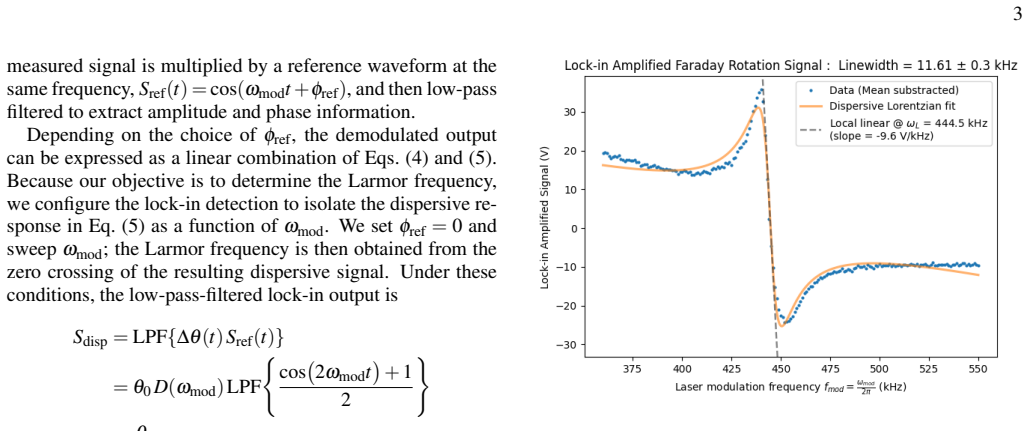
Bell–Bloom synchronous optical pumping with digital lock-in: the Larmor frequency f_L = (γ/2π)B0 (≈7 kHz/μT for 87Rb) is located by sweeping the laser modulation frequency and finding the zero crossing of the dispersive component D(ω) = (ω−ω_L)/[(ω−ω_L)^2+γ_r^2]; the sensor then locks to that slope and maps small dispersive-signal changes to field changes. The supporting machinery is the timing-marker pair—short-time derivative energy E(t) and windowed spectral entropy H(t)—which localize event onsets when raw amplitudes approach the noise floor.
What would settle it
A controlled multi-sensor or motion-tracked calibration run: record the car's true 3D position during a cycle, compute instantaneous car-to-sensor distance, and compare that against the extracted ΔB amplitudes. If amplitude versus true instantaneous distance does not collapse to the same piecewise power laws, the door-referenced exponents in the paper do not represent intrinsic source scaling. A separate check: drag a calibrated magnetic dipole past the sensor at known distances and verify the D^-3 law and the ~21 pT/√Hz sensitivity independently.
Extended reading notes
Core claim
On the authors' account, a single frequency-modulated laser beam both optically pumps and probes an isotopically enriched 87Rb vapor buffered with N2, and the resulting Faraday rotation is demodulated by digital lock-in to isolate the dispersive Larmor-resonance signal. Holding the modulation at the Larmor frequency and reading out the local dispersion slope converts field changes directly into ΔB readings at 200 samples/s. In an unshielded building, the sensor resolves step-like magnetic signatures from elevator door operation (about 0.2 μT at 2.5 m), larger traces from the moving car (about 1.6 μT at 2.5 m) and counterweight (about 0.9 μT), and the door signature follows a dipole-like D^-3
Load-bearing premise
The distance-scaling conclusions treat the horizontal separation from the sensor to the elevator door as the standoff for all three event classes, even though the moving car and counterweight change their true distance to the sensor throughout each event; if that door-referenced distance does not track the actual source-to-sensor distances, the reported decay slopes are artifacts of the chosen reference geometry.
Editorial extensions
If this is right
- Single-beam, all-optical operation removes RF coils and shielding, so sensitive atomic magnetometry can be packaged as a handheld 110 mL, ~5 W instrument.
- Intrinsic sensitivity around 21 pT/√Hz with 200 Hz output rate is sufficient to detect sub-μT, event-shaped magnetic perturbations in a real building.
- Door-operation signatures obey a D^-3 dipole-like decay, while car/counterweight signatures show apparent exponents near 1.5 at short range and 2.5 at longer range, indicating extended-source geometry rather than a single power law.
- Derivative-energy and spectral-entropy markers keep event timing reproducible out to 10 m, where raw amplitude barely exceeds ambient fluctuations.
- The sensor architecture, including Python-based processing on a single-board computer and commercial DAQ, is field-deployable without rack-mounted laboratory electronics.
Reading between the lines
- If the sensitivity and bandwidth hold outside the test building, an array of such sensors in a gradiometric configuration could push source localization and standoff detection beyond the single-sensor 10 m demonstrated here.
- The residual Bennett-structure asymmetry acknowledged in the dispersion curve means the instrument measures field changes accurately but its absolute field readout may be biased; a calibration or hole-burning correction could extend it to absolute total-field measurements.
- The car and counterweight decay exponents are referenced to the door; with true 3D source positions, the apparent 1.5-to-2.5 slope transition might disappear or change, so these exponents are best used as site-specific benchmarks rather than universal source scalings.
- The same timing-marker pipeline could transfer to other unshielded transient sources (vehicles, rotating machinery, personnel) with minimal modification.
Editorial analysis
A structured set of objections, weighed in public.
Referee Report
Summary. The paper reports a compact (~110 mL) single-beam 87Rb Bell–Bloom scalar magnetometer using digital lock-in dispersive tracking of the Larmor resonance, with no RF coils or magnetic shielding. The authors characterize the sensor in an unshielded indoor environment and use it to detect transient magnetic signatures from a controlled elevator motion sequence at standoff distances from 1.25 m to 10 m. They introduce derivative-energy and spectral-entropy timing markers to localize events at low SNR, extract event amplitudes, and report distance-scaling behavior: door events decay approximately as D^-3, while car/counterweight events show piecewise effective exponents of about 1.5 (D≤5 m) and 2.5 (D≥5 m). The atomic-physics derivation in §II is standard, but the headline sensitivity specification is internally inconsistent with the measured noise data, and several supporting claims about the closed-loop operation and distance-scaling interpretation require clarification.
Significance. If the sensitivity and bandwidth claims are substantiated, the instrument would be a valuable practical demonstration: a portable, single-beam, all-optical OPAM that operates in Earth-field conditions without RF coils or shielding and can resolve field perturbations from moving infrastructure at standoff distances up to 10 m. The empirical elevator dataset and the model-agnostic timing-marker approach are useful contributions to magnetic anomaly detection in realistic environments. However, the central performance metric—an intrinsic in-band sensitivity of ~21 pT/√Hz over 0.1–30 Hz—is currently unsupported by the data shown, and the paper does not describe the closed-loop architecture that the abstract invokes. These issues are fixable but need to be addressed before the claims can be accepted.
major comments (3)
- [Abstract; Fig. 3; §II.B] The abstract states an 'intrinsic in-band field sensitivity of approximately 21 pT/√Hz ... over a 0.1–30 Hz closed-loop in-band region,' but the body (Fig. 3) reports a noise floor below 6 pT/√Hz only near 80 Hz, and no amplitude spectral density is shown for the 0.1–30 Hz band. Section II.B (Eqs. 11–12) describes a linearized dispersive-tracking readout with slow drift compensation, which is an open-loop estimation of ΔB from the lock-in error signal; no feedback controller or closed-loop bandwidth is described. The 0.1–30 Hz figure therefore lacks direct evidence, and the relationship between the ~21 pT/√Hz estimate and the measured ~6 pT/√Hz near 80 Hz is unexplained. The authors should provide a low-frequency ASD (0.1–30 Hz), describe the control loop explicitly, and reconcile the two sensitivity numbers.
- [§II.B, Eq. (12)] The claim that the sensitivity is 'estimated from the lock-in dispersion slope' is not derived. Equation (12) converts a measured dispersive signal into ΔB using dSdisp/dωmod, but there is no noise propagation analysis connecting the voltage noise in Smeas to a magnetic-field noise spectral density. The 21 pT/√Hz value does not follow from the presented equations or from the dispersion slope of −9.6 V/kHz in Fig. 1. The authors should state the noise model, the measurement bandwidth, and the integration time used to obtain this sensitivity estimate, or remove the claim.
- [§III.C, Fig. 8] The distance-scaling exponents for elevator car and counterweight events are fitted against D, the horizontal distance from the sensor to the elevator door, even though these sources move vertically along the shaft and their true distance to the sensor changes throughout the event. The Fig. 8 caption acknowledges this, but the piecewise exponents n_eff≈1.5 and n≈2.5 are still reported as quantitative results. The authors should either use a distance metric that accounts for the moving source geometry, or clearly present the exponents as calibration-specific descriptors under the door-referenced geometry, with an assessment of how the inferred exponents would change under an alternative distance definition.
minor comments (5)
- [Abstract; Fig. 3 caption] The abstract claims a 'measurement bandwidth of 200 Hz,' but the sampling rate is stated as 200 samples/s, which gives a Nyquist frequency of 100 Hz. Please clarify the actual signal bandwidth and its relationship to the output rate.
- [§II.B, after Eq. (13)–(14)] The 'compensation logic' for slow drift is mentioned but never described. Please specify how the drift is tracked and subtracted, since this affects the validity of the differential readout at low frequencies.
- [§III.B] The window parameters for E(t) and H(t) are given, but the detection threshold for calling a 'major event' in Fig. 7 is not specified. Please define the thresholding procedure so the timing-marker results are reproducible.
- [§III.C, Fig. 8] The linear fits in Fig. 8 have no R², confidence intervals, or statement of how many trials contributed to each point. Reporting these would strengthen the distance-scaling conclusions.
- [§II.C, Fig. 2(c)] The data path states a 15 MHz sampling rate with a 250 μs lock-in integration time; please clarify how these produce a 200 samples/s output and whether anti-aliasing filtering is applied before decimation.
Circularity Check
No circular derivation: measured slope and external analytic theory carry the load; headline sensitivity and scaling claims are evidence concerns, not circularity.
full rationale
The paper's derivation chain does not reduce to its own inputs. The lock-in dispersive readout model is taken from the external analytic solution of Grujić and Weis (Eqs. 3-5), and the voltage-to-field conversion (Eqs. 10-12) uses the known 87Rb Larmor constant together with a measured local dispersion slope (-9.6 V/kHz, Fig. 1). The sensitivity estimate is a calibration-type quantity, not a prediction forced by a fitted parameter: it uses the measured slope and noise data. The elevator distance-scaling exponents are post-hoc fits (Fig. 8) interpreted against an external dipole expectation; they are not generated from fitted values, and the paper explicitly caveats the door-referenced standoff for extended sources. Self-citations to vapor-cell and heater hardware are ancillary and not load-bearing for the headline sensitivity or event-observability claims. The abstract's 21 pT/√Hz closed-loop figure is not well supported by the body's 6 pT/√Hz at 80 Hz ASD and the absence of a 0.1-30 Hz ASD, and the 'closed-loop' description is questionable; these are evidence/correctness concerns, not circularity.
Assumptions & free parameters
free parameters (3)
- Dispersion calibration slope dSdisp/dωmod at lock point =
-9.6 V/kHz (Fig. 1)
- Distance-decay exponents for door/car/CWT events =
Door ≈3; car/CWT ≈1.5 for D≤5 m and ≈2.5 for D≥5 m
- Event-timing window sizes and detection thresholds =
TE=2 s; 4 s Hann window; 0.2 s hop; smoothing not specified
assumptions (6)
- standard math Larmor relation f_L/B0 = γ/(2π) ≈ 7.0 kHz/µT for 87Rb (Eq. 1)
- domain assumption Low-power analytic solution of the Bloch equation for modulated pumping (Grujić-Weis, Eqs. 3–5), with γ_p(t)=γ1 sin(ω_mod t)+γ0
- domain assumption Measured Faraday rotation is proportional to vector polarization Sz(t) via constant χ^(1) (Eq. 8)
- ad hoc to paper Bennett-structure asymmetry is locally constant near resonance, so d∆S_asym/dω_mod≈0 (Eq. 14)
- domain assumption Elevator events can be classified as door/car/CWT using timing markers without independent ground truth
- ad hoc to paper Door-referenced standoff distance D is a valid common standoff for all source classes
Cite this review
Pith. "Pith review of Portable Single-Beam Atomic Total-Field Magnetometer for Stand-off Magnetic Sensing." pith.science (2026). https://pith.science/paper/7TSCU7FI
@misc{pith2026260108716,
  author       = {Pith},
  title        = {Pith review of: Portable Single-Beam Atomic Total-Field Magnetometer for Stand-off Magnetic Sensing},
  year         = {2026},
  howpublished = {\url{https://pith.science/paper/7TSCU7FI}},
  note         = {Machine review of arXiv:2601.08716}
}
abstract
Optically pumped atomic magnetometers (OPAMs) offer high sensitivity at room temperature and are increasingly considered for portable magnetic sensing in geomagnetic-field environments. Here we report a handheld-scale, single-beam scalar $^{87}$Rb OPAM with a sensor-head volume of approximately 110~mL. The device operates in an all-optical Bell-Bloom configuration and uses digital lock-in, dispersive tracking of the $^{87}$Rb Larmor resonance, implemented with a hybrid electronics stack that combines in-house control hardware with commercial modules. A single frequency-modulated laser beam performs both pumping and probing without RF coils. All signal processing is realized in Python on a single-board computer paired with a commercial off-the-shelf (COTS) data-acquisition module, enabling immediate deployment without dedicated signal-processing hardware. The magnetometer has an intrinsic in-band field sensitivity of approximately 21~pT/$\sqrt{\mathrm{Hz}}$, estimated from the lock-in dispersion slope, over a 0.1--30~Hz closed-loop in-band region with a digital-output rate of 200~samples/s. In an unshielded Earth-field deployment, we detect repeatable transient magnetic signatures from a controlled elevator motion sequence and quantify standoff observability over sensor-elevator distances from 1.25~m to 10~m. These results show that compact scalar OPAMs can provide bandwidth and range-resolved event sensitivity suitable for field-deployable magnetic anomaly detection and infrastructure monitoring in realistic geomagnetic environments.
Figures


Figures from the paper (4 more)


Reference graph
Works this paper leans on
-
[1]
Quantum sensors for biomedical applications,
1N. Aslam, H. Zhou, E. K. Urbach, M. J. Turner, R. L. Walsworth, M. D. Lukin, and H. Park, “Quantum sensors for biomedical applications,” Nature Reviews Physics5, 157–169 (2023), publisher: Nature Publishing Group. 2T. Sander-Thömmes and Y . Adachi, “Active field compensation using op- tically pumped magnetometers,” Proceedings on Automation in Medical En...
arXiv 2023
-
[2]
Fabrication of high-purity rb vapor cell for electric field sensing,
Hong, N.-W. Kang, and I.-H. Bae, “Fabrication of high-purity rb vapor cell for electric field sensing,” Curr. Opt. Photon.7, 207–212 (2023). 31S. H. Yim, D.-Y . Lee, S. Lee, and M. M. Kim, “Experimental setup to fab- ricate rb–xe gas cells for atom spin gyroscopes,” AIP Advances12, 015025 (2022). 32S. H. Yim, Z. Kim, S. Lee, T. H. Kim, and K. M. Shim, “No...
2023
Reviewed August 3, 2026 · model on record in the stance chip above.
Discussion (0). Continue with ORCID to comment.