REVIEW 4 major objections 5 minor 1 cited by
Diffusion-based Frameworks for Unsupervised Speech Enhancement
T0 review · 4 major / 5 minor · reviewed 2026-08-03 · deepseek-v4-flash
Pith's one-line read Explicitly sampling acoustic noise as a latent variable, rather than integrating it out, consistently improves unsupervised diffusion-based speech enhancement on both NMF-based and diffusion-based noise priors.
desk verdict A solid incremental contribution whose headline claim—explicit noise sampling is what improves results—is not actually isolated by the experiments. read the letter →
The pith
A machine-rendered reading of the paper's core claim, the machinery that carries it, and where it could break.
The reading
What carries the argument
The load-bearing mechanism is Gibbs sampling over the joint posterior p(s,n|x), alternating between drawing speech from p(s|x,n) and noise from p(n|x,s). For NMF noise, the noise posterior is closed-form Gaussian; for the diffusion noise prior, both draws use reversed-SDE updates whose likelihood terms rely on the uninformative-prior pseudo-likelihood approximation p(s|s_i) ≈ N(s_i/δ_i, σ^2/δ^2 I). The diffusion noise prior is a single score network S_ψ(a_t,t,κ) conditioned on a speech/noise label κ, so one model replaces two.
What would settle it
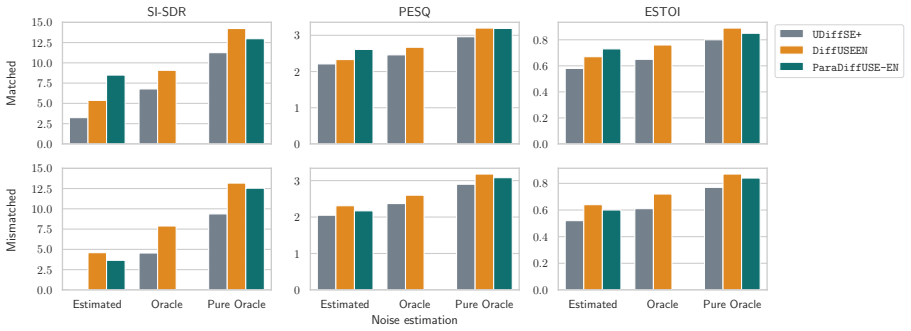
Run the matched-condition experiment with the same priors and likelihoods but replace the explicit Gibbs noise sampling with the implicit scheme and check whether the gap in SI-SDR/PESQ persists; or provide oracle NMF noise parameters to both UDiffSE+ and DiffUSEEN and see whether DiffUSEEN still wins — if the advantage disappears under oracle noise, the benefit comes from the noise estimator rather than from explicit sampling per se.
Extended reading notes
Core claim
The central discovery is that the previously ignored latent structure of noise matters. Where earlier unsupervised diffusion SE sampled only the speech posterior and let the noise enter only through an NMF-structured covariance, the paper formulates SE as joint posterior sampling over speech and noise, alternating Gibbs updates around the observation model x = s + n + r. They show that this explicit sampling step improves mixture consistency and artifact scores across two datasets, and that a single conditional score model can serve as both speech and noise prior. In matched conditions the explicit diffusion-noise variant ParaDiffUSE-EN reaches the best quality and intelligibility among unsu
Load-bearing premise
The uninformative-prior pseudo-likelihood approximation — treating the speech prior as flat when conditioning on the noised speech — is the load-bearing assumption; the paper itself notes it is not accurate, and if it biases the posterior samples, the reported gains from explicit noise modeling could be artifacts of that approximation.
Editorial extensions
If this is right
- Explicit noise modeling improves unsupervised speech enhancement consistently for both NMF-based and diffusion-based noise priors.
- ParaDiffUSE-EN achieves the best overall quality and intelligibility among unsupervised methods under matched conditions, approaching supervised baselines on WSJ0-QUT and VB-DMD.
- DiffUSEEN is more robust under mismatched conditions, with smaller SI-SDR degradation than its diffusion-based counterpart and than several supervised reference systems.
- Wiener post-filtering systematically refines ParaDiffUSE-EN outputs, with larger gains in matched settings.
- A joint speech-noise score model offers a favorable trade-off between performance and parameter count compared to training separate models.
Reading between the lines
- If explicit noise sampling is the true cause of the gains, then any unsupervised generative restoration task with additive nuisance sources — dereverberation, source separation, blind deconvolution — could benefit from the same latent-variable treatment.
- The joint conditional score model could be extended to multiple known noise classes without adding models; conditioning on noise-type labels might improve generalization under mismatch.
- The uninformative-prior pseudo-likelihood approximation is the most likely accuracy bottleneck; replacing it with a tighter likelihood at higher inference cost could close the matched-condition gap with supervised systems.
- The Wiener filtering benefit indicates that a cheap final mixture-consistency projection is a valuable complement to explicit posterior sampling.
Editorial analysis
A structured set of objections, weighed in public.
Referee Report
Summary. The paper addresses unsupervised single-channel speech enhancement using score-based diffusion models. It builds on UDiffSE/UDiffSE+/DEPSE by explicitly modeling acoustic noise as a latent variable in the E-step, jointly sampling speech and noise. Two frameworks are presented: DiffUSEEN, which retains an NMF-structured Gaussian noise prior but samples noise from its posterior via Gibbs, and ParaDiffUSE, which trains a single conditional score model on both speech and noise labels and provides an implicit-noise variant (ParaDiffUSE-IN) and an explicit-noise variant (ParaDiffUSE-EN) with Wiener post-filtering. The central claim, stated in Section VII, is that explicit noise sampling consistently improves unsupervised diffusion-based SE irrespective of the noise prior. The evaluation on WSJ0-QUT and VB-DMD compares these methods with several unsupervised and supervised baselines, with matched and mismatched conditions, and includes ablations on Wiener filtering and joint vs separate models.
Significance. If the central claim were cleanly established, the paper would make a useful contribution: it gives a unified derivation of prior EM-based unsupervised diffusion SE, introduces a principled joint speech–noise score model with label conditioning (reducing from two models to one), and demonstrates—in absolute terms—strong results under matched conditions (e.g., 8.49 dB SI-SDR and 2.61 PESQ on WSJ0-QUT, 18.00 dB SI-SDR on VB-DMD). The public release of code and demo is a plus. However, the evidence for the central claim is currently compromised by confounded comparisons and by reliance on an acknowledged approximate likelihood; the paper itself flags these limitations. The practical significance is therefore real but not yet fully supported.
major comments (4)
- [VI-B.1, Table III, Alg. 3] The headline comparison ParaDiffUSE-EN vs ParaDiffUSE-IN does not isolate explicit noise modeling. ParaDiffUSE-EN includes Wiener post-filtering (Alg. 3 lines 15-16) and a different likelihood-guidance schedule (λ_i = λ σ_{τ_i}, λ=5.75) from the constant λ=1 used for ParaDiffUSE-IN (§VI-A). Table III shows Wiener filtering alone contributes 1.0 dB SI-SDR on matched WSJ0-QUT and 2.49 dB SI-SDR, 0.14 PESQ, and 0.05 ESTOI on matched VB-DMD; without it, ParaDiffUSE-EN on matched VB-DMD has lower PESQ/ESTOI than ParaDiffUSE-IN (3.27/0.81 vs 3.42/0.83). Thus the 'best overall quality and intelligibility' claim depends on a post-processor applied to only one arm. Please report ParaDiffUSE-IN with the same Wiener post-filtering, or ParaDiffUSE-EN without, and control the λ schedule.
- [VI-B.1, Eqs. (12)/(25), VI-A] The DiffUSEEN vs UDiffSE+ comparison is likewise confounded. DiffUSEEN changes the observation model (adds σ_r^2 I in Eq. 25), replaces the E-step with Gibbs sampling and Tweedie-based estimates (Alg. 1, lines 6–9), and uses a tuned λ=1.75 instead of 1.5. The claimed improvement in SI-SAR/SI-SDR cannot therefore be attributed to explicit noise modeling alone. A controlled ablation—e.g., UDiffSE+ augmented with explicit noise sampling while keeping all other components fixed—is needed to support the central claim.
- [V-B, Eq. (21) and (47)/(49)] The paper explicitly states that the uninformative-prior approximation p(s|s_i) ≈ N(s_i/δ_i, σ_{τ_i}^2/δ_i^2 I) is 'not accurate', yet all proposed likelihood scores (Eqs. 30, 47, 49) rest on it. Because the approximation is common to both implicit and explicit arms, it does not by itself explain the relative gains, but it does cast doubt on the absolute performance and on the theoretical motivation that explicit mixture consistency should improve posterior sampling. I recommend a validation experiment: compare against DEPSE-TL's tractable-likelihood variant on a subset, or replace the approximate likelihood with a more accurate one for a few configurations to test sensitivity.
- [Table I / VI-B] Table I reports no error bars or confidence intervals; the claim that certain values are 'statistically significant' is based on paired t-tests for selected comparisons, but the reader cannot verify the variance across files. Given that the paper's main conclusion rests on multiple pairwise differences, reporting standard errors or intervals for all metrics in Table I (as already done in Tables III and IV) is necessary.
minor comments (5)
- [V-B] Typo: 'approximatation' should be 'approximation'.
- [Figure 4 caption] Typo: 'potentailly' should be 'potentially'.
- [Algorithm 3, line 11] The subscript in '∇ nτ logp' should be 'n_i' for consistency.
- [Abstract / Footnote 1] The abstract says code/demo/supplementary are publicly available, but the text later says 'Our code will be publicly available.' Please align these statements.
- [Table II] The RTF unit is described as 'second'; consider reporting 'seconds per second of audio' (or 's/s') for clarity.
Circularity Check
No significant circularity: the paper's claims are empirical, evaluated on held-out datasets, with transparent ablations and baselines; self-citations are prior-work comparisons, not load-bearing assumptions.
full rationale
The paper's derivation chain is self-contained: posterior sampling scores are derived from the diffusion SDE, Bayes' rule, Tweedie's formula, and explicit Gaussian/NMF or diffusion noise models (Eqs. 21–52). No fitted parameter is renamed as a prediction; the reported SI-SDR/PESQ/ESTOI/DNS-MOS numbers come from held-out WSJ0-QUT and VB-DMD test sets. Hyperparameters (λ, σ_r) are tuned on validation and are standard hyperparameter selection, not circular fitting. The heavy self-citation of UDiffSE+ [20] and DEPSE [21] is used as baselines and as the prior framework being extended; the new claims are not justified by asserting those papers' conclusions. The Wiener-filter ablation (Table III) is explicitly reported and even quantifies the post-processing contribution, so the potential confound between explicit noise sampling and Wiener filtering is disclosed rather than hidden. The acknowledged inaccuracy of the uninformative-prior approximation (Section V-B) is a modeling limitation and a correctness risk, but it is not circular: the approximation is an assumption, not an input that guarantees the empirical outcome. The skeptical concern that the central pairwise comparisons conflate multiple design changes is an experimental-design criticism, not a demonstration that any result reduces to its inputs by definition. No circular step meeting the required evidentiary standard was found.
Assumptions & free parameters
free parameters (5)
- Likelihood guidance scale λ_i =
1.5 (UDiffSE), 1.5 (UDiffSE+), 1.75 (DiffUSEEN), 1 (ParaDiffUSE-IN), 5.75×σ_{τ_i} (ParaDiffUSE-EN)
- Observation perturbation variance σ_r^2 =
σ_r = 5e-4
- NMF rank =
4
- Langevin step-size factor r =
not reported
- Number of reverse diffusion steps N =
30
assumptions (6)
- domain assumption Additive mixture model x = s + n (and x = s + n + r)
- domain assumption Noise prior is zero-mean Gaussian with NMF-structured covariance for DiffUSEEN
- standard math Score-based diffusion model provides a valid approximation of speech (and noise) log-density gradient
- ad hoc to paper Uninformative prior p(s) ∝ const, leading to p(s|s_i) ≈ p(s_i|s)
- ad hoc to paper Single Monte Carlo sample approximates the expectation in Eq. (41)
- domain assumption The joint score model Sψ with label conditioning accurately models both speech and noise distributions
Cite this review
Pith. "Pith review of Diffusion-based Frameworks for Unsupervised Speech Enhancement." pith.science (2026). https://pith.science/paper/MUTBUMLS
@misc{pith2026260109931,
  author       = {Pith},
  title        = {Pith review of: Diffusion-based Frameworks for Unsupervised Speech Enhancement},
  year         = {2026},
  howpublished = {\url{https://pith.science/paper/MUTBUMLS}},
  note         = {Machine review of arXiv:2601.09931}
}
read the original abstract
This paper addresses unsupervised diffusion-based single-channel speech enhancement (SE). Prior work in this direction combines a score-based diffusion model trained on clean speech with a Gaussian noise model whose covariance is structured by non-negative matrix factorization (NMF). This combination is used within an iterative expectation-maximization (EM) scheme, in which a diffusion-based posterior-sampling E-step estimates the clean speech. We first revisit this framework and propose to explicitly model both speech and acoustic noise as latent variables, jointly sampling them in the E-step instead of sampling speech alone as in previous approaches. We then introduce a new semi-supervised SE framework that replaces the NMF noise prior with a diffusion-based noise model, learned jointly with the speech prior in a single conditional score model. Within this framework, we derive two variants: one that implicitly accounts for noise and one that explicitly treats noise as a latent variable. Experiments on WSJ0-QUT and VoiceBank-DEMAND show that explicit noise modeling systematically improves SE performance for both NMF-based and diffusion-based noise priors. Under matched conditions, the diffusion-based noise model attains the best overall quality and intelligibility among unsupervised methods, while under mismatched conditions the proposed NMF-based explicit-noise framework is more robust and suffers less degradation than several supervised baselines. Code, demo, and supplementary materials are publicly available.
Figures


Figures from the paper (1 more)
Forward citations
Cited by 1 Pith paper
-
Audio-visual Contrastive Alignment for Diffusion-based Visual-conditioned Speech Enhancement
Augmenting diffusion-based visual-conditioned speech enhancement with a contrastive audio-visual loss produces consistent gains in interference suppression and perceptual quality, especially at low SNRs.
Reference graph
Works this paper leans on
-
[1]
Supervised speech separation based on deep learning: An overview,
D. Wang and J. Chen, “Supervised speech separation based on deep learning: An overview,”IEEE/ACM Transactions on Audio, Speech, and Language Processing, vol. 26, no. 10, pp. 1702–1726, 2018
2018
-
[2]
Conv-TasNet: Surpassing ideal time–frequency magnitude masking for speech separation,
Y . Luo and N. Mesgarani, “Conv-TasNet: Surpassing ideal time–frequency magnitude masking for speech separation,”IEEE/ACM transactions on audio, speech, and language processing, vol. 27, no. 8, pp. 1256–1266, 2019
2019
-
[3]
TF- GridNet: Making time-frequency domain models great again for monaural speaker separation,
Z.-Q. Wang, S. Cornell, S. Choi, Y . Lee, B.-Y . Kim, and S. Watanabe, “TF- GridNet: Making time-frequency domain models great again for monaural speaker separation,” inIEEE international conference on acoustics, speech and signal processing (ICASSP). IEEE, 2023, pp. 1–5
2023
-
[4]
TF-CrossNet: Leveraging global, cross-band, narrow-band, and positional encoding for single- and multi-channel speaker separation,
V . A. Kalkhorani and D. Wang, “TF-CrossNet: Leveraging global, cross-band, narrow-band, and positional encoding for single- and multi-channel speaker separation,”IEEE/ACM Transactions on Audio, Speech, and Language Processing, vol. 32, pp. 4999–5009, 2024
2024
-
[5]
SEGAN: Speech enhancement generative adversarial network,
S. Pascual, A. Bonafonte, and J. Serr `a, “SEGAN: Speech enhancement generative adversarial network,” inProc. Interspeech 2017, 2017, pp. 3642– 3646
2017
-
[6]
Conditional diffusion probabilistic model for speech enhancement,
Y .-J. Lu, Z.-Q. Wang, S. Watanabe, A. Richard, C. Yu, and Y . Tsao, “Conditional diffusion probabilistic model for speech enhancement,” in IEEE International Conference on Acoustics, Speech and Signal Processing (ICASSP), 2022, pp. 7402–7406
2022
-
[7]
StoRM: A diffusion-based stochastic regeneration model for speech enhancement and dereverberation,
J.-M. Lemercier, J. Richter, S. Welker, and T. Gerkmann, “StoRM: A diffusion-based stochastic regeneration model for speech enhancement and dereverberation,”IEEE/ACM Transactions on Audio, Speech, and Language Processing, vol. 31, pp. 2724–2737, 2023
2023
-
[8]
A composite predictive-generative approach to monaural universal speech enhancement,
J. Zhang, H. Yan, and X. Li, “A composite predictive-generative approach to monaural universal speech enhancement,”IEEE Transactions on Audio, Speech and Language Processing, 2025
2025
Show all 52 references
-
[9]
GAN-based speech enhancement for low snr using latent feature conditioning,
S. S. Shetu, E. A. Habets, and A. Brendel, “GAN-based speech enhancement for low snr using latent feature conditioning,” inICASSP 2025-2025 IEEE International Conference on Acoustics, Speech and Signal Processing (ICASSP). IEEE, 2025, pp. 1–5
2025
-
[10]
Improving deep speech denoising by noisy2noisy signal mapping,
N. Alamdari, A. Azarang, and N. Kehtarnavaz, “Improving deep speech denoising by noisy2noisy signal mapping,”Applied Acoustics, vol. 172, pp. 107631, 2021
2021
-
[11]
Analysis of noisy-target training for DNN-based speech enhancement,
T. Fujimura and T. Toda, “Analysis of noisy-target training for DNN-based speech enhancement,” inIEEE International Conference on Acoustics, Speech and Signal Processing (ICASSP), 2023, pp. 1–5
2023
-
[12]
Unsupervised sound separation using mixture invariant training,
S. Wisdom, E. Tzinis, H. Erdogan, R. Weiss, K. Wilson, and J. Hershey, “Unsupervised sound separation using mixture invariant training,”Advances in neural information processing systems, vol. 33, pp. 3846–3857, 2020
2020
-
[13]
RemixIT: Continual self-training of speech enhancement models via boot- strapped remixing,
E. Tzinis, Y . Adi, V . K. Ithapu, B. Xu, P. Smaragdis, and A. Kumar, “RemixIT: Continual self-training of speech enhancement models via boot- strapped remixing,”IEEE Journal of Selected Topics in Signal Processing, vol. 16, no. 6, pp. 1329–1341, 2022
2022
-
[14]
Self-supervised speech denoising using only noisy audio signals,
J. Wu, Q. Li, G. Yang, L. Li, L. Senhadji, and H. Shu, “Self-supervised speech denoising using only noisy audio signals,”Speech Communication, vol. 149, pp. 63–73, 2023
2023
-
[15]
A parallel-data-free speech enhancement method using multi-objective learning cycle-consistent generative adversarial network,
Y . Xiang and C. Bao, “A parallel-data-free speech enhancement method using multi-objective learning cycle-consistent generative adversarial network,” IEEE/ACM Transactions on Audio, Speech, and Language Processing, vol. 28, pp. 1826–1838, 2020
2020
-
[16]
MetricGAN- U: Unsupervised speech enhancement/dereverberation based only on noisy/reverberated speech,
S.-W. Fu, C. Yu, K.-H. Hung, M. Ravanelli, and Y . Tsao, “MetricGAN- U: Unsupervised speech enhancement/dereverberation based only on noisy/reverberated speech,” inIEEE International Conference on Acoustics, Speech and Signal Processing (ICASSP). IEEE, 2022, pp. 7412–7416
2022
-
[17]
Statistical speech enhancement based on probabilistic integration of variational autoen- coder and non-negative matrix factorization,
Y . Bando, M. Mimura, K. Itoyama, K. Yoshii, and T. Kawahara, “Statistical speech enhancement based on probabilistic integration of variational autoen- coder and non-negative matrix factorization,” in2018 IEEE International Conference on Acoustics, Speech and Signal Processing...
2018
-
[18]
Unsupervised speech enhancement using dynamical variational autoencoders,
X. Bie, S. Leglaive, X. Alameda-Pineda, and L. Girin, “Unsupervised speech enhancement using dynamical variational autoencoders,”IEEE/ACM Transactions on Audio, Speech, and Language Processing, vol. 30, pp. 2993– 3007, 2022
2022
-
[19]
Unsupervised speech enhancement with diffusion-based generative models,
B. Nortier, M. Sadeghi, and R. Serizel, “Unsupervised speech enhancement with diffusion-based generative models,” inIEEE International Conference on Acoustics, Speech and Signal Processing (ICASSP), 2024
2024
-
[20]
Diffusion- based unsupervised audio-visual speech enhancement,
J.-E. Ayilo, M. Sadeghi, R. Serizel, and X. Alameda-Pineda, “Diffusion- based unsupervised audio-visual speech enhancement,” inIEEE International Conference on Acoustics, Speech and Signal Processing (ICASSP), 2025
2025
-
[21]
Posterior transition modeling for unsupervised diffusion-based speech enhancement,
M. Sadeghi, J.-E. Ayilo, R. Serizel, and X. Alameda-Pineda, “Posterior transition modeling for unsupervised diffusion-based speech enhancement,” IEEE Signal Processing Letters, 2025
2025
-
[22]
Diffusion models for audio restoration: A review,
J.-M. Lemercier, J. Richter, S. Welker, E. Moliner, V . V ¨alim¨aki, and T. Gerkmann, “Diffusion models for audio restoration: A review,”IEEE Signal Processing Magazine, vol. 41, no. 6, pp. 72–84, 2025
2025
-
[23]
A survey on diffusion models for inverse problems,
G. Daras, H. Chung, C.-H. Lai, Y . Mitsufuji, J. C. Ye, P. Milanfar, A. G. Dimakis, and M. Delbracio, “A survey on diffusion models for inverse problems,”arXiv preprint arXiv:2410.00083, 2024
2024 arXiv
-
[24]
Parallel diffusion models of operator and image for blind inverse problems,
H. Chung, J. Kim, S. Kim, and J. C. Ye, “Parallel diffusion models of operator and image for blind inverse problems,” inProceedings of the IEEE/CVF Conference on Computer Vision and Pattern Recognition (CVPR), 2023, pp. 6059–6069
2023
-
[25]
Diffusion-based unsuper- vised audio-visual speech separation in noisy environments with noise prior,
Y . Yemini, R. Ben-Ari, S. Gannot, and E. Fetaya, “Diffusion-based unsuper- vised audio-visual speech separation in noisy environments with noise prior,” arXiv preprint arXiv:2509.14379, 2025
2025
-
[26]
Multi-source diffusion models for simultaneous music generation and sepa- ration,
G. Mariani, I. Tallini, E. Postolache, M. Mancusi, L. Cosmo, and E. Rodol `a, “Multi-source diffusion models for simultaneous music generation and sepa- ration,” inThe Twelfth International Conference on Learning Representations, 2024
2024
-
[27]
A recurrent variational autoencoder for speech enhancement,
S. Leglaive, X. Alameda-Pineda, L. Girin, and R. Horaud, “A recurrent variational autoencoder for speech enhancement,” inIEEE International Conference on Acoustics, Speech and Signal Processing (ICASSP), 2020
2020
-
[28]
Investigating RNN- based speech enhancement methods for noise-robust text-to-speech,
C. V . Botinhao, X. Wang, S. Takaki, and J. Yamagishi, “Investigating RNN- based speech enhancement methods for noise-robust text-to-speech,” in9th ISCA speech synthesis workshop, 2016, pp. 159–165
2016
-
[29]
A connection between score matching and denoising autoen- coders,
P. Vincent, “A connection between score matching and denoising autoen- coders,”Neural computation, vol. 23, no. 7, pp. 1661–1674, 2011
2011
-
[30]
Generative modeling by estimating gradients of the data distribution,
Y . Song and S. Ermon, “Generative modeling by estimating gradients of the data distribution,” inAdvances in Neural Information Processing Systems, 2019, pp. 11895–11907
2019
-
[31]
Score-based generative modeling through stochastic differential equations,
Y . Song, J. Sohl-Dickstein, D. P. Kingma, A. Kumar, S. Ermon, and B. Poole, “Score-based generative modeling through stochastic differential equations,” inInternational Conference on Learning Representations (ICLR), 2021
2021
-
[32]
Speech enhancement and dereverberation with diffusion-based generative models,
J. Richter, S. Welker, J.-M. Lemercier, B. Lay, and T. Gerkmann, “Speech enhancement and dereverberation with diffusion-based generative models,” IEEE/ACM Transactions on Audio, Speech, and Language Processing, 2023
2023
-
[33]
Solving inverse problems in medical imaging with score-based generative models,
Y . Song, L. Shen, L. Xing, and S. Ermon, “Solving inverse problems in medical imaging with score-based generative models,” inInternational Conference on Learning Representations, 2022
2022
-
[34]
Tweedie’s formula and selection bias,
B. Efron, “Tweedie’s formula and selection bias,”Journal of the American Statistical Association, vol. 106, no. 496, pp. 1602–1614, 2011
2011
-
[35]
Vincent, T
E. Vincent, T. Virtanen, and S. Gannot,Audio source separation and speech enhancement, John Wiley & Sons, 2018
2018
-
[36]
Nonnegative matrix factorization with the itakura-saito divergence: With application to music analysis,
C. F ´evotte, N. Bertin, and J.-L. Durrieu, “Nonnegative matrix factorization with the itakura-saito divergence: With application to music analysis,”Neural computation, vol. 21, no. 3, pp. 793–830, 2009
2009
-
[37]
Diffusion model based posterior sampling for noisy linear inverse problems,
X. Meng and Y . Kabashima, “Diffusion model based posterior sampling for noisy linear inverse problems,” inThe 16th Asian Conference on Machine Learning (Conference Track), 2024
2024
-
[38]
Diffusion posterior sampling for general noisy inverse problems,
H. Chung, J. Kim, M. T. Mccann, M. L. Klasky, and J. C. Ye, “Diffusion posterior sampling for general noisy inverse problems,” inThe Eleventh International Conference on Learning Representations, 2023
2023
-
[39]
CSR-I (WSJ0) complete LDC93S6B,
J. Garofolo, D. Graff, D. Paul, and D. Pallett, “CSR-I (WSJ0) complete LDC93S6B,”Web Download. Philadelphia: Linguistic Data Consortium, vol. 83, 1993
1993
-
[40]
The voice bank corpus: Design, collection and data analysis of a large regional accent speech database,
C. Veaux, J. Yamagishi, and S. King, “The voice bank corpus: Design, collection and data analysis of a large regional accent speech database,” in2013 international conference oriental COCOSDA held jointly with 2013 conference on Asian spoken language research and evaluation (O...
2013
-
[41]
The QUT-NOISE-SRE protocol for the evaluation of noisy speaker recognition,
D. Dean, A. Kanagasundaram, H. Ghaemmaghami, M. H. Rahman, and S. Sridharan, “The QUT-NOISE-SRE protocol for the evaluation of noisy speaker recognition,” inProceedings of Interspeech, 2015, pp. 3456–3460
2015
-
[42]
The diverse environments multi- channel acoustic noise database (DEMAND): A database of multichannel environmental noise recordings,
J. Thiemann, N. Ito, and E. Vincent, “The diverse environments multi- channel acoustic noise database (DEMAND): A database of multichannel environmental noise recordings,” inProceedings of Meetings on Acoustics. AIP Publishing, 2013, vol. 19
2013
-
[43]
Objective measurement of active speech level,
P. ITU-T, “Objective measurement of active speech level,”ITU-T Recom- mendation, 1993
1993
-
[44]
Algorithms to measure audio pro- gramme loudness and true-peak audio level,
Recommendation ITU-R BS.1770-4, “Algorithms to measure audio pro- gramme loudness and true-peak audio level,”International Telecommuni- cation Union (ITU), 2015
2015
-
[45]
SDR–half-baked or well done?,
J. Le Roux, S. Wisdom, H. Erdogan, and J. R. Hershey, “SDR–half-baked or well done?,” inIEEE International Conference on Acoustics, Speech and Signal Processing (ICASSP), 2019
2019
-
[46]
An algorithm for predicting the intelligibility of speech masked by modulated noise maskers,
J. Jensen and C. H. Taal, “An algorithm for predicting the intelligibility of speech masked by modulated noise maskers,”IEEE/ACM Transactions on Audio, Speech, and Language Processing, vol. 24, no. 11, pp. 2009–2022, 2016
2009
-
[47]
Perceptual evaluation of speech quality (PESQ)-a new method for speech quality assess- ment of telephone networks and codecs,
A. W. Rix, J. G. Beerends, M. P. Hollier, and A. P. Hekstra, “Perceptual evaluation of speech quality (PESQ)-a new method for speech quality assess- ment of telephone networks and codecs,” inIEEE international conference on acoustics, speech, and signal processing. Proceedings...
2001
-
[48]
DNSMOS P. 835: A non-intrusive perceptual objective speech quality metric to evaluate noise suppressors,
C. K. Reddy, V . Gopal, and R. Cutler, “DNSMOS P. 835: A non-intrusive perceptual objective speech quality metric to evaluate noise suppressors,” in IEEE International Conference on Acoustics, Speech and Signal Processing (ICASSP), 2022, pp. 886–890
2022
-
[49]
FiLM: Visual reasoning with a general conditioning layer,
E. Perez, F. Strub, H. De Vries, V . Dumoulin, and A. Courville, “FiLM: Visual reasoning with a general conditioning layer,” inProceedings of the AAAI conference on artificial intelligence, 2018, vol. 32
2018
-
[50]
Objective and subjective evaluation of speech enhancement methods in the udase task of the 7th chime challenge,
S. Leglaive, M. Fraticelli, H. ElGhazaly, L. Borne, M. Sadeghi, S. Wisdom, M. Pariente, J. R. Hershey, D. Pressnitzer, and J. P. Barker, “Objective and subjective evaluation of speech enhancement methods in the udase task of the 7th chime challenge,”Computer Speech and Languag...
2025
-
[51]
Sudo rm-rf: Efficient networks for universal audio source separation,
E. Tzinis, Z. Wang, and P. Smaragdis, “Sudo rm-rf: Efficient networks for universal audio source separation,” in2020 IEEE 30th International Workshop on Machine Learning for Signal Processing (MLSP). IEEE, 2020, pp. 1–6
2020
-
[52]
Masked spectrogram prediction for unsupervised domain adaptation in speech enhancement,
K. Zmolikova, M. S. Pedersen, and J. Jensen, “Masked spectrogram prediction for unsupervised domain adaptation in speech enhancement,”IEEE Open Journal of Signal Processing, vol. 5, pp. 274–283, 2024
2024
Reviewed August 3, 2026 · model on record in the stance chip above.
Discussion (0). Sign in to comment.