From Weibel seeds to collisionless dynamos beyond pair-plasmas
Pith reviewed 2026-05-16 13:59 UTC · model grok-4.3
The pith
Simulations link Weibel instability seed fields to collisionless dynamo amplification beyond pair plasmas
A machine-rendered reading of the paper's core claim, the machinery that carries it, and where it could break.
Core claim
The simulations capture magnetic seed generation via the electron Weibel instability and the ensuing dynamo amplification in collisionless turbulence with an ion-to-electron mass ratio of 100. The electron heat-flux closure in the 10-moment model regulates pressure isotropization and sets the magnetic Reynolds number, enabling investigation of the transition between kinetic and MHD-like regimes.
What carries the argument
The 10-moment collisionless fluid solver evolving full pressure tensors for electrons and ions, with the electron heat-flux closure that regulates isotropization and effective magnetic Reynolds number
Load-bearing premise
The chosen electron heat-flux closure accurately sets the effective magnetic Reynolds number and regulates pressure isotropization in a manner representative of the weakly collisional intracluster medium
What would settle it
A direct comparison of the magnetic field growth rates and saturation levels in these 10-moment simulations against full particle-in-cell kinetic simulations with the same mass ratio would test if the closure produces representative dynamo behavior
Figures


read the original abstract
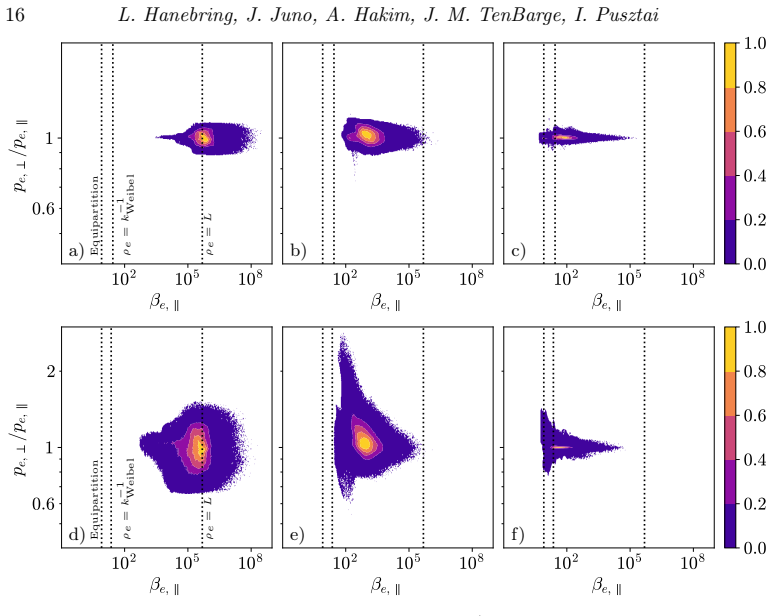
Bridging the spatiotemporal scales of magnetic seed field generation and subsequent dynamo amplification in the weakly collisional intracluster medium presents an extreme numerical challenge. We perform collisionless turbulence simulations with initially unmagnetized electrons that capture both magnetic seed generation via the electron Weibel instability and the ensuing dynamo amplification. Going beyond existing pair-plasma studies, we use an ion-to-electron mass ratio of 100 for which we find electron and ion dynamics are sufficiently decoupled. These simulations are enabled by the 10-moment collisionless fluid solver of Gkeyll, which evolves the full pressure tensor for all species. The electron heat-flux closure regulates pressure isotropization and effectively sets the magnetic Reynolds number. We investigate how the strength of the closure influences the transition between a regime reminiscent of previous kinetic pair-plasma simulations and a regime exhibiting dynamo behavior qualitatively similar to magnetohydrodynamics.
Editorial analysis
A structured set of objections, weighed in public.
Referee Report
Summary. The paper performs collisionless turbulence simulations with initially unmagnetized electrons using the 10-moment fluid model in Gkeyll at ion-to-electron mass ratio 100. It captures magnetic seed generation via the electron Weibel instability followed by dynamo amplification, and examines how varying the strength of the electron heat-flux closure controls the transition between a regime resembling prior kinetic pair-plasma runs and one exhibiting MHD-like dynamo behavior.
Significance. If the results hold after validation, the work would meaningfully extend kinetic studies of Weibel seeding into the regime of decoupled ions and electrons, offering a potential bridge between microscale seed generation and large-scale dynamo amplification in weakly collisional astrophysical plasmas such as the intracluster medium.
major comments (2)
- [Abstract and closure description] Abstract and § on the 10-moment closure: the statement that the heat-flux closure “regulates pressure isotropization and effectively sets the magnetic Reynolds number” is load-bearing for the central claim of a physical transition, yet the manuscript supplies no first-principles derivation or side-by-side benchmark against Vlasov/PIC data in the same driven-turbulence regime; without such evidence the reported dynamo behavior risks being an artifact of the chosen closure parameters.
- [Results on mass-ratio scan] Results on m_i/m_e = 100: the assertion that “electron and ion dynamics are sufficiently decoupled” at this mass ratio underpins the extension beyond pair-plasma studies, but the text does not report quantitative diagnostics (e.g., separate electron/ion energy spectra, timescale ratios, or cross-species correlation functions) that would confirm decoupling across the simulated range of closure strengths.
minor comments (1)
- [Abstract] The abstract supplies no numerical values for the varied closure strength, achieved Reynolds numbers, or any convergence metrics, which would help readers assess robustness at first reading.
Simulated Author's Rebuttal
We thank the referee for the thoughtful and constructive report. The comments highlight important points regarding validation of the closure and confirmation of species decoupling. We address each major comment below and will revise the manuscript to strengthen the presentation while preserving the core results.
read point-by-point responses
-
Referee: Abstract and § on the 10-moment closure: the statement that the heat-flux closure “regulates pressure isotropization and effectively sets the magnetic Reynolds number” is load-bearing for the central claim of a physical transition, yet the manuscript supplies no first-principles derivation or side-by-side benchmark against Vlasov/PIC data in the same driven-turbulence regime; without such evidence the reported dynamo behavior risks being an artifact of the chosen closure parameters.
Authors: The heat-flux closure in the 10-moment model is a standard component of the Gkeyll fluid solver, derived from moment closures that approximate kinetic effects by controlling the rate of pressure isotropization (see prior references on the model). The observed transition in dynamo behavior with varying closure strength is a direct outcome of the simulations and reflects how the effective magnetic Reynolds number is modulated within this framework. We acknowledge that a dedicated first-principles derivation is not repeated here and that side-by-side Vlasov/PIC benchmarks in the identical driven-turbulence setup are absent. In revision we will expand the closure section with additional physical motivation drawn from the literature, explicitly state the model assumptions, and add a limitations paragraph noting that full kinetic validation in this regime is left for future work. This addresses the concern without altering the reported findings. revision: partial
-
Referee: Results on m_i/m_e = 100: the assertion that “electron and ion dynamics are sufficiently decoupled” at this mass ratio underpins the extension beyond pair-plasma studies, but the text does not report quantitative diagnostics (e.g., separate electron/ion energy spectra, timescale ratios, or cross-species correlation functions) that would confirm decoupling across the simulated range of closure strengths.
Authors: We agree that explicit quantitative diagnostics would better substantiate the decoupling claim. In the revised manuscript we will add panels and analysis showing separate electron and ion energy spectra, timescale ratios (including electron-to-ion response time comparisons), and cross-species correlation functions evaluated across the explored closure strengths. These additions will confirm that at m_i/m_e = 100 the species remain dynamically decoupled throughout the runs. revision: yes
Circularity Check
No circularity: results follow from explicit simulation parameters and closure choice
full rationale
The paper reports outcomes of direct numerical simulations in the 10-moment Gkeyll solver with stated initial conditions, mass ratio m_i/m_e=100, and an explicit electron heat-flux closure. No derivation reduces a claimed prediction to a quantity fitted from the same run, no uniqueness theorem is invoked via self-citation, and no ansatz is smuggled through prior work. The transition between Weibel-seeded and dynamo-like regimes is presented as a numerical finding controlled by the chosen closure strength, without any self-referential redefinition of inputs as outputs.
Axiom & Free-Parameter Ledger
free parameters (1)
- heat-flux closure strength
axioms (1)
- domain assumption The 10-moment collisionless fluid solver of Gkeyll accurately evolves the full pressure tensor for electrons and ions at mass ratio 100.
Lean theorems connected to this paper
-
IndisputableMonolith/Cost/FunctionalEquation.leanwashburn_uniqueness_aczel unclear?
unclearRelation between the paper passage and the cited Recognition theorem.
The electron heat-flux closure regulates pressure isotropization and effectively sets the magnetic Reynolds number... ∂qjkl,α/∂xl = k0,α vth,α/√2 (pjk,α − pα δjk)
-
IndisputableMonolith/Foundation/AlexanderDuality.leanalexander_duality_circle_linking unclear?
unclearRelation between the paper passage and the cited Recognition theorem.
We perform collisionless turbulence simulations... mass ratio of 100... 10-moment collisionless fluid solver of Gkeyll
What do these tags mean?
- matches
- The paper's claim is directly supported by a theorem in the formal canon.
- supports
- The theorem supports part of the paper's argument, but the paper may add assumptions or extra steps.
- extends
- The paper goes beyond the formal theorem; the theorem is a base layer rather than the whole result.
- uses
- The paper appears to rely on the theorem as machinery.
- contradicts
- The paper's claim conflicts with a theorem or certificate in the canon.
- unclear
- Pith found a possible connection, but the passage is too broad, indirect, or ambiguous to say the theorem truly supports the claim.
Reference graph
Works this paper leans on
-
[1]
Bale, S. D., Kasper, J. C., Howes, G. G., Quataert, E., Salem, C. & Sundkvist, D.2009 Magnetic fluctuation power near proton temperature anisotropy instability thresholds in the solar wind.Phys. Rev. Lett.103, 211101. Barbour, Nathaniel, Dorland, William, Abel, Ian G. & Landreman, Matt2025 From Weibel seeds to collisionless dynamos beyond pair-plasmas17 M...
work page 2009
-
[2]
Gallow ay, D. J. & Proctor, M. R. E.1992 Numerical calculations of fast dynamos in smooth velocity fields with realistic diffusion.Nature356(6371), 691–693. Gary, S Peter1993Cambridge atmospheric and space science series: Theory of space plasma microinstabilities. Cambridge, England: Cambridge University Press. Govoni, Federica & Feretti, Luigina2004 Magn...
-
[3]
Hammett, Gregory W. & Perkins, Francis W.1990 Fluid moment models for landau damping with application to the ion-temperature-gradient instability.Phys. Rev. Lett. 64, 3019–3022. Helander, P., Strumik, M. & Schekochihin, A. A.2016 Constraints on dynamo action in plasmas.Journal of Plasma Physics82(6), 905820601. Huang, Ziyu, Dong, Chuanfei & W ang, Liang20...
work page 1990
-
[4]
Kato, Tsunehiko N.2005Saturationmechanismoftheweibelinstabilityinweaklymagnetized plasmas.Physics of Plasmas12(8), 080705. 18L. Hanebring, J. Juno, A. Hakim, J. M. TenBarge, I. Pusztai Kato, Tsunehiko N. & Takabe, Hideaki2008 Nonrelativistic collisionless shocks in unmagnetized electron-ion plasmas.The Astrophysical Journal681(2), L93. Komarov, S., Scheko...
work page 2018
-
[5]
& Hara, K.2025 Ten-moment fluid modeling of the weibel instability
Kuldinow, D.A. & Hara, K.2025 Ten-moment fluid modeling of the weibel instability. Journal of Plasma Physics91(2), E66. Kulsrud, Russell M. & Zweibel, Ellen G.2008 On the origin of cosmic magnetic fields. Reports on Progress in Physics71(4), 046901. Kunz, Matthew W., Schekochihin, Alexander A. & Stone, James M.2014 Firehose and mirror instabilities in a c...
work page 2025
-
[6]
Larmor, J.1919 Possible rotational origin of magnetic fields of sun and earth.Engineering Review108, 461ff. LeVeque, Randall J.1997 Wave propagation algorithms for multidimensional hyperbolic systems.Journal of Computational Physics131(2), 327–353. Liu, Zhuo, Zhou, Muni & Loureiro, Nuno F.2025 Suppression of inverse magnetic energy transfer in collisionle...
work page 1919
-
[7]
Medvedev, Mikhail V., Sil v a, Luis O. & Kamionkowski, Marc2006 Cluster magnetic fields from large-scale structure and galaxy cluster shocks.The Astrophysical Journal 642(1), L1. Mikhailovskii, A. B.1980 Oscillations of an isotropic relativistic plasma.Plasma Physics 22(2),
work page 1980
-
[8]
Ng, Jonathan, Hakim, Ammar, Bhattacharjee, A., Stanier, Adam & Daughton, W. 2017 Simulations of anti-parallel reconnection using a nonlocal heat flux closure.Physics of Plasmas24(8), 082112. Ng, Jonathan, Hakim, A., W ang, L. & Bhattacharjee, A.2020 An improved ten-moment closure for reconnection and instabilities.Physics of Plasmas27(8), 082106. Porter, ...
work page 2017
-
[9]
Pucci, F., Viviani, M., V alentini, F., Lapenta, G., Matthaeus, W. H. & Ser vidio, S.2021 Turbulent magnetogenesis in a collisionless plasma.The Astrophysical Journal Letters922(1), L18. Pusztai, Istv án, Juno, James, Brandenburg, Axel, TenBarge, Jason M., Hakim, Ammar, Francisquez, Manaure & Sundström, Andréas2020 Dynamo in weakly collisional nonmagnetiz...
-
[10]
Schoeffler, K. M., Loureiro, N. F., Fonseca, R. A. & Sil v a, L. O.2014 Magnetic-field generation and amplification in an expanding plasma.Phys. Rev. Lett.112, 175001. Schubert, G. & Soderlund, K.M.2011 Planetary magnetic fields: Observations and models. Physics of the Earth and Planetary Interiors187(3), 92–108, special Issue: Planetary Magnetism, Dynamo...
work page 2014
-
[11]
W ang, Liang, Hakim, Ammar H., Bhattacharjee, A. & Germaschewski, K.2015 Comparison of multi-fluid moment models with particle-in-cell simulations of collisionless magnetic reconnection.Physics of Plasmas22(1), 012108. W ang, Liang, Hakim, Ammar H., Ng, Jonathan, Dong, Chuanfei & Germaschewski, Kai2020 Exact and locally implicit source term solvers for mu...
-
[12]
Zhura vlev a, I., Churazov, E., Schekochihin, A. A., Allen, S. W., Vikhlinin, A. & Werner, N.2019 Suppressed effective viscosity in the bulk intergalactic plasma.Nature Astronomy3(9), 832–837
work page 2019
discussion (0)
Sign in with ORCID, Apple, or X to comment. Anyone can read and Pith papers without signing in.