REVIEW 3 major objections 4 minor 1 cited by
Market Making and Transient Impact in Spot FX
T0 review · 3 major / 4 minor · reviewed 2026-08-03 · deepseek-v4-flash
Pith's one-line read The paper claims that an FX dealer's optimal quoting and hedging policy changes when market impact decays exponentially rather than persisting forever, with quote skew and the internalization boundary depending linearly on the impact state,
desk verdict The B0 = β/(β+ω) formula is a clean and potentially useful closed-form correction for resilient impact, but the headline P&L benefit rests on one hand-picked parameter regime and an in-sample comparison. read the letter →
The pith
A machine-rendered reading of the paper's core claim, the machinery that carries it, and where it could break.
The reading
What carries the argument
The key object is the resilient impact state x_t, defined by dS_t = sigma dW_t + dx_t, dx_t = (-beta x_t + k v_t) dt, a single-exponential decay mechanism of the Obizhaeva-Wang type. The parameter beta sets how quickly a hedge trade's price effect fades, and the quadratic ansatz V = -A q^2 - B q x reduces the HJB equation to a Riccati system whose stationary solution gives the ratio B0 = beta/(beta + omega). This ratio is the load-bearing identity: it measures impact resilience against inventory risk relaxation and determines both how strongly quotes respond to x and how the execution boundary tilts in the (q,x) plane.
What would settle it
Measure the post-trade mid-price response to a dealer-sized FX interbank hedge (say 10–50 million notional), fit its decay rate beta and impact coefficient k, and compute the implied B0 = beta/(beta + omega). If the fitted beta is far from the band around omega = 560 day^-1, the paper's predicted dependence of optimal quotes on x and the P&L gain on large shocks will not materialize; a clean negative result would be impact that decays in seconds rather than minutes, leaving the internalization boundary nearly independent of x.
Extended reading notes
Core claim
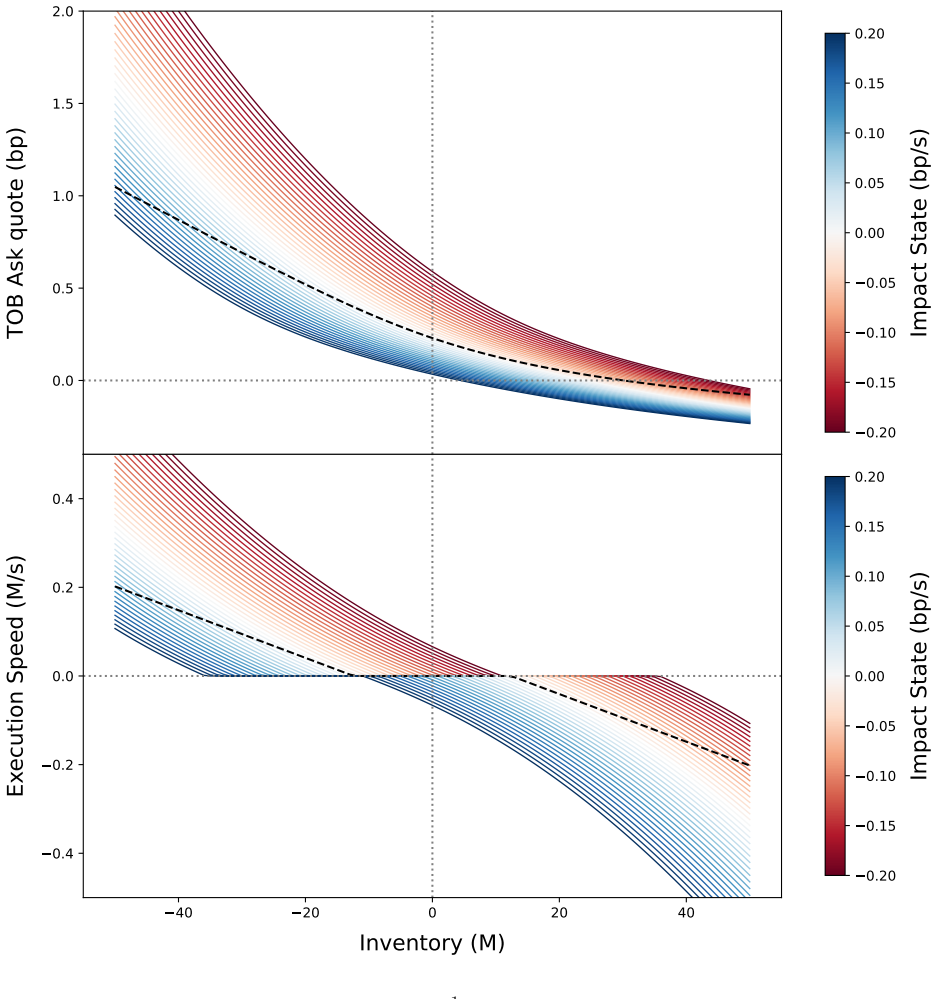
In the stationary quadratic approximation of the dealer's HJB problem with state dynamics dS_t = sigma dW_t + dx_t, dx_t = (-beta x_t + k v_t) dt, the cross-term coefficient is B0 = beta/(beta + omega). Consequently the optimal bid/ask quotes take the form delta^{n,*}_{b/a}(q,x) = delta^n_0 + (A0/c_n)(Delta_n ± 2q) ± (B0/c_n)x, and optimal hedging is activated when |-(2A0 - k(1-B0))q - B0 x| exceeds the per-unit hedging cost psi. This means the boundary of the no-hedge internalization zone is no longer a fixed inventory level but a line in the (q,x) plane, because a positive impact state acts as a price predictor that partially offsets inventory risk. The paper verifies by numerical HJB solu
Load-bearing premise
The results rest on the assumption that FX interbank impact decays as a single exponential with the rate beta fixed by hand to about 1000 day^-1, set to be comparable to the dealer's inventory relaxation rate omega of about 560 day^-1; if real impact decays much faster or much slower than inventory risk, the predicted shift in the internalization zone and the P&L benefit would shrink or disappear.
Editorial extensions
If this is right
- With transient impact, optimal quote skew becomes linear in the impact state: a dealer who recently hedged should quote differently until the impact decays.
- The pure internalization zone becomes a slanted region in (q,x) rather than a fixed inventory threshold; hedging turns on or off depending on whether the impact state points with or against current inventory risk.
- The stationary ratio B0 = beta/(beta + omega) interpolates between the permanent-impact limit (beta -> 0, B0 -> 0) and the fast-relaxation limit (beta -> infinity, B0 -> 1), so the model nests Almgren-Chriss as a special case.
- Optimizing with transient impact rather than permanent impact raises expected P&L after a large inventory shock, with the benefit concentrated in exactly the large trades that desks monitor most closely.
Reading between the lines
- A direct, testable extension: estimate beta from post-hedge price decay in an FX interbank feed and compare it with the implied omega = sigma sqrt(2 gamma xi); the quoted B0 then makes a quantitative prediction for how much quote skew should respond to recent hedge flow.
- The same quadratic treatment should carry over to multiple dealers or multiple currencies, with the scalar ratio beta/(beta + omega) becoming a matrix resolvent; the qualitative prediction would be that cross-impact persistence directs hedging flows toward instruments whose impact decays most slowly.
- Because the paper fixes beta by hand, the practical policy rule can be made adaptive: a desk that estimates beta online from post-trade price moves can toggle between permanent-impact and transient-impact quoting, and the value of doing so is concentrated where desks already focus risk attention — large client trades.
- Internalized client flow itself skews quotes and may create a transient external impact through price reading, so a closed-loop extension would couple the impact state to the dealer's own quote flow, not just its hedge flow.
Editorial analysis
A structured set of objections, weighed in public.
Referee Report
Summary. The paper studies optimal market making for an FX dealer who can internalize client flow and hedge in the interbank market, extending the Almgren-Chriss execution framework to exponentially decaying (transient) market impact. The dealer's state is (inventory, impact), with impact dynamics dx = (-βx + kv)dt. The paper derives the HJB equation, obtains an approximate stationary quadratic solution, and reports the key result B0 = β/(β+ω) (Eq. 17), leading to quote corrections linear in the impact state (Eq. 18) and a state-dependent internalization boundary (Eq. 19). A JAX-based numerical solution and Monte Carlo simulations illustrate optimal controls and a P&L benefit after a large inventory shock when the optimizer accounts for transient rather than permanent impact.
Significance. The theoretical core is coherent: the Riccati derivation is internally consistent, Eq. (17) is the correct stationary solution under the stated quadratic ansatz, and the paper provides a useful closed-form benchmark for a class of dealer models with resilient impact. The numerical JAX solver is a practical contribution and adds independent support beyond the approximation. However, the paper's central performance claim is not yet established as an FX result: the only numerical illustration uses one parameter set, the impact decay rate β is chosen by hand, and the comparison is in-sample. If the B0 = β/(β+ω) regime is not empirically relevant, the claimed benefit disappears. The paper is therefore a sound theoretical contribution whose empirical significance remains conditional on calibration and sensitivity analysis.
major comments (3)
- [§4, Eq. (17), Figure 3] The central performance claim rests on a single parameter set with β = 1000 day^-1 ≈ 1.8ω, chosen 'intentionally' rather than calibrated to FX data. Since B0 = β/(β+ω) controls the entire effect — the quote shift in Eq. (18) and the internalization boundary in Eq. (19) — no quantitative conclusion about FX can be drawn without a sensitivity sweep in β/ω (e.g., 0.1 to 10) and, ideally, an empirical estimate or cited bounds for the impact decay timescale. As written, the 'clear performance benefit' is an illustration of a specific regime, not a robust FX result.
- [§4, Figure 3] The performance comparison is in-sample: both the transient-impact-optimized and the Almgren-Chriss-optimized policies are simulated under the same transient-impact model with β = 1000 day^-1. The AC policy is therefore evaluated on a world that contradicts its own assumptions, so the P&L gap measures the cost of model misspecification under the paper's assumptions, not a measured empirical advantage. The claim should be reframed accordingly. In addition, the single Monte Carlo run with 10^4 paths has no error bars or confidence intervals; at minimum, report standard errors for the P&L difference.
- [§3, Eqs. (16)-(19)] The quadratic ansatz neglects H_E and the x^2 term, and the text acknowledges that the approximation 'deviates for larger inventories, as expected.' Figure 3 uses a 50M inventory shock, exactly the large-inventory regime where these neglected terms are most active. Therefore the closed-form formulas (17)-(19) cannot by themselves justify the numerical benefit claim; the paper should explicitly state that the P&L result is a numerical finding and quantify the approximation error, e.g., by also simulating the approximate controls and comparing with the exact HJB controls in Figure 3.
minor comments (4)
- [References] Typos: 'Jamingual' should be 'Jaimungal' in Cartea et al. (2015); 'Szymansk' appears truncated in Durin et al. (2023).
- [§2] The phrase in the Introduction, 'We begin by demonstrating that OTC trading implies a propagator-type impact,' overstates the status of Section 2: the 'demonstration' is an internal consequence of the Avellaneda-Stoikov quoting model, not an empirical measurement of transient impact. The paper itself later notes this is 'an internal transient impact,' so the language in the abstract/introduction should be aligned.
- [§3, footnote 5] The statement that the x^2 term is 'small' is asserted without quantitative justification. Given that the numerical examples reach impact states of order 0.04 bp and inventories of 50M, the relative size of x^2 versus the retained q^2 and qx terms should be checked or stated.
- [§4, Figure 3] The caption reports only that 10^4 trajectories were used; it does not state the time step, the terminal horizon, or whether the plotted quantities are pathwise means. Please include these details.
Circularity Check
No significant circularity; the paper's central Riccati derivation is self-contained, and the numerical comparison is an explicit in-model illustration rather than a fitted prediction.
full rationale
The algebraic core is not circular. Equation (17), B0 = β/(β+ω), is obtained by matching the qx-coefficient in the stationary HJB system under the stated quadratic ansatz V(t,q,x) = -A(t)q^2 - B(t)qx - C(t); it is a solved quantity, not an assumed one. The paper even notes that the neglected x^2 term is small and the execution Hamiltonian is dropped in the value-function approximation, which are approximations rather than hidden restatements of the conclusion. Section 2's 'demonstration' that the dealer's optimal quotes relax after an inventory shock is a logical consequence of the same market-making model (Eqs. 4-9), not an external empirical input used to fit the impact state in Section 3; the quote 'This is essentially an OTC equivalent of the Obizhaeva-Wang (2013) model' is an interpretation of that internal consequence, not a redefinition of the target result. The transient-impact state dx=(-βx+kv)dt is adopted as a stated assumption, motivated by standard references (Obizhaeva-Wang; Bouchaud et al.), and with transparent parameter choice: 'β = 1000 day^-1' is 'intentionally chosen to be comparable to the risk relaxation time', i.e., a parameter choice, not a fitted value renamed as a prediction. The performance comparison in Figure 3 is explicitly in-model: 'We compare the performance of optimal controls with transient impact to those with permanent impact (i.e., HJB is solved with β=0), even though the underlying impact is transient in both cases.' This is a controlled computational experiment showing consistency of the derived controls with the model's own dynamics; if it were presented as an empirical validation of FX impact, the lack of calibrated β and the absence of error bars would be a serious correctness/relevance risk, but that is not circularity. Self-citations (Barzykin et al. 2023, 2025) are used either to state modeling conventions already written in the paper or as an auxiliary remark on price reading; they are not load-bearing uniqueness theorems and are not the basis of Eq. (17). The paper also self-limits its claim by saying 'if large trades are rare... the Almgren-Chriss model can be a reasonable approximation after all,' which further confirms that the contribution is a conditional model analysis, not a data-derived prediction. No quoted equation reduces to its own input by construction, and no fitted parameter is relabeled as a forecast. Hence no significant circularity.
Assumptions & free parameters
free parameters (6)
- impact decay rate β =
1000 day^-1
- impact coefficient k =
0.005 bp/M
- transaction cost parameters ψ and η =
ψ=0.2 bp, η=1.5 bp·s/M
- risk aversion γ and volatility σ =
γ=10^-3 bp^-1 M^-1, σ=100 bp/day
- client intensity parameters λ0_n, a_n, b_n =
λ0_n=(2000,800,600,400,100,50) day^-1; a_n=-1; b_n=7 bp^-1
- size ladder Δn =
(1,2,5,10,20,50) M notional
assumptions (5)
- domain assumption Mid-price follows driftless Brownian motion
- domain assumption Client arrivals are Poisson with side-symmetric intensity λn(δ)
- domain assumption Hedging impact follows Obizhaeva-Wang exponential decay: dx=(-βx+kv)dt
- domain assumption Linearity of market impact ensures no dynamic arbitrage
- ad hoc to paper Quadratic value function ansatz with H_E and x^2 terms neglected
Cite this review
Pith. "Pith review of Market Making and Transient Impact in Spot FX." pith.science (2026). https://pith.science/paper/Z3K37AC6
@misc{pith2026260113421,
  author       = {Pith},
  title        = {Pith review of: Market Making and Transient Impact in Spot FX},
  year         = {2026},
  howpublished = {\url{https://pith.science/paper/Z3K37AC6}},
  note         = {Machine review of arXiv:2601.13421}
}
read the original abstract
Dealers in foreign exchange markets provide bid and ask prices to their clients at which they are happy to buy and sell, respectively. To manage risk, dealers can skew their quotes and hedge in the interbank market. Hedging offers certainty but comes with transaction costs and market impact. Optimal market making with execution has previously been addressed within the Almgren-Chriss market impact model, which includes instantaneous and permanent components. However, there is overwhelming empirical evidence of the transient nature of market impact, with instantaneous and permanent impacts arising as the two limiting cases. In this note, we consider an intermediate scenario and study the interplay between risk management and impact resilience.
Figures


Forward citations
Cited by 1 Pith paper
-
Hawkes-Driven OTC Market Making: Volterra-Riccati Approximation
A Volterra-Riccati approximation lets OTC market makers incorporate Hawkes-type persistence in RFQ flow into quote decisions, tracking the exact solution in exponential benchmarks and producing endogenous long-memory ...
Reference graph
Works this paper leans on
-
[1]
and Chriss, N., Optimal execution of portfolio transactions
Almgren, R. and Chriss, N., Optimal execution of portfolio transactions. J. Risk , 2001, 3 , 5--40
2001
-
[2]
and Stoikov, S., High-frequency trading in a limit order book
Avellaneda, M. and Stoikov, S., High-frequency trading in a limit order book. Quant. Finance , 2008, 8 , 217--224
2008
-
[3]
and Guéant, O., Algorithmic market making in dealer markets with hedging and market impact
Barzykin, A., Bergault, P. and Guéant, O., Algorithmic market making in dealer markets with hedging and market impact. Math. Finance , 2023, 33 , 41--79
2023
-
[4]
and Lemmel, M., Optimal Quoting under Adverse Selection and Price Reading, 2025
Barzykin, A., Bergault, P., Guéant, O. and Lemmel, M., Optimal Quoting under Adverse Selection and Price Reading, 2025. Available online at: https://arxiv.org/abs/2508.20225 (accessed 19 December 2025)
arXiv 2025
-
[5]
and Vieira, D., Closed-form approximations in multi-asset market making
Bergault, P., Evangelista, D., Guéant, O. and Vieira, D., Closed-form approximations in multi-asset market making. Appl. Math. Finance , 2021, 28 , 101--142
2021
-
[6]
and Guéant, O., Size matters for otc market makers: general results and dimensionality reduction techniques
Bergault, P. and Guéant, O., Size matters for otc market makers: general results and dimensionality reduction techniques. Math. Finance , 2021, 31 , 279--322
2021
-
[7]
and Gould, M., Trades, Quotes and Prices: Financial Markets Under the Microscope , 2018 (Cambridge University Press: Cambridge, United Kingdom)
Bouchaud, J.-P., Bonart, J., Donier, J. and Gould, M., Trades, Quotes and Prices: Financial Markets Under the Microscope , 2018 (Cambridge University Press: Cambridge, United Kingdom)
2018
-
[8]
and Bouchaud, J.-P., Crossover from Linear to Square-Root Market Impact
Bucci, F., Benzaquen, M., Lillo, F. and Bouchaud, J.-P., Crossover from Linear to Square-Root Market Impact. Phys. Rev. Lett. , 2019, 122 , 108302
2019
Show all 22 references
-
[9]
and Oomen, R., Internalisation by electronic fx spot dealers
Butz, M. and Oomen, R., Internalisation by electronic fx spot dealers. Quant. Finance , 2019, 19 , 35--56
2019
-
[10]
and Ricci, J., Buy low, sell high: A high frequency trading perspective
Cartea, \'A , Jaimungal, S. and Ricci, J., Buy low, sell high: A high frequency trading perspective. SIAM J. Financ. Math. , 2014, 5 , 415--444
2014
-
[11]
and Penalva, J., Algorithmic and High Frequency Trading , 2015 (Cambridge University Press: Cambridge, United Kingdom)
Cartea, \'A , Jamingual, S. and Penalva, J., Algorithmic and High Frequency Trading , 2015 (Cambridge University Press: Cambridge, United Kingdom)
2015
-
[12]
and Szymansk, G., The two square root laws of market impact and the role of sophisticated market participants, 2023
Durin, B., Rosenbaum, M. and Szymansk, G., The two square root laws of market impact and the role of sophisticated market participants, 2023. Available online at: https://arxiv.org/abs/2311.18283 (accessed 19 December 2025)
2023 arXiv
-
[13]
and Bouchaud, J.-P., Price impact without order book: A study of the OTC credit index market, 2016
Eisler, Z. and Bouchaud, J.-P., Price impact without order book: A study of the OTC credit index market, 2016. Available online at: https://arxiv.org/abs/1609.04620 (accessed 19 December 2025)
2016 arXiv
-
[14]
Gatheral, J., No-Dynamic-Arbitrage and Market Impact. Quant. Finance , 2010, 10 , 749--759
2010
-
[15]
and Fernandez-Tapia, J., Dealing with the inventory risk: a solution to the market making problem
Guéant, O., Lehalle, C.-A. and Fernandez-Tapia, J., Dealing with the inventory risk: a solution to the market making problem. Math. Financ. Econ. , 2013, 7 , 477--507
2013
-
[16]
Guéant, O., The Financial Mathematics of Market Liquidity: From optimal execution to market making , 2016 (Chapman and Hall/CRC: Boca Raton, FL)
2016
-
[17]
and Webster, K., The cost of misspecifying price impact, 2023
Hey, N., Bouchaud, J.-P., Mastromatteo, I., Muhle-Karbe, J. and Webster, K., The cost of misspecifying price impact, 2023. Available online at: https://arxiv.org/abs/2306.00599 (accessed 19 December 2025)
2023 arXiv
-
[18]
and Vo , M., Optimal Signal-Adaptive Trading with Temporary and Transient Price Impact
Neuman, E. and Vo , M., Optimal Signal-Adaptive Trading with Temporary and Transient Price Impact. SIAM J. Financ. Math. , 2022, 13 , 551--575
2022
-
[19]
and Wang, J., Optimal trading strategy and supply/demand dynamics
Obizhaeva, A.A. and Wang, J., Optimal trading strategy and supply/demand dynamics. J. Financ. Mark. , 2013, 16 , 1--32
2013
-
[20]
and Kanazawa, K., Strict universality of the square-root law in price impact across stocks: A complete survey of the Tokyo stock exchange
Sato, Y. and Kanazawa, K., Strict universality of the square-root law in price impact across stocks: A complete survey of the Tokyo stock exchange. Phys. Rev. Lett. , 2025, 135 , 257401
2025
-
[21]
and Bouchaud, J.-P., Anomalous price impact and the critical nature of liquidity in financial markets
T\'oth, B., Lemp\'eri\`ere, Y., Deremble, C., De Lataillade, J., Kockelkoren, J. and Bouchaud, J.-P., Anomalous price impact and the critical nature of liquidity in financial markets. Phys. Rev. X , 2011, 1 , 021006
2011
-
[22]
Handbook of Price Impact Modeling , 2023 (Chapman and Hall/CRC: Boca Raton, FL)
Webster, K. Handbook of Price Impact Modeling , 2023 (Chapman and Hall/CRC: Boca Raton, FL)
2023
Reviewed August 3, 2026 · model on record in the stance chip above.
Discussion (0). Continue with ORCID to comment.