100-Billion-Atom Molecular Dynamics Simulation of Acoustic Cavitation in a Simple Liquid
Pith reviewed 2026-05-16 12:59 UTC · model grok-4.3
The pith
A 100-billion-atom simulation reveals cavitation bubbles forming clusters that split and merge in sync with ultrasonic oscillations near the horn, with minimal impact on sound wave properties.
A machine-rendered reading of the paper's core claim, the machinery that carries it, and where it could break.
Core claim
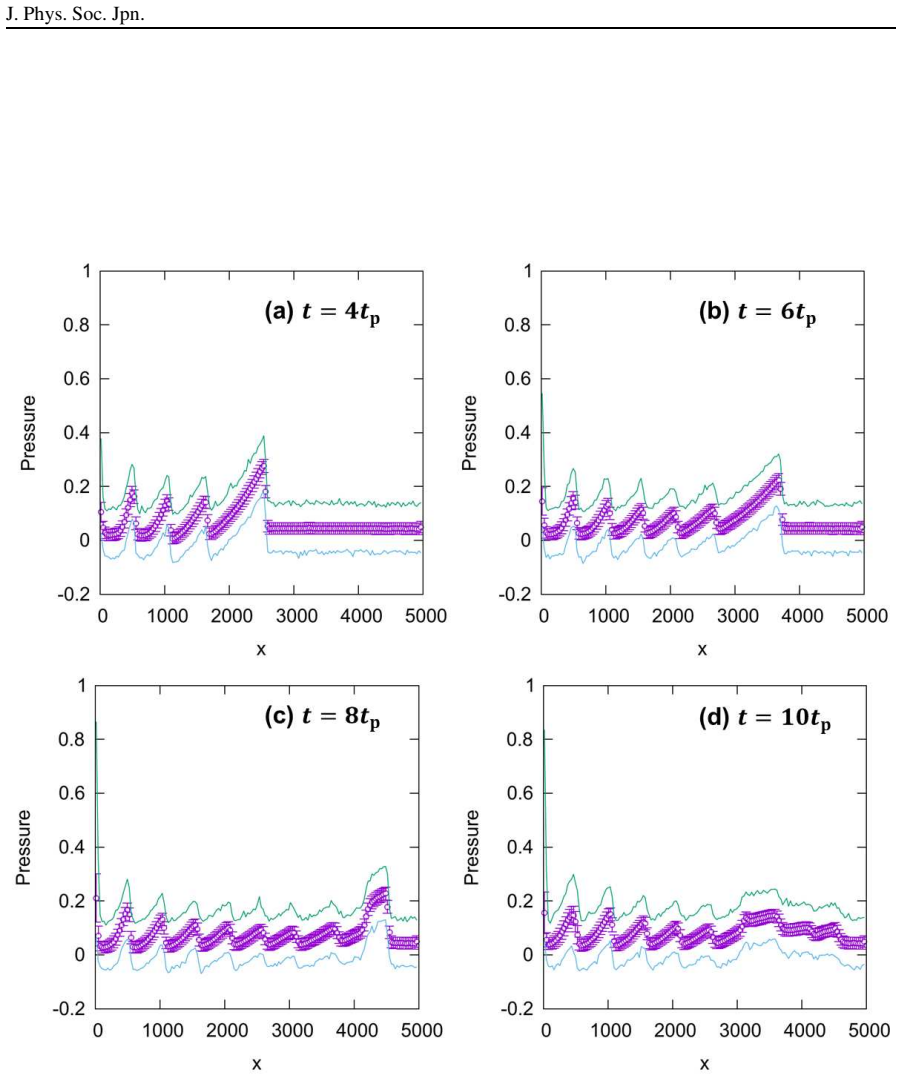
In a molecular dynamics simulation of approximately 100 billion atoms representing a simple liquid subjected to ultrasonic waves from a horn, cavitation bubbles nucleate and grow near the horn surface. These bubbles coalesce into a single large cluster that repeatedly fragments into multiple smaller clusters and subsequently merges, with this cycle synchronized to the horn's oscillation period. During the fragmentation phases, both pressure and temperature within the bubbles increase sharply. The amplitudes of these oscillations vary on timescales exceeding the driving period, indicating subharmonic behavior. Despite the presence of these bubbles, the propagation characteristics of the acous
What carries the argument
The 100-billion-atom molecular dynamics simulation, which enables direct observation of multi-bubble cluster formation, splitting, and merging that smaller simulations could not capture.
Load-bearing premise
The classical interatomic potentials and finite system size used here faithfully reproduce real multi-bubble cavitation dynamics without major artifacts from the model choices or boundaries.
What would settle it
Re-running the simulation with a different interatomic potential or substantially larger system size and checking whether the periodic cluster splitting-merging cycle and subharmonic pressure spikes persist would test the findings.
Figures


read the original abstract
A large-scale molecular dynamics (MD) simulation of acoustic cavitation in a simple liquid was performed using the supercomputer Fugaku. The system, consisting of approximately 100 billion atoms, was subjected to ultrasonic irradiation. Direct observation of multi-bubble dynamics has been challenging in both experimental measurements and conventional numerical fluid mechanics simulations. Moreover, previous MD simulations involving only hundreds of millions of atoms were unable to generate multiple bubbles within a system. Our results reveal that cavitation bubbles nucleate and grow near the ultrasonic horn, forming a large bubble cluster that periodically splits into multiple small clusters and subsequently merges again. This cycle is synchronized with the oscillation period of the horn. Pressure and temperature inside the bubbles exhibit sharp increases during cluster fragmentation, and their oscillation amplitudes vary on a timescale longer than the driving period of the horn, indicating the presence of subharmonic behavior consistent with experimental observations. Despite bubble formation, the effect on the acoustic properties of the sound wave was almost negligible, indicating that cavitation near the horn surface has limited influence on bulk acoustic properties. These findings provide new insights into the molecular-scale mechanisms of cavitation and offer guidance for optimizing ultrasonic systems in chemical and biomedical applications. Future work will focus on quantifying long-period oscillations, analyzing attenuation effects, and extending simulations to complex fluids.
Editorial analysis
A structured set of objections, weighed in public.
Referee Report
Summary. The manuscript reports results from a 100-billion-atom molecular dynamics simulation of acoustic cavitation in a simple liquid under ultrasonic irradiation by a horn. It claims that bubbles nucleate and grow near the horn to form a large cluster that periodically splits into smaller clusters and merges again in synchrony with the driving oscillation; that pressure and temperature inside bubbles show sharp increases during fragmentation; that bubble-property oscillations exhibit subharmonic behavior consistent with experiments; and that bubble formation has negligible effect on bulk acoustic properties of the sound wave.
Significance. If the chosen classical potential and boundary conditions faithfully reproduce real-liquid cavitation thresholds and growth rates, the direct observation of multi-bubble cluster dynamics at this scale would supply molecular-level mechanistic insight unavailable from continuum simulations or smaller MD runs. The reported synchronization of cluster splitting/merging with the driving period and the negligible acoustic attenuation are potentially useful for ultrasonic-process design.
major comments (2)
- Abstract: the claim that subharmonic behavior is 'consistent with experimental observations' is unsupported by any quantitative metric (e.g., power spectrum, amplitude ratio, or comparison to measured Blake threshold or growth rate), which is load-bearing because cavitation nucleation is exponentially sensitive to the equation of state and surface tension.
- Methods (implied by absence of detail): no convergence tests with respect to system size, timestep, or potential cutoff are reported, nor is the specific interatomic-potential parameterization or driving-amplitude implementation given; without these the reported splitting/merging cycle and internal pressure spikes cannot be distinguished from model artifacts.
minor comments (1)
- Abstract: the final sentence on future work is forward-looking and could be removed to keep the summary focused on present results.
Simulated Author's Rebuttal
We thank the referee for the constructive comments, which help clarify the presentation of our large-scale simulation results. We address each major comment point by point below.
read point-by-point responses
-
Referee: Abstract: the claim that subharmonic behavior is 'consistent with experimental observations' is unsupported by any quantitative metric (e.g., power spectrum, amplitude ratio, or comparison to measured Blake threshold or growth rate), which is load-bearing because cavitation nucleation is exponentially sensitive to the equation of state and surface tension.
Authors: We agree that the abstract claim would be strengthened by quantitative support. The revised manuscript will add a short statement referencing the power spectrum of the internal bubble pressure time series (which exhibits a distinct peak at half the driving frequency) and a direct comparison of the observed nucleation threshold to the Blake threshold computed for the model potential. These additions ground the subharmonic observation in the specific equation of state and surface tension of the simulation. revision: yes
-
Referee: Methods (implied by absence of detail): no convergence tests with respect to system size, timestep, or potential cutoff are reported, nor is the specific interatomic-potential parameterization or driving-amplitude implementation given; without these the reported splitting/merging cycle and internal pressure spikes cannot be distinguished from model artifacts.
Authors: We acknowledge that the current Methods section omits these essential details. The revised manuscript will include the specific interatomic potential parameterization, the precise implementation of the driving amplitude via boundary conditions on the horn, and results of convergence tests (system sizes down to 10^10 atoms, multiple timesteps, and cutoff radii) demonstrating that the cluster splitting/merging cycle and internal pressure spikes remain unchanged. These additions will confirm the robustness of the reported phenomena. revision: yes
Circularity Check
No circularity: results are direct simulation outputs
full rationale
The paper reports direct outputs from a 100-billion-atom molecular dynamics simulation under ultrasonic driving. No mathematical derivation chain exists that reduces any claimed prediction or first-principles result to its own inputs by construction. Bubble nucleation, cluster splitting/merging, internal pressure spikes, and subharmonic behavior are stated as simulation observations, not quantities fitted or defined in terms of themselves. Any self-citations (none load-bearing in the provided text) support methodology but do not close a loop on the central claims. The work is self-contained as a large-scale computational experiment.
Axiom & Free-Parameter Ledger
free parameters (2)
- ultrasonic driving frequency and amplitude
- interatomic potential parameters for the simple liquid
axioms (2)
- domain assumption Classical molecular dynamics with pairwise potentials accurately captures nucleation, growth, and cluster dynamics of cavitation bubbles.
- domain assumption The chosen system size and periodic or boundary conditions do not introduce significant finite-size artifacts into the observed cluster behavior.
Lean theorems connected to this paper
-
IndisputableMonolith/Cost/FunctionalEquation.leanwashburn_uniqueness_aczel unclear?
unclearRelation between the paper passage and the cited Recognition theorem.
intermolecular interactions were represented by the smoothed-cutoff Lennard-Jones (sLJ) potential... local temperature Ti... density ρi... pressure pi via virial theorem... gas-phase subcells connected through any of the 26 neighboring subcells... cluster map
-
IndisputableMonolith/Foundation/AlexanderDuality.leanalexander_duality_circle_linking unclear?
unclearRelation between the paper passage and the cited Recognition theorem.
rectangular domain of size Lx × Ly × Lz = 5000 × 6000 × 6000... periodic boundary conditions applied in the y- and z-directions
What do these tags mean?
- matches
- The paper's claim is directly supported by a theorem in the formal canon.
- supports
- The theorem supports part of the paper's argument, but the paper may add assumptions or extra steps.
- extends
- The paper goes beyond the formal theorem; the theorem is a base layer rather than the whole result.
- uses
- The paper appears to rely on the theorem as machinery.
- contradicts
- The paper's claim conflicts with a theorem or certificate in the canon.
- unclear
- Pith found a possible connection, but the passage is too broad, indirect, or ambiguous to say the theorem truly supports the claim.
Reference graph
Works this paper leans on
-
[1]
C. E. Brennen, Cavitation and Bubble Dynamics (Cambridge University Press, Cam- bridge, 2014)
work page 2014
-
[2]
R. W. Wood and A. L. Loomis, Philos. Mag. 4, 417 (1927)
work page 1927
-
[3]
W. T. Richards and A. L. Loomis, J. Am. Chem. Soc. 49, 3086 (1927)
work page 1927
-
[4]
G. Lajoinie, I. De Cock, C. C. Coussios, I. Lentacker, S. Le Gac, E. Stride, and M. V er- sluis, Biomicrofluidics 10, 011501 (2016)
work page 2016
-
[5]
M. V ersluis, E. Stride, G. Lajoinie, B. Dollet, and T. Sege rs, Ultrasound Med. Biol. 46, 2117 (2020)
work page 2020
- [6]
-
[7]
Z. Xiao, T. B. Aftab, and D. Li, Micro Nano Lett. 14, 782 (2019)
work page 2019
- [8]
-
[9]
H. E. Hansen, F. Seland, S. Sunde, O. S. Burheim, and B. G. Po llet, Ultrason. Sonochem. 85, 105991 (2022)
work page 2022
- [10]
-
[11]
K. Ferrara, R. Pollard, and M. Borden, Annu. Rev. Biomed. Eng. 9, 415 (2007)
work page 2007
-
[12]
S. Roovers, T. Segers, G. Lajoinie, J. Deprez, M. V erslui s, S. C. De Smedt, and I. Lentacker, Langmuir 35, 10173 (2019)
work page 2019
- [13]
-
[14]
Z. Ma, C. Bourquard, Q. Gao, S. Jiang, T. De Iure-Grimmel, R. Huo, X. Li, Z. He, Z. Y ang, and G. Y ang, Science377, 751 (2022)
work page 2022
- [15]
-
[16]
K. D. Commander and A. Prosperetti, J. Acoust. Soc. Am. 85, 732 (1989)
work page 1989
- [17]
- [18]
-
[19]
F. J. Trujillo, Ultrason. Sonochem. 47, 75 (2018)
work page 2018
-
[20]
I. Garcia-V argas, L. Barthe, P . Tierce, and O. Louisnard , Ultrason. Sonochem. 91, 106226 (2022). 18/19 J. Phys. Soc. Jpn
work page 2022
-
[21]
E. A. Neppiras, J. Acoust. Soc. Am. 46, 587 (1969)
work page 1969
-
[22]
A. ˇZnidarˇ ciˇ c, R. Mettin, C. Cair´ os, and M. Dular, Phys. Fluids 26, 023301 (2014)
work page 2014
-
[23]
P . Wu, X. Wang, W. Lin, and L. Bai, Ultrason. Sonochem. 82, 105878 (2022)
work page 2022
-
[24]
W. Xu. in Mesoscale Analysis of Hydraulics , (Springer, Singapore, 2020), pp. 7–44
work page 2020
-
[25]
L. Biasiori-Poulanges, C. Bourquard, B. Luki´ c, L. Broc he, and O. Supponen, Ultrason. Sonochem. 92, 106286 (2023)
work page 2023
-
[26]
T. J. Tiong, J. K. Chu, and K. W. Tan, Ultrason. Sonochem. 112, 107163 (2025)
work page 2025
-
[27]
X. Bian, S. Litvinov, R. Qian, M. Ellero, and N. A. Adams, P hys. Fluids 24, 012002 (2012)
work page 2012
-
[28]
S. Litvinov, M. Ellero, X. Hu, and N. A. Adams, Phys. Rev. E 77, 066703 (2008)
work page 2008
-
[29]
T. Y e, N. Phan-Thien, C. T. Lim, L. Peng, and H. Shi, Phys. R ev. E 95, 063314 (2017)
work page 2017
- [30]
- [31]
- [32]
- [33]
- [34]
- [35]
-
[36]
A. Moussatov, C. Granger, and B. Dubus, Ultrason. Sonoch em. 10, 191 (2003). 19/19
work page 2003
discussion (0)
Sign in with ORCID, Apple, or X to comment. Anyone can read and Pith papers without signing in.