REVIEW 3 major objections 5 minor 54 references
The Role of Inner Halo Angular Momentum (Spin) in Shaping Dark Matter Bars in Milky Way Analogs
T0 review · 3 major / 5 minor · reviewed 2026-08-03 · deepseek-v4-flash
Pith's one-line read Halo spin sets how strong a dark matter bar grows in disk galaxies.
desk verdict Useful spin-grid extension of the authors' own bar simulations, with a plausible DM-bar/spin trend that needs seed variation and a cleaner measurement description before it can be fully trusted. read the letter →
The pith
A machine-rendered reading of the paper's core claim, the machinery that carries it, and where it could break.
The reading
What carries the argument
The central object is the dark matter bar itself, measured by the m=2 Fourier amplitude A2/A0 of particles within R≤10 kpc and |z|≤3 kpc. The driving mechanism is resonant angular-momentum exchange between the stellar bar and the dark matter halo: the stellar bar loses angular momentum to the halo, and this reshapes inner-halo orbits into a bar-like configuration. The halo spin parameter λ enters as the control knob that sets how efficiently this transfer proceeds, yielding earlier, stronger dark matter bars for higher prograde spin.
What would settle it
A reader could settle the claim by taking one of the paper's simulations (e.g., the λ=0.1 prograde model), computing the m=2 Fourier amplitude using only dark matter particles inside R≤10 kpc, |z|≤3 kpc, and comparing it to the reported values that use the same methodology as the stellar bar measurement; if the dark-matter-only amplitude shows no monotonic increase with spin (or drops to near zero), the paper's core result is an artifact of disk contamination.
Extended reading notes
Core claim
The paper's central claim is that the dark matter bar—a bar-like overdensity that develops in the inner dark matter halo as a dynamical response to the stellar bar—has a long-term strength largely set by the halo's initial spin parameter λ. In a series of idealized Milky Way analog simulations spanning λ=0 to 0.1 (prograde) plus one retrograde model, the dark matter bar's m=2 Fourier amplitude at saturation increases monotonically with prograde spin, whereas the stellar bar's saturation amplitude is nearly spin-independent. The authors also show that stellar bar buckling events impose a temporary dip in dark matter bar strength, from which the bar recovers, ending at a strength higher than b
Load-bearing premise
The central claim rests on the assumption that the m=2 amplitude computed inside R≤10 kpc, |z|≤3 kpc is a clean measure of the halo's own bar; if disk particles contaminate this measurement, the spin-strength trend could simply mirror the stellar bar's behavior.
Editorial extensions
If this is right
- Galaxies that form in high-spin halos should develop detectable dark matter bars sooner and with greater amplitude, making the inner halo measurably non-spherical.
- Stellar bar buckling is not a permanent damper of the dark matter bar; the dark matter bar recovers and saturates at higher strength, so observations of strongly barred galaxies do not rule out past buckling events.
- Since dark matter bar pattern speeds converge regardless of initial spin, pattern speed measurements alone cannot be used to infer halo spin, but the initial pattern speed may be a spin indicator at early times.
- The orientation coupling between stellar and dark matter bars strengthens over time, so late-type barred galaxies are expected to show aligned stellar and dark matter bars.
- High-spin halos at high redshift could produce bars rapidly, offering a dynamical explanation for the surprisingly large fraction of barred galaxies seen in early-universe observations.
Reading between the lines
- An untested but direct consequence is that the non-axisymmetric inner halo produced by a strong dark matter bar might alter gravitational-lensing signals through the halo's projected mass distribution, giving an observational handle on halo spin that the paper only mentions in passing.
- The spin-strength trend could be probed by isolating the halo response: rerunning one simulation with the stellar disk replaced by a rigid or non-bar-forming disk would reveal whether the dark matter bar forms at all without the stellar bar, and whether its strength still tracks spin.
- The choice of the 10 kpc/3 kpc measurement box is a potential confounder; if the reported m=2 amplitude is re-computed using only dark matter particles (excluding disk particles), or with a different radial cut, and the monotonic trend vanishes, the central claim would need qualification.
Signed reviews
Editorial analysis
A structured set of objections, weighed in public.
Referee Report
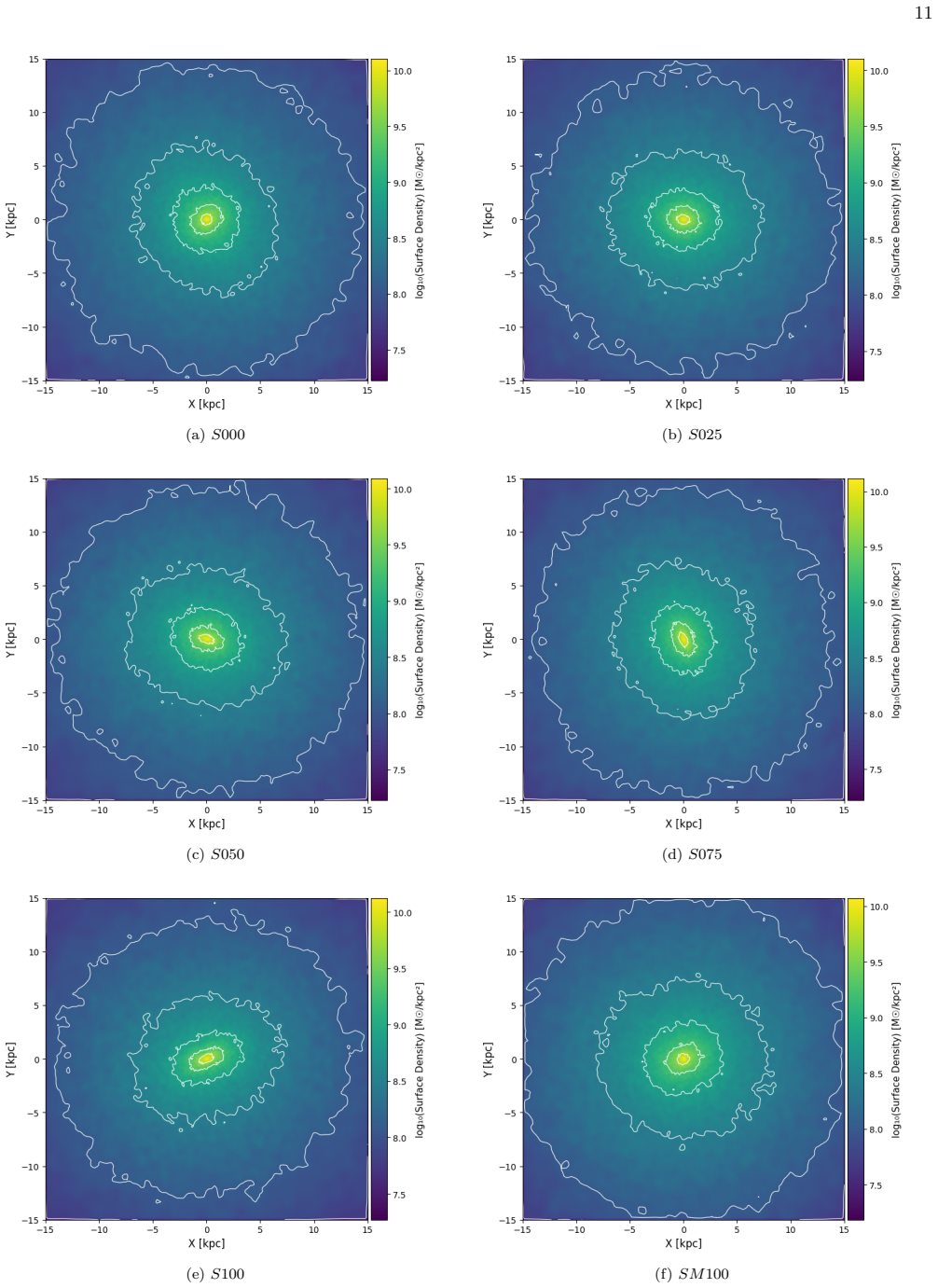
Summary. The paper uses idealized N-body simulations of Milky Way analogs with initial dark matter halo spin parameters λ = 0, 0.025, 0.05, 0.075, 0.1 (prograde) and one retrograde model (SM100), all evolved for ~9.78 Gyr. Following the model setup of Kataria & Shen (2022), the authors measure the m=2 Fourier amplitude A2/A0 for both the stellar disk and the dark matter halo within fixed cylindrical apertures. The central claim is that the dark matter (DM) bar strength at saturation increases monotonically with increasing prograde halo spin, that stellar buckling temporarily reduces DM bar strength, and that DM bar pattern speeds converge at late times regardless of spin. The paper also reports axis ratios, angular momentum transfer, and bar alignment as additional diagnostics of DM bar morphology.
Significance. If the central claim holds, the paper provides a systematic, parameter-controlled demonstration that inner halo angular momentum is a key determinant of DM bar properties in MW-like isolated galaxies, complementing cosmological simulation findings and offering a possible connection to high-redshift barred galaxies in JWST observations. Strengths include a clean spin grid (λ = 0–0.1 plus a retrograde model), a single-variable modification of the initial conditions, and a stated convergence test by doubling particle number. However, the paper's principal diagnostic for DM bars is ambiguously defined and lacks the sensitivity/robustness tests needed to support the headline spin-strength trend.
major comments (3)
- [§3.2, Eq. (4), §3.2.2] Eq. (4) states that a2 and b2 are “calculated for all disk particles,” yet §3.2.2 says the DM bar strength is measured with “the same methodology used for stellar bar strength.” If the DM-bar A2/A0 literally includes disk particles within R≤10 kpc, the reported spin-strength trend (Fig. 3) could simply trace the stellar bar's non-axisymmetric mass distribution inside that radius, not a halo response. If DM particles are used instead, the text must state this explicitly and Eq. (4) must be generalized. This ambiguity is load-bearing for the abstract's main claim; please clarify the particle selection and demonstrate separation (e.g., recompute A2/A0 using only DM particles, or decompose stellar and DM contributions).
- [§3.2.2, §3.6] No sensitivity tests are provided for the radial and vertical apertures used for the DM bar (R≤10 kpc, |z|≤3 kpc; stated in §3.6). Since the stellar bar is measured out to 20 kpc and is much stronger, the fixed DM-bar aperture may be contaminated by stellar particles or by the disk's quadrupole. The paper should show that the DM-bar amplitude and its spin dependence are robust to varying R_cut (e.g., 8, 10, 12 kpc) and |z| cut. This is directly relevant to the claim that the DM bar strength increases with λ.
- [§2, §3.2.2] The monotonic increase of DM bar saturation strength with λ is based on a single realization per spin value. With 10^6 particles per component and the stochastic nature of bar instability, run-to-run variance can be significant. Provide multiple realizations (at least for S000 and S100, or a seed-variation set) or a bootstrap-based error estimate to determine whether the reported trend is significant. Without this, the claim that the DM bar strength “gradually increases” with halo spin is not on solid statistical footing.
minor comments (5)
- [Title/abstract] The title contains “W ay” (line break artifact) and the affiliation contains “Enginnering”; these typos should be corrected.
- [§3.4] The text refers to “Figure 3.3” in §3.5 when describing SM100's delayed triggering; this should be a proper figure reference (e.g., Fig. 2 or Fig. 3).
- [§3.3] The statement that DM bar pattern speed is higher than the stellar counterpart references “Figure 7 of (Kataria & Shen 2022)” but no comparison plot is shown here; it would be helpful to include the stellar pattern speed in Fig. 4 or state clearly that the comparison is from the earlier paper.
- [§4] The explanation for the discrepancy with Collier et al. (2019) and Long et al. (2014) is deferred entirely to external papers (Kataria 2024; Kataria & Shen 2022). While acceptable as a pointer, a short self-contained physical discussion (e.g., halo concentration, disk response, or spin-injection method) would strengthen the narrative.
- [General notation] The spin parameter λ in Eq. (1) is written as J/√(2GM Rvir), which is not the standard Bullock et al. (2001) definition; the authors should either cite the exact definition or explicitly note that they use a simplified version.
Circularity Check
No fundamental circularity; central spin-strength trend is a direct simulation output, with only a mild self-citation burden.
full rationale
The paper's central claim—that DM bar strength increases with initial halo spin—is obtained by running N-body simulations with different λ and measuring A2/A0 (Eqs. 4–5). No parameter is fitted to the target trend, and no 'prediction' is derived from the measurement; the trend is a direct output of the simulations. The model setup is taken from the authors' own Kataria & Shen (2022), and Section 4 defers the explanation of disagreement with Long et al. (2014) and Collier et al. (2018, 2019) to Kataria (2024) and Kataria & Shen (2022). These are self-citations, but they are not the basis of the principal result; the trend would stand or fall on the simulations themselves. A measurement ambiguity exists: Eq. 4 defines the Fourier coefficients as 'calculated for all disk particles', while §3.2.2 applies 'the same methodology' to the DM bar; if the same particle selection is actually used, the DM-bar A2/A0 could be contaminated by the stellar bar. This is a validity concern, not circularity. No circular step satisfies the 'specific reduction' test; the score of 2 reflects the mild self-citation burden, not a circular derivation.
Assumptions & free parameters
free parameters (4)
- DM bar radial cutoff =
10 kpc
- bar vertical cutoff =
|z| ≤ 3 kpc
- halo AM shell =
10–25 kpc, |z| ≤ 10 kpc
- orbit-flip radius for spin injection =
30 kpc
assumptions (4)
- domain assumption The N-body integrations accurately capture the secular angular-momentum exchange between disk and halo.
- domain assumption The Hernquist halo and GalIC initial conditions from Kataria & Shen (2022) are a valid Milky Way analog.
- ad hoc to paper Reversing retrograde orbits within 30 kpc preserves equilibrium and cleanly isolates spin as the only changed variable.
- domain assumption The m=2 Fourier amplitude A2/A0 computed in the chosen cylinder is a valid measure of a distinct DM bar.
Cite this review
Pith. "Pith review of The Role of Inner Halo Angular Momentum (Spin) in Shaping Dark Matter Bars in Milky Way Analogs." pith.science (2026). https://pith.science/paper/RFIQECR5
@misc{pith2026260114420,
  author       = {Pith},
  title        = {Pith review of: The Role of Inner Halo Angular Momentum (Spin) in Shaping Dark Matter Bars in Milky Way Analogs},
  year         = {2026},
  howpublished = {\url{https://pith.science/paper/RFIQECR5}},
  note         = {Machine review of arXiv:2601.14420}
}
read the original abstract
Studies of galactic bars have primarily focused on stellar bars, since they can be directly observed through ultraviolet to infrared wavebands. Cosmological as well as idealised simulations reveal that the dark matter (DM) haloes interact with baryonic matter, primarily the stellar bars, dynamically by means of the exchange of angular momentum. In these simulations, the spherical DM halo dynamically responds to interaction with the stellar bar by reshaping its orbital structure in the proximity of the stellar bar, forming a bar-like configuration, called as the Dark Matter (DM) bar. Using N-body simulations of Milky Way analogs we discuss the role of inner halo angular momentum, measured as halo spin parameter {\lambda} of the dark matter halo, on formation and evolutionary characteristics of the DM bars. Our systematic study involves haloes with initial spin configurations ranging from {\lambda} = 0 to 0.1. The result conveys that DM bar formation and its characteristics are extensively dependent on the initial spin parameter {\lambda} of the DM halo. We demonstrate that the strength of the dark matter bar gradually increases with an increase in halo spin in long-term evolution, with a significant impact of stellar bar buckling on dark matter bar strength. The evolutionary characteristics of the DM bar are strongly influenced by the initial spin of the host halo.
Figures


Figures from the paper (6 more)


Reference graph
Works this paper leans on
-
[1]
Aguerri, J. A. L., M´ endez-Abreu, J., & Corsini, E. M. 2009, A&A, 495, 491, doi: 10.1051/0004-6361:200810931
-
[2]
2024, The stellar bar - dark matter halo connection in the TNG50 simulations
Ansar, S., & Das, M. 2024, The stellar bar - dark matter halo connection in the TNG50 simulations. https://arxiv.org/abs/2311.11998
arXiv 2024
-
[3]
Ansar, S., Kataria, S. K., & Das, M. 2023, MNRAS, 522, 2967, doi: 10.1093/mnras/stad1060
-
[4]
Ash, N., Valluri, M., Chen, Y., & Bell, E. F. 2024, The Astrophysical Journal, 976, 189, doi: 10.3847/1538-4357/ad863a 14
-
[6]
Athanassoula, E. 2003, Monthly Notices of the Royal Astronomical Society, 341, 1179–1198, doi: 10.1046/j.1365-8711.2003.06473.x
arXiv 2003
-
[7]
2005, Annals of the New York Academy of Sciences, 1045, 168, doi: 10.1196/annals.1350.013
Athanassoula, E. 2005, Annals of the New York Academy of Sciences, 1045, 168, doi: 10.1196/annals.1350.013
-
[9]
2007, MNRAS, 377, 1569, doi: 10.1111/j.1365-2966.2007.11711.x
Athanassoula, E. 2007, MNRAS, 377, 1569, doi: 10.1111/j.1365-2966.2007.11711.x
arXiv 2007
-
[10]
2013, Bars and secular evolution in disk galaxies: Theoretical input, ed
Athanassoula, E. 2013, Bars and secular evolution in disk galaxies: Theoretical input, ed. J. Falc´ on-Barroso & J. H
2013
Show all 54 references
-
[11]
Athanassoula, E., Machado, R. E. G., & Rodionov, S. A. 2013, MNRAS, 429, 1949, doi: 10.1093/mnras/sts452
2013 doi
-
[12]
2002, MNRAS, 330, 35, doi: 10.1046/j.1365-8711.2002.05028.x
Athanassoula, E., & Misiriotis, A. 2002, MNRAS, 330, 35, doi: 10.1046/j.1365-8711.2002.05028.x
2002
-
[13]
D., Jogee, S., & Marinova, I
Barazza, F. D., Jogee, S., & Marinova, I. 2008, ApJ, 675, 1194, doi: 10.1086/526510
2008 doi
-
[14]
2006, ApJ, 648, 807, doi: 10.1086/506016
Berentzen, I., & Shlosman, I. 2006, ApJ, 648, 807, doi: 10.1086/506016
2006 doi
-
[15]
Heller, C. H. 2007, The Astrophysical Journal, 666, 189–200, doi: 10.1086/520531
2007 doi
-
[16]
2008, Galactic Dynamics: Second Edition (Princeton University Press)
Binney, J., & Tremaine, S. 2008, Galactic Dynamics: Second Edition (Princeton University Press)
2008
-
[17]
S., Dekel, A., Kolatt, T
Bullock, J. S., Dekel, A., Kolatt, T. S., et al. 2001, ApJ, 555, 240, doi: 10.1086/321477
2001 doi
-
[18]
J., Sheth, K., Athanassoula, E., et al
Buta, R. J., Sheth, K., Athanassoula, E., et al. 2015, ApJS, 217, 32, doi: 10.1088/0067-0049/217/2/32
2015 doi
-
[19]
K., Shen, J., & Guo, M
Chen, B.-H., Kataria, S. K., Shen, J., & Guo, M. 2025, The Astrophysical Journal, 994, 124, doi: 10.3847/1538-4357/ae13a6
2025 doi
-
[20]
Chiba, R., & Kataria, S. K. 2024, Mon. Not. R. Astron. Soc., 528, 4115 Col ´ ın, P., Valenzuela, O., & Klypin, A. 2006, ApJ, 644, 687, doi: 10.1086/503791
2024 doi
-
[21]
2019, Monthly Notices of the Royal Astronomical Society, 488, 5788, doi: 10.1093/mnras/stz2144
Collier, A., Heller, C., & Shlosman, I. 2019, Monthly Notices of the Royal Astronomical Society, 488, 5788, doi: 10.1093/mnras/stz2144
2019 doi
-
[22]
2021, ApJ, 915, 23, doi: 10.3847/1538-4357/ac004d
Collier, A., & Madigan, A.-M. 2021, ApJ, 915, 23, doi: 10.3847/1538-4357/ac004d
2021 doi
-
[23]
2018, Monthly Notices of the Royal Astronomical Society, 476, 1331–1344, doi: 10.1093/mnras/sty270
Collier, A., Shlosman, I., & Heller, C. 2018, Monthly Notices of the Royal Astronomical Society, 476, 1331–1344, doi: 10.1093/mnras/sty270
2018 doi
-
[24]
Combes, F., & Sanders, R. H. 1981, A&A, 96, 164
1981
-
[25]
P., Mayer, L., Carollo, C
Debattista, V. P., Mayer, L., Carollo, C. M., et al. 2006, ApJ, 645, 209, doi: 10.1086/504147
2006 doi
-
[26]
P., & Sellwood, J
Debattista, V. P., & Sellwood, J. A. 2000, ApJ, 543, 704, doi: 10.1086/317148 Di Matteo, P., Haywood, M., Combes, F., Semelin, B., &
2000 doi
-
[27]
Snaith, O. N. 2013, A&A, 553, A102, doi: 10.1051/0004-6361/201220539
2013 doi
-
[29]
2009, The Astrophysical Journal, 697, 293–310, doi: 10.1088/0004-637x/697/1/293
Dubinski, J., Berentzen, I., & Shlosman, I. 2009, The Astrophysical Journal, 697, 293–310, doi: 10.1088/0004-637x/697/1/293
2009 doi
-
[30]
2018, MNRAS, 474, 5372, doi: 10.1093/mnras/stx3117
Erwin, P. 2018, MNRAS, 474, 5372, doi: 10.1093/mnras/stx3117
2018 doi
-
[31]
B., Frogel, J
Eskridge, P. B., Frogel, J. A., Pogge, R. W., et al. 2000, The Astronomical Journal, 119, 536–544, doi: 10.1086/301203
2000 doi
-
[32]
2025, The Astrophysical Journal, 985, 181, doi: 10.3847/1538-4357/adc8a7
Guo, Y., Jogee, S., Wise, E., et al. 2025, The Astrophysical Journal, 985, 181, doi: 10.3847/1538-4357/adc8a7
2025 doi
-
[33]
Hernquist, L., & Weinberg, M. D. 1992, ApJ, 400, 80, doi: 10.1086/171975
1992 doi
-
[34]
Hohl, F., & Hockney, R. W. 1969, Journal of Computational Physics, 4, 306, doi: 10.1016/0021-9991(69)90002-3
1969 doi
-
[36]
Kataria, S. K. 2024, MNRAS, 534, 3565, doi: 10.1093/mnras/stae2311
2024 doi
-
[37]
Kataria, S. K. 2025, Can A Kinematically Hot and Thick Disk Form A Bar? : Role of Highly Spinning Dark Matter Halos, arXiv, doi: 10.48550/ARXIV.2512.21632
2025 doi
-
[38]
K., & Das, M
Kataria, S. K., & Das, M. 2018, MNRAS, 475, 1653, doi: 10.1093/mnras/stx3279 —. 2019, ApJ, 886, 43, doi: 10.3847/1538-4357/ab48f7
2018 doi
-
[39]
K., Das, M., & Barway, S
Kataria, S. K., Das, M., & Barway, S. 2020, A&A, 640, A14, doi: 10.1051/0004-6361/202037527
2020 doi
-
[40]
K., & Shen, J
Kataria, S. K., & Shen, J. 2022, The Astrophysical Journal, 940, 175, doi: 10.3847/1538-4357/ac9df1 —. 2024, The Astrophysical Journal, 970, 45, doi: 10.3847/1538-4357/ad5b58
2022 doi
-
[41]
K., & Vivek, M
Kataria, S. K., & Vivek, M. 2024, MNRAS, 527, 3366, doi: 10.1093/mnras/stad3383
2024 doi
-
[42]
Kumar, A., Das, M., & Kataria, S. K. 2022, MNRAS, 509, 1262, doi: 10.1093/mnras/stab3019
2022 doi
-
[43]
Kumar, A., & Kataria, S. K. 2022, Monthly Notices of the Royal Astronomical Society, 514, 2497, doi: 10.1093/mnras/stac1487 Le Conte, Z. A., Gadotti, D. A., Ferreira, L., et al. 2024, Monthly Notices of the Royal Astronomical Society, 530, 1984, doi: 10.1093/mnras/stae921 15
2022 doi
-
[44]
2014, The Astrophysical Journal, 783, L18, doi: 10.1088/2041-8205/783/1/l18
Long, S., Shlosman, I., & Heller, C. 2014, The Astrophysical Journal, 783, L18, doi: 10.1088/2041-8205/783/1/l18
2014 doi
-
[45]
2024, Galaxies, 12, 27, doi: 10.3390/galaxies12030027
Manos, T. 2024, Galaxies, 12, 27, doi: 10.3390/galaxies12030027
2024 doi
-
[47]
2006, The Astrophysical Journal, 637, 214–226, doi: 10.1086/498338
Martinez-Valpuesta, I., Shlosman, I., & Heller, C. 2006, The Astrophysical Journal, 637, 214–226, doi: 10.1086/498338
2006 doi
-
[48]
H., Prendergast, K
Miller, R. H., Prendergast, K. H., & Quirk, W. J. 1970, ApJ, 161, 903, doi: 10.1086/150593
1970 doi
-
[49]
B., & Abraham, R
Nair, P. B., & Abraham, R. G. 2010, ApJL, 714, L260, doi: 10.1088/2041-8205/714/2/L260 O’Neill, J. K., & Dubinski, J. 2003, MNRAS, 346, 251, doi: 10.1046/j.1365-2966.2003.07085.x
2010
-
[50]
B., Agertz, O., & Renaud, F
Romeo, A. B., Agertz, O., & Renaud, F. 2023, MNRAS, 518, 1002, doi: 10.1093/mnras/stac3074
2023 doi
-
[51]
2013, Monthly Notices of the Royal Astronomical Society, 434, 1287–1299, doi: 10.1093/mnras/stt1088
Saha, K., & Naab, T. 2013, Monthly Notices of the Royal Astronomical Society, 434, 1287–1299, doi: 10.1093/mnras/stt1088
2013 doi
-
[52]
A., Bower, R
Schaye, J., Crain, R. A., Bower, R. G., et al. 2015, MNRAS, 446, 521, doi: 10.1093/mnras/stu2058
2015 doi
-
[53]
Sellwood, J. A. 2014, Reviews of Modern Physics, 86, 1, doi: 10.1103/RevModPhys.86.1
2014 doi
-
[54]
Teuben, P. J. 2005, ApJ, 632, 217, doi: 10.1086/432409
2005 doi
-
[55]
2005a, MNRAS, 361, 776, doi: 10.1111/j.1365-2966.2005.09238.x
Springel, V., Di Matteo, T., & Hernquist, L. 2005a, MNRAS, 361, 776, doi: 10.1111/j.1365-2966.2005.09238.x
2005
-
[56]
Springel, V., White, S. D. M., Jenkins, A., et al. 2005b, Nature, 435, 629, doi: 10.1038/nature03597
-
[57]
2024, The Astrophysical Journal, 975, 120, doi: 10.3847/1538-4357/ad77c8
Tahmasebzadeh, B., Dattathri, S., Valluri, M., et al. 2024, The Astrophysical Journal, 975, 120, doi: 10.3847/1538-4357/ad77c8
2024 doi
-
[58]
2009, The Astrophysical Journal, 707, 218–232, doi: 10.1088/0004-637x/707/1/218 —
Villa-Vargas, J., Shlosman, I., & Heller, C. 2009, The Astrophysical Journal, 707, 218–232, doi: 10.1088/0004-637x/707/1/218 —. 2010, The Astrophysical Journal, 719, 1470–1480, doi: 10.1088/0004-637x/719/2/1470
2009 doi
-
[59]
D., & Katz, N
Weinberg, M. D., & Katz, N. 2007, MNRAS, 375, 460, doi: 10.1111/j.1365-2966.2006.11307.x
2007
Reviewed August 3, 2026 · model on record in the stance chip above.
Discussion (0). Continue with ORCID to comment.