REVIEW 5 major objections 3 minor 62 references
Piecewise omnigenous magnetohydrodynamic equilibria as fusion reactor candidates
T0 review · 5 major / 3 minor · reviewed 2026-08-03 · deepseek-v4-flash
Pith's one-line read A new stellarator magnetic configuration satisfies the ideal MHD equilibrium equation while achieving unprecedented levels of piecewise omnigenity, combining low transport and stability in one reactor-scale design.
desk verdict CIEMAT-pw1 is a credible first demonstration of a deliberately optimized piecewise-omnigenous equilibrium, but the radial extension of the maximum-J benefits is argued, not shown. read the letter →
The pith
A machine-rendered reading of the paper's core claim, the machinery that carries it, and where it could break.
The reading
What carries the argument
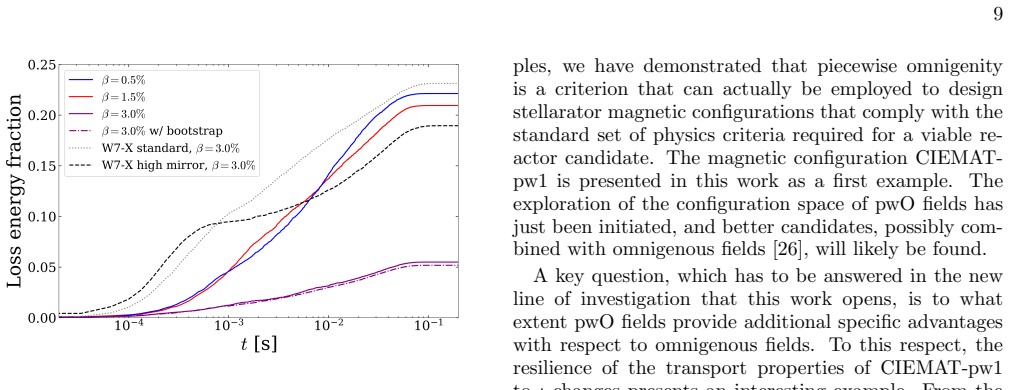
The load-bearing object is the parametrized piecewise-omnigenous field B_pwO(theta, zeta): a smooth (p = 2) generalization of a parallelogram-shaped field-strength distribution whose width and slope parameters are fixed by the requirements of collisionless trapped-particle confinement and zero bootstrap current. A fixed-boundary equilibrium solver and optimizer is used to minimize the relative deviation delta_B between the equilibrium B and this B_pwO at the middle flux surface, while also targeting Mercier stability, rotational transform, elongation, and mirror ratio. The argument that pwO closeness pays off in turbulence and fast-ion confinement relies on the approximate factorization B(s,
What would settle it
Compute the exact B(s, theta, zeta) from the equilibrium and compare it with f(s) B_pwO(theta, zeta) across the whole radius; if the residual is large enough that the derivative of J with respect to s changes sign, or a significant variation of J within a flux surface appears away from s = 0.5, the piecewise maximum-J claim fails. A direct test would be a full-volume neoclassical and gyrokinetic simulation at reactor collisionality checking that the radial energy flux stays below the reactor threshold at all radii, not just at the single optimized surface.
Extended reading notes
Core claim
On the paper's own terms, the central discovery is that a fixed-boundary stellarator equilibrium can be optimized to be very close to piecewise omnigenity while still solving the ideal MHD force balance equation and passing the usual reactor-physics filters. The optimized design has magnetic field strength at s = 0.5 within about one percent of the target pwO form (and roughly ten percent of the strict p-to-infinity limit), with the approximation degrading only weakly across the plasma volume. This closeness yields small effective ripple, a bootstrap transport coefficient comparable to that of a proven optimized stellarator, maximum-J-like behavior at finite beta, Mercier and ballooning stab
Load-bearing premise
The assumption that the magnetic field of the almost-pwO configuration can be written approximately as B = f(s) B_pwO with all shape parameters fixed except the minimum and maximum field strength — if the radial variation of different Fourier harmonics is too strong, the piecewise maximum-J property and its transport benefits do not extend away from the optimized surface.
Editorial extensions
If this is right
- If correct, piecewise omnigenity becomes a third viable design family alongside quasi-axisymmetry and quasi-isodynamicity.
- pwO configurations can satisfy all standard reactor physics criteria simultaneously in a single equilibrium.
- Robustness of transport properties to changes in the rotational transform — notably bootstrap-current-induced changes — suggests design flexibility for reactors.
- Turbulence can be mitigated through the piecewise maximum-J property even without exact omnigenity.
- The concept opens a wider configuration space for future coil and divertor optimization.
Reading between the lines
- The single-surface optimization at s = 0.5 may understate edge transport, since effective ripple rises toward the edge; a full reactor assessment should check whether finite-volume degradation remains acceptable when realistic profiles and electromagnetic effects are included.
- The robustness to rotational-transform changes hints that pwO designs might tolerate larger bootstrap current or coil tolerances than quasi-isodynamic designs, a property worth testing with explicit coil-error studies.
- The coil-feasibility estimate suggests a minimum plasma-to-coil distance of roughly 1.3 meters in the tightest region; whether this is compatible with a breeding blanket is an open question the paper leaves to future work.
- Because the optimizer simultaneously drives many targets, it is unclear how much of the good performance is due to pwO closeness versus the other constraints; a useful control experiment would be to optimize with the pwO deviation excluded and compare reactor metrics.
Signed reviews
Editorial analysis
A structured set of objections, weighed in public.
Referee Report
Summary. The paper presents CIEMAT-pw1, a fixed-boundary stellarator equilibrium optimized with DESC to minimize the local deviation δB (Eq. 5) between the magnetic field strength at s=0.5 and the piecewise-omnigenous (pwO) model field of Eq. (2) with p=2. The authors report that the optimized equilibrium has δB below 1% relative to the p=2 surrogate (and ~10% relative to the strict p→∞ pwO limit), low neoclassical effective ripple and bootstrap coefficient compared with W7-X, Mercier and COBRA stability, a rotational-transform profile compatible with an island divertor, electrostatic gyrokinetic turbulent fluxes in the reactor-relevant range, and an alpha heating efficiency near 95% at β=3%. The central claim is that CIEMAT-pw1 satisfies the standard set of physics criteria for a viable reactor candidate, thereby demonstrating piecewise omnigenity as a practical stellarator design concept.
Significance. If the results hold, CIEMAT-pw1 would be the first MHD equilibrium explicitly designed for piecewise omnigenity that simultaneously exhibits low neoclassical and turbulent transport, small bootstrap current, fast-ion confinement, and MHD stability, substantially broadening the stellarator design space beyond quasisymmetric and quasi-isodynamic concepts. The paper draws on a credible set of established numerical tools (DESC, SFINCS, stella, ASCOT, COBRA) and provides quantitative comparisons with W7-X, which strengthens the empirical content. The main gap is that the volume-integrated transport and stability benefits are bridged from the optimized surface to the whole plasma by the approximate factorization Eq. (6); this bridge is not directly verified via the second adiabatic invariant. If the authors close that gap and resolve the reproducibility issue in Appendix A, the paper would be a strong contribution to the field.
major comments (5)
- [§I, Eq. (6)–(7)] The volume-integrated conclusions (turbulence mitigation, fast-ion confinement, maximum-J) rely on Eq. (6), but the factorization is not established. Eq. (6) assumes B(s,θ,ζ)=f(s)BpwO with all shape parameters except Bmin and Bmax constant. The text does not specify how Bmin and Bmax are absorbed into f(s); if f(s) is a common radial multiplier, their radial profiles must be identical, which is not demonstrated, and if they vary independently, Eq. (6) is not a valid representation. Moreover, in real equilibria the Fourier harmonics of B decay as B_mn ~ s^{m/2}, so the high-m content of BpwO decays faster than the low-m content and B(θ,ζ) changes shape with s. The paper acknowledges degradation but never computes J(s,α,E,μ) or ∂sJ from the equilibrium; Γc is only a phase-space average of |∂αJ/∂sJ|^2 and does not establish the sign of ∂sJ. Since Eq. (7) is the bridge from s=0.5 to the full
- [§II, Fig. 6] The abstract claims 'unprecedented levels of piecewise omnigenity,' but the quantity actually targeted and reported is δB relative to the p=2 surrogate BpwO, not relative to the p→∞ piecewise-omnigenous limit. Fig. 6 states that the p→∞ relative difference is ~10% in specific surface regions and was not an optimization target. This is an order of magnitude larger than the reported <1% deviation from the p=2 surrogate and raises the question of whether the configuration demonstrates pwO at the level claimed, or only closeness to a smooth surrogate that shares transport properties with pwO. The distinction should be stated precisely in the abstract and the p→∞ deviation should be quantified as a function of s.
- [§III, Fig. 9] The Mercier criterion is reported as not satisfied near the core at the highest β values, with the text attributing this to simulations becoming 'unreliable.' The abstract's claim of 'robust MHD stability across a range of β values' depends on this being a numerical artifact. Please show convergence of D_mercier with resolution at β=3%, or otherwise state explicitly which β range is stable. COBRA negative growth rates for all cases are supportive but do not resolve the reported core Mercier inconsistency.
- [§II, Fig. 8 and Eq. (7)] The maximum-J property is stated to follow from ∂sBmin > 0 and ∂sBmax > 0 up to s=0.5. Under Eq. (6), ∂s f > 0 requires both Bmin and Bmax to increase radially; Fig. 8 shows this only for 'sufficiently high β' and up to s=0.5. The paper does not demonstrate ∂s f > 0 across the whole volume, nor does it present the direct computation of J(s,α,E,μ) that would validate Eq. (7) away from the optimized surface. The alpha-particle and turbulence conclusions are drawn at β=3%, where ∂sB are positive, so this is a partial gap rather than a fatal flaw, but the radial and β range of the maximum-J property should be made explicit.
- [Appendix A] The data availability statement is incomplete: the text says the configuration and scripts 'are available in the Zenodo link [?]' with a literal placeholder. For a computational design paper, the central claims cannot be independently checked without access to the equilibrium and optimization scripts. This must be resolved before publication.
minor comments (3)
- [Abstract and §II] Typos and minor wording issues: 'abscence' in the abstract; 'collisionlity' near Fig. 7; 'estabilization' near Fig. 12; 'orbit-averated' in §I. Also, the notation Γ_c is introduced in §II without defining the subscript c or the exact normalization used in Fig. 8.
- [§II, Fig. 7] The bootstrap coefficient is labeled D31; it would be clearer to use D_31 with sub/superscript formatting consistent with the text and references.
- [§I, Eq. (2)] Eq. (2) defines the pwO field with w2=π, while w1 depends on ι through Eq. (3). In §I, the text says 'all the parameters discussed below equation (2) (and ι) kept constant throughout the plasma volume' — but ι is a radial profile in the equilibrium, so this assumption needs an explicit caveat; otherwise the reader cannot tell whether the factorization refers to the local ι at each s or to a fixed value.
Circularity Check
No significant circularity: the paper's design targets are transparent, and the central result is the converged MHD equilibrium plus independent numerical checks.
full rationale
The paper's workflow is a multi-objective stellarator optimization, not a derivation that disguises its inputs as predictions. The optimization explicitly targets small δB relative to BpwO (Eq. 5), and Section II reports that the optimized equilibrium indeed has small δB at s=0.5; this is a convergence/achievement check, not a prediction. The neoclassical and bootstrap results are explicitly described as 'as expected [25, 27]' because the target field BpwO was constructed with w1 and w2 chosen from those prior theoretical works to guarantee collisionless confinement and zero bootstrap; the paper is transparent that these properties are design inputs. The independent content is that a real DESC fixed-boundary MHD equilibrium can closely approach this target at finite β while also satisfying rotational-transform, Mercier, mirror-ratio, and boundary-shape objectives, and that the subsequent SFINCS, stella, COBRA, and ASCOT evaluations are performed on the converged equilibrium rather than fitted to the reported metrics. The main weakness is not circularity but an unverified extrapolation: Eq. (6) is explicitly introduced as an assumption ('Let us then assume...'), and the paper does not directly verify ∂_s J < 0 away from s=0.5 or confirm that the factorized form holds across the volume. That is a correctness/evidence gap, not a circular reduction. The self-citations to [25–27] are published theoretical foundations used to set the target, not a uniqueness theorem invoked to forbid alternatives, and no fitted parameter is renamed as a prediction. The acknowledged limitations (no coil design, Zenodo placeholder, neutronics left for future work) further indicate a forward design study rather than a circular argument.
Assumptions & free parameters
free parameters (5)
- B_max, B_min =
not reported (optimization variables)
- t1, t2 =
not reported
- p (super-Gaussian exponent) =
2
- s0 (optimization surface) =
0.5
- w2 (poloidal width parameter) =
pi
assumptions (5)
- standard math Guiding-center orbits on a flux surface depend only on B(theta,zeta) in Boozer coordinates.
- domain assumption A field given by Eqs (2)-(4) with p->infinity is piecewise omnigenous and gives zero bootstrap current.
- ad hoc to paper Approximate factorization B(s,theta,zeta) = f(s) BpwO(theta,zeta) with constant shape parameters except Bmin/Bmax.
- domain assumption Piecewise maximum-J property (Eq 7) follows from the factorization and from d_s B_min > 0.
- domain assumption Fixed-boundary ideal MHD equilibria computed with DESC are representative; coil error fields and finite-beta self-consistency are ignored.
Cite this review
Pith. "Pith review of Piecewise omnigenous magnetohydrodynamic equilibria as fusion reactor candidates." pith.science (2026). https://pith.science/paper/2E43XHJO
@misc{pith2026260114886,
  author       = {Pith},
  title        = {Pith review of: Piecewise omnigenous magnetohydrodynamic equilibria as fusion reactor candidates},
  year         = {2026},
  howpublished = {\url{https://pith.science/paper/2E43XHJO}},
  note         = {Machine review of arXiv:2601.14886}
}
read the original abstract
In piecewise omnigenous magnetic fields, charged particles remain perfectly confined in the abscence of collisions and turbulence. This concept extends the traditional notion of omnigenity, the theoretical principle upon which most of existing magnetic fusion reactor designs, including tokamaks, are based. While piecewise omnigenity broadens the range of potentially viable stellarator reactor candidates, it is achieved by relaxing the requirement of continuity in the magnetic field strength, which could appear to pose significant challenges for the design of magnetohydrodynamic equilibria. In this work, a stellarator magnetic configuration is presented that satisfies the ideal magnetohydrodynamic equilibrium equation and that achieves unprecedented levels of piecewise omnigenity. As a result, it exhibits favorable transport characteristics, including reduced bulk radial (neoclassical and turbulent transport), bootstrap current and fast ion losses. In addition, the configuration displays robust MHD stability across a range of \b{eta} values and possesses a rotational transform profile compatible with an island divertor. Collectively, these features satisfy the standard set of physics criteria required for a viable reactor candidate which, until now, were believed to be attainable only by certain types of omnigenous stellarators.
Figures


Figures from the paper (8 more)



Reference graph
Works this paper leans on
-
[1]
For passing particles (figure 1, black), the component of the velocity that is parallel toBnever vanishes, and they go over the complete flux surface. In the absence of collisions and turbulence, passing particles are always well confined because their radial drift velocity vanishes when averaged over lowest-order orbits. The situation is different for tr...
arXiv 2026
-
[2]
Helander, C
P. Helander, C. D. Beidler, T. M. Bird, M. Drevlak, Y. Feng, R. Hatzky, F. Jenko, R. Kleiber, J. H. E. Proll, Y. Turkin, et al., Plasma Physics and Controlled Fusion54, 124009 (2012), URLhttps://doi.org/10. 1088/0741-3335/54/12/124009
2012
-
[3]
J. D. Lawson, Proceedings of the Physical Society. Sec- tion B70, 6 (1957), URLhttps://doi.org/10.1088/ 0370-1301/70/1/303
1957
-
[4]
T. G. Northrop, Annals of Physics15, 79 (1961), ISSN 0003-4916, URLhttps://www.sciencedirect. com/science/article/pii/0003491661901671
arXiv 1961
-
[5]
Helander and D
P. Helander and D. J. Sigmar,Collisional transport in magnetized plasmas, vol. 87 (Cambridge University Press, 2002)
2002
-
[6]
L. Spitzer, The Physics of Fluids1, 253 (1958), https://aip.scitation.org/doi/pdf/10.1063/1.1705883, URLhttps://aip.scitation.org/doi/abs/10.1063/ 1.1705883
-
[7]
Arcimovich, G
L. Arcimovich, G. Bobrovskij, E. Gorbunov, D. Ivanov, V. Kirillov, J. Kuznecov, S. Mirnov, M. Petrov, K. Razu- mova, V. Strelkov, et al.,Experiments in Tokamak De- vices(IAEA, 1969)
1969
-
[8]
A. H. Boozer, The Physics of Fluids26, 496 (1983), https://aip.scitation.org/doi/pdf/10.1063/1.864166, URLhttps://aip.scitation.org/doi/abs/10.1063/ 1.864166
doi:10.1063/1.864166 1983
Show all 62 references
-
[9]
N¨ uhrenberg and R
J. N¨ uhrenberg and R. Zille, Physics Letters A129, 113 (1988), ISSN 0375-9601, URL https://www.sciencedirect.com/science/article/ pii/0375960188900801
1988
-
[10]
J. R. Cary and S. G. Shasharina, Physical Review Let- ters78, 674 (1997), URLhttp://link.aps.org/doi/ 10.1103/PhysRevLett.78.674
1997 doi
-
[11]
Wobig, Plasma Physics and Controlled Fusion35, 903 (1993), URLhttps://doi.org/10.1088/0741-3335/35/ 8/001
H. Wobig, Plasma Physics and Controlled Fusion35, 903 (1993), URLhttps://doi.org/10.1088/0741-3335/35/ 8/001
1993 doi
-
[12]
Helander and J
P. Helander and J. N¨ uhrenberg, Plasma Physics and Con- trolled Fusion51, 055004 (2009), URLhttps://dx.doi. org/10.1088/0741-3335/51/5/055004
2009 doi
-
[13]
T. S. Pedersen, R. K¨ onig, M. Jakubowski, M. Krychowiak, D. Gradic, C. Killer, H. Nie- mann, T. Szepesi, U. Wenzel, A. Ali, et al., Nuclear Fusion59, 096014 (2019), URLhttps: //doi.org/10.1088/1741-4326/ab280f
2019 doi
-
[14]
Landreman and E
M. Landreman and E. Paul, Phys. Rev. Lett.128, 035001 (2022), URLhttps://link.aps.org/doi/10. 1103/PhysRevLett.128.035001
2022
-
[15]
A. G. Goodman, K. Camacho-Mata, S. A. Henneberg, R. Jorge, M. Landreman, G. Plunk, H. M. Smith, R. Mackenbach, C. Beidler, and P. Helander, Journal of Plasma Physics89, 905890504 (2023)
2023
-
[16]
D. W. Dudt, A. G. Goodman, R. Conlin, D. Panici, and E. Kolemen, Journal of Plasma Physics90, 905900120 (2024)
2024
-
[17]
H. Liu, G. Yu, C. Zhu, and G. Zhuang, https://arxiv.org/abs/2502.09350 (2025)
2025
-
[18]
V. V. Nemov, S. V. Kasilov, W. Kernbichler, and G. O. Leitold, Physics of Plasmas15, 052501 (2008), https://doi.org/10.1063/1.2912456, URLhttps://doi. org/10.1063/1.2912456
2008 doi
-
[19]
J. L. Velasco, I. Calvo, S. Mulas, E. S´ anchez, F. Parra, ´A. Cappa, and the W7-X Team, Nuclear Fusion 61, 116059 (2021), URLhttps://doi.org/10.1088/ 1741-4326/ac2994
2021
-
[20]
S´ anchez, J
E. S´ anchez, J. Velasco, I. Calvo, and S. Mulas, Nuclear Fusion63, 066037 (2023), URLhttps://dx.doi.org/ 10.1088/1741-4326/accd82
2023 doi
-
[21]
A. G. Goodman, P. Xanthopoulos, G. G. Plunk, H. Smith, C. N¨ uhrenberg, C. D. Beidler, S. A. Hen- neberg, G. Roberg-Clark, M. Drevlak, and P. Helander, PRX Energy3, 023010 (2024), URLhttps://link.aps. org/doi/10.1103/PRXEnergy.3.023010
2024 doi
-
[22]
Hegna, D
C. Hegna, D. Anderson, E. Andrew, A. Ayilaran, A. Bader, T. Bohm, K. C. Mata, J. Canik, L. Carba- jal, A. Cerfon, et al., Journal of Plasma Physics91, E76 (2025)
2025
-
[23]
Lion, J.-C
J. Lion, J.-C. Angl` es, L. Bonauer, A. Ba˜ n´ on Navarro, S. Cadena Ceron, R. Davies, M. Drevlak, N. Fop- piani, J. Geiger, A. Goodman, et al., Fusion Engi- neering and Design214, 114868 (2025), ISSN 0920- 3796, URLhttps://www.sciencedirect.com/science/ article/pii/S0920379625000705
2025
-
[24]
C. P. Swanson, Fusion Engineering and Design (submit- ted), URLhttps://arxiv.org/html/2512.08027v2
-
[25]
Bader, A
A. Bader, A. Ayilaran, J. Canik, A. De, W. Guttenfelder, C. Hegna, M. Knilans, A. Malkus, T. Pedersen, P. Sinha, et al., Journal of Plasma Physics91, E67 (2025)
2025
-
[26]
J. L. Velasco, I. Calvo, F. J. Escoto, E. S´ anchez, H. Thienpondt, and F. I. Parra, Phys. Rev. Lett.133, 185101 (2024), URLhttps://link.aps.org/doi/10. 1103/PhysRevLett.133.185101
2024
-
[27]
Velasco, E
J. Velasco, E. S´ anchez, and I. Calvo, Nuclear Fusion 65, 056012 (2025), URLhttps://dx.doi.org/10.1088/ 1741-4326/adc4f6
2025
-
[28]
Calvo, J
I. Calvo, J. L. Velasco, P. Helander, and F. I. Parra, Phys. Rev. E112, L023201 (2025), URLhttps://link.aps. org/doi/10.1103/tnh1-mq88
2025 doi
-
[29]
D. A. Spong, S. P. Hirshman, J. C. Whitson, D. B. Batchelor, B. A. Carreras, V. E. Lynch, and J. A. Rome, Physics of Plasmas5, 1752 (1998), ISSN 1070-664X, https://pubs.aip.org/aip/pop/article- pdf/5/5/1752/19230573/1752 1 online.pdf, URLhttps: //doi.org/10.1063/1.872844
1998 doi
-
[30]
Bindel, M
D. Bindel, M. Landreman, and M. Padidar, Plasma Physics and Controlled Fusion65, 065012 (2023), URL https://dx.doi.org/10.1088/1361-6587/acd141
2023 doi
-
[31]
R. G. et al., arXiv:2505.04211v1 p. arXiv:2505.04211v1 (2025)
2025
-
[32]
M. N. Rosenbluth, The Physics of Fluids11, 869 (1968), ISSN 0031-9171, https://pubs.aip.org/aip/pfl/article- pdf/11/4/869/12535285/869 1 online.pdf, URLhttps: //doi.org/10.1063/1.1692009
1968 doi
-
[33]
Helander, J
P. Helander, J. H. E. Proll, and G. G. Plunk, Physics of Plasmas20, 122505 (2013), https://doi.org/10.1063/1.4846818, URLhttps: //doi.org/10.1063/1.4846818
2013 doi
-
[34]
G. G. Plunk, J. W. Connor, and P. Helander, Journal of Plasma Physics83, 715830404 (2017)
2017
-
[35]
Proll, G
J. Proll, G. Plunk, B. Faber, T. G¨ orler, P. Helander, I. McKinney, M. Pueschel, H. Smith, and P. Xanthopou- los, Journal of Plasma Physics88, 905880112 (2022)
2022
-
[36]
Rodr ´ ıguez, P
E. Rodr ´ ıguez, P. Helander, and A. Goodman, Journal of 11 Plasma Physics90, 905900212 (2024)
2024
-
[37]
Velasco, I
J.L. Velasco, I. Calvo, E. S´ anchez, and F. Parra, Nuclear Fusion63, 126038 (2023), URLhttps://dx.doi.org/ 10.1088/1741-4326/acfe8a
2023 doi
-
[38]
C. D. Beidler, K. Allmaier, M. Y. Isaev, S. V. Kasilov, W. Kernbichler, G. O. Leitold, H. Maaßberg, D. R. Mikkelsen, S. Murakami, M. Schmidt, et al., Nuclear Fu- sion51, 076001 (2011), URLhttp://stacks.iop.org/ 0029-5515/51/i=7/a=076001
2011
-
[39]
C. G. Albert, C. D. Beidler, G. Kapper, S. V. Kasilov, and W. Kernbichler, Journal of Plasma Physics91, E77 (2025)
2025
-
[40]
Sanchez, S
R. Sanchez, S. P. Hirshman, A. S. Ware, L. A. Berry, and D. A. Spong, Plasma Physics and Controlled Fusion42, 641 (2000), URLhttp://stacks.iop.org/0741-3335/ 42/i=6/a=303
2000
-
[41]
Waelbroeck, Nuclear Fusion49, 104025 (2009), URL https://doi.org/10.1088/0029-5515/49/10/104025
F. Waelbroeck, Nuclear Fusion49, 104025 (2009), URL https://doi.org/10.1088/0029-5515/49/10/104025
2009 doi
-
[42]
S´ anchez, Nuclear Fusion (submitted), URLhttps: //arxiv.org/abs/2512.08825
E. S´ anchez, Nuclear Fusion (submitted), URLhttps: //arxiv.org/abs/2512.08825
-
[43]
Alonso, I
J. Alonso, I. Calvo, D. Carralero, J.L. Velasco, J. Garc ´ ıa- Rega˜ na, I. Palermo, and D. Rapisarda, Nuclear Fusion 62, 036024 (2022), URLhttps://doi.org/10.1088/ 1741-4326/ac49ac
2022
-
[44]
Landreman, H
M. Landreman, H. Smith, A. Moll´ en, and P. He- lander, Physics of Plasmas21, 042503 (2014), URL http://scitation.aip.org/content/aip/journal/ pop/21/4/10.1063/1.4870077
2014 doi
-
[45]
A. B. Navarro, A. D. Siena, J. Velasco, F. Wilms, G. Merlo, T. Windisch, L. LoDestro, J. Parker, and F. Jenko, Nuclear Fusion63, 054003 (2023), URLhttps: //dx.doi.org/10.1088/1741-4326/acc3af
2023 doi
-
[46]
Landreman and P
M. Landreman and P. J. Catto, Physics of Plasmas19, 056103 (2012)
2012
-
[47]
Barnes, F
M. Barnes, F. Parra, and M. Landreman, Journal of Computational Physics391, 365 (2019), ISSN 0021- 9991, URLhttp://www.sciencedirect.com/science/ article/pii/S002199911930066X
2019
-
[48]
Garc ´ ıa-Rega˜ na, I
J. Garc ´ ıa-Rega˜ na, I. Calvo, E. S´ anchez, H. Thienpondt, J. Velasco, and J. Capit´ an, Nuclear Fusion65, 016036 (2024), URLhttps://dx.doi.org/10.1088/1741-4326/ ad86cb
2024 doi
-
[49]
Mulholland, K
P. Mulholland, K. Aleynikova, B. J. Faber, M. J. Pueschel, J. H. E. Proll, C. C. Hegna, P. W. Terry, and C. N¨ uhrenberg, Phys. Rev. Lett.131, 185101 (2023), URLhttps://link.aps.org/doi/10. 1103/PhysRevLett.131.185101
2023
-
[50]
Di Siena, A
A. Di Siena, A. Ba˜ n´ on Navarro, and F. Jenko, Phys. Rev. Lett.125, 105002 (2020), URLhttps://link.aps.org/ doi/10.1103/PhysRevLett.125.105002
2020 doi
-
[51]
J. M. Garc ´ ıa-Rega˜ na, I. Calvo, F. I. Parra, and H. Thien- pondt, Phys. Rev. Lett.133, 105101 (2024), URL https://link.aps.org/doi/10.1103/PhysRevLett. 133.105101
2024 doi
-
[52]
G. T. Roberg-Clark, Journal of Plasma Physics (submit- ted), URLhttps://arxiv.org/abs/2506.22166v1
-
[53]
Thienpondt, J
H. Thienpondt, J. Garc ´ ıa-Rega˜ na, I. Calvo, G. Acton, and M. Barnes, Nuclear Fusion65, 016062 (2024), URL https://dx.doi.org/10.1088/1741-4326/ad9ab9
2024 doi
-
[54]
¨Ak¨ aslompolo, P
S. ¨Ak¨ aslompolo, P. Drewelow, Y. Gao, A. Ali, C. Bieder- mann, S. Bozhenkov, C. Dhard, M. Endler, J. Fellinger, O. Ford, et al., Journal of Instrumentation14, C10012 (2019), URLhttps://doi.org/10.1088/1748-0221/14/ 10/c10012. FIG. 14: Estimate of coil complexity
2019 doi
-
[55]
Landreman, S
M. Landreman, S. Buller, and M. Drevlak, Physics of Plasmas29, 082501 (2022), https://doi.org/10.1063/5.0098166, URLhttps: //doi.org/10.1063/5.0098166
2022 doi
-
[56]
Kessel, J
C. Kessel, J. Manickam, G. Rewoldt, and W. M. Tang, Phys. Rev. Lett.72, 1212 (1994), URLhttps://link. aps.org/doi/10.1103/PhysRevLett.72.1212
1994 doi
-
[57]
Nadeem, T
M. Nadeem, T. Rafiq, and M. Persson, Physics of Plas- mas8, 4375 (2001), ISSN 1070-664X, URLhttps://doi. org/10.1063/1.1396842
2001 doi
-
[58]
d’Herbemont, F
V. d’Herbemont, F. I. Parra, I. Calvo, and J L Velasco, Journal of Plasma Physics88, 905880507 (2022)
2022
-
[59]
C. D. Beidler, Y. I. Kolesnichenko, V. S. Marchenko, I. N. Sidorenko, and H. Wobig, Physics of Plasmas8, 2731 (2001), https://doi.org/10.1063/1.1365958, URLhttps: //doi.org/10.1063/1.1365958
2001 doi
-
[60]
DESC team,Desc optimization package website(2025), URLhttps://control.princeton.edu/research/ stellarator_optimization/desc/
2025
-
[61]
Kappel, M
J. Kappel, M. Landreman, and D. Malhotra, Plasma Physics and Controlled Fusion66, 025018 (2024), URL https://dx.doi.org/10.1088/1361-6587/ad1a3e
2024 doi
-
[62]
At the time instant when this happens, the particle transitions to a different region of the magnetic surface (figure 1, pink)
Transitioning particles are a subclass of trapped particles, one of whose bounce points, at some instant along their trajectory, lies on a local maximum ofB. At the time instant when this happens, the particle transitions to a different region of the magnetic surface (figure 1...
Reviewed August 3, 2026 · model on record in the stance chip above.
Discussion (0). Continue with ORCID to comment.