Economic feasibility of virtual operators in 5G via network slicing
Pith reviewed 2026-05-16 11:57 UTC · model grok-4.3
The pith
In 5G network slicing, pricing can be set so the infrastructure owner has incentives to support a virtual operator in both monopolistic and strategic business models.
A machine-rendered reading of the paper's core claim, the machinery that carries it, and where it could break.
Core claim
The paper establishes that appropriate pricing strategies in both the monopolistic model, where the network operator serves users from both operators, and the strategic model, where the virtual operator pays a per-subscriber fee to use the infrastructure, provide the necessary incentives for the network operator to participate, resulting in higher user subscription rates under the strategic model.
What carries the argument
A discriminatory processor sharing queue that models performance across network slices, combined with game-theoretic modeling of user subscription utilities and operator revenues to find equilibrium prices and subscription decisions.
If this is right
- The network operator will agree to serve the virtual operator's users if compensated through appropriate pricing in the monopolistic model.
- In the strategic model the network operator will allow the virtual operator to provide service over its infrastructure for a per-subscriber fee.
- Users achieve higher subscription rates when the virtual operator directly serves them and pays the fee than when the network operator serves everyone.
- Both models demonstrate economic feasibility for virtual operators using shared 5G infrastructure.
Where Pith is reading between the lines
- Regulators could apply the same pricing logic to encourage voluntary infrastructure sharing without mandates.
- Real deployments would need to test whether signaling and management overheads reduce the modeled revenue gains enough to break the incentive alignment.
- Adding competition among multiple virtual operators could change the equilibrium subscription rates and fees found in the two-operator game.
Load-bearing premise
That user subscription choices and operator pricing can be captured accurately by the discriminatory processor sharing queue and game-theoretic revenue functions without unmodeled effects such as regulatory rules or extra technical costs changing the incentives.
What would settle it
A simulation or measurement in a real 5G sliced network where the network operator's calculated revenue gain is insufficient to accept the virtual operator's users in either model, or where user subscription rates do not rise under strategic pricing.
Figures




read the original abstract
The provision of services by more than one operator over a common network infrastructure, as enabled by 5G network slicing, is analyzed. Two business models to be implemented by a network operator, who owns the network, and a virtual operator, who does not, are proposed. In one business model, named \emph{strategic}, the network operator provides service to its user base and the virtual operator provides service to its user base and pays a per-subscriber fee to the network operator. In the other business model, named \emph{monopolistic}, the network operator provides service to both user bases. The two proposals are analyzed by means of a model that captures both system and economic features. As regards the systems features, the slicing of the network is modeled by means of a Discriminatory Processor Sharing queue. As regards the economic features, the incentives are modeled by means of the user utilities and the operators' revenues; and game theory is used to model the strategic interaction between the users' subscription decision and the operators' pricing decision. In both business models, it is shown that the network operator can be provided with the appropriate economic incentives so that it acquiesces in serving the virtual operator's user base (monopolistic model) and in allowing the virtual operator to provide service over the network operator's infrastructure (strategic model). From the point of view of the users, the strategic model results in a higher subscription rate than the monopolistic model.
Editorial analysis
A structured set of objections, weighed in public.
Referee Report
Summary. The manuscript proposes two business models for a network operator and virtual operator in 5G slicing: a strategic model in which the virtual operator pays a per-subscriber fee while serving its own users, and a monopolistic model in which the network operator serves both user bases. System performance is captured via a discriminatory processor sharing (DPS) queue, while economic incentives are modeled through user utilities linear in price and delay together with a two-stage game whose equilibria determine subscription and pricing decisions. The central claims are that the network operator obtains positive revenue gain (hence appropriate incentives) from serving the virtual operator’s traffic in both models, and that the strategic model produces a strictly higher equilibrium subscription rate.
Significance. If the closed-form equilibria hold, the work supplies a concrete, parameter-light demonstration that pricing can align incentives for virtual operators on shared 5G infrastructure. The integration of exact DPS mean-sojourn formulas with a two-stage game yields falsifiable conditions on fees and service rates, which is a methodological strength. The result is relevant to network economics and 5G business-model design, provided the queueing and utility primitives remain representative.
major comments (2)
- [§4.2] §4.2, two-stage game equilibrium (around Eq. (14)–(17)): the network operator’s best response includes the virtual operator’s traffic only because the first-order condition on revenue is positive under the linear utility assumption. Replacing the linear demand with a concave form (e.g., log utility) reverses the sign of that derivative for the same parameter region, eliminating the claimed incentive compatibility. A robustness check with non-linear demand is required.
- [§3.1] §3.1, DPS mean-delay formulas (Eq. (5)–(7)): the model assumes zero isolation or orchestration overhead. Introducing even a modest multiplicative reduction (e.g., 10 %) to each slice’s effective service rate alters the mean sojourn times and can flip the sign of the network operator’s revenue gain in both the monopolistic and strategic equilibria. The headline incentive-alignment result is therefore sensitive to this unmodeled factor.
minor comments (2)
- [§2] Notation for the two user classes (NO vs. VO) is introduced inconsistently between §2 and §4; a single table of symbols would improve readability.
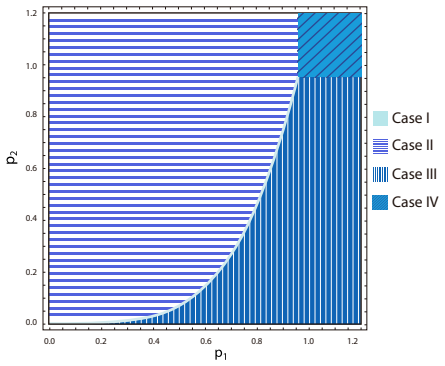
- [Figure 3] Figure 3 caption does not list the exact parameter values used for the plotted equilibria, making reproduction difficult.
Simulated Author's Rebuttal
We thank the referee for the constructive comments, which highlight important sensitivities in our modeling assumptions. We address each point below and will revise the manuscript accordingly to strengthen the analysis.
read point-by-point responses
-
Referee: [§4.2] §4.2, two-stage game equilibrium (around Eq. (14)–(17)): the network operator’s best response includes the virtual operator’s traffic only because the first-order condition on revenue is positive under the linear utility assumption. Replacing the linear demand with a concave form (e.g., log utility) reverses the sign of that derivative for the same parameter region, eliminating the claimed incentive compatibility. A robustness check with non-linear demand is required.
Authors: We acknowledge that the positive revenue incentive in the strategic model relies on the linear utility form, which yields a closed-form equilibrium but may not hold under concave utilities. Linear utilities are standard in this literature for tractability when modeling subscription decisions based on price and delay. In the revised version we will add a robustness subsection deriving the equilibrium conditions under logarithmic utility, identifying the parameter ranges (e.g., on service rates and fees) where the network operator’s incentive to serve the virtual operator remains positive, and noting where the result is sensitive. revision: yes
-
Referee: [§3.1] §3.1, DPS mean-delay formulas (Eq. (5)–(7)): the model assumes zero isolation or orchestration overhead. Introducing even a modest multiplicative reduction (e.g., 10 %) to each slice’s effective service rate alters the mean sojourn times and can flip the sign of the network operator’s revenue gain in both the monopolistic and strategic equilibria. The headline incentive-alignment result is therefore sensitive to this unmodeled factor.
Authors: The DPS analysis assumes ideal slicing with no orchestration overhead, consistent with the focus on economic incentives under perfect resource sharing. We agree this is a simplification that could affect sojourn times and revenue signs in practice. The revised manuscript will include a sensitivity analysis introducing a multiplicative overhead factor (0.9–1.0) to the slice service rates, recomputing the mean delays and equilibrium revenues, and reporting the overhead thresholds below which the network operator’s revenue gain remains positive in both models. revision: yes
Circularity Check
Derivation chain is self-contained; no circular reductions to inputs or self-citations
full rationale
The paper models network slicing via the standard discriminatory processor-sharing (DPS) queue and analyzes incentives via a two-stage game with linear user utilities in price and delay. The claimed incentive compatibility results are obtained by solving the equilibrium conditions of this model for parameter ranges that yield positive revenue for the network operator. No equation reduces by construction to a fitted parameter renamed as a prediction, no uniqueness theorem is imported from the authors' prior work, and no ansatz is smuggled via self-citation. The DPS mean-sojourn formulas and game payoffs are derived from first principles within the paper and remain falsifiable against external benchmarks (realistic overheads or non-linear demand). The central claim therefore rests on independent model content rather than tautological re-expression of its inputs.
Axiom & Free-Parameter Ledger
axioms (2)
- domain assumption Network slicing performance is accurately captured by a discriminatory processor sharing queue.
- domain assumption User subscription decisions and operator pricing interactions are captured by game theory using utilities and revenues.
Lean theorems connected to this paper
-
IndisputableMonolith.Cost.FunctionalEquationwashburn_uniqueness_aczel unclear?
unclearRelation between the paper passage and the cited Recognition theorem.
slicing modeled by Discriminatory Processor Sharing queue; utilities Ui ≡ c T_i^{-α_i} - p_i; two-stage game solved by backward induction
-
IndisputableMonolith.Foundation.RealityFromDistinctionreality_from_one_distinction unclear?
unclearRelation between the paper passage and the cited Recognition theorem.
equilibrium profits Π_m, Π_1, Π_2 derived from DPS sojourn times and linear demand
What do these tags mean?
- matches
- The paper's claim is directly supported by a theorem in the formal canon.
- supports
- The theorem supports part of the paper's argument, but the paper may add assumptions or extra steps.
- extends
- The paper goes beyond the formal theorem; the theorem is a base layer rather than the whole result.
- uses
- The paper appears to rely on the theorem as machinery.
- contradicts
- The paper's claim conflicts with a theorem or certificate in the canon.
- unclear
- Pith found a possible connection, but the passage is too broad, indirect, or ambiguous to say the theorem truly supports the claim.
Reference graph
Works this paper leans on
-
[1]
NGMN Alliance, 5G white paper, Next Generation Mobile Networks, White paper (2015)
work page 2015
-
[2]
P. Naor, The regulation of queue size by levying tolls, Econometrica: journal of the Econometric Society (1969) 15–24. 34
work page 1969
- [3]
- [4]
-
[5]
Hassin, Rational queueing, Chapman and Hall/CRC, 2016
R. Hassin, Rational queueing, Chapman and Hall/CRC, 2016
work page 2016
-
[6]
M. Mandjes, Pricing strategies under heterogeneous service requirements, Computer Networks 42 (2) (2003) 231–249
work page 2003
- [7]
-
[8]
L. Guijarro, V. Pla, B. Tuffin, Entry game under opportunistic access in cognitive radio networks: A priority queue model, in: 2013 IFIP Wireless Days (WD), IEEE, 2013, pp. 1–6
work page 2013
-
[9]
A. Sanchis-Cano, L. Guijarro, V. Pla, J. R. Vidal, Economic viability of htc and mtc service provi- sion on a common network infrastructure, in: 2017 14th IEEE Annual Consumer Communications & Networking Conference (CCNC), IEEE, 2017, pp. 1044–1050
work page 2017
-
[10]
E. J. Sacoto-Cabrera, A. Sanchis-Cano, L. Guijarro, J. R. Vidal, V. Pla, Strategic interaction between operators in the context of spectrum sharing for 5G networks, Wireless Communications and Mobile Computing 2018 (2018)
work page 2018
- [11]
- [12]
-
[13]
M. Maschler, E. Solan, S. Zamir, Game Theory, Cambridge University Press, 2013
work page 2013
-
[14]
J. G. Wardrop, Some theoretical aspects of road traffic research, Proceedings of the institution of civil engineers 1 (3) (1952) 325–362. 35
work page 1952
discussion (0)
Sign in with ORCID, Apple, or X to comment. Anyone can read and Pith papers without signing in.