On the relation between time-reversed acoustics and Green's function retrieval in space-variant and in time-variant materials
Pith reviewed 2026-05-16 11:08 UTC · model grok-4.3
The pith
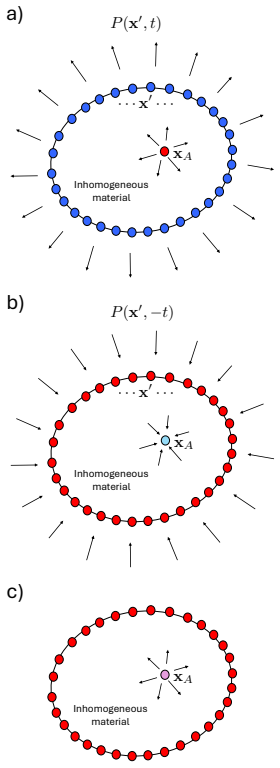
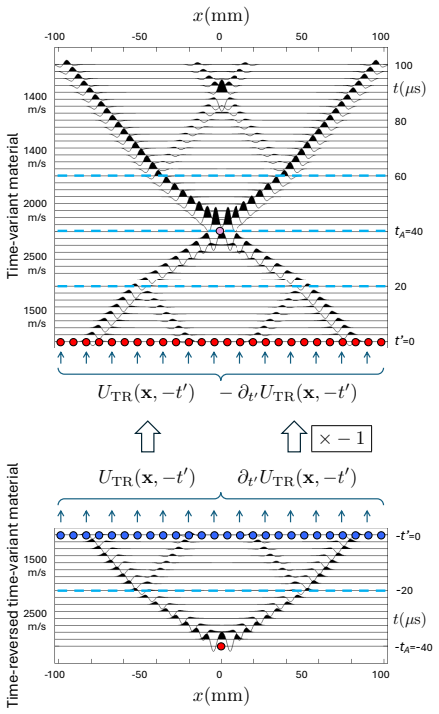
Time-reversed acoustics in time-variant materials requires emitting a sign-reversed two-component wave field from one instant, unlike the single-component boundary emission used in classical space-variant materials.
A machine-rendered reading of the paper's core claim, the machinery that carries it, and where it could break.
Core claim
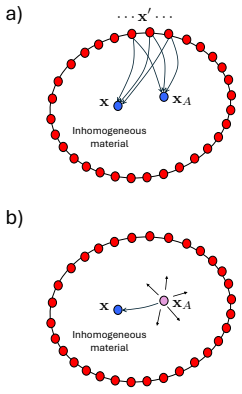
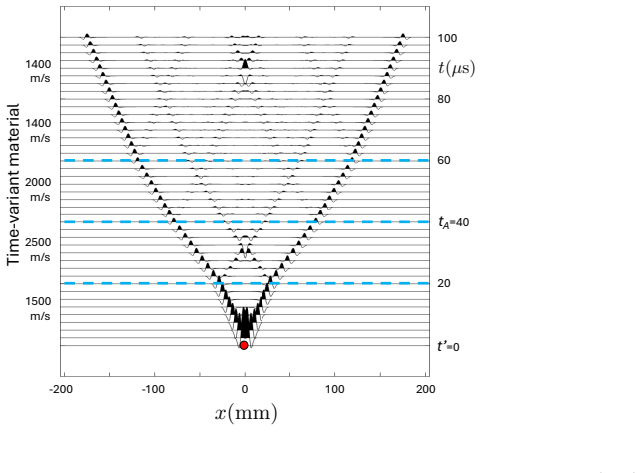
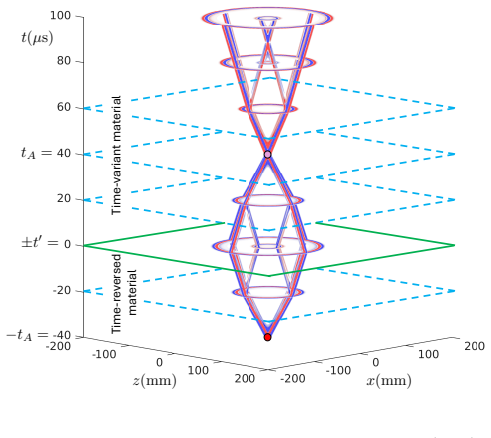
Whereas classical time-reversed acoustics involves emission of a time-reversed single-component wave field from a boundary into the inhomogeneous material, its idealized counterpart involves emission of a sign-reversed two-component wave field, recorded in a time-reversed material, from a single time instant into the actual time-variant material. Likewise, classical Green's function retrieval involves temporal crosscorrelation of wave fields at two space locations in response to single-component sources on a boundary, whereas its counterpart involves spatial crosscorrelation of wave fields at two time instants in response to two-component sources at a single time instant.
What carries the argument
The partial interchange of time and space in the wave equations of time-variant versus space-variant materials, constrained by the requirement that causality holds in both classes.
If this is right
- Green's functions between any two times in a time-variant material are obtained by spatial crosscorrelation of responses to two-component sources acting at one fixed time.
- Focusing in time-variant materials is achieved by emitting a sign-reversed two-component field from a single instant rather than a time-reversed single-component field from a closed surface.
- The methods apply directly to homogeneous media whose parameters change with time while preserving causality.
- The same formal relation holds when the material is both space-variant and time-variant, provided the wave equation analogy is maintained.
Where Pith is reading between the lines
- The duality suggests analogous retrieval schemes could be derived for electromagnetic or elastic waves in media with time-modulated constitutive parameters.
- Experimental tests could use acoustic waveguides whose stiffness or density is varied in time by external controls to verify the predicted shift from temporal to spatial correlations.
- The approach may supply a route to real-time adaptive imaging in environments whose properties drift, such as ocean water with changing temperature profiles.
- Because the construction rests only on the wave equation and causality, the same logic may transfer to other linear wave systems without requiring new derivations.
Load-bearing premise
The wave equations for space-variant and time-variant materials remain similar enough that the same retrieval procedures can be mapped onto each other once the roles of time and space are swapped.
What would settle it
A numerical simulation in which a single-component time-reversed field is emitted into a time-variant material and fails to reconstruct the Green's function, while the corresponding sign-reversed two-component field emitted at one instant succeeds.
Figures
read the original abstract
The methods of time-reversed acoustics and Green's function retrieval are traditionally deployed for classical inhomogeneous, time-invariant materials. The mutual relation between these methods is well-established. Recently, similar methods have been proposed for homogeneous, time-variant materials. Here we investigate their mutual relation and their relation with the corresponding methods in classical materials. For this analysis we make use of the fact that the wave equations for both classes of material are similar, with the roles of time and space interchanged. However, the principle of causality holds for both classes of material, hence, here the roles of time and space are not interchanged. We find that: (1) whereas classical time-reversed acoustics involves emission of a time-reversed single-component wave field from a (ideally closed) boundary into the inhomogeneous material, its idealized counterpart involves emission of a sign-reversed two-component wave field, recorded in a time-reversed material, from a single time instant into the actual time-variant material; (2) whereas classical Green's function retrieval involves temporal crosscorrelation of wave fields at two space locations in response to single-component sources on a (ideally closed) boundary, its counterpart involves spatial crosscorrelation of wave fields at two time instants in response to two-component sources at a single time instant.
Editorial analysis
A structured set of objections, weighed in public.
Referee Report
Summary. The manuscript examines the relationship between time-reversed acoustics and Green's function retrieval for classical inhomogeneous time-invariant materials versus homogeneous time-variant materials. It notes the formal similarity of the governing wave equations under interchange of time and space coordinates, while emphasizing that causality is preserved in both settings and therefore prevents a complete duality. From this, the paper derives two main distinctions: classical TRA emits a time-reversed single-component field from a closed boundary, whereas the time-variant counterpart emits a sign-reversed two-component field from a single time instant; classical Green's retrieval performs temporal cross-correlation of responses to boundary sources, whereas the counterpart performs spatial cross-correlation of responses to two-component sources at one instant.
Significance. If the mapping is rigorously established, the work supplies a conceptual bridge that could guide the transfer of focusing and imaging techniques between static and dynamic media. It clarifies how causality modifies the expected symmetry and may prove useful in applied contexts such as acoustic focusing in time-varying fluids or seismic monitoring of changing subsurface conditions.
major comments (2)
- [Abstract, claim (1)] The central step from wave-equation similarity (with causality adjustment) to the specific claim of a sign-reversed two-component source emitted from a single time instant (claim (1)) is not accompanied by an explicit derivation or intermediate equation in the text; without this mapping the asserted distinction from classical single-component boundary emission remains unverified and load-bearing for the paper's main result.
- [Abstract, claim (2)] The analogous claim for Green's function retrieval (claim (2))—that spatial cross-correlation at two time instants in response to two-component sources at one instant retrieves the appropriate Green's function—likewise lacks a concrete derivation showing preservation of the retrieval property under the causality-constrained interchange; this step is required to substantiate the reported counterpart procedure.
minor comments (1)
- The abstract is compact; a brief parenthetical reminder of the precise form of the wave operator for each material class would help readers follow the interchange argument without consulting external references.
Simulated Author's Rebuttal
We thank the referee for the thoughtful review and for recognizing the potential conceptual bridge our work provides between static and dynamic media. We agree that the two central claims in the abstract require more explicit derivations to be fully substantiated. Below we address each major comment and outline the revisions we will make.
read point-by-point responses
-
Referee: [Abstract, claim (1)] The central step from wave-equation similarity (with causality adjustment) to the specific claim of a sign-reversed two-component source emitted from a single time instant (claim (1)) is not accompanied by an explicit derivation or intermediate equation in the text; without this mapping the asserted distinction from classical single-component boundary emission remains unverified and load-bearing for the paper's main result.
Authors: We agree that the mapping from the interchanged wave equations (with causality preserved) to the precise form of the two-component, sign-reversed emission at a single time instant needs to be shown step by step. In the revised manuscript we will insert a new subsection (or expanded paragraph) immediately after the statement of the wave-equation similarity. This subsection will contain the intermediate equations that (i) interchange the roles of time and space while enforcing the causal ordering, (ii) identify the two-component field that must be emitted, and (iii) demonstrate that the emission occurs from a single time instant rather than a closed spatial boundary. We will also add a short comparison table that contrasts the classical single-component boundary emission with the time-variant counterpart. revision: yes
-
Referee: [Abstract, claim (2)] The analogous claim for Green's function retrieval (claim (2))—that spatial cross-correlation at two time instants in response to two-component sources at one instant retrieves the appropriate Green's function—likewise lacks a concrete derivation showing preservation of the retrieval property under the causality-constrained interchange; this step is required to substantiate the reported counterpart procedure.
Authors: We accept the referee's observation. The current text sketches the spatial cross-correlation procedure but does not derive it from the interchanged wave equation under the causality constraint. In the revision we will add an explicit derivation (new equations and accompanying text) that starts from the time-variant wave equation, applies the space-time interchange while respecting causality, and arrives at the spatial cross-correlation of the two-component responses recorded at two distinct times. This derivation will be placed in the same new subsection as the TRA derivation so that both claims are supported by parallel, fully written-out steps. revision: yes
Circularity Check
No circularity: derivation follows from wave-equation similarity under causality constraint without reduction to fitted inputs or self-citations
full rationale
The paper's central claims (1) and (2) are presented as direct consequences of the stated similarity between the wave equations for space-variant and time-variant materials, with the explicit caveat that causality prevents a full interchange of time and space roles. No equations are shown that define a quantity in terms of itself, no parameters are fitted to data and then relabeled as predictions, and no load-bearing step reduces to a prior self-citation whose validity is assumed rather than derived. The abstract and described reasoning remain self-contained against external wave-physics benchmarks, yielding an honest non-finding of circularity.
Axiom & Free-Parameter Ledger
axioms (1)
- domain assumption Wave equations for space-variant time-invariant materials and time-variant space-invariant materials are similar with time and space roles interchanged
Lean theorems connected to this paper
-
IndisputableMonolith/Foundation/RealityFromDistinction.leanreality_from_one_distinction unclear?
unclearRelation between the paper passage and the cited Recognition theorem.
the wave equations for both classes of material are similar, with the roles of time and space interchanged. However, the principle of causality holds for both classes of material, hence, here the roles of time and space are not interchanged
What do these tags mean?
- matches
- The paper's claim is directly supported by a theorem in the formal canon.
- supports
- The theorem supports part of the paper's argument, but the paper may add assumptions or extra steps.
- extends
- The paper goes beyond the formal theorem; the theorem is a base layer rather than the whole result.
- uses
- The paper appears to rely on the theorem as machinery.
- contradicts
- The paper's claim conflicts with a theorem or certificate in the canon.
- unclear
- Pith found a possible connection, but the passage is too broad, indirect, or ambiguous to say the theorem truly supports the claim.
Reference graph
Works this paper leans on
-
[1]
Velocity modulation of electromagnetic waves
F. R. Morgenthaler, “Velocity modulation of electromagnetic waves”, IRE Trans. Microw. Theory Tech.6, 167–172 (1958)
work page 1958
-
[2]
Wave propagation and dipole radiation in a suddenly created plasma
C. L. Jiang, “Wave propagation and dipole radiation in a suddenly created plasma”, IEEE Trans. Antennas Propag.23, 83–90 (1975)
work page 1975
-
[3]
Time refraction and time reflection: Two basic concepts
J. T. Mendon¸ ca and P. K. Shukla, “Time refraction and time reflection: Two basic concepts”, Phys. Scr.65, 160–163 (2002)
work page 2002
-
[4]
Electromagnetic waves in a time periodic medium with step-varying refractive index
T. T. Koutserimpas and R. Fleury, “Electromagnetic waves in a time periodic medium with step-varying refractive index”, IEEE Trans. Antennas Propag.66, 5300–5307 (2018)
work page 2018
-
[5]
Spacetime metamaterials—Part I: General concepts
C. Caloz and Z. L. Deck-L´ eger, “Spacetime metamaterials—Part I: General concepts”, IEEE Trans. Antennas Propag.68, 1569–1582 (2020)
work page 2020
-
[6]
Light propagation through metamaterial temporal slabs: reflection, refraction, and special cases
D. Ramaccia, A. Toscano, and F. Bilotti, “Light propagation through metamaterial temporal slabs: reflection, refraction, and special cases”, Opt. Lett.45, 5836–5839 (2020)
work page 2020
-
[7]
Frequency conversion cascade by crossing multiple space and time interfaces
B. Apffel and E. Fort, “Frequency conversion cascade by crossing multiple space and time interfaces”, Phys. Rev. Lett.128, 064501 (2022)
work page 2022
-
[8]
Observation of temporal reflection and broadband frequency translation at photonic time interfaces
H. Moussa, G. Xu, S. Yin, E. Galiffi, Y. Ra’di, and A. Al` u, “Observation of temporal reflection and broadband frequency translation at photonic time interfaces”, Nat. Phys.19, 863–868 (2023)
work page 2023
-
[9]
Temporal chirp, temporal lensing, and temporal routing via space-time interfaces
V. Pacheco-Pe˜ na, M. Fink, and N. Engheta, “Temporal chirp, temporal lensing, and temporal routing via space-time interfaces”, Phys. Rev. B111, L100306 (2025)
work page 2025
-
[10]
Theory and experimental observation of scattering by a space-time corner
L. Stefanini, E. Galiffi, S. Yin, S. Singh, D. M. Sol´ ıs, N. Engheta, A. Toscano, D. Ramaccia, F. Bilotti, and A. Al` u, “Theory and experimental observation of scattering by a space-time corner”, Phys. Rev. Lett.135, 113802 (2025)
work page 2025
-
[11]
Time reversal and holography with spacetime transformations
V. Bacot, M. Labousse, A. Eddi, M. Fink, and E. Fort, “Time reversal and holography with spacetime transformations”, Nat. Phys.12, 972–977 (2016)
work page 2016
-
[12]
From the time-reversal mirror to the instantaneous time mirror
M. Fink and E. Fort, “From the time-reversal mirror to the instantaneous time mirror”, Eur. Phys. J. Spec. Top.226, 1477–1486 (2017)
work page 2017
-
[13]
Time-reversal by time-dependent perturbations
G. Bal, M. Fink, and O. Pinaud, “Time-reversal by time-dependent perturbations”, SIAM J. Appl. Math.79, 754–780 (2019)
work page 2019
-
[14]
Damping-driven time reversal for waves
S. Hidalgo-Caballero, S. K. Sreenivas, V. Bacot, S. Wildeman, M. Harazi, X. Jia, A. Tourin, M. Fink, A. Cassinelli, M. Labousse, and E. Fort, “Damping-driven time reversal for waves”, Phys. Rev. Lett.130, 087201 (2023)
work page 2023
-
[15]
Elastic wave packets crossing a space-time interface
A. Delory, C. Prada, M. Lanoy, A. Eddi, M. Fink, and F. Lemoult, “Elastic wave packets crossing a space-time interface”, Phys. Rev. Lett.133, 267201 (2025)
work page 2025
-
[16]
Time-reversal of ultrasonic fields – Part I: Basic principles
M. Fink, “Time-reversal of ultrasonic fields – Part I: Basic principles”, IEEE Trans. Ultras. Ferroel. Freq. Contr.39, 555–566 (1992)
work page 1992
-
[17]
Reflection and transmission of electromagnetic waves at a temporal boundary
Y. Xiao, D. N. Maywar, and G. P. Agrawal, “Reflection and transmission of electromagnetic waves at a temporal boundary”, Opt. Lett.39, 574–577 (2014)
work page 2014
-
[18]
A. T. de Hoop and I. E. Lager, “Closed-form analytic expressions for the pulsed-source radiated electromagnetic field in a class of media with time-varying wave speed”, Wave Motion51, 418– 424 (2014)
work page 2014
-
[19]
Space-Time Cross-Mapping and Application to Wave Scattering
M. A. Salem and C. Caloz, “Space-time cross-mapping and application to wave scattering”, 29 doi.org/10.48550/arXiv.1504.02012 (2015)
work page internal anchor Pith review Pith/arXiv arXiv doi:10.48550/arxiv.1504.02012 2015
-
[20]
Loss compensation in time-dependent elastic metamaterials
D. Torrent, W. J. Parnell, and A. N. Norris, “Loss compensation in time-dependent elastic metamaterials”, Phys. Rev. B97, 014105 (2018)
work page 2018
-
[21]
Spacetime metamaterials—Part II: Theory and applications
C. Caloz and Z. L. Deck-L´ eger, “Spacetime metamaterials—Part II: Theory and applications”, IEEE Trans. Antennas Propag.68, 1583–1598 (2020)
work page 2020
-
[22]
On acoustic space-time media that compute their own inverse
D.-J. Van Manen, J. Aichele, J. M¨ uller, M. Serra-Garcia, and K. Wapenaar, “On acoustic space-time media that compute their own inverse”, doi.org/10.48550/arXiv.2406.15203 (2024)
-
[23]
Waves in space-dependent and time- dependent materials: A systematic comparison
K. Wapenaar, J. Aichele, and D.-J. van Manen, “Waves in space-dependent and time- dependent materials: A systematic comparison”, Wave Motion130, 103374 (2024)
work page 2024
-
[24]
One-channel time-reversal in chaotic cavities: Theoretical limits
C. Draeger and M. Fink, “One-channel time-reversal in chaotic cavities: Theoretical limits”, J. Acoust. Soc. Am.105, 611–617 (1999)
work page 1999
-
[25]
J. de Rosny and M. Fink, “Overcoming the diffraction limit in wave physics using a time- reversal mirror and a novel acoustic sink”, Phys. Rev. Lett.89, 124301 (2002)
work page 2002
-
[26]
Ultrasonics without a source: Thermal fluctuation correlations at MHz frequencies
R. L. Weaver and O. I. Lobkis, “Ultrasonics without a source: Thermal fluctuation correlations at MHz frequencies”, Phys. Rev. Lett.87, 134301 (2001)
work page 2001
-
[27]
Long-range correlations in the diffuse seismic coda
M. Campillo and A. Paul, “Long-range correlations in the diffuse seismic coda”, Science299, 547–549 (2003)
work page 2003
-
[28]
Synthesis of an inhomogeneous medium from its acoustic transmission re- sponse
K. Wapenaar, “Synthesis of an inhomogeneous medium from its acoustic transmission re- sponse”, Geophysics68, 1756–1759 (2003)
work page 2003
-
[29]
R. Snieder, “Extracting the Green’s function from the correlation of coda waves: A derivation based on stationary phase”, Phys. Rev. E69, 046610 (2004)
work page 2004
-
[30]
Interferometric/daylight seismic imaging
G. T. Schuster, J. Yu, J. Sheng, and J. Rickett, “Interferometric/daylight seismic imaging”, Geophys. J. Int.157, 838–852 (2004)
work page 2004
-
[31]
Modeling of wave propagation in inhomogeneous media
D.-J. Van Manen, J. O. A. Robertsson, and A. Curtis, “Modeling of wave propagation in inhomogeneous media”, Phys. Rev. Lett.94, 164301 (2005)
work page 2005
-
[32]
Recov- ering the Green’s function from field-field correlations in an open scattering medium (L)
A. Derode, E. Larose, M. Tanter, J. de Rosny, A. Tourin, M. Campillo, and M. Fink, “Recov- ering the Green’s function from field-field correlations in an open scattering medium (L)”, J. Acoust. Soc. Am.113, 2973–2976 (2003)
work page 2003
-
[33]
K. Wapenaar, J. Fokkema, and R. Snieder, “Retrieving the Green’s function in an open system by cross-correlation: a comparison of approaches (L)”, J. Acoust. Soc. Am.118, 2783–2786 (2005)
work page 2005
-
[34]
However, we follow the terminology used by Fink and coworkers
One could argue that, in the light of the aforementioned notion that waves reflected by a time boundary propagate forward in time and backward in space, we should speak here of space-reversed acoustics. However, we follow the terminology used by Fink and coworkers
-
[35]
K. Wapenaar, “Green’s functions, propagation invariants, reciprocity theorems, wave-field representations and propagator matrices in two-dimensional time-dependent materials”, Proc. R. Soc. A481, 20240479 (2025)
work page 2025
-
[36]
J. Aichele, J. M¨ uller, D.-J. van Manen, and K. Wapenaar, “Diffuse wave-field correlation in space: An instantaneous time-reversal mirror for Green’s function retrieval”, in preparation (2026)
work page 2026
-
[37]
A. T. de Hoop,Handbook of Radiation and Scattering of Waves(Academic Press, London) (1995), Chaps. 2, 7, 15 and 28
work page 1995
-
[38]
P. M. Morse and H. Feshbach,Methods of Theoretical Physics, Vol. I(McGraw-Hill Book Company Inc., New York) (1953), Chap. 7
work page 1953
-
[39]
Diffraction-limited, scalar image formation with holograms of arbitrary shape
R. P. Porter, “Diffraction-limited, scalar image formation with holograms of arbitrary shape”, J. Opt. Soc. Am.60, 1051–1059 (1970). 30
work page 1970
-
[40]
An inverse scattering formula that uses all the data
M. L. Oristaglio, “An inverse scattering formula that uses all the data”, Inverse Probl.5, 1097–1105 (1989)
work page 1989
-
[41]
Determination of source parameters by wavefield extrapolation
G. A. McMechan, “Determination of source parameters by wavefield extrapolation”, Geophys. J. R. Astr. Soc.71, 613–628 (1982)
work page 1982
-
[42]
Reverse modelling for seismic event characterization
D. Gajewski and E. Tessmer, “Reverse modelling for seismic event characterization”, Geophys. J. Int.163, 276–284 (2005)
work page 2005
-
[43]
Time-reversal methods in geophysics
C. Larmat, R. A. Guyer, and P. A. Johnson, “Time-reversal methods in geophysics”, Phys. Today63, 31–35 (2010)
work page 2010
-
[44]
C. Hemon, “Equations d’onde et modeles”, Geophys. Prospect.26, 790–821 (1978)
work page 1978
-
[45]
Iterative depth migration by backward time propagation
N. D. Whitmore, “Iterative depth migration by backward time propagation”, inSEG, Ex- panded Abstracts, 382–385 (1983)
work page 1983
-
[46]
Migration by extrapolation of time-dependent boundary values
G. A. McMechan, “Migration by extrapolation of time-dependent boundary values”, Geophys. Prospect.31, 413–420 (1983)
work page 1983
-
[47]
Reverse time migration: A prospect of seismic imaging methodology
H.-W. Zhou, H. Hu, Z. Zou, Y. Wo, and O. Youn, “Reverse time migration: A prospect of seismic imaging methodology”, Earth-Sc. Rev.179, 207–227 (2018)
work page 2018
-
[48]
Acoustic time-reversal mirrors
M. Fink and C. Prada, “Acoustic time-reversal mirrors”, Inverse Probl.17, R1–R38 (2001)
work page 2001
-
[49]
The iterative time reversal process: Analysis of the convergence
C. Prada, J.-L. Thomas, and M. Fink, “The iterative time reversal process: Analysis of the convergence”, J. Acoust. Soc. Am.97, 62–71 (1995)
work page 1995
-
[50]
G. Montaldo, J. F. Aubry, M. Tanter, and M. Fink, “Spatio-temporal coding in complex media for optimum beamforming: The iterative time-reversal approach”, IEEE Trans. Ultras. Ferroel. Freq. Contr.52, 220–230 (2005)
work page 2005
-
[51]
Optimal waveform design for array imaging
L. Borcea, G. Papanicolaou, and C. Tsogka, “Optimal waveform design for array imaging”, Inverse Probl.23, 1973–2020 (2007)
work page 1973
-
[52]
‘Single-sided’ autofocusing of sound in layered materials
J. H. Rose, “‘Single-sided’ autofocusing of sound in layered materials”, Inverse Probl.18, 1923–1934 (2002)
work page 1923
-
[53]
Connection of scattering principles: a visual and mathematical tour
F. Broggini and R. Snieder, “Connection of scattering principles: a visual and mathematical tour”, Eur. J. Phys.33, 593–613 (2012)
work page 2012
-
[54]
K. Wapenaar, F. Broggini, E. Slob, and R. Snieder, “Three-dimensional single-sided Marchenko inverse scattering, data-driven focusing, Green’s function retrieval and their mu- tual relations”, Phys. Rev. Lett.110, 084301 (2013)
work page 2013
-
[55]
Extracting the Green function from diffuse, equipartitioned waves
A. E. Malcolm, J. A. Scales, and B. A. van Tiggelen, “Extracting the Green function from diffuse, equipartitioned waves”, Phys. Rev. E70, 015601(R) (2004)
work page 2004
-
[56]
Extracting coherent wave fronts from acoustic ambient noise in the ocean
P. Roux, W. A. Kuperman, and the NPAL Group, “Extracting coherent wave fronts from acoustic ambient noise in the ocean”, J. Acoust. Soc. Am.116, 1995–2003 (2004)
work page 1995
-
[57]
Infrasonic ambient noise interferometry from correlations of microbaroms
M. M. Haney, “Infrasonic ambient noise interferometry from correlations of microbaroms”, Geophys. Res. Lett.36, L19808 (2009)
work page 2009
-
[58]
Passivein vivoelastography from skeletal muscle noise
K. G. Sabra, S. Conti, P. Roux, and W. A. Kuperman, “Passivein vivoelastography from skeletal muscle noise”, Appl. Phys. Lett.90, 194101 (2007)
work page 2007
-
[59]
Green’s function representations for seismic interferometry
K. Wapenaar and J. Fokkema, “Green’s function representations for seismic interferometry”, Geophysics71, SI33–SI46 (2006)
work page 2006
-
[60]
The virtual source method: Theory and case study
A. Bakulin and R. Calvert, “The virtual source method: Theory and case study”, Geophysics 71, SI139–SI150 (2006)
work page 2006
-
[61]
G. T. Schuster,Seismic Interferometry(Cambridge University Press) (2009), Chap. 2
work page 2009
-
[62]
J. Van der Neut, J. Thorbecke, K. Mehta, E. Slob, and K. Wapenaar, “Controlled-source interferometric redatuming by crosscorrelation and multidimensional deconvolution in elastic media”, Geophysics76, SA63–SA76 (2011). 31
work page 2011
-
[63]
L. Stehly, M. Campillo, B. Froment, and R. L. Weaver, “Reconstructing Green’s function by correlation of the coda of the correlation (C 3) of ambient seismic noise”, J. Geophys. Res. 113, B11306 (2008)
work page 2008
-
[64]
A representation for Green’s function retrieval by multi- dimensional deconvolution
K. Wapenaar and J. van der Neut, “A representation for Green’s function retrieval by multi- dimensional deconvolution”, J. Acoust. Soc. Am.128, EL366–EL371 (2010)
work page 2010
-
[65]
Directional balancing for seismic and general wavefield interfer- ometry
A. Curtis and D. Halliday, “Directional balancing for seismic and general wavefield interfer- ometry”, Geophysics75, SA1–SA14 (2010)
work page 2010
-
[66]
Generalized interferometry−I: Theory for interstation correlations
A. Fichtner, L. Stehly, L. Ermert, and C. Boehm, “Generalized interferometry−I: Theory for interstation correlations”, Geophys. J. Int.208, 603–638 (2017)
work page 2017
-
[67]
Bremmer series that correct parabolic approximations
J. Corones, “Bremmer series that correct parabolic approximations”, J. Math. Anal. Appl. 50, 361–372 (1975)
work page 1975
-
[68]
Migration with the full acoustic wave equation
D. D. Kosloff and E. Baysal, “Migration with the full acoustic wave equation”, Geophysics 48, 677–687 (1983)
work page 1983
-
[69]
Derivation and application of extended parabolic wave theories. I. The factorized Helmholtz equation
L. Fishman and J. J. McCoy, “Derivation and application of extended parabolic wave theories. I. The factorized Helmholtz equation”, J. Math. Phys.25, 285–296 (1984)
work page 1984
-
[70]
Review of elastic and electromagnetic wave propagation in horizontally layered media
B. Ursin, “Review of elastic and electromagnetic wave propagation in horizontally layered media”, Geophysics48, 1063–1081 (1983)
work page 1983
-
[71]
C. P. A. Wapenaar and A. J. Berkhout, “Wave-field extrapolation techniques for inhomoge- neous media which include critical angle events. Part II: Methods using the two-way wave equation”, Geophys. Prospect.34, 147–179 (1986)
work page 1986
-
[72]
Electromagnetic fields in planarly layered anisotropic media
L. O. Løseth and B. Ursin, “Electromagnetic fields in planarly layered anisotropic media”, Geophys. J. Int.170, 44–80 (2007)
work page 2007
-
[73]
Transmission of elastic waves through a stratified solid medium
W. T. Thomson, “Transmission of elastic waves through a stratified solid medium”, J. Appl. Phys.21, 89–93 (1950)
work page 1950
-
[74]
The dispersion of surface waves on multilayered media
N. A. Haskell, “The dispersion of surface waves on multilayered media”, Bull. Seism. Soc. Am. 43, 17–34 (1953)
work page 1953
-
[75]
Propagator matrices in elastic wave and vibration problems
F. Gilbert and G. E. Backus, “Propagator matrices in elastic wave and vibration problems”, Geophysics31, 326–332 (1966)
work page 1966
-
[76]
Surface waves in a laterally varying layered structure
J. H. Woodhouse, “Surface waves in a laterally varying layered structure”, Geophys. J. R. Astr. Soc.37, 461–490 (1974)
work page 1974
-
[77]
Seismic waves in a stratified half-space
B. L. N. Kennett and N. J. Kerry, “Seismic waves in a stratified half-space”, Geophys. J. R. Astr. Soc.57, 557–584 (1979)
work page 1979
-
[78]
Time-reversed water waves generated from an instantaneous time mirror
D. Peng, Y. Fan, R. Liu, X. Guo, and S. Wang, “Time-reversed water waves generated from an instantaneous time mirror”, J. Phys. Commun.4, 105013 (2020). 32
work page 2020
discussion (0)
Sign in with ORCID, Apple, or X to comment. Anyone can read and Pith papers without signing in.