An ISAC-ready Full-Duplex Backscatter Architecture for the mmWave IoT
Pith reviewed 2026-05-16 10:32 UTC · model grok-4.3
The pith
Armstrong enables full-duplex mmWave backscatter at ranges over 88 meters for 100 times less cost than prior platforms.
A machine-rendered reading of the paper's core claim, the machinery that carries it, and where it could break.
Core claim
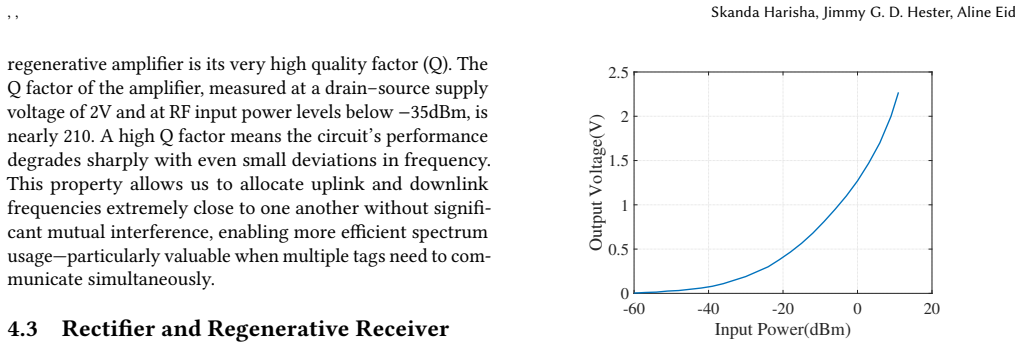
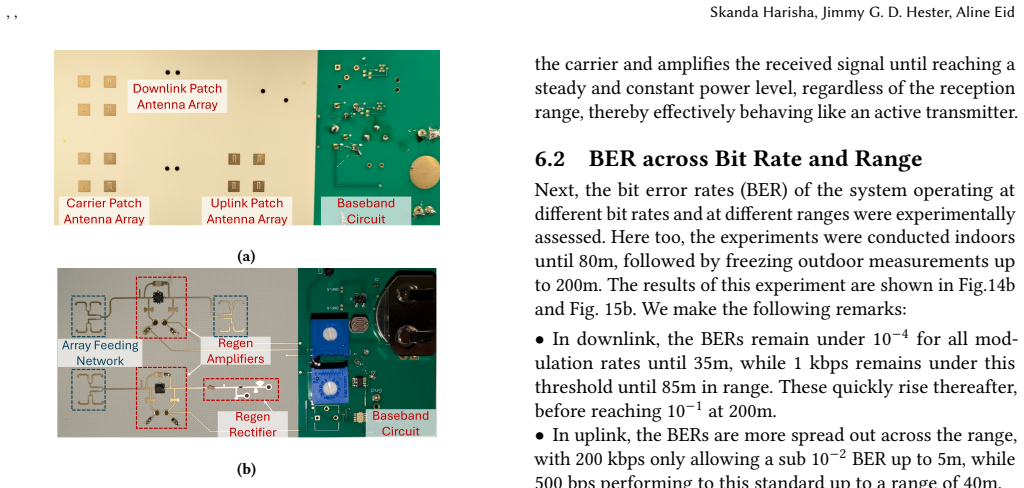
Armstrong is the first mmWave full-duplex backscatter tag architecture. It operates in full duplex at ranges beyond 88m and beyond 200m in downlink alone, delivering 20x the reach of state-of-the-art systems while being over 100x cheaper than existing mmWave backscatter platforms. This is enabled by a novel low-power regenerative amplifier that provides 30 dB of gain while consuming only 7.7 mW during active transmission, paired with a regenerative rectifier that achieves state-of-the-art sensitivity down to -60 dBm. When integrated on a compact PCB and tested, it achieves 1 Kbps BERs of less than 10^{-1} at 200m downlink and 88m full duplex.
What carries the argument
The low-power regenerative amplifier providing 30 dB gain at 7.7 mW consumption, combined with the regenerative rectifier sensitive to -60 dBm, which together support full-duplex backscatter operation.
If this is right
- mmWave IoT tags can support simultaneous uplink and downlink communication over distances exceeding 88 meters.
- ISAC systems gain a low-cost option for integrating sensing and communication in power-constrained environments.
- The cost of mmWave backscatter platforms drops by more than two orders of magnitude, broadening potential applications.
- Long-range resilient communication at 1 Kbps becomes feasible for IoT devices in diverse scenarios.
Where Pith is reading between the lines
- This circuit approach may inspire similar low-power designs for other high-frequency wireless systems.
- Deployment in multi-device networks could test interference handling beyond single-link evaluations.
- Hybrid integration with active radio systems might further enhance range and reliability.
- Mobile scenarios with Doppler effects present a natural next test for the architecture.
Load-bearing premise
The low-power regenerative amplifier and rectifier will preserve their gain, sensitivity, and full-duplex capability once placed on a compact PCB and used in actual mmWave settings with interference and signal loss.
What would settle it
An experiment measuring bit error rates above 0.1 at 88 meters in full-duplex mode in a typical deployment environment would indicate the performance claims do not hold.
Figures






read the original abstract
Achieving long-range, high data rate, concurrent two-way mmWave communication with power-constrained IoT devices is fundamental to scaling future ubiquitous sensing systems, yet the substantial power demands and high cost of mmWave hardware have long stood in the way of practical deployment. This paper presents Armstrong, the first mmWave full-duplex backscatter tag architecture, charting a genuinely low-cost path toward high-performance mmWave connectivity for ISAC systems. Armstrong operates in full duplex at ranges beyond 88m and beyond 200m in downlink alone, delivering 20x the reach of state-of-the-art systems while being over 100x cheaper than existing mmWave backscatter platforms. Enabling this leap is a novel low-power regenerative amplifier that provides 30 dB of gain while consuming only 7.7 mW during active transmission, paired with a regenerative rectifier that achieves state-of-the-art sensitivity down to -60 dBm. We integrate our circuits on a compact PCB and evaluate it across diverse downlink and uplink scenarios, where it achieves 1 Kbps BERs of less than 10^{-1} at 200m and 88m, respectively, demonstrating resilient, high-quality communication even at extended ranges.
Editorial analysis
A structured set of objections, weighed in public.
Referee Report
Summary. The manuscript introduces Armstrong, the first mmWave full-duplex backscatter tag architecture for ISAC systems. It features a novel low-power regenerative amplifier (30 dB gain at 7.7 mW) and regenerative rectifier (-60 dBm sensitivity) integrated on a compact PCB, claiming full-duplex operation beyond 88 m and downlink-only operation beyond 200 m at 1 Kbps with BER < 10^{-1}, delivering 20x the range of prior art while being over 100x cheaper.
Significance. If the reported ranges and BER performance are reproducible under realistic mmWave propagation and interference conditions, the architecture would constitute a meaningful step toward practical, low-cost mmWave backscatter for ubiquitous IoT sensing and ISAC, substantially extending the reach of power-constrained tags beyond current mmWave backscatter limits.
major comments (2)
- [Abstract/Evaluation] Abstract and Evaluation sections: the claimed 200 m downlink and 88 m full-duplex ranges with BER < 10^{-1} at 1 Kbps are not supported by reported received-power measurements, antenna gain patterns, or residual self-interference levels; without these, the link budget cannot be verified against free-space path loss exceeding 170 dB at 60 GHz over 200 m plus atmospheric absorption.
- [Evaluation] Evaluation section: no error bars, raw data, or detailed methodology (e.g., measurement setup, path-loss model, or BER collection procedure) are provided for the -60 dBm rectifier sensitivity or 30 dB amplifier gain when the circuits are integrated on the compact PCB, which is load-bearing for the full-duplex and range claims.
minor comments (1)
- [Abstract] The abstract would be clearer if it explicitly stated the carrier frequency (presumably 60 GHz) and the exact modulation or coding used to achieve the 1 Kbps rate.
Simulated Author's Rebuttal
We thank the referee for the constructive feedback on our manuscript introducing Armstrong, the first mmWave full-duplex backscatter architecture. We address each major comment point by point below and have revised the manuscript to incorporate additional supporting details where needed.
read point-by-point responses
-
Referee: [Abstract/Evaluation] Abstract and Evaluation sections: the claimed 200 m downlink and 88 m full-duplex ranges with BER < 10^{-1} at 1 Kbps are not supported by reported received-power measurements, antenna gain patterns, or residual self-interference levels; without these, the link budget cannot be verified against free-space path loss exceeding 170 dB at 60 GHz over 200 m plus atmospheric absorption.
Authors: We acknowledge the need for an explicit link budget to substantiate the range claims. In the revised manuscript, we have added a dedicated link-budget subsection within the Evaluation section. This includes calculations using the measured 30 dB regenerative amplifier gain at 7.7 mW, the -60 dBm rectifier sensitivity, PCB-integrated antenna gains, Friis transmission formula adjusted for 60 GHz atmospheric absorption, and measured residual self-interference levels. The updated analysis confirms the reported 88 m full-duplex and 200 m downlink ranges at 1 Kbps with BER < 10^{-1} are consistent with the prototype measurements. revision: yes
-
Referee: [Evaluation] Evaluation section: no error bars, raw data, or detailed methodology (e.g., measurement setup, path-loss model, or BER collection procedure) are provided for the -60 dBm rectifier sensitivity or 30 dB amplifier gain when the circuits are integrated on the compact PCB, which is load-bearing for the full-duplex and range claims.
Authors: We agree that expanded methodological transparency is required for reproducibility. The revised Evaluation section now includes error bars on all performance curves, raw measurement datasets provided as supplementary material, and a detailed methodology subsection describing the measurement setup (including equipment and calibration), the path-loss model (Friis with mmWave-specific adjustments), and the BER collection procedure (multiple independent trials at each distance with the integrated PCB). These additions directly support the reported circuit performance and range results. revision: yes
Circularity Check
No circularity: performance claims rest on experimental measurements, not derivations or fitted predictions
full rationale
The paper describes a hardware architecture with novel low-power circuits (regenerative amplifier and rectifier) integrated on a compact PCB and evaluated experimentally for BER performance at stated ranges. No equations, link-budget derivations, or parameter-fitting steps are presented that reduce by construction to the claimed outputs. Central results (88 m full-duplex, 200 m downlink) are reported as measured outcomes rather than predictions derived from self-referential models or self-citations. This is a standard experimental hardware paper with no load-bearing mathematical chain that collapses to its inputs.
Axiom & Free-Parameter Ledger
axioms (1)
- domain assumption Standard assumptions about mmWave propagation, circuit gain, and rectifier sensitivity hold under the tested conditions.
Lean theorems connected to this paper
-
IndisputableMonolith/Cost/FunctionalEquation.leanwashburn_uniqueness_aczel unclear?
unclearRelation between the paper passage and the cited Recognition theorem.
novel low-power regenerative amplifier that provides 30 dB of gain while consuming only 7.7 mW... regenerative rectifier that achieves state-of-the-art sensitivity down to -60 dBm... 1 Kbps BERs of less than 10^{-1} at 200m and 88m
-
IndisputableMonolith/Foundation/RealityFromDistinction.leanreality_from_one_distinction unclear?
unclearRelation between the paper passage and the cited Recognition theorem.
The core idea behind our system is a dual regenerative architecture... positive feedback to achieve high gain
What do these tags mean?
- matches
- The paper's claim is directly supported by a theorem in the formal canon.
- supports
- The theorem supports part of the paper's argument, but the paper may add assumptions or extra steps.
- extends
- The paper goes beyond the formal theorem; the theorem is a base layer rather than the whole result.
- uses
- The paper appears to rely on the theorem as machinery.
- contradicts
- The paper's claim conflicts with a theorem or certificate in the canon.
- unclear
- Pith found a possible connection, but the passage is too broad, indirect, or ambiguous to say the theorem truly supports the claim.
Reference graph
Works this paper leans on
-
[1]
A vision of 6g wireless systems: Applications, trends, technologies, and open research problems,
W. Saad, M. Bennis, and M. Chen, “A vision of 6g wireless systems: Applications, trends, technologies, and open research problems, ”IEEE network, vol. 34, no. 3, pp. 134–142, 2019
work page 2019
-
[2]
Integrating sensing and communi- cations for ubiquitous iot: Applications, trends, and challenges,
Y. Cui, F. Liu, X. Jing, and J. Mu, “Integrating sensing and communi- cations for ubiquitous iot: Applications, trends, and challenges, ”IEEE network, vol. 35, no. 5, pp. 158–167, 2021
work page 2021
-
[3]
Integrated sensing and communications: Toward dual-functional wire- less networks for 6g and beyond,
F. Liu, Y. Cui, C. Masouros, J. Xu, T. X. Han, Y. C. Eldar, and S. Buzzi, “Integrated sensing and communications: Toward dual-functional wire- less networks for 6g and beyond, ”IEEE journal on selected areas in communications, vol. 40, no. 6, pp. 1728–1767, 2022
work page 2022
-
[4]
J. Wang, N. Varshney, C. Gentile, S. Blandino, J. Chuang, and N. Golmie, “Integrated sensing and communication: Enabling techniques, applica- tions, tools and data sets, standardization, and future directions, ”IEEE Internet of Things Journal, vol. 9, no. 23, pp. 23 416–23 440, 2022
work page 2022
-
[5]
Study on NR positioning support,
3GPP, “Study on NR positioning support, ” TR 38.855, Technical Report 16.0.0, Tech. Rep., 2019
work page 2019
-
[6]
Localization and sensing in 5g nr and beyond,
R. Mundlamuri, “Localization and sensing in 5g nr and beyond, ” Ph.D. dissertation, Sorbonne Université, 2025
work page 2025
-
[7]
Omniscatter: extreme sensitivity mmwave backscattering using commodity fmcw radar,
K. M. Bae, N. Ahn, Y. Chae, P. Pathak, S.-M. Sohn, and S. M. Kim, “Omniscatter: extreme sensitivity mmwave backscattering using commodity fmcw radar, ” inProceedings of the 20th Annual International Conference on Mobile Systems, Applications and Services, ser. MobiSys ’22. New York, NY, USA: Association for Computing Machinery, 2022, p. 316–329. [Online]....
-
[8]
Millimetro: mmwave retro-reflective tags for accurate, long range localization,
E. Soltanaghaei, A. Prabhakara, A. Balanuta, M. Anderson, J. M. Rabaey, S. Kumar, and A. Rowe, “Millimetro: mmwave retro-reflective tags for accurate, long range localization, ” inProceedings of the 27th Annual International Conference on Mobile Computing and Networking, ser. MobiCom ’21. New York, NY, USA: Association for Computing Machinery, 2021, p. 69...
-
[9]
Long-range mmid localization and orientation sensing via frequency-divided beam multiplexing,
S. Harisha, J. G. Hester, and A. Eid, “Long-range mmid localization and orientation sensing via frequency-divided beam multiplexing, ” in2024 IEEE International Conference on RFID (RFID), 2024, pp. 1–6
work page 2024
-
[10]
Dragonfly: Single mmwave radar 3d localization of highly dynamic tags in gps-denied environments,
S. Harisha, J. G. D. Hester, and A. Eid, “Dragonfly: Single mmwave radar 3d localization of highly dynamic tags in gps-denied environments, ” inProceedings of the 31st Annual International Conference on Mobile Computing and Networking, ser. ACM MOBICOM ’25. New York, NY, USA: Association for Computing Machinery, 2025, p. 1136–1150. [Online]. Available: ht...
-
[11]
Integrated two-way radar backscatter communication and sensing with low-power iot tags,
R. Okubo, L. Jacobs, J. Wang, S. Bowers, and E. Soltanaghai, “Integrated two-way radar backscatter communication and sensing with low-power iot tags, ” inProceedings of the ACM SIGCOMM 2024 Conference, ser. ACM SIGCOMM ’24. New York, NY, USA: Association for Computing Machinery, 2024, p. 327–339. [Online]. Available: https://doi.org/10.1145/3651890.3672226
-
[12]
A millimeter wave backscatter network for two-way communication and localization,
H. Lu, M. Mazaheri, R. Rezvani, and O. Abari, “A millimeter wave backscatter network for two-way communication and localization, ” inProceedings of the ACM SIGCOMM 2023 Conference, ser. ACM SIGCOMM ’23. New York, NY, USA: Association for Computing Machinery, 2023, p. 49–61. [Online]. Available: https://doi.org/10.1145/ 3603269.3604873
-
[13]
E. Sharp and M. Diab, “Van atta reflector array, ”IRE Transactions on Antennas and Propagation, vol. 8, no. 4, pp. 436–438, 1960
work page 1960
-
[14]
Wide-angle microwave lens for line source applications,
W. Rotman and R. Turner, “Wide-angle microwave lens for line source applications, ”IEEE Transactions on Antennas and Propagation, vol. 11, no. 6, pp. 623–632, 1963
work page 1963
-
[15]
A. Eid, J. G. D. Hester, and M. M. Tentzeris, “Rotman lens-based wide angular coverage and high-gain semipassive architecture for ultralong range mm-wave rfids, ”IEEE Antennas and Wireless Propagation Letters, vol. 19, no. 11, pp. 1943–1947, 2020
work page 1943
-
[16]
Hawkeye: Hectometer- range subcentimeter localization for large-scale mmwave backscatter,
K. M. Bae, H. Moon, S.-M. Sohn, and S. M. Kim, “Hawkeye: Hectometer- range subcentimeter localization for large-scale mmwave backscatter, ” inProceedings of the 21st Annual International Conference on Mobile Systems, Applications and Services, 2023, pp. 303–316
work page 2023
-
[17]
S. J. Douglas,Inventing american broadcasting, 1899-1922. Johns Hopkins University Press, 1987
work page 1922
-
[18]
EVK02001 RF Module EVK, https://www.sivers-semiconductors.com/ wireless/evk02001/
-
[19]
RFSoC 4x2 Kit , https://www.amd.com/en/corporate/university- program/aup-boards/rfsoc4x2.html
-
[20]
The versatile u-slot patch antenna,
K. F. Lee, S. L. S. Yang, A. A. Kishk, and K. M. Luk, “The versatile u-slot patch antenna, ”IEEE Antennas and Propagation Magazine, vol. 52, no. 1, pp. 71–88, 2010
work page 2010
-
[21]
Small circularly polarized u-slot wideband patch antenna,
K. Y. Lam, K.-M. Luk, K. F. Lee, H. Wong, and K. B. Ng, “Small circularly polarized u-slot wideband patch antenna, ”IEEE Antennas and Wireless Propagation Letters, vol. 10, pp. 87–90, 2011
work page 2011
-
[22]
A single layer wideband u-slot microstrip patch antenna array,
H. Wang, X. Huang, and D. Fang, “A single layer wideband u-slot microstrip patch antenna array, ”IEEE antennas and wireless propagation letters, vol. 7, pp. 9–12, 2008
work page 2008
-
[23]
Interdigital capacitors and their application to lumped- element microwave integrated circuits,
G. Alley, “Interdigital capacitors and their application to lumped- element microwave integrated circuits, ”IEEE Transactions on Mi- crowave Theory and Techniques, vol. 18, no. 12, pp. 1028–1033, 1970
work page 1970
-
[24]
Nonlinear modeling and harmonic recycling of millimeter-wave rectifier circuit,
S. Ladan and K. Wu, “Nonlinear modeling and harmonic recycling of millimeter-wave rectifier circuit, ”IEEE Transactions on Microwave Theory and Techniques, vol. 63, no. 3, pp. 937–944, 2015
work page 2015
-
[25]
EVAL-ADL6010 , https://www.analog.com/en/resources/evaluation- hardware-and-software/evaluation-boards-kits/eval-adl6010.html
-
[26]
Analog Discovery 3 , https://files.digilent.com/datasheets/Analog- Discovery-3-Datasheet.pdf
-
[27]
L. Yao, W. Ruan, Q. Z. Sheng, X. Li, and N. J. Falkner, “Exploring tag-free rfid-based passive localization and tracking via learning- based probabilistic approaches, ” inProceedings of the 23rd ACM International Conference on Conference on Information and Knowledge Management, ser. CIKM ’14. New York, NY, USA: Association for Computing Machinery, 2014, p...
-
[28]
Maltz, Randy Kern, Hemant Kumar, Marios Zikos, Hongyu Wu, Changhoon Kim, and Naveen Karri
J. Wang and D. Katabi, “Dude, where’s my card? rfid positioning that works with multipath and non-line of sight, ” inProceedings of the ACM SIGCOMM 2013 Conference on SIGCOMM, ser. SIGCOMM ’13. New York, NY, USA: Association for Computing Machinery, 2013, p. 51–62. [Online]. Available: https://doi.org/10.1145/2486001.2486029
-
[29]
3d localization for sub- centimeter sized devices,
R. Nandakumar, V. Iyer, and S. Gollakota, “3d localization for sub- centimeter sized devices, ” inProceedings of the 16th ACM Conference on Embedded Networked Sensor Systems, ser. SenSys ’18. New York, NY, USA: Association for Computing Machinery, 2018, p. 108–119. [Online]. Available: https://doi.org/10.1145/3274783.3274851
-
[30]
Rf-idraw: virtual touch screen in the air using rf signals,
J. Wang, D. Vasisht, and D. Katabi, “Rf-idraw: virtual touch screen in the air using rf signals, ” inProceedings of the 2014 ACM Conference on SIGCOMM, ser. SIGCOMM ’14. New York, NY, USA: Association for Computing Machinery, 2014, p. 235–246. [Online]. Available: https://doi.org/10.1145/2619239.2626330
-
[31]
Minding the billions: Ultra- wideband localization for deployed rfid tags,
Y. Ma, N. Selby, and F. Adib, “Minding the billions: Ultra- wideband localization for deployed rfid tags, ” inProceedings of the 23rd Annual International Conference on Mobile Computing and Networking, ser. MobiCom ’17. New York, NY, USA: Association for Computing Machinery, 2017, p. 248–260. [Online]. Available: https://doi.org/10.1145/3117811.3117833
-
[32]
Tomoid: A scalable approach to device free indoor localization via rfid tomography,
Y.-H. Su, J. Ren, Z. Qian, D. Fouhey, and A. Sample, “Tomoid: A scalable approach to device free indoor localization via rfid tomography, ” in IEEE INFOCOM 2023 - IEEE Conference on Computer Communications, 13 , , Skanda Harisha, Jimmy G. D. Hester, Aline Eid 2023, pp. 1–10
work page 2023
-
[33]
Optimal 4qam backscatter modulation for passive uhf crfid tags,
J. Zhao, G. Wang, D. Li, S. Xu, X. Guo, and Y. Li, “Optimal 4qam backscatter modulation for passive uhf crfid tags, ”Physical Communication, vol. 66, p. 102421, 2024. [Online]. Available: https: //www.sciencedirect.com/science/article/pii/S1874490724001393
work page 2024
-
[34]
Enabling instantaneous feedback with full-duplex backscatter,
V. Liu, V. Talla, and S. Gollakota, “Enabling instantaneous feedback with full-duplex backscatter, ” inProceedings of the 20th Annual International Conference on Mobile Computing and Networking, ser. MobiCom ’14. New York, NY, USA: Association for Computing Machinery, 2014, p. 67–78. [Online]. Available: https://doi.org/10.1145/ 2639108.2639136
-
[35]
J. G. D. Hester and M. M. Tentzeris, “Inkjet-printed flexible mm-wave van-atta reflectarrays: A solution for ultralong-range dense multitag and multisensing chipless rfid implementations for iot smart skins, ” IEEE Transactions on Microwave Theory and Techniques, vol. 64, no. 12, pp. 4763–4773, 2016
work page 2016
-
[36]
mmtag: a millimeter wave backscatter network,
M. H. Mazaheri, A. Chen, and O. Abari, “mmtag: a millimeter wave backscatter network, ” inProceedings of the 2021 ACM SIGCOMM 2021 Conference, ser. SIGCOMM ’21. New York, NY, USA: Association for Computing Machinery, 2021, p. 463–474. [Online]. Available: https://doi.org/10.1145/3452296.3472917
-
[37]
Inkjet- printed reflection amplifier for increased-range backscatter radio,
J. Kimionis, A. Georgiadis, A. Collado, and M. M. Tentzeris, “Inkjet- printed reflection amplifier for increased-range backscatter radio, ” in 44th European Microwave Conference (EuMC), 2014, 2014, pp. 53–56
work page 2014
-
[38]
Enhancement of rf tag backscatter efficiency with low-power reflection amplifiers,
——, “Enhancement of rf tag backscatter efficiency with low-power reflection amplifiers, ”IEEE Transactions on Microwave Theory and Tech- niques, vol. 62, no. 12, pp. 3562–3571, 2014
work page 2014
-
[39]
Tunnel diodes for backscattering commu- nications,
F. Amato and G. D. Durgin, “Tunnel diodes for backscattering commu- nications, ” in2018 2nd URSI Atlantic Radio Science Meeting (AT-RASC), 2018, pp. 1–3
work page 2018
-
[40]
Tunnelscatter: Low power communication for sensor tags using tunnel diodes,
A. Varshney, A. Soleiman, and T. Voigt, “Tunnelscatter: Low power communication for sensor tags using tunnel diodes, ” inThe 25th Annual International Conference on Mobile Computing and Networking, ser. MobiCom ’19. New York, NY, USA: Association for Computing Machinery, 2019. [Online]. Available: https://doi.org/10.1145/3300061. 3345451
-
[41]
M. V. Thayyil, A. Figueroa, N. Joram, and F. Ellinger, “Integrated super- regenerative amplifier based 24 ghz fmcw radar active reflector tags for joint ranging and communication, ”IET Radar, Sonar & Navigation, vol. 17, no. 8, pp. 1196–1212, 2023
work page 2023
-
[42]
Multiband rectenna for microwave applications,
A. Okba, A. Takacs, H. Aubert, S. Charlot, and P.-F. Calmon, “Multiband rectenna for microwave applications, ”Comptes Rendus Physique, vol. 18, no. 2, pp. 107–117, 2017, energy and radiosciences. [Online]. Available: https://www.sciencedirect.com/science/article/ pii/S1631070516301852
work page 2017
-
[43]
S. Ladan, A. B. Guntupalli, and K. Wu, “A high-efficiency 24 ghz rectenna development towards millimeter-wave energy harvesting and wireless power transmission, ”IEEE Transactions on Circuits and Systems I: Regular Papers, vol. 61, no. 12, pp. 3358–3366, 2014
work page 2014
-
[44]
Extending the range of 5g energy transfer: Towards the wireless power grid,
A. Eid, J. Hester, and M. M. Tentzeris, “Extending the range of 5g energy transfer: Towards the wireless power grid, ” in2022 16th European Conference on Antennas and Propagation (EuCAP), 2022, pp. 1–4
work page 2022
-
[45]
A. Eid, J. Hester, and M. Tentzeris, “5g as a wireless power grid, ”Scien- tific Reports, 01 2021
work page 2021
-
[46]
A high sensitivity cmos rectifier for 5g mm-wave energy harvesting,
E. Shaulov, T. Elazar, and E. Socher, “A high sensitivity cmos rectifier for 5g mm-wave energy harvesting, ”IEEE Transactions on Circuits and Systems I: Regular Papers, vol. 71, no. 7, pp. 3041–3049, 2024
work page 2024
-
[47]
Analysis of mm-wave cmos recti- fiers and ka-band implementation,
T. Elazar, E. Shaulov, and E. Socher, “Analysis of mm-wave cmos recti- fiers and ka-band implementation, ”IEEE Transactions on Microwave Theory and Techniques, vol. 71, no. 6, pp. 2758–2768, 2023. 14
work page 2023
discussion (0)
Sign in with ORCID, Apple, or X to comment. Anyone can read and Pith papers without signing in.