pith. sign in

arxiv: 2601.18853 · v3 · submitted 2026-01-26 · 🧮 math.HO · math.PR

Probabilities

Pith reviewed 2026-05-16 10:55 UTC · model grok-4.3

classification 🧮 math.HO math.PR
keywords probability theoryrandom variableslimit theoremsconditional probabilitygenerating functionstextbookexercisesbachelor level
0
0 comments X

The pith

A textbook presents probability fundamentals across seven chapters with exercises and detailed solutions.

A machine-rendered reading of the paper's core claim, the machinery that carries it, and where it could break.

The work is an English translation of a probability textbook whose first part delivers seven chapters on core topics for bachelor students. These cover event algebras, random variables, independence, conditional probabilities, moments for discrete and continuous cases, generating functions, and limit theorems. Each chapter supplies exercises whose solutions often extend the theory, making the material self-contained for learners. A sympathetic reader would value the structured progression and built-in practice that supports active mastery of the subject.

Core claim

The central claim is that probability theory at the bachelor level is best conveyed through a sequence of seven chapters on event algebras, random variables, independence, conditional probabilities, moments of discrete and continuous random variables, generating functions, and limit theorems, each accompanied by numerous exercises whose detailed solutions provide substantial extensions to the theoretical material.

What carries the argument

The seven-chapter pedagogical sequence that progresses from event algebras through random variables, independence, conditional probabilities, moments, generating functions, and limit theorems, with integrated exercises and solutions acting as the primary learning mechanism.

If this is right

  • Students acquire working knowledge of independence and conditional probability through progressive chapter exercises.
  • Detailed solutions allow readers to verify results and encounter extensions not stated in the main text.
  • The structure prepares learners for the advanced topics listed for the unreleased second part.
  • The exercise format supports both self-study and classroom use at the bachelor level.

Where Pith is reading between the lines

These are editorial extensions of the paper, not claims the author makes directly.

  • Making the material available under CC-BY-NC-SA enables free distribution and adaptation for teaching.
  • The translation broadens access for English-speaking students who lack the original French edition.
  • Completion with the master-level chapters would create a continuous curriculum from introductory to advanced probability.

Load-bearing premise

The English translation faithfully preserves the mathematical accuracy and pedagogical intent of the original French volumes without introducing errors or omissions.

What would settle it

A side-by-side check that uncovers mathematical inaccuracies, omitted proofs, or altered exercise solutions between the English text and the original French volumes.

Figures

Figures reproduced from arXiv: 2601.18853 by Jean-Yves Ouvrard, Xavier Ouvrard.

Figure 1.1
Figure 1.1. Figure 1.1: François de La Rochefoucauld (1613 - 1680) Today, probability theory finds applications across numerous fields. In Physics and Biology, ran￾domness and chance play a pivotal role—for instance, in the vast diversity of traits among species—, where statistical methods are essential for analysis. In Economics and Technology understanding and managing probabilities is key to controlling outcomes and navigati… view at source ↗
Figure 1.2
Figure 1.2. Figure 1.2: Robert Brown (1773 - 1858) predictable and unpredictable components, with chance serving as the source of the unpredictable. This is the common interpretation of chance. Chance often reflects our ignorance of certain conditions within the experiment. For instance, choosing between two boxes—one containing a reward and the other empty—can be seen as a form of drawing lots. In this case, what appears rando… view at source ↗
Figure 1.3
Figure 1.3. Figure 1.3: Andrey Kolmogorov (1903 - 1987) P   ] i∈N Ai   = + X∞ i=0 P (Ai). The triple (Ω, A, P) is called a probability space—or sometimes a probabilized space[1.7] . The term law of probability is often used interchangeably with probability in some contexts. The following proposition presents the elementary properties of probabilized spaces. Proposition 1.6 First Properties of Probabilities Let (Ω, A, P) be … view at source ↗
Figure 1.4
Figure 1.4. Figure 1.4: Henri Poincaré (1854 - 1912) of A. Then denoting |J| the cardinal of the set J ⊂ I, the Poincaré formula can be expressed as P [ i∈I Ai ! = X J⊂I |J|=1 P   \ j∈J Aj   − X J⊂I |J|=2 P   \ j∈J Aj   + X J⊂I |J|=3 P   \ j∈J Aj   − · · · + (−1)|I|−1 P   \ j∈I Aj   . Proof 1.7 This proposition is proved by induction on n. Initialization step From the equation (1.3), this formula is true at the … view at source ↗
Figure 1.5
Figure 1.5. Figure 1.5: Daniel Bernoulli (1700 - 1782) Thus, the probability law P ′ is a binomial law, P ′ = B  n, 1 6  . 2. More generally, consider an experiment with only two possible outcomes, referred to as a Bernoulli[1.21]trial: “success” with probability p and “failure” with probability q = 1 − p. When repeating this Bernoulli trial n times independently,[1.22]the probability law governing the event “obtain exactly k… view at source ↗
Figure 1.6
Figure 1.6. Figure 1.6: Siméon Denis Poisson (1781-1840) 1.4.3.5. Hypergeometric Model Let U1 and U2 be two disjoint subsets of a set U such that U = U1 ⊎ U2. Denote the cardinalities by |U| = r, |U1| = r1 and, |U2| = r2, where r2 = r − r1. Let n be an integer such that 1 ⩽ n < r. We randomly select n elements of U and study the probability of obtaining exactly k1 elements from U1—which implies selecting exactly k2 = n − k1 ele… view at source ↗
Figure 2.1
Figure 2.1. Figure 2.1: Guido Fubini (1879 - 1943) We now present the Fubini[2.5] theorem for families. Corollary 2.19 Fubini Theorem for Families (i) Let (xij ) (i,j)∈I×J be a double family of non-negative real numbers, possibly infinite. Then X (i,j)∈I×J xij = X i∈I   X j∈J xij   = X j∈J X i∈I xij! . (2.13) (ii) Let (xij ) (i,j)∈I×J be a double family of real numbers (finite) of arbitrary sign. Then, if one of the sums P … view at source ↗
Figure 3.1
Figure 3.1. Figure 3.1: Triangular law, case n = 7 • If n < k ⩽ 2n, then P (Z = k) = Xn j=k−n  1 n + 12 = 2n − k + 1 (n + 1)2 . Thus, X 2n j=0 P (Z = k) = 1, ensuring that PZ ({0, 1, 2, . . . , 2n}) = 1. If k and l are symmetric with respect to n, i.e. if l = 2n − k, then P (Z = l) = 2n − (2n − l) + 1 (n + 1)2 and thus P (Z = l) = P (Z = k) = k + 1 (n + 1)2 . We then say that the law of Z is symmetric with respect to n. In [… view at source ↗
Figure 3.2
Figure 3.2. Figure 3.2: Geometric laws on N and N ∗ where 1Ai is the indicator function of the event Ai relatively to Ω, follows a binomial law B (n, p). Proof 3.20 First, we note that Sn (Ω) ⊂ J0, nK . For every k ∈ J0, nK , we have (Sn = k) = ] I∈P(J1,nK) |I|=k   \ i∈I Ai ! ∩   \ i∈{1,2,...,n}\I A c i     Since this is a disjoint union, using the additivity of P, the independence of the events Ai— using Proposition 3.… view at source ↗
Figure 3.3
Figure 3.3. Figure 3.3: Examples of Binomial Laws Remark In other words, the family of binomial laws with the second parameter p is stable under convolution. Proof 3.21 We consider the random variable Sn1+n2 = Sn1 + n1X +n2 i=n1+1 1Ai . The random variables Sn1 and n1P +n2 i=n1+1 1Ai are independent and follow the respective laws B (n1, p) and B (n2, p). By definition of convolution, the convolution of the laws B (n1, p) and B … view at source ↗
Figure 4.1
Figure 4.1. Figure 4.1: Blaise Pascal (1623-1662) P(B) = 1 2  b1 b1 + w1 + b2 b2 + w2  . Example 4.11 The Second Problem of the Knight of Méré The origins of probability theory trace back to 1654, when Blaise Pascal[4.3]solved two prob￾lems posed by the Knight of Méré. One of them is the following: “Two players are engaged in a game of chance played over several rounds. The first player to win three rounds wins the entire sta… view at source ↗
Figure 4.2
Figure 4.2. Figure 4.2: Blaise Pascal (1623-1662) Example 4.17 Markovian Sequence Let (Ui) 1⩽i⩽n be a sequence of independent random variables taking values in Z. Define, for i = 1, . . . , n, the random variables Xi = U1 + · · · + Ui . Prove that the sequence (Xi) 1⩽i⩽n is a Markovian sequence taking values in Z. Solution For i ⩾ 2, we can recursively express Xi as Xi = Xi−1 + Ui . Then, using the previous notations, for every… view at source ↗
Figure 5.1
Figure 5.1. Figure 5.1: Otto Hölder (1859 - 1937) Definition 5.12 Conjugate Real Numbers Two positive real numbers p and q are said to be conjugate, if they satisfy the relation 1 p + 1 q = 1. Remark This condition implies that both p and q must be strictly greater than 1. Lemma 5.13 Let p and q be two conjugate real numbers. For every two non-negative real numbers a and b, ab ⩽ a p p + b q q . (5.5) Proof 5.13 The function x 7… view at source ↗
Figure 5.2
Figure 5.2. Figure 5.2: Hermann Minkowski (1864 - 1909) X i∈I (xi + yi) p ρi = X i∈I (xi + yi) p−1 xiρi + X i∈I (xi + yi) p−1 yiρi . We now apply the inequality (5.6) to each of the factors on the right part. Let q be the conjugate exponent of p, that is 1 p + 1 q = 1. Applying the inequality (5.6), we have X i∈I (xi + yi) p−1 xiρi ⩽ X i∈I (xi + yi) q(p−1) ρi !1 q X i∈I x p i ρi !1 p X i∈I (xi + yi) p−1 yiρi ⩽ X i∈I (xi + yi) q… view at source ↗
Figure 5.3
Figure 5.3. Figure 5.3: Hermann Schwarz (1843 - 1921) E (|XY |) ⩽ (E(|X| p )) 1 p (E (|Y | q )) 1 q . (5.8) With p = q = 2 in (5.8) and by observing that |E (XY )| ⩽ E (|XY |), we obtain the so-called Schwarz[5.6] inequality |E (XY )| ⩽  E  X2  1 2  E  Y 2  1 2 . (5.9) (iii) Let α and β be two integers, such that: 1 ⩽ α ⩽ β. Then, we have the set inclusion L β d (Ω, A, P) ⊂ Lα d (Ω, A, P) and (E (|Xα |)) 1 α ⩽  E  [P… view at source ↗
Figure 5.4
Figure 5.4. Figure 5.4: Abraham Wald (1902-1950) and its variance is given by σ 2 S = σ 2 X1 E (T) + (E (X1))2 σ 2 T . (5.32) Proof 5.40 (i) We cannot, in general, differentiate a composed function under the left-hand limit (or the right one) without justification, as there is no general theorem for that—one can look for counter-examples. Therefore, even though the generating functions GT and GX1 admit a left-hand derivative in… view at source ↗
Figure 6.1
Figure 6.1. Figure 6.1: Exponential law with parameter p 6.1.2.1. Uniform Law on the Interval [a, b] The uniform law on the interval [a, b] is denoted U ([a, b]). Its density f is defined for every x ∈ R by f (x) = 1 b − a 1[a,b] (x), where a and b are two real numbers such that a < b. The uniform law assigns equal probability to any two sub-intervals of the same length within the interval [a, b] . 6.1.2.2. Exponential Law with… view at source ↗
Figure 6.2
Figure 6.2. Figure 6.2: Cauchy law m − σ m m + σ 1 σ √ 2πe 1 σ √ 2π [PITH_FULL_IMAGE:figures/full_fig_p202_6_2.png] view at source ↗
Figure 6.3
Figure 6.3. Figure 6.3: Normal law f (x) = 1 σ √ 2π exp − (x − m) 2 2σ 2 ! . Its graph is the famous bell-shaped curbe of Gauss. It has two inflection points of abscissas x1 = m − σ and x2 = m + σ, and f (x1) = f (x2) = 1 σ √ 2πe , which shows that the higher and narrower the peak is, the smaller σ must be. This law appears very frequently in modelling, due to the central limit theorem, which will be stated later. 6.1.2.5. Chi-… view at source ↗
Figure 6.4
Figure 6.4. Figure 6.4: Different values of σ f (x) = 1R+ (x) 1 Kn exp  − x 2  x n 2 −1 , where, for each integer p ⩾ 1, we denote K2p = 2p (p − 1)! and K2p+1 = (2p − 1)! 2 p−1 (p − 1)! √ 2π. We can show that the Chi-Squared law is the law followed by a random variable of the form X2 1 + · · · + X2 n , where X1, . . . , Xn are independent random variables, each following the standard normal law N (0, 1). This explains the exp… view at source ↗
Figure 6.5
Figure 6.5. Figure 6.5: Irénée-Jules Bienaymé (1796 - 1878) Definition 6.17 Centered Variable. Centered Reduced Variable. Suppose that X is a real random variable of density fX and that X admits a moment of order two. • The random variable X − E (X) is called a centered variable: its expectation is zero. • The random variable X − E(X) σX is called the centered reduced variable associated with X : its expectation is zero and its… view at source ↗
Figure 6.6
Figure 6.6. Figure 6.6: Pafnuty Chebyshev (1821-1894) Proof 6.18 For every real number ϵ > 0, let m = E (X). Then σ 2 X = ˆ +∞ −∞ (x − m) 2 fX (x) dx ⩾ mˆ−ϵ −∞ (x − m) 2 fX (x) dx + ˆ +∞ m+ϵ (x − m) 2 fX (x) dx ⩾ ϵ 2   mˆ−ϵ −∞ fX (x) dx + ˆ +∞ m+ϵ fX (x) dx   ⩾ ϵ 2P (|X − E (X)| > ϵ). This yields the inequality. Remark The Bienaymé-Chebyshev inequality is often used in the following form, for ρ > 0 P (|X − E (X)| > ρσX) ⩽… view at source ↗
Figure 7.1
Figure 7.1. Figure 7.1: Comparison of the binomial law B (15, 0.4) and of the Gauss law of same expectation and standard deviation. Corollary 7.5 If Sn is a random variable following the binomial law B (n, p), then for every real numbers a and b such that a < b, denoting q = 1 − p, lim n→+∞   P (a < Sn ⩽ b) − 1 √ 2π b−np √ ˆnpq a−np √npq e − x 2 2 dx   = 0. We give on [PITH_FULL_IMAGE:figures/full_fig_p255_7_1.png] view at source ↗
Figure 7.2
Figure 7.2. Figure 7.2: P (−1.96 ⩽ X ⩽ 1.96) = 0.95 when X follows the standard normal law N (0, 1) Below are three commonly non-decreasing values of the function Φ : Φ (1.64) − Φ (−1.64) ≈ 0.9 Φ (1.96) − Φ (−1.96) ≈ 0.95 Φ (3.09) − Φ (−3.09) ≈ 0.99 [PITH_FULL_IMAGE:figures/full_fig_p256_7_2.png] view at source ↗
Figure 7
Figure 7. Figure 7: illustrates the interpretation of this integral when [PITH_FULL_IMAGE:figures/full_fig_p256_7.png] view at source ↗
Figure 7.3
Figure 7.3. Figure 7.3: Comparison of a Poisson law P (λ)—with λ = 3.7—and a Gauss law of same expectation and variance. −10 10 20 30 40 50 1 2 3 4 5 6 ·10−2 N (20, 40) χ 2 20 [PITH_FULL_IMAGE:figures/full_fig_p259_7_3.png] view at source ↗
Figure 7.4
Figure 7.4. Figure 7.4: Comparison of a Chi-Squared law with 20 degrees of freedom and a Gauss law of same expectation and variance. 257 [PITH_FULL_IMAGE:figures/full_fig_p259_7_4.png] view at source ↗
Figure 8.1
Figure 8.1. Figure 8.1: Emile Borel (1856 - 1994) µ   \ n∈N An   = lim n→+∞ µ (An). Measure generation Theorem 8.19 Carathéodory Extension Theorem Let µ be a σ−additive function on an unitary algebra A and satisfying µ (∅) = 0. Then µ admits a unique extension to a measure µ on the σ−algebra generated by A. Theorem 8.20 Extension from a Semi-Algebra Let S be a semi-algebra on Ω. The algebra S generated by S is the family of… view at source ↗
Figure 8.2
Figure 8.2. Figure 8.2: Thomas Joannes Stieltjes (1856 - 1994) Example 8.21 Let Id be the semi-algebra on R consisting of intervals of the form ]a, b] , and define µ the function length defined on Id. µ is σ−additive on Id. By Carathéodory Extension Theorem, µ admits a unique extension to a measure on the Borel σ−algebra BR. This extension measure is called the Borel[8.3] measure on R. More generally, let F : R → R be a right-c… view at source ↗
Figure 8.3
Figure 8.3. Figure 8.3: Henri-Léon Lebesgue (1875 - 1941) Definition 8.22 µ−negligible Set. Complete Measured Space Let (Ω, A, µ) be a measured space. • A set A is said to be µ−negligible if there exists a set B ∈ A with A ⊂ B and µ (B) = 0. • The measured space (Ω, A, µ) is said to be complete, if every µ−neglectible set belongs to A; this way, any subset of sets of measure zero is measurable. Proposition 8.23 Extension to a C… view at source ↗
Figure 8.4
Figure 8.4. Figure 8.4: Beppo Levi (1875 - 1961) f ⩽ g ⇒ I (f) ⩽ I (g). (c) Monotone Convergence Theorem (Beppo Levi[8.6]Property) If fn ↗ f, then I (fn) ↗ I (f). (d) Continuity from Above (under Finite Bound) If fn ↘ f pointwise and there exists n0 such that I (fn0 ) < +∞ then I (fn) ↘ I (f). (e) Linearity with scalars ∀a ∈ R +, I (af) = aI (f). 8.2.2. Link Between Integral and Measure Theorem 8.29 Link Between Integral and Me… view at source ↗
Figure 8.5
Figure 8.5. Figure 8.5: Jean Gaston Darboux (1887 - 1956) respectively f + (ω0) < +∞ or f − (ω0) < +∞. In this case, we still have ˆ Ω fdδω0 = f (ω0). • A similar argument shows that if µ is a discrete measure µ = + X∞ n=1 αnδωn where αn ∈ R + and ωn ∈ Ω, then for every f ∈ M+, ˆ Ω fdµ = + X∞ n=1 αnf (ωn). If f is A−measurable and of arbitrary sign, then f is µ−integrable if and only if + X∞ n=1 αn |f (ωn)| < +∞. In this case, … view at source ↗
Figure 9.1
Figure 9.1. Figure 9.1: Johann Radon (1887 - 1956) This is a λ−system containing C and Ω. It thus contains the σ−algebra A generated by C . This shows that on A µ1 = µ2. 2. If one of the measures µ1 or µ2 is unbounded, consider their restrictions to the sets En. From Part I, they are equal for every n. The Poincaré formula—Part I, Proposition 1.7—is still valid for finite measures. The restriction of µ1 and µ2 to the sets En ar… view at source ↗
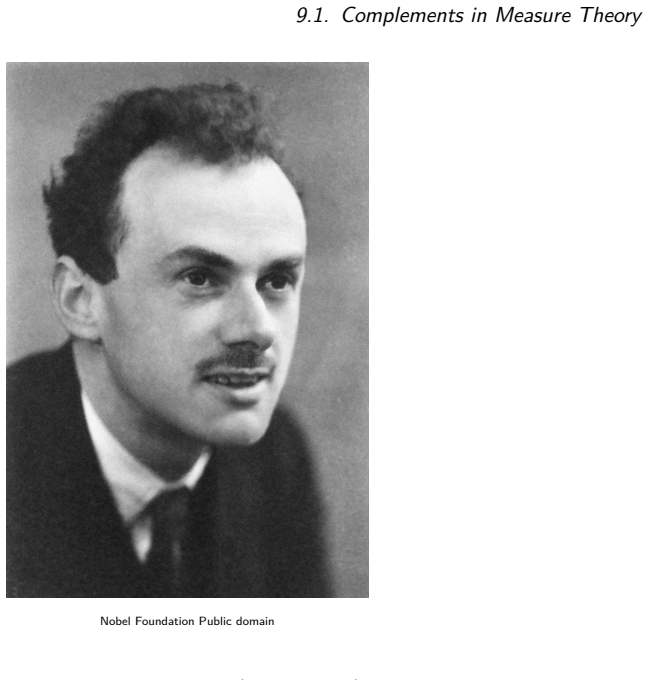
Figure 9.2
Figure 9.2. Figure 9.2: Beppo Levi (1875 - 1961) Corollary 9.7 Equality of Radon Measures by Their Integral Equality on Every Com￾pact Let µ1 and µ2 be two non-negative measures on  R d , BRd  finite on every compact set—we say that they are Radon[9.1]measures. If ∀f ∈ C + K  R d  ˆ Rd fdµ1 = ˆ Rd fdµ2, then the measures µ1 and µ2 are equal. Proof 9.7 The class C of bounded open subsets of R d is a π−system. The measures µ1… view at source ↗
Figure 9.3
Figure 9.3. Figure 9.3: Henri Lebesgue (1875 - 1941) Definition 9.9 Density of a Measure Let µ be a non-negative measure on the probabilizable space (Ω, A). Let f be a non-negative, measurable, real-valued function defined on this space. The measure defined by A 7→ ˆ A fdµ is called measure with density f with respect to µ, and is denoted by[9.3] f · µ. Definition 9.10 Absolutely Continuous Measure. Foreign Measures A measure ν… view at source ↗
Figure 9.4
Figure 9.4. Figure 9.4: Paul Dirac (1902 - 1984) Example 9.11 The Lebesgue[9.4] measure λ on R and the Dirac[9.5] measure δ0 at 0 are mutually singular, since λ ({0}) = δ ({0} c ) = 0. If ν = f · µ, then clearly ν ≪ µ. The converse—whether every measure ν ≪ µ can be written in this form—is the object of the Radon-Nikodym[9.6] theorem. For a proof of this theorem, the interested reader may refer to [Neveu(1972)] or [Métivier(196… view at source ↗
Figure 9.5
Figure 9.5. Figure 9.5: Otto M. Nikodym (1887 - 1974) Proposition 9.13 Integration with Respect to A Measure with Density Let µ be a non-negative measure on the probabilizable space (Ω, A), and let f be a non￾negative measurable real-valued function defined on this space. Let ν = f · µ be the measure with density f with respect to µ. Let h be a measurable function on (Ω, A). • If h is non-negative, then ˆ Ω hdν = ˆ Ω h · fdµ. (… view at source ↗
Figure 9.6
Figure 9.6. Figure 9.6: Carl Jacobi (1804 - 1851) • If h is non-negative, then ˆ E2 hdT (µ1) = ˆ E1 h ◦ Tdµ1. (9.2) • If h is of arbitrary sign, then for h to be T (µ1) −integrable it must and it suffices that h ◦ T is µ1−integrable; in that case, the equality (9.2) still holds. Theorem 9.16 Change of Variables Theorem Let T be a C 1 -diffeomorphism from an open set U of R d onto an open set V of R d . Let f be a measurable rea… view at source ↗
Figure 9.7
Figure 9.7. Figure 9.7: Andrey Markov (1856-1922) Proof 9.41 Let X ∈ L 1 (Ω, A, P) be a non-negative random variable. Let D = {X ⩾ ϵ} for some fixed ϵ > 0. Since X ⩾ ϵ on D, we have the chain of inequalities: E (X) = ˆ Ω XdP ⩾ ˆ D XdP ⩾ ϵP (D), hence, the first inequality. The second inequality follows from the inclusion (X > ϵ) ⊂ (X ⩾ ϵ). When X ∈ L 1 F (Ω, A, P), the second inequality is obtained by applying the first inequal… view at source ↗
Figure 9.8
Figure 9.8. Figure 9.8: Sergei Bernstein (1880-1968) with the real number ϵ 2 , noting that (∥X − E(X)∥ > ϵ) =  ∥X − E(X)∥ 2 > ϵ2  and that E  [PITH_FULL_IMAGE:figures/full_fig_p325_9_8.png] view at source ↗
Figure 9.9
Figure 9.9. Figure 9.9: Harold Hotelling (1895-1973) where p > 0. Determine the law of X. Exercise 9.4 Normal Laws in R 2 . Exponential and Hotelling Laws Let X = (X1, X2) be a random variable taking values in R 2 following the standard normal law NR2 (0, 1), that is, with density function fX given by ∀x ∈ R 2 , fX (x) = 1 2π exp − ∥x∥ 2 2 ! , where ∥·∥ denotes the usual Euclidean norm. 1. Determine the law of the random variab… view at source ↗
Figure 10.1
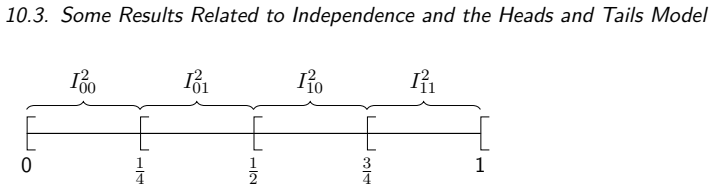
Figure 10.1. Figure 10.1: Dyadic intervals for n = 2 • The second finishes with an infinite sequence of 1. There is no other case of non-uniqueness. Indeed, suppose there were. Then 0.x1x2 · · · xj · · · = 0.y1y2 · · · yj · · · Let k be the first index such that xj ̸= yj . Without loss of generality, suppose xk = 1 and yk = 0. Then 1 2 k + + X∞ j=k+1 xj 2 j = + X∞ j=k+1 yj 2 j . From the relation (10.12), the only possibility is… view at source ↗
Figure 11.1
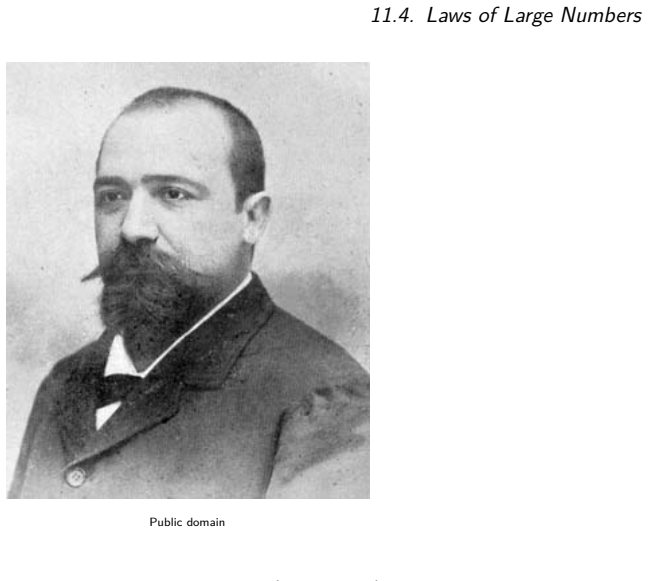
Figure 11.1. Figure 11.1: Ernesto Cesàro (1805-1906) If (Xn)n∈N∗ is a sequence of real-valued random variables, we denote for every n ∈ N ∗ , Xn = 1 n Xn j=1 Xj . In statistical terminology, Xn is called the empirical mean of the sample (X1, X2, · · · , Xn). We give the name of law of large numbers to refer to two main theorems asserting the convergence of the sequence of general term Xn under certain assumptions. For the weak l… view at source ↗
Figure 11.2
Figure 11.2. Figure 11.2: Leopold Kronecker (1823-1891) Proof 11.18 Let ϵ > 0 be an arbitrary real number. Let N be an integer such that, for every n ⩾ N, |xn − x| ⩽ ϵ. Since [PITH_FULL_IMAGE:figures/full_fig_p408_11_2.png] view at source ↗
Figure 11.3
Figure 11.3. Figure 11.3: Aleksandr Yakovlevich Khinchin (1894 - 1959) All the assumptions of the previous theorem are satisfied, in particular, if the random variables Xn are independent and of same law, and if X1 admits a second-order moment. In fact, if the random variables are independent and of same law, the mere existence of a first-order moment is sufficient, as shown by the Khinchin[11.7]theorem stated below. Before stud… view at source ↗
Figure 13.1
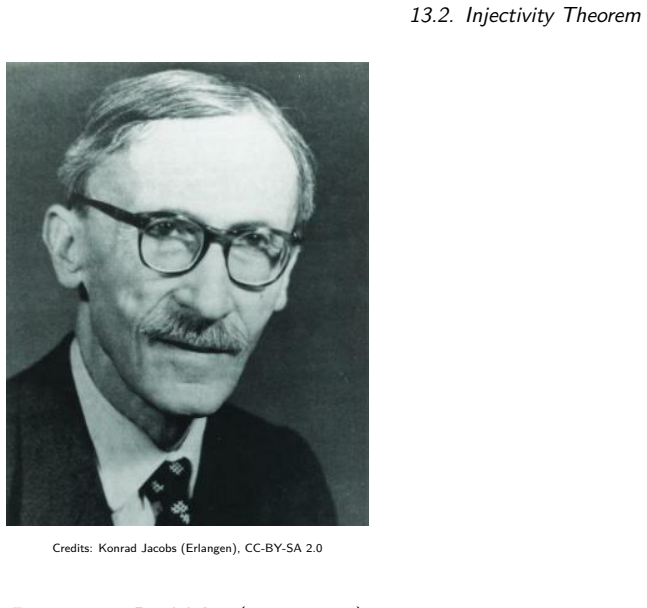
Figure 13.1. Figure 13.1: Paul Lévy (1886 - 1971) Remark It follows from the injectivity property that the characteristic function of a random variable taking values in R d completely characterizes the law of this random variable—hence its name. In particular, the Table in Chapter 9 which presents probability laws together with their Fourier transforms, can be read in both directions. This property was first proved by Paul Lévy[… view at source ↗
read the original abstract

Probabilities is the English translation of the book Probabilit\'es Tome 1 and Tome 2. The mathematic content is authored by Prof. Jean-Yves Ouvrard. The English version has been done by his eldest son Dr. Xavier Ouvrard. In this first version, only the first part is released. Part 1 contains 7 chapters and corresponds to bachelor level. The first part introduces the fundamentals of probability theory across 7 chapters, targeting bachelor level, including event algebras, random variables, independence, conditional probabilities, moments of discrete and continuous random variables, generating functions, and limit theorems. The second part contains 10 chapters and corresponds to master level. Following a brief introduction to measure theory, this part develops more advanced topics: probability measures and their complements, distributions and moments of random variables, modes of convergence, laws of large numbers, conditional expectation, Fourier transforms and characteristic functions, Gaussian random variables, convergence of measures, convergence in distribution, discrete-time stochastic processes, martingales, and Markov chains. The reader's work is greatly facilitated by the inclusion, in every chapter, of numerous exercises, all accompanied by detailed solutions that often provide substantial extensions to the theoretical material. Any feedback is welcome, at probabilities@xerox.mozmail.com The content is released in CC-BY-NC-SA.

Editorial analysis

A structured set of objections, weighed in public.

Desk editor's note, referee report, simulated authors' rebuttal, and a circularity audit. Tearing a paper down is the easy half of reading it; the pith above is the substance, this is the friction.

Referee Report

0 major / 2 minor

Summary. The manuscript is the English translation of the first part of 'Probabilités' by Prof. Jean-Yves Ouvrard (translated by Dr. Xavier Ouvrard). It presents fundamentals of probability theory across 7 chapters at bachelor level, covering event algebras, random variables, independence, conditional probabilities, moments of discrete and continuous random variables, generating functions, and limit theorems. Each chapter includes numerous exercises accompanied by detailed solutions that often extend the theoretical material.

Significance. If the translation is faithful, the manuscript supplies a structured pedagogical resource whose primary strength is the extensive set of exercises with solutions that provide substantial extensions. This format supports self-study and reinforces core concepts in a standard bachelor-level probability curriculum. As a translation of established material rather than a source of new theorems or derivations, its contribution is mainly one of accessibility for English readers.

minor comments (2)
  1. [Abstract] Abstract: the statement that 'in this first version, only the first part is released' is clear, but the title 'Probabilities' does not indicate the partial release; adding 'Part 1' or an explicit scope note would improve clarity for readers.
  2. The contact address probabilities@xerox.mozmail.com is supplied for feedback; verify that the domain and address are correctly rendered and active.

Simulated Author's Rebuttal

0 responses · 0 unresolved

We thank the referee for their review and positive assessment of the manuscript as a faithful English translation providing a structured bachelor-level resource on probability theory, with particular value placed on the extensive exercises and detailed solutions. We note the recommendation for minor revision.

Circularity Check

0 steps flagged

No circularity: standard expository textbook with no derivations or fitted claims

full rationale

The work is a translation of a conventional probability textbook covering established bachelor- and master-level topics (event algebras, random variables, independence, conditional probability, moments, generating functions, limit theorems, measure theory, martingales, Markov chains, etc.). It contains no novel theorems, no parameter-fitting, no predictions derived from data, and no load-bearing self-citations or uniqueness claims. All material is presented as standard mathematical exposition accompanied by exercises and solutions; therefore no step reduces by construction to its own inputs.

Axiom & Free-Parameter Ledger

0 free parameters · 0 axioms · 0 invented entities

This is an expository textbook that relies on the standard Kolmogorov axioms of probability already established in the literature; no new free parameters, ad-hoc axioms, or invented entities are introduced.

pith-pipeline@v0.9.0 · 5532 in / 920 out tokens · 23540 ms · 2026-05-16T10:55:52.729491+00:00 · methodology

discussion (0)

Sign in with ORCID, Apple, or X to comment. Anyone can read and Pith papers without signing in.

Reference graph

Works this paper leans on

15 extracted references · 15 canonical work pages

  1. [1]

    [Adams and Guillemin(1996)] Malcolm Ritchie Adams and Victor Guillemin.Measure theory and probability, volume

  2. [2]

    Economica,

    [Antoniadis et al.(1992)Antoniadis, Berruyer, and Carmona] Anestis Antoniadis, Jacques Berruyer, and René Carmona.Régression non linéaire et applications. Economica,

  3. [3]

    Academic press,

    [Ash and Doléans-Dade(2000)] Robert B Ash and Catherine A Doléans-Dade.Probability and mea- sure theory. Academic press,

  4. [4]

    [Durrett(2019)] Rick Durrett.Probability: theory and examples, volume

  5. [5]

    Über zwei bekannte einwände gegen das boltzmannsche h-theorem.Phys

    [Ehrenfest and Ehrenfest(1907)] P Ehrenfest and T Ehrenfest. Über zwei bekannte einwände gegen das boltzmannsche h-theorem.Phys. Z, 8:311–314,

  6. [6]

    [Ekeland(1991)] Ivar Ekeland.Au hasard: la chance, la science, et le monde. Seuil,

  7. [7]

    University of Chicago Press,

    [Ekeland(1996)] Ivar Ekeland.The broken dice, and other mathematical tales of chance. University of Chicago Press,

  8. [8]

    [Feller(1958)] William Feller.An introduction to probability theory and its applications, Volume 1, volume

  9. [9]

    Statistique.(No Title),

    [Fourgeaud and Fuchs(1967)] Claude Fourgeaud and Aimé Fuchs. Statistique.(No Title),

  10. [10]

    Notions fondamentales de la théorie des probabilités, maîtrises de mathématiques.(No Title),

    [Métivier(1968)] Michel Métivier. Notions fondamentales de la théorie des probabilités, maîtrises de mathématiques.(No Title),

  11. [11]

    Bases mathématiques du calcul des probabilités.(No Title),

    [Neveu(1964)] Jacques Neveu. Bases mathématiques du calcul des probabilités.(No Title),

  12. [12]

    Martingales à temps discret.(No Title),

    [Neveu(1972)] Jacques Neveu. Martingales à temps discret.(No Title),

  13. [13]

    [Shiryaev(2016)] Albert N Shiryaev.Probability-1, volume

  14. [14]

    [Tao(2011)] Terence Tao.An introduction to measure theory, volume

  15. [15]

    At the time of their first publication, these books were entirely original in French in their approach and content

    811 This volume is the English translation of the two French books Probabilités Tome 1 and Tome 2, authored by Professor Jean-Yves Ouvrard and originally published in 1998 and 2000 by Éditions Cassini. At the time of their first publication, these books were entirely original in French in their approach and content. They have since remained authoritative ...