Mean-Field Learning for Storage Aggregation
Pith reviewed 2026-05-16 10:05 UTC · model grok-4.3
The pith
Large populations of heterogeneous storage devices converge to a unique convex mean-field limit that acts as a tractable surrogate for their aggregate behavior.
A machine-rendered reading of the paper's core claim, the machinery that carries it, and where it could break.
Core claim
As the population of storage devices grows, aggregate performance converges to a unique, convex mean-field limit. This convexity produces a price-responsive characterization of the aggregate and permits bounding the mean-field approximation error. A convex surrogate model with physically interpretable parameters is then constructed to approximate the aggregate behavior of large populations and is identified as an optimization problem solved by a gradient-based algorithm on historical price-response data.
What carries the argument
The mean-field limit of aggregate storage behavior, shown to be unique and convex for large heterogeneous populations and used to build the price-responsive surrogate model.
If this is right
- Aggregate storage behavior can be represented by a single convex optimization problem suitable for power-system operations.
- The approximation error between the surrogate and true aggregate response can be bounded explicitly.
- Surrogate parameters can be learned efficiently from historical price-response data without needing detailed device-level models.
- The learned model can be embedded directly into existing grid dispatch and market-clearing tools.
Where Pith is reading between the lines
- The same mean-field construction could be applied to other distributed resources such as electric-vehicle fleets whose individual models are also heterogeneous and nonconvex.
- Real-time updates to the surrogate parameters could be performed incrementally as new price-response observations arrive.
- Convexity of the aggregate model may simplify the design of incentive mechanisms or contracts offered to storage aggregators.
Load-bearing premise
The storage devices are sufficiently heterogeneous and the population is large enough for the mean-field limit to be unique and convex.
What would settle it
An experiment or simulation in which the aggregate storage response remains visibly nonconvex or fails to converge for arbitrarily large populations of heterogeneous devices.
Figures
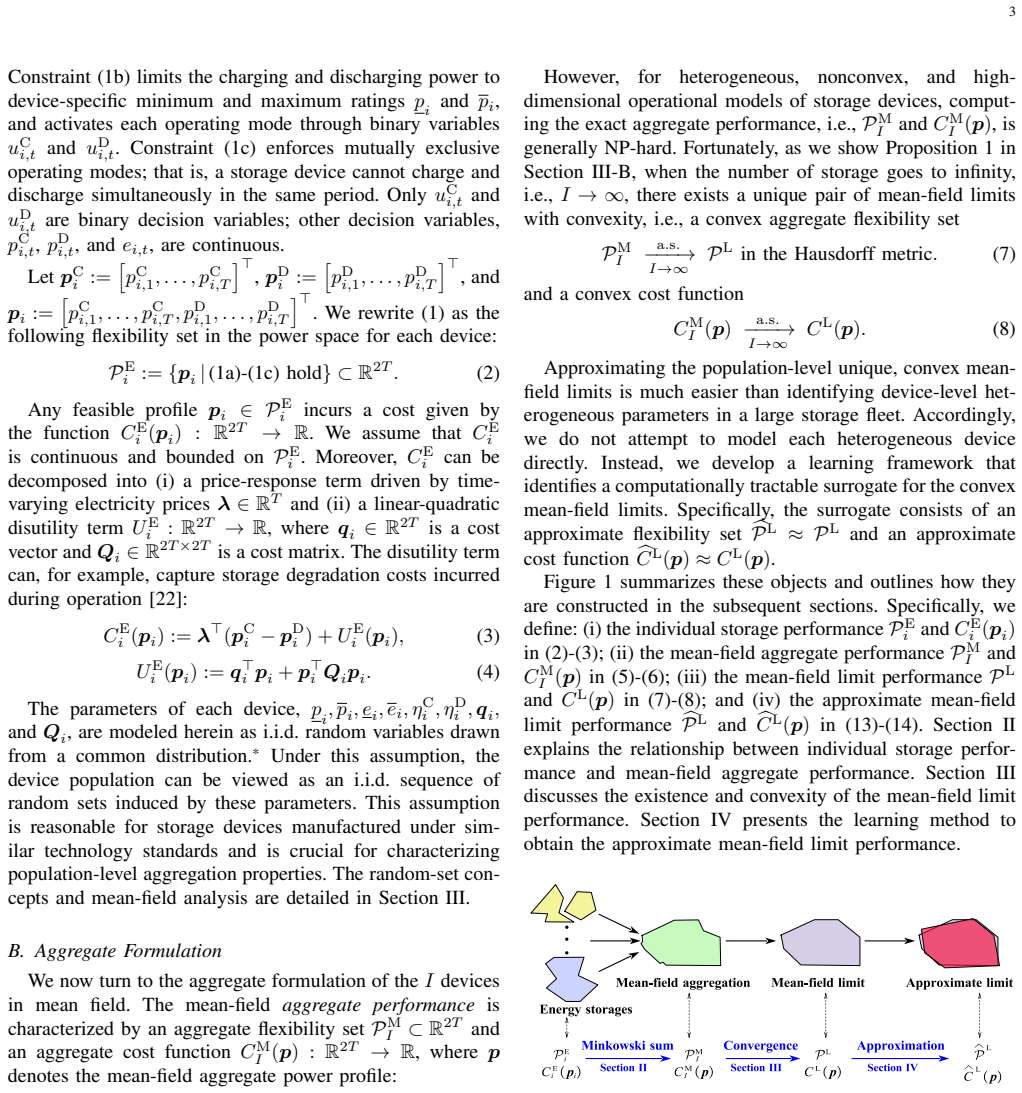


read the original abstract
Distributed energy storage devices can be aggregated to provide operational flexibility for power systems. This requires representing a massive device population as a single, tractable surrogate that is computationally efficient and accurate. However, surrogate identification is challenging due to heterogeneity, nonconvexity, and high dimensionality of storage devices. To address these challenges, this paper develops a mean-field learning framework for storage aggregation. We interpret aggregation as the average behavior of a large storage population and show that, as the population grows, aggregate performance converges to a unique, convex mean-field limit, enabling tractable population-level modeling. This convexity further yields a price-responsive characterization of aggregate storage behavior and allows us to bound the mean-field approximation error. We construct a convex surrogate model with physically interpretable parameters that approximates the aggregate behavior of large storage populations and can be embedded directly into power system operations. Surrogate parameter identification is formulated as an optimization problem using historical price-response data, and we adopt a gradient-based algorithm for efficient learning. Case studies validate the theoretical findings and demonstrate the effectiveness of the proposed framework in approximation accuracy and data efficiency.
Editorial analysis
A structured set of objections, weighed in public.
Referee Report
Summary. The manuscript develops a mean-field learning framework for aggregating distributed energy storage devices. It interprets aggregation as the average behavior of a large population and shows that as the population grows, aggregate performance converges to a unique, convex mean-field limit. This enables a price-responsive characterization, an error bound on the mean-field approximation, and construction of a convex surrogate model with physically interpretable parameters. Surrogate parameters are identified via gradient-based optimization on historical price-response data, with case studies validating approximation accuracy and data efficiency.
Significance. If the convergence and convexity results hold, the framework would provide a tractable, convex surrogate for large-scale heterogeneous storage populations that can be directly embedded in power-system optimization, addressing nonconvexity and dimensionality issues in aggregation. The data-driven learning from external historical data and the explicit error bound are strengths that could improve upon existing heuristic aggregation methods.
major comments (2)
- [Abstract] Abstract: the claim that aggregate performance converges to a unique, convex mean-field limit as the population grows, enabling an error bound, is stated without an explicit list of assumptions (e.g., Lipschitz continuity of value functions or transition kernels, or a quantitative heterogeneity measure) or the dependence of the bound on N; this is load-bearing because the skeptic correctly notes that uniqueness and convexity can fail for finite N=100–1000 without sufficient heterogeneity.
- [Case Studies] Case studies: no quantitative error metrics, finite-N rates, or convexity checks for the learned surrogate are reported, despite the abstract asserting that the convexity yields a usable bound; without these, it is impossible to verify whether the approximation remains accurate or convex for practical population sizes.
minor comments (1)
- The abstract could more clearly distinguish the mean-field limit derivation (from population averaging) from the subsequent surrogate identification step that uses external data.
Simulated Author's Rebuttal
We thank the referee for the constructive comments on our manuscript. We address each major comment below and will revise the paper to strengthen the explicit statement of assumptions and the quantitative validation in the case studies.
read point-by-point responses
-
Referee: [Abstract] Abstract: the claim that aggregate performance converges to a unique, convex mean-field limit as the population grows, enabling an error bound, is stated without an explicit list of assumptions (e.g., Lipschitz continuity of value functions or transition kernels, or a quantitative heterogeneity measure) or the dependence of the bound on N; this is load-bearing because the skeptic correctly notes that uniqueness and convexity can fail for finite N=100–1000 without sufficient heterogeneity.
Authors: We agree that the abstract should more explicitly reference the assumptions. The convergence and uniqueness results rely on Lipschitz continuity of the value functions and transition kernels together with a quantitative heterogeneity measure (detailed in Assumption 1 and Theorem 1). The error bound scales as O(1/N) modulated by the heterogeneity parameter. In the revision we will add a concise clause to the abstract listing these assumptions and noting the N-dependence, while keeping the abstract length appropriate. This clarifies that the mean-field convexity is an asymptotic property and that finite-N deviations are controlled by the heterogeneity bound. revision: yes
-
Referee: [Case Studies] Case studies: no quantitative error metrics, finite-N rates, or convexity checks for the learned surrogate are reported, despite the abstract asserting that the convexity yields a usable bound; without these, it is impossible to verify whether the approximation remains accurate or convex for practical population sizes.
Authors: We accept that the case-study section would be strengthened by explicit quantitative metrics. The current version emphasizes qualitative agreement and data efficiency; we will add tables reporting mean-absolute and mean-squared errors between finite-N aggregates and the mean-field limit for N ranging from 50 to 5000, empirical convergence rates, and numerical checks (e.g., Hessian eigenvalues) confirming convexity of the learned surrogate. These additions will directly demonstrate accuracy and convexity for practical population sizes and support the usability of the derived error bound. revision: yes
Circularity Check
No significant circularity; mean-field limit follows from population averaging
full rationale
The derivation chain begins with the interpretation of aggregation as the average behavior of a large heterogeneous storage population and proceeds to a standard mean-field convergence argument as N grows. This limit is shown to be unique and convex under the stated regularity and heterogeneity assumptions, after which a price-responsive characterization and error bound are obtained directly from the convexity property. Surrogate parameters are then identified by solving an optimization problem against external historical price-response data. None of these steps reduces to a self-definition, a fitted input renamed as a prediction, or a load-bearing self-citation; the central claims remain independent of the learned parameters and rest on population-level averaging rather than tautological closure within the paper's own equations.
Axiom & Free-Parameter Ledger
free parameters (1)
- surrogate parameters
axioms (1)
- domain assumption Large-population limit yields unique convex mean-field behavior
Forward citations
Cited by 1 Pith paper
-
Reachable-Set Decomposition for Real-Time Aggregation of Multi-Zone HVAC Fleets
A reachable-set decomposition framework encodes remaining-horizon feasibility into per-period constraints for scalable real-time aggregation of multi-zone HVAC fleets via offline inner approximations and online parall...
Reference graph
Works this paper leans on
-
[1]
Preference-oriented aggregation of heterogeneous distributed energy resources for reserve dispatch,
J. Liu, X. Ai, S. Cui, X. Xue, S. Wang, J. Fang, W. Yao, and J. Wen, “Preference-oriented aggregation of heterogeneous distributed energy resources for reserve dispatch,”IEEE Transactions on Smart Grid, 2025
work page 2025
-
[2]
Texas’ only energy provider with home backup power,
“Texas’ only energy provider with home backup power,” [Online]. Available: https://www.basepowercompany.com/, accessed: Nov. 6, 2025
work page 2025
-
[3]
Bid and self-schedule submission in California ISO markets,
“Bid and self-schedule submission in California ISO markets,” [Online]. Available: https://www.caiso.com/documents/section-30- bid-and-self-schedule-submission-in-california-iso-markets-as-of- aug-1-2024.pdf, August 2024, accessed: Nov. 6, 2025
work page 2024
-
[4]
FERC order no. 2222: Fact sheet,
“FERC order no. 2222: Fact sheet,” [Online]. Available: https://www. ferc.gov/media/ferc-order-no-2222-fact-sheet, Sep. 2020, accessed: Nov. 6, 2025
work page 2020
-
[5]
Predicting strategic energy storage behaviors,
Y . Bian, N. Zheng, Y . Zheng, B. Xu, and Y . Shi, “Predicting strategic energy storage behaviors,”IEEE Transactions on Smart Grid, vol. 15, no. 2, pp. 1608–1619, 2023
work page 2023
-
[6]
Coupling-aware aggregation of multi-zone HV AC loads under uncertainty: A two-level framework,
J. Liu, H. Jiang, X. Ai, S. Wang, X. Xue, S. Cui, J. Hou, J. Fang, and J. Wen, “Coupling-aware aggregation of multi-zone HV AC loads under uncertainty: A two-level framework,”IEEE Transactions on Smart Grid, 2025
work page 2025
-
[7]
Characterizing the flexibility of electric vehicle fleets considering battery degradation cost,
Z. Long, N. Zhang, K. Feng, Y . Wang, and J. Wang, “Characterizing the flexibility of electric vehicle fleets considering battery degradation cost,”IEEE Transactions on Industry Applications, 2025
work page 2025
-
[8]
Efficient quantification and representation of aggregate flexibility in electric vehicles,
N. K. Panda and S. H. Tindemans, “Efficient quantification and representation of aggregate flexibility in electric vehicles,”Electric Power Systems Research, vol. 235, p. 110811, 2024
work page 2024
-
[9]
Exact aggregate models for optimal management of heterogeneous fleets of storage devices,
D. Angeli, Z. Dong, and G. Strbac, “Exact aggregate models for optimal management of heterogeneous fleets of storage devices,”IEEE Transactions on Control of Network Systems, vol. 11, no. 3, pp. 1430– 1439, 2023
work page 2023
-
[10]
J. Liu, X. Ai, J. Fang, S. Cui, S. Wang, W. Yao, and J. Wen, “Continuous-time aggregation of massive flexible HV AC loads con- sidering uncertainty for reserve provision in power system dispatch,” IEEE Transactions on Smart Grid, vol. 15, no. 5, pp. 4835–4849, 2024
work page 2024
-
[11]
Aggregate power flexibility in unbalanced distribution systems,
X. Chen, E. Dall’Anese, C. Zhao, and N. Li, “Aggregate power flexibility in unbalanced distribution systems,”IEEE Transactions on Smart Grid, vol. 11, no. 1, pp. 258–269, 2019
work page 2019
-
[12]
Leveraging two-stage adaptive robust optimization for power flexibility aggregation,
X. Chen and N. Li, “Leveraging two-stage adaptive robust optimization for power flexibility aggregation,”IEEE Transactions on Smart Grid, vol. 12, no. 5, pp. 3954–3965, 2021
work page 2021
-
[13]
Aggregation and disaggregation of energetic flexibility from distributed energy resources,
F. L. M ¨uller, J. Szab ´o, O. Sundstr ¨om, and J. Lygeros, “Aggregation and disaggregation of energetic flexibility from distributed energy resources,”IEEE Transactions on Smart Grid, vol. 10, no. 2, pp. 1205– 1214, 2017
work page 2017
-
[14]
F. Al Taha, T. Vincent, and E. Bitar, “An efficient method for quanti- fying the aggregate flexibility of plug-in electric vehicle populations,” IEEE Transactions on Smart Grid, vol. 16, no. 4, pp. 3142–3154, 2024
work page 2024
-
[15]
Alleviating the curse of dimensionality in minkowski sum approximations of storage flexibility,
E. ¨Ozt¨urk, T. Faulwasser, K. Worthmann, M. Preißinger, and K. Rhein- berger, “Alleviating the curse of dimensionality in minkowski sum approximations of storage flexibility,”IEEE Transactions on Smart Grid, vol. 15, no. 6, pp. 5733–5743, 2024
work page 2024
-
[16]
Model-free aggregation for virtual power plants using input convex neural networks,
W. Lin, Y . Wang, J. Wu, and F. Feng, “Model-free aggregation for virtual power plants using input convex neural networks,”IEEE Transactions on Smart Grid, vol. 16, no. 3, pp. 2404–2415, 2025
work page 2025
-
[17]
Data-driven modeling of aggregate flexibility under uncertain and non-convex device models,
S. Taheri, V . Kekatos, S. Veeramachaneni, and B. Zhang, “Data-driven modeling of aggregate flexibility under uncertain and non-convex device models,”IEEE Transactions on Smart Grid, vol. 13, no. 6, pp. 4572–4582, 2022
work page 2022
-
[18]
New insights from the shapley-folkman lemma on dispatchable demand in energy markets,
K. Hreinsson, A. Scaglione, M. Alizadeh, and Y . Chen, “New insights from the shapley-folkman lemma on dispatchable demand in energy markets,”IEEE Transactions on Power Systems, vol. 36, no. 5, pp. 4028–4041, 2021
work page 2021
-
[19]
arXiv preprint arXiv:1911.01525 , year=
W. Han and Y . Yang, “Statistical inference in mean-field variational bayes,”arXiv preprint arXiv:1911.01525, 2019
-
[20]
X. Guo, A. Hu, R. Xu, and J. Zhang, “Learning mean-field games,” Advances in neural information processing systems, vol. 32, 2019
work page 2019
-
[21]
Optimal mechanisms for demand response: An indifference set approach,
M. Mehrabi, O. Karaduman, and S. Wager, “Optimal mechanisms for demand response: An indifference set approach,”arXiv preprint arXiv:2409.07655, 2024
-
[22]
Perturbed decision-focused learning for modeling strategic energy storage,
M. Yi, S. Alghumayjan, and B. Xu, “Perturbed decision-focused learning for modeling strategic energy storage,”IEEE Transactions on Smart Grid, 2025
work page 2025
- [23]
-
[24]
Integrals of set-valued functions,
R. J. Aumann, “Integrals of set-valued functions,”Journal of mathe- matical analysis and applications, vol. 12, no. 1, pp. 1–12, 1965
work page 1965
-
[25]
A strong law of large numbers for random compact sets,
Z. Artstein and R. A. Vitale, “A strong law of large numbers for random compact sets,”The Annals of Probability, pp. 879–882, 1975
work page 1975
-
[26]
Quasi-equilibria in markets with non-convex prefer- ences,
R. M. Starr, “Quasi-equilibria in markets with non-convex prefer- ences,”Econometrica: journal of the Econometric Society, pp. 25–38, 1969
work page 1969
-
[27]
IKEA Germany launches dynamic electricity tariff,
“IKEA Germany launches dynamic electricity tariff,” [Online]. Avail- able: https://bit.ly/49B3Vxk (accessed Jan. 23, 2026), January 2026
work page 2026
-
[28]
Wholesale market partic- ipation of DERAs: DSO-DERA-ISO coordination,
C. Chen, S. Bose, T. D. Mount, and L. Tong, “Wholesale market partic- ipation of DERAs: DSO-DERA-ISO coordination,”IEEE Transactions on Power Systems, vol. 39, no. 5, pp. 6605–6614, 2024
work page 2024
-
[29]
Optnet: Differentiable optimization as a layer in neural networks,
B. Amos and J. Z. Kolter, “Optnet: Differentiable optimization as a layer in neural networks,” inInternational conference on machine learning. PMLR, 2017, pp. 136–145
work page 2017
-
[30]
Differentiable convex optimization layers,
A. Agrawal, B. Amos, S. Barratt, S. Boyd, S. Diamond, and J. Z. Kolter, “Differentiable convex optimization layers,”Advances in neural information processing systems, vol. 32, 2019
work page 2019
-
[31]
Dataset of electricity prices,
“Dataset of electricity prices,” [Online]. Available: https://bit.ly/ 4r4w4mg (accessed Sep. 27, 2025), September 2025. 11 TABLE II:Random variables versus random sets. Concept Random variablexRandom setX Object (value space)x: Ω→R n, a measurable map taking values inR n X: Ω→2 Rn , a measurable map taking values in nonempty, compact subsets ofR n (Defini...
work page 2025
-
[32]
Side-by-side comparison.Table II summarizes the key correspondences between random variables and random sets that are directly used in our mean-field analysis. In particular, aggregation is captured by Minkowski addition, and conver- gence is measured via the Hausdorff distance. These correspondences enable a random-set analog of the strong law of large n...
-
[33]
From points to sets.The key distinction is that a random variable realizes apointinR n, whereas a random set realizes acompact setinR n for each outcomeω. Accordingly, the appropriate notion of expectation is the Aumann expectation, defined through (measurable) selections of the random set. Lemma 1 further implies that Minkowski averaging of ran- dom sets...
-
[34]
A toy example.To illustrate the analogy, consider a one-dimensional example. Letξbe a nonnegative integrable random variable and define the random set X(ω) := [0, ξ(ω)] = x∈R 0≤x≤ξ(ω) . A single realization ofXis thus an interval[0, ξ(ω)]. Now considerIi.i.d. random sets{X i}I i=1, whereX i = [0, ξi]and{ξ i}I i=1 are i.i.d. random variables. The mean-fiel...
-
[35]
random sets defined on a non-atomic probability space
Aggregate flexibility set.Under Assumption 1, the aug- mented sets{ ‹PE i }I i=1 are integrable i.i.d. random sets defined on a non-atomic probability space. Projecting{ ‹PE i }I i=1 onto the power coordinates shows that the flexibility sets{P E i }I i=1 12 are also integrable i.i.d. random sets defined on a non-atomic probability space. Therefore, Lemma ...
-
[36]
Applying Lemma 1 to{ ‹PE i }I i=1 yields lim I→∞ dH Ä‹PM I ,E î Conv(‹PE i ) óä =a.s
Augmented power-cost set.Define the mean-field aug- mented set by ‹PM I := 1 I IM i=1 ‹PE i ⊂R 2T+1 . Applying Lemma 1 to{ ‹PE i }I i=1 yields lim I→∞ dH Ä‹PM I ,E î Conv(‹PE i ) óä =a.s. 0
-
[37]
Identification of the cost limit.From the definition ofC M I in (6) and of the augmented sets in Section III-B, one verifies that the truncated epigraph of the mean-field aggregate cost coincides with the mean-field augmented set, i.e.,epiC M I = ‹PM I .Combining this identity with the convergence in Step 2, we obtain lim I→∞ dH Ä epiC M I ,E î Conv(‹PE i...
discussion (0)
Sign in with ORCID, Apple, or X to comment. Anyone can read and Pith papers without signing in.