Game-Based and Gamified Robotics Education: A Comparative Systematic Review and Design Guidelines
Pith reviewed 2026-05-16 09:39 UTC · model grok-4.3
The pith
A review of 95 studies shows game-based learning suits informal robotics settings while gamification dominates formal classrooms using project-based methods.
A machine-rendered reading of the paper's core claim, the machinery that carries it, and where it could break.
Core claim
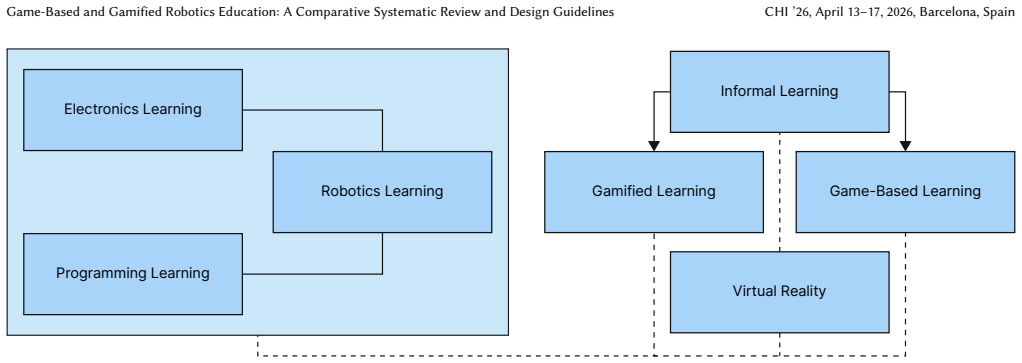
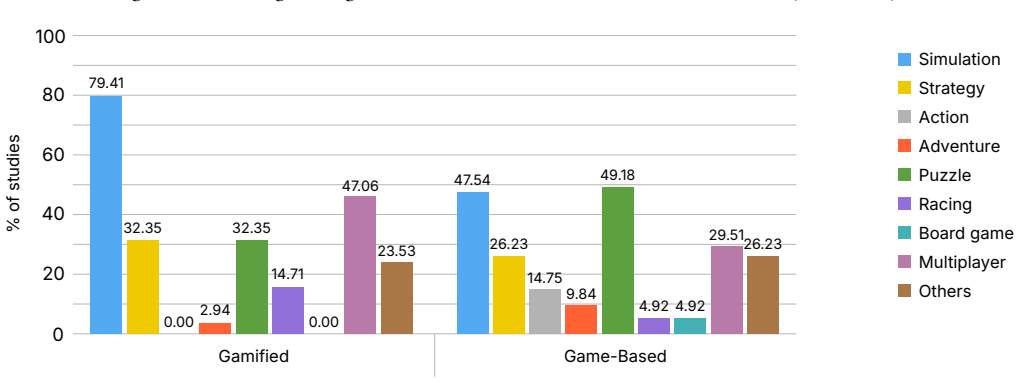
The review identifies three main patterns across the 95 studies: an approach-context-pedagogy coupling in which game-based learning appears more often in informal settings while gamification prevails in formal classrooms and favors project-based learning; a strong emphasis on introductory programming and modular hardware kits with limited uptake of advanced software, hardware, or immersive technologies; and short study durations that rely primarily on self-report measures.
What carries the argument
The PRISMA-aligned coding scheme that classifies each study by approach, learning context, skill level, modality, pedagogy, and outcomes.
If this is right
- Educators should match game-based learning to informal out-of-school programs and gamification to structured classroom projects.
- Current practice centers on introductory programming with modular kits, leaving room for wider use of advanced tools.
- Future studies should extend beyond short time frames and incorporate objective performance measures instead of self-reports.
- The proposed design space supplies concrete best practices and pitfalls for implementing either approach.
Where Pith is reading between the lines
- Hybrid designs that combine selected elements of both game-based learning and gamification could be tested for settings that sit between informal and formal contexts.
- The identified emphasis on basic tools suggests that scaling advanced robotics platforms will require targeted training materials matched to each approach.
- Longer-term studies could check whether the context-specific patterns persist when computational thinking gains are measured over multiple semesters.
Load-bearing premise
The 95 included studies are representative of the full field and the coding categories capture the meaningful differences without bias from the four databases or the 2014-2025 window.
What would settle it
A new search across additional databases or years that finds substantially more studies using advanced hardware or immersive technologies inside formal classrooms would alter the reported patterns of limited adoption and context coupling.
Figures



read the original abstract
Robotics education fosters computational thinking, creativity, and problem-solving, but remains challenging due to technical complexity. Game-based learning (GBL) and gamification offer engagement benefits, yet their comparative impact remains unclear. We present the first PRISMA-aligned systematic review and comparative synthesis of GBL and gamification in robotics education, analyzing 95 studies from 12,485 records across four databases (2014-2025). We coded each study's approach, learning context, skill level, modality, pedagogy, and outcomes (k = .918). Three patterns emerged: (1) approach-context-pedagogy coupling (GBL more prevalent in informal settings, while gamification dominated formal classrooms [p < .001] and favored project-based learning [p = .009]); (2) emphasis on introductory programming and modular kits, with limited adoption of advanced software (~17%), advanced hardware (~5%), or immersive technologies (~22%); and (3) short study horizons, relying on self-report. We propose eight research directions and a design space outlining best practices and pitfalls, offering actionable guidance for robotics education.
Editorial analysis
A structured set of objections, weighed in public.
Referee Report
Summary. The manuscript presents the first PRISMA-aligned systematic review comparing game-based learning (GBL) and gamification in robotics education. From 12,485 records screened across four databases (2014-2025), 95 studies were included and coded on approach, context, skill level, modality, pedagogy, and outcomes (inter-rater reliability κ = .918). Three patterns are reported: (1) statistically significant approach-context-pedagogy coupling, with GBL more common in informal settings and gamification dominant in formal classrooms (p < .001) and favoring project-based learning (p = .009); (2) heavy emphasis on introductory programming and modular kits, with limited use of advanced software (~17%), hardware (~5%), or immersive technologies (~22%); and (3) predominantly short-term studies relying on self-report measures. The paper proposes eight research directions and a design space of best practices and pitfalls.
Significance. If the synthesis holds, the review supplies a much-needed comparative overview of GBL versus gamification in robotics education, an area previously lacking structured synthesis. The use of explicit PRISMA reporting, high inter-rater reliability, and statistical tests for the key associations adds methodological rigor uncommon in many educational reviews. The resulting design guidelines and research agenda are actionable for both practitioners and researchers, directly addressing gaps such as under-adoption of advanced technologies and short evaluation horizons. These contributions can help standardize and improve future work in the field.
minor comments (4)
- [Abstract and Section 3.1] Abstract and Section 3.1: The search window is stated as 2014-2025; clarify whether the upper bound is inclusive and provide the exact search date to support reproducibility.
- [Section 4] Section 4 (Results): Percentages for technology adoption (e.g., ~17% advanced software) should be accompanied by the corresponding absolute counts (n out of 95) to allow readers to assess the base rates directly.
- [Section 6] Section 6 (Design Guidelines): Consider adding a summary table that explicitly maps each of the eight research directions or guidelines back to the specific coding frequencies or statistical patterns reported earlier.
- [Figures] Figure 2 or equivalent: Ensure all axis labels, legends, and statistical annotations (including exact p-values and test names) are legible at print size.
Simulated Author's Rebuttal
We thank the referee for the positive assessment of our manuscript and the recommendation for minor revision. The summary accurately reflects our PRISMA-aligned approach, the statistical findings on approach-context couplings, the observed limitations in technology adoption, and the proposed research directions. We appreciate the recognition of the methodological rigor and actionable contributions.
Circularity Check
No circularity: literature synthesis with external data only
full rationale
This is a PRISMA systematic review that codes and statistically summarizes 95 external studies drawn from database searches. No equations, fitted parameters, derivations, or self-citations serve as load-bearing premises for the reported patterns; the three observed associations (approach-context coupling, technology adoption rates, study duration) are computed directly from the coded attributes of the included papers. Inter-rater reliability (k=.918) and p-values are reported on the external corpus, with no reduction of any claim to the authors' own prior inputs or definitions. The review is therefore self-contained against external benchmarks.
Axiom & Free-Parameter Ledger
axioms (2)
- standard math PRISMA guidelines provide a reliable framework for conducting and reporting systematic reviews
- domain assumption Cohen's kappa of 0.918 indicates sufficient coding consistency across studies
Reference graph
Works this paper leans on
-
[1]
Surattana Adipat, Kittisak Laksana, Kanrawee Busayanon, Alongkorn Asawa- sowan, and Boonlit Adipat. 2021. Engaging students in the learning process with game-based learning: The fundamental concepts.International Journal of Technology in Education4, 3 (2021), 542–552. Publisher: ERIC
work page 2021
-
[2]
Filippo Agalbato and Daniele Loiacono. 2018. Robo 3: A Puzzle Game to Learn Coding. In2018 IEEE Games, Entertainment, Media Conference (GEM). IEEE, 359–366
work page 2018
-
[3]
Louis Alfieri, Ross Higashi, Robin Shoop, and Christian D Schunn. 2015. Case studies of a robot-based game to shape interests and hone proportional reasoning skills.International Journal of STEM Education2 (2015), 1–13. Publisher: Springer
work page 2015
-
[4]
Dimitris Alimisis. 2013. Educational robotics: Open questions and new chal- lenges.Themes in Science and Technology Education6, 1 (2013), 63–71. Publisher: ERIC
work page 2013
-
[5]
Maximilian Altmeyer, Pascal Lessel, and Antonio Krüger. 2018. Investigating gamification for seniors aged 75+. InProceedings of the 2018 Designing Interactive Systems Conference. 453–458
work page 2018
-
[6]
Rafael Alves Heinze, Regan L Mandryk, and Madison Klarkowski. 2024. Explor- ing the Role of Action Mechanics in Game-Based Stress Recovery.Proceedings of the ACM on Human-Computer Interaction8, CHI PLAY (2024), 1–32
work page 2024
-
[7]
Pamela Andrade, Effie Lai-Chong Law, Juan Carlos Farah, and Denis Gillet
-
[8]
InProceedings of the 32nd Australian Conference on Human-Computer Interaction
Evaluating the effects of introducing three gamification elements in STEM educational software for secondary schools. InProceedings of the 32nd Australian Conference on Human-Computer Interaction. 220–232
-
[9]
Julian M Angel-Fernandez and Markus Vincze. 2018. Towards a definition of educational robotics. InAustrian Robotics Workshop 2018, Vol. 37
work page 2018
-
[10]
Gizem Ateş. 2022. Work in Progress: Learning Fundamental Robotics Concepts Through Games at Bachelor Level. In2022 IEEE Global Engineering Education Conference (EDUCON). IEEE, 1956–1958
work page 2022
-
[11]
Soumela Atmatzidou and Stavros Demetriadis. 2016. A didactical model for educational robotics activities: A study on improving skills through strong or minimal guidance. InInternational Conference EduRobotics 2016. Springer, 58–72
work page 2016
-
[12]
Serdar As,ut. 2024. Developing a Hybrid Learning Environment for Architectural Robotics. InProceedings of the 42nd Conference on Education and Research in Computer Aided Architectural Design in Europe. eCAADe, 695–704
work page 2024
-
[13]
Abdul Syafiq Bahrin, Mohd Shahrizal Sunar, and Azizul Azman. 2021. Enjoyment as gamified experience for informal learning in virtual reality. InInternational Conference on Intelligent Technologies for Interactive Entertainment. Springer, 383–399
work page 2021
-
[14]
Jacky Baltes, Reinhard Gerndt, Saeed Saeedvand, Soroush Sadeghnejad, Petr Čížek, and Jan Faigl. 2023. Learning Through Competitions—The FIRA Youth Mission Impossible Competition. InInternational Conference on Robotics in Education (RiE). Springer, 383–394
work page 2023
-
[15]
İremsu Baş, Demir Alp, Ceren Dolu, Melis Alsan, Andy Emre Koçak, Irmak Atılgan, and Sedat Yalçın. 2023. Enhancing Prototyping Skills of K-12 Students Through Lemon: A Bio-Inspired Robotics Kit. InInternational Conference on Human-Computer Interaction. Springer, 264–270
work page 2023
-
[16]
Marina Umaschi Bers, Louise Flannery, Elizabeth R Kazakoff, and Amanda Sullivan. 2014. Computational thinking and tinkering: Exploration of an early childhood robotics curriculum.Computers & education72 (2014), 145–157. Publisher: Elsevier
work page 2014
-
[17]
Max V Birk, Regan L Mandryk, and Cheralyn Atkins. 2016. The motivational push of games: The interplay of intrinsic motivation and external rewards in games for training. InProceedings of the 2016 Annual Symposium on Computer- Human Interaction in Play. 291–303
work page 2016
-
[18]
Mayara Bonani, Raquel Oliveira, Filipa Correia, André Rodrigues, Tiago Guer- reiro, and Ana Paiva. 2018. What my eyes can’t see, a robot can show me: Exploring the collaboration between blind people and robots. InProceedings of the 20th International ACM SIGACCESS Conference on Computers and Accessibil- ity. 15–27
work page 2018
-
[19]
Elise Buckley, Joseph D Monaco, Kevin M Schultz, Robert W Chalmers, Armin Hadzic, Kechen Zhang, Grace M Hwang, and M Dwight Carr. 2022. An interdis- ciplinary approach to high school curriculum development: Swarming Powered by Neuroscience. In2022 IEEE Integrated STEM Education Conference (ISEC). IEEE, 1–8
work page 2022
-
[20]
Ridho Dedy Arief Budiman, Herman Dwi Surjono, and Edi Hidayat. 2025. Gam- ification: Enhancing Constructivist Skills through Line-Following Robots.Inter- national Journal of Online & Biomedical Engineering21, 1 (2025)
work page 2025
-
[21]
José M Cañas, Diego Martín-Martín, Pedro Arias, Julio Vega, David Roldán- Álvarez, Lía García-Pérez, and Jesús Fernández-Conde. 2020. Open-source drone programming course for distance engineering education.Electronics9, 12 (2020),
work page 2020
-
[22]
José M Cañas, Eduardo Perdices, Lía García-Pérez, and Jesús Fernández-Conde
-
[23]
A ROS-based open tool for intelligent robotics education.Applied Sciences 10, 21 (2020), 7419. Publisher: MDPI
work page 2020
-
[24]
Tan-I Chen, Shih-Kai Lin, and Hung-Chang Chung. 2023. Gamified Educational Robots Lead an Increase in Motivation and Creativity in STEM Education. Journal of Baltic Science Education22, 3 (2023), 427–438. Publisher: Scientia Socialis Ltd. 29 K. Donelaicio Street, LT-78115 Siauliai, Republic
work page 2023
-
[25]
Chien-Hsing Chou, Yu-Sheng Su, and Hui-Ju Chen. 2019. Interactive teaching aids integrating building blocks and programming logic.Journal of Internet Technology20, 6 (2019), 1709–1720
work page 2019
-
[26]
Chan-Jin Chung, Shannan Palonis, Elmer Santos, Pamela Sparks, and Christo- pher Cartwright. 2021. Design, implementation, and assessment of synchronized worldwide online robotics competitions for engineering and computing educa- tion. In2021 IEEE Frontiers in Education Conference (FIE). IEEE, 1–8
work page 2021
-
[27]
Douglas B Clark, Emily E Tanner-Smith, and Stephen S Killingsworth. 2016. Digital games, design, and learning: A systematic review and meta-analysis. Review of educational research86, 1 (2016), 79–122. Publisher: Sage Publications Sage CA: Los Angeles, CA
work page 2016
-
[28]
Jacob Cohen. 1960. A coefficient of agreement for nominal scales.Educational and psychological measurement20, 1 (1960), 37–46
work page 1960
-
[29]
Joana M Costa. 2023. Using game concepts to improve Programming Learning: A multi-level meta-analysis.Computer Applications in Engineering Education31, 4 (2023), 1098–1110. Publisher: Wiley Online Library
work page 2023
-
[30]
Valter Costa, Tiago Cunha, Miguel Oliveira, Heber Sobreira, and Armando Sousa. 2015. Robotics: using a competition mindset as a tool for learning ROS. InRobot 2015: Second Iberian Robotics Conference: Advances in Robotics, Volume
work page 2015
-
[31]
Raúl Crespo, René García, and Samuel Quiroz. 2015. Virtual reality simulator for robotics learning. In2015 International Conference on interactive collaborative and blended learning (ICBL). IEEE, 61–65
work page 2015
-
[32]
Raúl Crespo, René García, and Samuel Quiroz. 2015. Virtual reality application for simulation and off-line programming of the mitsubishi movemaster RV-M1 robot integrated with the oculus rift to improve students training.Procedia Computer Science75 (2015), 107–112. Publisher: Elsevier
work page 2015
-
[33]
Milan Dahal, Lydia Kresin, and Chris Rogers. 2023. Introductory activities for teaching robotics with smartmotors. InInternational Conference on Robotics in Education (RiE). Springer, 229–241
work page 2023
-
[34]
Thabatta Moreira Alves De Araújo, Anderson Ribeiro De Oliveira Santos Silva, Alisson Marques Da Silva, Eduardo Habib Bechelane Maia, and Michel Pires Da Silva. 2023. Prorobot: An experience report of an introduction to program- ming and robotics course. In2023 Latin American Robotics Symposium (LARS), 2023 Brazilian Symposium on Robotics (SBR), and 2023 W...
work page 2023
-
[35]
Bruno Henrique De Paula, Andrew Burn, Richard Noss, and José Armando Valente. 2018. Playing Beowulf: Bridging computational thinking, arts and liter- ature through game-making.International journal of child-computer interaction 16 (2018), 39–46. Publisher: Elsevier
work page 2018
-
[36]
Chris Dede. 2009. Immersive interfaces for engagement and learning.science 323, 5910 (2009), 66–69. Publisher: American Association for the Advancement of Science
work page 2009
-
[37]
Sebastian Deterding, Dan Dixon, Rilla Khaled, and Lennart Nacke. 2011. From game design elements to gamefulness: defining" gamification". InProceedings of the 15th international academic MindTrek conference: Envisioning future media environments. 9–15
work page 2011
-
[38]
D Dewantara, M Misbah, S Haryandi, and S Mahtari. 2021. Game-based learning for the mastery of HOTS in prospective physics teachers in digital electron- ics courses. InJournal of Physics: Conference Series, Vol. 1869. IOP Publishing, 012153
work page 2021
-
[39]
2000.Robots for kids: exploring new tech- nologies for learning
Allison Druin and James A Hendler. 2000.Robots for kids: exploring new tech- nologies for learning. Morgan Kaufmann
work page 2000
-
[40]
Dalila Alves Durães. 2015. Gaming and robotics to transforming learning. In Methodologies and intelligent systems for technology enhanced learning. Springer, 51–56
work page 2015
-
[41]
Belkis Díaz-Lauzurica and David Moreno-Salinas. 2019. Computational thinking and robotics: A teaching experience in compulsory secondary education with students with high degree of apathy and demotivation.Sustainability11, 18 (2019), 5109. Publisher: MDPI
work page 2019
-
[42]
Amy Eguchi. 2014. Robotics as a learning tool for educational transformation. In Proceeding of 4th international workshop teaching robotics, teaching with robotics & 5th international conference robotics in education Padova (Italy), Vol. 1. 1–6
work page 2014
-
[43]
Fivia Eliza, Muhammad Hakiki, Mughnil Muhtaj, Della Asmaria Putri, Yayuk Hidayah, Ade Fricticarani, Jamal Fakhri, Iqbal Arpannudin, Desty Endrawati Subroto, and Kelik Sussolaikah. 2025. Game-D: Development of an educational game using a line follower robot on straight motion material.International Journal of Information and Education Technology15, 1 (2025)
work page 2025
-
[44]
Francisco J Estrada. 2017. Practical robotics in computer science using the LEGO NXT: An experience report. InProceedings of the 2017 ACM Conference on Innovation and Technology in Computer Science Education. 329–334
work page 2017
-
[45]
Salomi Evripidou, Kyriakoula Georgiou, Lefteris Doitsidis, Angelos A Amana- tiadis, Zinon Zinonos, and Savvas A Chatzichristofis. 2020. Educational robotics: Platforms, competitions and expected learning outcomes.IEEE access8 (2020), Game-Based and Gamified Robotics Education: A Comparative Systematic Review and Design Guidelines CHI ’26, April 13–17, 202...
work page 2020
-
[46]
Chiara Fante, Fabrizio Ravicchio, and Flavio Manganello. 2024. Navigating the Evolution of Game-Based Educational Approaches in Secondary STEM Education: A Decade of Innovations and Challenges.Education Sciences14, 6 (2024), 662. Publisher: MDPI
work page 2024
-
[47]
Raúl Fernández-Ruiz, Daniel Palacios-Alonso, José María Cañas-Plaza, and David Roldán-Álvarez. 2022. Automatic competitions in the unibotics open online robot programming web. InIberian Robotics conference. Springer, 463–474
work page 2022
-
[48]
Guo Freeman, Dane Acena, Nathan J McNeese, and Kelsea Schulenberg. 2022. Working together apart through embodiment: Engaging in everyday collabo- rative activities in social Virtual Reality.Proceedings of the ACM on Human- Computer Interaction6, GROUP (2022), 1–25
work page 2022
-
[49]
Guo Freeman and Divine Maloney. 2021. Body, avatar, and me: The presentation and perception of self in social virtual reality.Proceedings of the ACM on human- computer interaction4, CSCW3 (2021), 1–27
work page 2021
-
[50]
Maximilian Achim Friehs, Martin Dechant, Sarah Vedress, Christian Frings, and Regan Lee Mandryk. 2020. Effective gamification of the stop-signal task: two controlled laboratory experiments.JMIR Serious Games8, 3 (2020), e17810
work page 2020
-
[51]
Lorella Gabriele, Davide Marocco, Francesca Bertacchini, Pietro Pantano, and Eleonora Bilotta. 2017. An educational robotics lab to investigate cognitive strategies and to foster learning in an arts and humanities course degree.Inter- national Journal of Online Engineering13, 4 (2017)
work page 2017
-
[52]
William W Gaver. 1991. Technology affordances. InProceedings of the SIGCHI conference on Human factors in computing systems. 79–84
work page 1991
-
[53]
Mohamed Gharib, Tala Katbeh, G Benjamin Cieslinski, and Brady Creel. 2021. A Novel Trilogy of e-STEM Programs. InASME International Mechanical Engi- neering Congress and Exposition, Vol. 85659. American Society of Mechanical Engineers, V009T09A041
work page 2021
-
[54]
Christian Giang, Morgane Chevalier, Lucio Negrini, Ran Peleg, Evgeniia Bonnet, Alberto Piatti, and Francesco Mondada. 2018. Exploring escape games as a teaching tool in educational robotics. InInternational Conference EduRobotics
work page 2018
-
[55]
Barry Golding, Mike Brown, and Annette Foley. 2009. Informal learning: A dis- cussion around defining and researching its breadth and importance.Australian Journal of Adult Learning49, 1 (2009), 34–56
work page 2009
-
[56]
Brianna L Grant, Paul C Yielder, Tracey A Patrick, Bill Kapralos, Michael Williams-Bell, and Bernadette A Murphy. 2019. Audiohaptic feedback enhances motor performance in a low-fidelity simulated drilling task.Brain sciences10, 1 (2019), 21. Publisher: MDPI
work page 2019
-
[57]
Heiko Hamann, Carlo Pinciroli, and Sebastian Von Mammen. 2018. A gamifica- tion concept for teaching swarm robotics. In2018 12th European Workshop on Microelectronics Education (EWME). IEEE, 83–88
work page 2018
-
[58]
Robin Han, Dominik Auer, Sarah Edenhofer, and Sebastian von Mammen. 2016. SkyNetz: A Playful Experiential Robotics Simulator. In2016 8th International Conference on Games and Virtual Worlds for Serious Applications (VS-GAMES). IEEE, 1–4
work page 2016
-
[59]
Carlo Harvey, Elmedin Selmanović, Jake O’Connor, and Malek Chahin. 2021. A comparison between expert and beginner learning for motor skill develop- ment in a virtual reality serious game.The Visual Computer37, 1 (2021), 3–17. Publisher: Springer
work page 2021
-
[60]
Katriina Heljakka, Pirita Ihamäki, Pauliina Tuomi, and Petri Saarikoski. 2019. Gamified coding: Toy robots and playful learning in early education. In2019 International Conference on Computational Science and Computational Intelligence (CSCI). IEEE, 800–805
work page 2019
-
[61]
Nico Hempe and Jürgen Rossmann. 2015. The eRobotics Approach as a Uni- fying Concept for eLearning and eSystems Engineering. In2015 International Conference on Developments of E-Systems Engineering (DeSE). IEEE, 293–299
work page 2015
-
[62]
Ross Higashi, Erik Harpstead, Jaemarie Solyst, Jonaya Kemper, Judith Odili Uchidiuno, and Jessica Hammer. 2021. The design of co-robotic games for computer science education. InExtended Abstracts of the 2021 Annual Symposium on Computer-Human Interaction in Play. 111–116
work page 2021
-
[63]
Quan Nha Hong, Pierre Pluye, Sergi Fàbregues, Gillian Bartlett, Felicity Board- man, Margaret Cargo, Pierre Dagenais, Marie-Pierre Gagnon, Frances Griffiths, Belinda Nicolau, et al. 2018. Mixed methods appraisal tool (MMAT), version 2018.Registration of copyright1148552, 10 (2018), 1–7
work page 2018
-
[64]
J Hrbacek and L Stuchlikova. 2018. Step by Step to the World of Science and Technology. In2018 16th International Conference on Emerging eLearning Technologies and Applications (ICETA). IEEE, 197–204
work page 2018
-
[65]
Ting-Chia Hsu, Shao-Chen Chang, and Yu-Ting Hung. 2018. How to learn and how to teach computational thinking: Suggestions based on a review of the literature.Computers & Education126 (2018), 296–310. Publisher: Elsevier
work page 2018
-
[66]
Shu-Hsien HUANG, Chia-Chun TSENG, and SHIH Ju-Ling. 2017. The design and evaluation of a STEM interdisciplinary game-based learning about the great voyage. InInternational Conference on Computers in Education
work page 2017
-
[67]
Suprabha Jadhav, Kalind Karia, Prasad Trimukhe, Sourav Jena, and Kavi Arya
-
[68]
In2021 IEEE Global Engineering Education Conference (EDUCON)
PBL approach in online robotics competition in resource-poor environ- ments: maze solver robot. In2021 IEEE Global Engineering Education Conference (EDUCON). IEEE, 492–498
-
[69]
Georg Jäggle, Richard Balogh, and Markus Vincze. 2023. The Effectiveness of Ed- ucational Robotics Simulations in Enhancing Student Learning. InInternational Conference on Robotics in Education (RiE). Springer, 325–334
work page 2023
-
[70]
Nizwardi Jalinus, Rahmat Azis Nabawi, and Aznil Mardin. 2017. The seven steps of project based learning model to enhance productive competences of vocational students. InInternational Conference on Technology and Vocational Teachers (ICTVT 2017). Atlantis Press, 251–256
work page 2017
-
[71]
Computer Science in Mechanical Engi- neering
Daniela Janßen, Daniel Schilberg, Anja Richert, and Sabina Jeschke. 2016. Pump it up!–An Online Game in the Lecture “Computer Science in Mechanical Engi- neering”.Automation, Communication and Cybernetics in Science and Engineering 2015/2016(2016), 309–315. Publisher: Springer
work page 2016
-
[72]
Martin Johnson and Dominika Majewska. 2022. Formal, Non-Formal, and Informal Learning: What Are They, and How Can We Research Them? Research Report.Cambridge University Press & Assessment(2022). Publisher: ERIC
work page 2022
-
[73]
Michail Kalogiannakis, Effransia Tzagaraki, Stamatios Papadakis, et al. 2021. A systematic review of the use of BBC micro: bit in primary school. InConference Proceedings. New Perspectives in Science Education 2021
work page 2021
-
[74]
Dominic Kao, Christos Mousas, Alejandra J Magana, D Fox Harrell, Rabindra Ratan, Edward F Melcer, Brett Sherrick, Paul Parsons, and Dmitri A Gusev
-
[75]
VR: A programming game in virtual reality.arXiv preprint arXiv:2007.04495(2020)
Hack. VR: A programming game in virtual reality.arXiv preprint arXiv:2007.04495(2020)
-
[76]
Zoi Karageorgiou, Eirini Mavrommati, and Panagiotis Fotaris. 2019. Escape room design as a game-based learning process for STEAM education. InECGBL 2019 13th European Conference on Game-Based Learning. Academic Conferences and publishing limited, 378
work page 2019
-
[77]
Sukran Karaosmanoglu, Sebastian Cmentowski, Lennart E Nacke, and Frank Steinicke. 2024. Born to run, programmed to play: Mapping the extended reality exergames landscape. InProceedings of the 2024 CHI Conference on Human Factors in Computing Systems. 1–28
work page 2024
-
[78]
Nicos Kasenides, Andriani Piki, and Nearchos Paspallis. 2024. The Edifying Im- pact of Blending Game-Based Learning with Educational Robotics: A Systematic Review of Empirical Evidence. InInternational Conference on Human-Computer Interaction. Springer, 97–115
work page 2024
-
[79]
Saail Kashinath Narvekar, Rucmenya Bessariya, Arjun Sadananda, and Kavi Arya. 2020. Learn, build and compete: An aquatic robot-fish challenge. In Proceedings of the 2020 3rd International Conference on Education Technology Management. 60–65
work page 2020
-
[80]
Vinayak Khade, Nafiseh Masoudi, Dane Acena, Guo Freeman, Rahul Rai, David Gorsich, Denise Rizzo, and Matt Castanier. 2022. Requirements elicitation: Impacts of gamification on variety, novelty, and completeness. InASME Inter- national Mechanical Engineering Congress and Exposition, Vol. 86663. American Society of Mechanical Engineers, V004T06A019
work page 2022
discussion (0)
Sign in with ORCID, Apple, or X to comment. Anyone can read and Pith papers without signing in.