REVIEW 3 major objections 5 minor 36 references
Evidence-Decision-Feedback: Theory-Driven Adaptive Scaffolding for LLM Agents
T0 review · 3 major / 5 minor · reviewed 2026-08-03 · deepseek-v4-flash
Pith's one-line read EDF, a three-stage evidence-decision-feedback framework, makes LLM tutoring agents adapt their scaffolding to students' demonstrated mastery in a real classroom.
desk verdict A useful framework for LLM tutoring with an evaluation that overreaches; the EDF architecture is worth serious attention, but the empirical claims need human-grounded validation. read the letter →
The pith
A machine-rendered reading of the paper's core claim, the machinery that carries it, and where it could break.
The reading
What carries the argument
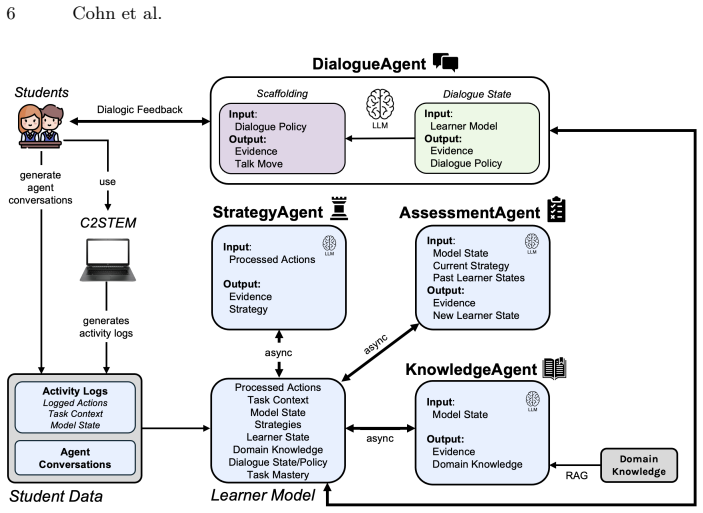
EDF's evidence-decision-feedback loop, instantiated in Copa as four sub-agents (Strategy, Assessment, Knowledge, Dialogue) operating over a shared learner model. The DialogueAgent maps evidence to a dialogue policy (e.g., PROBE_UNDERSTANDING, SUGGEST_ACTION, PUSH_LIMIT) that generates a talk move. The workhorse is the chain-of-thought 'evidence' output that traces each decision back to student data.
What would settle it
A version of Copa with its chain-of-thought evidence blocks stripped out that produces identical student-facing feedback would show the interpretability chain is decorative rather than functional.
Extended reading notes
Core claim
The paper claims that LLM pedagogical agents can be structured around three linked stages—evidence, decision, feedback—so that scaffolding is personalized and traceable. In a six-week classroom study with 33 dyads using the Copa agent in an open-ended kinematics environment, the framework produced dialogue-policy shifts that correlated with task mastery, understanding-mastery alignment, reduced help-seeking, and interpretability chain scores significantly above baselines.
Load-bearing premise
The paper's claims rest on the LLM's self-reported chain-of-thought evidence and automated dialogue-state labels being faithful—that they accurately capture both the agent's reasoning and the student's genuine understanding.
Editorial extensions
If this is right
- Copa's scaffolding policy shifts from probing to suggesting actions and pushing limits as students' task mastery rises, consistent with ZPD-based scaffold fading.
- Students' success at verbally explaining their code increases with task mastery, suggesting progress reflects understanding rather than gaming.
- Students request agent support less often as mastery grows, indicating reduced reliance and developing autonomy.
- All three interpretability links—grounding, alignment, faithfulness—show statistically significant non-random structure, supporting that feedback is traceable to student input.
- EDF offers a reusable blueprint for connecting learning theory to concrete, inspectable components in LLM-based pedagogical agents.
Reading between the lines
- Because the design is correlational and single-system, the observed adaptivity could partly reflect students self-selecting which moments to ask for help; a controlled comparison against a non-EDF tutor would test the framework's unique contribution.
- The 'helpfulness paradox'—students wanting direct answers while the agent probes—likely generalizes beyond this setting; future agents may need to explain their pedagogical intent or negotiate roles to sustain student buy-in.
- The interpretability metrics are automated proxies; a stakeholder study asking teachers whether the evidence-to-policy traces actually aid their trust would be a natural next step.
- The EDF separation of evidence, decision, and feedback could be ported to other open-ended learning environments, but the specific policies and evidence types would need re-authoring per domain.
Signed reviews
Editorial analysis
A structured set of objections, weighed in public.
Referee Report
Summary. The paper introduces Evidence-Decision-Feedback (EDF), a three-module framework (Evidence, Decision, Feedback) for theory-driven adaptive scaffolding in LLM-based pedagogical agents, and instantiates it as Copa, a multi-agent peer deployed in the C2STEM open-ended learning environment. In a six-week high school study with 33 dyads, the authors analyze 7,017 logged actions and 238 student-agent conversation turns to address four research questions: scaffold adaptivity, alignment of verbalized understanding with task mastery, student reliance on the agent, and interpretability of agent feedback. They report significant Spearman correlations between dialogue policies and task mastery (e.g., PROBE_UNDERSTANDING decreases, SUGGEST_ACTION and PUSH_LIMIT increase), a positive correlation between `DEMONSTRATES_UNDERSTANDING` success rate and mastery deciles (rho=0.40), decreasing support requests with mastery (rho=-0.26), and internal traceability scores for Grounding, Alignment, and Faithfulness that exceed shuffled baselines. The paper concludes that EDF supports personalized, effective, and interpretable scaffolding without fostering overreliance.
Significance. The EDF framework is a constructive synthesis of ITS/learning-theory principles and agentic LLM design; the explicit separation of evidence gathering, pedagogical decision-making, and feedback generation, coupled with a shared learner model, is a concrete architectural contribution that could guide future LLM tutoring systems. The participatory design process, authentic classroom deployment, and public supplementary materials are commendable strengths. However, the empirical support for two central claims is currently incomplete: RQ2's understanding-mastery alignment rests on an unvalidated automated dialogue-state label produced by the same agent whose decisions it is used to validate, and RQ4's interpretability evidence is entirely internal to the LLM's own outputs. If these issues are addressed by external validation or by appropriately tempering the claims, the paper would be a valuable contribution to AIED and multi-agent LLM systems. As it stands, the evidence supports EDF as an architecture for system-internal consistency and adaptive behavior, but not yet the broader notions of validated understanding-mastery alignment and stakeholder-facing interpretability asserted in the
major comments (3)
- [§5.2, Fig. 4a; §4] The RQ2 'success rate' is not an externally validated measure: it is the DialogueAgent's own DEMONSTRATES_UNDERSTANDING classification made immediately after a PROBE_UNDERSTANDING policy. The same agent also has access to task mastery in the learner model (Section 4). No human gold-standard coding, inter-rater reliability, or manipulation check is reported. The positive correlation (rho=0.40) can therefore reflect the classifier labeling high-mastery students' utterances as demonstrating understanding rather than a genuine understanding-mastery alignment. The claim that students were 'not merely gaming the system' requires independent coding or a clear separation between the evidence used for labeling and the mastery variable. At minimum, the claim should be rephrased as internal/exploratory, and the limitation should be stated explicitly in addition to the general caveats in Section 6.
- [§5.4, Table 3] Interpretability is measured with internal traceability metrics: Grounding uses token overlap between student logs and the LLM's own CoT 'evidence'; Alignment and Faithfulness use SBERT similarity between the LLM's own policy, evidence, and feedback texts. These statistics show the pipeline is internally consistent, not that stakeholders can understand or trust the reasoning; CoT outputs are not guaranteed to reflect the actual decision basis. The abstract's claim that EDF 'support[s] interpretable, evidence-grounded explanations' therefore goes beyond what RQ4 establishes. I recommend either (i) adding a small human evaluation with teachers/students scoring the trace chain, or (ii) explicitly reframing RQ4 as 'internal traceability' and reserving 'interpretability' for future work, as the paper itself does in Section 6.
- [§5.1–§5.3, Tables 2 and Fig. 4] The statistical analyses treat policy frequencies and success rates as independent across mastery levels, but the data are repeated measures from 33 dyads over three sessions (238 dialogue turns). Spearman correlations are reported without confidence intervals or clustering adjustments; the effective sample size is much smaller than the number of data points. Additionally, footnote 4 reports that Copa suppressed PROBE_UNDERSTANDING when mastery was greater than 0.7, so Figure 4a's correlation is only identified on the lower-mastery range; the paper should report this restriction and discuss how it affects the 'understanding-mastery alignment' conclusion. These issues do not invalidate the framework, but transparency about them is needed and the strength of the empirical conclusions should be tempered accordingly.
minor comments (5)
- [§5.5] Report standard deviations and sample sizes for the Likert-scale items (e.g., means of 3.81 and 2.69 are given without variability or N).
- [Table 1] Define all column abbreviations in the caption (OE, MAS, SR, INT, etc.) and ensure the legend is self-contained; some symbols are not intuitive without cross-referencing the text.
- [Footnote 4 / §5.2] Clarify whether the mastery > 0.7 cutoff for not probing is a fixed design rule, and state explicitly its consequence: RQ2 analyses are restricted to lower mastery levels.
- [§4] Specify the exact GPT-5 model version/date used for reproducibility, and indicate where prompts and full model configurations are available in the supplement.
- [§3] The statement 'Over four years of participatory design' would benefit from a citation to the supplementary materials or a brief description of the PD process, since it is a key grounding claim.
Circularity Check
No construction-level circularity; the main risks are construct validity and self-referential evaluation, not derivation-by-definition.
full rationale
This paper is an empirical design framework rather than a mathematical derivation, so the relevant question is whether any claimed result is forced to equal its inputs by construction. The task-mastery measure comes from the external C2STEM rubrics, and RQ1/RQ3 are empirical correlations against that independent rubric, so those trends could have failed to appear. The main self-referential points are in RQ2 and RQ4. RQ2's 'success rate' is defined as the proportion of instances the DialogueAgent itself labels as DEMONSTRATES_UNDERSTANDING immediately after a PROBE_UNDERSTANDING policy (§5.2), and no human gold standard or inter-rater reliability is reported; footnote 4 also shows the agent suppresses probes when mastery > 0.7, so the sample is mastery-gated. RQ4's Grounding, Alignment, and Faithfulness are keyword overlap and SBERT similarity among the LLM's own inputs, CoT evidence, policies, and talk moves; they establish internal consistency, not stakeholder interpretability. The paper itself concedes this: 'rigorous stakeholder-centric evaluation across these axes remains future work' (§6) and 'reported relationships are correlational rather than causal.' Self-citations (e.g., CoTAL [13], participatory design [8,12,7,9,11,10,13,15]) support provenance and prompt engineering but do not carry a uniqueness or equivalence theorem, so no load-bearing argument reduces to a self-citation. These are validity and generalizability limitations, not circular reductions: no equation or metric is defined in terms of the very claim it is used to establish in a way that forces the reported numbers. Score 2 reflects the presence of self-referential evaluation choices without a demonstrated circular derivation.
Assumptions & free parameters
free parameters (1)
- PROBE_UNDERSTANDING suppression threshold =
mastery > 0.7
assumptions (4)
- domain assumption Social Cognitive Theory, Zone of Proximal Development, and social constructivism are valid/appropriate models for tutoring behavior.
- domain assumption Percentage score on C2STEM tasks is a valid measure of task mastery and a reasonable proxy for learning.
- domain assumption Chain-of-thought 'evidence' outputs honestly reflect the agent's actual reasoning and used inputs.
- domain assumption Automated classification of dialogue states (e.g., DEMONSTRATES_UNDERSTANDING) is accurate enough to measure verbalized understanding.
Cite this review
Pith. "Pith review of Evidence-Decision-Feedback: Theory-Driven Adaptive Scaffolding for LLM Agents." pith.science (2026). https://pith.science/paper/KHO2F2A5
@misc{pith2026260201415,
  author       = {Pith},
  title        = {Pith review of: Evidence-Decision-Feedback: Theory-Driven Adaptive Scaffolding for LLM Agents},
  year         = {2026},
  howpublished = {\url{https://pith.science/paper/KHO2F2A5}},
  note         = {Machine review of arXiv:2602.01415}
}
read the original abstract
LLMs offer tremendous opportunities for pedagogical agents to help students construct knowledge and develop problem-solving skills, yet many of these agents operate on a "one-size-fits-all" basis, limiting their ability to personalize support. To address this, we introduce Evidence-Decision-Feedback (EDF), a theoretical framework for adaptive scaffolding with LLM agents. EDF integrates elements of intelligent tutoring systems (ITS) and agentic behavior by organizing interactions around evidentiary inference, pedagogical decision-making, and adaptive feedback. We instantiate EDF through Copa, a Collaborative Peer Agent for STEM+C problem-solving. In an authentic high school classroom study, we show that EDF-guided interactions align feedback with students' demonstrated understanding and task mastery; promote scaffold fading; and support interpretable, evidence-grounded explanations without fostering overreliance.
Figures


Figures from the paper (1 more)

Reference graph
Works this paper leans on
-
[1]
Frontiers in Psychology13, 813632 (2022)
Azevedo, R., et al.: Lessons learned and future directions of metatutor: Leveraging multichannel data to scaffold self-regulated learning with an intelligent tutoring system. Frontiers in Psychology13, 813632 (2022)
2022
-
[2]
Prentice-Hall, Englewood Cliffs, NJ (1986)
Bandura, A.: Social Foundations of Thought and Action: A Social Cognitive The- ory. Prentice-Hall, Englewood Cliffs, NJ (1986)
1986
-
[3]
International Journal of Artificial Intelligence in Education26(1), 350–364 (2016)
Biswas, G., Segedy, J.R., Bunchongchit, K.: From design to implementation to practice a learning by teaching system: Betty’s brain. International Journal of Artificial Intelligence in Education26(1), 350–364 (2016)
2016
-
[4]
In: International Conference on Artificial Intelligence in Education
Borchers, C., Shou, T.: Can large language models match tutoring system adaptiv- ity? a benchmarking study. In: International Conference on Artificial Intelligence in Education. pp. 407–420. Springer (2025)
2025
-
[5]
In: International handbook of metacognition and learning technologies, pp
Bull, S., Kay, J.: Open learner models as drivers for metacognitive processes. In: International handbook of metacognition and learning technologies, pp. 349–365. Springer (2013)
2013
-
[6]
In: 18th International Conference on Educational Data Mining
Chu, Y., Li, H., et al.: A llm-powered automatic grading framework with human- level guidelines optimization. In: 18th International Conference on Educational Data Mining. International EDM Society (July 2025)
2025
-
[7]
In: Proceedings of the 18th International Conference on Computer-Supported Collaborative Learning-CSCL 2025, pp
Cohn, C., Fonteles, J.H., Snyder, C., Srivastava, N., Campbell, D., Montenegro, J., Biswas, G., et al.: Exploring the design of pedagogical agent roles in collab- orative stem+c learning. In: Proceedings of the 18th International Conference on Computer-Supported Collaborative Learning-CSCL 2025, pp. 330-334. Inter- national Society of the Learning Sciences (2025)
2025
-
[8]
In: Proceedings of the AAAI conference on artificial intelligence
Cohn, C., Hutchins, N., Le, T., Biswas, G.: A chain-of-thought prompting approach with llms for evaluating students’ formative assessment responses in science. In: Proceedings of the AAAI conference on artificial intelligence. vol. 38 (2024)
2024
Show all 36 references
-
[9]
arXiv preprint arXiv:2505.17238 (2025)
Cohn, C., Rayala, S., Snyder, C., Fonteles, J., Jain, S., Mohammed, N., Timalsina, U., Burriss, S.K., Srivastava, N., Deweese, M., et al.: Personalizing student-agent interactions using log-contextualized retrieval augmented generation (rag). arXiv preprint arXiv:2505.17238 (2025)
2025 arXiv
-
[10]
In: Proceedings of the AAAI Conference on Artificial Intelligence
Cohn, C., Rayala, S., Srivastava, N., Fonteles, J.H., Jain, S., Luo, X., Mereddy, D., Mohammed, N., Biswas, G.: A theory of adaptive scaffolding for llm-based peda- gogical agents. In: Proceedings of the AAAI Conference on Artificial Intelligence. vol. 40, pp. 1757–1765 (2026)
2026
-
[11]
British Journal of Educational Technology56(2), 595–620 (2025)
Cohn, C., Snyder, C., Fonteles, J.H., TS, A., Montenegro, J., Biswas, G.: A mul- timodal approach to support teacher, researcher and ai collaboration in stem+c learning environments. British Journal of Educational Technology56(2), 595–620 (2025)
2025
-
[12]
In: International Conference on Artificial Intelligence in Education
Cohn, C., Snyder, C., Montenegro, J., Biswas, G.: Towards a human-in-the-loop llm approach to collaborative discourse analysis. In: International Conference on Artificial Intelligence in Education. pp. 11–19. Springer (2024)
2024
-
[13]
Cohn, C., T S, A., Biswas, G.: Cotal: Human-in-the-loop prompt engineering for generalizableformativeassessmentscoring.arXivpreprintarXiv:2504.02323(2026)
2026 arXiv
-
[14]
In: Proceedings of the 3rd International Conference on Artificial Intelligence and Education
Dai, L., et al.: Agent4EDU: Advancing AI for Education with Agentic Workflows. In: Proceedings of the 3rd International Conference on Artificial Intelligence and Education. ICAIE ’24, Association for Computing Machinery (Apr 2025) Evidence-Decision-Feedback 15
2025
-
[15]
Learning and Instruction (Jun 2026)
Fonteles, J.H., Cohn, C., Ayalon, E., Zhou, M., TS, A., Davalos, E., Li, Z., Rayala, S., Mereddy, D., Coursey, A., Jain, S., Zhang, Y., Enyedy, N., Danish, J., Biswas, G.: Analyzing embodied learning in classroom settings: A human-in-the-loop ai approach for multimodal learnin...
2026
-
[16]
Elsevier (2014)
Helander, M.G.: Handbook of human-computer interaction. Elsevier (2014)
2014
-
[17]
Journal of Science Education and Technology (2020)
Hutchins, N.M., et al.: C2stem: A system for synergistic learning of physics and computational thinking. Journal of Science Education and Technology (2020)
2020
-
[18]
arXiv preprint arXiv:2512.16301 (2025)
Jiang, P., et al.: Adaptation of agentic ai. arXiv preprint arXiv:2512.16301 (2025)
2025
-
[19]
arXiv preprint arXiv:2407.12687 (2024)
Jurenka, I., et al.: Towards responsible development of generative ai for education: An evaluation-driven approach. arXiv preprint arXiv:2407.12687 (2024)
2024
-
[20]
Cognitive science36(5), 757–798 (2012)
Koedinger, K.R., Corbett, A.T., Perfetti, C.: The knowledge-learning-instruction framework: Bridging the science-practice chasm to enhance robust student learn- ing. Cognitive science36(5), 757–798 (2012)
2012
-
[21]
arXiv:2506.08872 (2025)
Kosmyna, N., et al.: Your brain on chatgpt: Accumulation of cognitive debt when using an ai assistant for essay writing task. arXiv:2506.08872 (2025)
2025 arXiv
-
[22]
In: IEEE International Conference on Big Data (Dec 2024)
Li, Q., et al.: EduMAS: A Novel LLM-Powered Multi-Agent Framework for Edu- cational Support. In: IEEE International Conference on Big Data (Dec 2024)
2024
-
[23]
PeerJ Computer Science11, e2991 (2025)
Liu, Z., Agrawal, P., Singhal, S., Madaan, V., Kumar, M., Verma, P.K.: Lpitu- tor: an llm based personalized intelligent tutoring system using rag and prompt engineering. PeerJ Computer Science11, e2991 (2025)
2025
-
[24]
British Journal of Educational Technology56(3), 999–1027 (2025)
Malik, R., et al.: Scaffolding middle school mathematics curricula with large lan- guage models. British Journal of Educational Technology56(3), 999–1027 (2025)
2025
-
[25]
ETS Research Report Series2003(1), i–29 (2003)
Mislevy, R.J., Almond, R.G., Lukas, J.F.: A brief introduction to evidence-centered design. ETS Research Report Series2003(1), i–29 (2003)
2003
-
[26]
Cambridge University Press (2005)
Moreno, R.: Multimedia learning with animated pedagogical agents. Cambridge University Press (2005)
2005
-
[27]
Nkambou, R., Bourdeau, J., Mizoguchi, R.: Introduction: what are intelligent tu- toring systems, and why this book? In: Advances in intelligent tutoring systems, pp. 1–12. Springer (2010)
2010
-
[28]
International Journal of Artificial Intelligence in Edu- cation26(1), 457–473 (2016)
Ohlsson, S.: Constraint-based modeling: from cognitive theory to computer tutoring–and back again. International Journal of Artificial Intelligence in Edu- cation26(1), 457–473 (2016)
2016
-
[29]
arXiv preprint arXiv:2512.04123 (2025)
Pan, M.Z., Arabzadeh, N., et al.: Measuring agents in production. arXiv preprint arXiv:2512.04123 (2025)
2025 arXiv
-
[30]
Computers and Education: Artificial Intelligence p
Shi, Y., Yu, K., Dong, Y., Chen, F.: Large language models in education: a sys- tematic review of empirical applications, benefits, and challenges. Computers and Education: Artificial Intelligence p. 100529 (2025)
2025
-
[31]
Computer games and instruction55(2), 503–524 (2011)
Shute, V.J.: Stealth assessment in computer-based games to support learning. Computer games and instruction55(2), 503–524 (2011)
2011
-
[32]
In: International Conference on Artificial Intelligence in Education
Stamper, J., Xiao, R., Hou, X.: Enhancing llm-based feedback: Insights from in- telligent tutoring systems and the learning sciences. In: International Conference on Artificial Intelligence in Education. pp. 32–43. Springer (2024)
2024
-
[33]
Stryker, C.: What is agentic ai? (2025), https://www.ibm.com/think/topics/ agentic-ai, IBM Think, Staff Editor, AI Models
2025
-
[34]
In: European Conference on Technology Enhanced Learning
Thomas, D.R., Borchers, C., Bhushan, S., Gatz, E., Gupta, S., Koedinger, K.R.: Llm-generated feedback supports learning if learners choose to use it. In: European Conference on Technology Enhanced Learning. pp. 489–503. Springer (2025)
2025
-
[35]
Vygotsky,L.S.:Mindinsociety:Thedevelopmentofhigherpsychologicalprocesses, vol. 86. Harvard university press (1978)
1978
-
[36]
In: International Conference on Computers in Education (2025)
Zhou, Y., Pankiewicz, M., et al.: Impact of llm feedback on learner persistence in programming. In: International Conference on Computers in Education (2025)
2025
Reviewed August 3, 2026 · model on record in the stance chip above.
Discussion (0). Continue with ORCID to comment.