REVIEW 3 major objections 6 minor 4 references
ProAct: A Benchmark and Multimodal Framework for Structure-Aware Proactive Response
T0 review · 3 major / 6 minor · reviewed 2026-08-03 · deepseek-v4-flash
Pith's one-line read Proactive robot helpers should aim to reduce thread-mixing, not copy the human's next step.
desk verdict ProAct-75 is a genuinely new benchmark with a plausible but unproven central claim; the parallel-action gains are partly built into the metric, and the graph-fidelity premise needs direct validation. read the letter →
The pith
A machine-rendered reading of the paper's core claim, the machinery that carries it, and where it could break.
The reading
What carries the argument
The central object is the task graph: a directed acyclic graph whose nodes are executable steps or structural start/end nodes, with edges encoding precedence and each node typed AND or OR to say when it becomes enabled. From the graph, thread mapping π groups parallelizable branches that share reachability, and the entropy-driven heuristic (Eqs. 7–9) chooses the feasible action that minimizes thread-mixing entropy, favoring stable parallel progress over copying the human's next step. A second mechanism, the Hierarchical Binding Module (HBM), is a contrastive loss that ties trigger-to-task and task-to-step representations to improve long-tail perception. Together they turn a standard MLLM int
What would settle it
Take a subset of videos where the human's observed step order visibly contradicts the annotated task graph, disable the one-step runtime alignment in the Table 3 simulation, and re-measure saved steps and parallel actions. If ProAct-Helper's advantage over commonsense models shrinks or reverses when graph legality is enforced strictly, then the reported gains partially measure artifacts of the graph annotation rather than better collaboration.
Extended reading notes
Core claim
The paper's central claim is that proactive response is best modeled as five coupled tasks—trigger detection, task detection, step detection, future action prediction, and proactive action selection—with action selection grounded in an explicit task graph. ProAct-Helper learns perception via hierarchical binding losses that align trigger-to-task and task-to-step representations, then selects the next robot action by searching the task graph: among all currently legal actions, it picks the one that minimizes the length-weighted binary entropy of human/robot participation across parallel threads. The paper reports that this entropy-driven selection yields more parallel actions and saved steps
Load-bearing premise
The whole argument rests on the assumption that the hand-annotated task graphs faithfully encode the real precedence and parallel structure of each task—and the paper's own appendix concedes that human ground-truth step traces may not strictly satisfy graph preconditions, requiring a one-step runtime alignment safeguard in the full-rollout simulation.
Editorial extensions
If this is right
- A fine-tuned 3B/7B multimodal model combined with a one-step graph heuristic can outperform strong closed-source models on proactive action selection, so graph structure can substitute for raw model scale.
- Structure-aware benchmarks can measure collaboration properties that ordinary video benchmarks cannot: saved steps, parallel-action rate, and thread-mixing entropy.
- The approach is deployable in closed loop: planning latency is small (about 0.08 seconds per step in the reported measurements), enabling online one-step decisions from keyframe streams.
- Common-sense LLM planning often defaults to waiting when the human's next step seems imminent, whereas the entropy objective establishes stable robot execution threads, as shown by the parallel-action and robot-entropy metrics.
- Cross-level contrastive binding (trigger→task and task→step) consistently improves long-tail task and step recognition across backbone sizes, indicating that hierarchical supervision matters for perception.
Reading between the lines
- A testable extension the paper leaves implicit: replace the one-step entropy lookahead with a multi-step or full-horizon search over the same objective; the reported gains may grow if global thread balance, not just the next step, drives the heuristic.
- The 'saved steps' and parallel-action numbers are computed under an author-designed simulation of human behavior (the human follows the annotated trajectory unless preempted); real deployments would need logged human responses to verify that reduced thread-mixing entropy corresponds to perceived collaboration quality.
- The entropy objective is a proxy for cognitive load; a direct human-subject study comparing thread-mixing entropy against task-switching costs or subjective workload could validate or refine the design choice.
- The paper's failure analysis notes future-step hallucination; one natural follow-up is graph-feasible decoding inside the language model itself rather than filtering its predictions afterwards, which could clean up action candidates before the graph search.
Editorial analysis
A structured set of objections, weighed in public.
Referee Report
Summary. The paper introduces ProAct-75, a video benchmark for proactive response with 75 tasks, 91,581 step-level annotations, and explicit task graphs encoding AND/OR dependencies and parallel threads across assistance, maintenance, and safety-monitoring scenarios. The authors propose ProAct-Helper, an MLLM-based framework with a Hierarchical Binding Module (HBM) for trigger/task/step detection and future-action prediction, and an entropy-driven heuristic search over task-graph threads for proactive action selection. The central claim is that this combination outperforms strong closed-source models, specifically improving trigger mF1 by 6.21%, saving 0.25 more steps in online one-step decisions, and increasing parallel-action rate by 15.58%. The paper also reports ablations, cross-view generalization, latency, and qualitative analyses.
Significance. If validated, ProAct-75 would be a valuable resource: it is one of the few video benchmarks that explicitly provides task-graph structure for proactive decision-making, and the scale (75 tasks, 91k annotations) plus the release of code and detailed annotation protocol are strengths. The idea of using a lightweight graph-constrained entropy objective on top of an MLLM is interesting and potentially practical. The paper is also commendable for including hyperparameter sensitivity, OOD view evaluation, and failure-case analysis. However, the core claim about proactive action selection is currently supported by metrics that partly encode the planner's own objective and by a simulation whose human-behavior model is not grounded in measured data; the experimental validation therefore does not yet independently establish the claimed advantage.
major comments (3)
- [§6.1 (Evaluation Metrics) and §5.3, Eq. (9)] The Parallel Actions (PA) metric is defined as the fraction of effective robot actions with π(a) ≠ π(h_prev), i.e., actions on a different thread from the human's most recent thread. This is exactly the behavior that the entropy objective in Eq. (9) is designed to produce, since minimizing H_mix favors actions in threads with low current human participation. Consequently, the 15.58% PA gain in Table 1 and the 33.95% PA in Table 3 are substantially built into the evaluation rather than independently measured. The paper needs an external validation of collaboration quality—for example, a user study, task-completion time in a validated environment, or a comparison against a planner optimizing a different, equally reasonable objective—to show that the entropy choice yields real improvement rather than merely optimizing the metric it is scored on.
- [Appendix A, Algorithm 1, and §3.1] The paper states that human execution 'may not strictly satisfy task-graph preconditions' and introduces a one-step runtime alignment that augments A_legal with the observed human step for the Table 3 simulation. This is a direct admission that the task graphs do not always match actual human behavior. Since the legal set A_legal and the thread mapping π used in Eqs. (6)–(9) are both derived from the same graph, any graph–behavior mismatch means (i) the feasibility filter may prune actually-helpful robot actions, and (ii) the metrics E, ER, PA, and SS computed over π-induced threads partly measure graph artifacts rather than collaboration quality. The authors should quantify the mismatch (e.g., the percentage of human steps that required the safeguard) and report the main results on the subset of videos where the graph is fully consistent with the human trace.
- [§6.4, Table 3] The Table 3 simulation assumes that 'the human follows the annotated trajectory unless preempted by the robot, then switches to parallel branches until completion.' This is an author-designed behavioral assumption that is never validated against human data. All saved-step numbers in Table 3, and the online SS results in Table 1 that similarly rely on ground-truth trajectory membership, inherit this assumption. The paper should either provide empirical evidence that this response model reflects how humans actually adapt to robot actions, or show sensitivity of the conclusions to alternative human models (e.g., a human who ignores the robot and continues on the original thread, or one who re-plans optimally). Without such analysis, the saved-steps claim cannot be distinguished from an artifact of the simulation's assumptions.
minor comments (6)
- [§6.2] Typo: 'F or trigger/task/step detection' should be 'For trigger/task/step detection'.
- [§5.1] The symbol λ_bind is used in Eq. (3) but the decomposition into λ_tt and λ_ts appears only in Eq. (5); consider defining these earlier.
- [§6.1] The notation A_pred is treated as a set with duplicates removed, but earlier it is introduced as a sequence; please clarify the conversion and how duplicates are handled.
- [Table 3] Greedy and ProAct-Helper both achieve SS = 9.868, but Greedy has much higher E (0.837 vs 0.662) and lower PA (28.11 vs 33.95). This difference is not fully explained; the paper discusses E/ER for closed-source LLMs but not why Greedy matches ProAct-Helper on SS.
- [§6.4 and Figure 5b] The safety-monitoring tasks lack proactive action selection and future-action prediction; the paper does not state whether Table 1 and Table 3 results are restricted to assistance/maintenance tasks. Please report the task distribution for the proactive-action-selection metrics.
- [§6.2] The two 'ProAct-Helper (plain)' rows for 3B and 7B are not clearly labeled in Table 1; adding a column or grouping would improve readability.
Circularity Check
No significant circularity; aligned metric-objective and graph-fidelity caveats are validity issues, not tautologies.
full rationale
The paper's derivation chain is self-contained. ProAct-Helper is trained on ProAct-75's train split and evaluated on its test split; the task-graph action selection (Eq. 7-9) is a hand-coded heuristic, not a parameter fitted to the evaluation metrics. The PA metric counts different-thread actions, and Eq. 9 explicitly favors such actions; this is an aligned objective-metric design common in optimization papers, not a hidden reduction, because the contribution is the comparison against LLM baselines that are given the same thread information in prompts and fail to achieve comparable PA. Appendix A's admission that human traces 'may not strictly satisfy task-graph preconditions' and the one-step runtime alignment are genuine validity threats to the benchmark and Table 3 simulation, but they undermine construct validity rather than making any equation equal to its input. Self-citations (e.g., Zhu et al. 2025) appear in related-work motivation alongside external citations and are not load-bearing. No circular step is exhibited.
Assumptions & free parameters
free parameters (7)
- Loss weights lambda_tt=0.3, lambda_ts=0.5 =
0.3 / 0.5
- Trigger loss weight lambda_trig =
not reported
- Contrastive temperature tau (Eq. 4) =
not reported
- Keyframe window size 5, stride 3 =
5 / 3
- Future prediction horizon n=5 =
5
- Training config: LoRA r=32, alpha=32, LR 5e-5, 10 epochs, batch 128 =
as listed
- Thread mapping pi(v) and thread weights w_k (Eq. 6, 8) =
computed from graph
assumptions (6)
- standard math DAG reachability and AND/OR precedence semantics (Eq. 1-2)
- domain assumption Ground-truth human step traces satisfy task-graph feasibility
- ad hoc to paper Thread-mixing entropy quantifies coordination cost, and minimizing it yields beneficial parallel assistance
- domain assumption Simulated human behavior: human follows GT trajectory, but switches to parallel branches when the robot preempts
- domain assumption Task graphs generated by GPT-4o + Gemini-3-Pro with manual review faithfully encode the true step dependencies of the videos
- standard math Mid-level node-pair thread decomposition is well-defined and complete (branch independence condition)
invented entities (1)
-
Parallel threads (thread mapping pi) induced by mid-level start/end node pairs
Cite this review
Pith. "Pith review of ProAct: A Benchmark and Multimodal Framework for Structure-Aware Proactive Response." pith.science (2026). https://pith.science/paper/4VUDBXQF
@misc{pith2026260203430,
  author       = {Pith},
  title        = {Pith review of: ProAct: A Benchmark and Multimodal Framework for Structure-Aware Proactive Response},
  year         = {2026},
  howpublished = {\url{https://pith.science/paper/4VUDBXQF}},
  note         = {Machine review of arXiv:2602.03430}
}
read the original abstract
While passive agents merely follow instructions, proactive agents align with higher-level objectives, such as assistance and safety by continuously monitoring the environment to determine when and how to act. However, developing proactive agents is hindered by the lack of specialized resources. To address this, we introduce ProAct-75, a benchmark designed to train and evaluate proactive agents across diverse domains, including assistance, maintenance, and safety monitoring. Spanning 75 tasks, our dataset features 91,581 step-level annotations enriched with explicit task graphs. These graphs encode step dependencies and parallel execution possibilities, providing the structural grounding necessary for complex decision-making. Building on this benchmark, we propose ProAct-Helper, a reference baseline powered by a Multimodal Large Language Model (MLLM) that grounds decision-making in state detection, and leveraging task graphs to enable entropy-driven heuristic search for action selection, allowing agents to execute parallel threads independently rather than mirroring the human's next step. Extensive experiments demonstrate that ProAct-Helper outperforms strong closed-source models, improving trigger detection mF1 by 6.21%, saving 0.25 more steps in online one-step decision, and increasing the rate of parallel actions by 15.58%.
Figures

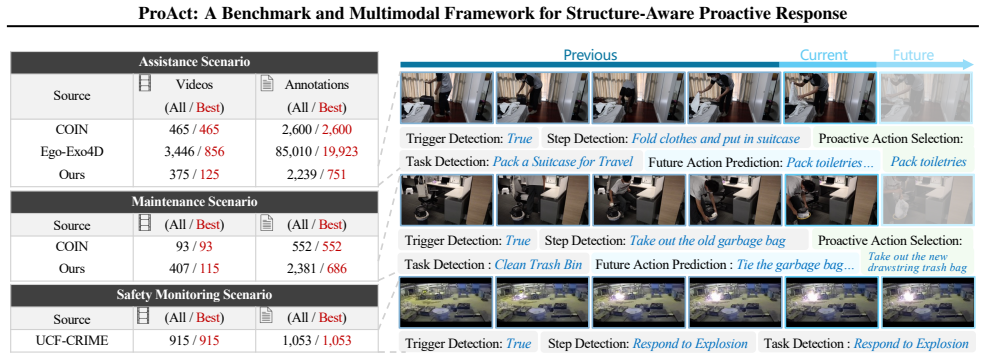

Figures from the paper (7 more)


Reference graph
Works this paper leans on
-
[1]
You must output a JSON object with key "action"
-
[2]
Wait / None
The value must be exactly one string from CANDIDATE_ACTIONS, or "Wait / None" if the list is empty
-
[3]
action":
Prefer actions that are parallel to the human’s current thread (i.e., from a different execution thread in the task graph), when possible. Thread (thread): an independent branch in the task graph induced by the same mid-level start/end node pair; different threads have no shared nodes. User: TASK: {task_name} TASK_GRAPH (compact): {task_graph} COMPLETED_S...
-
[4227]
Rhinehart, N., McAllister, R., Kitani, K., and Levine, S
PMLR, 2018. Rhinehart, N., McAllister, R., Kitani, K., and Levine, S. Pre- cog: Prediction conditioned on goals in visual multi-agent settings. InProceedings of the IEEE/CVF international conference on computer vision, pp. 2821–2830, 2019. Schrempf, O. C., Hanebeck, U. D., Schmid, A. J., and Worn, H. A novel approach to proactive human-robot coopera- tion...
arXiv 2018
Reviewed August 3, 2026 · model on record in the stance chip above.
Discussion (0). Sign in to comment.