REVIEW 2 major objections 4 minor 83 references
Three-dimensional spin-orbital liquids
T0 review · 2 major / 4 minor · reviewed 2026-08-03 · deepseek-v4-flash
Pith's one-line read This paper claims that three-dimensional spin-orbital liquids—exactly solvable extensions of the Kitaev model—host stable gapless Majorana metals with topological Fermi surfaces, nodal lines, and Weyl points.
desk verdict A careful, explicit map of 3D spin-orbital liquids; the four-coordinated analysis is genuinely new, but its flux-sector assumption needs stronger support. read the letter →
The pith
A machine-rendered reading of the paper's core claim, the machinery that carries it, and where it could break.
The reading
What carries the argument
The central object is the Clifford-algebra representation of the spin-orbital Hamiltonian: four-dimensional Gamma matrices replace Pauli matrices, and exact solvability follows from fractionalizing each site into six Majorana fermions, of which ν = 6 − γ_m are itinerant (ν = 3 for three-coordinated lattices, ν = 2 for four-coordinated). The bond operators û_ij form a static Z2 gauge field whose flux sector is fixed by Lieb's theorem where applicable; the projective symmetry group implementation of time-reversal—whether it relates momentum k to −k or to −k + k0—plus inversion and rotation symmetries, determines which nodal manifolds are stable. The paper uses this machinery to classify the ze
What would settle it
A small-cluster exact diagonalization of the unperturbed chiral square-octagon or layered honeycomb model that finds a flux configuration with lower energy than the zero-flux sector would overturn every band structure and nodal-manifold result in the paper.
Extended reading notes
Core claim
The paper's central claim is that the q=1 spin-orbital Hamiltonian, placed on three-coordinated lattices (hyperoctagon, hyperhoneycomb, hyperhexagon) and four-coordinated lattices (chiral square-octagon, layered honeycomb), maps exactly onto free Majorana fermions coupled to a static Z2 gauge field, and that the resulting Majorana band structures are generically gapless with stable nodal manifolds: topological Fermi surfaces on the hyperoctagon and chiral square-octagon, a threefold degenerate nodal line on the hyperhoneycomb, a twofold degenerate nodal line on the layered honeycomb, and charge-3 Weyl points on the hyperhexagon. These structures are protected by a combination of projective t
Load-bearing premise
The ground state of every lattice is assumed to sit in the Lieb flux sector (zero flux on length-6 loops, π-flux on length-8 loops); for the chiral square-octagon, where Lieb's theorem does not apply, and the layered honeycomb, where it fixes only part of the fluxes, this is supported only by undocumented small-system numerics.
Editorial extensions
If this is right
- If the flux-sector assumption holds, the unperturbed three-coordinated SOLs are triplicate copies of the known Kitaev spin liquids, so the nodal structures of the hyperoctagon, hyperhoneycomb, and hyperhexagon Kitaev models appear with a threefold flavor degeneracy.
- On the four-coordinated lattices, the two-flavor SOL supports topological Fermi surfaces (chiral square-octagon) and twofold degenerate nodal lines (layered honeycomb) that have no single-flavor Kitaev counterpart, establishing a genuinely two-component Majorana band topology.
- The symmetry-allowed quadratic perturbations cannot gap the topological Fermi surfaces of the hyperoctagon and chiral square-octagon without first destroying their topological charge, implying a finite threshold for gapping.
- Breaking time-reversal generically converts nodal lines into Weyl points (hyperhexagon, and layered honeycomb when mirror symmetry is also broken) or into tubular Fermi surfaces (hyperhoneycomb and mirror-preserving layered honeycomb).
Reading between the lines
- If the Lieb flux sector is correct, the chiral square-octagon's topological Fermi surfaces should produce protected surface arcs in a slab geometry—a direct, testable consequence not computed in the paper.
- The undocumented small-system numerics used to justify the Lieb flux sector on the four-coordinated lattices are the main fragility; a published small-cluster exact diagonalization would either confirm or refute the entire band-structure analysis.
- The fine-tuned parameter points where flat zero-energy bands appear (e.g., Γ = Γ′ = J/2 and K = −J) could serve as platforms for strongly interacting Majorana physics once non-solvable perturbations are included.
- The paper's organizing principle—nodal manifolds constrained by projective time-reversal and flavor structure—could be used to predict the fate of other 3D Kitaev-type lattices beyond the five studied here.
Editorial analysis
A structured set of objections, weighed in public.
Referee Report
Summary. The paper constructs exactly solvable three-dimensional spin-orbital liquid (SOL) models using the q=1 Clifford-algebra representation, and analyzes their Majorana band structures. For three three-coordinated lattices (hyperoctagon, hyperhoneycomb, hyperhexagon), the unperturbed SOL is three identical copies of the corresponding Kitaev spin liquid; for two four-coordinated lattices (chiral square-octagon, layered honeycomb), it is a two-flavor Majorana model not equivalent to a known Kitaev spin liquid. The authors classify the gapless nodal structures—topological Fermi surfaces, nodal lines, Weyl points—and study their evolution under solvable quadratic perturbations (on-site, nearest-neighbor K/Γ/Γ′/Γ-bar, and next-nearest-neighbor κ), producing phase diagrams and summary tables. The central claim is that these systems host a rich set of gapless Majorana metals with topologically protected nodal features, organized by lattice symmetry and flavor structure.
Significance. If the results hold, the paper provides a useful extension of exactly solvable spin-liquid physics to three dimensions and to multi-flavor Majorana systems. The four-coordinated lattices are genuinely new and not merely replicated Kitaev models; the explicit Majorana Hamiltonians, symmetry analyses, and tables of phase behavior are valuable references. However, the central results for the four-coordinated lattices rest on an assumed ground-state flux sector supported only by undocumented small-size numerics, and the perturbed phase diagrams are computed in a fixed flux sector without establishing its stability. These caveats reduce the certainty of the concrete classifications, though the overall construction is internally consistent.
major comments (2)
- [Sec. II C 3, Sec. V B/C] The ground-state flux sector for the chiral square-octagon and the layered honeycomb is a load-bearing input. Lieb's theorem does not fix this sector: the chiral square-octagon lacks the required mirror planes, and the layered honeycomb's mirror planes constrain only half of the independent Wilson loops. The statement in Sec. II C 3 that "numerical simulations for small sizes of the flux unit cells" support the Lieb sector is not documented: no system sizes, no flux-sector enumeration, no energy differences are provided. Every band structure, Chern number, winding number, and phase diagram in Sec. V is computed in this sector, so an incorrect sector would change the nodal manifolds and topological invariants. The authors should either supply the numerical evidence (or a published reference) or explicitly present all Sec. V results as conditional on the Lieb-sector assumption. Equation (1
- [Sec. IV (Figs. 4, 7, 11), Tables I-II] The phase diagrams for perturbations assume that the Lieb flux sector remains the ground state for all perturbation strengths. For the three-coordinated lattices, Ref. [35] validates the sector only "in the vicinity of the unperturbed SOL," yet the diagrams extend to large K, Γ, Γ′ values (e.g., the K>1 gapped region on the hyperoctagon, and Γ<−3 on the hyperhoneycomb). The authors acknowledge in Sec. VI that strong perturbations can stabilize alternative flux sectors, but the figures and tables do not indicate where this may occur. A change in the ground-state flux sector would alter the itinerant Majorana band topology and hence the phase boundaries. Please either compute or bound the flux-sector stability region, or restate the phase diagrams as fixed-sector results throughout the paper.
minor comments (4)
- [Sec. II C 5, Eq. (12)] The statement that the ν=2 model is "two identical copies of the Kitaev model" is misleading, because a single-flavor Majorana hopping model on a four-coordinated lattice is not the Kitaev model in the standard sense. Suggest rewording to "two identical copies of the same single-flavor Majorana model on this lattice."
- [Sec. II C 2] The parity constraint is only shown to be harmless for gapless states. For the gapped phases identified in Secs. IV and V (e.g., hyperoctagon for K>1), please clarify how the physical subspace is recovered, or note that the same parity-adjustment argument applies to gapped states.
- [Sec. V B/C] The numerical simulations for the four-coordinated lattices mentioned in Secs. V B and V C are not described anywhere. If they are to be relied upon, they should be documented in an appendix; otherwise the statements should be softened or removed.
- [Throughout] Presentation issues: "representatie" in the Introduction; "pertubations" in the heading of Sec. V C 3; "Wickoff" should be "Wyckoff" in Sec. V B 1; "along the lines of Refs. [34]" in Sec. II C 3 appears to be a singular reference and should be corrected.
Circularity Check
No significant circularity: all nodal structures are outputs of the explicit Majorana Hamiltonian; the Lieb flux sector is an input assumption, not a fitted prediction.
full rationale
The derivation chain is self-contained in the relevant sense: the spin-orbital Hamiltonian (Eq. (2)) is mapped to free Majorana fermions in a fixed Z2 gauge (Eq. (8)), and all band structures, Fermi surfaces, nodal lines, and Weyl points are obtained by diagonalizing the resulting M(k) matrices (e.g., Eqs. (47), (51), (55), (69), (73)). No parameter is fitted to a subset of data and then renamed a prediction; the only input beyond the Hamiltonian is the choice of flux sector. That choice is explicitly flagged as an assumption: for the four-coordinated lattices the authors rely on undocumented small-size numerics ('These indicate that the Lieb configuration is the correct ground state sector') and state in the Discussion that working in the ground-state flux sector is 'a central assumption.' An incorrect flux sector would change the band structures, but this is a correctness risk, not circularity: the sector is an input, not an output derived from the model. For the three-coordinated lattices, Eq. (13) shows the unperturbed SOL is three identical copies of the known Kitaev spin liquid, so the nodal structures are inherited rather than independently derived; this is derivative but not circular. Same-group previous work (Refs. [20,21,35]) is used as external support for the Kitaev classifications and flux sectors, and those results are published, numerically checked, and not invoked as an unverified uniqueness theorem. No step reduces to its own definition by construction.
Assumptions & free parameters
assumptions (3)
- domain assumption Ground-state flux sector is the Lieb sector (0 flux on 4n+2 loops, pi flux on 4n loops) for all five lattices.
- domain assumption Only quadratic perturbations that commute with all plaquette operators are considered; non-solvable interaction terms are excluded.
- domain assumption For gapless states the physical-subspace parity constraint can always be satisfied at zero energy cost in the thermodynamic limit.
Cite this review
Pith. "Pith review of Three-dimensional spin-orbital liquids." pith.science (2026). https://pith.science/paper/HGP5KH7F
@misc{pith2026260206628,
  author       = {Pith},
  title        = {Pith review of: Three-dimensional spin-orbital liquids},
  year         = {2026},
  howpublished = {\url{https://pith.science/paper/HGP5KH7F}},
  note         = {Machine review of arXiv:2602.06628}
}
read the original abstract
Spin-orbital liquids provide an exactly solvable route to three-dimensional Z2 quantum spin liquids beyond the original Kitaev setting. Built from higher-dimensional Clifford-algebra representations, spin-orbital Hamiltonians can be realized on both three- and four-coordinated lattices, giving rise to phases with 3 and 2 itinerant Majorana flavors, respectively. We demonstrate that these models host a rich set of gapless Majorana metals, characterized, in particular, by topological Fermi surfaces, nodal lines, and Weyl semimetal phases. We analyze the stability of these structures under physically motivated perturbations and identify generic splitting patterns and topological transitions driven by symmetry breaking and flavor mixing. This yields a unified organizing framework for three-dimensional Majorana metals in fractionalized spin liquids.
Figures


Figures from the paper (18 more)






Reference graph
Works this paper leans on
-
[35]
A. Y. Kitaev, Fault-tolerant quantum computation by anyons, Annals of physics303, 2 (2003)
2003
-
[1]
III C— can have on the low-energy behavior of the SOL
Perturbations We start with a general discussion on the different ef- fects that the perturbations—introduced in Sec. III C— can have on the low-energy behavior of the SOL. The TR-breaking NNN term is identical for all the flavors. Thus, it is the only perturbation that does not affect the flavor degeneracy, or in other words, the SO(3) symme- try of the ...
-
[2]
Doing a Fourier transform and combining all the Majoranas into a single spinorψ ψ(k) = (cx k,1,
Structure of perturbed Hamiltonian in momentum space In order to simplify the notation—as well as avoid the display of large matrices—later on, we now discuss the general structure of the perturbed Hamiltonian in mo- mentum space and define certain sub-blocks. Doing a Fourier transform and combining all the Majoranas into a single spinorψ ψ(k) = (cx k,1, ...
-
[3]
It can be visualized as a square-octagon lattice, where the squares are replaced by co-rotating spirals, see Fig
The lattice and symmetries We begin our discussion with the most symmetric three-coordinated lattice, the hyperoctagon, or (10,3)a lattice. It can be visualized as a square-octagon lattice, where the squares are replaced by co-rotating spirals, see Fig. 2. y xz FIG. 2. Hyperoctagon lattice with unit cell and translation vectors. Colors blue/purple/pink de...
-
[4]
Unperturbed spin-orbital liquid For the unperturbed SOL on the hyperoctagon lattice, the momentum Hamiltonian for each of the Majorana 10 (a) (e)(d)(c)(b) FIG. 3. (a) BZ and FSs for the unperturbed SOL on the hyperoctagon lattice. (b)-(e) High-symmetry line plots for the unperturbed model, as well as for switching on one of the perturbations. flavors is i...
-
[5]
This requires a finite perturbation strength
Effect of perturbations The topological charge of the FS is stable against any perturbation: while infinitesimal perturbations (even those that obey threefold rotation symmetry) split the 9- fold degeneracy at the P point, the topological charge of the FS only changes when WPs move into or out of the surface. This requires a finite perturbation strength. ...
-
[6]
(49) The lattice with our choice of unit cell and lattice trans- lation vectors is illustrated in Fig
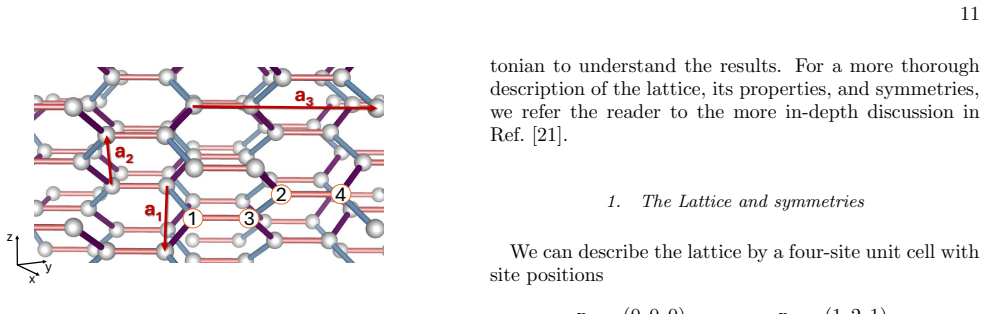
The Lattice and symmetries We can describe the lattice by a four-site unit cell with site positions r1 = (0,0,0),r 2 = (1,2,1), r3 = (1,1,0),r 4 = (2,3,1) (48) with lattice translation vectors a1 = (−1,1,−2),a 2 = (−1,1,2),a 3 = (2,4,0). (49) The lattice with our choice of unit cell and lattice trans- lation vectors is illustrated in Fig. 5. The correspon...
-
[7]
Unperturbed spin-orbital liquid For the unperturbed Hamiltonian, the SOL on the hy- perhoneycomb lattice consists of three identical copies, (51), of the corresponding Kitaev spin liquid—one for each itinerant Majorana flavor. Using the same gauge as in [21], the Hamiltonian for each Majorana flavor can be written as M(k) = 0 0iJ z iA13 0 0iA 2 iJz...
Show all 83 references
-
[8]
Unperturbed spin-orbital liquid For the unperturbed Hamiltonian, each Majorana fla- vor realizes the same band structure as in the Kitaev model on the hyperhexagon lattice. Using the same con- ventions as in [21], the Hamiltonian describing a single flavor of the SOL on the hy...
-
[9]
Effect of perturbations a. Time-reversal invariant perturbationsThe NN perturbations break the SO(3) flavor symmetry, thus al- lowing the charge 3 WPs to split into three separate ones that can move through the Brillouin zone individually. This is the generic behavior that occ...
-
[10]
Overview table of possible SOL behavior on the four-coordinated lattices under perturbations
Perturbations For four-coordinated lattices, the most direct analogue of the TR-breaking NNN term takes the form ˜H(2) κ =κ X ⟨ijk⟩ αβ ϵαβγδ uα ijuβ jk (icx i cx k +ic y i cy k),(56) 15 TABLE II. Overview table of possible SOL behavior on the four-coordinated lattices under pe...
-
[11]
As we did for the three-coordinated lattices, we can apply a Fourier transform and combine all the Majoranas into a single spinorψ ψ(k) = (cx k,1,
Structure of perturbed Hamiltonian in momentum space The structure of the perturbed Hamiltonian for a four- coordinated lattice is similar to a three-coordinated lat- tice, if not simpler, as we now have two instead of three itinerant Majoranas. As we did for the three-coordin...
-
[12]
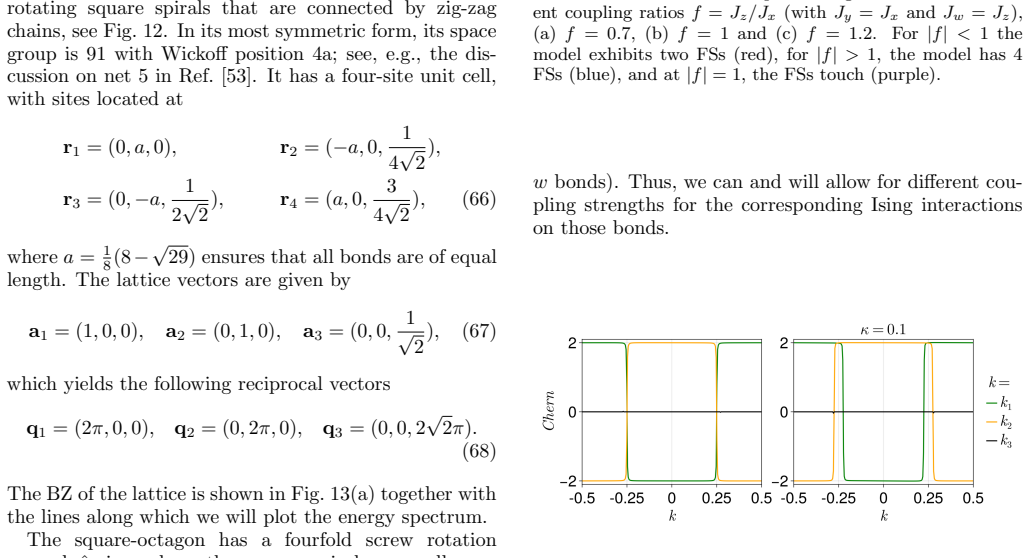
The lattice and symmetries The chiral square-octagon can be visualized by co- rotating square spirals that are connected by zig-zag chains, see Fig. 12. In its most symmetric form, its space group is 91 with Wickoff position 4a; see, e.g., the dis- cussion on net 5 in Ref. [53...
-
[13]
Baskaran, S
G. Baskaran, S. Mandal, and R. Shankar, Exact results for spin dynamics and fractionalization in the Kitaev model, Physical review letters98, 247201 (2007)
2007
-
[14]
Unperturbed spin-orbital liquid The chiral square-octagon lattice has 8 fundamen- tal loops of length 6 per unit cell—though not all independent—and 1 of length 8, see Appendix VIII B for further details and pictures. While Lieb’s theorem can- not be applied to this lattice, o...
-
[15]
The chiral square-octagon has two symmetry- inequivalent bonds
Effect of perturbations We now proceed with discussing the effect of pertur- bations, starting with the NN TR-preserving perturba- tions. The chiral square-octagon has two symmetry- inequivalent bonds. We denote the perturbation strength of the nearest-neighbor perturbation (5...
-
[16]
The resulting lattice is again bipartite
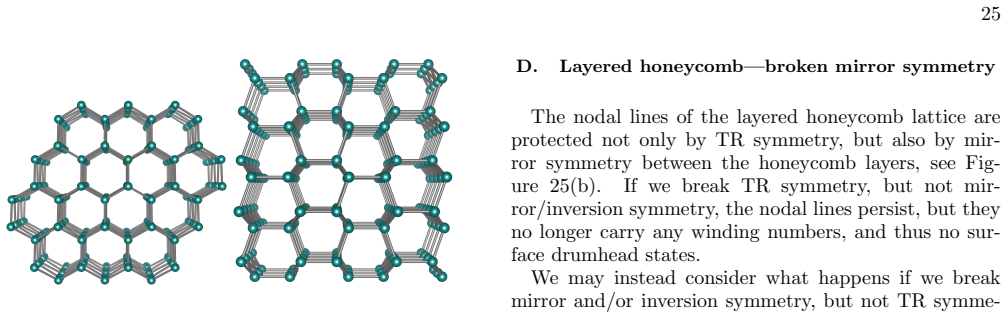
The lattice and symmetries The layered honeycomb lattice is easiest visualized as AA stacked honeycomb layers (i.e., all sites of the lay- ers sit exactly above one another), where the A sites of a given layer connect to the A sites of the layer above, whereas the B sites conn...
-
[17]
These are not all independent, as we have three volume constraints per unit cell
Unperturbed spin-orbital liquid The layered honeycomb has 8 fundamental loops of length 6 per unit cell. These are not all independent, as we have three volume constraints per unit cell. The fun- damental loops as well as the constraints are visualized in Appendix VIII B 2. Wh...
-
[18]
representative lattices
Effect of pertubations The layered honeycomb lattice distinguishes intralayer (x, y, z) bonds from the interlayerwbonds. Accordingly, the symmetry-allowed nearest-neighbor perturbations re- duce to two independent couplings: ¯Γ1 on the (x, y, z) bonds and ¯Γ2 on thewbond. Eith...
2025
-
[19]
Hyperoctagon For the hyperoctagon, or (10,3)a, lattice, we use the same reference gauge as in [21], that is, ux 12 =−1, u y 13 =−1, u z 32 = +1, ux 34 =−1, u y 24 = +1, u z 14 =−1. (78) For the unperturbed Hamiltonian, the matrices on the diagonal,M xx(k) =M yy (k) =M zz (k) =...
-
[20]
Hyperhoneycomb For the hyperhoneycomb, or (10,3)b, lattice, we use the same reference gauge as in [21], that is, ux 23 = +1, u y 14 = +1, u z 13 = +1, ux 14 = +1, u y 23 = +1, u z 24 = +1. (82) For the unperturbed Hamiltonian, the matrices on the diagonal,M xx(k) =M yy (k) =M ...
-
[21]
Hyperhexagon For the hyperhexagon, or (8,3)b, lattice, we use the same reference gauge as in [21], that is, ux 43 = +1, u y 42 = +1, u z 14 = +1, ux 21 = +1, u y 53 = +1, u z 25 = +1, ux 56 = +1, u y 61 = +1, u z 36 = +1. (86) For the unperturbed Hamiltonian, the matrices on t...
-
[22]
Lieb’s theorem does not apply to the chiral square-octagon lattice, as it lacks mirror planes
Chiral square-octagon The chiral square-octagon lattice has eight loop oper- ators of length 6, see Appendix VIII B 1. Lieb’s theorem does not apply to the chiral square-octagon lattice, as it lacks mirror planes. We will, however, still assume that the ground state is given b...
-
[23]
Thus, Lieb’s theorem suggests that the ground state has flux zero
Layered honeycomb The layered honeycomb lattice has 8 loop operators of length 6, see Appendix VIII B 2. Thus, Lieb’s theorem suggests that the ground state has flux zero. We choose the gauge such that going from the A to the B sublattice is positive (where A=site 2,4 and B=si...
-
[24]
Four loops of length 6 can be visualized as transversing once around the square-spiral and moving back via the zig-zag chain to the starting point
Chiral square-octagon The chiral square octagon has eight loops of length 6 and one loop of length 8 per unit cell. Four loops of length 6 can be visualized as transversing once around the square-spiral and moving back via the zig-zag chain to the starting point. Fig. 20(b), (...
-
[25]
Layered honeycomb The layered honeycomb lattice has 8 loops of length 6 per unit cell: two honeycomb plaquettes of the origi- nal honeycomb layer and six loops that connect the two FIG. 22. Visualization of the 5 loops constituting one of the volume constraints in the layered ...
-
[26]
Chulliparambil, L
S. Chulliparambil, L. Janssen, M. Vojta, H.-H. Tu, and U. F. P. Seifert, Flux crystals, Majorana metals, and flat bands in exactly solvable spin-orbital liquids, Physical Review B103, 075144 (2021)
2021
-
[27]
P. W. Anderson, Resonating valence bonds: A new kind of insulator?, Materials Research Bulletin8, 153 (1973)
1973
-
[28]
Wen, Quantum orders and symmetric spin liquids, Physical Review B65, 165113 (2002)
X.-G. Wen, Quantum orders and symmetric spin liquids, Physical Review B65, 165113 (2002)
2002
-
[29]
The lattice vectors are given by a1 = (1,0,0),a 2 = (0,1,0),a 3 = (0,0, 1√ 2 ),(67) which yields the following reciprocal vectors q1 = (2π,0,0),q 2 = (0,2π,0),q 3 = (0,0,2 √ 2π)
ensures that all bonds are of equal length. The lattice vectors are given by a1 = (1,0,0),a 2 = (0,1,0),a 3 = (0,0, 1√ 2 ),(67) which yields the following reciprocal vectors q1 = (2π,0,0),q 2 = (0,2π,0),q 3 = (0,0,2 √ 2π). (68) The BZ of the lattice is shown in Fig. 13(a) toge...
-
[30]
Balents, Spin liquids in frustrated magnets, Nature 464, 199 (2010)
L. Balents, Spin liquids in frustrated magnets, Nature 464, 199 (2010)
2010
-
[31]
Broholm, R
C. Broholm, R. J. Cava, S. A. Kivelson, D.-H. Lee, B. Normand, and T. Senthil, Quantum spin liquids, Sci- ence367, eaay0668 (2020)
2020
-
[32]
Knolle and R
J. Knolle and R. Moessner, A field guide to spin liq- uids, Annual Review of Condensed Matter Physics10, 451 (2019). 26
2019
-
[33]
Y. Zhou, K. Kanoda, and T.-K. Ng, Quantum spin liquid states, Rev. Mod. Phys.89, 025003 (2017)
2017
-
[34]
Savary and L
L. Savary and L. Balents, Quantum spin liquids: a re- view, Reports on Progress in Physics80, 016502 (2016), publisher: IOP Publishing
2016
-
[36]
M. A. Levin and X.-G. Wen, String-net condensation: A physical mechanism for topological phases, Physical Review B71, 045110 (2005)
2005
-
[37]
Kitaev, Anyons in an exactly solved model and be- yond, Annals of Physics321, 2 (2006)
A. Kitaev, Anyons in an exactly solved model and be- yond, Annals of Physics321, 2 (2006)
2006
-
[38]
Moessner and S
R. Moessner and S. L. Sondhi, Resonating valence bond phase in the triangular lattice quantum dimer model, Physical Review Letters86, 1881 (2001)
2001
-
[39]
Knolle, D
J. Knolle, D. Kovrizhin, J. Chalker, and R. Moessner, Dy- namics of a two-dimensional quantum spin liquid: signa- tures of emergent Majorana fermions and fluxes, Physical Review Letters112, 207203 (2014)
2014
-
[40]
Knolle, G.-W
J. Knolle, G.-W. Chern, D. Kovrizhin, R. Moessner, and N. Perkins, Raman scattering signatures of ki- taev spin liquids in a 2 iro 3 iridates, arXiv preprint arXiv:1406.3944 (2014)
2014 arXiv
-
[41]
Kanega, T
M. Kanega, T. N. Ikeda, and M. Sato, Linear and non- linear optical responses in Kitaev spin liquids, Physical Review Research3, L032024 (2021)
2021
-
[42]
Yao and S
H. Yao and S. A. Kivelson, An exact chiral spin liquid with non-abelian anyons, arXiv preprint arXiv:0708.0040 (2007)
2007 arXiv
-
[43]
S. Yang, D. L. Zhou, and C. P. Sun, Mosaic spin models with topological order, Phys. Rev. B76, 180404 (2007)
2007
-
[44]
Mandal and N
S. Mandal and N. Surendran, Exactly solvable Ki- taev model in three dimensions, Physical Review B—Condensed Matter and Materials Physics79, 024426 (2009)
2009
-
[45]
Hermanns and S
M. Hermanns and S. Trebst, Quantum spin liquid with a Majorana Fermi surface on the three-dimensional hyper- octagon lattice, Physical Review B89, 235102 (2014)
2014
-
[46]
O’Brien, M
K. O’Brien, M. Hermanns, and S. Trebst, Classification of gapless Z2 spin liquids in three-dimensional Kitaev mod- els, Physical Review B93, 085101 (2016)
2016
-
[47]
Eschmann, P
T. Eschmann, P. A. Mishchenko, T. A. Bojesen, Y. Kato, M. Hermanns, Y. Motome, and S. Trebst, Thermody- namics of a gauge-frustrated Kitaev spin liquid, Phys. Rev. Res.1, 032011 (2019)
2019
-
[48]
M. G. Yamada, V. Dwivedi, and M. Hermanns, Crys- talline Kitaev spin liquids, Physical Review B96, 155107 (2017)
2017
-
[49]
Yao, S.-C
H. Yao, S.-C. Zhang, and S. A. Kivelson, Algebraic spin liquid in an exactly solvable spin model, Physical review letters102, 217202 (2009)
2009
-
[50]
Ryu, Three-dimensional topological phase on the dia- mond lattice, Physical Review B79, 075124 (2009)
S. Ryu, Three-dimensional topological phase on the dia- mond lattice, Physical Review B79, 075124 (2009)
2009
-
[51]
C. Wu, D. Arovas, and H.-H. Hung, Γ-matrix generaliza- tion of the Kitaev model, Physical Review B—Condensed Matter and Materials Physics79, 134427 (2009)
2009
-
[52]
V. Chua, H. Yao, and G. A. Fiete, Exact chiral spin liq- uid with stable spin Fermi surface on the kagome lat- tice, Physical Review B—Condensed Matter and Mate- rials Physics83, 180412 (2011)
2011
-
[53]
Nakai, S
R. Nakai, S. Ryu, and A. Furusaki, Time-reversal sym- metric Kitaev model and topological superconductor in two dimensions, Physical Review B85, 155119 (2012)
2012
-
[54]
Wang and A
F. Wang and A. Vishwanath, Z 2 spin-orbital liquid state in the square lattice Kugel-Khomskii model, Phys. Rev. B80, 064413 (2009)
2009
-
[55]
Corboz, M
P. Corboz, M. Lajk´ o, A. M. L¨ auchli, K. Penc, and F. Mila, Spin-Orbital Quantum Liquid on the Honey- comb Lattice, Phys. Rev. X2, 041013 (2012)
2012
-
[56]
Chulliparambil, U
S. Chulliparambil, U. F. P. Seifert, M. Vojta, L. Janssen, and H.-H. Tu, Microscopic models for Kitaev’s sixteen- fold way of anyon theories, Physical Review B102, 201111 (2020)
2020
-
[57]
F. L. Pedrocchi, S. Chesi, and D. Loss, Physical solu- tions of the Kitaev honeycomb model, Physical Review B—Condensed Matter and Materials Physics84, 165414 (2011)
2011
-
[58]
E. H. Lieb, Flux Phase of the Half-Filled Band, Physical Review Letters73, 2158 (1994)
1994
-
[59]
J. Nasu, T. Kaji, K. Matsuura, M. Udagawa, and Y. Mo- tome, Finite-temperature phase transition to a quantum spin liquid in a three-dimensional Kitaev model on a hy- perhoneycomb lattice, Phys. Rev. B89, 115125 (2014)
2014
-
[60]
Eschmann, P
T. Eschmann, P. A. Mishchenko, K. O’Brien, T. A. Boje- sen, Y. Kato, M. Hermanns, Y. Motome, and S. Trebst, Thermodynamic classification of three-dimensional Ki- taev spin liquids, Physical Review B102, 075125 (2020)
2020
-
[61]
P. A. Mishchenko, Y. Kato, K. O’Brien, T. A. Bojesen, T. Eschmann, M. Hermanns, S. Trebst, and Y. Motome, Chiral spin liquids with crystalline Z 2 gauge order in a three-dimensional Kitaev model, Physical Review B101, 045118 (2020)
2020
-
[62]
Fundamental plaquettes are those that cannot be built up by smaller plaquettes
-
[63]
J. Nasu, M. Udagawa, and Y. Motome, Vaporization of Kitaev Spin Liquids, Phys. Rev. Lett.113, 197205 (2014)
2014
-
[64]
Band degeneracies (former choice) or zero modes (latter choice) need to be handled carefully
-
[65]
In the Majorana representation, this changes the symmetry class to DIII, yielding aZ 2 invariant in two dimensions and aZinvari- ant in three dimensions
In [25, 28], an alternative TR symmetry was considered for theν= 2 case, involving a combination ofTwith a rotation of the spin degrees of freedom. In the Majorana representation, this changes the symmetry class to DIII, yielding aZ 2 invariant in two dimensions and aZinvari- ...
-
[66]
Chaloupka and G
J. Chaloupka and G. Khaliullin, Hidden symmetries of the extended Kitaev-Heisenberg model: Implications for the honeycomb-lattice iridates A 2IrO3, Physical Review B92, 024413 (2015)
2015
-
[67]
Khaliullin and S
G. Khaliullin and S. Okamoto, Theory of orbital state and spin interactions in ferromagnetic titanates, Phys. Rev. B68, 205109 (2003)
2003
-
[68]
Kimchi and A
I. Kimchi and A. Vishwanath, Kitaev-Heisenberg models for iridates on the triangular, hyperkagome, kagome, fcc, and pyrochlore lattices, Physical Review B89, 014414 (2014), publisher: American Physical Society
2014
-
[69]
Note, however, that the resulting 1D chains are different for each of the Majorana flavors
-
[70]
Quartic perturbations, on the other hand, can gap the Majorana FS of the isotropic system to nodal lines, which in turn are protected by TR [56]
-
[71]
Bradlyn, J
B. Bradlyn, J. Cano, Z. Wang, M. Vergniory, C. Felser, R. J. Cava, and B. A. Bernevig, Beyond Dirac and Weyl fermions: Unconventional quasiparticles in conventional 27 crystals, Science353, aaf5037 (2016)
2016
-
[72]
Kimchi, J
I. Kimchi, J. G. Analytis, and A. Vishwanath, Three- dimensional quantum spin liquids in models of harmonic- honeycomb iridates and phase diagram in an infinite-D approximation, Physical Review B90, 205126 (2014)
2014
-
[73]
E. K.-H. Lee, R. Schaffer, S. Bhattacharjee, and Y. B. Kim, Heisenberg-kitaev model on the hyperhoneycomb lattice, Physical Review B89, 045117 (2014)
2014
-
[74]
Takayama, A
T. Takayama, A. Kato, R. Dinnebier, J. Nuss, H. Kono, L. Veiga, G. Fabbris, D. Haskel, and H. Takagi, Hyper- honeycomb iridateβ-Li 2IrO3 as a platform for Kitaev magnetism, Physical Review Letters114, 077202 (2015)
2015
-
[75]
Takagi, T
H. Takagi, T. Takayama, G. Jackeli, G. Khaliullin, and S. E. Nagler, Concept and realization of Kitaev quantum spin liquids, Nature Reviews Physics1, 264 (2019)
2019
-
[76]
Without loss of gen- erality, we will set the coupling constants identical for both types
Note that the lattice has two types of bonds that are not connected by any symmetry—those constituting the spirals and those connecting them. Without loss of gen- erality, we will set the coupling constants identical for both types
-
[77]
Rather, the low-energy features originate from the presence of 6 chargeless zero-modes on the ring, with a very flat, but non-zero dispersion connecting them
We note that in certain parameter regimes—in partic- ular for Γ ′ <0.5,K= Γ = 0—the system can exhibit ring-like low-energy features that, however, are not nodal lines. Rather, the low-energy features originate from the presence of 6 chargeless zero-modes on the ring, with a v...
-
[78]
O’keeffe and N
M. O’keeffe and N. Brese, Uninodal 4-connected 3D nets. I. Nets without 3-or 4-rings, Foundations of Crystallog- raphy48, 663 (1992)
1992
-
[79]
In our numerical simulations, we considered values up to κ= 5
-
[80]
The latter are of no use in Lieb’s theorem
The mirror planes of the honeycomb lattice become glide- mirrors for the layered honeycomb. The latter are of no use in Lieb’s theorem
-
[81]
Hermanns, S
M. Hermanns, S. Trebst, and A. Rosch, Spin-Peierls in- stability of three-dimensional spin liquids with Majo- rana Fermi surfaces, Physical Review Letters115, 177205 (2015)
2015
-
[82]
Momma and F
K. Momma and F. Izumi,VESTA 3for three- dimensional visualization of crystal, volumetric and mor- phology data, Journal of Applied Crystallography44, 1272 (2011)
2011
-
[83]
Danisch and J
S. Danisch and J. Krumbiegel, Makie.jl: Flexible high- performance data visualization for Julia, Journal of Open Source Software6, 3349 (2021)
2021
Reviewed August 3, 2026 · model on record in the stance chip above.
Discussion (0). Continue with ORCID to comment.