REVIEW 4 major objections 5 minor 27 references
Time-independent theoretical framework for stroboscopic nonlinear dynamics based on time-nonlocal response
T0 review · 4 major / 5 minor · reviewed 2026-08-03 · deepseek-v4-flash
Pith's one-line read Under fast square-wave modulation, the quasi-steady dynamics of two stroboscopic beams in a photorefractive crystal are governed by a time-independent competition between self-focusing and self-defocusing nonlinearities, and this model almo
desk verdict A genuinely first-principles effective model for stroboscopic photorefractive nonlinearity, but the stated validity condition is incomplete and the numerics are thin. read the letter →
The pith
A machine-rendered reading of the paper's core claim, the machinery that carries it, and where it could break.
The reading
What carries the argument
The carrying mechanism is the time-nonlocal (memory) response of the photorefractive crystal: the dielectric relaxation time τ_d acts as a low-pass filter that averages over many stroboscopic periods. Equation (7) gives the exact piecewise solution for the space-charge field in each half-period; in the limit T << τ_d and after many periods, the exponentially decaying memory terms from previous cycles drop out, and the field collapses to Eq. (8). This is what allows the two alternating nonlinear processes to be replaced by a single simultaneous nonlinearity.
What would settle it
A decisive experimental test: with a fixed crystal and fixed input beams, sweep the stroboscopic period T from well below the crystal's dielectric time constant τ_d up to τ_d, and measure the time-averaged output profile. The paper's mechanism predicts a clear transition from Eq. (9) matching almost exactly at small T to large deviations at T ~ τ_d; absence of such a transition would disprove the time-nonlocal averaging mechanism.
Extended reading notes
Core claim
The central claim, derived from first principles rather than assumed, is that the space-charge field in a photorefractive crystal under stroboscopic square-wave bias reaches a quasi-steady state in which the field is given by Eq. (8), and hence the refractive index change by Eq. (9): Δn = γ(|φ+|²/(|φ+|²+|φ−|²) − |φ−|²/(|φ+|²+|φ−|²)). This is the first analytic reduction of stroboscopic nonlinearity to a time-independent form. The two beams, though switched in time, effectively feel a nonlinearity in which self-focusing and self-defocusing coexist, weighted by their relative intensities. The paper verifies numerically that propagation under this static model matches the full time-dependent eq
Load-bearing premise
The model assumes that once a quasi-steady state has built up, the beam profiles at each propagation plane are essentially frozen in time while the space-charge field is computed; no quantitative bound on the allowed residual time variation is given, and the paper shows this can be only partially satisfied near the output face for spaced beams.
Editorial extensions
If this is right
- Stroboscopic nonreciprocity—the violation of action–reaction between two beams—can be predicted directly from the static Eq. (9), without time-stepping through each modulation cycle.
- Vector solitons in the stroboscopic setting are governed by the coupled equations (10); their existence and shape can be computed as static bound states.
- The effective nonlinearity has a form unavailable in unmodulated materials, opening a route to engineering optical nonlinearities by choice of modulation waveform rather than by material chemistry.
- Any medium whose response is slow compared with a two-phase modulation should admit a similar time-independent reduction, making the framework general across time-nonlocal systems.
- The derivation supersedes the empirical model used in earlier reports: calculations based on Eq. (9) agree with full dynamics where the empirical one does not.
Reading between the lines
- The same averaging argument suggests a duty-cycle generalization: with unequal half-periods, the effective weights multiplying the two intensity fractions should become unequal, yielding a tunable asymmetry not explored in the paper.
- The quasi-steady reduction should break down when the modulation period approaches the dielectric time constant; testing the model at intermediate T would map the validity boundary of Eq. (9).
- The frozen-profile premise implies that a purely transverse instability—where beam profiles change rapidly within one period—would invalidate the model; this could be probed by injecting beams with strong transverse self-bending.
- Because the effective nonlinearity depends only on relative intensities, the framework may extend to multi-beam or spatially structured inputs, as long as each component's time profile follows the square-wave phases.
Editorial analysis
A structured set of objections, weighed in public.
Referee Report
Summary. The paper proposes an effective time-independent model for stroboscopic nonlinear dynamics in photorefractive crystals. Starting from the band-transport model, the authors derive an analytic expression for the space-charge field under fast square-wave modulation of the applied electric field. In the quasi-steady state, they approximate the nonlinearity as Δn = γ(|φ+|²/(|φ+|²+|φ−|²) − |φ−|²/(|φ+|²+|φ−|²)), in which self-focusing and self-defocusing responses effectively coexist. The model is tested against direct numerical simulations of the full time-dependent equations for two cases—nonreciprocal interaction of two Gaussian beams and a vector soliton—using an intensity-overlap metric S. The authors report S ≈ 1 for the derived model and significant deviations for the previously used empirical model.
Significance. If the derivation is correct, the paper provides a compact, parameter-free effective description of a nonlinearity that cannot be realized in static materials, and it would explain the mechanism behind recent stroboscopic nonlinearity experiments. The derivation from the band-transport model and the validation against the parent model are valuable strengths; no parameters are fitted to the target results, and the comparison with an empirical baseline is appropriate. The main weaknesses are that the passage from Eq. (7) to Eq. (8) relies on an intensity-dependent smallness condition that is not stated, the quasi-steady assumption at propagation planes z > 0 is not quantified, and the numerical validation covers only a narrow parameter range. These issues are fixable but currently prevent the paper from fully supporting its 'almost exactly reproduces' claim.
major comments (4)
- [§2, Eq. (7)→Eq. (8)] The approximation leading to Eq. (8) requires (T/τ_d)(Q_+ + Q_-) ≪ 1, i.e. (T/τ_d)(2 + |φ_+|² + |φ_-|²) ≪ 1, not merely T/τ_d ≪ 1. The text states the condition is satisfied because the stroboscopic period is small relative to τ_d, but at high intensities this product can be order unity or larger even when T ≪ τ_d, causing the linearizations 1 − exp[−T(Q_++Q_-)] ≈ T(Q_++Q_-) and exp[−T Q_±] ≈ 1 − T Q_± to fail. The manuscript should give an explicit intensity-dependent validity criterion and either restrict the central claim or test the model in the regime where this product is not small. The numerical examples (T/τ_d = 0.02, |φ|² ≈ 2, product ≈ 0.12) do not cover the high-intensity failure regime.
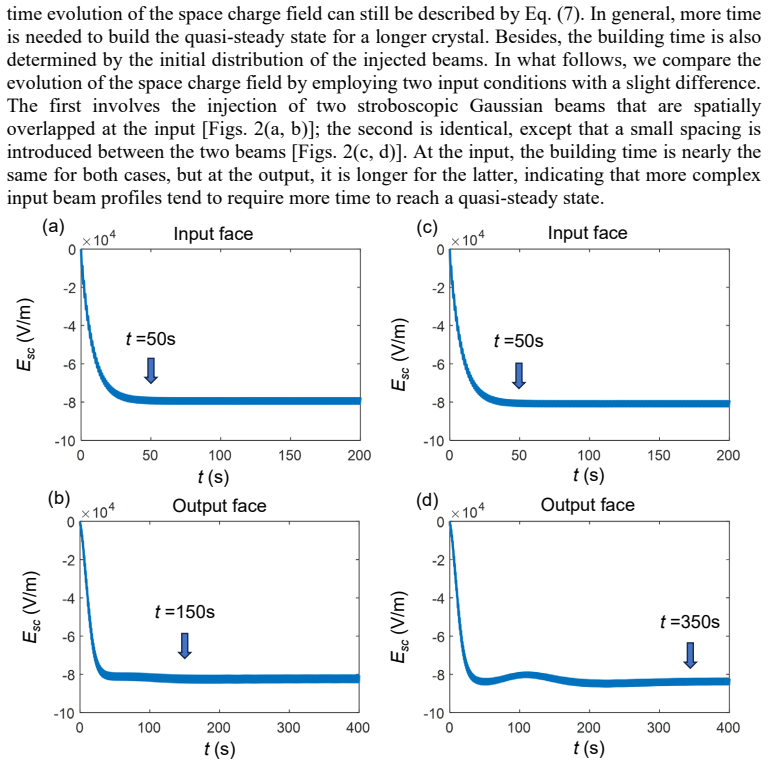
- [§2, quasi-steady assumption for z > 0] The derivation for propagation planes z0 > 0 relies on treating φ±(x,z0,t) as approximately time-independent once t > t0. This is asserted but not proven or quantified. The manuscript itself notes that the building time depends on the input beam profile and is longer at the output for the spaced-beam case (Fig. 2d), indicating residual temporal variation. A smallness criterion for ∂φ±/∂t, or a bound on the induced error in Eq. (7), is needed; this assumption is load-bearing because Eq. (7) for z0 > 0 is otherwise not justified.
- [§3, validation scope] The numerical validation covers a single parameter set (T = 1 s, τ_d = 50 s) and two input profiles. No quantitative values of S are reported in the text or figures, only 'nearly 1,' and there is no scan over T/τ_d, beam amplitude, or propagation length. Since the central claim is that the model 'almost exactly reproduces' the full time-dependent dynamics under 'suitable modulation conditions,' the validation should map the range of validity in the (T/τ_d, intensity) plane and report the numerical S values. This is particularly important because the approximation condition in Eq. (8) is intensity-dependent.
- [§2, Eq. (7-1) and (7-2)] Equations (7-1) and (7-2) are severely garbled in the submitted manuscript; the exponentials, fractions, and brackets are not typeset correctly. Since Eq. (8) is obtained from these expressions, the derivation cannot be checked. Please provide a clean, unambiguous version of Eq. (7) and ideally an intermediate step showing the linearization, so that the claimed rigorous derivation can be verified.
minor comments (5)
- [Abstract / §1] There are grammatical slips: 'Time modulation provide s' and 'Abstract: Recent experiments... / In this work, we elucidate' with duplicated phrasing. These should be cleaned up.
- [§2, Eq. (1)–(3)] The typesetting of Eqs. (1)–(3) contains stray characters such as '∂⎛⎫∂ +=' and '11 lim .extx dd E QE E Ett t ττ', making the equations hard to read. Please ensure all variables and operators are unambiguously typeset.
- [§3.1, empirical model] The empirical model I0± from Ref. [21] is not defined. For reproducibility, the manuscript should state its explicit form or clearly reference the equation number in the cited paper.
- [Fig. 4] The y-axis label reads 'S (a.u.)' though S defined in Eq. (11) is dimensionless and bounded by [0,1]. Please use a dimensionless axis label.
- [§3.2, Eqs. (10-1),(10-2)] The Laplacian term in Eqs. (10-1) and (10-2) appears as 'u k n x uu' without clear parentheses; please correct the notation so that the ∂²/∂x² term is explicit.
Circularity Check
No significant circularity: Eq. (9) is derived from the band-transport model and validated against numerical solutions of the same equations, with no fitted target parameters.
full rationale
The central claim is that the time-independent model, Eq. (9), follows from the band-transport equations under stated conditions (T/τ_d ≪ 1 and N ≫ 1). The derivation begins with the standard photorefractive band-transport equation (Eq. 1), solves it exactly for piecewise-constant driving fields (Eqs. 3–7), and then applies explicit approximations to obtain Eq. (8) and hence Eq. (9). No parameter in Eq. (9) is fitted to the time-dependent simulations used for validation: γ is defined from material constants and the applied field, and the comparisons in Figs. 3–4 are independent numerical cross-checks rather than fits. The only potentially fragile input is the quasi-steady assumption that φ±(x, z0, t) can be treated as time-independent after t0; this is an explicit physical approximation stated in Section 2, and the paper itself notes that more complex input profiles take longer to reach quasi-steady behavior. If that approximation fails, the effective model loses accuracy, but that is a validity limitation, not circularity. The self-citations [21–23] are used to motivate experimentally observed stroboscopic scenarios and to supply an empirical baseline model; they do not carry the derivation of Eq. (9). The reviewer's concern about needing an intensity-dependent smallness condition is a boundedness/validity issue, not a circular-reasoning issue. Accordingly, no circular step meets the quoted-evidence requirement.
Assumptions & free parameters
assumptions (5)
- domain assumption The band-transport model, Eq. (1), correctly describes the space-charge field dynamics in the photorefractive crystal under square-wave applied field and stroboscopic illumination.
- domain assumption The Pockels effect, Eq. (6-3), linearly converts the space-charge field to a refractive index change.
- domain assumption After a build-up time t0, the optical fields φ±(x,z0,t) are approximately time-independent at each propagation plane z0.
- domain assumption The fast-modulation condition T(Q+ + Q−) ≪ 1 and long-time limit N ≫ 1 hold.
- standard math Standard ODE solution formula (variation of parameters) and Taylor expansions e^{−x} ≈ 1 for small x are valid.
Cite this review
Pith. "Pith review of Time-independent theoretical framework for stroboscopic nonlinear dynamics based on time-nonlocal response." pith.science (2026). https://pith.science/paper/PLJWCKYA
@misc{pith2026260207600,
  author       = {Pith},
  title        = {Pith review of: Time-independent theoretical framework for stroboscopic nonlinear dynamics based on time-nonlocal response},
  year         = {2026},
  howpublished = {\url{https://pith.science/paper/PLJWCKYA}},
  note         = {Machine review of arXiv:2602.07600}
}
read the original abstract
Recent experiments have demonstrated the ability to manipulate nonlinear interactions via time modulation, giving rise to the so-called stroboscopic nonlinearity. To date, however, this phenomenon has not been subjected to a rigorous theoretical analysis. In this work, we clarify the physical mechanism underlying stroboscopic nonlinear dynamics based on time-nonlocal response and establish an effective time-independent model under suitable modulation conditions. The proposed model almost exactly reproduces the full time-dependent dynamics in the quasi-steady state and significantly outperforms empirical descriptions used previously. Our results provide a clear physical picture of stroboscopic nonlinear dynamics, and can be extended to other systems with time-nonlocal response, establishing a general framework for engineering nonlinear interactions through temporal modulation.
Figures

Reference graph
Works this paper leans on
-
[1]
Floating under a levitating liquid,
B. Apffel, F. Novkoski, A. Eddi, and E. Fort, “Floating under a levitating liquid,” Nature 585, 48-52 (2020)
2020
-
[2]
Enhancing and controlling parametric instabilities in mechanical systems,
A. A. Grandi, S. Protière, and A. Lazarus, “Enhancing and controlling parametric instabilities in mechanical systems,” Extreme Mech. Lett. 43, 101195 (2021)
2021
-
[3]
Electrically driven nonreciprocity induced by interband photonic transition on a silicon chip,
H. Lira, Z. Yu, S. Fan, and M. Lipson, “Electrically driven nonreciprocity induced by interband photonic transition on a silicon chip,” Phys. Rev. Lett. 109, 033901 (2012)
2012
-
[4]
Photonic time crystals: a materials perspective,
S. Saha, O. Segal, C. Fruhling, E. Lustig, M. Segev, A. Boltasseva, and V. M. Shalaev, “Photonic time crystals: a materials perspective,” Opt. Express 31, 8267-8273 (2023)
2023
-
[5]
Observation of a discrete time crystal,
J. Zhang, P. W. Hess, A. Kyprianidis, P. Becker, A. Lee, J. Smith, G. Pagano, I.- D. Potirniche, A. C. Potter, A. Vishwanath, N. Y. Yao, and C. Monroe, “Observation of a discrete time crystal,” Nature 543, 217-220 (2017)
2017
-
[6]
Kapitza trap for ultracold atoms,
J. Jiang, E. Bernhart, M. Röhrle, J. Benary, M. Beck, C. Baals, and H. Ott, “Kapitza trap for ultracold atoms,” Phys. Rev. Lett. 131, 033401 (2023)
2023
-
[7]
Dynamic stability of the pendulum with vibrating suspension point,
P. L. Kapitza, “Dynamic stability of the pendulum with vibrating suspension point,” Sov. Phys. JETP 21, 588-597 (1951)
1951
-
[8]
Faraday waves on a viscoelastic liquid,
C. Wagner, H. W. Müller, and K. Knorr, “Faraday waves on a viscoelastic liquid,” Phys. Rev. Lett. 83, 308 (1999)
1999
Show all 27 references
-
[9]
Subwavelength ultrasonic circulator based on spatiotemporal modulation,
R. Fleury, D. L. Sounas, and A. Alù, “Subwavelength ultrasonic circulator based on spatiotemporal modulation,” Phys. Rev. B 91, 174306 (2015). 10.D. L. Sounas and A. Alù, “Non-reciprocal photonics based on time modulation,” Nat. Photonics 11, 774-783 (2017)
2015
-
[11]
Light emission by free electrons in photonic time-crystals,
A. Dikopoltsev, Y. Sharabi, M. Lyubarov, Y. Lumer, S. Tsesses, E. Lustig, I. Kaminer, and M. Segev, “Light emission by free electrons in photonic time-crystals,” Proc. Natl. Acad. Sci. U.S.A. 119, e2119705119 (2022)
2022
-
[12]
Amplified emission and lasing in photonic time crystals,
M. Lyubarov, Y. Lumer, A. Dikopoltsev, E. Lustig, Y. Sharabi, and M. Segev, “Amplified emission and lasing in photonic time crystals,” Science 377, 425-428 (2022)
2022
-
[13]
Superluminal k-gap solitons in nonlinear photonic time crystals,
Y. Pan, M.-I. Cohen, and M. Segev, “Superluminal k-gap solitons in nonlinear photonic time crystals,” Phys. Rev. Lett. 130, 233801 (2023)
2023
-
[14]
Observation of discrete time-crystalline order in a disordered dipolar many-body system,
S. Choi, J. Choi, R. Landig, G. Kucsko, H. Zhou, J. Isoya, F. Jelezko, S. Onoda, H. Sumiya, V. Khemani, C. v. Keyserlingk, N. Y. Yao, E. Demler, and M. D. Lukin, “Observation of discrete time-crystalline order in a disordered dipolar many-body system,” Nature 543, 221-225 (2017)
2017
-
[15]
Higher-order and fractional discrete time crystals in Floquet -driven Rydberg atoms,
B. Liu, L.-H. Zhang, Q.-F. Wang, Y. Ma, T.-Y. Han, J. Zhang, Z.-Y. Zhang, S.-Y. Shao, Q. Li, H.-C. Chen, B.-S. Shi, and D. -S. Ding, “Higher-order and fractional discrete time crystals in Floquet -driven Rydberg atoms,” Nat. Commun. 15, 9730 (2024)
2024
-
[16]
Observation of a space- time crystal in a superfluid quantum gas,
J. Smits, L. Liao, H. T. C. Stoof, and P. van der Straten, “Observation of a space- time crystal in a superfluid quantum gas,” Phys. Rev. Lett. 121, 185301 (2018)
2018
-
[17]
Faraday -wave contact-line shear gradient induces streaming and tracer self-organization: From vortical to hedgehoglike patterns,
H. Alarcón, M. Herrera-Muñoz, N. Périnet, N. Mujica, P. Gutiérrez, and L. Gordillo, “Faraday -wave contact-line shear gradient induces streaming and tracer self-organization: From vortical to hedgehoglike patterns,” Phys. Rev. Lett. 125, 254505 (2020)
2020
-
[18]
Observation of Faraday waves in a Bose- Einstein condensate,
P. Engels, C. Atherton, and M. A. Hoefer, “Observation of Faraday waves in a Bose- Einstein condensate,” Phys. Rev. Lett. 98, 095301 (2007)
2007
-
[19]
Spontaneous formation of star -shaped surface patterns in a driven Bose- Einstein condensate,
K. Kwon, K. Mukherjee, S. J. Huh, K. Kim, S. I. Mistakidis, D. K. Maity, P. G. Kevrekidis, S. Majumder, P. Schmelcher, and J.- y. Choi, “Spontaneous formation of star -shaped surface patterns in a driven Bose- Einstein condensate,” Phys. Rev. Lett. 127, 113001 (2021)
2021
-
[20]
Pattern formation in a driven Bose-Einstein condensate,
Z. Zhang, K.-X. Yao, L. Feng, J. Hu, and C. Chin, “Pattern formation in a driven Bose-Einstein condensate,” Nat. Phys. 16, 652-656 (2020)
2020
-
[21]
Breaking the action–reaction principle of light interactions under a stroboscopic nonlinearity,
W. Ma, Y. Zhuang, Z. Wang, P. Jia, P. Zhang, Y. Hu, Z. Chen, and J. Xu, “Breaking the action–reaction principle of light interactions under a stroboscopic nonlinearity,” Laser Photonics Rev. 17, 2200177 (2023)
2023
-
[22]
Optical spiral predator–prey dynamics,
J. Wu, Y.-H. Zhuang, Y. Hu, and J.-J. Xu, “Optical spiral predator–prey dynamics,” Chin. Phys. Lett. 42, 024202 (2025)
2025
-
[23]
Unusual impulse–momentum relationship in non- reciprocal light interactions,
Y.-H. Zhuang, J. Wu, S.-Y. Li, Y. Hu, Z.-G. Chen, and J.-J. Xu, “Unusual impulse–momentum relationship in non- reciprocal light interactions,” Light: Sci. Appl. (2026), in press
2026
-
[24]
Three-dimensional optical beam propagation and solitons in photorefractive crystals,
B. Crosignani, P. Di Porto, A. Degasperis, M. Segev, and S. Trillo, “Three-dimensional optical beam propagation and solitons in photorefractive crystals,” J. Opt. Soc. Am. B 14, 3078-3090 (1997)
1997
-
[25]
Molding and stretched evolution of optical solitons in cumulative nonlinearities,
C. Dari-Salisburgo, E. DelRe, and E. Palange, “Molding and stretched evolution of optical solitons in cumulative nonlinearities,” Phys. Rev. Lett. 91, 263903 (2003)
2003
-
[26]
Photorefractive solitons and their underlying nonlocal physics,
E. DelRe, B. Crosignani, and P. Di Porto, “Photorefractive solitons and their underlying nonlocal physics,” Prog. Opt. 53, 153-200 (2009)
2009
-
[27]
Slow and fast light in photorefractive SBN: 60,
W. Horn, J. v Bassewitz, and C. Denz, “Slow and fast light in photorefractive SBN: 60,” J. Opt. 12, 104011 (2010)
2010
-
[28]
Photoconduction of polar and nonpolar cuts of undoped Sr0.61Ba0.39Nb2O6 single crystals,
E. Beyreuther, J. Ratzenberger, M. Roeper, B. Kirbus, M. Rüsing, L. I. Ivleva, and L. M. Eng, “Photoconduction of polar and nonpolar cuts of undoped Sr0.61Ba0.39Nb2O6 single crystals,” Crystals 11, 780 (2021)
2021
Reviewed August 3, 2026 · model on record in the stance chip above.
Discussion (0). Sign in to comment.