Recognition: no theorem link
Characterisation of an EXor outburst SPICY 97589
Pith reviewed 2026-05-16 02:40 UTC · model grok-4.3
The pith
The 2023 outburst of SPICY 97589 is confirmed as an accretion event onto an M3 star at 2.38e-7 solar masses per year.
A machine-rendered reading of the paper's core claim, the machinery that carries it, and where it could break.
Core claim
The 2023 outburst was driven by an influx of material from the surrounding environment to the central star, an accretion outburst. The accretion rate reaches 2.38 plus or minus 0.58 times 10 to the minus 7 solar masses per year. The spectral fingerprint of emission lines is also characteristic of an outbursting EXor-type source, including variable disk winds.
What carries the argument
Emission line luminosities from multi-waveband spectroscopy converted to mass-accretion rate via empirical relations, compared between outburst peak and post-outburst quiescent spectra.
If this is right
- The central star is an M3.0 type with effective temperature 3410 K, luminosity 0.41 solar luminosities and mass 0.29 solar masses.
- The outburst contributes to disk evolution by transporting material inward at an elevated rate.
- Variable disk winds form part of the spectral signature during the outburst phase.
Where Pith is reading between the lines
- Outbursts of this kind may represent a major channel for mass assembly in young stars across clusters.
- Targeted spectroscopic monitoring of similar young objects could uncover additional EXor events.
- Extended time-series data might reveal whether the outbursts repeat on predictable timescales.
Load-bearing premise
The conversion of observed emission-line luminosities to mass-accretion rate relies on empirical relations calibrated on other stars; if those relations do not apply to this object the quoted rate could be systematically off.
What would settle it
An independent measurement of accretion rate, such as through continuum veiling, showing no significant increase during the 2023 event would falsify the accretion-driven outburst claim.
Figures



read the original abstract
Stellar outbursts from variable or periodic accretion are thought to be ubiquitous across young stellar populations. However, relatively few outbursting objects have been discovered to date. Here, we present the characterisation of a new EXor-type episodic accretor. We aim to characterise the nature of the 2023 outburst of SPICY 97589/Gaia23bab and characterise the stellar source for the first time, while exploring how an accretion outburst contributes to disk evolution. We employ multi-waveband medium-resolution spectroscopy with UVB-VIS-NIR coverage during the peak of the 2023 outburst and the post-outburst quiescent object. The broad wavelength coverage of the dataset allows for robust measurements of the accretion rate using known line tracers. The addition of quiescent spectra provides a good estimation of stellar parameters of the central star while also informing us on the evolution of the disk during outburst phases. We find the stellar source to be a 3410\,K, M3.0 type star with a luminosity of 0.41 $L_\odot$ and an estimated stellar mass of 0.29 $M_\odot$. We measure the accretion rate of SPICY 97589 to be $\dot M = 2.38\pm0.58\times10^{-7}\,\mathrm{M_\odot yr^{-1}}$. This value is at two orders of magnitude greater than the quiescent accretion rate. Thus, we confirm that the 2023 outburst was driven by an influx of material from the surrounding environment to the central star, an accretion outburst. The spectral fingerprint of emission lines is also characteristic of an outbursting EXor-type source, including variable disk winds.
Editorial analysis
A structured set of objections, weighed in public.
Referee Report
Summary. The manuscript presents multi-wavelength (UVB-VIS-NIR) spectroscopic observations of SPICY 97589/Gaia23bab during the peak of its 2023 outburst and in quiescence. It classifies the central source as an M3.0 star (T_eff = 3410 K, L = 0.41 L_⊙, M_* = 0.29 M_⊙) and derives an outburst accretion rate Ṁ = 2.38 ± 0.58 × 10^{-7} M_⊙ yr^{-1} from emission-line luminosities, two orders of magnitude above the quiescent value, thereby confirming the event as an EXor-type accretion outburst with characteristic line emission and variable disk winds.
Significance. If the reported factor-of-100 increase in accretion rate holds, the work adds a well-observed low-mass EXor to the still-small sample of such objects and directly links the photometric outburst to enhanced accretion, with implications for disk evolution. The broad wavelength coverage enabling simultaneous use of multiple line tracers is a methodological strength.
major comments (1)
- [§4] §4 (accretion-rate derivation): The mass-accretion rate is obtained from Hα, Paβ and Brγ luminosities via empirical calibrations (Alcalá et al.-style relations) derived on higher-mass T Tauri samples. No quantitative assessment is given of whether these relations remain valid for an M3.0 star at T_eff = 3410 K; if line-formation physics, veiling or extinction differ systematically, both the absolute Ṁ and the reported factor-of-100 contrast with quiescence become uncertain. An orthogonal check (e.g., continuum veiling or UV excess) is absent.
minor comments (2)
- [Abstract and §3] The abstract and §3 state that 'known line tracers' were used but do not list the specific lines or equivalent-width measurements; adding a table of line luminosities and the exact calibration coefficients employed would improve reproducibility.
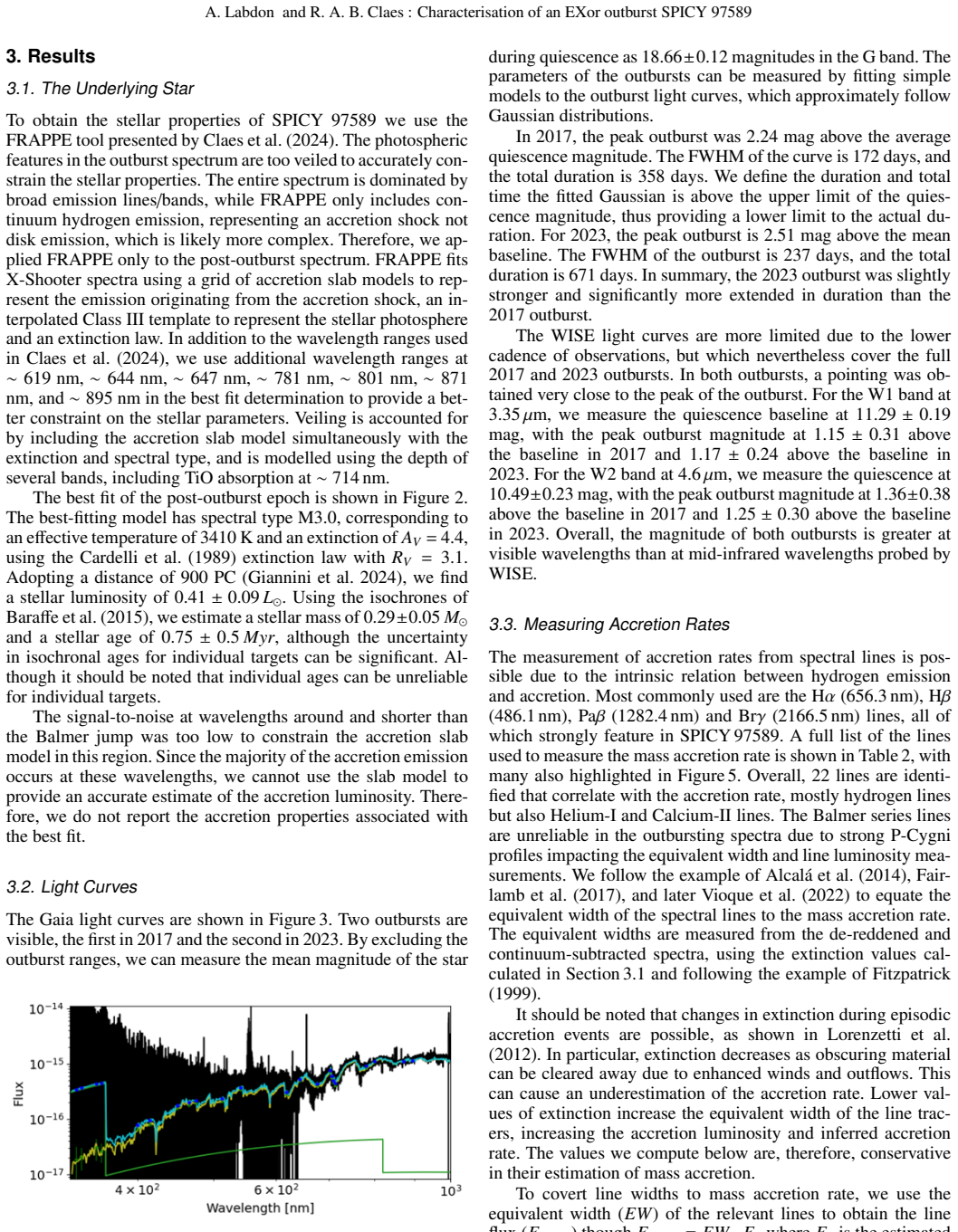
- [Figures] Figure 2 (or equivalent spectral comparison plot) would benefit from explicit annotation of the lines used for the Ṁ calculation and a clear quiescent vs. outburst overlay to highlight the factor-of-100 change.
Simulated Author's Rebuttal
We thank the referee for their constructive review and recommendation for minor revision. The comment on the accretion-rate derivation is addressed point-by-point below.
read point-by-point responses
-
Referee: [§4] §4 (accretion-rate derivation): The mass-accretion rate is obtained from Hα, Paβ and Brγ luminosities via empirical calibrations (Alcalá et al.-style relations) derived on higher-mass T Tauri samples. No quantitative assessment is given of whether these relations remain valid for an M3.0 star at T_eff = 3410 K; if line-formation physics, veiling or extinction differ systematically, both the absolute Ṁ and the reported factor-of-100 contrast with quiescence become uncertain. An orthogonal check (e.g., continuum veiling or UV excess) is absent.
Authors: We agree that the Alcalá et al.-style empirical relations were calibrated on samples dominated by higher-mass T Tauri stars. For our M3.0 source (T_eff = 3410 K), systematic differences in veiling, extinction, or line-formation physics could affect the absolute Ṁ value. However, the reported factor-of-100 contrast remains robust because both the outburst and quiescent accretion rates are derived using identical relations and the same set of line tracers. We will revise §4 to add a quantitative discussion of the applicability of these calibrations to low-mass stars, including the typical scatter in the relations and references to prior applications on M-dwarfs and brown dwarfs. An orthogonal check via UV excess or continuum veiling is not feasible with the current UVB-VIS-NIR dataset, which lacks the necessary UV coverage for such measurements; the internal consistency across Hα, Paβ, and Brγ provides the primary validation. revision: partial
Circularity Check
No circularity: accretion rates derived from external empirical line-luminosity relations applied to independent outburst and quiescent spectra
full rationale
The paper measures stellar parameters (T_eff=3410 K, L=0.41 L_sun, M=0.29 M_sun) and accretion rates directly from UVB-VIS-NIR spectra using established external calibrations (Alcalá-style relations for Hα, Paβ, Brγ). The factor-of-100 contrast between outburst (2.38e-7 M_sun/yr) and quiescent rates follows from applying the identical external conversion to two independent epochs; no parameter is fitted to the present data and then re-used as a prediction, no self-citation supplies a uniqueness theorem or ansatz, and no step renames or re-derives its own input. The derivation chain is therefore self-contained against external benchmarks.
Axiom & Free-Parameter Ledger
free parameters (1)
- line-to-accretion-rate conversion factors
axioms (1)
- domain assumption Standard stellar spectral classification and pre-main-sequence evolutionary models apply to this source.
Reference graph
Works this paper leans on
-
[1]
Alcalá, J. M., Manara, C. F., Natta, A., et al. 2017, A&A, 600, A20 Alcalá, J. M., Natta, A., Manara, C. F., et al. 2014, A&A, 561, A2
work page 2017
- [2]
-
[3]
Audard, M., Stringfellow, G. S., Güdel, M., et al. 2010, A&A, 511, A63
work page 2010
-
[4]
Baraffe, I., Homeier, D., Allard, F., & Chabrier, G. 2015, A&A, 577, A42
work page 2015
- [5]
-
[6]
Chambers, K. C., Magnier, E. A., Metcalfe, N., et al. 2016, arXiv e-prints, arXiv:1612.05560
work page internal anchor Pith review Pith/arXiv arXiv 2016
-
[7]
Claes, R. A. B., Campbell-White, J., Manara, C. F., et al. 2024, A&A, 690, A122
work page 2024
-
[8]
Clarke, C., Lodato, G., Melnikov, S. Y ., & Ibrahimov, M. A. 2005, MNRAS, 361, 942 Cruz-Sáenz de Miera, F., Kóspál, Á., Abrahám, P., et al. 2023, A&A, 678, A88
work page 2005
-
[9]
Cutri, R. M., Skrutskie, M. F., van Dyk, S., et al. 2003, VizieR Online Data Catalog, 2246
work page 2003
-
[10]
Cutri, R. M., Skrutskie, M. F., van Dyk, S., et al. 2014, VizieR Online Data
work page 2014
-
[11]
Dunham, M. M. & V orobyov, E. I. 2012, ApJ, 747, 52
work page 2012
-
[12]
Evans, Neal J., I., Dunham, M. M., Jørgensen, J. K., et al. 2009, ApJS, 181, 321
work page 2009
-
[13]
Fairlamb, J. R., Oudmaijer, R. D., Mendigutia, I., Ilee, J. D., & van den Ancker, M. E. 2017, MNRAS, 464, 4721
work page 2017
-
[14]
Fiorellino, E., Manara, C. F., Nisini, B., et al. 2021, A&A, 650, A43
work page 2021
-
[15]
Fischer, W. J., Hillenbrand, L. A., Herczeg, G. J., et al. 2023, in Astronomical Society of the Pacific Conference Series, V ol. 534, Protostars and Planets VII, ed. S. Inutsuka, Y . Aikawa, T. Muto, K. Tomida, & M. Tamura, 355
work page 2023
-
[16]
Fitzpatrick, E. L. 1999, PASP, 111, 63
work page 1999
- [17]
-
[18]
1998, Accretion Processes in Star Formation, V ol
Hartmann, L. 1998, Accretion Processes in Star Formation, V ol. 32
work page 1998
- [19]
- [20]
-
[21]
Herbig, G. H. 2007, AJ, 133, 2679
work page 2007
-
[22]
Herbig, G. H. 2008, AJ, 135, 637
work page 2008
-
[23]
Herczeg, G. J. & Hillenbrand, L. A. 2008, ApJ, 681, 594 Article number, page 8 of 11 A. Labdon and R. A. B. Claes : Characterisation of an EXor outburst SPICY 97589
work page 2008
-
[24]
T., Breedt, E., Delgado, A., et al
Hodgkin, S. T., Breedt, E., Delgado, A., et al. 2023, Transient Name Server Dis- covery Report, 2023-493, 1
work page 2023
- [25]
-
[26]
Kenyon, S. & Hartmann, L. 1995, ApJ, 101, 117 Kóspál, Á., Ábrahám, P., Goto, M., et al. 2011, ApJ, 736, 72
work page 1995
-
[27]
Kraus, S., Caratti o Garatti, A., Garcia-Lopez, R., et al. 2016, MNRAS, 462, L61
work page 2016
-
[28]
Kuhn, M. A., Benjamin, R. A., Ishida, E. E. O., et al. 2023, Research Notes of the American Astronomical Society, 7, 57
work page 2023
-
[29]
Kuhn, M. A., de Souza, R. S., Krone-Martins, A., et al. 2021, ApJS, 254, 33
work page 2021
-
[30]
Kuhn, M. A., Hillenbrand, L. A., Connelley, M. S., et al. 2024, MNRAS
work page 2024
-
[31]
Lin, D. N. C. & Papaloizou, J. C. B. 1996, ARA&A, 34, 703
work page 1996
-
[32]
Lorenzetti, D., Antoniucci, S., Giannini, T., et al. 2012, ApJ, 749, 188
work page 2012
-
[33]
Lorenzetti, D., Larionov, V . M., Giannini, T., et al. 2009, ApJ, 693, 1056
work page 2009
-
[34]
2010, in Society of Photo-Optical Instrumentation Engineers (SPIE) Conference Series, V ol
Modigliani, A., Goldoni, P., Royer, F., et al. 2010, in Society of Photo-Optical Instrumentation Engineers (SPIE) Conference Series, V ol. 7737, Observatory Operations: Strategies, Processes, and Systems III, ed. D. R. Silva, A. B. Peck, & B. T. Soifer, 773728
work page 2010
- [35]
-
[36]
Pringle, J. E. & Rees, M. J. 1972, A&A, 21, 1
work page 1972
-
[37]
Shu, F. H. 1977, ApJ, 214, 488
work page 1977
-
[38]
Sipos, N., Ábrahám, P., Acosta-Pulido, J., et al. 2009, A&A, 507, 881
work page 2009
- [39]
-
[40]
Vernet, J., Dekker, H., D’Odorico, S., et al. 2011, A&A, 536, A105
work page 2011
-
[41]
Vioque, M., Oudmaijer, R. D., Wichittanakom, C., et al. 2022, ApJ, 930, 39
work page 2022
-
[42]
Wang, M.-T., Herczeg, G. J., Liu, H.-G., et al. 2023, ApJ, 957, 113 Appendix A: Photometric Sources Table A.1.List of photometric sources and fluxes used to compile the spectral energy distribution. References: PAN-STARRS Chambers et al. (2016), 2MASS Cutri et al. (2003), WISE Cutri et al. (2014). λFlux Error Source [Å] [ergs −1cm−2Å−1] 4810 6.93E-18 4.90...
work page 2023
discussion (0)
Sign in with ORCID, Apple, or X to comment. Anyone can read and Pith papers without signing in.