REVIEW 3 major objections 5 minor 37 references
ML-Assisted Bulk Resource Allocation: Custom Outage-Based Loss Function and Reliability Analysis
T0 review · 3 major / 5 minor · reviewed 2026-08-02 · deepseek-v4-flash
Pith's one-line read Bulk reliability in ML resource allocation is a set-level problem, and the paper's RBOL loss targets gate and ranking failures jointly to approach the physical outage limit.
desk verdict A useful, honestly reported extension of outage-based ML to D-of-R bulk allocation; the empirical case is consistent and worth referee time, but the analytical framing is overstated and the results rest on one synthetic channel family without error bars. read the letter →
The pith
A machine-rendered reading of the paper's core claim, the machinery that carries it, and where it could break.
The reading
What carries the argument
The load-bearing object is RBOL (ranking-aware bulk outage loss), a differentiable surrogate for the hard GTBA outage event. GTBA (gate + top-D allocation) is the two-stage decision rule: first discard any resource whose predicted risk exceeds a fixed threshold q_th; if fewer than D pass, declare a gate outage; otherwise allocate the D admissible resources with lowest predicted risk. RBOL sums three terms: a softplus shortfall that penalizes the expected number of accepted-and-physically-good resources falling below D; a softplus margin penalty at the top-D cutoff weighted by the fraction of good resources outside and bad resources inside the selected set; and a small BCE stability term. The
What would settle it
Train the same neural predictor with RBOL and with pointwise losses on a different channel model (e.g., measured urban traces with correlated resources, R=16, D=4, q_th=0.4), then compare bulk outage probability under GTBA. If RBOL's roughly 15-41 percent improvement over pointwise baselines disappears or reverses, the universality claim fails.
Extended reading notes
Core claim
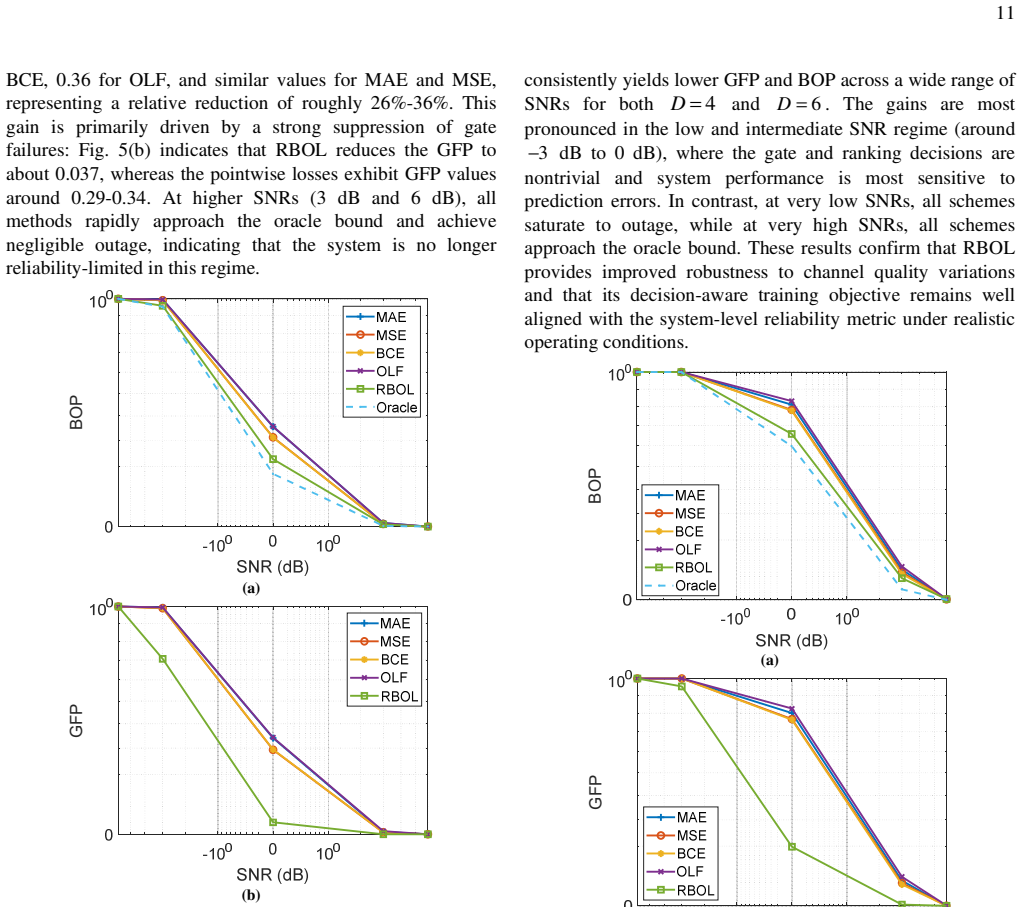
The paper's central claim is that bulk outage probability under the gate + top-D allocation (GTBA) rule decomposes exactly into gate failures — fewer than D resources passing the admission threshold — and selection failures — ranking errors that put bad resources into or good resources out of the selected top-D set — and that a differentiable loss built from a soft gate-count shortfall and a cutoff-aware ranking margin, with a small binary cross-entropy regularizer, suppresses both failure modes. On a synthetic fading-channel model with R=16 independent resources, a recurrent predictor trained with this ranking-aware bulk outage loss (RBOL) achieves substantially lower bulk outage probabilit
Load-bearing premise
The load-bearing premise is that the composite RBOL surrogate is faithful enough to the hard GTBA outage rule that minimizing it on training channels also lowers outage under the hard rule on test channels; the paper checks this only on one synthetic fading-channel family with independent resources and tuned hyperparameters.
Editorial extensions
If this is right
- Operators can train one predictor per required bulk size D and still use the same GTBA rule at inference; no per-resource labels are needed at deployment.
- When the candidate pool R is large, effort is best spent sharpening the top-D ranking boundary rather than improving average per-resource accuracy.
- The oracle lower bound gives a countable target: the gap between achieved BOP and OBOP is exactly the cost of imperfect prediction and ranking, so it can drive decisions on adding resources versus improving the model.
- The gate threshold q_th acts as a dial between gate failures and selection failures, and the paper's BOP-GFP frontier exposes the best operating point for each D.
- The loss's BCE term is only a regularizer; the set-level shortfall and cutoff terms are what carry the outage gains.
Reading between the lines
- Editorial extension: because gate failures account for most of the baselines' outage at moderate D, retuning the gate threshold upward for those baselines might shrink their gap to RBOL; the paper's threshold sweeps suggest RBOL still leads at every q_th, but the direct counterfactual is not run.
- Editorial extension: the asymptotic analysis predicts that in large candidate pools ranking errors, not resource scarcity, dominate outage; a testable consequence is that increasing R at fixed D should shrink the RBOL-to-oracle gap faster for RBOL than for pointwise losses.
- Editorial extension: the loss uses true outage labels only during training, so a deployment-time variant could distill RBOL into a lightweight calibration post-processor; whether that preserves the BOP gains is not examined here.
- Editorial extension: the BOP-versus-GFP frontier introduced in the threshold experiment is a ready-made design curve: an operator could pick q_th by choosing the frontier point that meets a gate-failure budget, independent of the trained loss.
Editorial analysis
A structured set of objections, weighed in public.
Referee Report
Summary. The paper extends outage-based ML resource allocation from single-resource selection to bulk allocation, where a user needs at least D reliable resources from R candidates. It proposes a gate + top-D allocation (GTBA) policy and a differentiable ranking-aware bulk outage loss (RBOL) combining a softplus shortfall term, a cutoff-aware ranking penalty, and a BCE regularizer. The authors derive an exact decomposition of the bulk outage probability (BOP) into gate and selection failures, give an oracle lower bound, and state an asymptotic result for large R. Extensive simulations on a synthetic tapped-delay-line channel model with R=16 report that RBOL-trained models reduce BOP and GFP compared with MAE, MSE, BCE, and OLF across stress regimes, SNR sweeps, and gate-threshold sweeps.
Significance. If the reported gains hold beyond the single tested channel model, the paper addresses a genuine gap: prior outage-based ML allocation targets single-resource selection, while modern systems often allocate multiple resources jointly. The GTBA rule is practical and the decomposition of BOP into gate vs. selection failures is a useful conceptual lens. The empirical comparison is extensive and consistently favors RBOL. However, the analytical contribution is modest — the oracle lower bound is a trivial consequence of physical scarcity, and the asymptotic proposition concerns only the oracle, not any learned policy. The main evidence is empirical, and that evidence currently lacks uncertainty quantification and generalizes only to one synthetic channel family. With appropriate revisions and scoped claims, the work could be a worthwhile contribution to ML-assisted reliability-oriented scheduling.
major comments (3)
- [Section V-C, Figs. 2–8 and Table II] The paper reports BOP/GFP values that are averages over only 10 retrains, yet no error bars, confidence intervals, or significance tests are provided. For instance, the claimed 27%–41% BOP reduction at D=4 is presented as a single number, so the reader cannot assess whether this is within random variation. Since the central claim is empirical superiority of RBOL, this is load-bearing. Please report standard errors or confidence intervals across the 10 retrains, and ideally also across independent test sets, and use them to support the comparative claims.
- [Section IV-D, Proposition 1 and following paragraph] Proposition 1 proves only that the oracle BOP tends to 0 as R→∞ for fixed D. The subsequent sentence — 'BOP is dominated by ranking errors' in the large-R, fixed-D regime — is not a corollary of Proposition 1 for learned GTBA models. It requires additional assumptions about the learned risk scores (e.g., consistency or calibration) that are neither stated nor proved. This assertion is used to motivate the ranking-aware penalty, but as written it is an unsupported claim. Please either prove it under explicit assumptions or clearly label it as a heuristic expectation.
- [Section III-C, Eq. (23)] The central claim is that RBOL is a differentiable surrogate for the GTBA bulk outage event, but no quantitative alignment guarantee is established. The shortfall term (14) counts accepted-and-good resources through the soft gate, and the cutoff term (20) is a heuristic penalty; there is no bound or consistency argument relating the minimizer of (23) to the hard BOP (10). The only validation is a single synthetic TDL channel family with R=16 and hyperparameters tuned on the validation set. Since the paper's main conclusion is that set-level ranking-aware objectives are 'essential', this gap is load-bearing. Please add a theoretical analysis under explicit margin/calibration assumptions, or substantially broaden the empirical validation (e.g., multiple channel models, different R, real channel traces).
minor comments (5)
- [Table I and Section III-C] The τ schedule contradicts the prose. The text says smaller τ (sharper) is needed for large D, but Table I sets τ = max(0.08, 0.2 D) for D>2, which increases with D (e.g., 0.8 at D=4, 2.0 at D=10). Please correct the formula or the explanation.
- [Section V-C, Example 1] The phrase 'BCE- and finite-outage-trained models' in the second paragraph is undefined. Presumably it refers to BCE and OLF, but it should be stated explicitly for readability.
- [Section IV-A, Eqs. (11) and (25)] Equations (11) and (25) are identical decompositions of the BOP; consider presenting only one and referencing it.
- [Section IV-C, Lemma 1] Lemma 1 is a straightforward consequence of the definition of the oracle and the fact that the selected set is a subset of all resources. This is fine, but calling it a 'strict lower bound' is misleading: it is a lower bound, but the word 'strict' suggests the inequality is always strict, which it is not (e.g., when the oracle also fails). Please rephrase.
- [Data availability] The data generator is attributed to a public GitHub repository [28], but no code implementing RBOL or the full training pipeline is provided. Releasing such code would greatly improve reproducibility.
Circularity Check
No significant circularity: the central empirical claim is self-contained and no prediction reduces to a fitted input or self-citation chain.
full rationale
The paper's central claim is the empirical superiority of RBOL-trained GTBA over pointwise losses and OLF. This is established by Monte Carlo simulation on a shared test set under the hard GTBA decision rule, not derived from the reliability analysis. The RBOL loss in Eq. (23) is an explicit proposed design, not an output of the oracle analysis. The analytical BOP decomposition in Eq. (25) is an exact law-of-total-probability identity following from the definitions in Eqs. (6)-(10); it describes the evaluation metric rather than predicting the simulation outcome. Lemma 1 (oracle lower bound) is proved directly by the subset argument that the oracle outage event is contained in any GTBA outage event, so it is a trivial bound, not a load-bearing derivation of the empirical gains. Proposition 1 is a standard law-of-large-numbers statement about the oracle only and does not imply any learned model's performance. Self-citations to prior single-resource OLF work [9,10] and to the data generator [28] are disclosed, used as a baseline and a tool, respectively, and do not force the measured comparisons. Validation-set hyperparameter tuning of tau, lambda_rank, m, and lambda_bce is reported openly and is standard experimental practice; the reported test-set BOP values are not obtained by fitting the evaluated quantity itself. No equation in the paper reduces the claimed 'prediction' to a fitted value by construction, and no load-bearing argument rests on an unverified self-citation. Accordingly, the paper is not circular; concerns about generalization beyond a single synthetic TDL channel family or about surrogate alignment are robustness/correctness issues, not circularity.
Assumptions & free parameters
free parameters (5)
- q_th (gate threshold) =
0.4
- tau (softness of gate surrogate) =
0.15 for D<=2; max(0.08, 0.2/D) otherwise
- lambda_rank (ranking weight) =
8
- m (cutoff margin) =
0.08
- lambda_bce (BCE regularizer weight) =
0.2 for D<=2, 0.05 otherwise
assumptions (4)
- domain assumption Resources are statistically independent
- domain assumption The synthetic tapped-delay-line channel model with unit-power Gaussian taps and random phase rotations is representative of real channels
- ad hoc to paper For a well-trained calibrated model, P_gate -> 0 as R -> infinity
- standard math Shannon achievable rate expression is used for labeling reliability
Cite this review
Pith. "Pith review of ML-Assisted Bulk Resource Allocation: Custom Outage-Based Loss Function and Reliability Analysis." pith.science (2026). https://pith.science/paper/AG3IZL6G
@misc{pith2026260300712,
  author       = {Pith},
  title        = {Pith review of: ML-Assisted Bulk Resource Allocation: Custom Outage-Based Loss Function and Reliability Analysis},
  year         = {2026},
  howpublished = {\url{https://pith.science/paper/AG3IZL6G}},
  note         = {Machine review of arXiv:2603.00712}
}
abstract
Machine learning (ML)-assisted outage-based resource allocation has recently emerged as an effective alternative to conventional scheduling methods in reliability-critical wireless systems. However, existing approaches are fundamentally limited to single-resource allocation, whereas modern and emerging systems increasingly require the simultaneous allocation of multiple resources to meet aggregate rate and reliability constraints. In this paper, we extend outage-based learning to the bulk resource allocation regime, where a user requires at least $D$ reliable resources from a pool of $R$ candidates. We first introduce a practical allocation policy, termed gate + top-$D$ allocation (GTBA), which combines threshold-based admission control with ranking-based selection. We then propose a novel ranking-aware bulk outage loss (RBOL) that provides a differentiable surrogate for the bulk outage event induced by GTBA, explicitly accounting for both gate failures and ranking errors near the selection boundary. An exact reliability analysis is developed, establishing a decomposition of bulk outage probability (BOP), identifying dominant failure mechanisms and deriving an oracle lower bound that characterizes the fundamental performance limit. Extensive simulations under balanced, light and heavy stress regimes demonstrate that RBOL consistently outperforms conventional pointwise losses and baselines, achieving substantial reductions in BOP and remaining significantly closer to the oracle bound across a wide range of operating conditions. These results confirm that set-level ranking-aware training objectives are essential for reliable ML-assisted bulk resource allocation.
Figures


Figures from the paper (4 more)



Reference graph
Works this paper leans on
-
[1]
Distributed machine learning for wireless communication networks: Techn iques, architectures, and applications,
S. Hu, X. Chen, W. Ni, E. Hossain, and X. Wang, "Distributed machine learning for wireless communication networks: Techn iques, architectures, and applications," IEEE Communications Surveys & Tutorials, vol. 23, no. 3, pp. 1458-1493, 2021
2021
-
[2]
ML- based radio resource management in 5G and beyond ne tworks: A survey,
I. A. Bartsiokas, P. K. Gkonis, D. I. Kaklamani , and I. S. Venieris, "ML- based radio resource management in 5G and beyond ne tworks: A survey," IEEE Access, vol. 10, pp. 83507-83528, 2022. GFPBOPBOPANAR 14
2022
-
[3]
A comprehensive survey of machin e learning applied to resource allocation in wireless communic ations,
D. G. S. Pivoto, F. A. de Figueiredo, C. Cavdar , G. R. de Lima Tejerina, and L. L. Mendes, "A comprehensive survey of machin e learning applied to resource allocation in wireless communic ations," IEEE Communications Surveys & Tutorials, vol. 28, pp. 1986-2053, 2026
1986
-
[4]
Resource allocation for twin maintenance and tas k processing in vehicular edge computing network,
Y. Xie et al. , "Resource allocation for twin maintenance and tas k processing in vehicular edge computing network," IEEE Internet of Things Journal, vol. 12, no. 15, pp. 32008-32021, 2025
2025
-
[5]
Predicti on and qos enhancement in new generation cellular networks with mobile hos ts: A survey on different protocols and conventional/unconventional approaches,
P. Fazio, F. De Rango, and M. Tropea, "Predicti on and qos enhancement in new generation cellular networks with mobile hos ts: A survey on different protocols and conventional/unconventional approaches," IEEE Communications Surveys & Tutorials, vol. 19, no. 3, pp. 1822-1841, 2017
2017
-
[6]
Opportunistic quality of se rvice constrained scheduling algorithms for wireless networks,
G. Chandrasekaran, "Opportunistic quality of se rvice constrained scheduling algorithms for wireless networks," Ph.D. dissertation, Faculty of the Graduate School, University of Texas , Texas, United States, 2024
2024
-
[7]
C ross Layer Optimization Using AI/ML Assisted Federated Edge Le arning in 6G Networks,
S. Louvros, A. Pandey, B. Shah, and Y. Buch, "C ross Layer Optimization Using AI/ML Assisted Federated Edge Le arning in 6G Networks," Future Internet, vol. 18, no. 2, 2026
2026
-
[8]
Optimal classifier for an ML-assisted resource allocation i n wireless communications,
R. Raina, D. E. Simmons, N. Simmons, and M. D. Yacoub, "Optimal classifier for an ML-assisted resource allocation i n wireless communications," IEEE Networking Letters, vol. 6, no. 3, 2024
2024
Show all 37 references
-
[9]
O utage performance and novel loss function for an ML-assisted resource allocation: An exact analytical framework,
N. Simmons, D. E. Simmons, and M. D. Yacoub, "O utage performance and novel loss function for an ML-assisted resource allocation: An exact analytical framework," IEEE Transactions on Machine Learning in Communications and Networking, vol. 2, pp. 335-350, 2024
2024
-
[10]
ML- assisted resource allocation outage probability: Si mple, closed-Form approximations,
R. Raina, N. Simmons, D. E. Simmons, and M. D. Yacoub, "ML- assisted resource allocation outage probability: Si mple, closed-Form approximations," in 2023 IEEE International Conference on Advanced Networks and Telecommunications Systems (ANTS) , Jaipur, India, 2023, pp. 1-6
2023
-
[11]
A custom loss function for machine learning-based resource allocation policies,
N. Simmons, D. E. Simmons, R. Raina, and M. D. Yacoub, "A custom loss function for machine learning-based resource allocation policies," in 2024 IEEE International Conference on Machine Learn ing for Communication and Networking (ICMLCN) , Stockholm, Sweden, 2024, pp. 19-24
2024
-
[12]
To Trust or Not to Trust: On Calibration in ML-based Resource Allocation for Wireless Networks,
R. Raina, N. Simmons, D. E. Simmons, M. D. Yac oub, and T. Q. Duong, "To Trust or Not to Trust: On Calibration in ML-based Resource Allocation for Wireless Networks," IEEE Transactions on Network Science and Engineering, vol. 13, pp. 5961-5977, 2026
2026
-
[13]
Resource allocation with edge computing in IoT networks via machine learning,
X. Liu, J. Yu, J. Wang, and Y. Gao, "Resource allocation with edge computing in IoT networks via machine learning," IEEE Internet of Things Journal, vol. 7, no. 4, pp. 3415-3426, 2020
2020
-
[14]
Multiuser resource control with deep reinforcement learning i n IoT edge computing,
L. Lei, H. Xu, X. Xiong, K. Zheng, W. Xiang, a nd X. Wang, "Multiuser resource control with deep reinforcement learning i n IoT edge computing," IEEE Internet of Things Journal, vol. 6, no. 6, pp. 10119- 10133, 2019
2019
-
[15]
Toward Sustainable 6G Cellular System Core-Network-Level Traffic Aggre gation: An Empirical Study,
T. Ogawara, S. Itahara, A. Suzuki, and M. Suzu ki, "Toward Sustainable 6G Cellular System Core-Network-Level Traffic Aggre gation: An Empirical Study," IEEE Access, vol. 13, pp. 116856-116868, 2025
2025
-
[16]
THz Channels for Short-Range Mobile Networks: Multipath Channel Behavior and Human Body Shadowing Effects,
M. Kim, J.-i. Takada, M. Mao, C. C. Kang, X. D u, and A. Ghosh, "THz Channels for Short-Range Mobile Networks: Multipath Channel Behavior and Human Body Shadowing Effects," IEEE Communications Magazine, vol. 64, no. 1, pp. 138-144, 2026
2026
-
[17]
Joint Communications, Sensing, and Positioning in 6G Multi-Functional Satellite Systems: Survey an d Open Challenges,
C. K. Sheemar et al. , "Joint Communications, Sensing, and Positioning in 6G Multi-Functional Satellite Systems: Survey an d Open Challenges," arXiv preprint arXiv:2509.25937, 2025
2025
-
[18]
Next-Generation Reconfigurable Antenna Systems for 6G: Challenges, Architectures, and Vision,
R. Singh, I. Ahmad, F. Alanazi, and D. Alqahta ni, "Next-Generation Reconfigurable Antenna Systems for 6G: Challenges, Architectures, and Vision," IEEE Access, vol. 13, pp. 196355-196373, 2025
2025
-
[19]
Gradient-based multi-objective deep learning: Algorithms, theories, applications, and beyond,
W. Chen et al. , "Gradient-based multi-objective deep learning: Algorithms, theories, applications, and beyond," arXiv preprint arXiv:2501.10945, 2025
2025 arXiv
-
[20]
Strictly prope r scoring rules, prediction, and estimation,
T. Gneiting and A. E. Raftery, "Strictly prope r scoring rules, prediction, and estimation," Journal of the American statistical Association, vol. 102, no. 477, pp. 359-378, 2007
2007
-
[21]
C. M. Bishop and N. M. Nasrabadi, Pattern recognition and machine learning (no. 4). Springer, 2006
2006
-
[22]
Trivedi, Exploring Probability and Random Processes Using MATLAB®
R. Trivedi, Exploring Probability and Random Processes Using MATLAB® . Educohack Press, 2025
2025
-
[23]
Révész, The laws of large numbers
P. Révész, The laws of large numbers . Academic Press, 2014
2014
-
[24]
Monte Carlo theory and practice,
F. James, "Monte Carlo theory and practice," Reports on progress in Physics, vol. 43, no. 9, pp. 1145-1189, 1980
1980
-
[25]
Root mean square error (RMSE) o r mean absolute error (MAE): When to use them or not,
T. O. Hodson, "Root mean square error (RMSE) o r mean absolute error (MAE): When to use them or not," Geoscientific Model Development Discussions, vol. 2022, pp. 1-10, 2022
2022
-
[26]
Evaluating performance of regr ession machine learning models using multiple error metrics in azure machin e learning studio,
A. Botchkarev, "Evaluating performance of regr ession machine learning models using multiple error metrics in azure machin e learning studio," Available at SSRN 3177507, 2018
2018
-
[27]
Enhancing brain stroke detection : A novel deep neural network with weighted binary cross entropy t raining,
A. N. Qasim, S. Alani, S. N. Mahmood, S. S. Mo hammed, D. A. Aziz, and K. I. M. Ata, "Enhancing brain stroke detection : A novel deep neural network with weighted binary cross entropy t raining," Revue d'Intelligence Artificielle, vol. 38, no. 3, p. 777, 2024
2024
-
[28]
Available: https://github.com/ML4Comms/greedy- resource-allocation- outage-classification
-
[29]
A S urvey of Radio Resource Scheduling for 6G and Future Wireless Networks,
A. M. Jaradat, M. Alayedi, and H. Arslan, "A S urvey of Radio Resource Scheduling for 6G and Future Wireless Networks," IEEE Open Journal of the Communications Society, vol. 6, pp. 10191-10218, 2025
2025
-
[30]
Multi ‐objective strategy ‐based resource allocation and performance improvements in 5G and beyond wireless networks,
S. Pradeep and L. Lakshminarasimman, "Multi ‐objective strategy ‐based resource allocation and performance improvements in 5G and beyond wireless networks," International Journal of Communication Systems, vol. 35, no. 15, p. e5288, 2022
2022
-
[31]
Measurement-Based Non-Stationary Markov Tapped Delay Line Channel Model for 5G-Railways,
X. Zhang et al. , "Measurement-Based Non-Stationary Markov Tapped Delay Line Channel Model for 5G-Railways," IEEE Antennas and Wireless Propagation Letters, vol. 24, no. 8, pp. 2277-2281, 2025
2025
-
[32]
Advanced Techniques for Chan nel Modeling, Estimation, and Resource Allocation Optimization in 5G/6G Wireless Communication Systems,
D. W. M. Guerra, "Advanced Techniques for Chan nel Modeling, Estimation, and Resource Allocation Optimization in 5G/6G Wireless Communication Systems," Ph.D. dissertation, Departm ent of Electrical Engineering, State University of Londrina, Londrina , Paraná, Brazil, 2024
2024
-
[33]
Achievable rate with antenna size constraint: Shan non meets Chu and Bode,
V. Shyianov, M. Akrout, F. Bellili, A. Mezghan i, and R. W. Heath, "Achievable rate with antenna size constraint: Shan non meets Chu and Bode," IEEE Transactions on Communications, vol. 70, no. 3, pp. 2010- 2024, 2021
2010
-
[34]
Improving robustness using generated data,
S. Gowal, S.-A. Rebuffi, O. Wiles, F. Stimberg , D. A. Calian, and T. A. Mann, "Improving robustness using generated data," Advances in neural information processing systems, vol. 34, pp. 4218-4233, 2021
2021
-
[35]
xlstm: Extended long short-term memory,
M. Beck et al. , "xlstm: Extended long short-term memory," Advances in Neural Information Processing Systems, vol. 37, pp. 107547-107603, 2024
2024
-
[36]
Th e role of activation function in CNN,
W. Hao, W. Yizhou, L. Yaqin, and S. Zhili, "Th e role of activation function in CNN," in 2020 2nd international conference on information technology and computer application (ITCA) , Guangzhou, China, 2020, pp. 429-432
2020
-
[37]
Understanding the adam optimization algorithm in machine learning,
O. Hospodarskyy, V. Martsenyuk, N. Kukharska, A. Hospodarskyy, and S. Sverstiuk, "Understanding the adam optimization algorithm in machine learning," in Proc. 2nd Int. Workshop Comput. Inf. Technol. Ind. 4.0, Ternopil, Ukraine, Jun. 2024
2024
Reviewed August 2, 2026 · model on record in the stance chip above.
Discussion (0). Sign in to comment.