An Investigation of Stabilization Scaling in Finite-Strain Virtual Element Methods for Hyperelasticity
Pith reviewed 2026-05-21 11:49 UTC · model grok-4.3
The pith
A decoupled kernel stabilization for hyperelastic virtual elements stays shear-scaled as Poisson ratio approaches one-half.
A machine-rendered reading of the paper's core claim, the machinery that carries it, and where it could break.
Core claim
Under standard polygon regularity assumptions the proposed deviatoric stabilization term is uniformly equivalent to μ_E times the squared H1 seminorm on the kernel, with equivalence constants independent of mesh size and of Poisson ratio; the volumetric term is scaled independently by a bulk measure and may be suppressed as ν approaches 1/2.
What carries the argument
Decoupled kernel-only stabilization, with the deviatoric contribution scaled solely by a local shear modulus plus bounded directional weights and the volumetric contribution scaled by an independent bulk modulus that can be capped.
If this is right
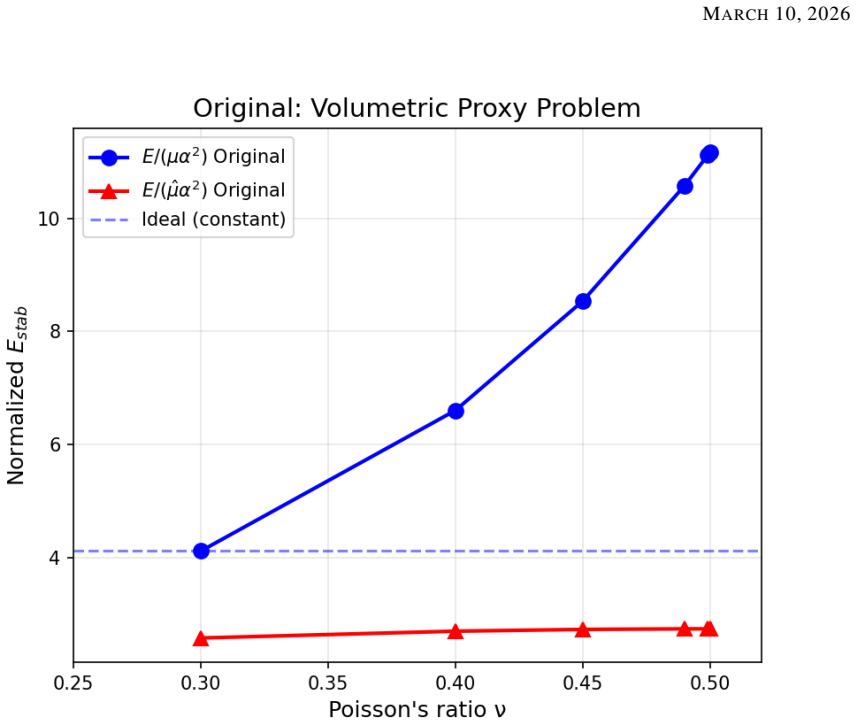
- Classical surrogate stabilizations assign bulk-driven energy to isochoric kernel modes as ν approaches 1/2, producing artificial stiffening.
- The new scaling remains shear-controlled on the kernel for any Poisson ratio, including the incompressible limit.
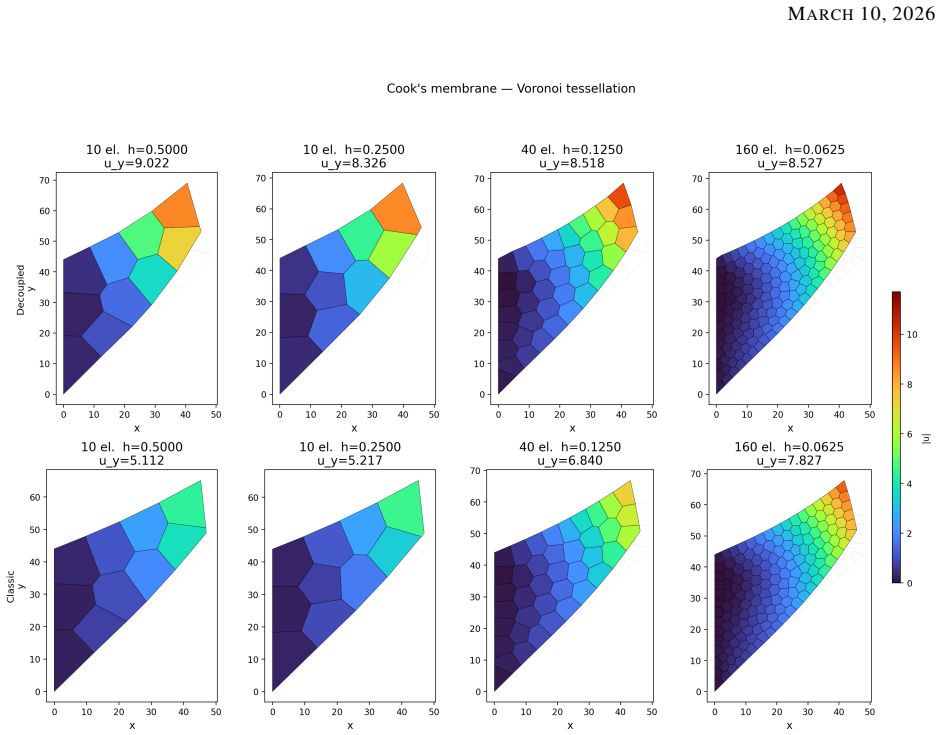
- Kernel spectra and Cook-membrane tests exhibit improved robustness across triangular, quadrilateral and general polygonal meshes.
- Newton tangent linearization stays consistent because the stabilization is defined directly on the kernel without auxiliary sub-triangulations.
Where Pith is reading between the lines
- The same separation of shear and volumetric channels could be tested in three-dimensional polyhedral virtual elements where sub-tessellation costs grow rapidly.
- If the directional geometry weights remain bounded under the stated regularity, the construction may extend to other nonlinear constitutive laws that become singular in certain strain modes.
- A practical implementation could default the volumetric stabilization to zero when ν exceeds a user-specified threshold without altering the shear part.
Load-bearing premise
The uniform equivalence and stability bounds hold only when the polygonal elements satisfy standard regularity assumptions that control shape and diameter ratios.
What would settle it
Compute the smallest eigenvalue of the deviatoric stabilization matrix divided by μ_E |·|_{1,E}^2 for a sequence of successively refined nearly incompressible polygonal meshes; if this ratio tends to zero or infinity as h decreases or ν approaches 1/2, the uniform equivalence claim is false.
Figures





read the original abstract
Low-order virtual element methods (VEM) compute a consistent finite-strain contribution through polynomial projections and rely on stabilization to control the unresolved modes in the projector kernel. In current hyperelastic VEM practice, stabilization is often defined by integrating a nonlinear surrogate energy over an auxiliary sub-triangulation and scaled through modified Lam\'e parameters and incompressibility factors; this can introduce sensitivity to the arbitrary internal tessellation, complicate consistent Newton linearization, and, most critically, inject bulk-dependent proxies into shear-type kernel penalties, artificially stiffening isochoric missing modes in the nearly incompressible regime. This work develops a submesh-free, kernel-only stabilization that decouples deviatoric and volumetric channels and is explicitly designed to scale like the current Newton tangent energy on the kernel: the deviatoric term is scaled solely by a shear measure and enhanced by bounded geometry-driven directional weights, while the volumetric term is scaled by an independent bulk measure and can be capped or suppressed as $\nu\to 1/2$. A spectral framework is established in which the canonical VEM stability requirement on the kernel is characterized by generalized Rayleigh quotients and eigenvalue bounds, and it is shown under standard polygon regularity assumptions that the deviatoric stabilization is uniformly equivalent to $\mu_E|\cdot|_{1,E}^2$ on the kernel with constants independent of mesh size and Poisson ratio. Element-level diagnostics confirm that classical surrogate-based stabilizations assign bulk-driven energy to isochoric kernel modes as $\nu\to 1/2$, whereas the proposed decoupled stabilization remains shear-scaled; kernel spectra and Cook's membrane simulations in the nearly incompressible regime further support improved robustness across polygonal mesh families.
Editorial analysis
A structured set of objections, weighed in public.
Referee Report
Summary. The manuscript develops a submesh-free stabilization for low-order virtual element methods in finite-strain hyperelasticity. It decouples deviatoric and volumetric channels, scaling the deviatoric term by a shear measure with bounded geometry-driven weights and the volumetric term by an independent bulk measure that can be suppressed as ν→1/2. A spectral framework using generalized Rayleigh quotients characterizes kernel stability, and the central result proves that, under standard polygon regularity assumptions, the deviatoric stabilization is uniformly equivalent to μ_E |·|_{1,E}^2 on the kernel with constants independent of mesh size and Poisson ratio. Element diagnostics, kernel spectra, and Cook's membrane results are presented in support.
Significance. If the uniform equivalence holds, the work provides a targeted improvement over classical surrogate stabilizations that suffer from bulk contamination and artificial stiffening in the nearly incompressible regime. The spectral framework offers a systematic, reusable tool for analyzing VEM kernel stability, and the decoupling strategy directly mitigates a known practical difficulty in hyperelastic VEM. The combination of the parameter-free scaling, independence from internal tessellation, and supporting numerics strengthens the case for adoption in robust large-deformation simulations on polygonal meshes.
major comments (1)
- [Spectral framework section] Spectral framework section: the proof that the equivalence constants are independent of ν as ν→1/2 relies on the boundedness of the geometry-driven directional weights; an explicit estimate showing that these weights remain O(1) uniformly for all admissible star-shaped polygons (with the stated minimum-angle condition) would make the load-bearing uniformity claim fully transparent.
minor comments (3)
- [Spectral framework section] The definition of the generalized Rayleigh quotient should include a short remark on how the material measures (μ_E, bulk modulus) enter the numerator and denominator so that readers can immediately see the shear-only scaling.
- [Numerical results] In the Cook's membrane experiments, the figure captions or text should state the precise sequence of Poisson ratios (e.g., 0.3, 0.49, 0.499) and the number of refinement levels used, to allow direct visual confirmation of ν-independence.
- [Introduction] A brief sentence in the introduction contrasting the new stabilization with the classical surrogate approach (sub-triangulation, modified Lamé parameters, incompressibility factors) would help readers locate the novelty without consulting the abstract.
Simulated Author's Rebuttal
We thank the referee for the careful reading, positive assessment, and constructive suggestion to strengthen the transparency of the uniformity claim in the spectral framework. We address the major comment below.
read point-by-point responses
-
Referee: [Spectral framework section] Spectral framework section: the proof that the equivalence constants are independent of ν as ν→1/2 relies on the boundedness of the geometry-driven directional weights; an explicit estimate showing that these weights remain O(1) uniformly for all admissible star-shaped polygons (with the stated minimum-angle condition) would make the load-bearing uniformity claim fully transparent.
Authors: We agree that an explicit estimate would improve clarity and make the load-bearing uniformity claim fully transparent. In the revised manuscript we will add a short lemma in the Spectral framework section establishing that the geometry-driven directional weights are bounded above and below by positive constants depending only on the uniform star-shapedness parameter and the minimum-angle condition. The proof follows directly from the normalization of the weights together with the uniform control on angles and aspect ratios guaranteed by the standard polygon regularity assumptions; the resulting bounds are independent of mesh size, specific polygon geometry, and Poisson ratio. This addition will render the independence of the equivalence constants from ν explicit without altering the existing arguments. revision: yes
Circularity Check
No significant circularity identified
full rationale
The paper constructs a decoupled deviatoric-volumetric stabilization explicitly to scale with the Newton tangent energy on the VEM kernel using standard projectors and material measures, then proves uniform equivalence to μ_E |·|_{1,E}^2 under independent polygon regularity assumptions (star-shapedness and minimum angle conditions). This is a direct mathematical argument via generalized Rayleigh quotients and eigenvalue bounds, not a reduction of the central claim to a fitted parameter, self-definition, or self-citation chain. The abstract and analysis contain no load-bearing self-citations, ansatz smuggling, or renaming of known results; the result is self-contained against external benchmarks and standard VEM theory.
Axiom & Free-Parameter Ledger
axioms (1)
- domain assumption standard polygon regularity assumptions
Lean theorems connected to this paper
-
IndisputableMonolith/Cost/FunctionalEquation.leanwashburn_uniqueness_aczel unclear?
unclearRelation between the paper passage and the cited Recognition theorem.
the deviatoric stabilization is uniformly equivalent to μ_E |·|_{1,E}^2 on the kernel with constants independent of mesh size and Poisson ratio
What do these tags mean?
- matches
- The paper's claim is directly supported by a theorem in the formal canon.
- supports
- The theorem supports part of the paper's argument, but the paper may add assumptions or extra steps.
- extends
- The paper goes beyond the formal theorem; the theorem is a base layer rather than the whole result.
- uses
- The paper appears to rely on the theorem as machinery.
- contradicts
- The paper's claim conflicts with a theorem or certificate in the canon.
- unclear
- Pith found a possible connection, but the passage is too broad, indirect, or ambiguous to say the theorem truly supports the claim.
Reference graph
Works this paper leans on
-
[1]
B.B. Xu, F. Peng, P. Junker, et al. Virtual element method with non-matching and adaptive meshes for phase field fracture. InComputational Mechanics, V olume 76, pages 1621–1634, 2025. https://doi.org/10.1007/ s00466-025-02665-7
work page 2025
-
[2]
S. Sharma, Himanshu, and A. Ramaswamy. Fine to coarse mesh transition in phase-field fracture simulations using the virtual element method. InFinite Elements in Analysis and Design, V olume 249, pages 104371, 2025. https://doi.org/10.1016/j.finel.2025.104371
- [3]
-
[4]
P. Wriggers, B. Hudobivnik, and O. Allix. On two simple virtual Kirchhoff–Love plate elements for isotropic and anisotropic materials. InComputational Mechanics, V olume 69, pages 615–637, 2022. https://doi.org/10. 1007/s00466-021-02106-1
work page 2022
-
[5]
G. Wang and Y . He. An interface-fitted virtual element method for Stokes moving interface problem. InComputer Methods in Applied Mechanics and Engineering, V olume 454, pages 118861, 2026.https://doi.org/10.1016/ j.cma.2026.118861
-
[6]
L. Beirão da Veiga, F. Brezzi, A. Cangiani, G. Manzini, L. D. Marini, and A. Russo. Basic principles of virtual element methods. InMathematical Models and Methods in Applied Sciences, V olume 23, Issue 1, pages 199–214, 2013.https://doi.org/10.1142/S0218202512500492
-
[7]
The hitchhiker’s guide to the virtual element method
L. Beirão da Veiga, F. Brezzi, L. D. Marini, and A. Russo. The Hitchhiker’s guide to the virtual element method. InMathematical Models and Methods in Applied Sciences, V olume 2, Issue 8, pages 1541–1573, 2014. https://doi.org/10.1142/s021820251440003x
-
[8]
B. Ahmad, A. Alsaedi, F. Brezzi, L. D. Marini, and A. Russo. Equivalent projectors for virtual element methods. In Computers and Mathematics with Applications, V olume 66, Issue 3, pages 376–391, 2013.http://dx.doi.org/ 10.1016/j.camwa.2013.05.015
-
[9]
P. Wriggers, B. D. Reddy, W. Rust, and others. Efficient virtual element formulations for compressible and incompressible finite deformations. InComputational Mechanics, V olume 60, pages 253–268, 2017. https: //doi.org/10.1007/s00466-017-1405-4
-
[10]
P. Wriggers and B. Hudobivnik. A low order virtual element formulation for finite elasto–plastic deformations. InComputer Methods in Applied Mechanics and Engineering, V olume 327, pages 459–477, 2017. https: //doi.org/10.1016/j.cma.2017.08.053
-
[11]
B. Hudobivnik, F. Aldakheel, and P. Wriggers. A low order 3D virtual element formulation for finite elasto–plastic deformations. InComputational Mechanics, V olume 63, pages 253–269, 2019. https://doi.org/10.1007/ s00466-018-1593-6
work page 2019
-
[13]
D. van Huyssteen and B. D. Reddy. A virtual element method for transversely isotropic hyperelasticity. In Computer Methods in Applied Mechanics and Engineering, V olume 386, pages 114108, 2021. https://doi. org/10.1016/j.cma.2021.114108
-
[14]
L. Mascotto. The role of stabilization in the virtual element method: A survey. InComputers and Mathematics with Applications, V olume 151, pages 244–251, 2023.https://doi.org/10.1016/j.camwa.2023.09.045. 40 MARCH10, 2026
-
[15]
R. Fujimoto and I. Saiki. Study of the stabilization parameter in the virtual element method. InComputer Methods in Applied Mechanics and Engineering, V olume 428, pages 117106, 2024.https://doi.org/10.1016/j.cma. 2024.117106
-
[16]
S. Berrone, A. Borio, and F. Marcon. A stabilization-free Virtual Element Method based on divergence-free projections. InComputer Methods in Applied Mechanics and Engineering, V olume 424, pages 116885, 2024. https://doi.org/10.1016/j.cma.2024.116885
-
[17]
S. Berrone, A. Borio, D. Fassino, and F. Marcon. Stabilization-free Virtual Element Method for 2D second order elliptic equations. InComputer Methods in Applied Mechanics and Engineering, V olume 438, Part A, pages 117839, 2025.https://doi.org/10.1016/j.cma.2025.117839
-
[18]
S. Berrone, A. Borio, D. Fassino, and F. Marcon. A residual a posteriori error estimate for the stabilization- free virtual element method. InJournal of Computational Physics, V olume 553, pages 114704, 2026. https: //doi.org/10.1016/j.jcp.2026.114704
-
[19]
L.C. Evans. Partial differential equations. American Mathematical Society, Providence, R.I., 2010
work page 2010
-
[20]
H. Brezis. Functional analysis, Sobolev spaces and partial differential equations. Springer, New York, NY , 2011. https://doi.org/10.1007/978-0-387-70914-7. 41 MARCH10, 2026 A Functional analysis overview This appendix summarizes the functional-analytic setting and notation used throughout the paper, including the geometric regularity assumptions required...
discussion (0)
Sign in with ORCID, Apple, or X to comment. Anyone can read and Pith papers without signing in.