DNA Ternary Full Adder
Pith reviewed 2026-05-15 12:08 UTC · model grok-4.3
The pith
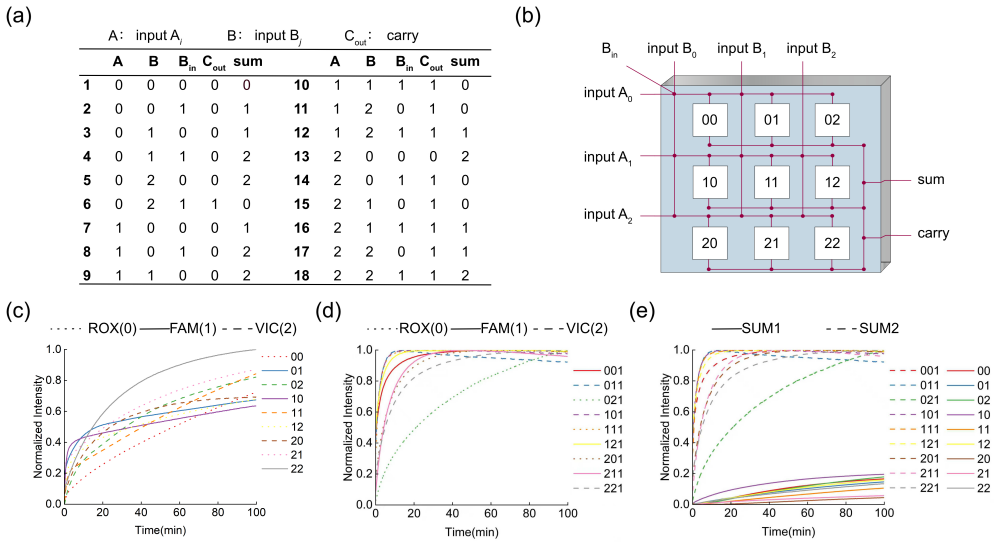
A DNA competitive blocking circuit recognizes all ternary input triples and produces correct outputs for 17-trit addition.
A machine-rendered reading of the paper's core claim, the machinery that carries it, and where it could break.
Core claim
A novel ternary full adder architecture uses a competitive blocking circuit to recognize and compute all three-input ternary combinations, combined with a dynamic concentration adjustment strategy; biochemical experiments confirm that the circuit produces correct output digits and achieves 17-trit ternary addition.
What carries the argument
The competitive blocking (CB) circuit, which distinguishes every three-input ternary combination and blocks unwanted reactions to yield the correct sum and carry.
If this is right
- The CB circuit yields the correct output digits for a ternary full adder.
- The approach achieves 17-trit ternary addition in biochemical experiments.
- The CA strategy increases the number of trits that can be processed.
- The design supplies a methodological foundation for DNA-based ternary logic circuits.
Where Pith is reading between the lines
- If the circuit scales without cumulative error, larger trit lengths become feasible by repeating the CA step.
- The same recognition mechanism could be reused to build other ternary arithmetic blocks such as multipliers.
- Integration with existing DNA strand-displacement gates might allow mixed binary-ternary molecular processors.
Load-bearing premise
The competitive blocking circuit can accurately recognize and compute every three-input ternary combination without interference or errors across the full input range in a biochemical setting.
What would settle it
A single biochemical run in which the circuit produces an incorrect sum or carry digit for any tested ternary input triple, such as inputs 0-1-2.
Figures




read the original abstract
As transistor dimensions continue to shrink, binary devices are rapidly approaching their fundamental limits in power density. In response, multi-valued systems have attracted significant attention due to their enhanced information density. Among these, the ternary system stands out as the most practical option, being the closest integer base to (e), which is considered optimal for information efficiency. Despite the intrinsic advantages of DNA nanomaterials, such as programmability, energy efficiency, and massive parallelism, their application in ternary logic remains largely unexplored, particularly in the realm of ternary addition circuits. This gap can be attributed to a fundamental challenge: ternary logic requires circuits capable of recognizing and processing a far larger set of input combinations than binary systems, a task that existing models and techniques often struggle to accomplish. In this work, we propose a novel architecture for a ternary full adder. Our design includes a competitive blocking (CB) circuit that enables the recognition and computation of all possible three-input ternary combinations. Coupled with a dynamic concentration adjustment (CA) strategy, this approach significantly enhances the number of trits that can be processed. Biochemical experiments demonstrate that the CB circuit successfully yields the correct output digits for a ternary full adder, achieving 17-trit ternary addition. To our knowledge, this work represents the first successful DNA-based ternary adder, establishing a new methodological foundation for DNA computing and highlighting its considerable potential for scalable digital information processing.
Editorial analysis
A structured set of objections, weighed in public.
Referee Report
Summary. The manuscript proposes a competitive blocking (CB) circuit to recognize and compute all 27 three-input ternary combinations, paired with a dynamic concentration adjustment (CA) strategy, to realize a DNA-based ternary full adder. Biochemical experiments are reported to confirm that the circuit produces correct output digits, enabling 17-trit ternary addition and constituting the first such DNA ternary adder.
Significance. If the experimental results are robust, this establishes a practical foundation for ternary logic in DNA computing, leveraging DNA programmability to achieve higher information density than binary systems while addressing the challenge of handling expanded input sets. The reported scaling to 17 trits via the CB+CA approach would represent a concrete advance in scalable molecular computation.
major comments (2)
- [Results] Results section (biochemical experiments): The central claim that the CB circuit yields correct outputs for 17-trit addition rests on the reported experiments, yet the manuscript provides insufficient quantitative data on error rates, controls for all 27 input combinations, sequence designs, and raw fluorescence/gel measurements. This weakens support for the scalability assertion and the assumption that the circuit operates without interference across the full input range.
- [Methods] Methods (CA strategy implementation): The dynamic concentration adjustment strategy is described at a high level but lacks explicit protocols for how concentrations are tuned in the biochemical setting to prevent crosstalk or incomplete reactions when scaling beyond small numbers of trits.
minor comments (2)
- [Abstract] Abstract: The phrase 'achieving 17-trit ternary addition' should clarify whether this refers to a single 17-trit number or multi-trit operations with carry propagation.
- [Introduction] Introduction: The claim that ternary is 'the most practical option' closest to e would benefit from a brief citation to information-theoretic results on optimal radix.
Simulated Author's Rebuttal
We thank the referee for the constructive comments, which will help improve the clarity and robustness of our presentation. We address each major comment below and will incorporate the requested details in the revised manuscript.
read point-by-point responses
-
Referee: [Results] Results section (biochemical experiments): The central claim that the CB circuit yields correct outputs for 17-trit addition rests on the reported experiments, yet the manuscript provides insufficient quantitative data on error rates, controls for all 27 input combinations, sequence designs, and raw fluorescence/gel measurements. This weakens support for the scalability assertion and the assumption that the circuit operates without interference across the full input range.
Authors: We agree that additional quantitative details will strengthen the support for our claims. In the revised manuscript, we will add error rates derived from replicate experiments, explicit controls confirming correct outputs across all 27 input combinations, complete sequence designs placed in the supplementary information, and the raw fluorescence and gel measurements. These expansions will directly demonstrate the absence of significant interference and better justify the observed scalability to 17 trits. revision: yes
-
Referee: [Methods] Methods (CA strategy implementation): The dynamic concentration adjustment strategy is described at a high level but lacks explicit protocols for how concentrations are tuned in the biochemical setting to prevent crosstalk or incomplete reactions when scaling beyond small numbers of trits.
Authors: We will expand the Methods section to provide explicit protocols for the CA strategy. The revised text will specify the concentration values used at each scale, the timing and criteria for dynamic adjustments, and the biochemical measures employed to avoid crosstalk and incomplete reactions, including sequence orthogonality verification and buffer optimization. revision: yes
Circularity Check
No circularity; experimental demonstration stands on reported biochemical results
full rationale
The paper presents a DNA-based ternary full adder implemented via competitive blocking (CB) circuits plus concentration adjustment (CA). Its core claim is that biochemical experiments confirm correct output for all 27 input combinations and scale to 17 trits. No derivation chain, first-principles prediction, or fitted-parameter step exists; the manuscript reports direct experimental outcomes (fluorescence/gel data and controls) rather than any mathematical reduction that could collapse to its own inputs. Self-citations, if present, are not load-bearing for the headline result. The work is therefore self-contained against external benchmarks.
Axiom & Free-Parameter Ledger
axioms (1)
- domain assumption DNA strand displacement and hybridization reactions can be programmed to implement reliable logic operations without significant crosstalk.
invented entities (2)
-
Competitive Blocking (CB) circuit
no independent evidence
-
Dynamic concentration adjustment (CA) strategy
no independent evidence
Lean theorems connected to this paper
-
IndisputableMonolith/Cost/FunctionalEquation.leanwashburn_uniqueness_aczel unclear?
unclearRelation between the paper passage and the cited Recognition theorem.
competitive blocking (CB) circuit that enables the recognition and computation of all possible three-input ternary combinations... k2 ≫ k1,k3
-
IndisputableMonolith/Foundation/AbsoluteFloorClosure.leanreality_from_one_distinction unclear?
unclearRelation between the paper passage and the cited Recognition theorem.
achieving 17-trit ternary addition... CA strategy
What do these tags mean?
- matches
- The paper's claim is directly supported by a theorem in the formal canon.
- supports
- The theorem supports part of the paper's argument, but the paper may add assumptions or extra steps.
- extends
- The paper goes beyond the formal theorem; the theorem is a base layer rather than the whole result.
- uses
- The paper appears to rely on the theorem as machinery.
- contradicts
- The paper's claim conflicts with a theorem or certificate in the canon.
- unclear
- Pith found a possible connection, but the passage is too broad, indirect, or ambiguous to say the theorem truly supports the claim.
Reference graph
Works this paper leans on
-
[1]
Goñi-Moreno, A. & Nikel, P. I. High-performance biocomputing in synthetic biology–integrated transcriptional and metabolic circuits.Frontiers in bioengineering and biotechnology7, 40 (2019). 2.Adleman, L. M. Molecular computation of solutions to combinatorial problems.science266, 1021–1024 (1994)
work page 2019
- [2]
- [3]
-
[4]
Spencer, D. M., Reyna, A. G. & Pisetsky, D. S. The binding of monoclonal and polyclonal anti-z-dna antibodies to dna of various species origin.International Journal of Molecular Sciences22, 8931 (2021). 7.Jingjing, M. Three-input logic gate based on dna strand displacement reaction.Scientific Reports13, 15210 (2023)
work page 2021
- [5]
-
[6]
Zhang, C., Paluzzi, V . E., Sha, R., Jonoska, N. & Mao, C. Implementing logic gates by dna crystal engineering.Advanced Materials35, 2302345 (2023). 11/14
work page 2023
-
[7]
Allemani, C.et al.Global surveillance of trends in cancer survival 2000–14 (concord-3): analysis of individual records for 37 513 025 patients diagnosed with one of 18 cancers from 322 population-based registries in 71 countries.The Lancet 391, 1023–1075 (2018)
work page 2000
-
[8]
Zandvakili, I. & Lazaridis, K. N. Cell-free dna testing: future applications in gastroenterology and hepatology.Therapeutic Advances in Gastroenterology12, 1756284819841896 (2019). 12.Shieh, P. B. Advances in the genetic testing of neuromuscular diseases.Neurologic Clinics38, 519–528 (2020)
work page 2019
-
[9]
Yang, Q.et al.Dna logic circuits for multiple tumor cells identification using intracellular microrna molecular bispecific recognition.Advanced healthcare materials10, 2101130 (2021)
work page 2021
-
[10]
Chen, C., Wen, J., Wen, Z., Song, S. & Shi, X. Dna strand displacement based computational systems and their applications. Frontiers in Genetics14, 1120791 (2023). 15.Xu, J., Chen, C. & Shi, X. Graph computation using algorithmic self-assembly of dna molecules.ACS Synthetic Biology 11, 2456–2463 (2022)
work page 2023
- [11]
-
[12]
Oishi, M. Comparative study of dna circuit system-based proportional and exponential amplification strategies for enzyme-free and rapid detection of mirna at room temperature.ACS omega3, 3321–3329 (2018)
work page 2018
- [13]
-
[14]
Wang, B., Wang, S. S., Chalk, C., Ellington, A. D. & Soloveichik, D. Parallel molecular computation on digital data stored in dna.Proceedings of the National Academy of Sciences120, e2217330120 (2023)
work page 2023
-
[15]
Seelig, G., Soloveichik, D., Zhang, D. Y . & Winfree, E. Enzyme-free nucleic acid logic circuits.science314, 1585–1588 (2006). 21.Elbaz, J.et al.Dna computing circuits using libraries of dnazyme subunits.Nature nanotechnology5, 417–422 (2010)
work page 2006
-
[16]
Orbach, R.et al.A full-adder based on reconfigurable dna-hairpin inputs and dnazyme computing modules.Chemical Science5, 3381–3387 (2014)
work page 2014
-
[17]
Liu, C.et al.Cross-inhibitor: a time-sensitive molecular circuit based on dna strand displacement.Nucleic acids research 48, 10691–10701 (2020). 24.Lv, H.et al.Dna-based programmable gate arrays for general-purpose dna computing.Nature622, 292–300 (2023)
work page 2020
-
[18]
Wang, F.et al.Implementing digital computing with dna-based switching circuits.Nature communications11, 121 (2020)
work page 2020
-
[19]
Weng, Z.et al.Cooperative branch migration: a mechanism for flexible control of dna strand displacement.ACS nano16, 3135–3144 (2022)
work page 2022
-
[20]
Wu, L., Wang, G. A. & Li, F. Plug-and-play module for reversible and continuous control of dna strand displacement kinetics.Journal of the American Chemical Society146, 6516–6521 (2024)
work page 2024
-
[21]
Qian, L. & Winfree, E. Scaling up digital circuit computation with dna strand displacement cascades.science332, 1196–1201 (2011)
work page 2011
-
[22]
Qian, L., Winfree, E. & Bruck, J. Neural network computation with dna strand displacement cascades.nature475, 368–372 (2011)
work page 2011
-
[23]
Evans, C. G. & Winfree, E. Physical principles for dna tile self-assembly.Chemical Society Reviews46, 3808–3829 (2017)
work page 2017
-
[24]
Woods, D.et al.Diverse and robust molecular algorithms using reprogrammable dna self-assembly.Nature567, 366–372 (2019)
work page 2019
-
[25]
Sarraf, N., Rodriguez, K. R. & Qian, L. Modular reconfiguration of dna origami assemblies using tile displacement. Science Robotics8, eadf1511 (2023)
work page 2023
-
[26]
Amir, Y .et al.Universal computing by dna origami robots in a living animal.Nature nanotechnology9, 353–357 (2014)
work page 2014
-
[27]
Chatterjee, G., Dalchau, N., Muscat, R. A., Phillips, A. & Seelig, G. A spatially localized architecture for fast and modular dna computing.Nature nanotechnology12, 920–927 (2017). 35.Bui, H.et al.Localized dna hybridization chain reactions on dna origami.ACS nano12, 1146–1155 (2018). 12/14
work page 2017
-
[28]
Li, Z.et al.Programming directional strand polymerization on dna origami for logic computing.Small Structures2500220 (2025)
work page 2025
-
[29]
Song, T.et al.Improving the performance of dna strand displacement circuits by shadow cancellation.ACS nano12, 11689–11697 (2018). 38.Turberfield, A. J.et al.Dna fuel for free-running nanomachines.Physical review letters90, 118102 (2003)
work page 2018
-
[30]
Zhang, D. Y ., Turberfield, A. J., Yurke, B. & Winfree, E. Engineering entropy-driven reactions and networks catalyzed by dna.Science318, 1121–1125 (2007)
work page 2007
-
[31]
Zhang, D. Y . & Winfree, E. Control of dna strand displacement kinetics using toehold exchange.Journal of the American Chemical Society131, 17303–17314 (2009)
work page 2009
-
[32]
Mehra, V . C. R. 2-bit comparator using different logic style of full adder.Int. J. Soft Comput. Eng. IJSCE3, 277–9 (2013)
work page 2013
-
[33]
Imana, J. L. Fast bit-parallel binary multipliers based on type-i pentanomials.IEEE Transactions on Computers67, 898–904 (2017)
work page 2017
-
[34]
Navi, K., Moaiyeri, M. H., Mirzaee, R. F., Hashemipour, O. & Nezhad, B. M. Two new low-power full adders based on majority-not gates.Microelectronics journal40, 126–130 (2009)
work page 2009
-
[35]
Kouretas, I., Basetas, C. & Paliouras, V . Low-power logarithmic number system addition/subtraction and their impact on digital filters.IEEE Transactions on Computers62, 2196–2209 (2012)
work page 2012
-
[36]
Aguirre-Hernandez, M. & Linares-Aranda, M. Cmos full-adders for energy-efficient arithmetic applications.IEEE transactions on very large scale integration (VLSI) systems19, 718–721 (2010)
work page 2010
- [37]
-
[38]
Li, H.et al.Implementation of arithmetic functions on a simple and universal molecular beacon platform.Advanced Science2, 1500054 (2015)
work page 2015
- [39]
-
[40]
Park, K. S., Seo, M. W., Jung, C., Lee, J. Y . & Park, H. G. Simple and universal platform for logic gate operations based on molecular beacon probes.Small8, 2203–2212 (2012)
work page 2012
- [41]
- [42]
-
[43]
Huang, D.et al.Versatile and homogeneous dna tetraplex platform for constructing label-free logic devices: From design to application.Chemistry–A European Journal25, 6996–7003 (2019)
work page 2019
-
[44]
Tandon, A.et al.Demonstration of arithmetic calculations by dna tile-based algorithmic self-assembly.ACS nano14, 5260–5267 (2020)
work page 2020
-
[45]
Xie, N.et al.Scaling up multi-bit dna full adder circuits with minimal strand displacement reactions.Journal of the American Chemical Society144, 9479–9488 (2022)
work page 2022
-
[46]
Stérin, T., Eshra, A., Adio, J., Evans, C. G. & Woods, D. A thermodynamically favoured molecular computer: Robust, fast, renewable, scalable.bioRxiv2025–07 (2025). 56.Hayes, B. Third base.American scientist89, 490–494 (2001)
work page 2025
-
[47]
Jeong, J. W.et al.Tunnelling-based ternary metal–oxide–semiconductor technology.Nature Electronics2, 307–312 (2019). 58.Xu, J., Liu, W., Zhang, K. & Zhu, E. Dna coding theory and algorithms.Artificial Intelligence Review58, 178 (2025)
work page 2019
- [48]
-
[49]
Zhang, S., Wang, K., Huang, C. & Sun, T. Reconfigurable and resettable arithmetic logic units based on magnetic beads and dna.Nanoscale7, 20749–20756 (2015). 13/14 Acknowledgements This work was supported by the National Major Scientific Instrument and Equipment Development Project of the National Natural Science Foundation of China (No. 62427811) and the...
work page 2015
discussion (0)
Sign in with ORCID, Apple, or X to comment. Anyone can read and Pith papers without signing in.