Recognition: no theorem link
Navig-AI-tion: Navigation by Contextual AI and Spatial Audio
Pith reviewed 2026-05-15 11:15 UTC · model grok-4.3
The pith
A vision language model plus spatial audio cue reduces route deviations compared to audio-only map directions.
A machine-rendered reading of the paper's core claim, the machinery that carries it, and where it could break.
Core claim
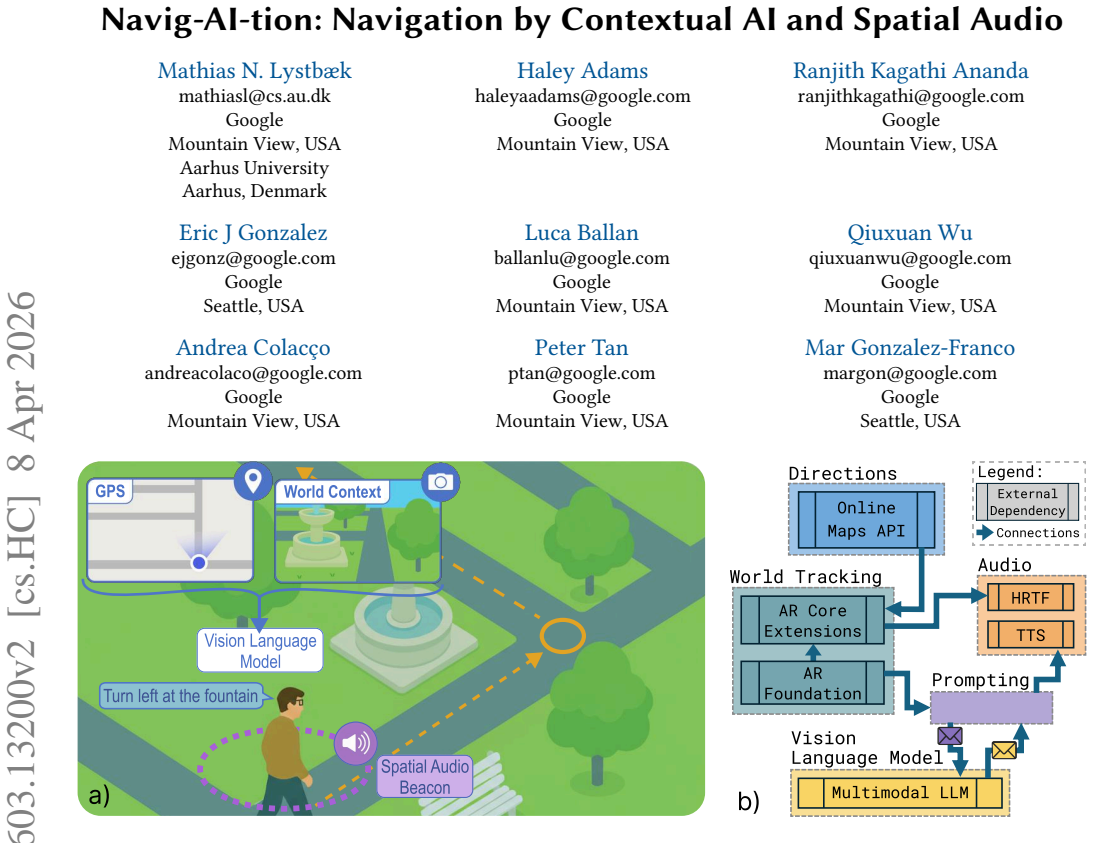
The system uses a Vision Language Model to pull out environmental landmarks that anchor spoken navigation instructions and triggers a directional spatial audio cue whenever the user orients away from the intended path, indicating the exact turn needed. In a twelve-person user study the combined landmark-plus-spatial-audio version produced fewer route deviations than a VLM-only condition or an audio-only Google Maps baseline. Participants reported that the spatial cue supported orientation and that landmark-anchored instructions created a clearer navigation experience than standard audio map output.
What carries the argument
The directional spatial audio cue that activates on VLM-detected misalignment to supply precise turn guidance anchored to extracted landmarks.
If this is right
- Audio-only navigation produces fewer errors once a real-time corrective spatial cue is added to landmark references.
- Landmark-anchored instructions give users a clearer sense of the route than cardinal-direction audio alone.
- The spatial cue effectively communicates orientation changes without any visual display.
- Mobile navigation aids can incorporate live environmental context extracted on the device to support audio-first use.
Where Pith is reading between the lines
- The approach could be especially valuable for users who must navigate without sight and currently depend on audio maps that lack environmental anchors.
- Extending the landmark extraction to handle moving obstacles or changing lighting would test whether the same cueing logic scales beyond static scenes.
- Pairing the system with improved localization sensors might further reduce the remaining deviations observed in the current study.
- Similar corrective audio could be applied to other audio-heavy tasks such as indoor wayfinding where visual maps are unavailable.
Load-bearing premise
The vision language model must correctly identify useful landmarks from the user's moving viewpoint in real time and the spatial audio must reach the ears without latency or localization errors that would weaken the corrective signal.
What would settle it
A replication study in which the VLM frequently misses or mislabels landmarks or the spatial audio arrives late, yielding no reduction or an increase in route deviations relative to the baselines.
Figures


read the original abstract
Audio-only walking navigation can leave users disoriented, relying on vague cardinal directions and lacking real-time environmental context, leading to frequent errors. To address this, we present a novel system that integrates a Vision Language Model (VLM) with a spatial audio cue. Our system extracts environmental landmarks to anchor navigation instructions and, crucially, provides a directional spatial audio signal when the user faces the wrong direction, indicating the precise turn direction. In a user study (n=12), the spatial audio cue with VLM reduced route deviations compared to both VLM-only and Google Maps (audio-only) baseline systems. Users reported that the spatial audio cue effectively supported orientation and that landmark-anchored instructions provided a better navigation experience over audio-only Google Maps. This work serves as an initial look at the utility of future audio-only navigation systems for incorporating directional cues, especially real-time corrective spatial audio.
Editorial analysis
A structured set of objections, weighed in public.
Referee Report
Summary. The manuscript introduces Navig-AI-tion, a navigation system integrating a Vision Language Model (VLM) to extract real-time environmental landmarks with spatial audio cues that provide directional corrective signals when users face the wrong way. It claims that in a user study (n=12), the combined VLM + spatial audio condition reduced route deviations relative to VLM-only and audio-only Google Maps baselines, with users reporting improved orientation and navigation experience.
Significance. If the empirical result is substantiated with proper statistical support and methodological detail, the work could offer a modest contribution to HCI and accessible navigation research by showing how real-time VLM context plus spatial audio can address disorientation in audio-only walking guidance. The approach is timely given interest in multimodal AI for everyday mobility, but the current lack of quantitative rigor limits its immediate impact.
major comments (3)
- [User Study] User Study section: No statistical tests, p-values, effect sizes, confidence intervals, or error bars are reported for the claimed reduction in route deviations despite n=12. This is load-bearing because small-sample variance, learning effects, or individual differences could produce apparent differences without a true system benefit.
- [User Study] User Study section: The manuscript provides no description of how route deviations were quantified (e.g., GPS path logging, cumulative angular error, meters off-route) or whether conditions were counterbalanced, which prevents assessment of measurement consistency and internal validity.
- [System Implementation] System Implementation: No validation, error rates, or failure cases are given for the VLM's real-time landmark extraction during walking, nor for spatial audio localization accuracy and latency; these are central to whether the corrective cue can function as described.
minor comments (2)
- [Abstract] Abstract: The phrase 'reduced route deviations' should be accompanied by at least the direction of the effect and a brief note on the metric used.
- [Related Work] Related Work: Limited discussion of prior spatial audio navigation systems (e.g., work on bone-conduction or HRTF-based cues) leaves the novelty claim under-contextualized.
Simulated Author's Rebuttal
We thank the referee for the constructive and detailed feedback. We address each major comment below and will revise the manuscript accordingly to strengthen the methodological and statistical reporting.
read point-by-point responses
-
Referee: [User Study] User Study section: No statistical tests, p-values, effect sizes, confidence intervals, or error bars are reported for the claimed reduction in route deviations despite n=12. This is load-bearing because small-sample variance, learning effects, or individual differences could produce apparent differences without a true system benefit.
Authors: We agree that the lack of statistical analysis weakens the current presentation of the results. In the revised manuscript we will report appropriate tests (repeated-measures ANOVA or non-parametric Friedman test with post-hoc Wilcoxon signed-rank tests), exact p-values, effect sizes (Cohen’s d or rank-biserial correlation), and 95% confidence intervals. Error bars will be added to the route-deviation figure, and we will explicitly discuss the exploratory nature of the n=12 study together with the risks of small-sample variance and order effects. revision: yes
-
Referee: [User Study] User Study section: The manuscript provides no description of how route deviations were quantified (e.g., GPS path logging, cumulative angular error, meters off-route) or whether conditions were counterbalanced, which prevents assessment of measurement consistency and internal validity.
Authors: We will expand the User Study section with a precise operational definition of route deviation: GPS trajectories were logged at 1 Hz and deviation was computed as the cumulative Euclidean distance (in meters) between the logged path and the planned route polyline at each time step. We will also state that the three conditions were presented in counterbalanced order via a Latin-square design across the 12 participants to control for learning and sequence effects. revision: yes
-
Referee: [System Implementation] System Implementation: No validation, error rates, or failure cases are given for the VLM's real-time landmark extraction during walking, nor for spatial audio localization accuracy and latency; these are central to whether the corrective cue can function as described.
Authors: We acknowledge this omission. The revised manuscript will add a dedicated validation subsection that reports (a) VLM landmark-extraction accuracy and failure cases observed on the walking videos collected during the study and (b) measured spatial-audio localization accuracy (angular error) and end-to-end latency obtained from controlled bench tests of the prototype. These data will be summarized with descriptive statistics and example failure cases. revision: yes
Circularity Check
No circularity: empirical user study with direct measurements
full rationale
The paper reports an n=12 user study comparing a VLM+spatial-audio navigation system against VLM-only and Google Maps baselines, with the central claim resting on observed reductions in route deviations. No mathematical derivations, equations, fitted parameters, or self-citations are invoked to generate the result; the outcome is produced by direct empirical measurement of participant paths rather than by construction from inputs. The study design is self-contained against external benchmarks (baselines and user reports), satisfying the criteria for a non-circular empirical finding.
Axiom & Free-Parameter Ledger
axioms (2)
- ad hoc to paper VLM can accurately identify and describe relevant environmental landmarks in real-time walking conditions
- domain assumption Spatial audio cues can be localized precisely enough by users to indicate correct turn directions without confusion
Reference graph
Works this paper leans on
-
[1]
Steven Abreu, Tiffany D. Do, Karan Ahuja, Eric J. Gonzalez, Lee Payne, Daniel McDuff, and Mar Gonzalez-Franco. 2024. PARSE-Ego4D: Personal Action Rec- ommendation Suggestions for Egocentric Videos. doi:10.48550/arXiv.2407.09503
-
[2]
Christopher C Berger, Mar Gonzalez-Franco, Ana Tajadura-Jiménez, Dinei Floren- cio, and Zhengyou Zhang. 2018. Generic HRTFs may be good enough in virtual reality. Improving source localization through cross-modal plasticity.Frontiers in Neuroscience12 (2018), 21. doi:10.3389/fnins.2018.00021
-
[4]
Howard Chen, Alane Suhr, Dipendra Misra, Noah Snavely, and Yoav Artzi. 2019. TOUCHDOWN: Natural Language Navigation and Spatial Reasoning in Visual Street Environments. In2019 IEEE/CVF Conference on Computer Vision and Pattern Recognition (CVPR). IEEE, New York, NY, USA, 12530–12539. doi:10.1109/CVPR. 2019.01282
-
[5]
Gregory D Clemenson, Antonella Maselli, Alexander J Fiannaca, Amos Miller, and Mar Gonzalez-Franco. 2021. Rethinking GPS navigation: creating cognitive maps through auditory clues.Scientific reports11, 1 (Apr 2021), 10 pages. doi:10. 1038/s41598-021-87148-4
work page 2021
-
[6]
Louisa Dahmani and Véronique D Bohbot. 2020. Habitual use of GPS negatively impacts spatial memory during self-guided navigation.Scientific reports10, 1 (Apr 2020), 14 pages. doi:10.1038/s41598-020-62877-0
-
[7]
Aaron L Gardony, Tad T Brunyé, Caroline R Mahoney, and Holly A Taylor. 2013. How navigational aids impair spatial memory: Evidence for divided attention. Spatial Cognition & Computation13, 4 (2013), 319–350. doi:10.1080/13875868. 2013.792821
-
[8]
Mar Gonzalez-Franco, Gregory D Clemenson, and Amos Miller
-
[9]
How GPS weakens memory—and what we can do about it. https://www.scientificamerican.com/article/how-gps-weakens-memory- mdash-and-what-we-can-do-about-it/
-
[10]
Karl Moritz Hermann, Mateusz Malinowski, Piotr Mirowski, Andras Banki- Horvath, Keith Anderson, and Raia Hadsell. 2020. Learning to Follow Directions in Street View.Proceedings of the AAAI Conference on Artificial Intelligence34, 07 (Apr. 2020), 11773–11781. doi:10.1609/aaai.v34i07.6849
-
[11]
Simon Holland, David R Morse, and Henrik Gedenryd. 2002. AudioGPS: Spatial audio navigation with a minimal attention interface.Personal and Ubiquitous computing6, 4 (Sep 2002), 253–259. doi:10.1007/s007790200025
-
[12]
Toru Ishikawa, Hiromichi Fujiwara, Osamu Imai, and Atsuyuki Okabe. 2008. Wayfinding with a GPS-based mobile navigation system: A comparison with 5 maps and direct experience.Journal of environmental psychology28, 1 (2008), 74–82. doi:10.1016/j.jenvp.2007.09.002
-
[13]
Gilly Leshed, Theresa Velden, Oya Rieger, Blazej Kot, and Phoebe Sengers. 2008. In-car gps navigation: engagement with and disengagement from the environ- ment. InProceedings of the SIGCHI Conference on Human Factors in Computing Systems(Florence, Italy)(CHI ’08). Association for Computing Machinery, New York, NY, USA, 1675–1684. doi:10.1145/1357054.1357316
-
[14]
Tiffany Liu, Javier Hernandez, Mar Gonzalez-Franco, Antonella Maselli, Melanie Kneisel, Adam Glass, Jarnail Chudge, and Amos Miller. 2022. Characterizing and Predicting Engagement of Blind and Low-Vision People with an Audio- Based Navigation App. InExtended Abstracts of the 2022 CHI Conference on Human Factors in Computing Systems(New Orleans, LA, USA)(C...
-
[15]
David McGookin, Stephen Brewster, and Pablo Priego. 2009. Audio Bubbles: Employing Non-speech Audio to Support Tourist Wayfinding.Lecture Notes in Computer Science (including subseries Lecture Notes in Artificial Intelligence and Lecture Notes in Bioinformatics)5763 LNCS (2009), 41–50. doi:10.1007/978-3-642- 04076-4_5
-
[16]
Laura Miola, Veronica Muffato, A Boldrini, Francesca Pazzaglia, and Chiara Meneghetti. 2024. Development of a self-report measure of GPS uses and its relationship with environmental knowledge and self-efficacy and pleasure in exploring.Cognitive Research: Principles and Implications9, 1 (Nov 2024), 78. doi:10.1186/s41235-024-00605-2
-
[17]
Laura Miola, Veronica Muffato, Enrico Sella, Chiara Meneghetti, and Francesca Pazzaglia. 2024. GPS use and navigation ability: A systematic review and meta- analysis.Journal of Environmental Psychology99 (2024), 102417. doi:10.1016/j. jenvp.2024.102417
work page doi:10.1016/j 2024
-
[18]
Piotr Mirowski, Andras Banki-Horvath, Keith Anderson, Denis Teplyashin, Karl Moritz Hermann, Mateusz Malinowski, Matthew Koichi Grimes, Karen Simonyan, Koray Kavukcuoglu, Andrew Zisserman, and Raia Hadsell. 2019. The StreetLearn Environment and Dataset.CoRRabs/1903.01292 (2019), 13 pages. arXiv:1903.01292 http://arxiv.org/abs/1903.01292
work page internal anchor Pith review Pith/arXiv arXiv 2019
-
[19]
Martin Raubal and Max J Egenhofer. 1998. Comparing the complexity of wayfind- ing tasks in built environments.Environment and Planning B: Planning and Design 25, 6 (1998), 895–913
work page 1998
-
[20]
Brian D. Simpson, Douglas S. Brungart, Ronald C. Dallman, Jacque Joffrion, Michael D. Presnar, and Robert H. Gilkey. 2005. Spatial Audio as a Navigation Aid and Attitude Indicator.Proceedings of the Human Factors and Ergonomics Society Annual Meeting49, 17 (9 2005), 1602–1606. doi:10.1177/154193120504901722
-
[21]
Simone Spagnol, György Wersényi, Michał Bujacz, Oana Bălan, Marcelo Her- rera Martínez, Alin Moldoveanu, and Runar Unnthorsson. 2018. Current Use and Future Perspectives of Spatial Audio Technologies in Electronic Travel Aids.Wireless Communications and Mobile Computing2018, 1 (2018), 3918284. doi:10.1155/2018/3918284
-
[22]
Steven Strachan, Parisa Eslambolchilar, Roderick Murray-Smith, Stephen Hughes, and Sile O’Modhrain. 2005. GpsTunes: controlling navigation via audio feedback. InProceedings of the 7th International Conference on Human Computer Interaction with Mobile Devices & Services(Salzburg, Austria)(MobileHCI ’05). Association for Computing Machinery, New York, NY, U...
-
[23]
Alexis Topete, Chuanxiuyue He, John Protzko, Jonathan Schooler, and Mary Hegarty. 2024. How is GPS used? Understanding navigation system use and its relation to spatial ability.Cognitive research: principles and implications9, 1 (Mar 2024), 16. doi:10.1186/s41235-024-00545-x
-
[24]
Nigel Warren, Matt Jones, Steve Jones, and David Bainbridge. 2005. Navigation via continuously adapted music. InCHI ’05 Extended Abstracts on Human Factors in Computing Systems(Portland, OR, USA)(CHI EA ’05). Association for Computing Machinery, New York, NY, USA, 1849–1852. doi:10.1145/1056808.1057038
-
[25]
Ziwei Xu, Sanjay Jain, and Mohan Kankanhalli. 2025. Hallucination is Inevitable: An Innate Limitation of Large Language Models. arXiv:2401.11817 [cs.CL] doi:10. 48550/arXiv.2401.11817
work page internal anchor Pith review arXiv 2025
-
[26]
[audio cue] is clear about direction. Whenever lost track then can listen for the audio
He Zhang, Nicholas J. Falletta, Jingyi Xie, Rui Yu, Sooyeon Lee, Syed Masum Billah, and John M. Carroll. 2025. Enhancing the Travel Experience for People with Visual Impairments through Multimodal Interaction: NaviGPT, A Real-Time AI-Driven Mobile Navigation System. InCompanion Proceedings of the 2025 ACM International Conference on Supporting Group Work....
discussion (0)
Sign in with ORCID, Apple, or X to comment. Anyone can read and Pith papers without signing in.